How Impala Works 
Yue Chen 
http://linkedin.com/in/yuechen2 
http://dataera.wordpress.com
http://dataera.wordpress.com 
http://linkedin.com/in/yuechen2 
What’s Impala?
http://dataera.wordpress.com 
http://linkedin.com/in/yuechen2 
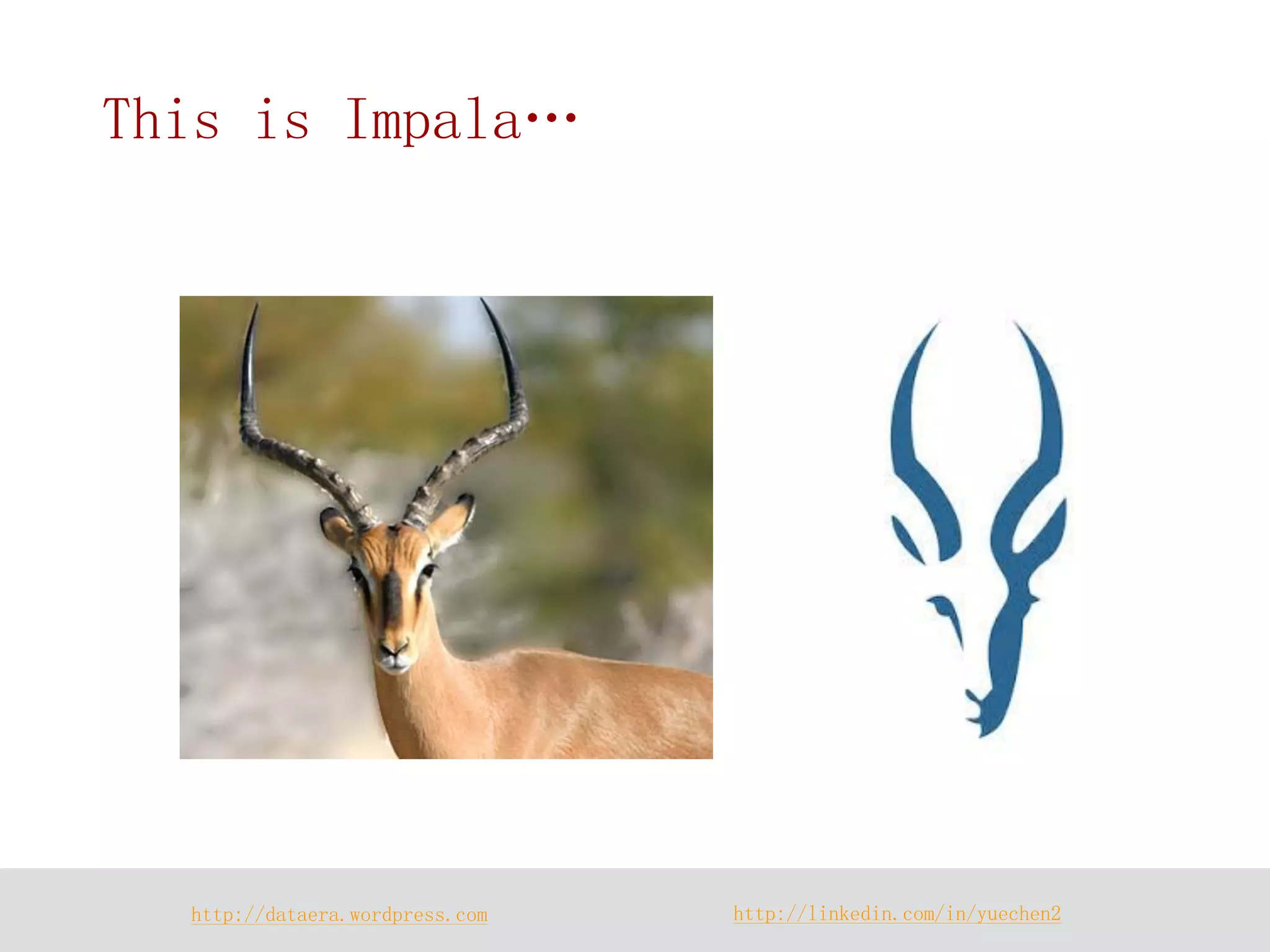
This is Impala…
http://dataera.wordpress.com 
http://linkedin.com/in/yuechen2 
Goal of Impala 
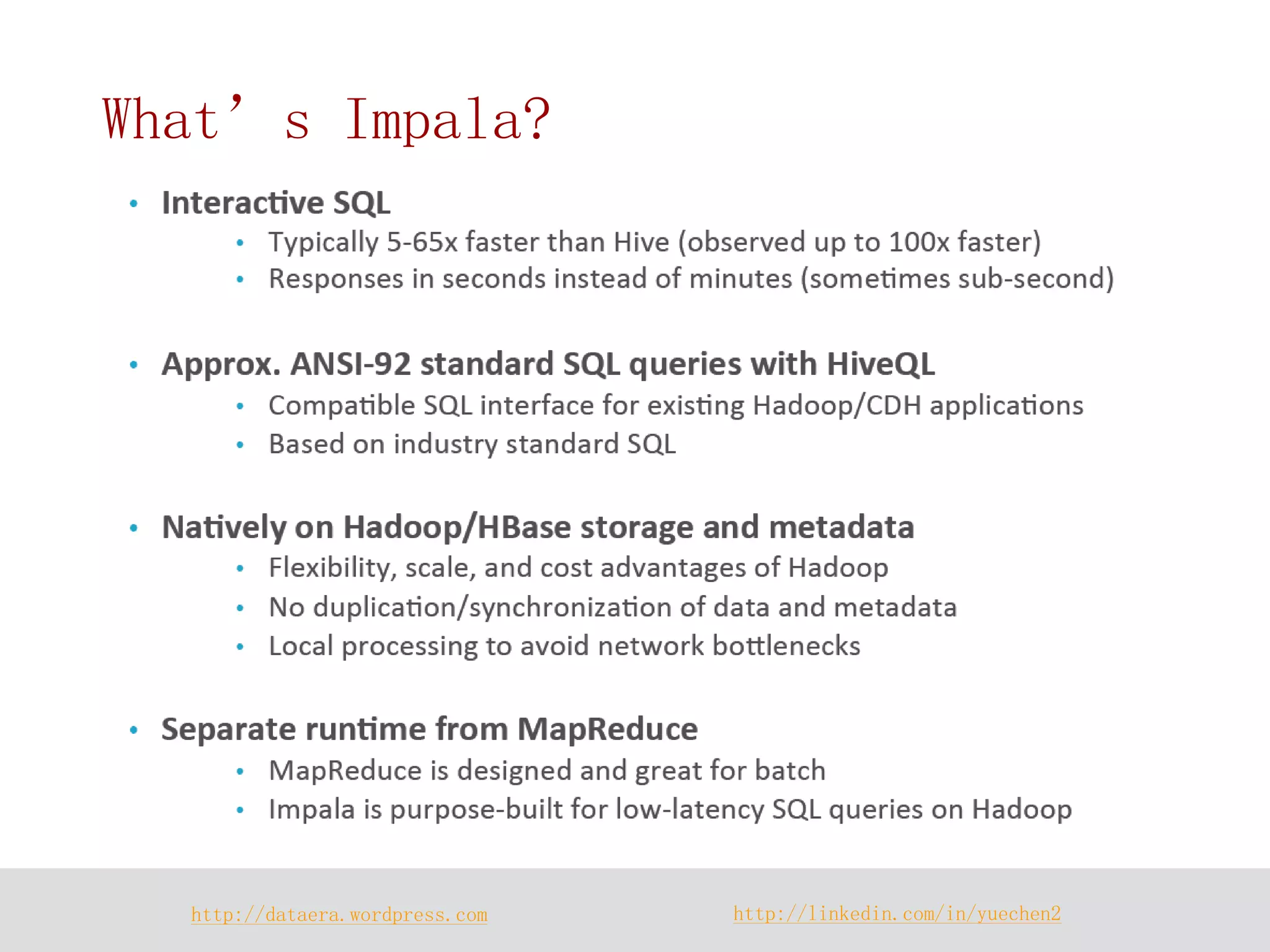
A general SQL engine for distributed systems, supporting both OLTP and OLAP. 
Interactive (real-time) queries. 
Built on top of HDFS and HBase. 
Engine is written in C++, fast. 
The database execution engine is like that of massively parallel processing (MPP) databases, not using MapReduce.
http://dataera.wordpress.com 
http://linkedin.com/in/yuechen2 
What’s Impala? 
In-memory, distributed SQL query engine (no MapReduce) 
Native backend code (C++) 
Distributed on HDFS data nodes
http://dataera.wordpress.com 
http://linkedin.com/in/yuechen2 
What’s Impala?
http://dataera.wordpress.com 
http://linkedin.com/in/yuechen2 
Why Impala?
http://dataera.wordpress.com 
http://linkedin.com/in/yuechen2 
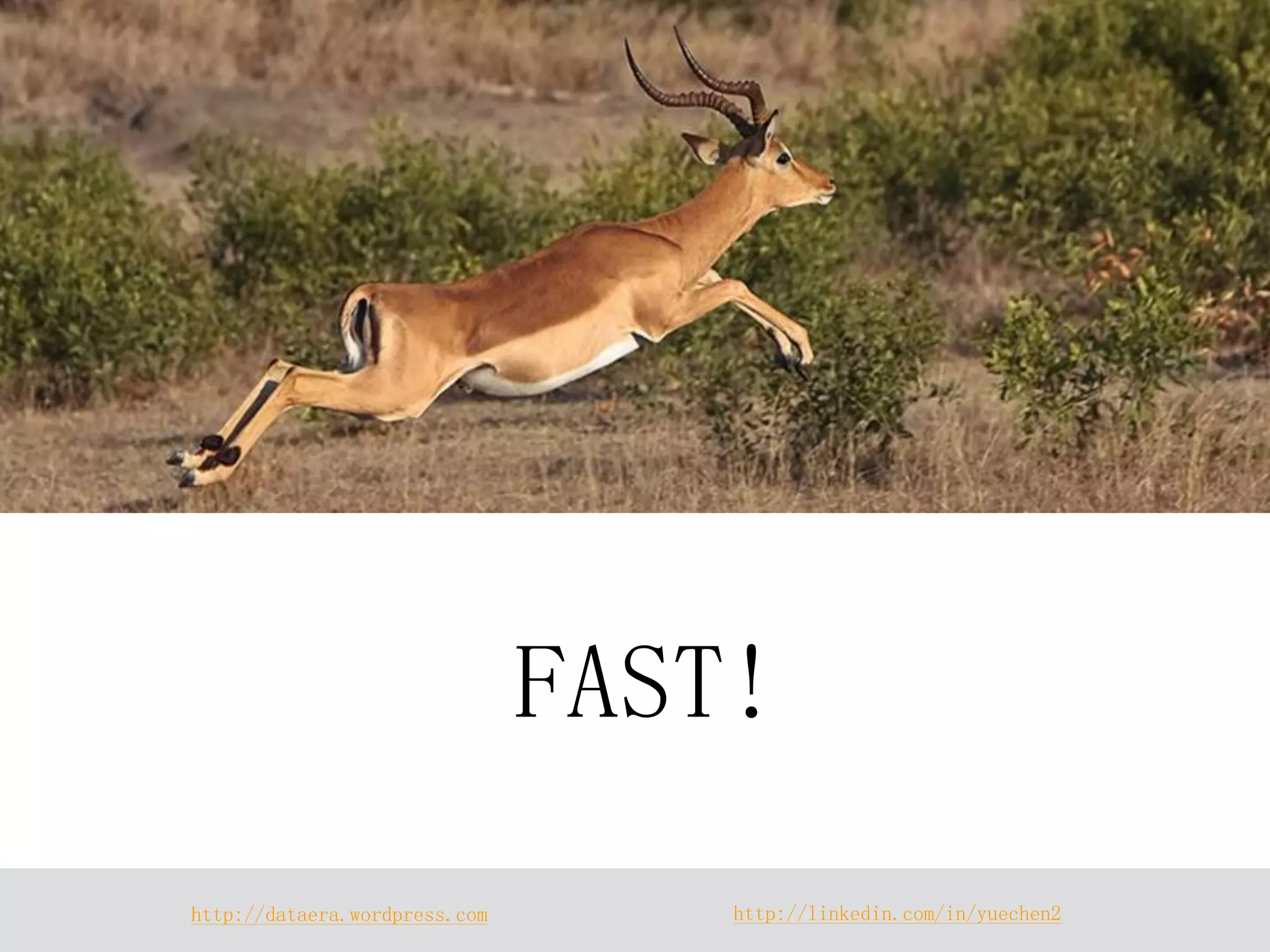
FAST!
http://dataera.wordpress.com 
http://linkedin.com/in/yuechen2 
Why HDFS? 
Low cost 
Reliability 
Easy to scale out
http://dataera.wordpress.com 
http://linkedin.com/in/yuechen2 
Architecture
http://dataera.wordpress.com 
http://linkedin.com/in/yuechen2 
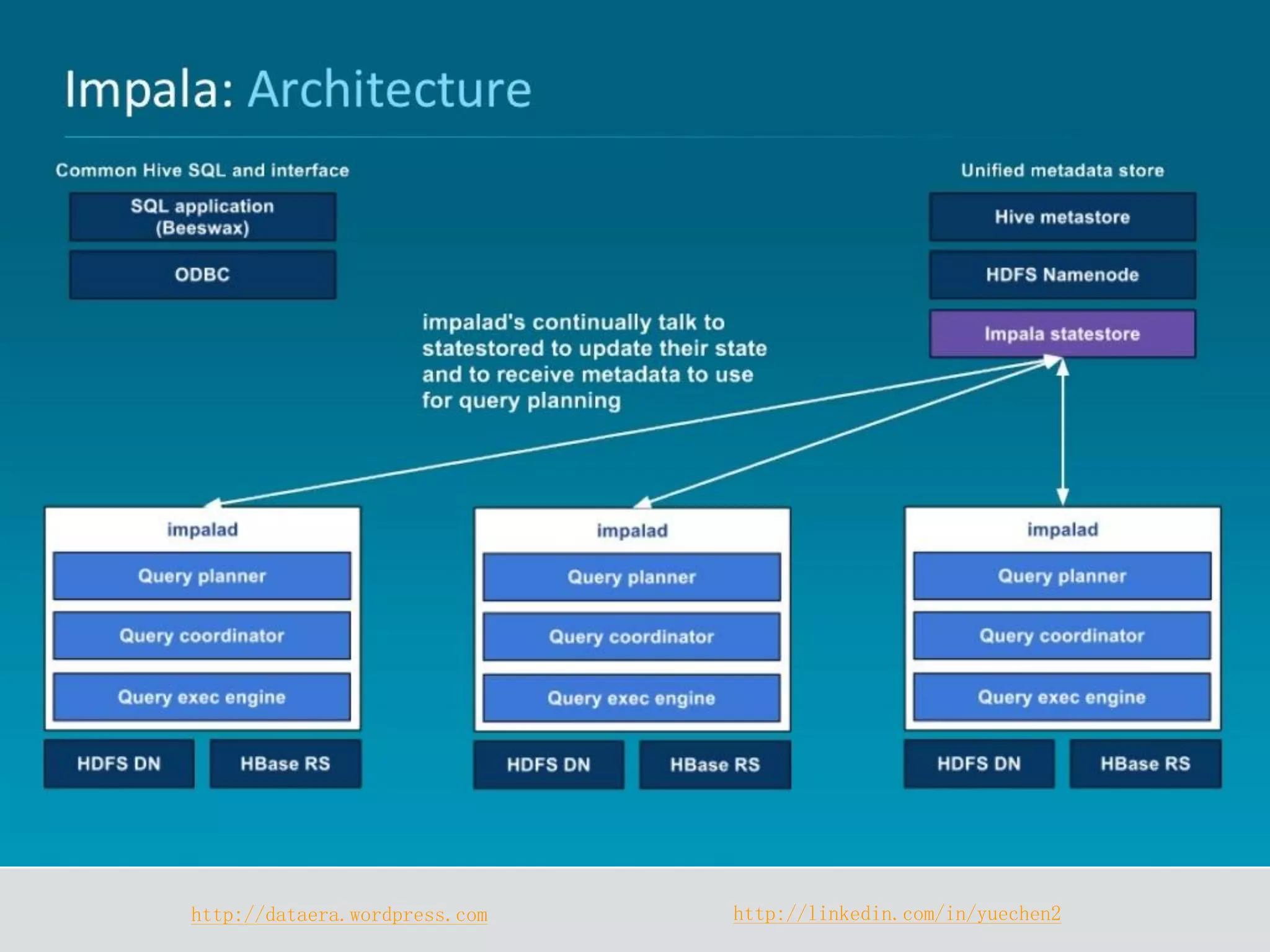
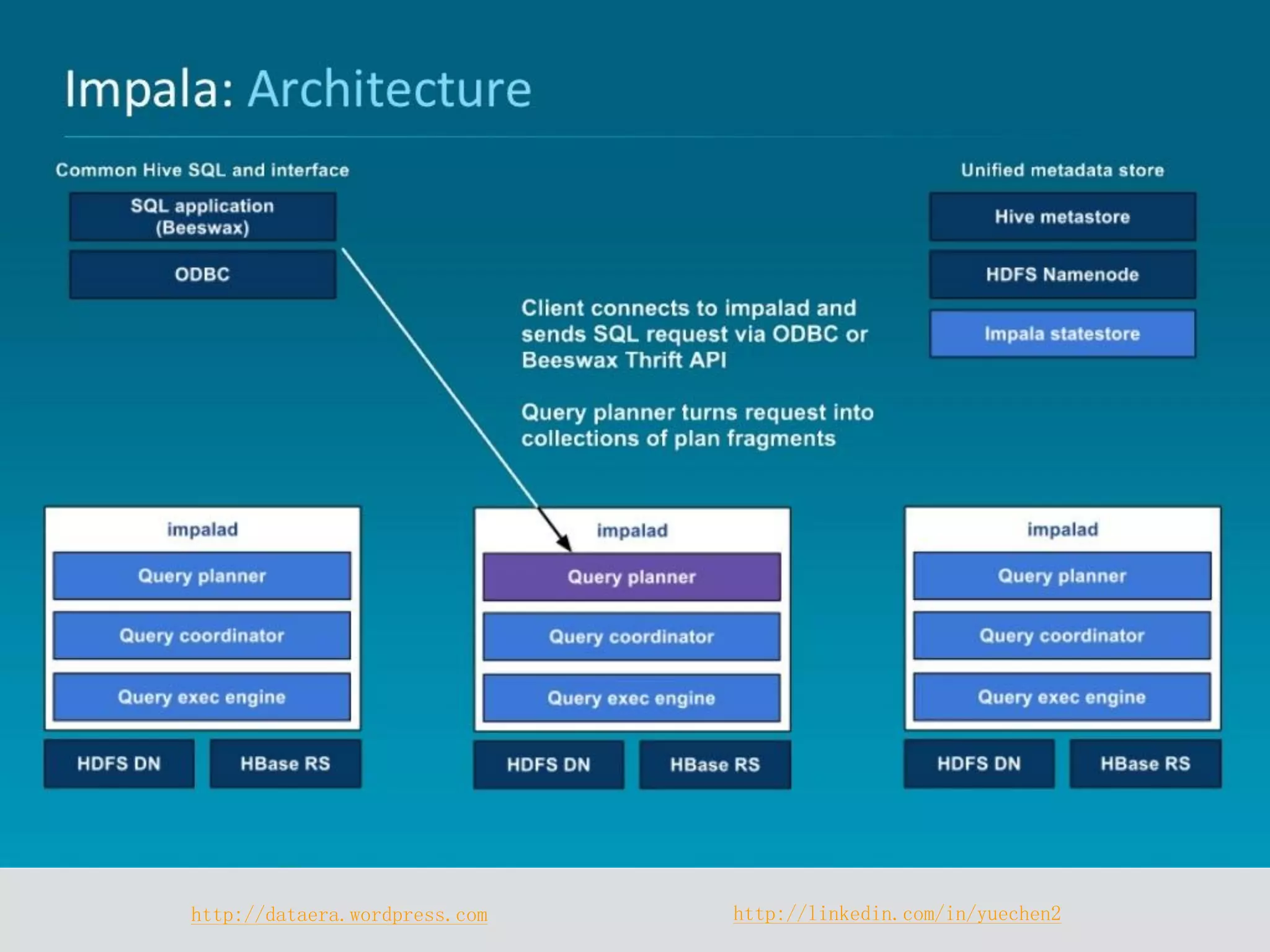
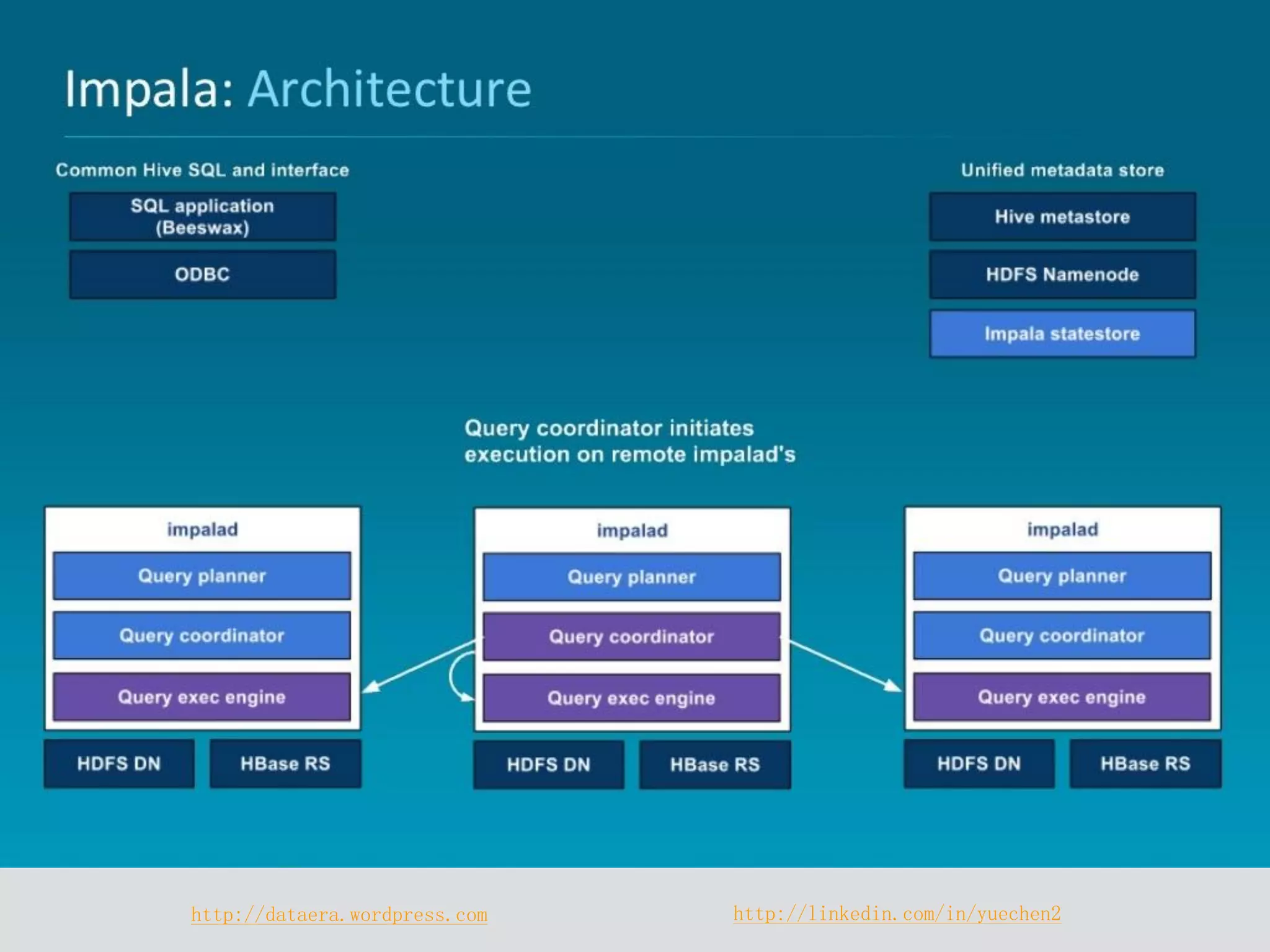
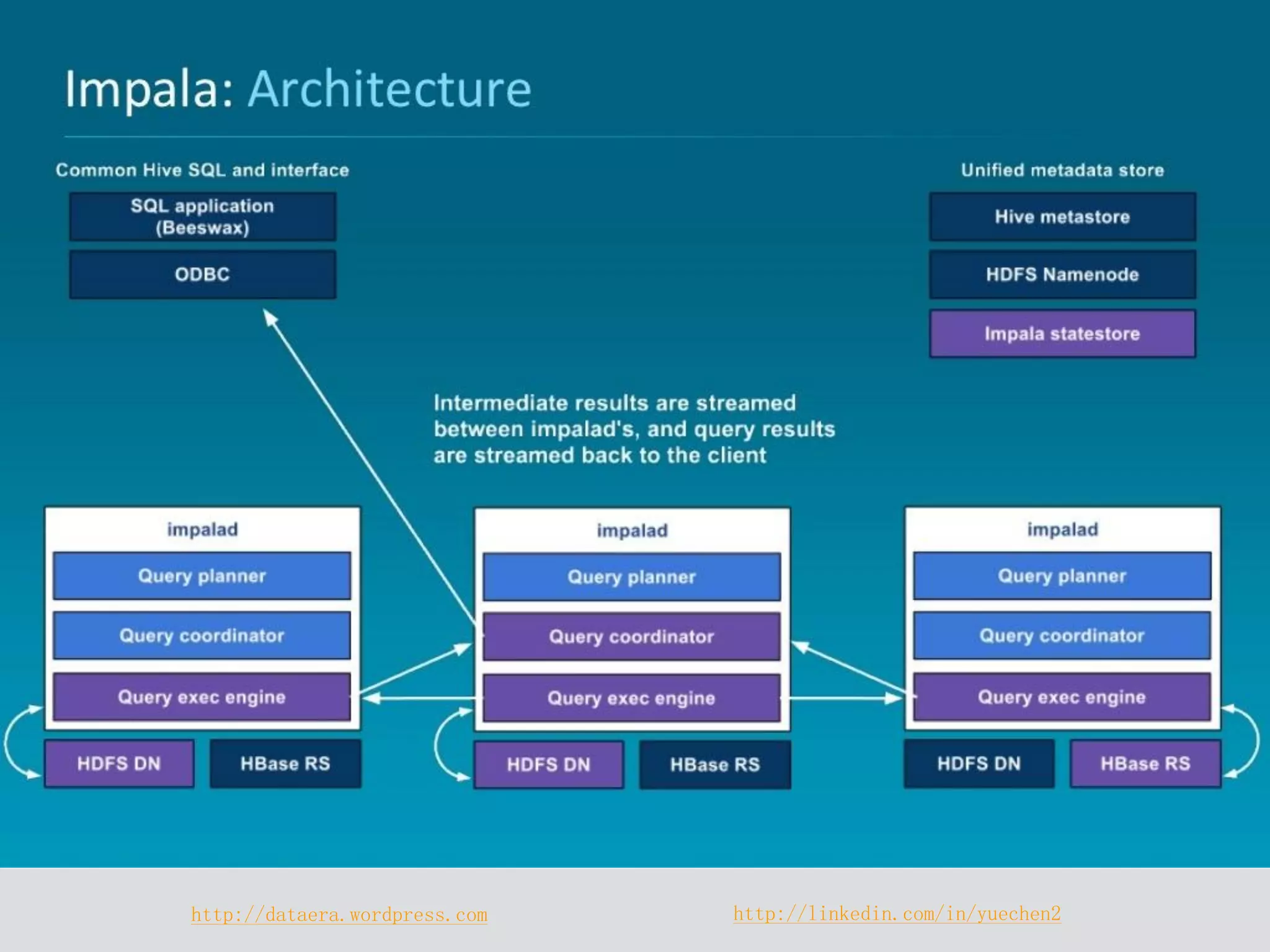
Architecture Overview 
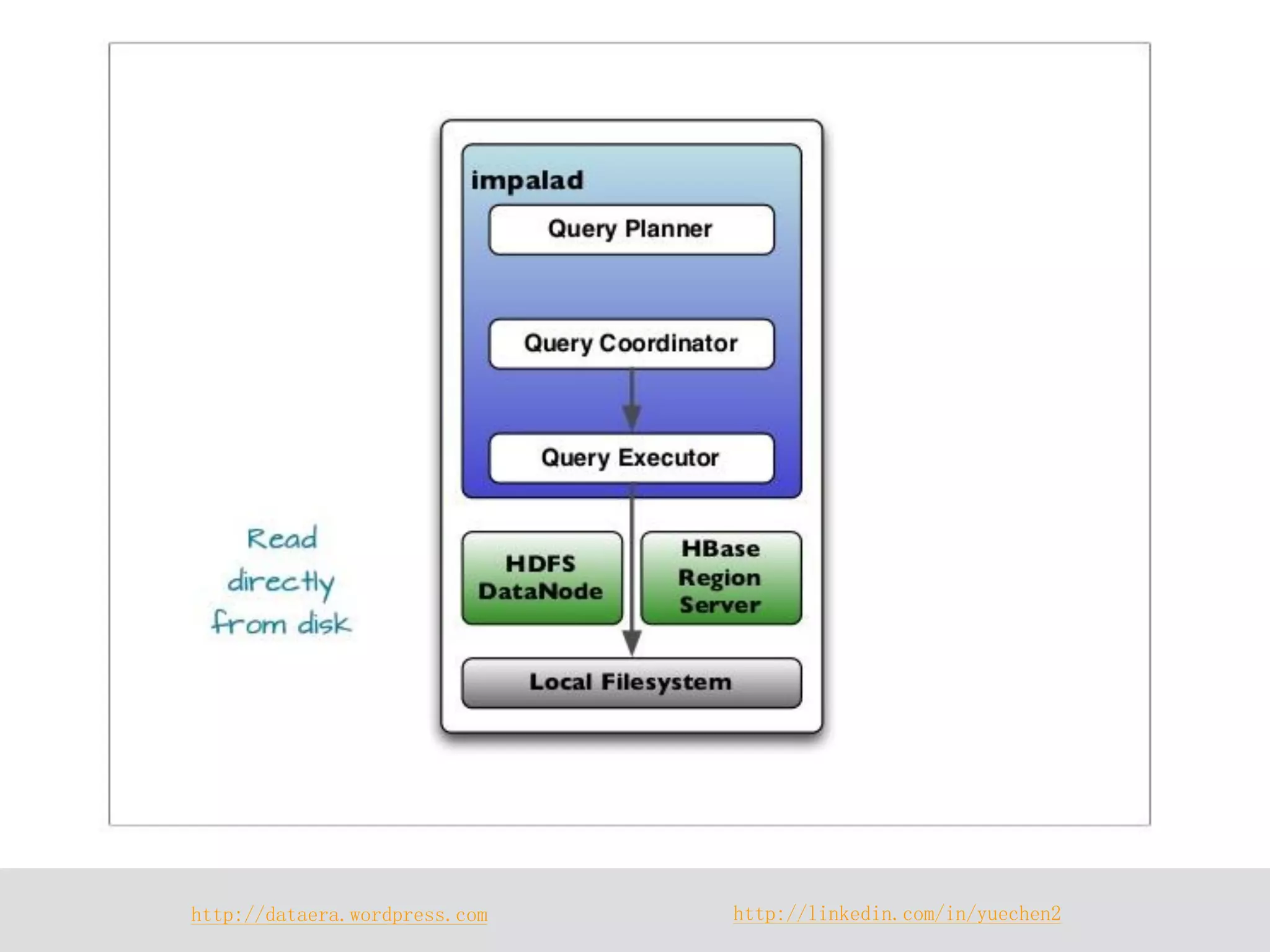
impalad daemon runs on HDFS nodes 
statestored for cluster metadata 
(Hive) metastore for database metadata 
Queries run on relevant nodes 
Data streamed to clients
http://dataera.wordpress.com 
http://linkedin.com/in/yuechen2 
Architecture Overview 
Submit queries via Hue/Beeswax, Thrift API, CLI, ODBC, JDBC 
No fault tolerance (query fails if any query on any node fails) 
Intermediate data never hits disk
http://dataera.wordpress.com 
http://linkedin.com/in/yuechen2 
statestored 
Acts as a cluster monitor 
Not a single point of failure
http://dataera.wordpress.com 
http://linkedin.com/in/yuechen2 
Metadata 
Uses Hive metastore 
Daemons cache metadata 
Can create tables in Hive or Impala
http://dataera.wordpress.com 
http://linkedin.com/in/yuechen2 
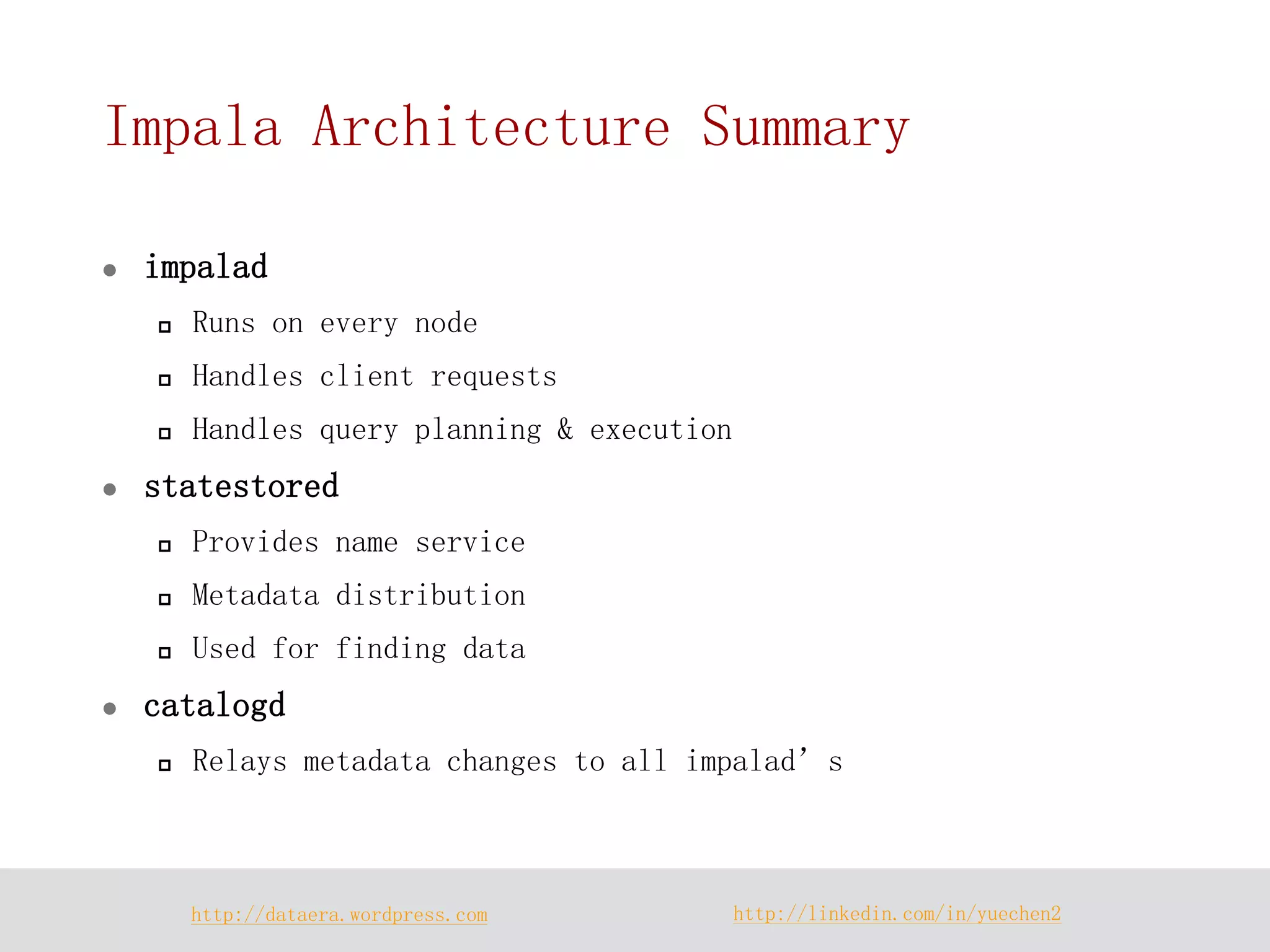
Impala Architecture Summary 
impalad 
Runs on every node 
Handles client requests 
Handles query planning & execution 
statestored 
Provides name service 
Metadata distribution 
Used for finding data 
catalogd 
Relays metadata changes to all impalad’s
http://dataera.wordpress.com 
http://linkedin.com/in/yuechen2
http://dataera.wordpress.com 
http://linkedin.com/in/yuechen2
http://dataera.wordpress.com 
http://linkedin.com/in/yuechen2
http://dataera.wordpress.com 
http://linkedin.com/in/yuechen2
http://dataera.wordpress.com 
http://linkedin.com/in/yuechen2 
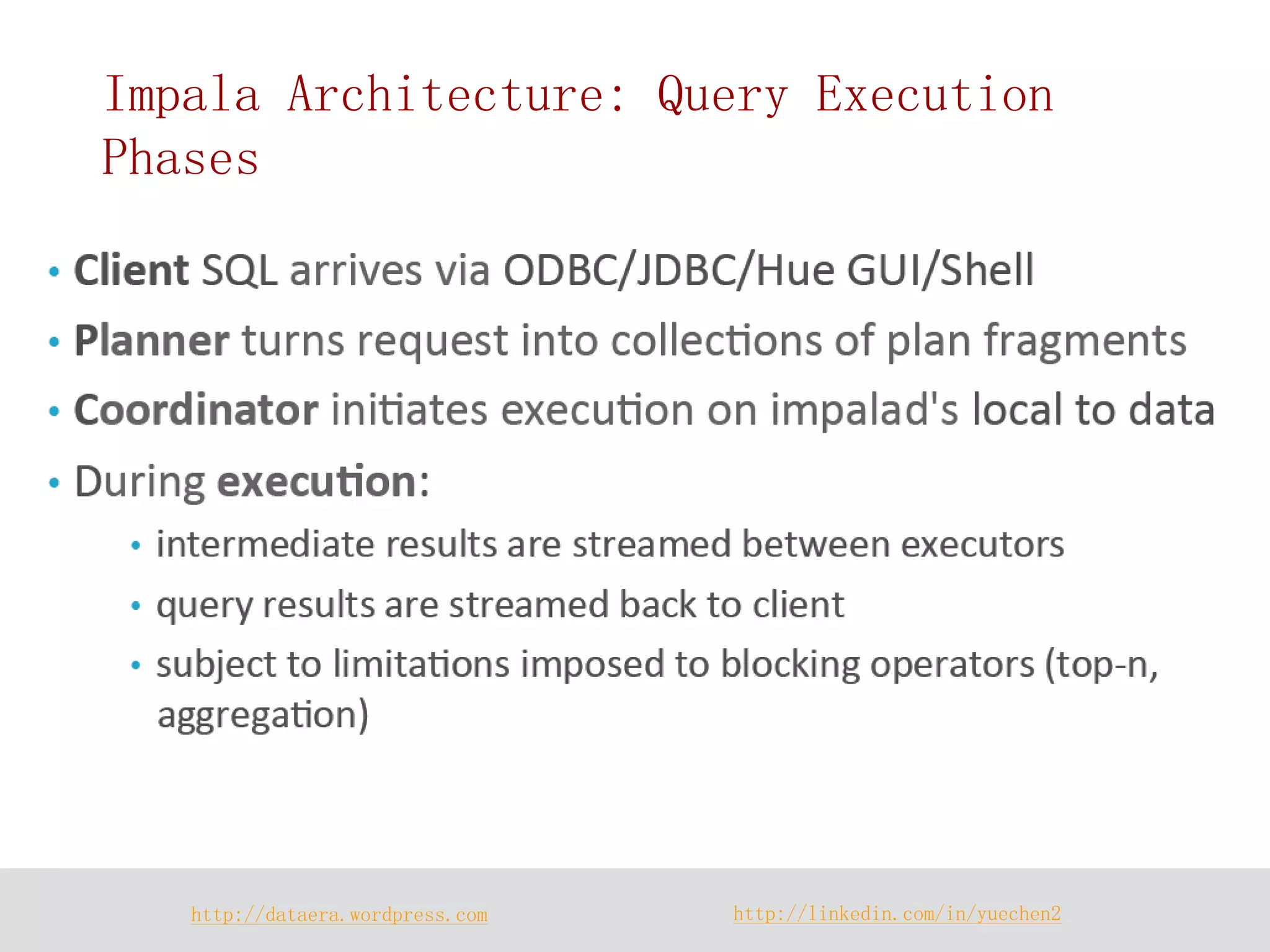
Impala Architecture: Query Execution Phases
http://dataera.wordpress.com 
http://linkedin.com/in/yuechen2 
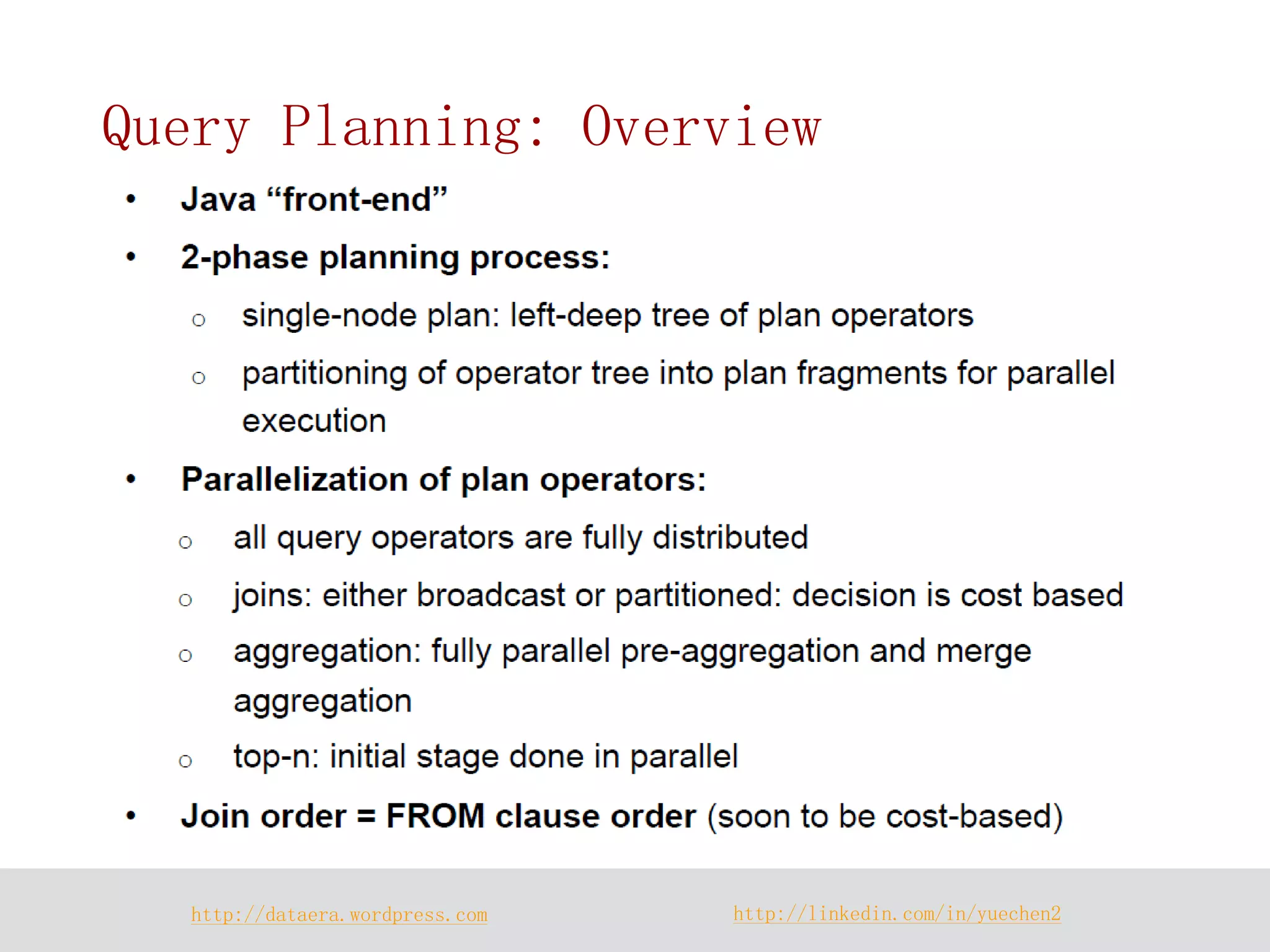
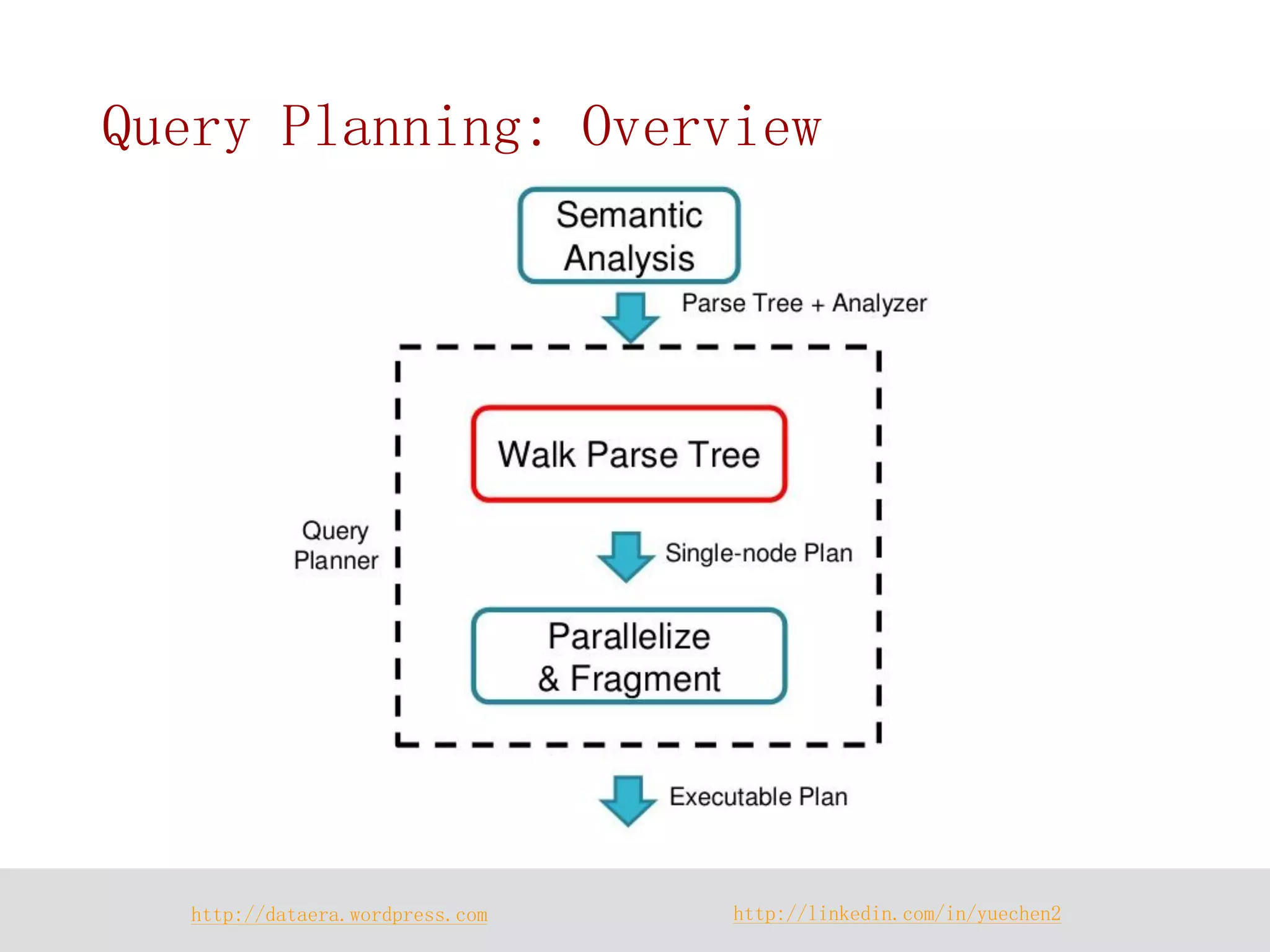
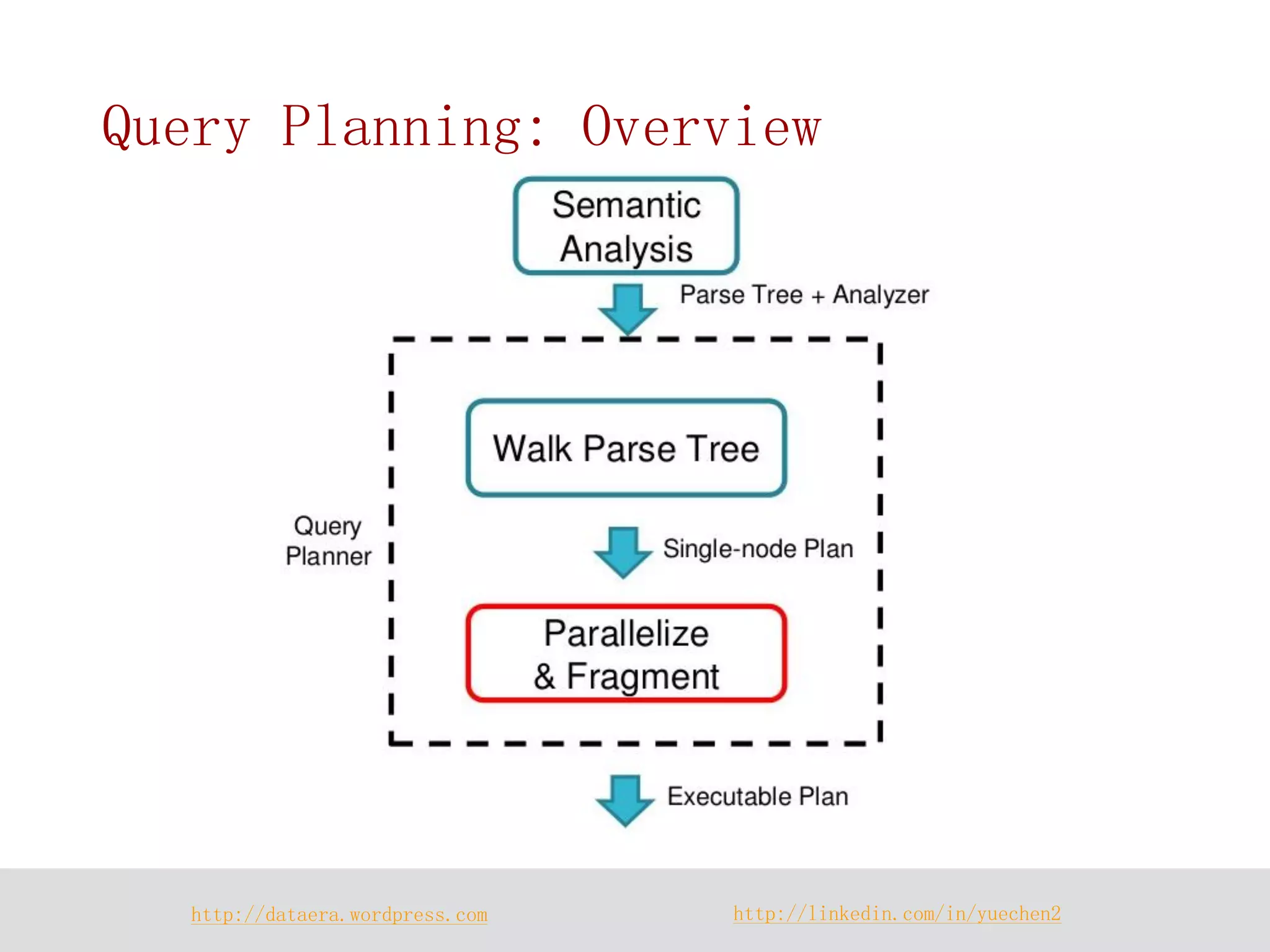
Query Planning: Overview
http://dataera.wordpress.com 
http://linkedin.com/in/yuechen2 
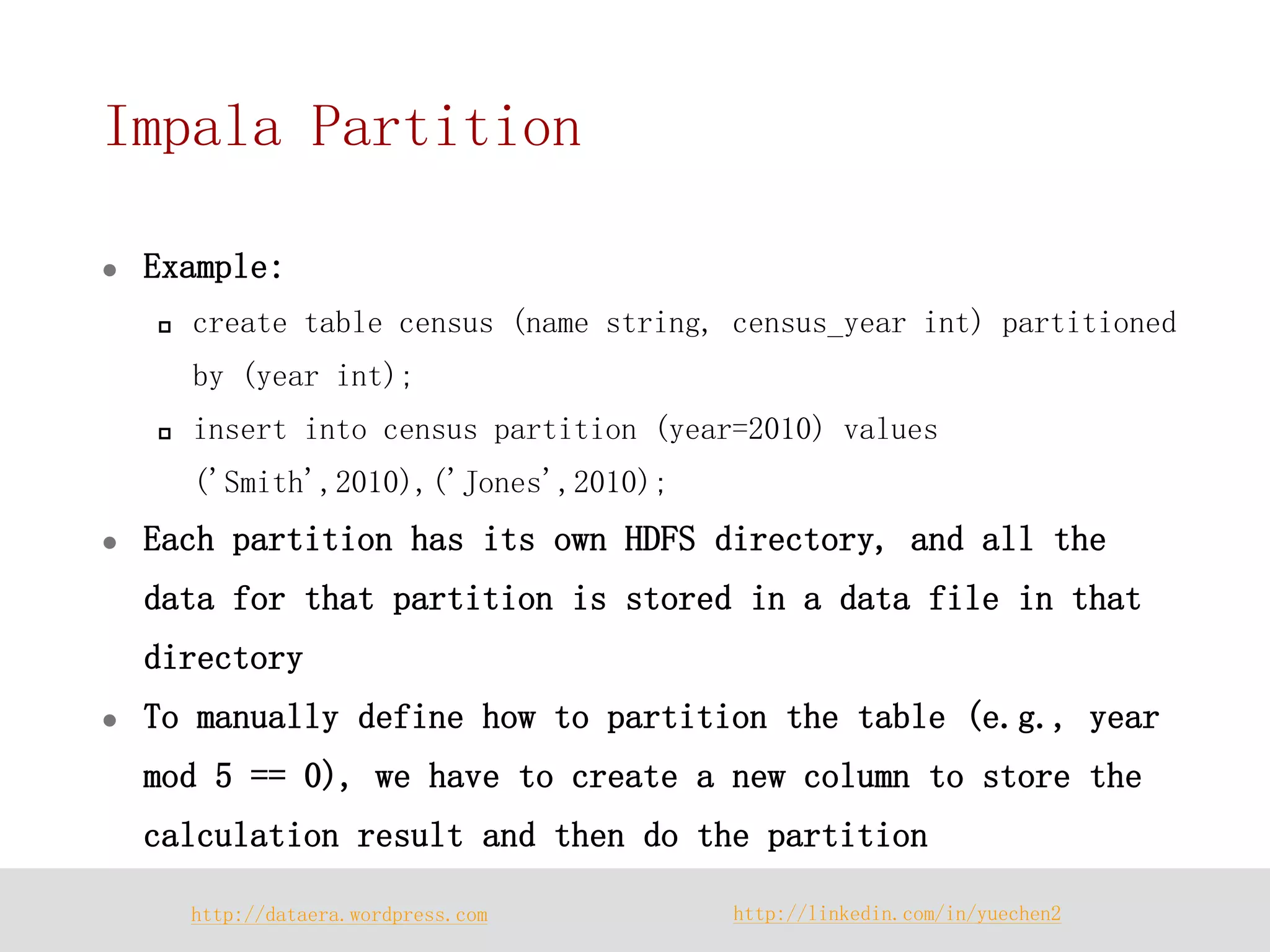
Impala Partition 
Example: 
create table census (name string, census_year int) partitioned by (year int); 
insert into census partition (year=2010) values ('Smith',2010),('Jones',2010); 
Each partition has its own HDFS directory, and all the data for that partition is stored in a data file in that directory 
To manually define how to partition the table (e.g., year mod 5 == 0), we have to create a new column to store the calculation result and then do the partition
http://dataera.wordpress.com 
http://linkedin.com/in/yuechen2 
Frontend
http://dataera.wordpress.com 
http://linkedin.com/in/yuechen2 
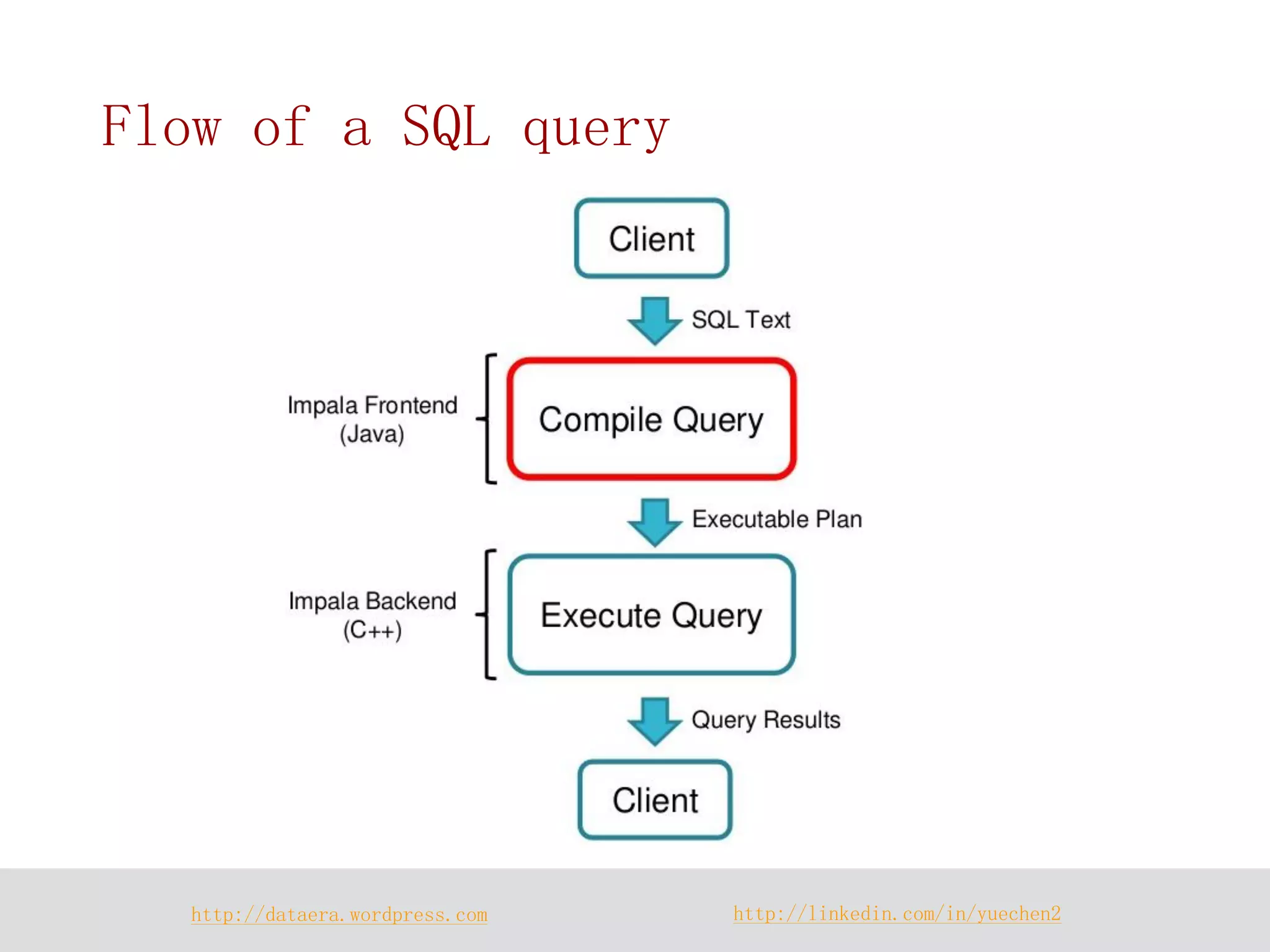
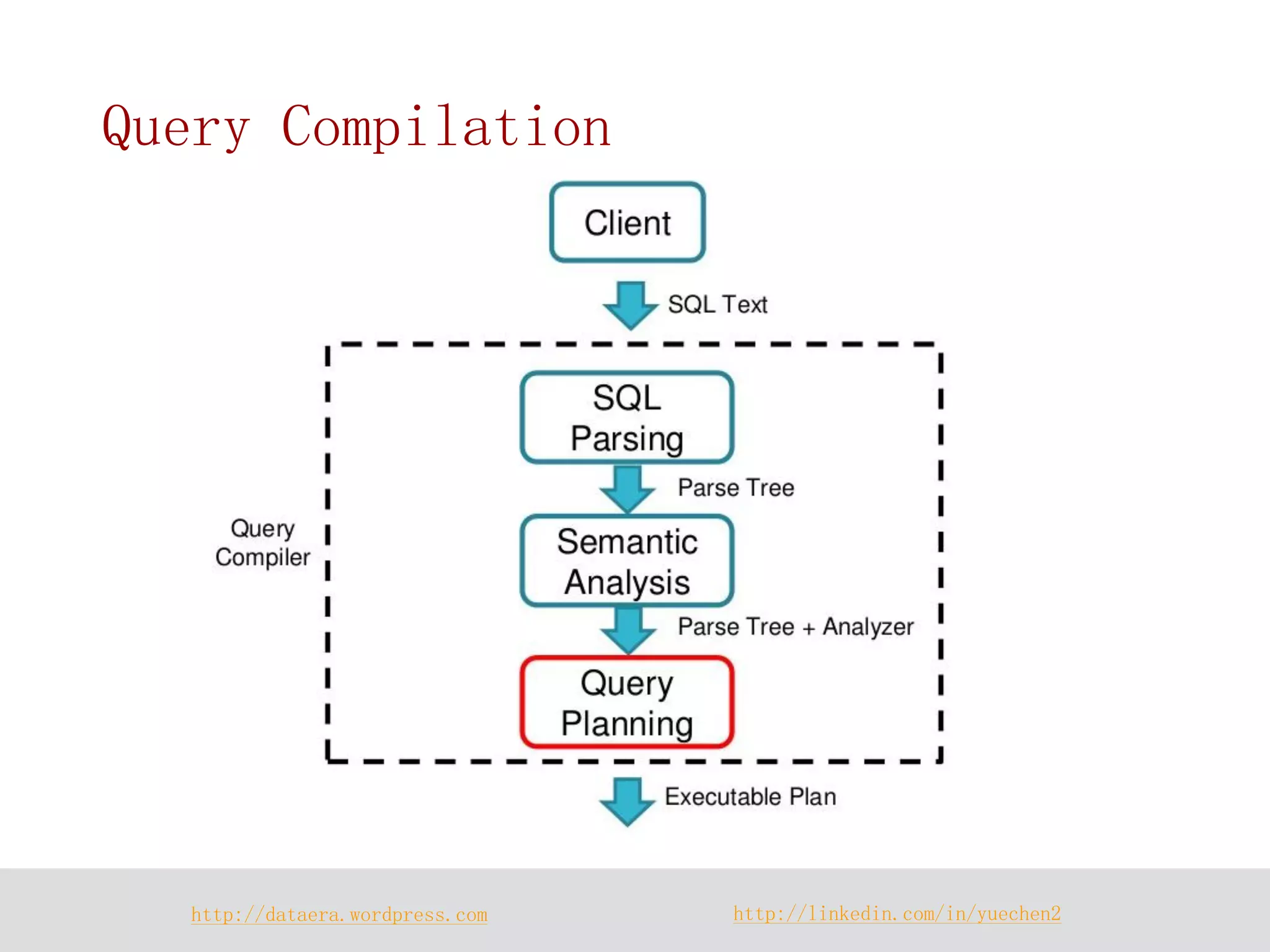
Flow of a SQL query
http://dataera.wordpress.com 
http://linkedin.com/in/yuechen2 
Query Compilation
http://dataera.wordpress.com 
http://linkedin.com/in/yuechen2 
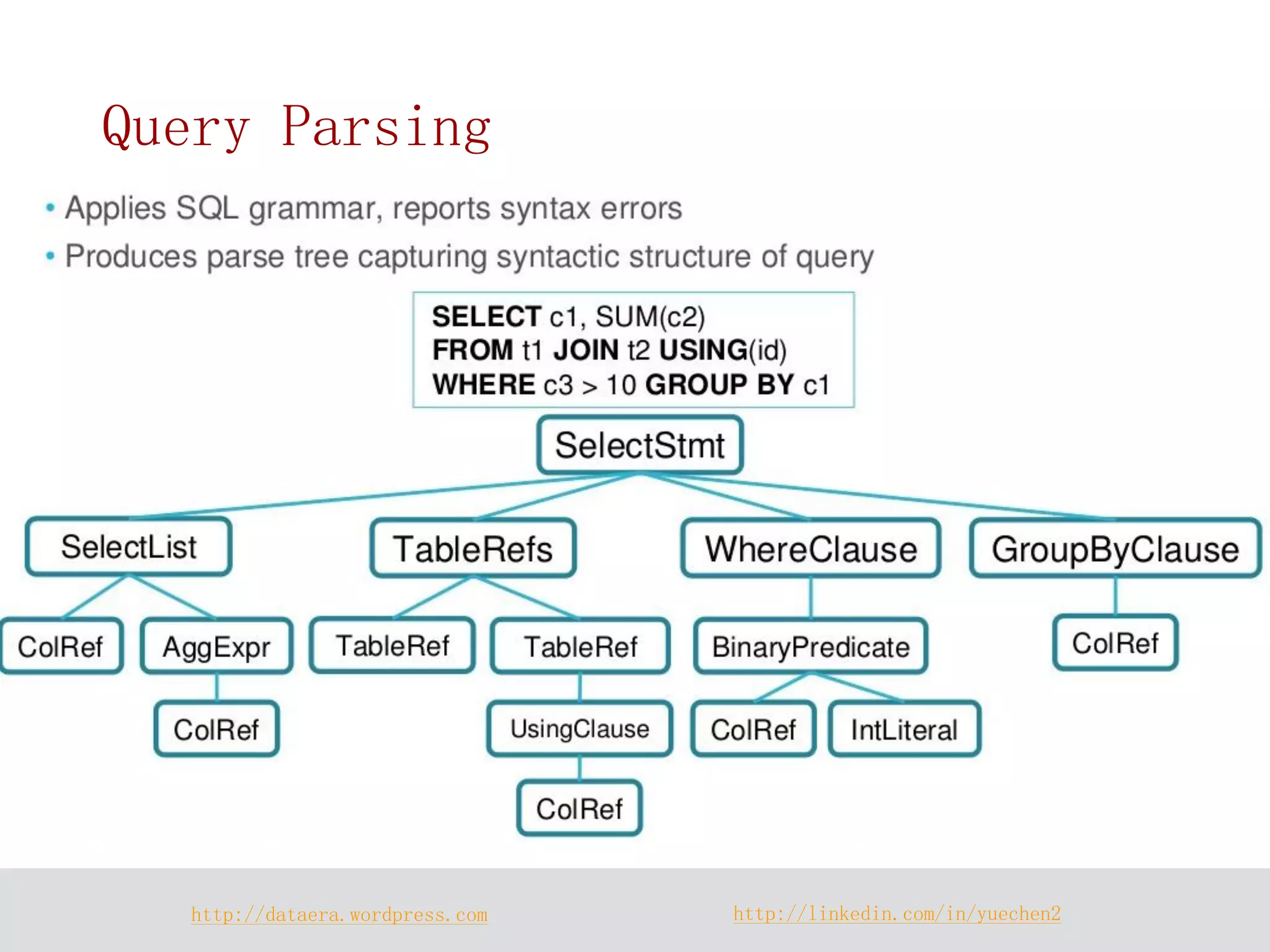
Query Parsing
http://dataera.wordpress.com 
http://linkedin.com/in/yuechen2 
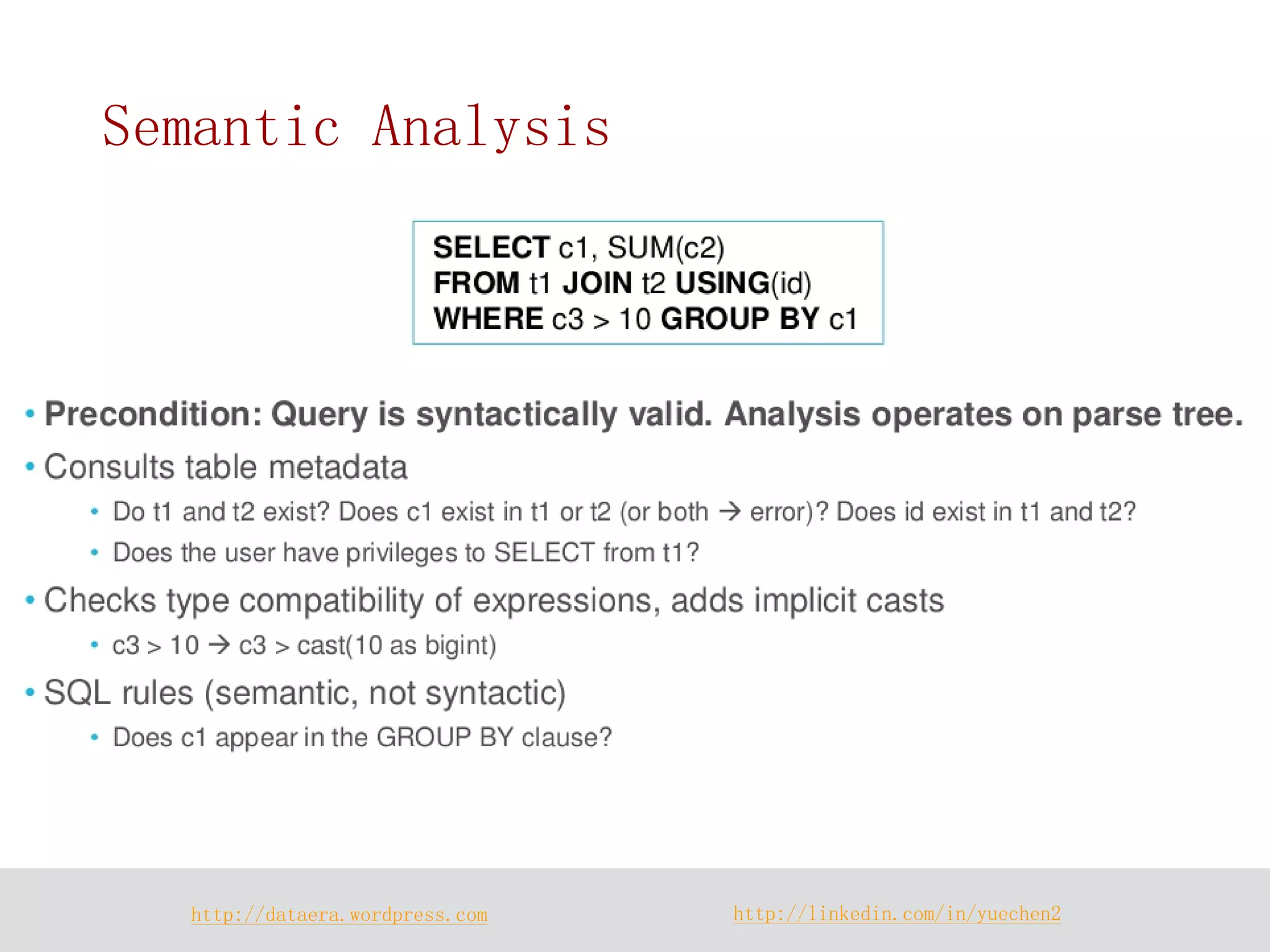
Semantic Analysis
http://dataera.wordpress.com 
http://linkedin.com/in/yuechen2 
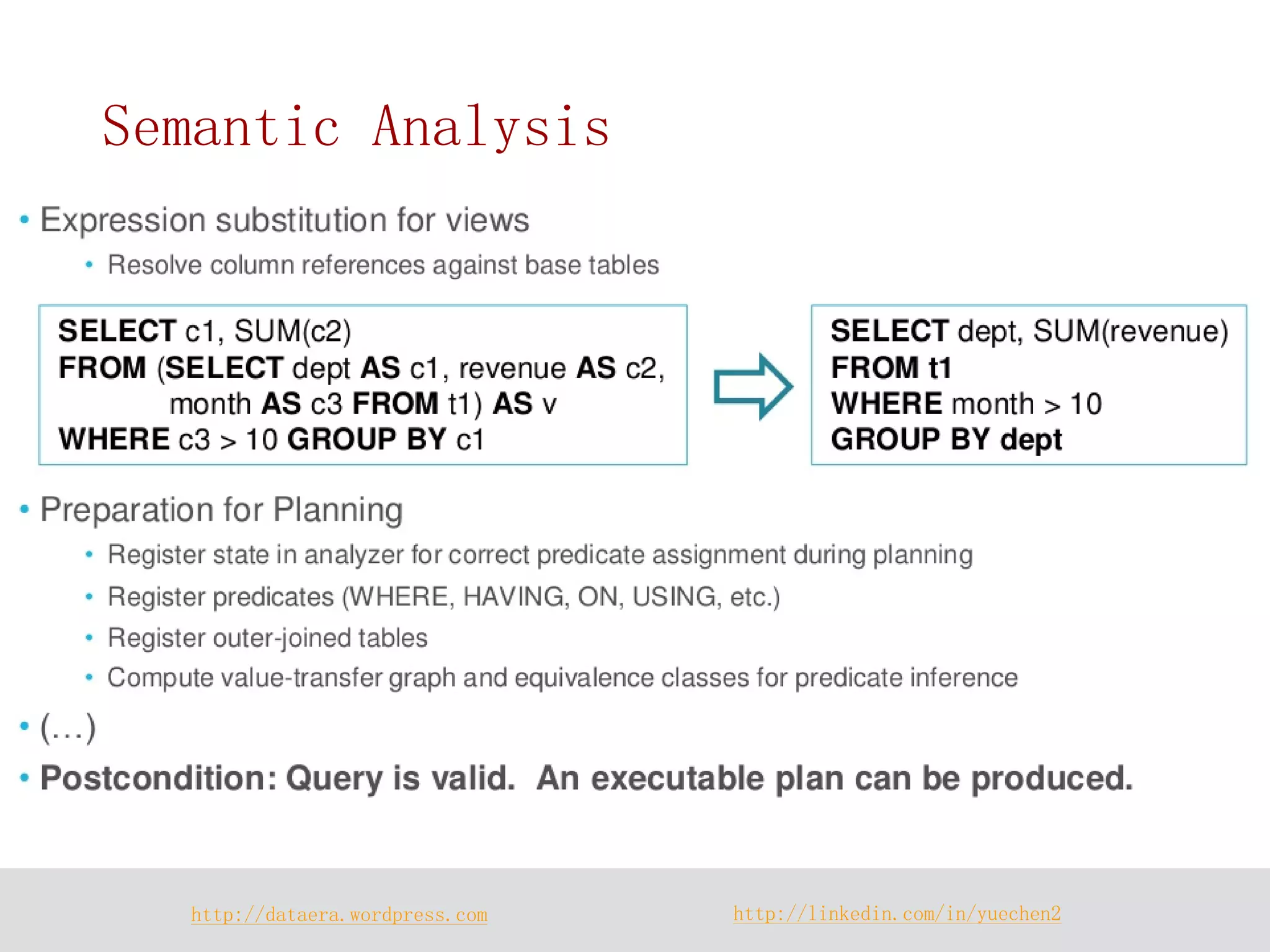
Semantic Analysis
http://dataera.wordpress.com 
http://linkedin.com/in/yuechen2 
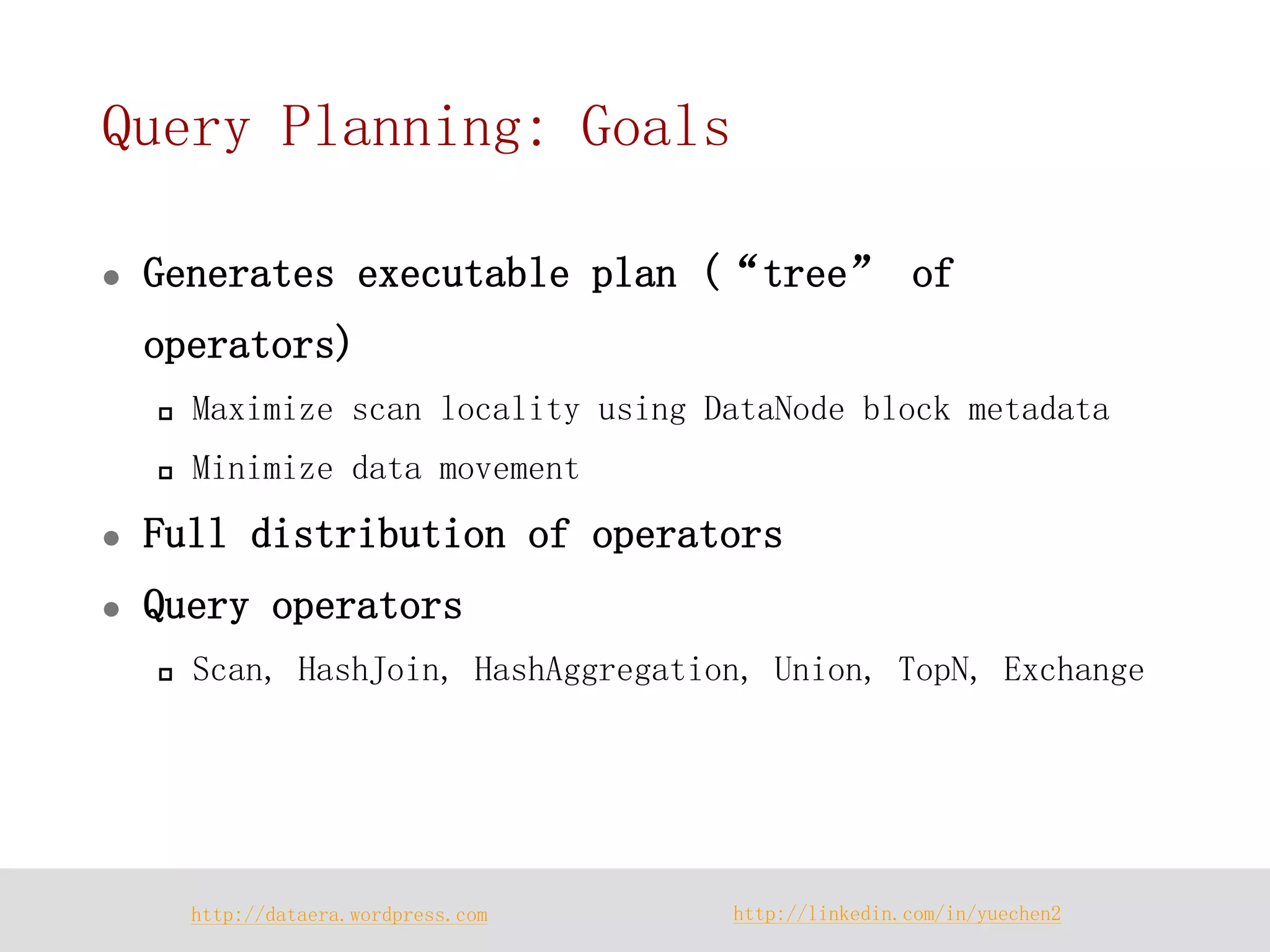
Query Planning: Goals 
Generates executable plan (“tree” of operators) 
Maximize scan locality using DataNode block metadata 
Minimize data movement 
Full distribution of operators 
Query operators 
Scan, HashJoin, HashAggregation, Union, TopN, Exchange
http://dataera.wordpress.com 
http://linkedin.com/in/yuechen2 
Query Planning: Overview
http://dataera.wordpress.com 
http://linkedin.com/in/yuechen2 
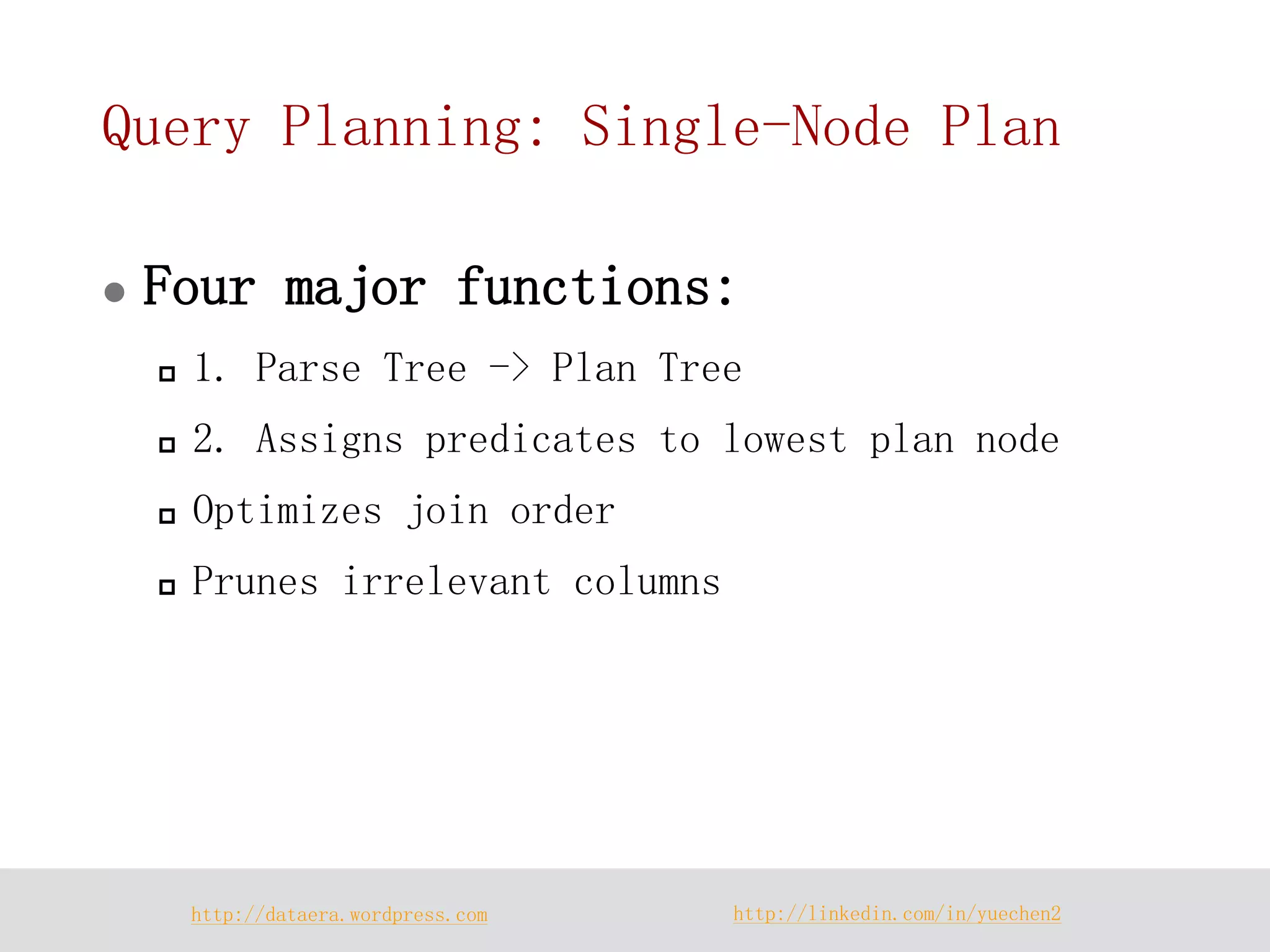
Query Planning: Single-Node Plan 
Four major functions: 
1. Parse Tree -> Plan Tree 
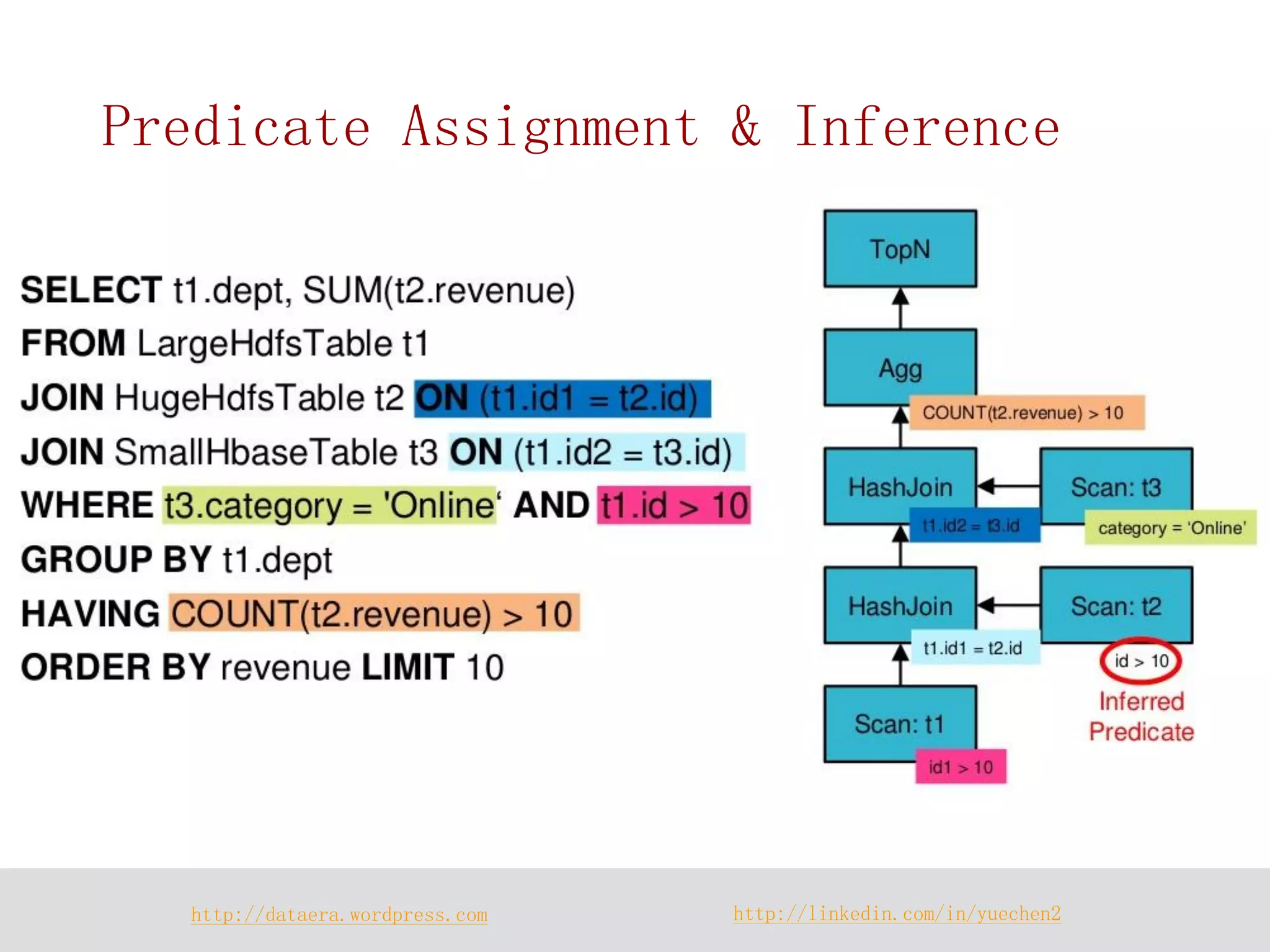
2. Assigns predicates to lowest plan node 
Optimizes join order 
Prunes irrelevant columns
http://dataera.wordpress.com 
http://linkedin.com/in/yuechen2 
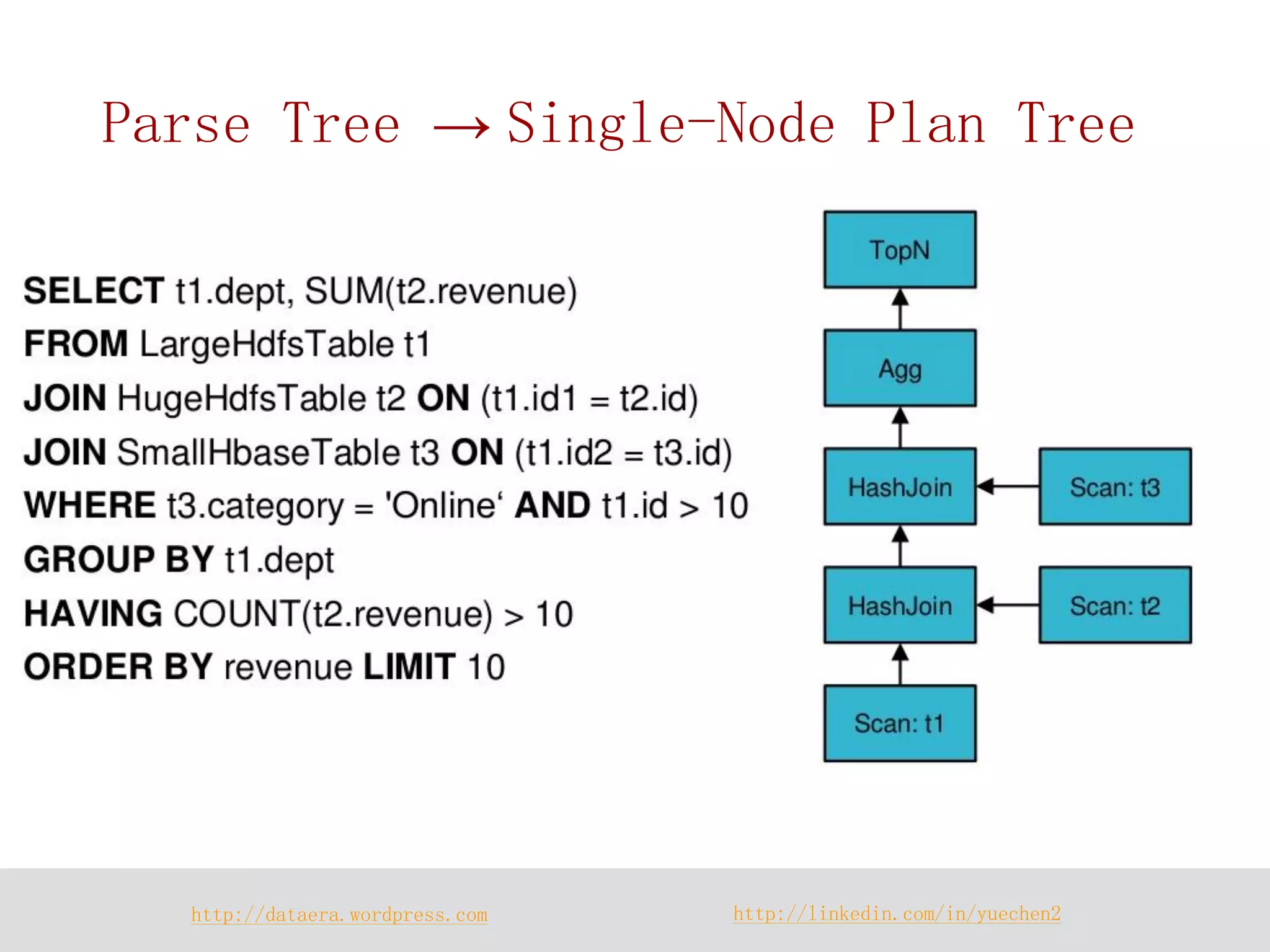
Parse Tree → Single-Node Plan Tree
http://dataera.wordpress.com 
http://linkedin.com/in/yuechen2 
Predicate Assignment & Inference
http://dataera.wordpress.com 
http://linkedin.com/in/yuechen2 
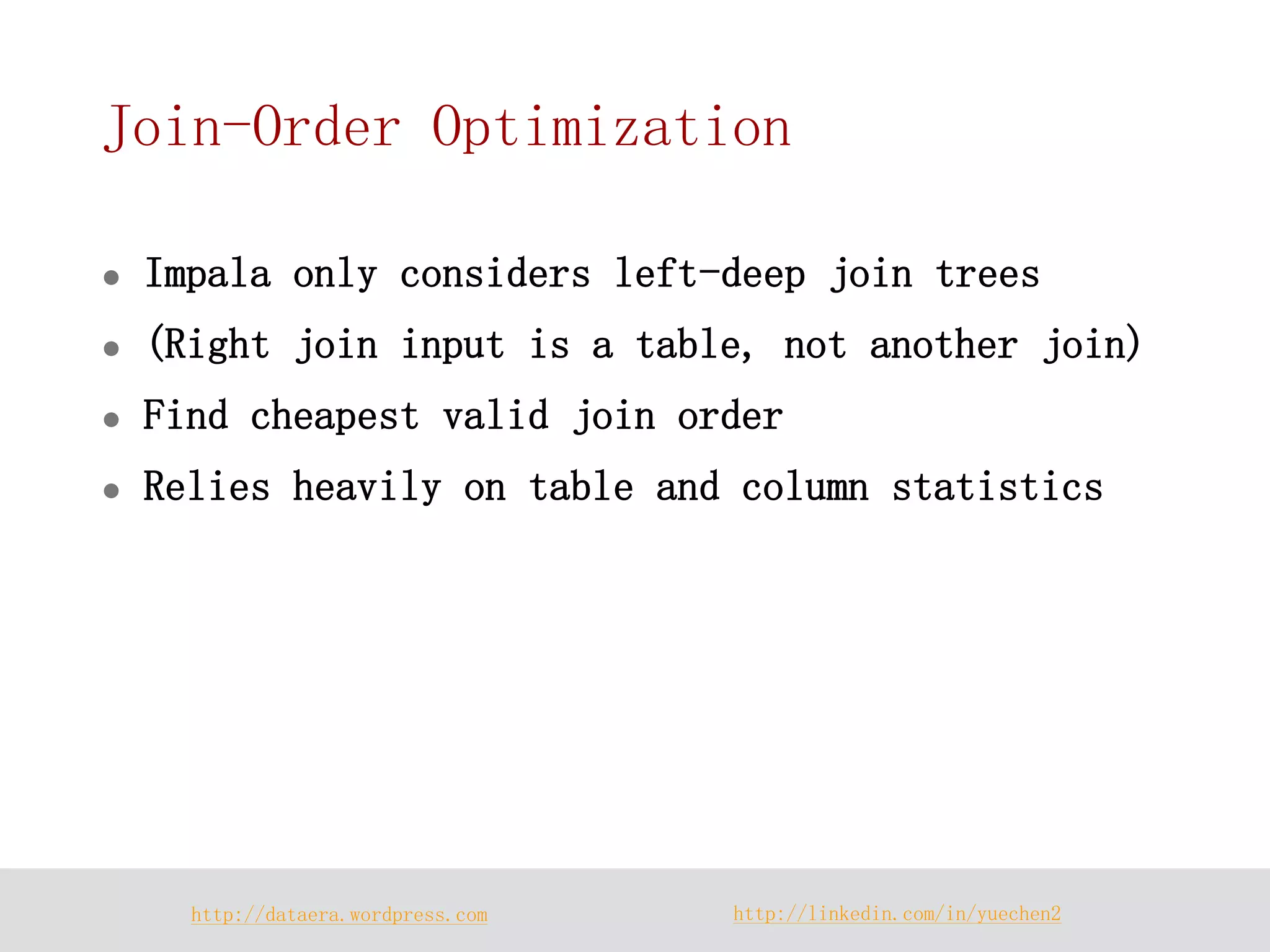
Join-Order Optimization 
Impala only considers left-deep join trees 
(Right join input is a table, not another join) 
Find cheapest valid join order 
Relies heavily on table and column statistics
http://dataera.wordpress.com 
http://linkedin.com/in/yuechen2 
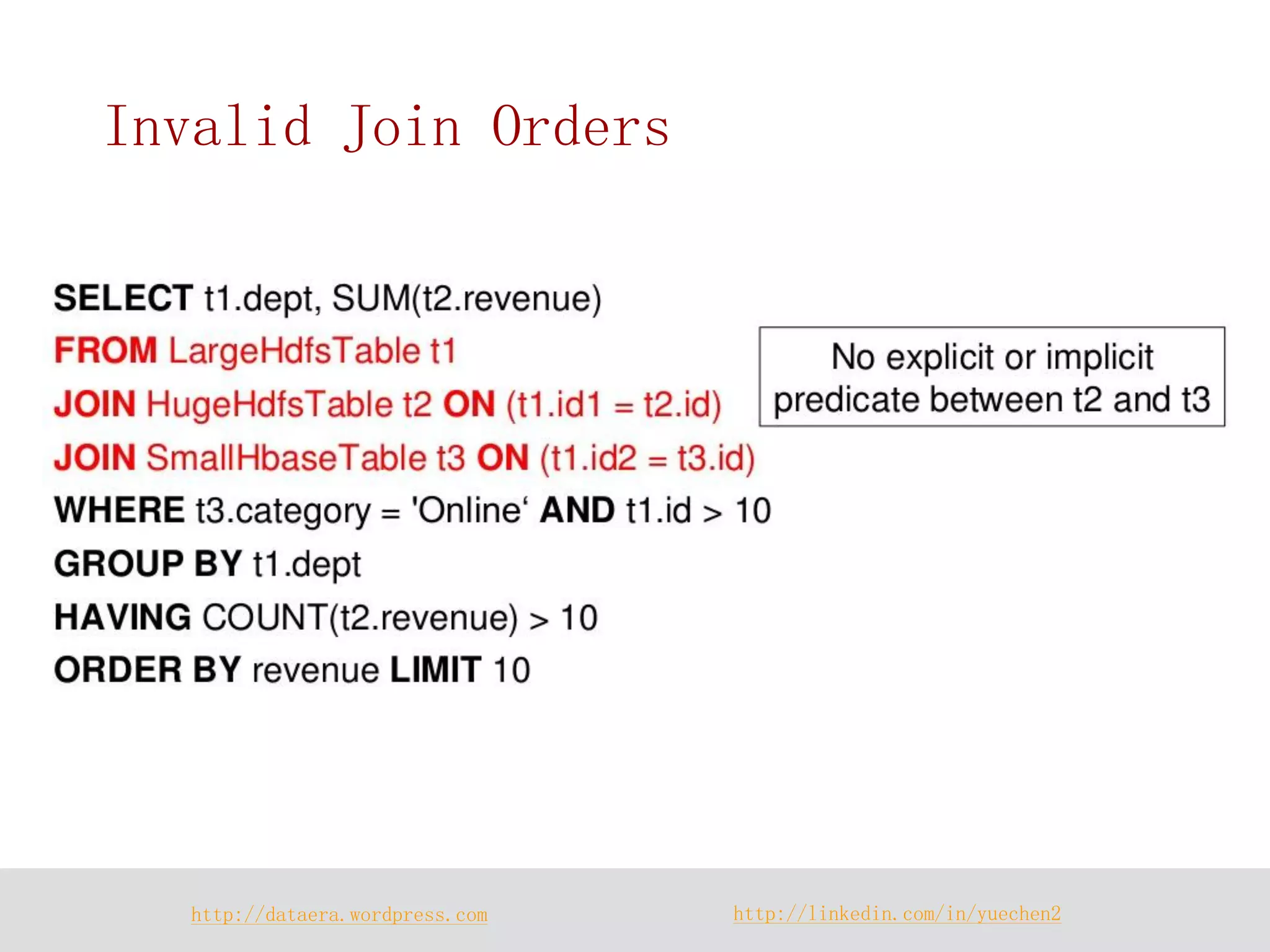
Invalid Join Orders
http://dataera.wordpress.com 
http://linkedin.com/in/yuechen2 
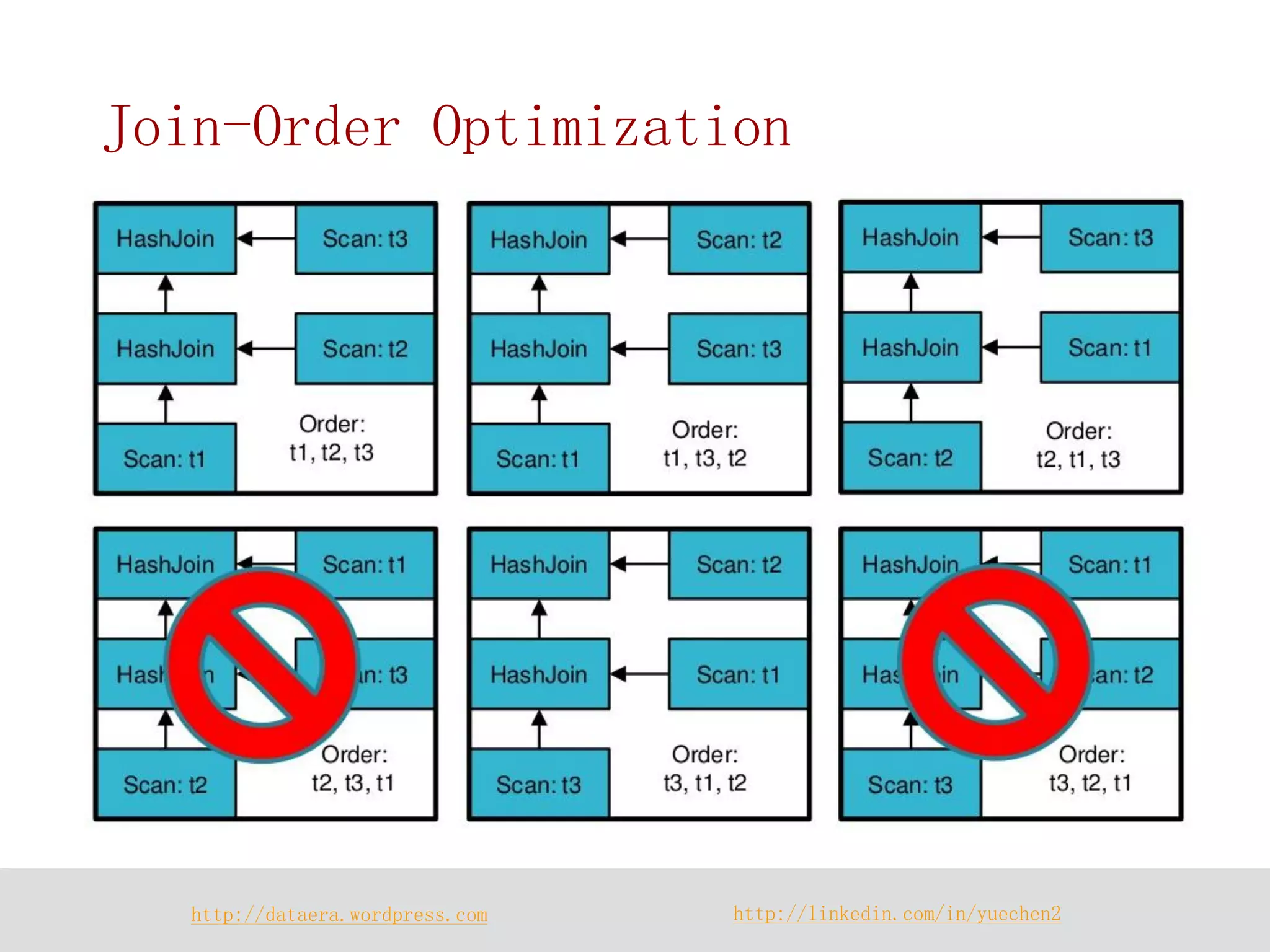
Join-Order Optimization
http://dataera.wordpress.com 
http://linkedin.com/in/yuechen2 
Join-Order Optimization 
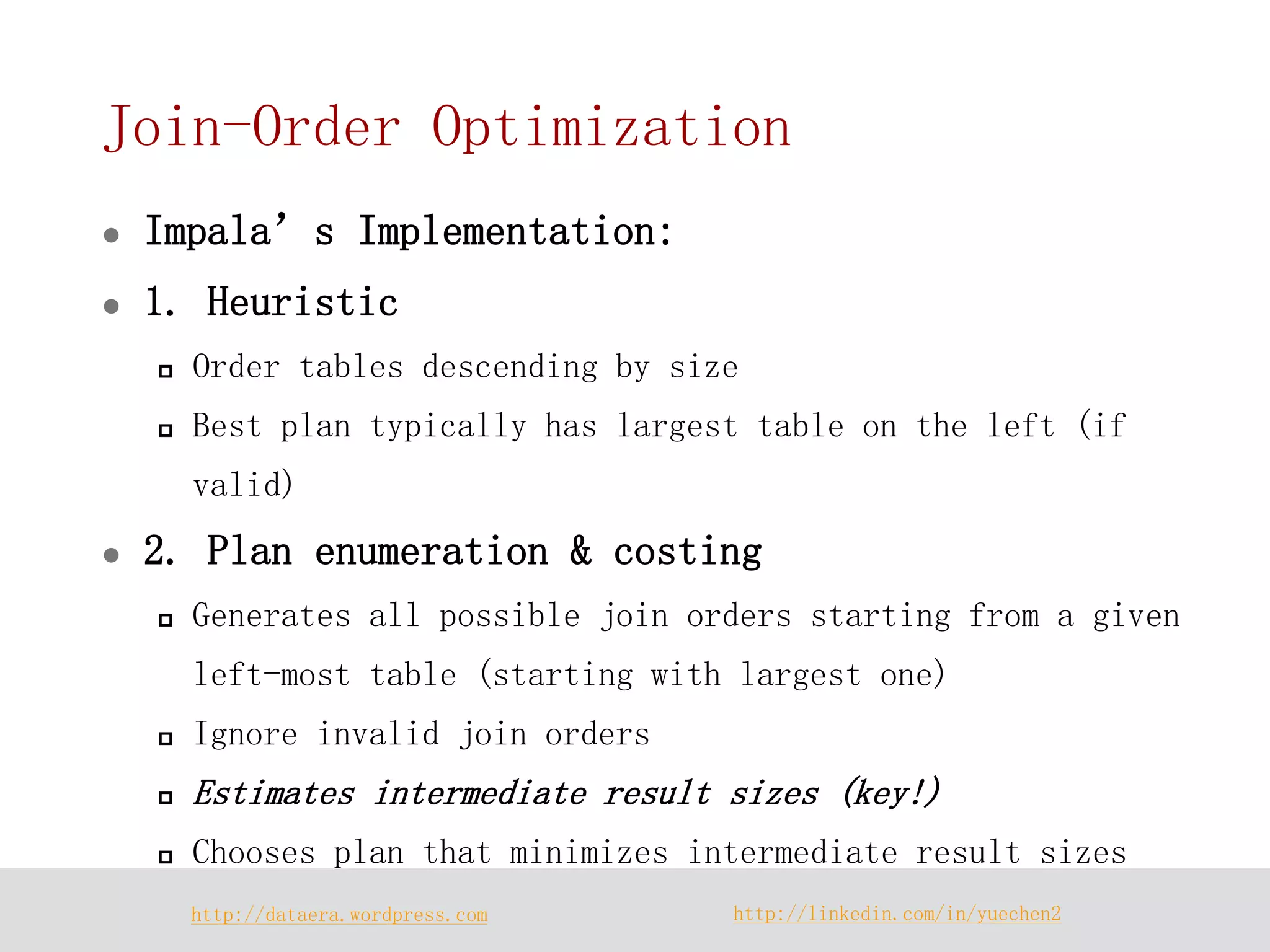
Impala’s Implementation: 
1. Heuristic 
Order tables descending by size 
Best plan typically has largest table on the left (if valid) 
2. Plan enumeration & costing 
Generates all possible join orders starting from a given left-most table (starting with largest one) 
Ignore invalid join orders 
Estimates intermediate result sizes (key!) 
Chooses plan that minimizes intermediate result sizes
http://dataera.wordpress.com 
http://linkedin.com/in/yuechen2 
Query Planning: Overview
http://dataera.wordpress.com 
http://linkedin.com/in/yuechen2 
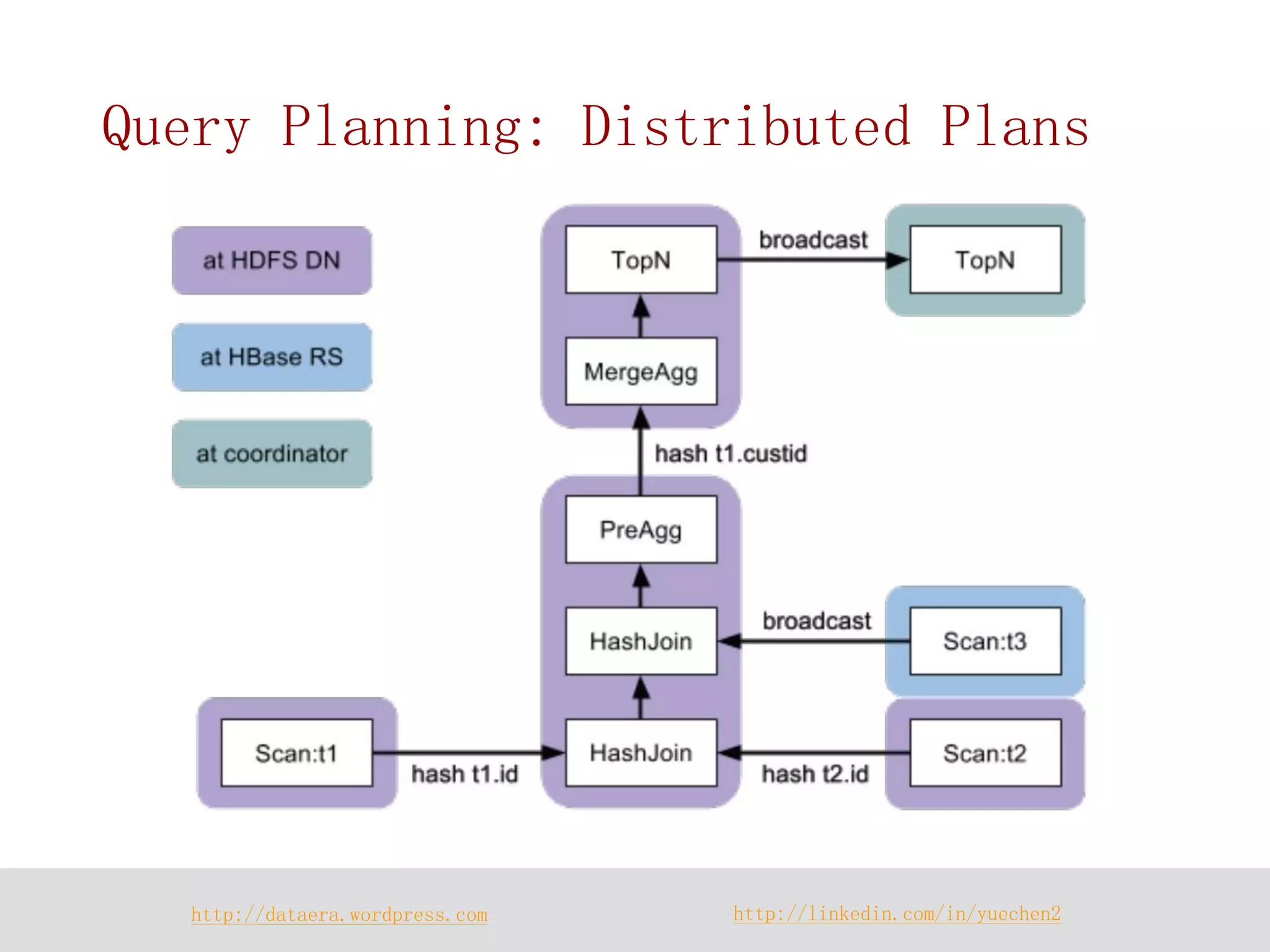
Query Planning: Distributed Plans
http://dataera.wordpress.com 
http://linkedin.com/in/yuechen2 
Query Planning: Distributed Plans
http://dataera.wordpress.com 
http://linkedin.com/in/yuechen2 
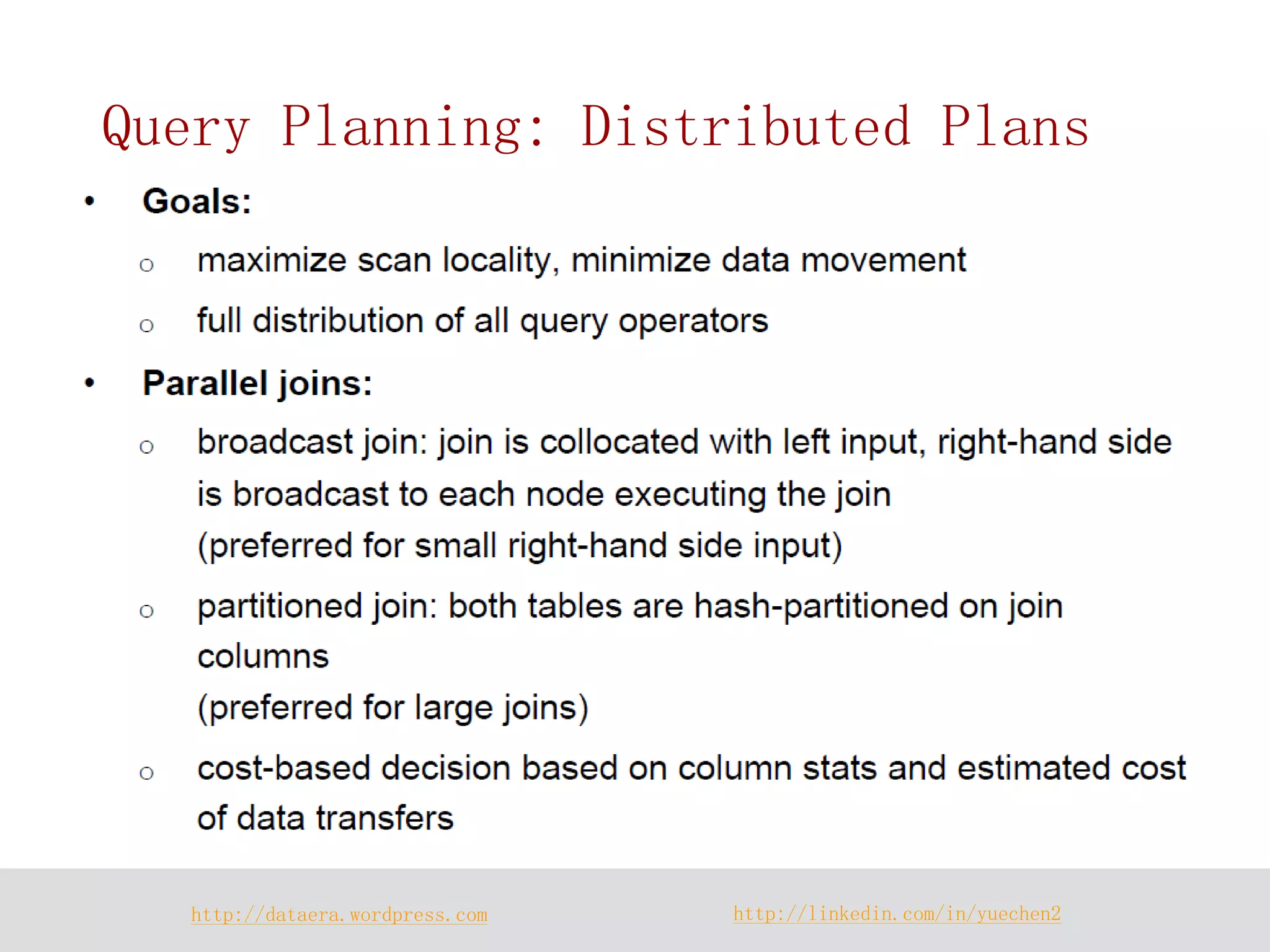
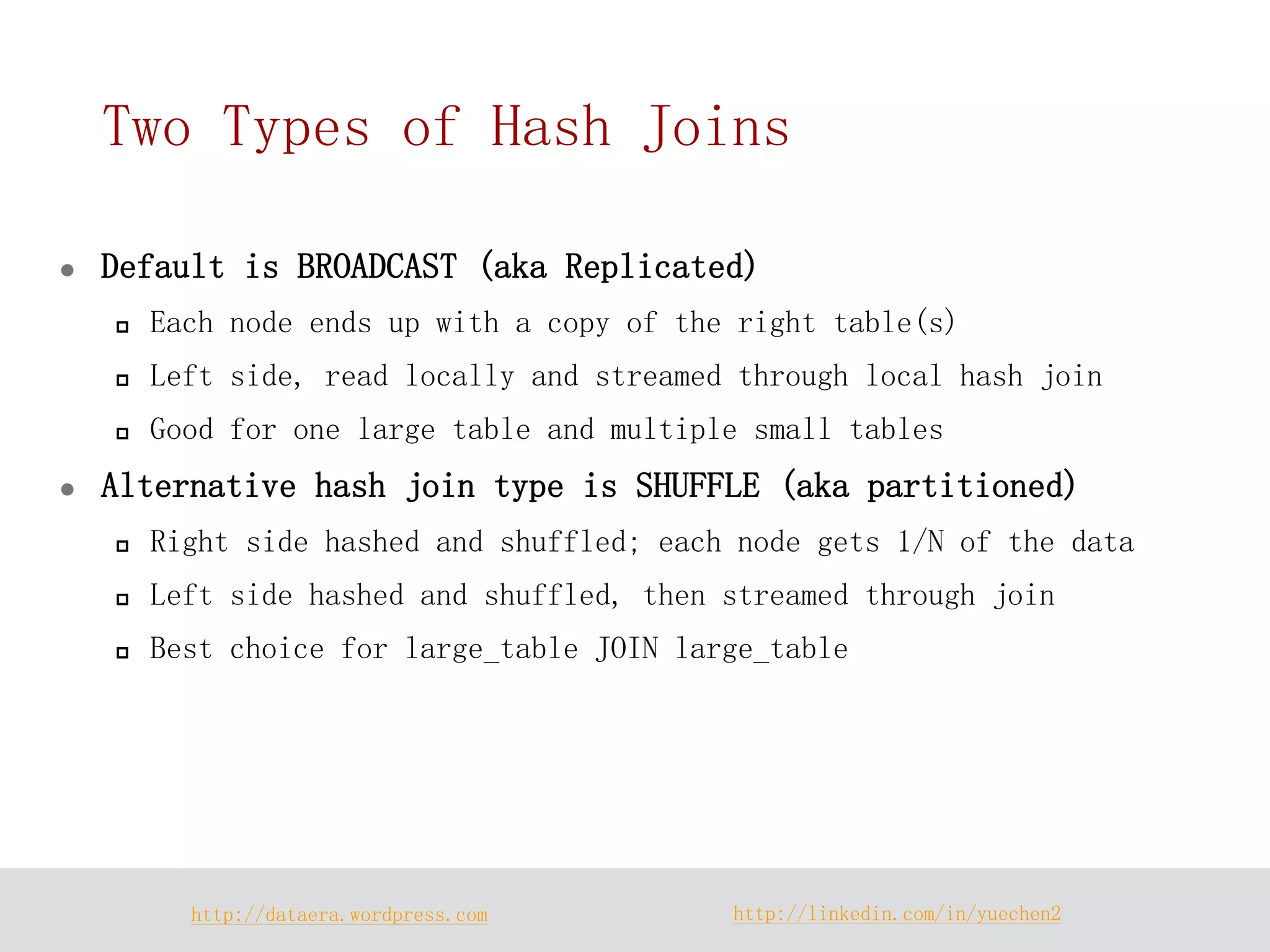
Two Types of Hash Joins 
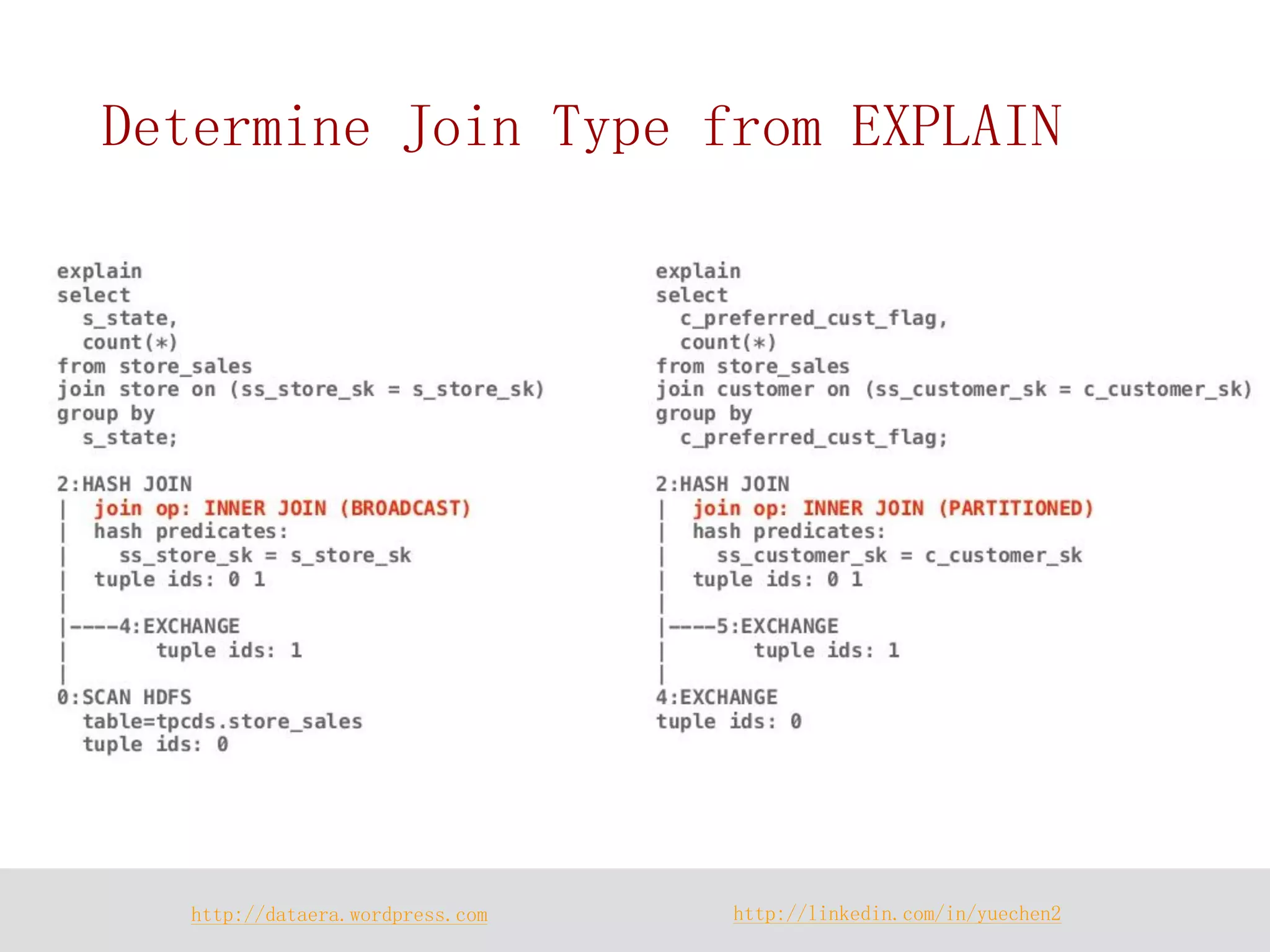
Default is BROADCAST (aka Replicated) 
Each node ends up with a copy of the right table(s) 
Left side, read locally and streamed through local hash join 
Good for one large table and multiple small tables 
Alternative hash join type is SHUFFLE (aka partitioned) 
Right side hashed and shuffled; each node gets 1/N of the data 
Left side hashed and shuffled, then streamed through join 
Best choice for large_table JOIN large_table
http://dataera.wordpress.com 
http://linkedin.com/in/yuechen2 
Join Hint 
select … 
from large_table 
join [broadcast] small_table 
select … 
from large_table 
join [shuffle] large_table
http://dataera.wordpress.com 
http://linkedin.com/in/yuechen2 
Determine Join Type from EXPLAIN
http://dataera.wordpress.com 
http://linkedin.com/in/yuechen2 
Query Planning: Distributed Plans
http://dataera.wordpress.com 
http://linkedin.com/in/yuechen2 
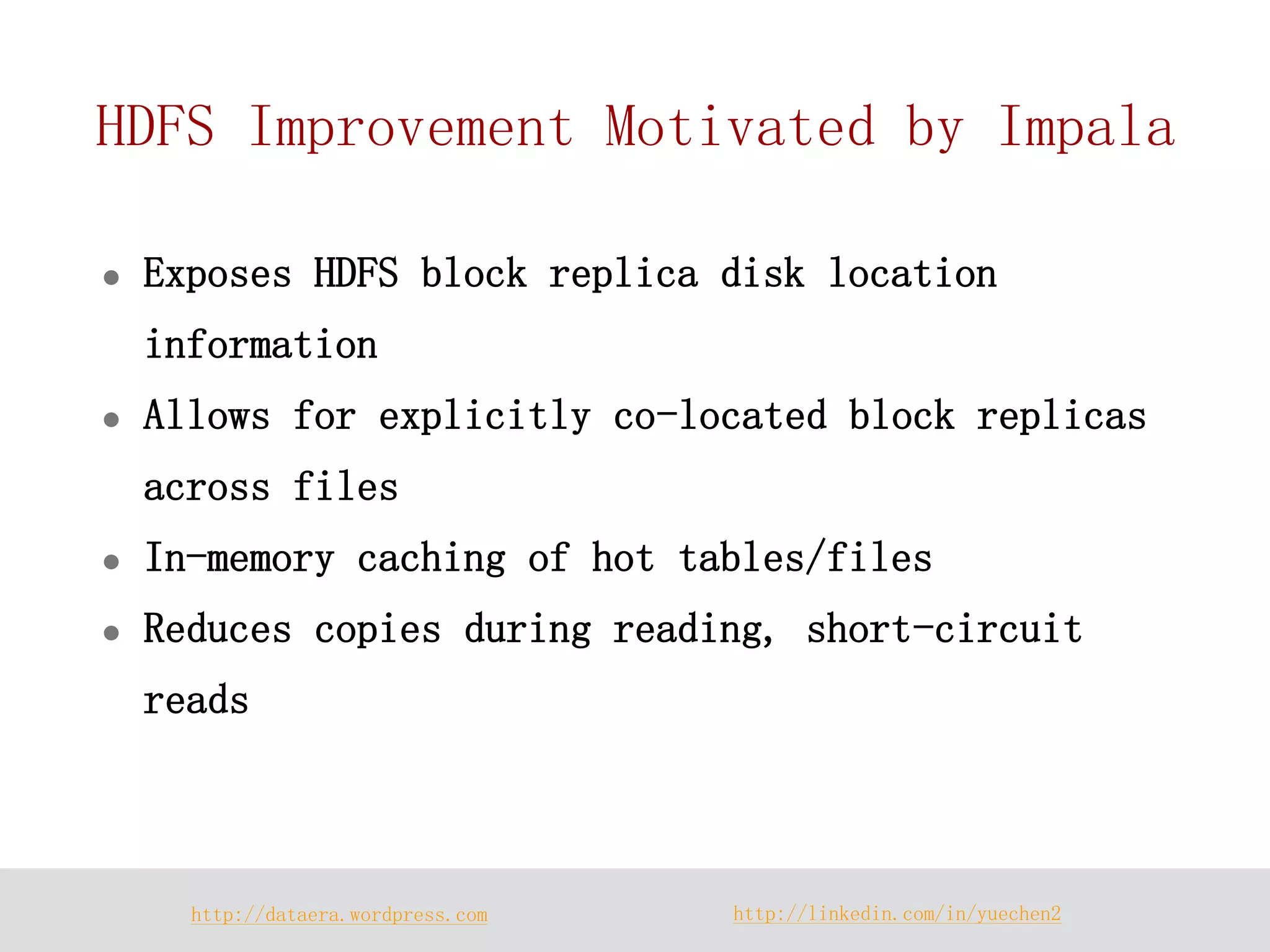
HDFS Improvement Motivated by Impala 
Exposes HDFS block replica disk location information 
Allows for explicitly co-located block replicas across files 
In-memory caching of hot tables/files 
Reduces copies during reading, short-circuit reads
http://dataera.wordpress.com 
http://linkedin.com/in/yuechen2 
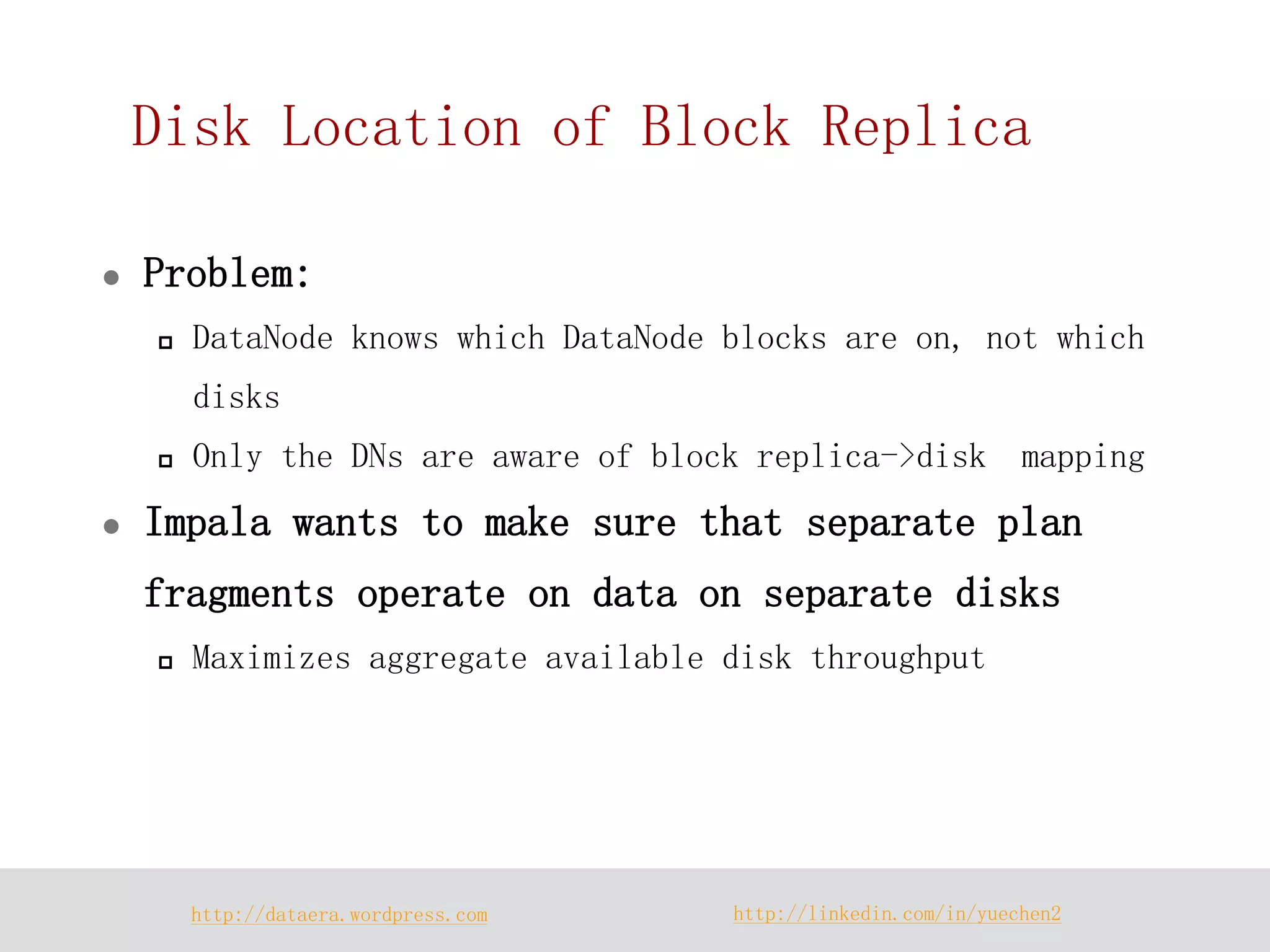
Disk Location of Block Replica 
Problem: 
DataNode knows which DataNode blocks are on, not which disks 
Only the DNs are aware of block replica->disk mapping 
Impala wants to make sure that separate plan fragments operate on data on separate disks 
Maximizes aggregate available disk throughput
http://dataera.wordpress.com 
http://linkedin.com/in/yuechen2 
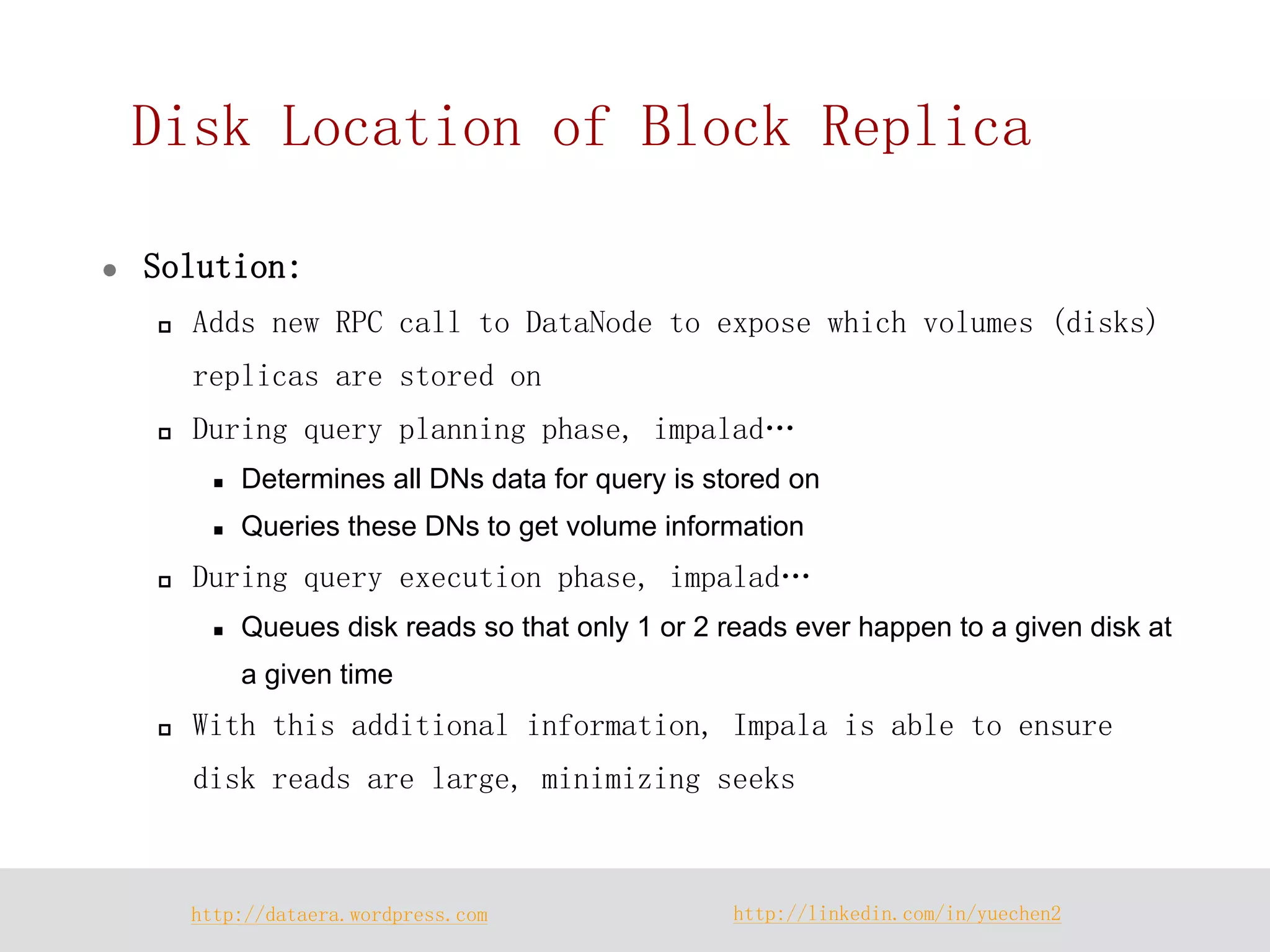
Disk Location of Block Replica 
Solution: 
Adds new RPC call to DataNode to expose which volumes (disks) replicas are stored on 
During query planning phase, impalad… 
Determines all DNs data for query is stored on 
Queries these DNs to get volume information 
During query execution phase, impalad… 
Queues disk reads so that only 1 or 2 reads ever happen to a given disk at a given time 
With this additional information, Impala is able to ensure disk reads are large, minimizing seeks
http://dataera.wordpress.com 
http://linkedin.com/in/yuechen2 
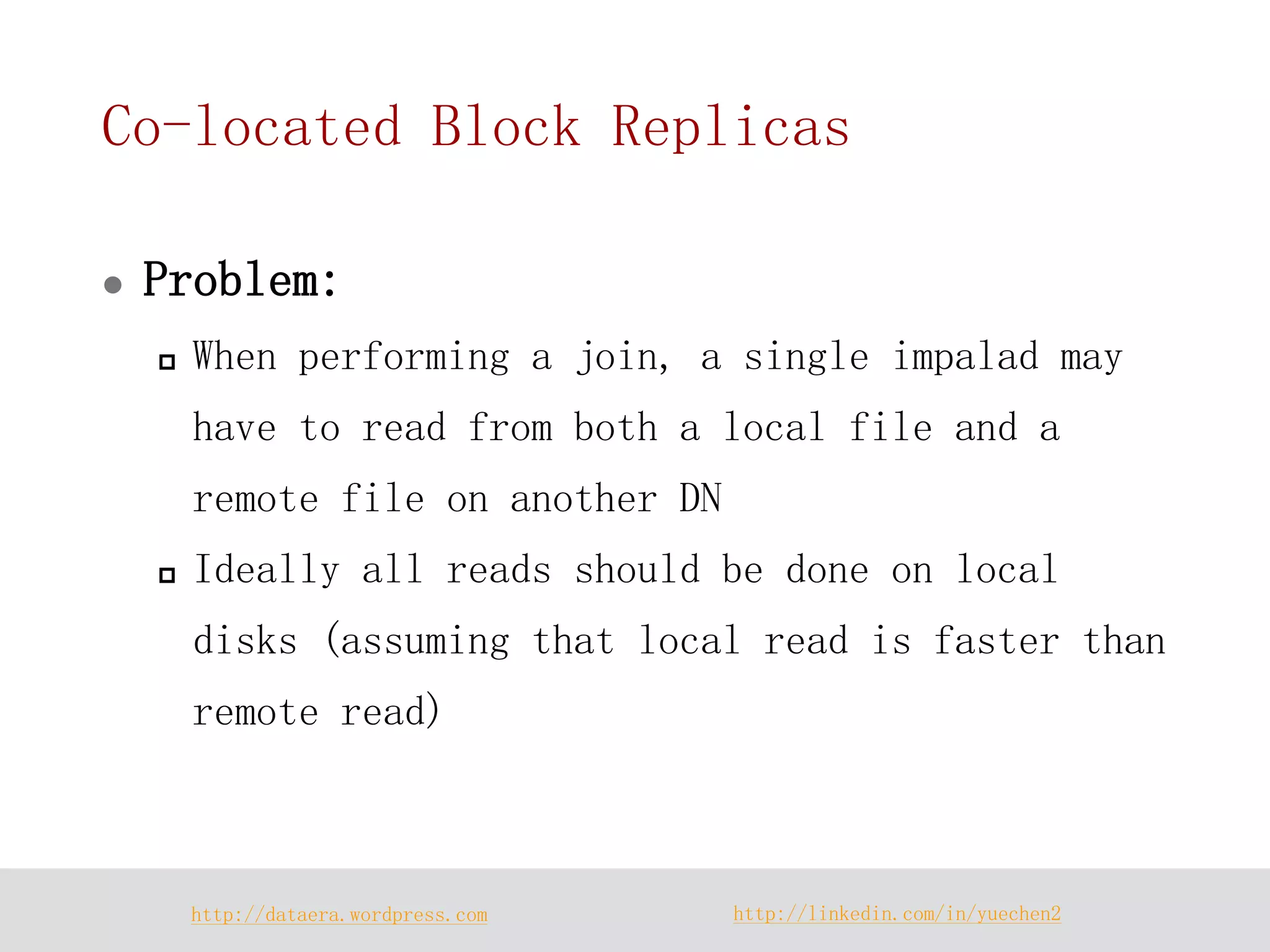
Co-located Block Replicas 
Problem: 
When performing a join, a single impalad may have to read from both a local file and a remote file on another DN 
Ideally all reads should be done on local disks (assuming that local read is faster than remote read)
http://dataera.wordpress.com 
http://linkedin.com/in/yuechen2 
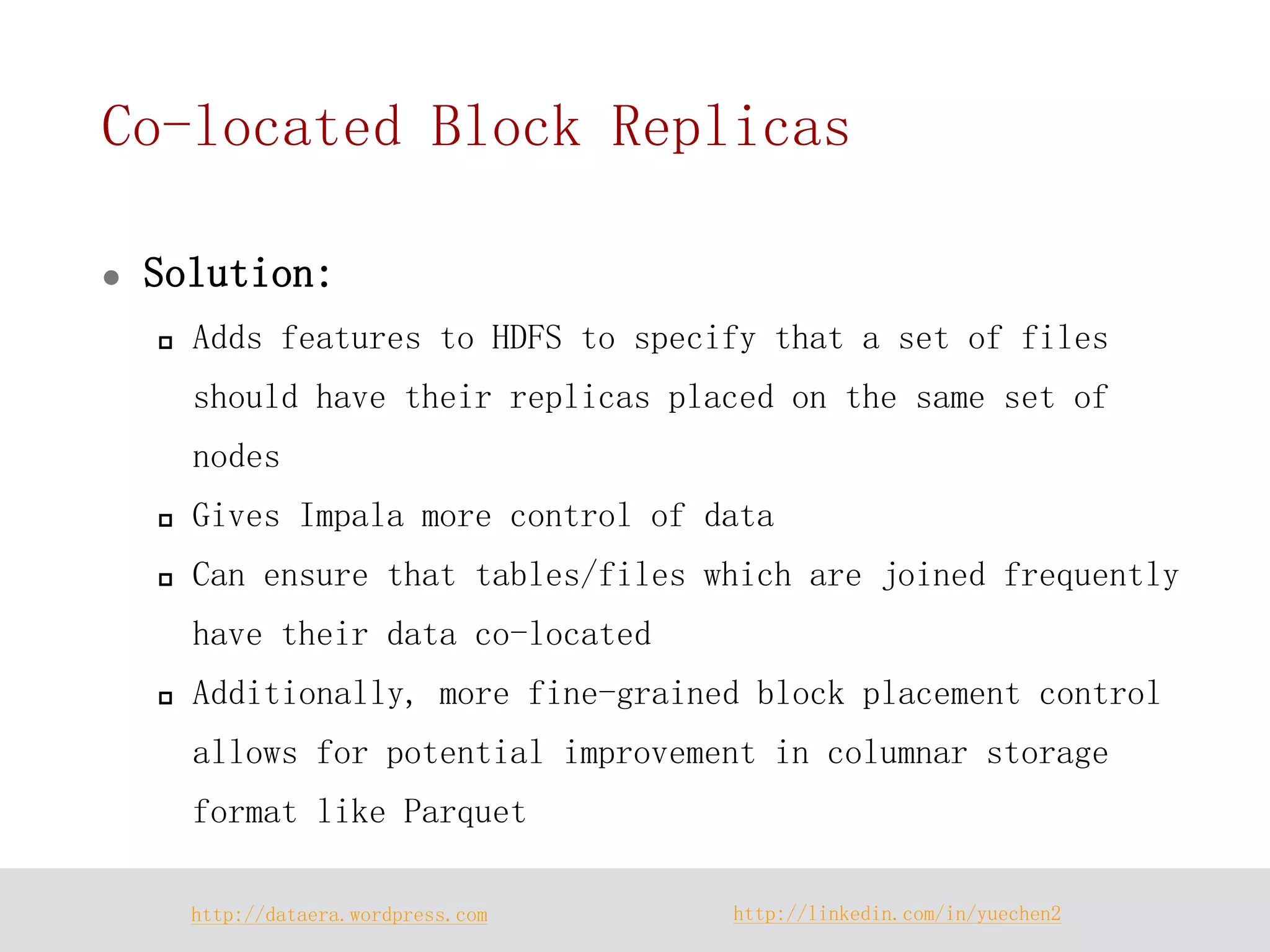
Co-located Block Replicas 
Solution: 
Adds features to HDFS to specify that a set of files should have their replicas placed on the same set of nodes 
Gives Impala more control of data 
Can ensure that tables/files which are joined frequently have their data co-located 
Additionally, more fine-grained block placement control allows for potential improvement in columnar storage format like Parquet
http://dataera.wordpress.com 
http://linkedin.com/in/yuechen2 
In-memory Caching 
Problem: 
Impala queries are IO-bound 
Memory is fast and getting cheaper
http://dataera.wordpress.com 
http://linkedin.com/in/yuechen2 
In-memory Caching 
Solution: 
Adds facility to HDFS to explicitly read specific HDFS files into memory 
Allows Impala to read data at full memory bandwidth speed 
Gives cluster operator control over which files/tables are queried frequently and thus could be kept in memory
http://dataera.wordpress.com 
http://linkedin.com/in/yuechen2 
Short-circuit Reads 
Problem: 
A typical read in HDFS must be read from disk by DataNode, copied into DN memory, sent over network, copied into client buffers.
http://dataera.wordpress.com 
http://linkedin.com/in/yuechen2 
Short-circuit Reads 
Solution: 
Reads are performed directly on local files, using direct buffers 
In HDFS, allow for reads to completely bypass DataNode when client is co-located with block replica files, avoiding overhead of HDFS API 
Reads data directly from disk to client buffers
http://dataera.wordpress.com 
http://linkedin.com/in/yuechen2
http://dataera.wordpress.com 
http://linkedin.com/in/yuechen2 
Code Generation
http://dataera.wordpress.com 
http://linkedin.com/in/yuechen2 
Why Code Generation?
http://dataera.wordpress.com 
http://linkedin.com/in/yuechen2 
Why Code Generation? 
SPEED!
http://dataera.wordpress.com 
http://linkedin.com/in/yuechen2 
Why Code Generation? 
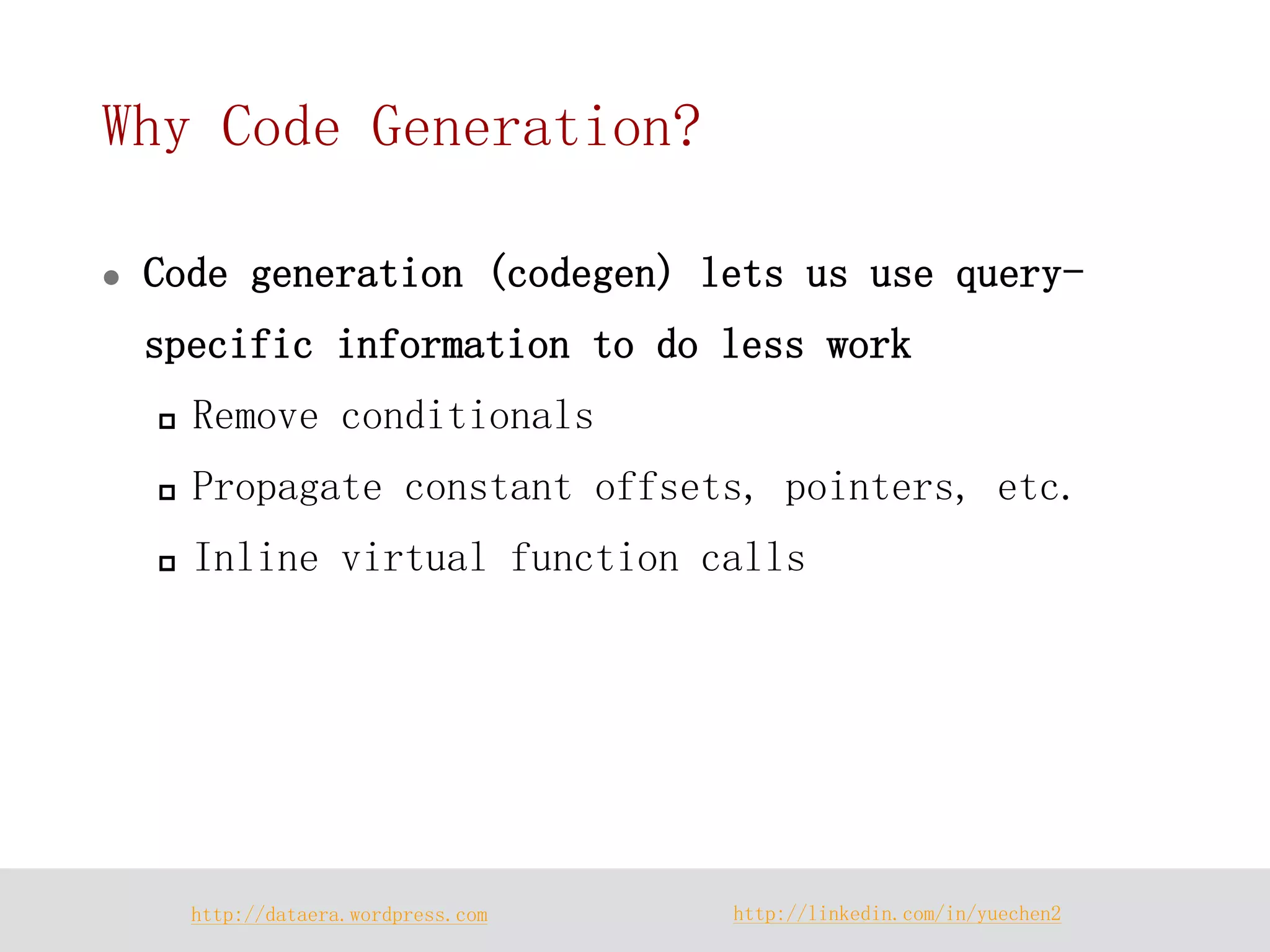
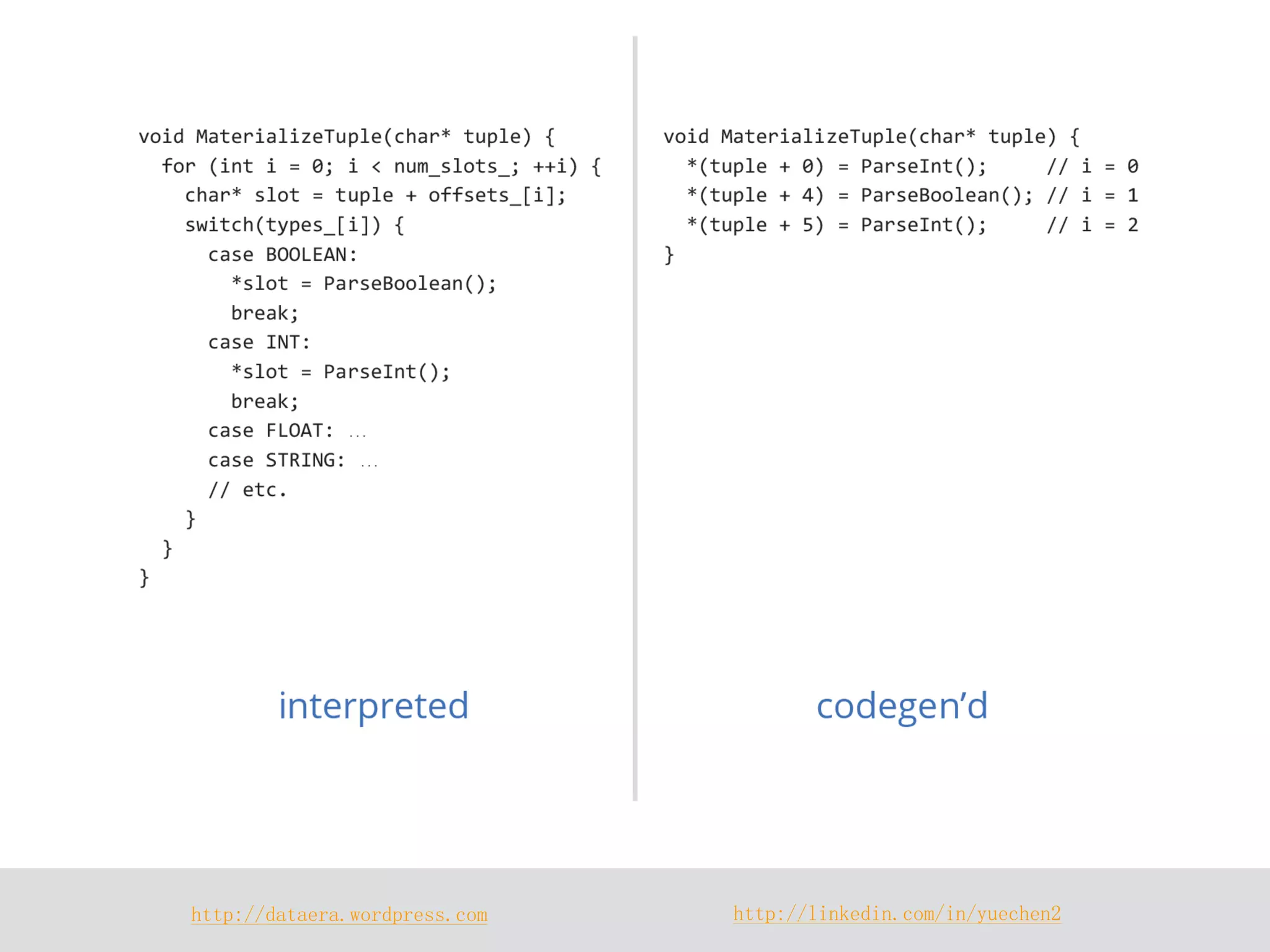
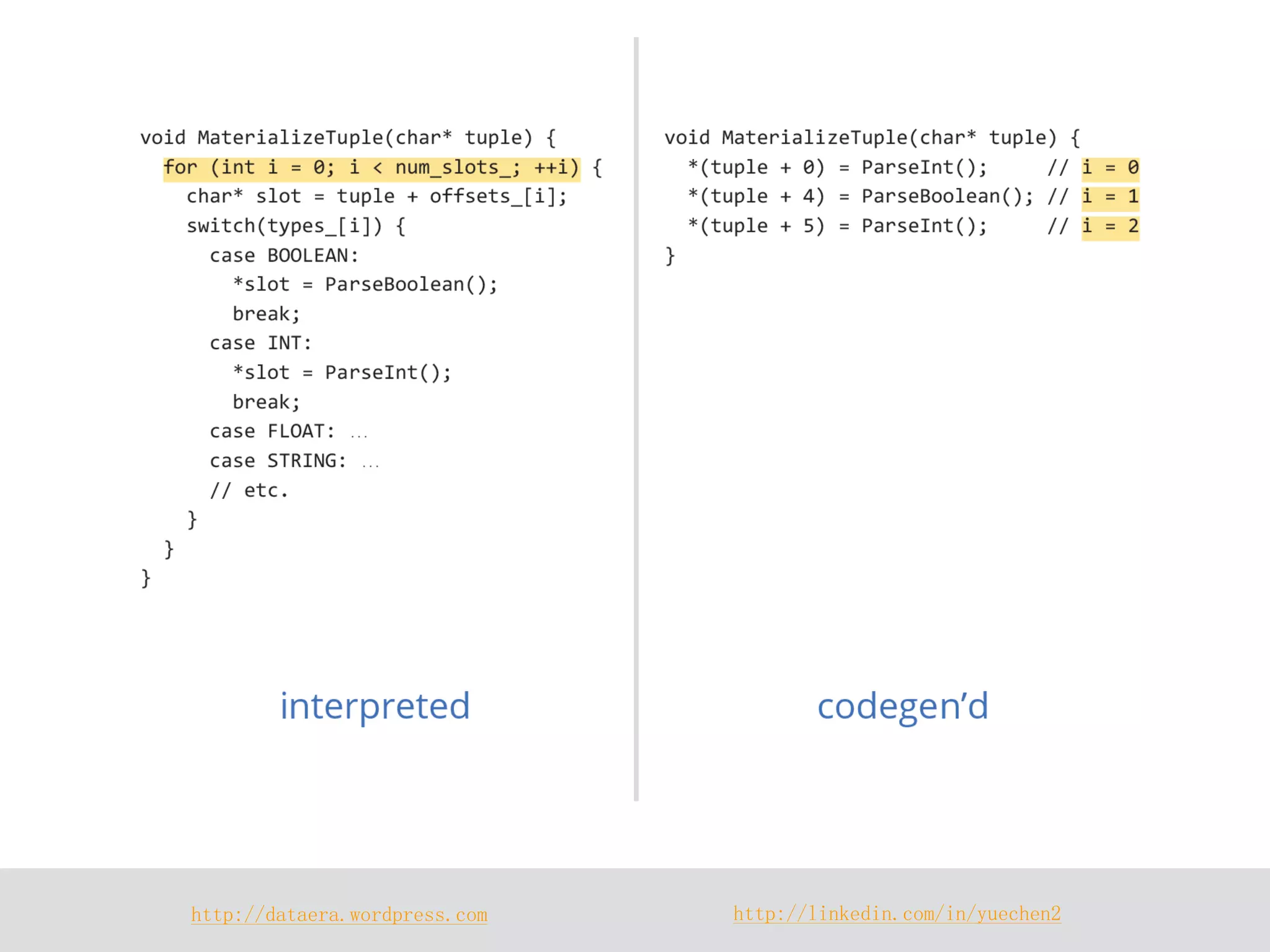
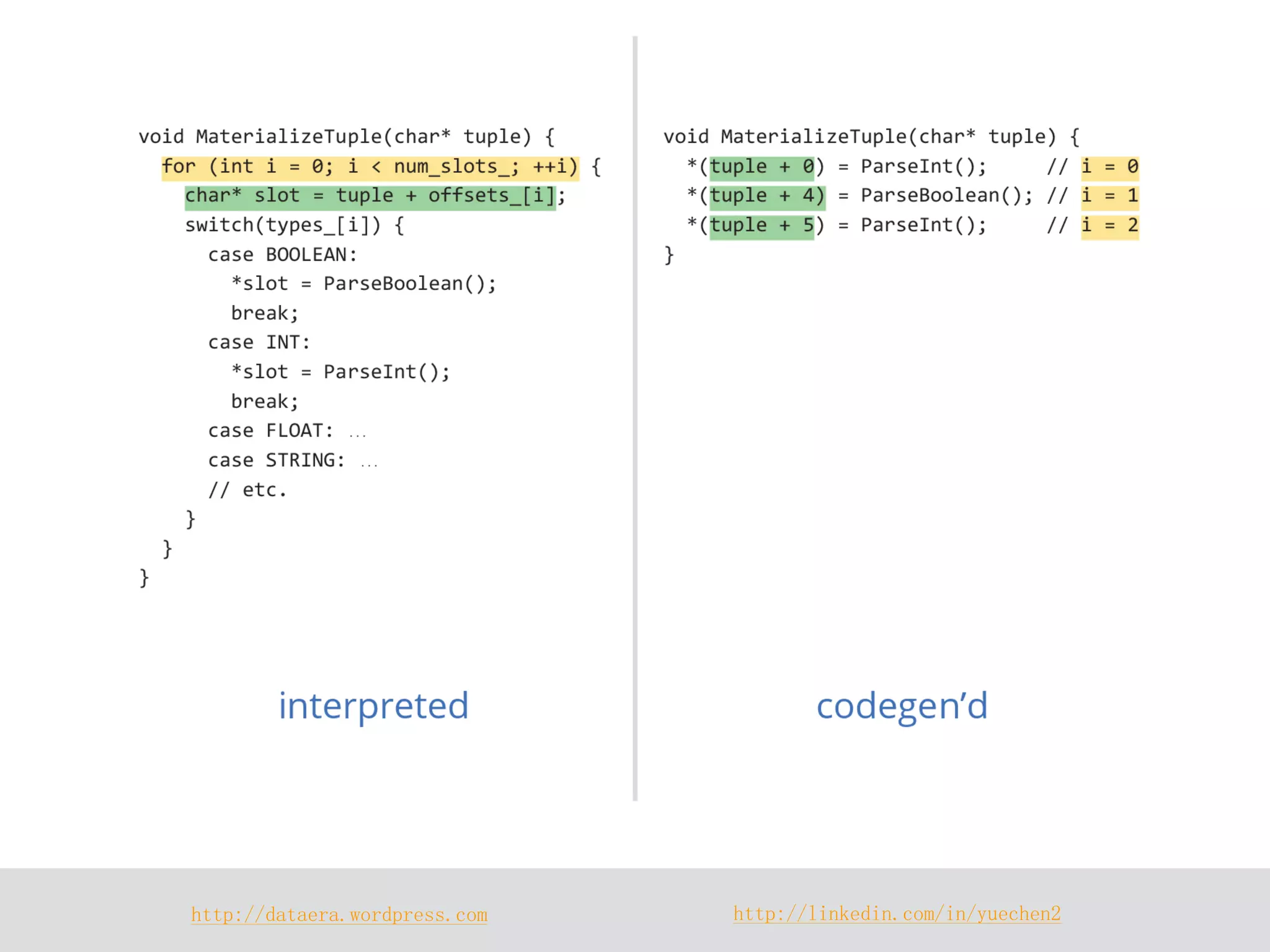
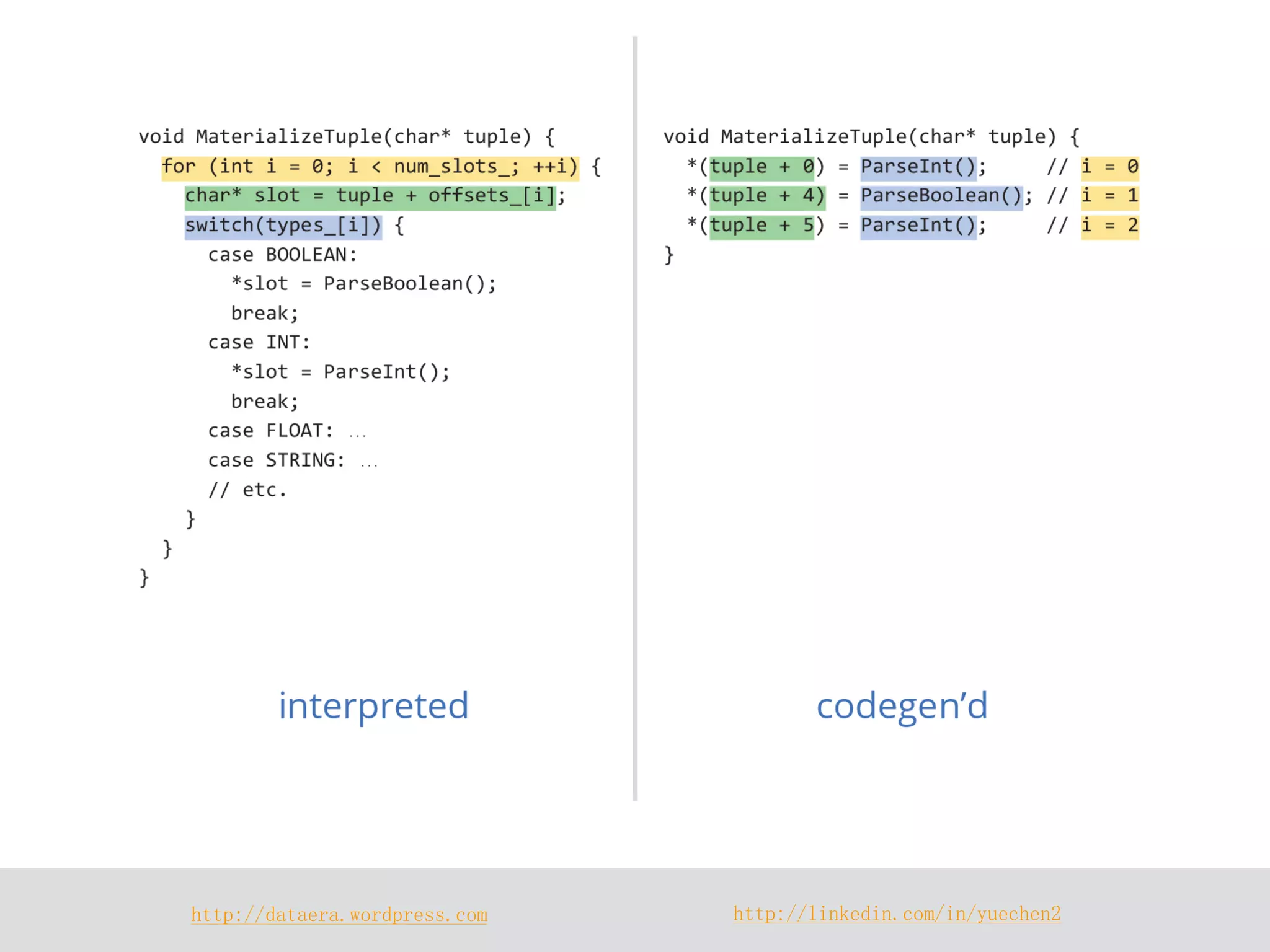
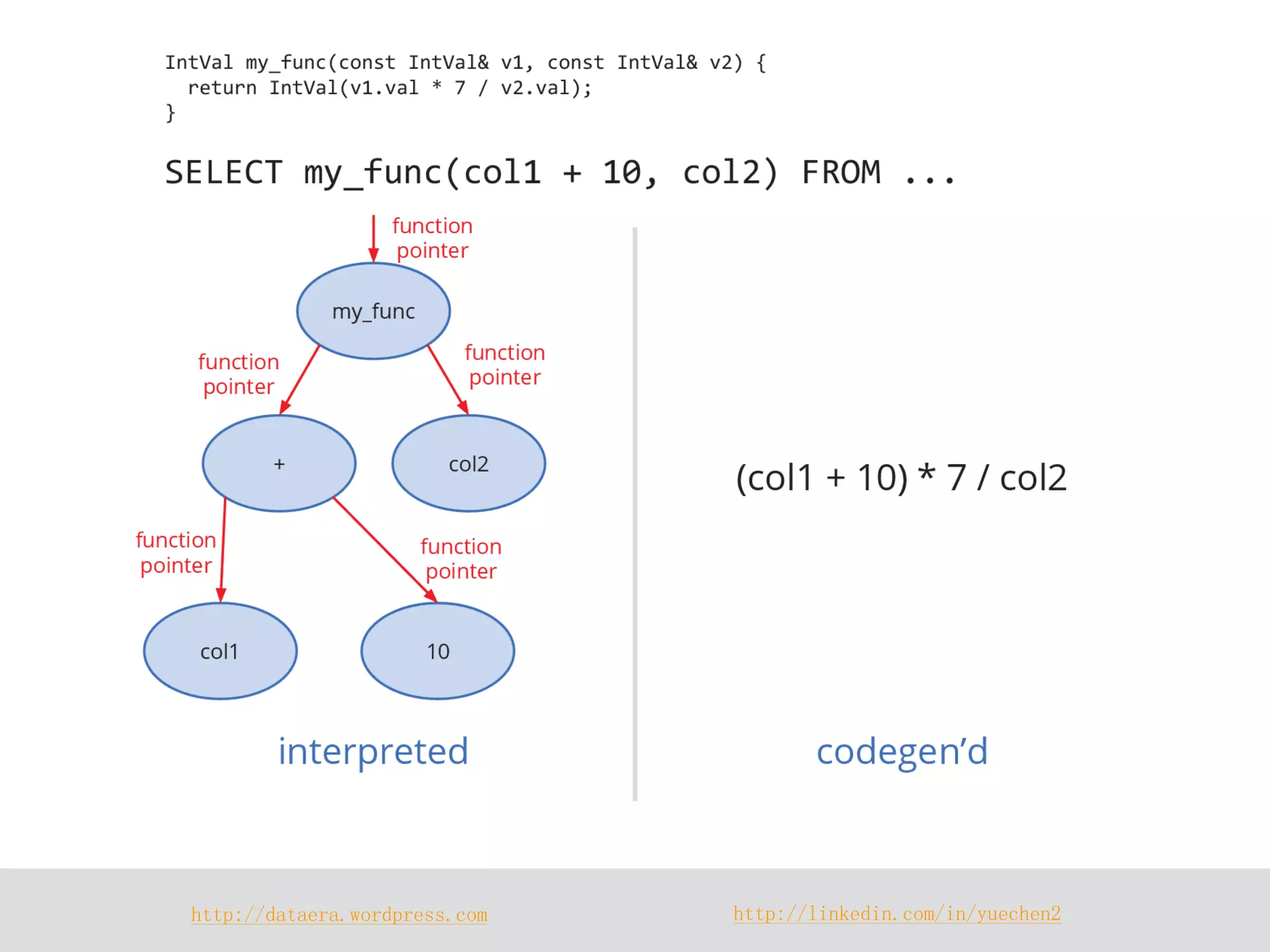
Code generation (codegen) lets us use query- specific information to do less work 
Remove conditionals 
Propagate constant offsets, pointers, etc. 
Inline virtual function calls
http://dataera.wordpress.com 
http://linkedin.com/in/yuechen2
http://dataera.wordpress.com 
http://linkedin.com/in/yuechen2
http://dataera.wordpress.com 
http://linkedin.com/in/yuechen2
http://dataera.wordpress.com 
http://linkedin.com/in/yuechen2
http://dataera.wordpress.com 
http://linkedin.com/in/yuechen2 
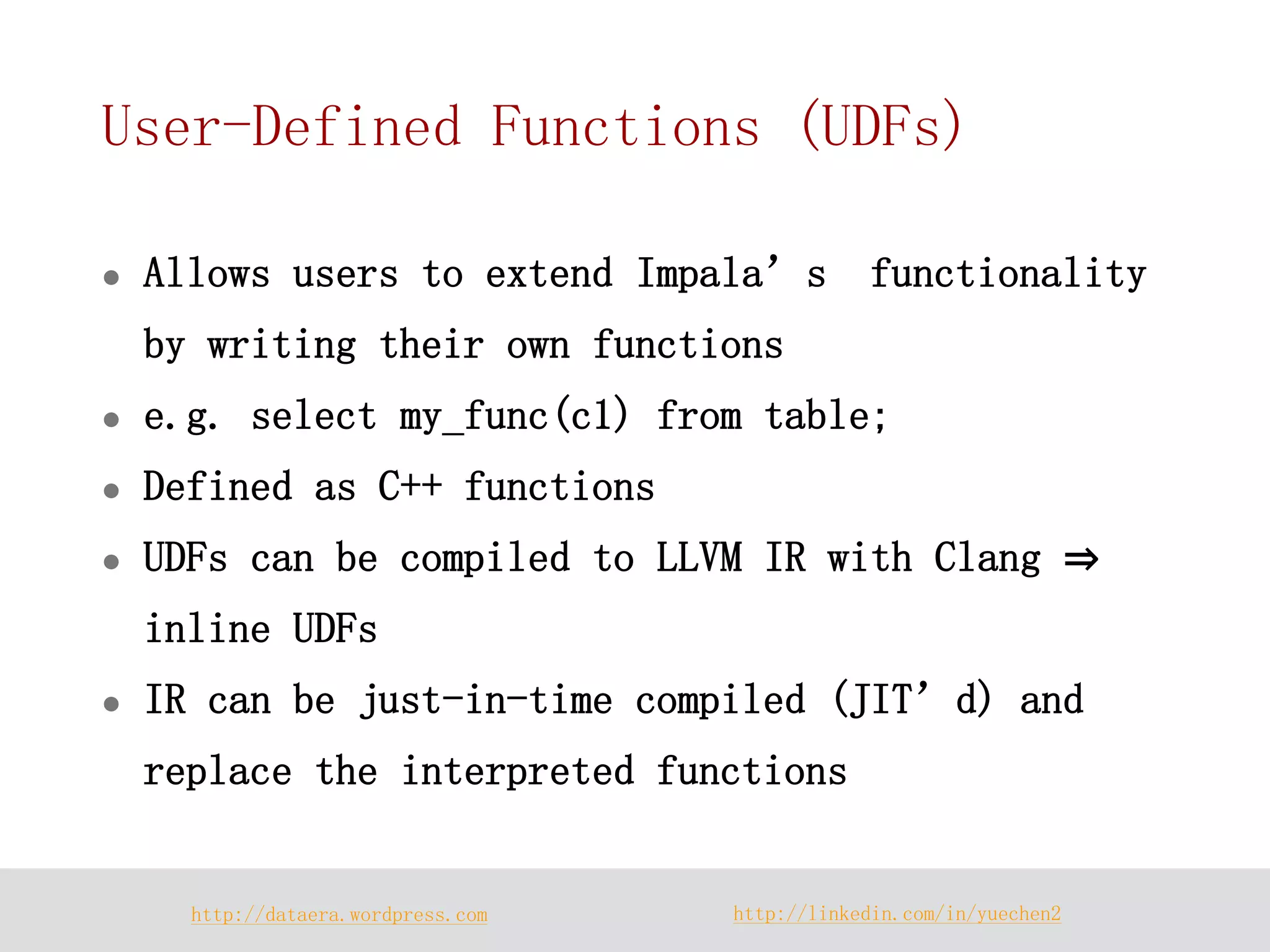
User-Defined Functions (UDFs) 
Allows users to extend Impala’s functionality by writing their own functions 
e.g. select my_func(c1) from table; 
Defined as C++ functions 
UDFs can be compiled to LLVM IR with Clang ⇒ inline UDFs 
IR can be just-in-time compiled (JIT’d) and replace the interpreted functions
http://dataera.wordpress.com 
http://linkedin.com/in/yuechen2
http://dataera.wordpress.com 
http://linkedin.com/in/yuechen2 
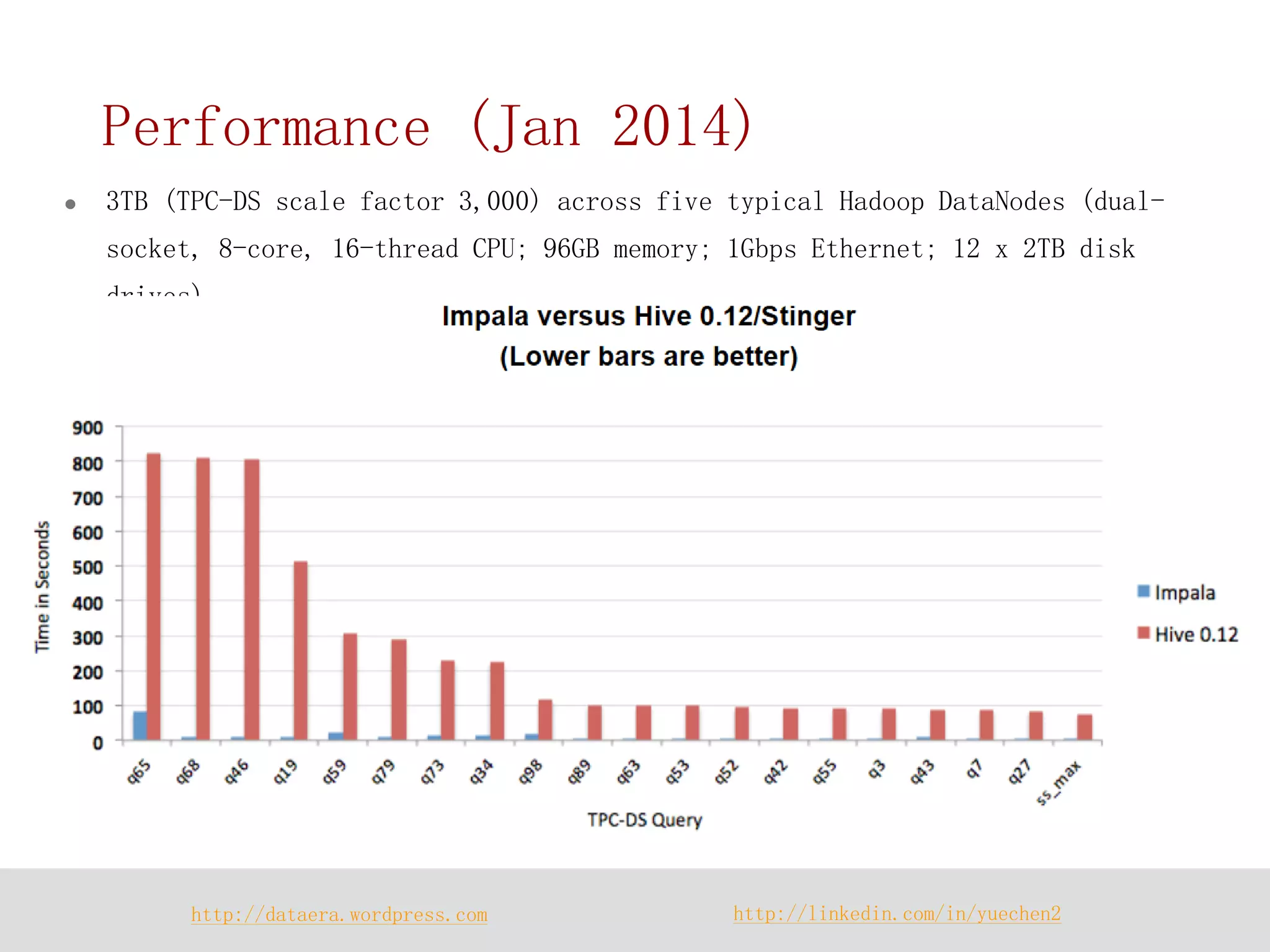
Performance (Jan 2014) 
3TB (TPC-DS scale factor 3,000) across five typical Hadoop DataNodes (dual- socket, 8-core, 16-thread CPU; 96GB memory; 1Gbps Ethernet; 12 x 2TB disk drives).
http://dataera.wordpress.com 
http://linkedin.com/in/yuechen2 
Performance (Jan 2014) 
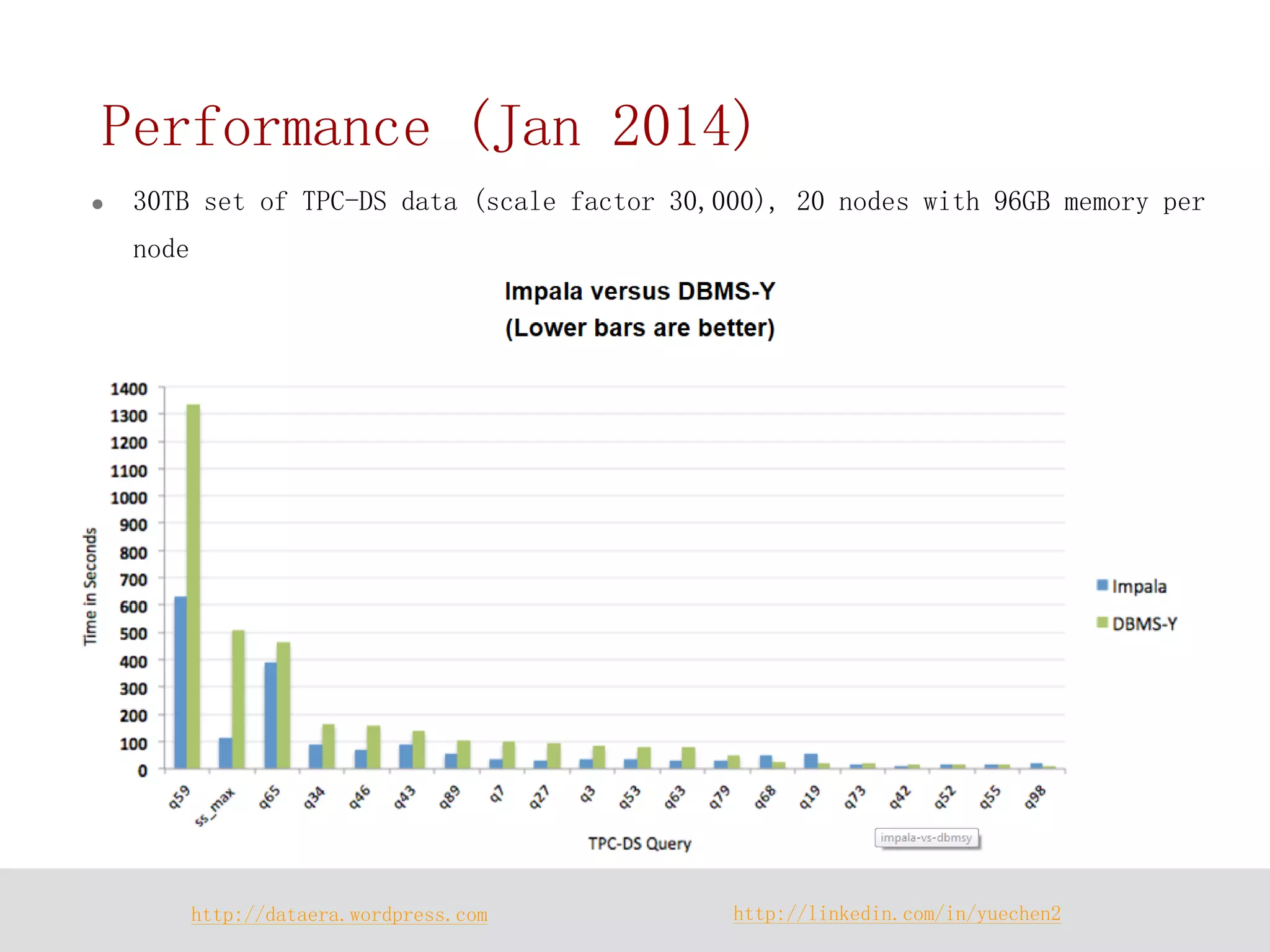
30TB set of TPC-DS data (scale factor 30,000), 20 nodes with 96GB memory per node
http://dataera.wordpress.com 
http://linkedin.com/in/yuechen2 
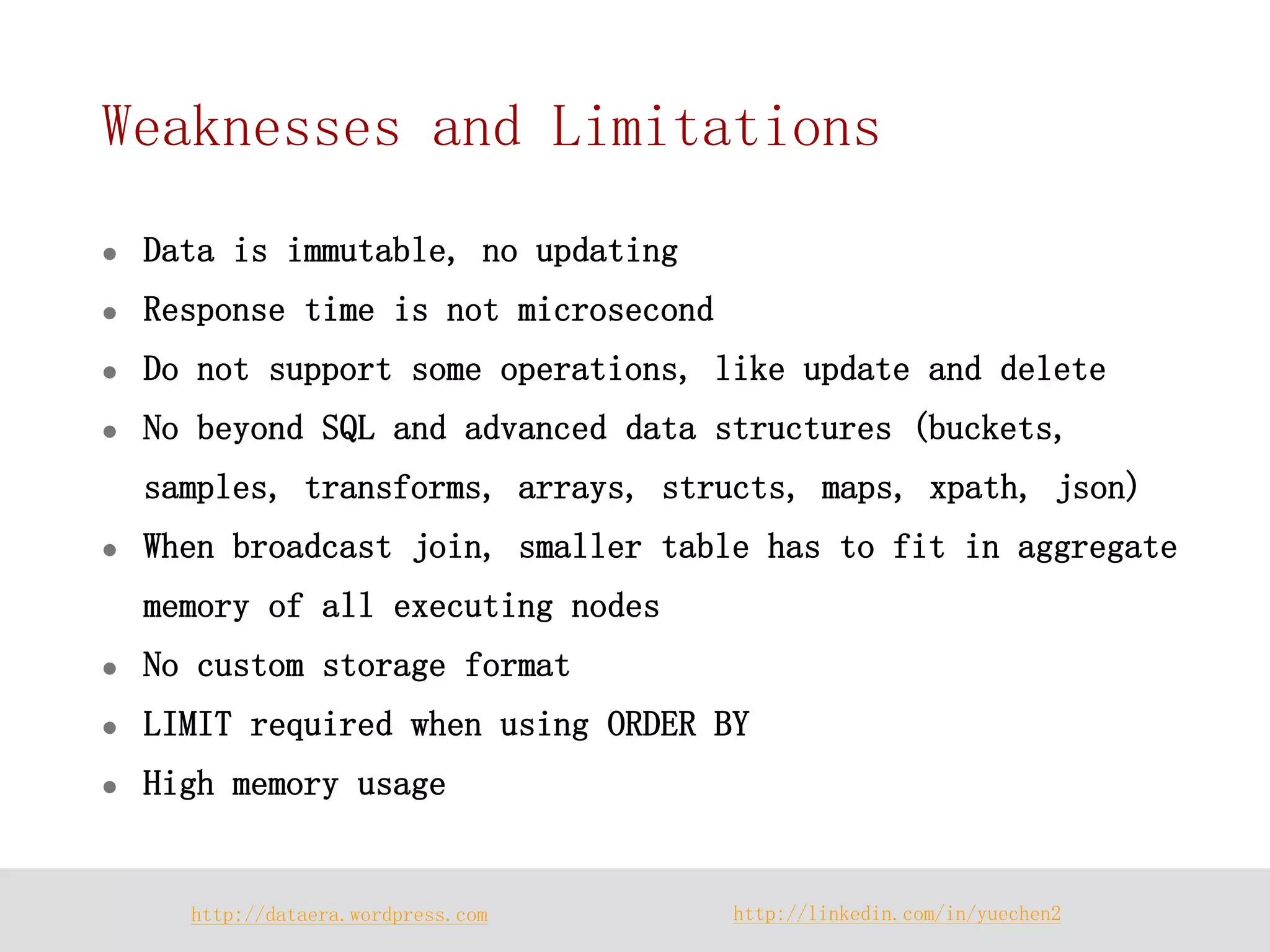
Weaknesses and Limitations 
Data is immutable, no updating 
Response time is not microsecond 
Do not support some operations, like update and delete 
No beyond SQL and advanced data structures (buckets, samples, transforms, arrays, structs, maps, xpath, json) 
When broadcast join, smaller table has to fit in aggregate memory of all executing nodes 
No custom storage format 
LIMIT required when using ORDER BY 
High memory usage
http://dataera.wordpress.com 
http://linkedin.com/in/yuechen2 
References 
Cloudera Impala official documentation and slides

How Impala Works