Secure In-Cache Execution
Yue Chen, Mustakimur Khandaker, Zhi Wang
Florida State University
20th International Symposium on Research in Attacks, Intrusions and Defenses (RAID 2017)
Cold Boot Attack
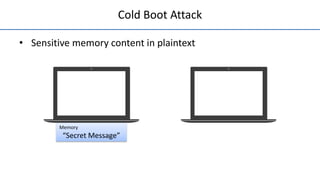
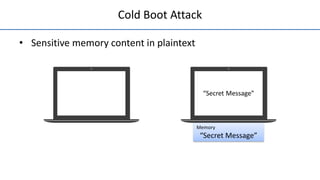
• Dump memory by freezing and transplanting​
• Steal sensitive information
Cold Boot Attack
• Sensitive memory content in plaintext
Memory
“Secret Message”
Cold Boot Attack
• Sensitive memory content in plaintext
Memory
“Secret Message”
“Secret Message”
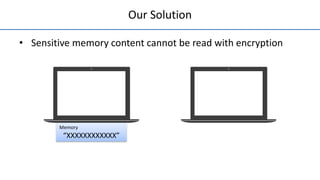
Our Solution
• Sensitive memory content cannot be read with encryption
Memory
“XXXXXXXXXXXX”
Our Solution
• Sensitive memory content cannot be read with encryption
Memory
“XXXXXXXXXXXX”
? ? ?
EncExec: Design Goals
• Data secrecy
– Plaintext view only in cache; key protected as well
• Performance isolation
– Performance impact isolated from other processes
• Application transparency
– User program unmodified to run under EncExec
Threat Model
• Able to perform cold boot attacks
• No malware installed (e.g., kernel rootkit)
• Typical use scenario:
– Laptops lost in public places, even protected by encrypted hard disks
and screen locks
Design Overview
• Data in memory always encrypted; decrypted into the L3 cache only when
accessed
• Use reserved cache as a window over protected data
– Use L3 (instead of L1 or L2) cache to minimize performance impact
Design Overview
• Decrypted data will never be evicted to memory (no cache conflict)
– Extend kernel’s virtual memory management to strictly control access
– Only data in the window are mapped in the address space
– If more data than window size -> page replacement
Design Overview
Two modes:
1. Given a block of secure memory for storing critical data
– Need to (slightly) modify the program
2. Use reserved cache to protect all the data of the process
– Use the reserved cache as a moving window
Design: Key Techniques
• Spatial cache reservation
– Reserves a small part of the L3 cache for its use
• Secure in-cache execution
– Data encrypted in memory, plaintext view only in cache
CPU Cache
Intel Core i7 4790 cache architecture
CPU Cache
2-way set-associative cache, 8 cache lines in 4 sets. Each cache line has 16 bytes.
Challenges: Spatial Cache Reservation
• Fine-grained cache control
– x86 transparently manages cache assignment and replacement
• Countermeasures:
– Rule 1
• Protected data are only cached by the reserved cache
• No other memory is cached by the reserved cache
– Rule 2:
• Accessible (decrypted) protected data is less than the reserved cache size
– Thus, reserved cache content will not be evicted
Design: Spatial Cache Reservation
• Use page table to control reserved memory usage
• Page table can only map page-sized and page-aligned memory
• Reserve at least a whole page on the L3 cache
• Reserve a smallest page of the cache (4KB)
– How much space in total we need to reserve?
Design: Spatial Cache Reservation
0400 08 0C 10 14 18 1C 20 24 28 2C 30 34 38 3C
*4*0 *8 *C
40 44 48 4C
Cache
Memory
*0 *4 *8 *C
Set 0 Set 1 Set 3Set 2
Design: Spatial Cache Reservation
0400 08 0C 10 14 18 1C 20 24 28 2C 30 34 38 3C
*4*0 *8 *C
40 44 48 4C
Cache
Memory
*0 *4 *8 *C
Set 0 Set 1 Set 3Set 2
: Needs to be reserved
Design: Spatial Cache Reservation
0400 08 0C 10 14 18 1C 20 24 28 2C 30 34 38 3C
*4*0 *8 *C
40 44 48 4C
Cache
Memory
*0 *4 *8 *C
Set 0 Set 1 Set 3Set 2
: Needs to be reserved
Design: Spatial Cache Reservation
0400 08 0C 10 14 18 1C 20 24 28 2C 30 34 38 3C
*4*0 *8 *C
40 44 48 4C
Cache
Memory
*0 *4 *8 *C
Set 0 Set 1 Set 3Set 2
: Needs to be reserved
Example: Spatial Cache Reservation
• Intel Core-i7 4790 L3 cache
– 16-way set-associative; physically indexed and physically tagged
– Cache line size: 64 bytes = 26 bytes (offset field: 6 bits)
– Cache size: 8 MB
• Set number: 8M/(64*16) = 8192 = 213 (set field: 13 bits)
• If machine has 16GB (234) of physical memory, tag field has
15 bits (34 – 6 - 13 = 15).
Example: Spatial Cache Reservation
• Reserve one page (4KB)
• 64 cache lines in one page
– Page_size/cache_line_size = 4K/64 = 64
• Need to reserve 64 cache sets
– All the cache lines in the same set reserved together (16-way)
• Reserve 64KB cache in total
– 64 (set number) * 16 (associativity ways) * 64B (cache line size) = 64KB
Example: Spatial Cache Reservation
• Reserve 1/128 of the physical memory
– 64 (reserved sets) / 8192 (total) = 1/128
• Reserve one physical page for every 128 pages
• If RAM is 16GB, the total reserved memory is:
– 16GB * 1/128 = 128MB
• Ensure no cache eviction:
– Can use 64KB (16 pages) at a time of the 128MB
– Name these 16 pages as plaintext pages
– Protected data can be larger than 64KB as we use demand paging
Design: Secure In-Cache Execution
Desynchronize memory (encrypted) and cache (plaintext)
• Cache in write-back mode
– Guaranteed by hardware and existing kernels (in most OS’es)
• L3 cache is inclusive of L1 and L2 caches
– Guaranteed by hardware and existing kernels
• No conflict in the reserved cache
– No more protected data at a time than the reserved cache size
Design: Secure In-Cache Execution
More data to protect?
• Demand paging
– Access unmapped data -> page fault
– Allocate a plaintext page (for securing data)
– If no page available, select one for replacement
• Encrypt the plaintext page, copy it back
• Decrypt faulting page into plaintext, update page table if necessary
Design: Secure In-Cache Execution
• Dedicate one plaintext page to store keys and sub-keys
– Cannot be evicted or replaced
• Frequent protected data encryption/decryption
– Use CPU built-in support to speed up cryptographic algorithms
Implementation: Spatial Cache Reservation
• Reserve physical pages in the booting process
– Modify allocators to skip reserved pages
• Make sure no reserved pages exist in page table
• Hook run-time page allocator and kernel’s whole-cache
flushing function
Implementation: Secure In-Cache Execution
• pmap is used to unmap a page
– Consist of architecture-specific data and functions to manage the
process’ page table
– Maintain a reverse mapping for physical pages
– Track page usage information for page replacement
• Remove shared protected pages from other processes
Performance Evaluation
• Use the hardware-accelerated AES (AES-NI) to encrypt and
decrypt data
• About 3μs on average to encrypt/decrypt 4KB data using 128-
bit AES algorithm
– 6μs to replace an existing page
Performance Evaluation
Overhead of common cryptographic algorithms
Mode 1: Choose data to encrypt
Mode 2: Encrypt all the data
Test with 15 or 31 plaintext pages
Performance Evaluation
Overhead of RSA and DH handshakes
Mode 1: Choose data to encrypt
Mode 2: Encrypt all the data
Test with 15 or 31 plaintext pages
Performance Evaluation
Performance of Bonnie while concurrently running the
mbed TLS benchmark. The unit on the Y-axis is MB/sec
or thousand_seeks/sec (for RandomSeeks only).
Secure In-Cache Execution
www.YueChen.me
Q & A
Backup Slides
Compared to Intel SGX
• SGX is great!
• EncExec
– Works on old CPUs
– No time-consuming context switch
– Supports unmodified programs

EncExec: Secure In-Cache Execution

  • 1.
    Secure In-Cache Execution YueChen, Mustakimur Khandaker, Zhi Wang Florida State University 20th International Symposium on Research in Attacks, Intrusions and Defenses (RAID 2017)
  • 2.
    Cold Boot Attack •Dump memory by freezing and transplanting​ • Steal sensitive information
  • 3.
    Cold Boot Attack •Sensitive memory content in plaintext Memory “Secret Message”
  • 4.
    Cold Boot Attack •Sensitive memory content in plaintext Memory “Secret Message” “Secret Message”
  • 5.
    Our Solution • Sensitivememory content cannot be read with encryption Memory “XXXXXXXXXXXX”
  • 6.
    Our Solution • Sensitivememory content cannot be read with encryption Memory “XXXXXXXXXXXX” ? ? ?
  • 7.
    EncExec: Design Goals •Data secrecy – Plaintext view only in cache; key protected as well • Performance isolation – Performance impact isolated from other processes • Application transparency – User program unmodified to run under EncExec
  • 8.
    Threat Model • Ableto perform cold boot attacks • No malware installed (e.g., kernel rootkit) • Typical use scenario: – Laptops lost in public places, even protected by encrypted hard disks and screen locks
  • 9.
    Design Overview • Datain memory always encrypted; decrypted into the L3 cache only when accessed • Use reserved cache as a window over protected data – Use L3 (instead of L1 or L2) cache to minimize performance impact
  • 10.
    Design Overview • Decrypteddata will never be evicted to memory (no cache conflict) – Extend kernel’s virtual memory management to strictly control access – Only data in the window are mapped in the address space – If more data than window size -> page replacement
  • 11.
    Design Overview Two modes: 1.Given a block of secure memory for storing critical data – Need to (slightly) modify the program 2. Use reserved cache to protect all the data of the process – Use the reserved cache as a moving window
  • 12.
    Design: Key Techniques •Spatial cache reservation – Reserves a small part of the L3 cache for its use • Secure in-cache execution – Data encrypted in memory, plaintext view only in cache
  • 13.
    CPU Cache Intel Corei7 4790 cache architecture
  • 14.
    CPU Cache 2-way set-associativecache, 8 cache lines in 4 sets. Each cache line has 16 bytes.
  • 15.
    Challenges: Spatial CacheReservation • Fine-grained cache control – x86 transparently manages cache assignment and replacement • Countermeasures: – Rule 1 • Protected data are only cached by the reserved cache • No other memory is cached by the reserved cache – Rule 2: • Accessible (decrypted) protected data is less than the reserved cache size – Thus, reserved cache content will not be evicted
  • 16.
    Design: Spatial CacheReservation • Use page table to control reserved memory usage • Page table can only map page-sized and page-aligned memory • Reserve at least a whole page on the L3 cache • Reserve a smallest page of the cache (4KB) – How much space in total we need to reserve?
  • 17.
    Design: Spatial CacheReservation 0400 08 0C 10 14 18 1C 20 24 28 2C 30 34 38 3C *4*0 *8 *C 40 44 48 4C Cache Memory *0 *4 *8 *C Set 0 Set 1 Set 3Set 2
  • 18.
    Design: Spatial CacheReservation 0400 08 0C 10 14 18 1C 20 24 28 2C 30 34 38 3C *4*0 *8 *C 40 44 48 4C Cache Memory *0 *4 *8 *C Set 0 Set 1 Set 3Set 2 : Needs to be reserved
  • 19.
    Design: Spatial CacheReservation 0400 08 0C 10 14 18 1C 20 24 28 2C 30 34 38 3C *4*0 *8 *C 40 44 48 4C Cache Memory *0 *4 *8 *C Set 0 Set 1 Set 3Set 2 : Needs to be reserved
  • 20.
    Design: Spatial CacheReservation 0400 08 0C 10 14 18 1C 20 24 28 2C 30 34 38 3C *4*0 *8 *C 40 44 48 4C Cache Memory *0 *4 *8 *C Set 0 Set 1 Set 3Set 2 : Needs to be reserved
  • 21.
    Example: Spatial CacheReservation • Intel Core-i7 4790 L3 cache – 16-way set-associative; physically indexed and physically tagged – Cache line size: 64 bytes = 26 bytes (offset field: 6 bits) – Cache size: 8 MB • Set number: 8M/(64*16) = 8192 = 213 (set field: 13 bits) • If machine has 16GB (234) of physical memory, tag field has 15 bits (34 – 6 - 13 = 15).
  • 22.
    Example: Spatial CacheReservation • Reserve one page (4KB) • 64 cache lines in one page – Page_size/cache_line_size = 4K/64 = 64 • Need to reserve 64 cache sets – All the cache lines in the same set reserved together (16-way) • Reserve 64KB cache in total – 64 (set number) * 16 (associativity ways) * 64B (cache line size) = 64KB
  • 23.
    Example: Spatial CacheReservation • Reserve 1/128 of the physical memory – 64 (reserved sets) / 8192 (total) = 1/128 • Reserve one physical page for every 128 pages • If RAM is 16GB, the total reserved memory is: – 16GB * 1/128 = 128MB • Ensure no cache eviction: – Can use 64KB (16 pages) at a time of the 128MB – Name these 16 pages as plaintext pages – Protected data can be larger than 64KB as we use demand paging
  • 24.
    Design: Secure In-CacheExecution Desynchronize memory (encrypted) and cache (plaintext) • Cache in write-back mode – Guaranteed by hardware and existing kernels (in most OS’es) • L3 cache is inclusive of L1 and L2 caches – Guaranteed by hardware and existing kernels • No conflict in the reserved cache – No more protected data at a time than the reserved cache size
  • 25.
    Design: Secure In-CacheExecution More data to protect? • Demand paging – Access unmapped data -> page fault – Allocate a plaintext page (for securing data) – If no page available, select one for replacement • Encrypt the plaintext page, copy it back • Decrypt faulting page into plaintext, update page table if necessary
  • 26.
    Design: Secure In-CacheExecution • Dedicate one plaintext page to store keys and sub-keys – Cannot be evicted or replaced • Frequent protected data encryption/decryption – Use CPU built-in support to speed up cryptographic algorithms
  • 27.
    Implementation: Spatial CacheReservation • Reserve physical pages in the booting process – Modify allocators to skip reserved pages • Make sure no reserved pages exist in page table • Hook run-time page allocator and kernel’s whole-cache flushing function
  • 28.
    Implementation: Secure In-CacheExecution • pmap is used to unmap a page – Consist of architecture-specific data and functions to manage the process’ page table – Maintain a reverse mapping for physical pages – Track page usage information for page replacement • Remove shared protected pages from other processes
  • 29.
    Performance Evaluation • Usethe hardware-accelerated AES (AES-NI) to encrypt and decrypt data • About 3μs on average to encrypt/decrypt 4KB data using 128- bit AES algorithm – 6μs to replace an existing page
  • 30.
    Performance Evaluation Overhead ofcommon cryptographic algorithms Mode 1: Choose data to encrypt Mode 2: Encrypt all the data Test with 15 or 31 plaintext pages
  • 31.
    Performance Evaluation Overhead ofRSA and DH handshakes Mode 1: Choose data to encrypt Mode 2: Encrypt all the data Test with 15 or 31 plaintext pages
  • 32.
    Performance Evaluation Performance ofBonnie while concurrently running the mbed TLS benchmark. The unit on the Y-axis is MB/sec or thousand_seeks/sec (for RandomSeeks only).
  • 33.
  • 34.
  • 35.
    Compared to IntelSGX • SGX is great! • EncExec – Works on old CPUs – No time-consuming context switch – Supports unmodified programs