ACTIVE
ACTIVE
LISTENING
LISTENING
DR.ABDUL RASHAD
DR.ABDUL RASHAD
ISRA INSTITUTE OF REHABILITATION
SCIENCES
SCIENCES
WHAT IS LISTENING?
 If you ask a group of people to give
a one word description of listening,
some would say hearing.
BUT LISTENING…
 Is following and understanding the
sound---it is hearing with a purpose.
DEFINITION OF LISTENING
 The process of receiving, constructing
meaning from, and responding to
spoken and/or nonverbal messages; to
hear something with thoughtful
attention
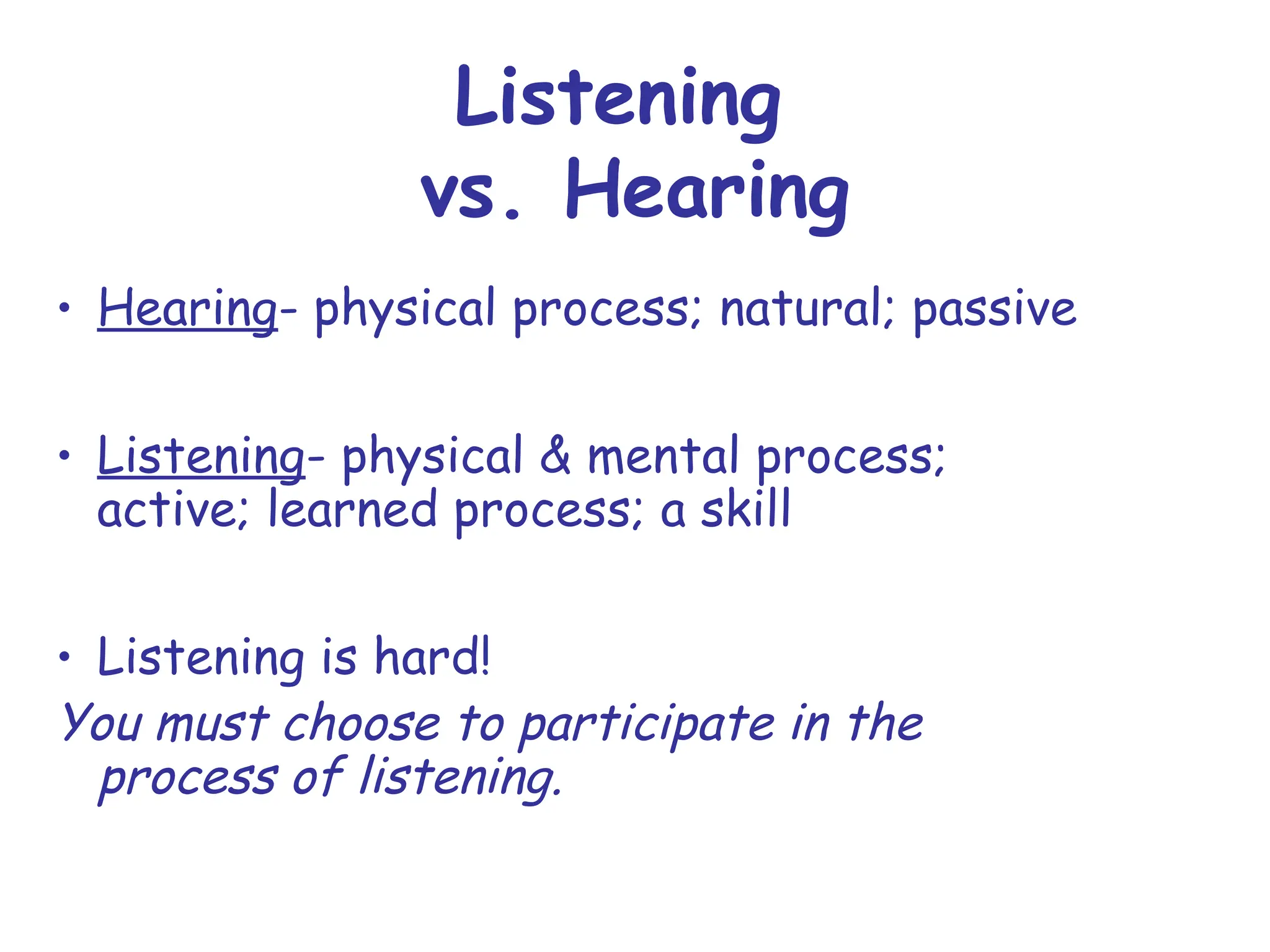
Listening
vs. Hearing
• Hearing- physical process; natural; passive
• Listening- physical & mental process;
active; learned process; a skill
• Listening is hard!
You must choose to participate in the
process of listening.
Listening is a conscious activity
based on three basic skills:
1) Attitude
2) Attention
3) Adjustment
1)Attitude
Maintain a constructive Attitude
2)Attention
Strive to pay Attention
3)Adjustment
Cultivate a capacity for Adjustment
Empathy
What is it:
Reflection of content and feeling at
a deeper level
Purpose:
To try and get an understanding of what
may be deeper feelings
HERE IS AN EXAMPLE OF HOW
EMPATHIC LISTENING DIFFERS
FROM THE OTHER TYPES OF
LISTENING…
A computer instructor explains with
enthusiasm how to use a new word
processing program
Focuses on the Program
 She certainly enjoys teaching this
word processing program.
 I think she would enjoy teaching any
subject.
 She seems very impressed with the
usefulness of this new version.
Focuses on Person
 her feelings about teaching
 the importance to her of
teaching this particular program
 her evaluation of the program
Empathizing
 Empathizing does not mean you need
to agree with your partner
 Empathizing does not mean you need
to give in to your partner
 Empathizing means you do not dismiss
what your partner says as ridiculous
or silly.
It is easy to know when you are
being empathic because:
 1. Your body language and tone match
 2. Your tone and your feelings match
 3. You are focused on what your partner
is saying and meaning.
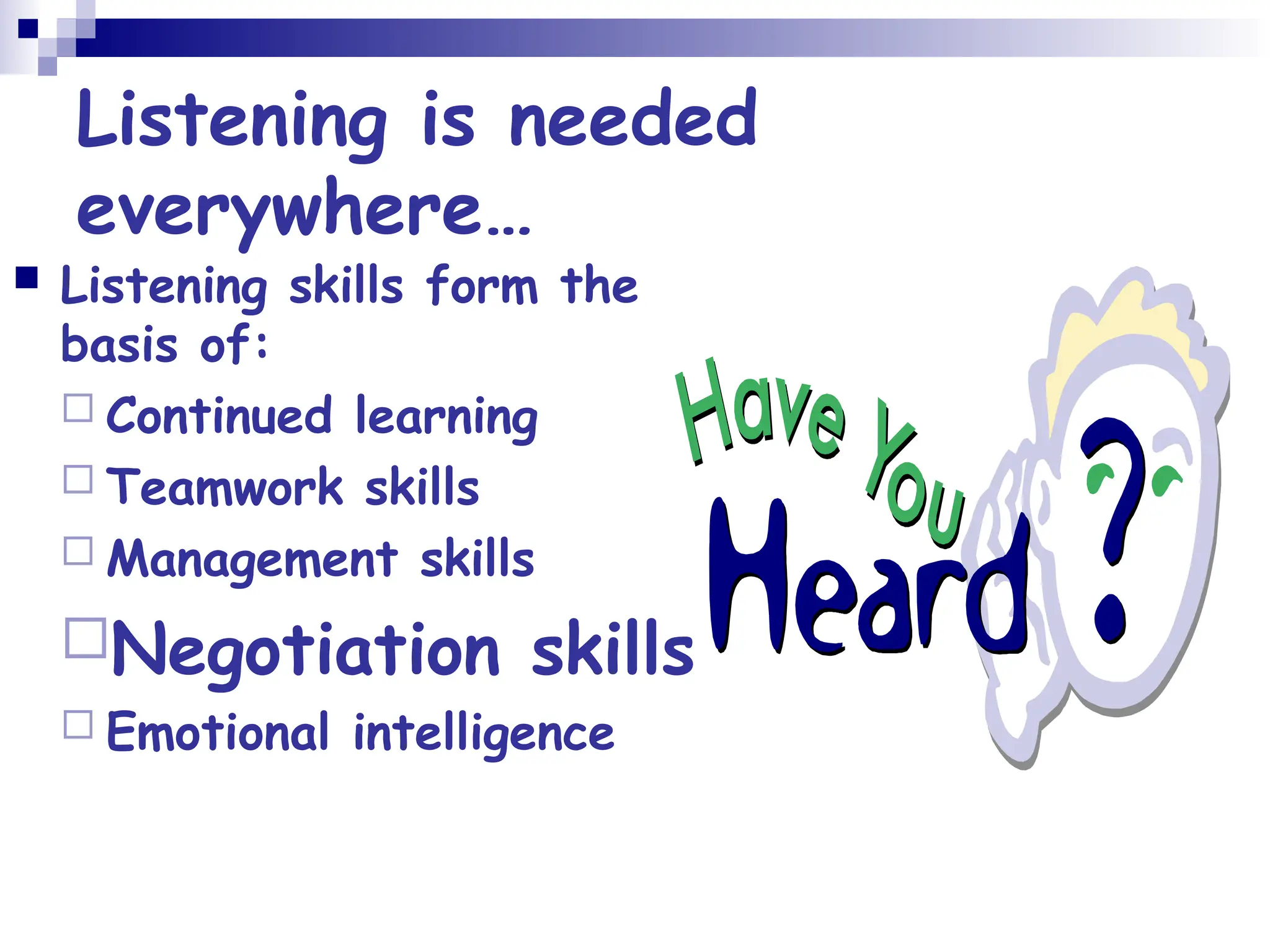
Listening is needed
everywhere…
 Listening skills form the
basis of:
 Continued learning
 Teamwork skills
 Management skills
Negotiation skills
 Emotional intelligence
… But not practiced effectively
 70% of all communication
is
Misunderstood
Misinterpreted
Rejected
Distorted
Not heard
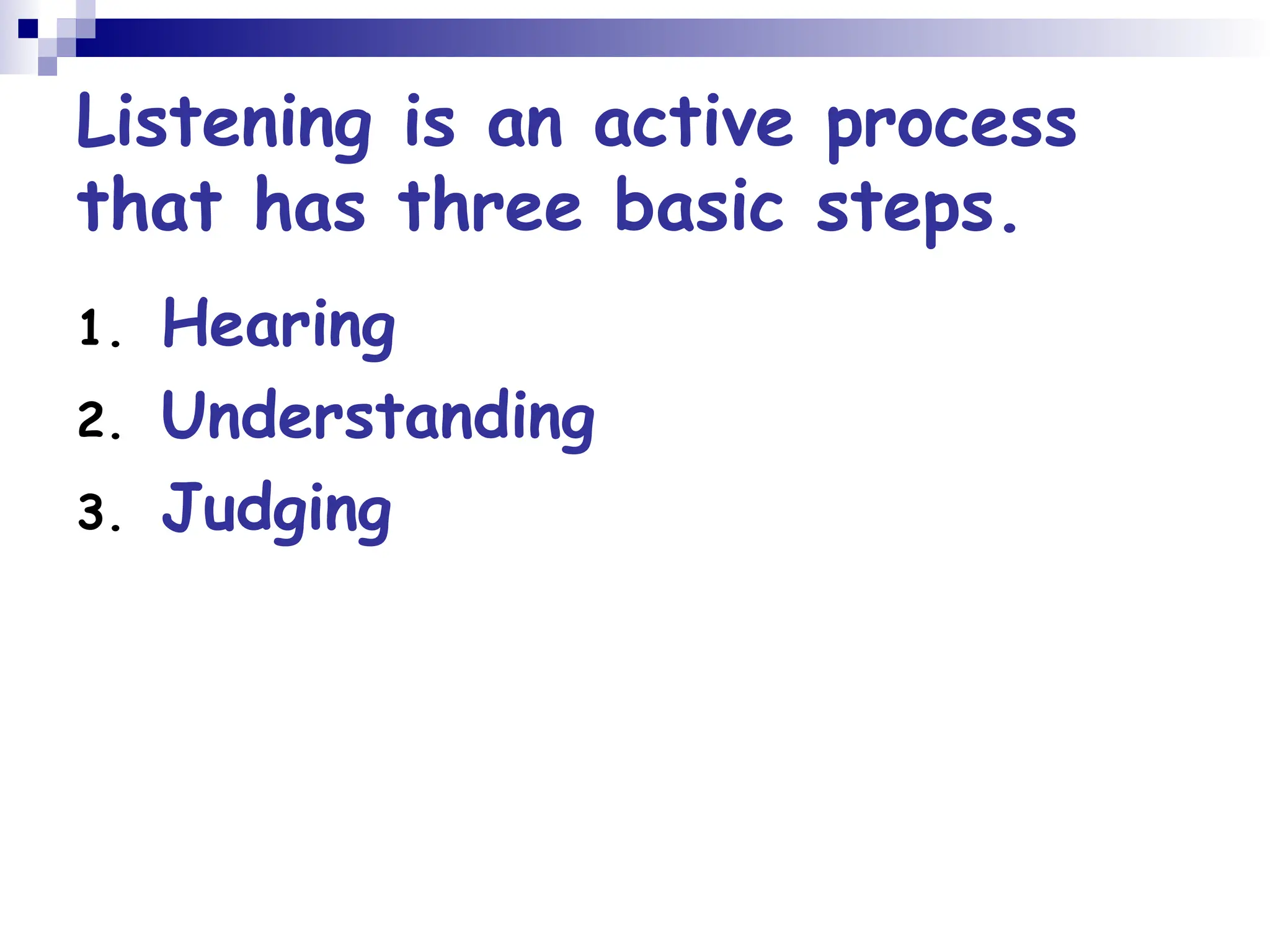
Listening is an active process
that has three basic steps.
1. Hearing
2. Understanding
3. Judging
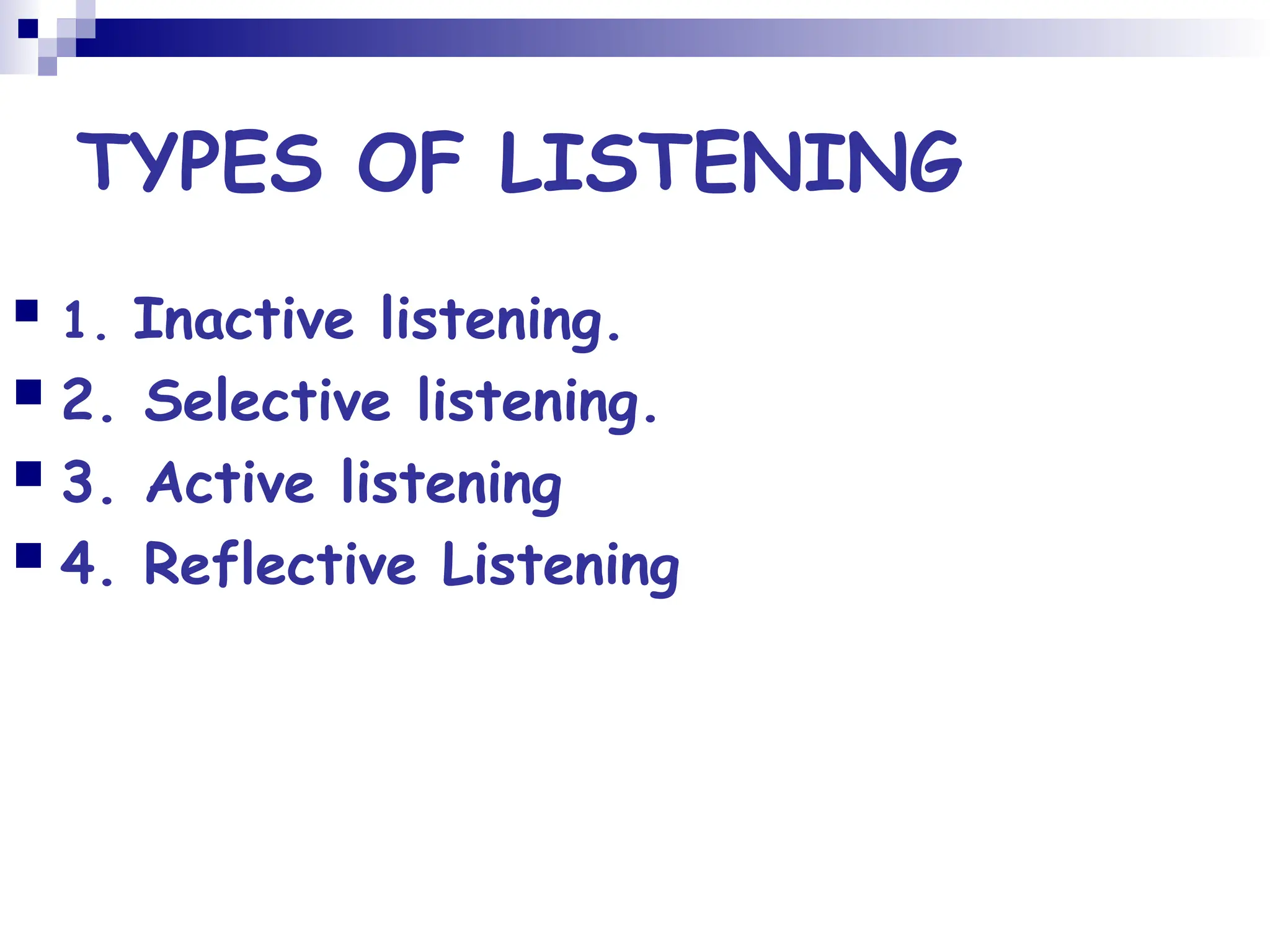
TYPES OF LISTENING
 1. Inactive listening.
 2. Selective listening.
 3. Active listening
 4. Reflective Listening
Active Listening
WHAT IS ACTIVE
LISTENING?
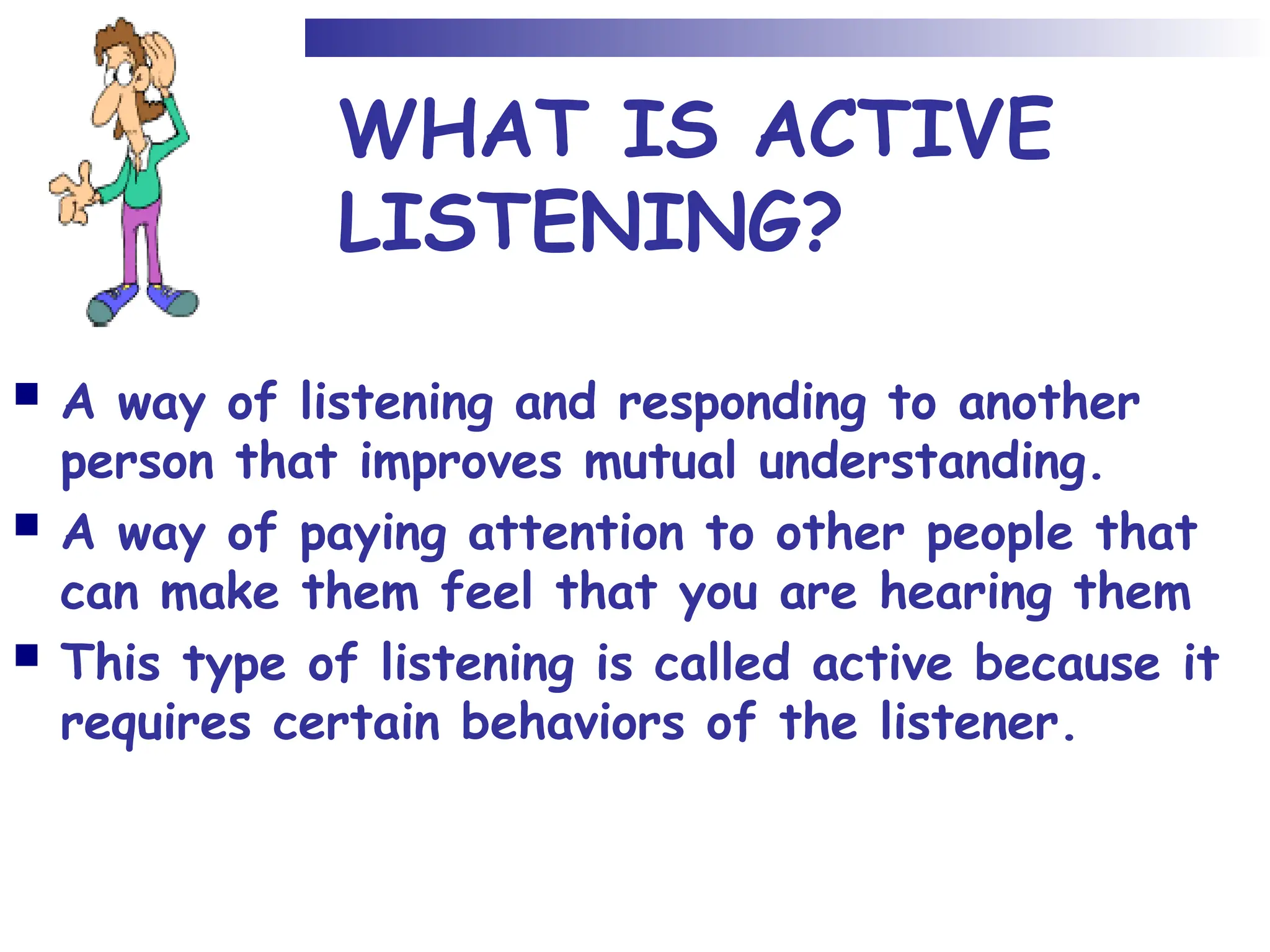
 A way of listening and responding to another
person that improves mutual understanding.
 A way of paying attention to other people that
can make them feel that you are hearing them
 This type of listening is called active because it
requires certain behaviors of the listener.
WHY LISTEN
ACTIVELY?
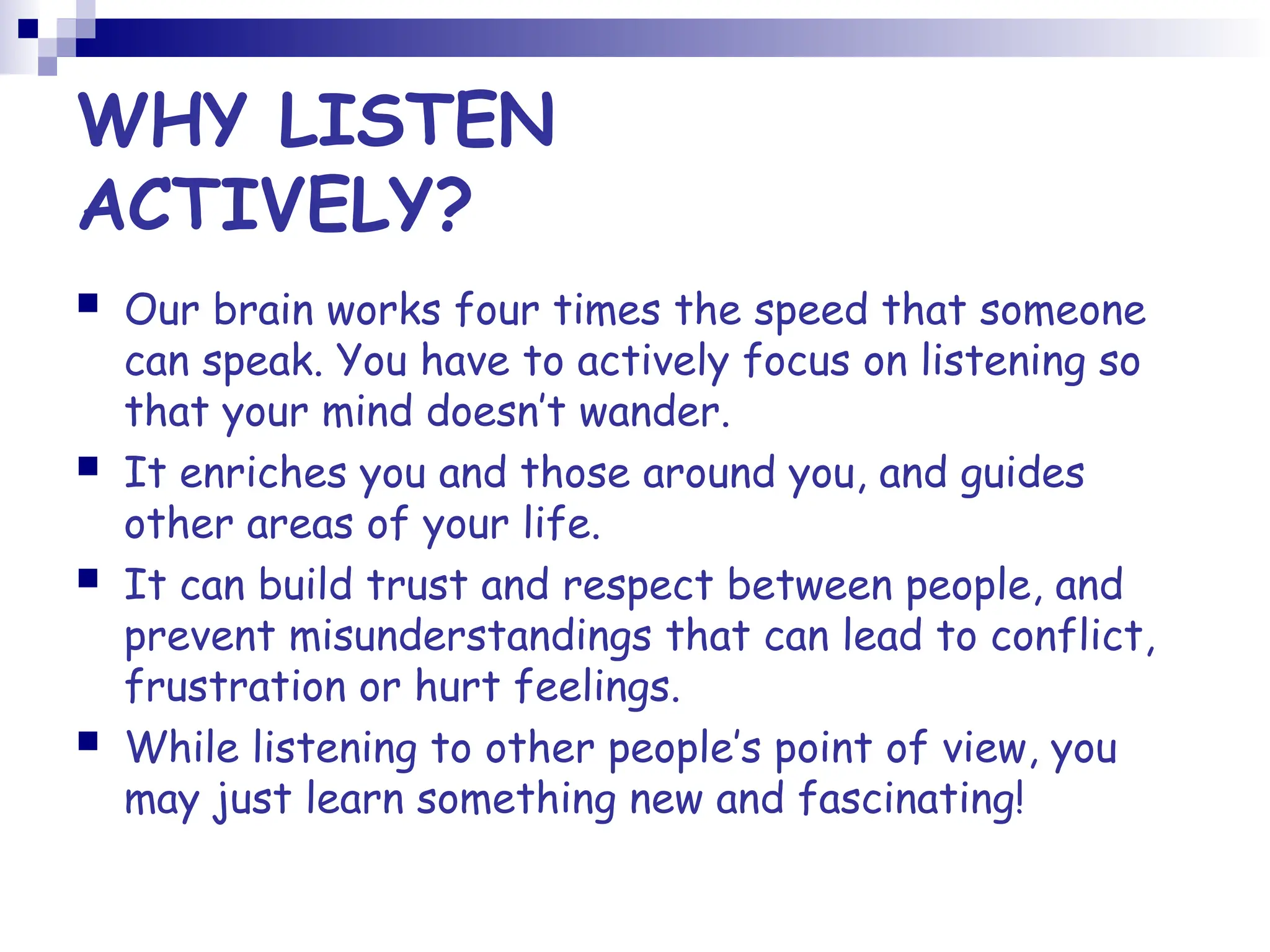
 Our brain works four times the speed that someone
can speak. You have to actively focus on listening so
that your mind doesn’t wander.
 It enriches you and those around you, and guides
other areas of your life.
 It can build trust and respect between people, and
prevent misunderstandings that can lead to conflict,
frustration or hurt feelings.
 While listening to other people’s point of view, you
may just learn something new and fascinating!
Do you know these?
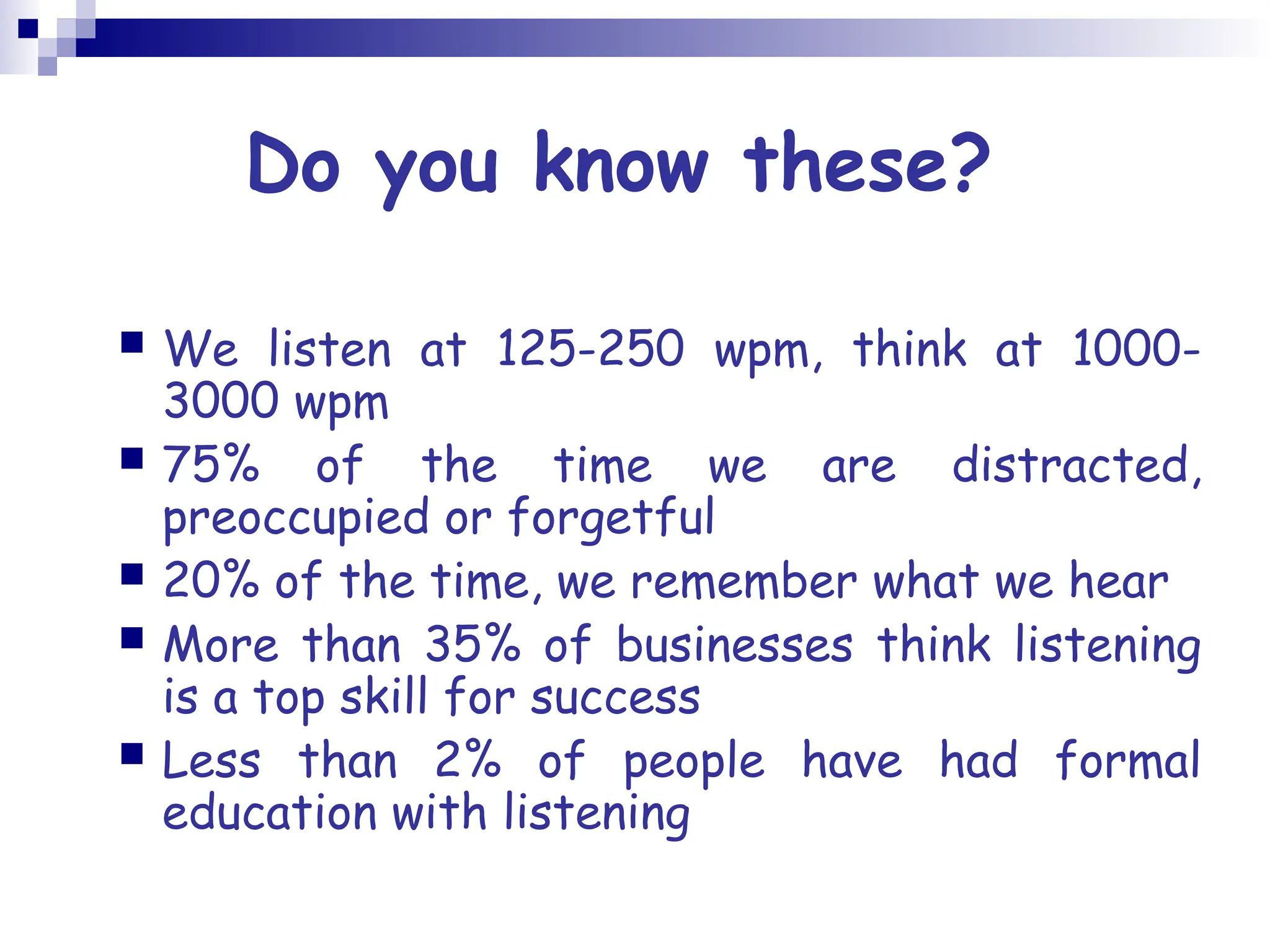
 We listen at 125-250 wpm, think at 1000-
3000 wpm
 75% of the time we are distracted,
preoccupied or forgetful
 20% of the time, we remember what we hear
 More than 35% of businesses think listening
is a top skill for success
 Less than 2% of people have had formal
education with listening
BENEFITS OF ACTIVE
LISTENING
 It forces people to listen attentively to others.
 It tends to open people up, to get them to say
more.
 Shows empathy
 Builds relationships
The Main Goals to Active
Listening
 Maximize your understanding of the
other’s perspective
 Minimize their defensiveness (and your
own, too)
KEY CONCEPTS OF ACTIVE
LISTENING
 1. Display involvement in what the person is saying
 2. Carefully observe the person speaking
 3. Resist distractions
 4. Try to stay focused on what is being said
 5. Ask for clarification of anything that you do not
fully understand
 6. Delay making judgments about what is said.
Active listeners speak 30% of the
time and listen 70% of the time.
Sometimes, we have to try hard not to
interrupt – the only acceptable reason
is to clarify or confirm what has been
said.
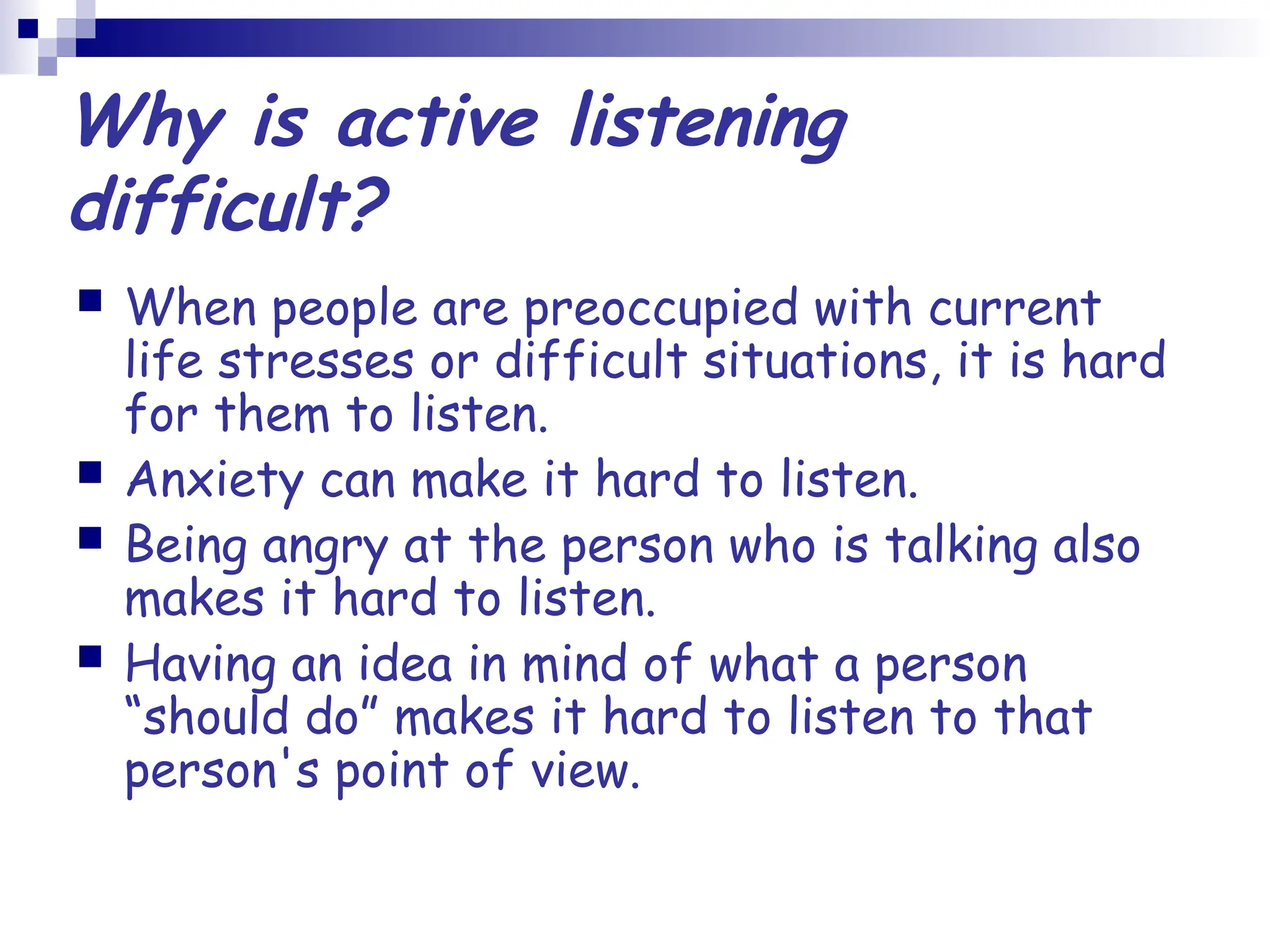
Why is active listening
difficult?
 When people are preoccupied with current
life stresses or difficult situations, it is hard
for them to listen.
 Anxiety can make it hard to listen.
 Being angry at the person who is talking also
makes it hard to listen.
 Having an idea in mind of what a person
“should do” makes it hard to listen to that
person's point of view.
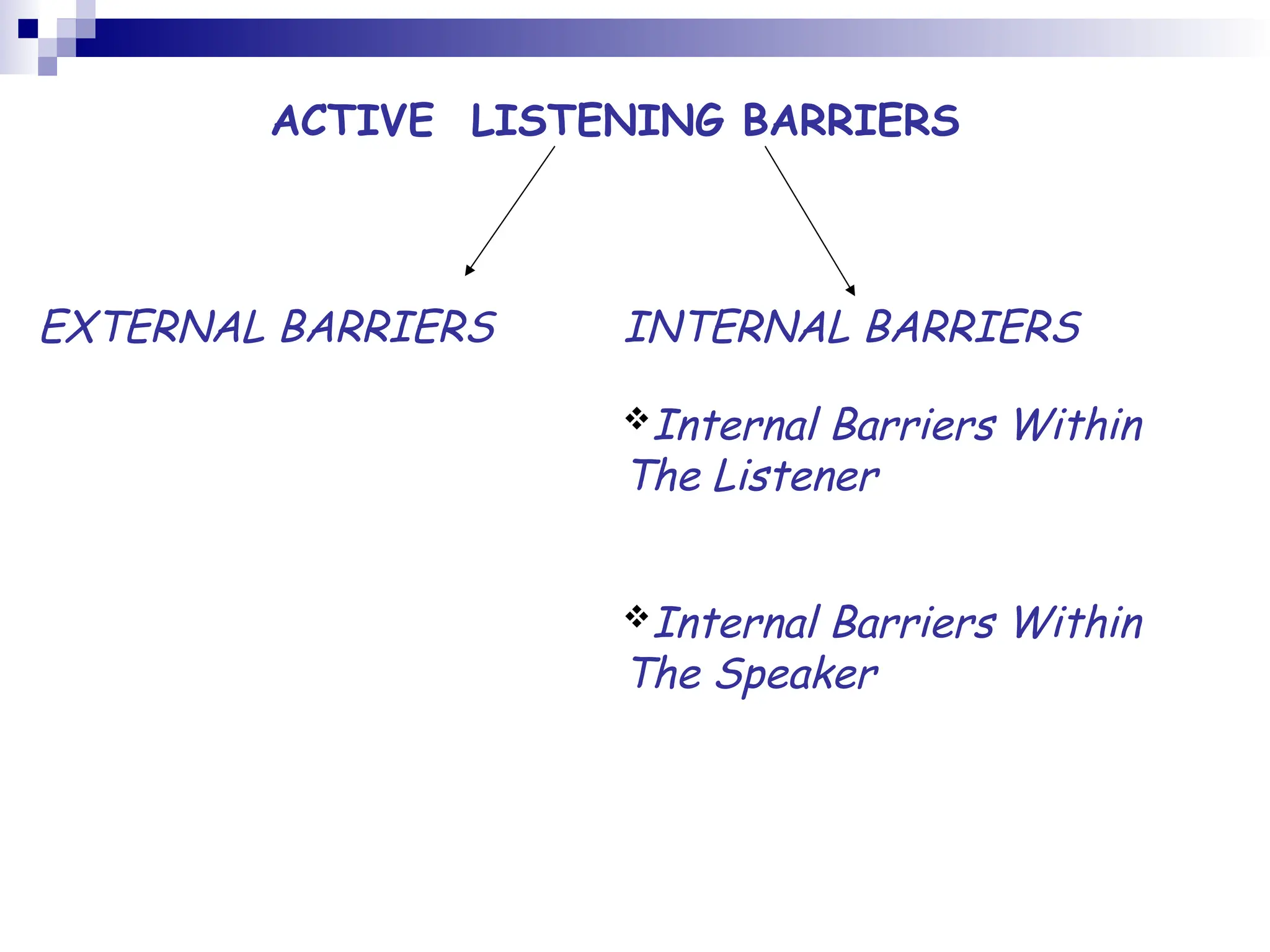
ACTIVE LISTENING BARRIERS
EXTERNAL BARRIERS INTERNAL BARRIERS
Internal Barriers Within
The Listener
Internal Barriers Within
The Speaker
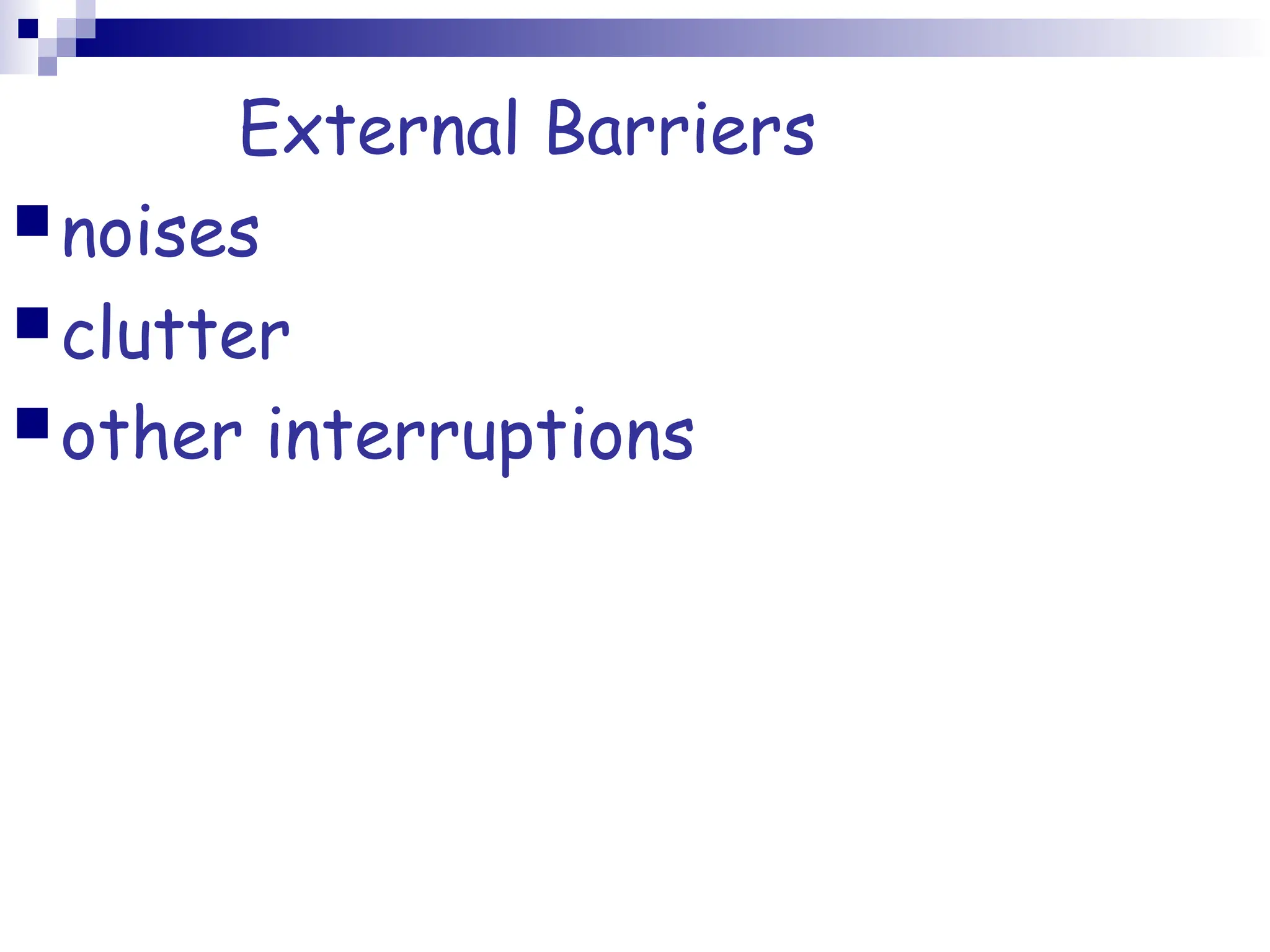
External Barriers
noises
clutter
other interruptions
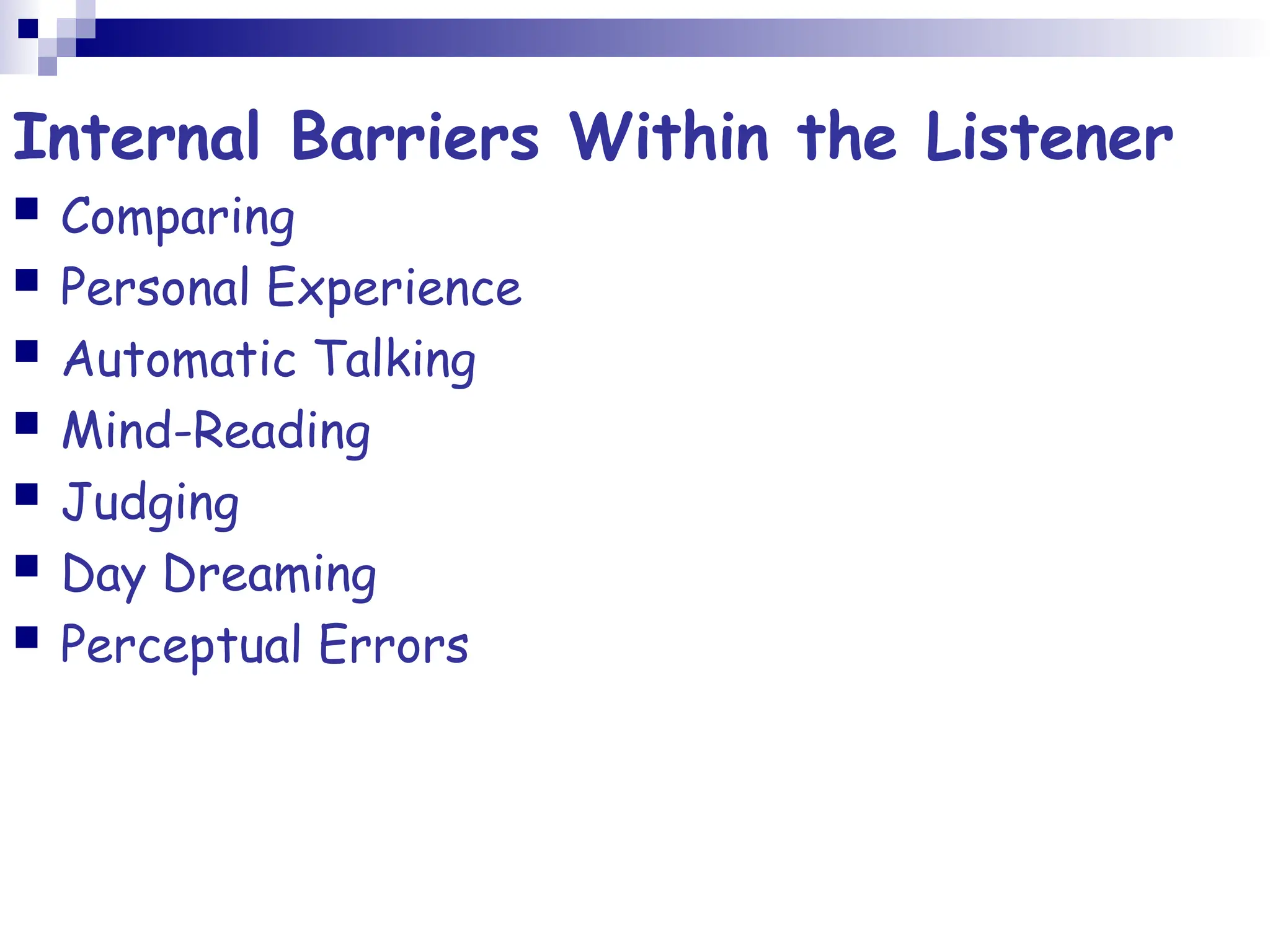
Internal Barriers Within the Listener
 Comparing
 Personal Experience
 Automatic Talking
 Mind-Reading
 Judging
 Day Dreaming
 Perceptual Errors
Barriers Within the Speaker
 Expectations
 Avoidance
 Speaking in Code
 Boundary
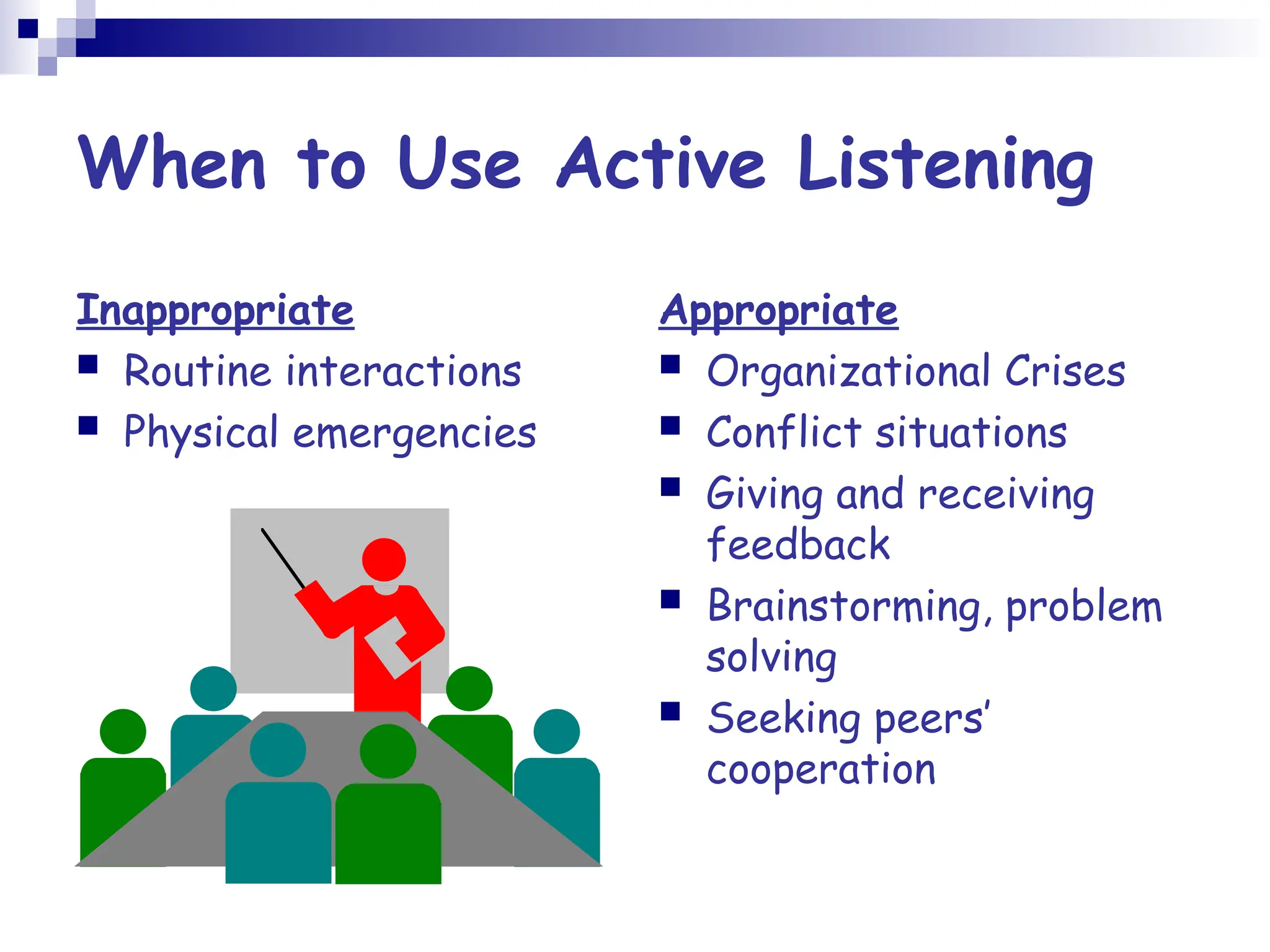
When to Use Active Listening
Inappropriate
 Routine interactions
 Physical emergencies
Appropriate
 Organizational Crises
 Conflict situations
 Giving and receiving
feedback
 Brainstorming, problem
solving
 Seeking peers’
cooperation
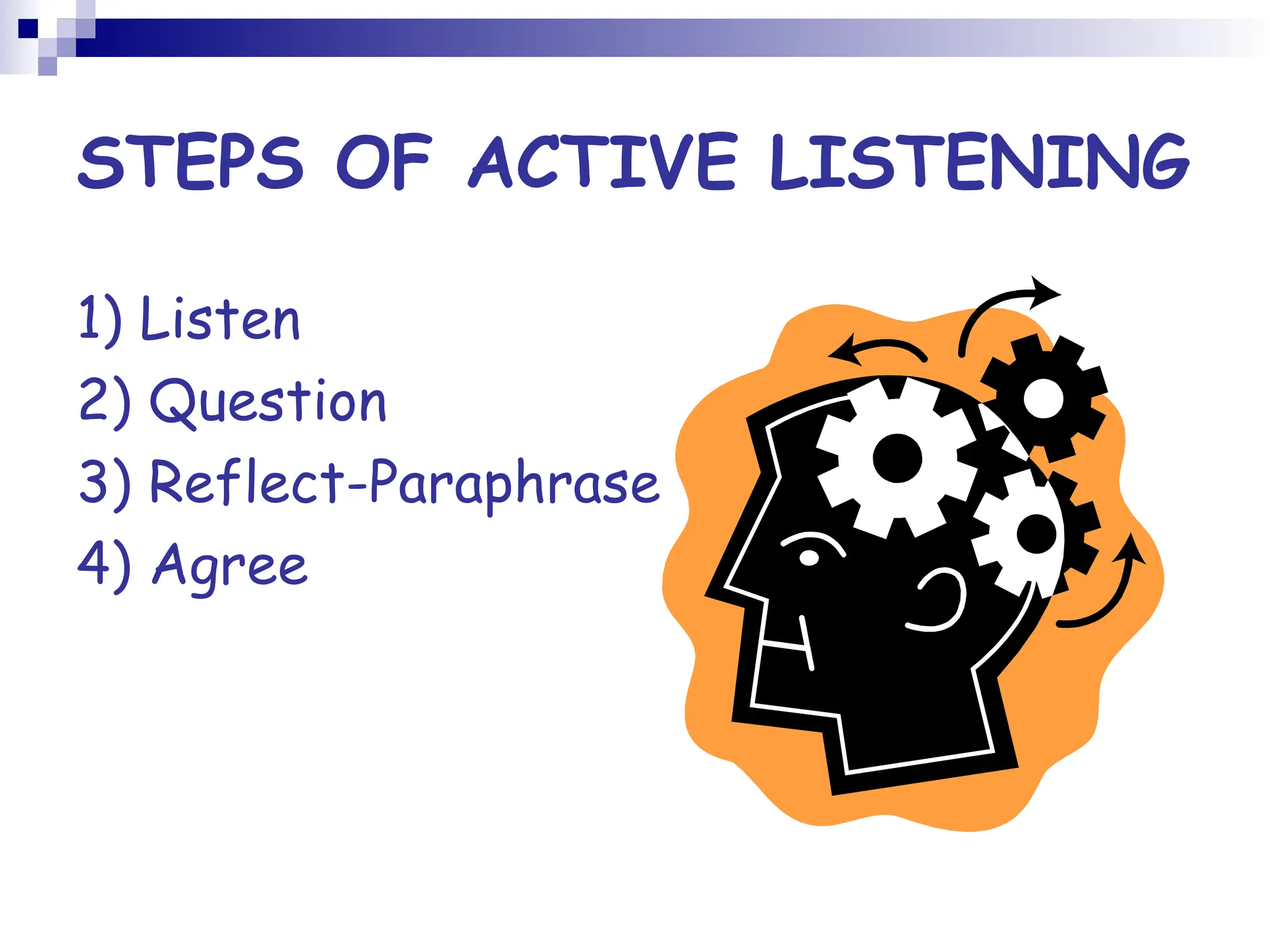
STEPS OF ACTIVE LISTENING
1) Listen
2) Question
3) Reflect-Paraphrase
4) Agree
Step 1: Listen
 To Feelings As Well As Words
 Words – Emotions -- Implications
 Focus on Speaker
 Don’t plan, speak, or get distracted
 What Is Speaker Talking About?
 Topic? Speaker? Listener? Others?
 Look At Speaker
 Use Verbal & Non-Verbal Encouragers
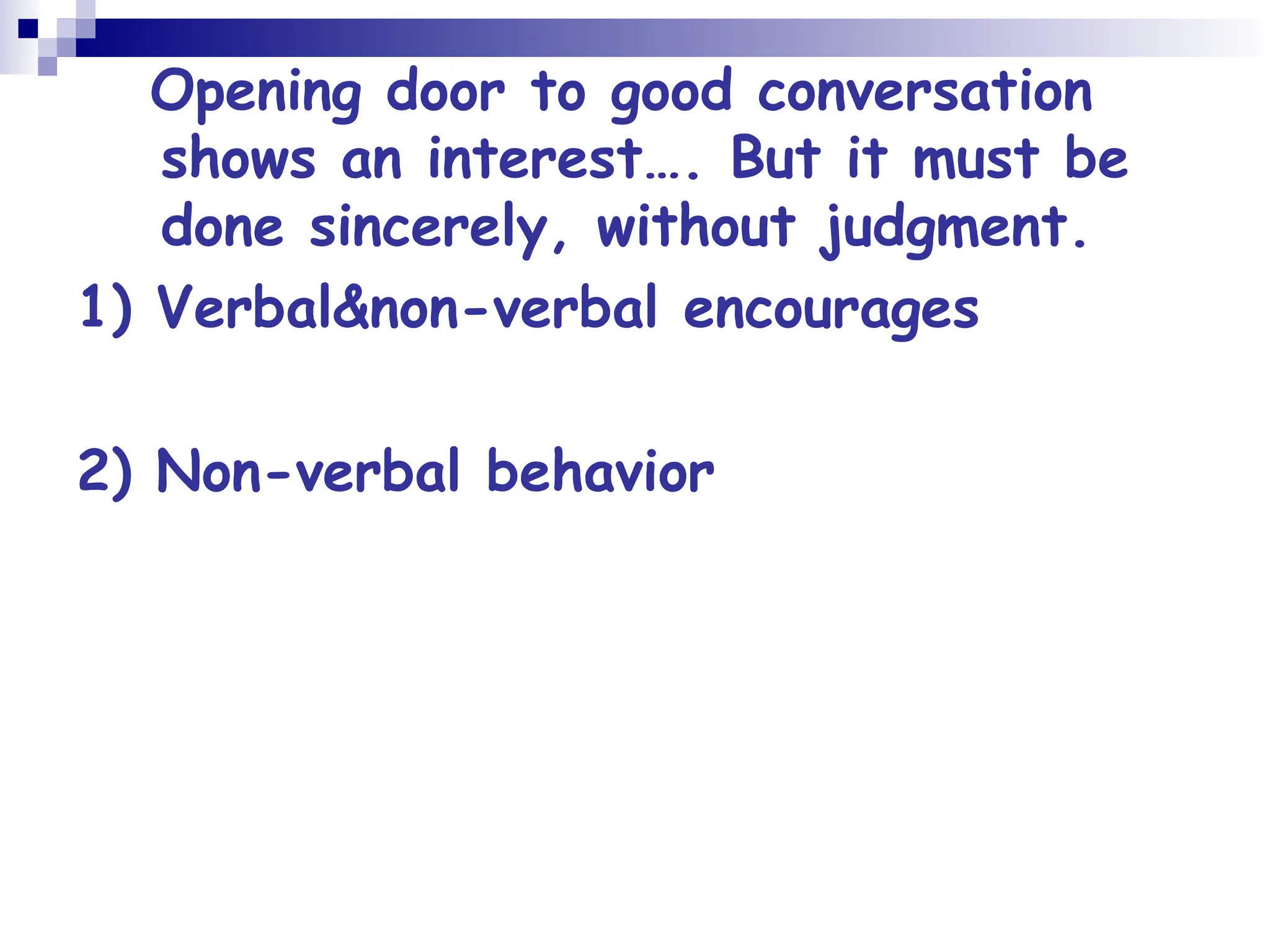
Opening door to good conversation
shows an interest…. But it must be
done sincerely, without judgment.
1) Verbal&non-verbal encourages
2) Non-verbal behavior
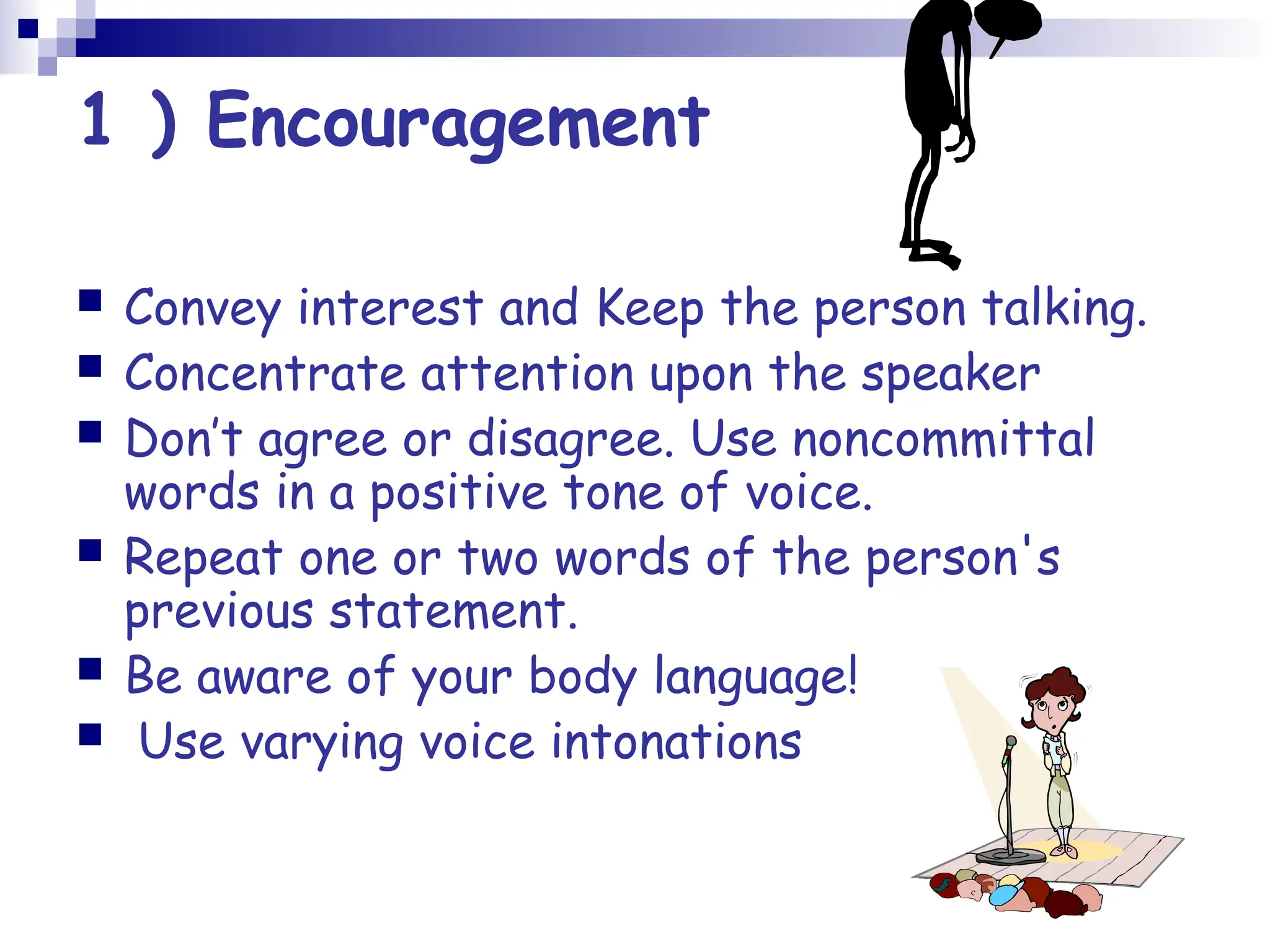
1 ) Encouragement
 Convey interest and Keep the person talking.
 Concentrate attention upon the speaker
 Don’t agree or disagree. Use noncommittal
words in a positive tone of voice.
 Repeat one or two words of the person's
previous statement.
 Be aware of your body language!
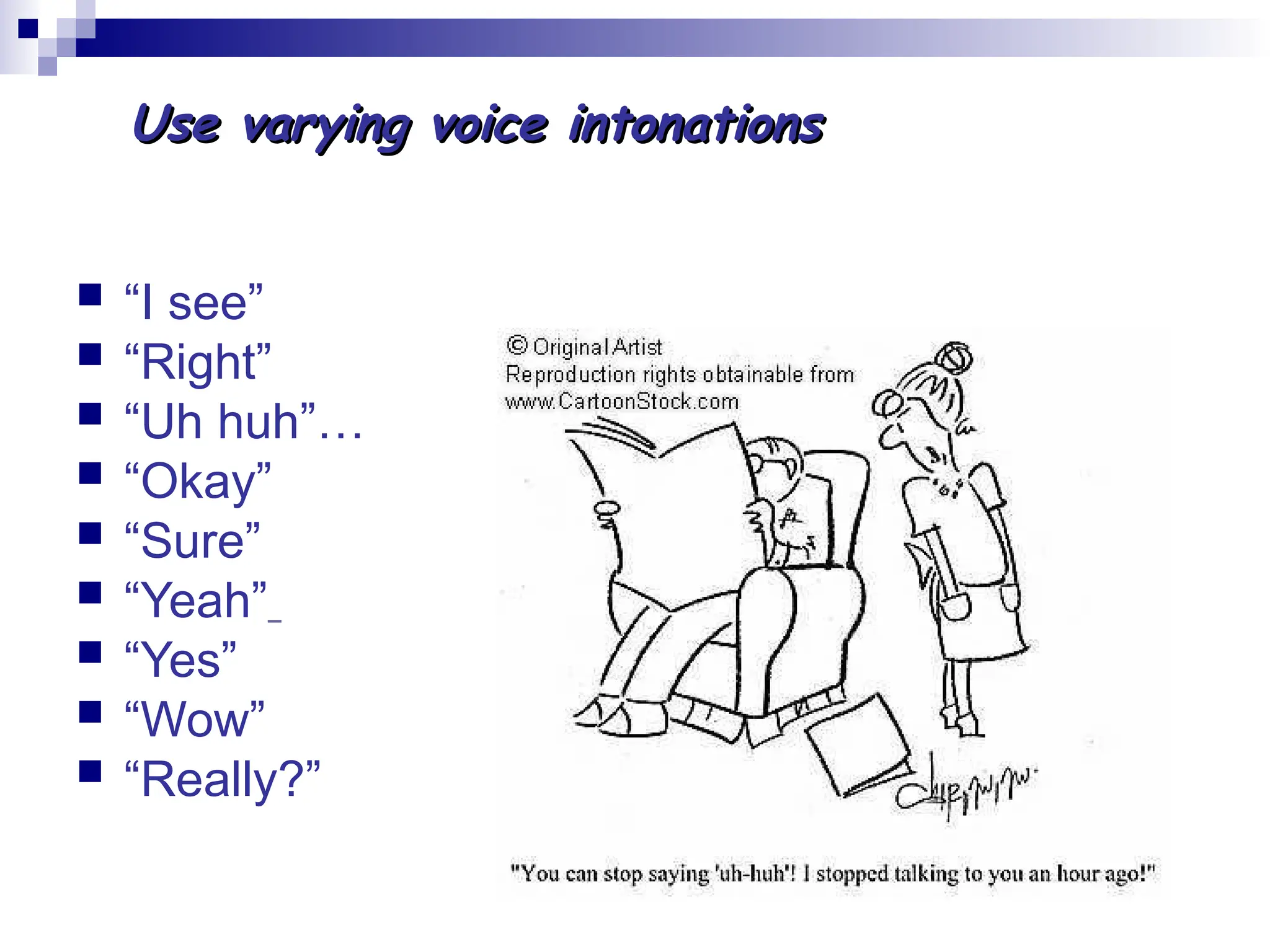
 Use varying voice intonations
 “I see”
 “Right”
 “Uh huh”…
 “Okay”
 “Sure”
 “Yeah”
 “Yes”
 “Wow”
 “Really?”
Use varying voice intonations
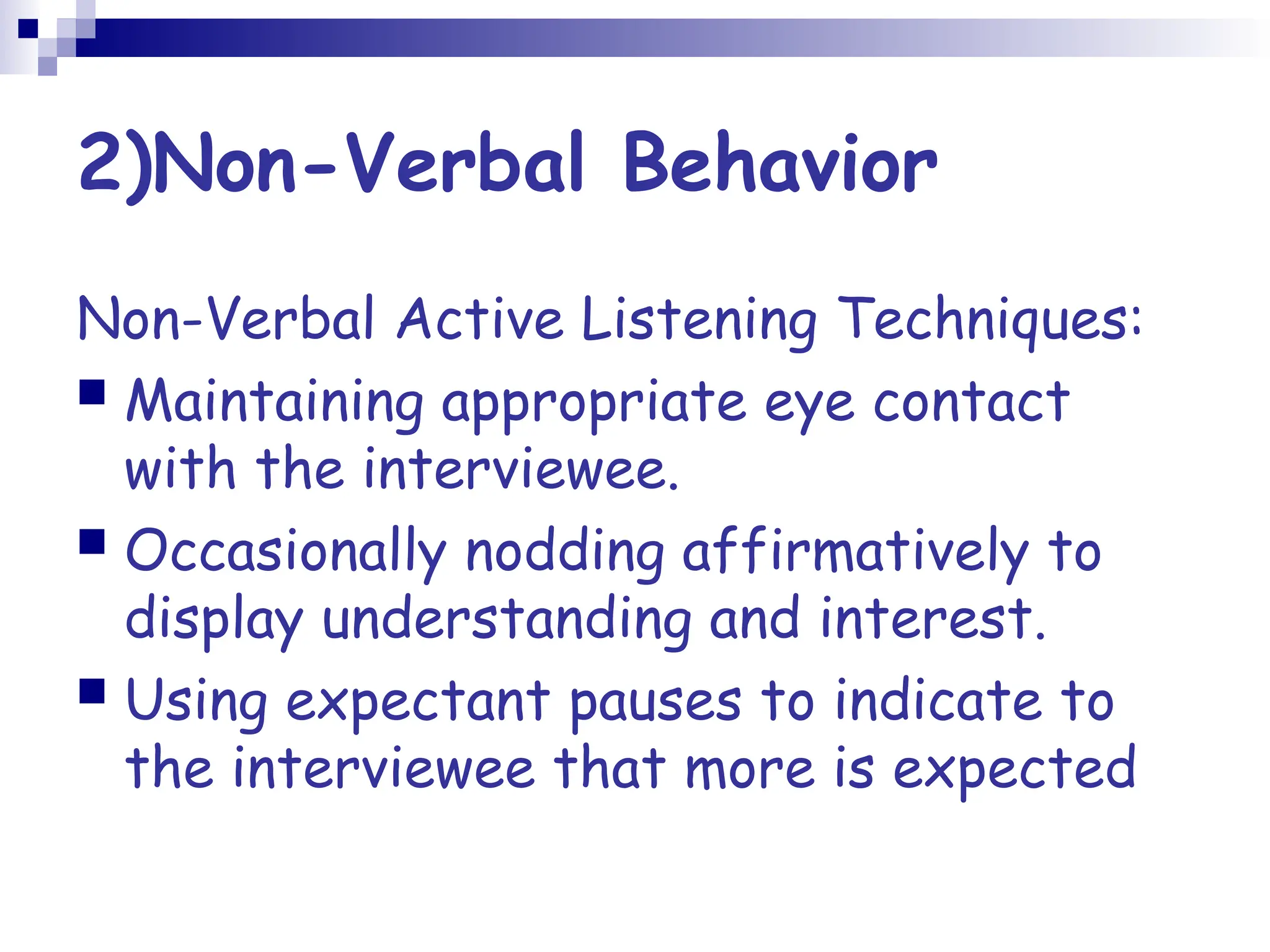
2)Non-Verbal Behavior
Non-Verbal Active Listening Techniques:
 Maintaining appropriate eye contact
with the interviewee.
 Occasionally nodding affirmatively to
display understanding and interest.
 Using expectant pauses to indicate to
the interviewee that more is expected
The various forms of
NVC
 touch
 sound
 smell
 timing and speed of delivery of speech
 proximity
 posture
 dress
 eye contact
 gestures
 facial expressions
 use of silence
Step 3: Reflect-Paraphrase
In that step we will use another
techniques for active listening;
1. Reflecting
2. Reframing
3. Paraphrasing
4. Acknowleding
5. Summarizing
1. REFLECTING
 Reflect What Is Said (In your words)
 Reflect Feelings
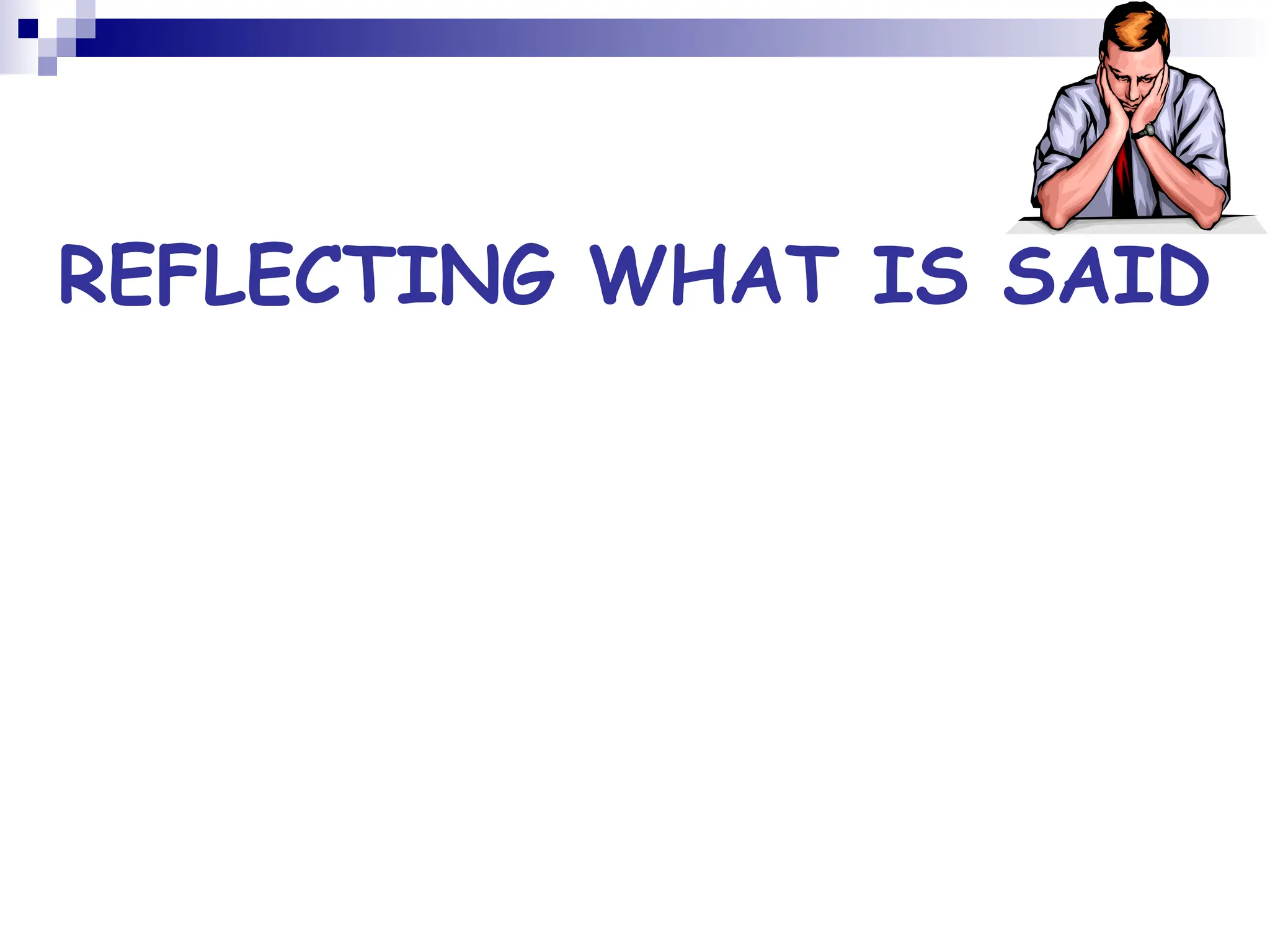
REFLECTING WHAT IS SAID
REFLECTING FEELINGS
 Someone may say: “Don’t worry. I’m fine”
(when she actually looks very upset)…
Reflecting, you say
 “You say you’re OK, but by the tone of your
voice, you seem upset, correct?”
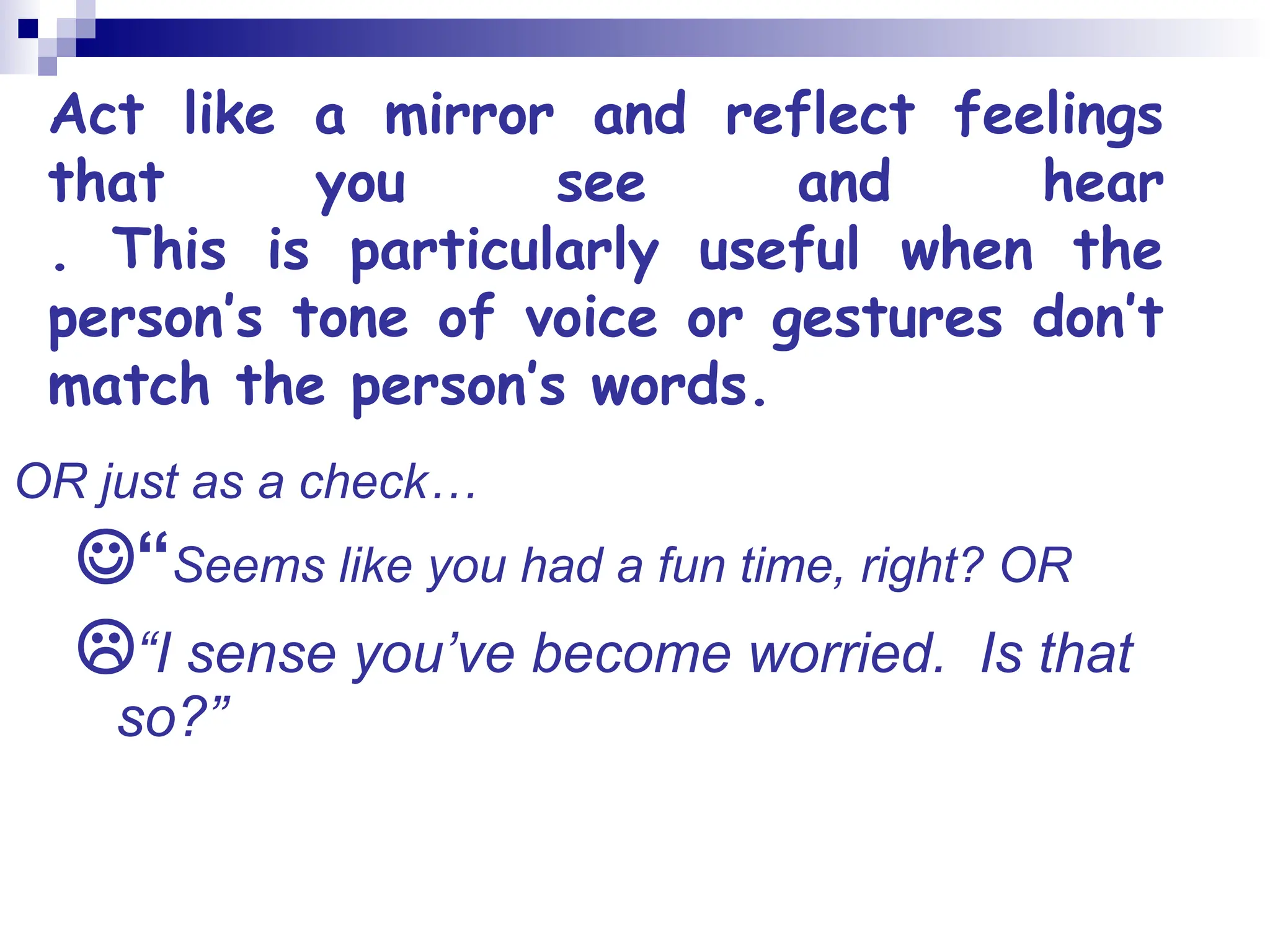
Act like a mirror and reflect feelings
that you see and hear
. This is particularly useful when the
person’s tone of voice or gestures don’t
match the person’s words.
OR just as a check…
“Seems like you had a fun time, right? OR
“I sense you’ve become worried. Is that
so?”
2.REFRAMING
Why You Do It?
 to help the other person see their concerns in a new light
 to broaden the meaning of an issue to identify needs or
interests
 to diffuse negative feelings
 to establish the focus for resolution
How You Do It?
 recognize underlying needs
 re-word concerns from negative neutral/positive past
→
future; problem opportunity; interpersonal system
→ → →
rights/wrongs impacts positions interests singular
→ → →
multiple
REFRAMING(cont.)
 Concern: “She always talks to everyone
else but me when there is a problem.”
 Reframe: “It sounds as if you would like
more direct communication to resolve
concerns.”
3.PARAPHASING
PARAPHRASE the speaker to
acknowledge the story and capture
the content.
EXAMPLE: “Let’s see if I got this right.
You’re upset because you think we’re
going off in the wrong direction and you
want to clarify our objective before we
write this assignment. Is that right”
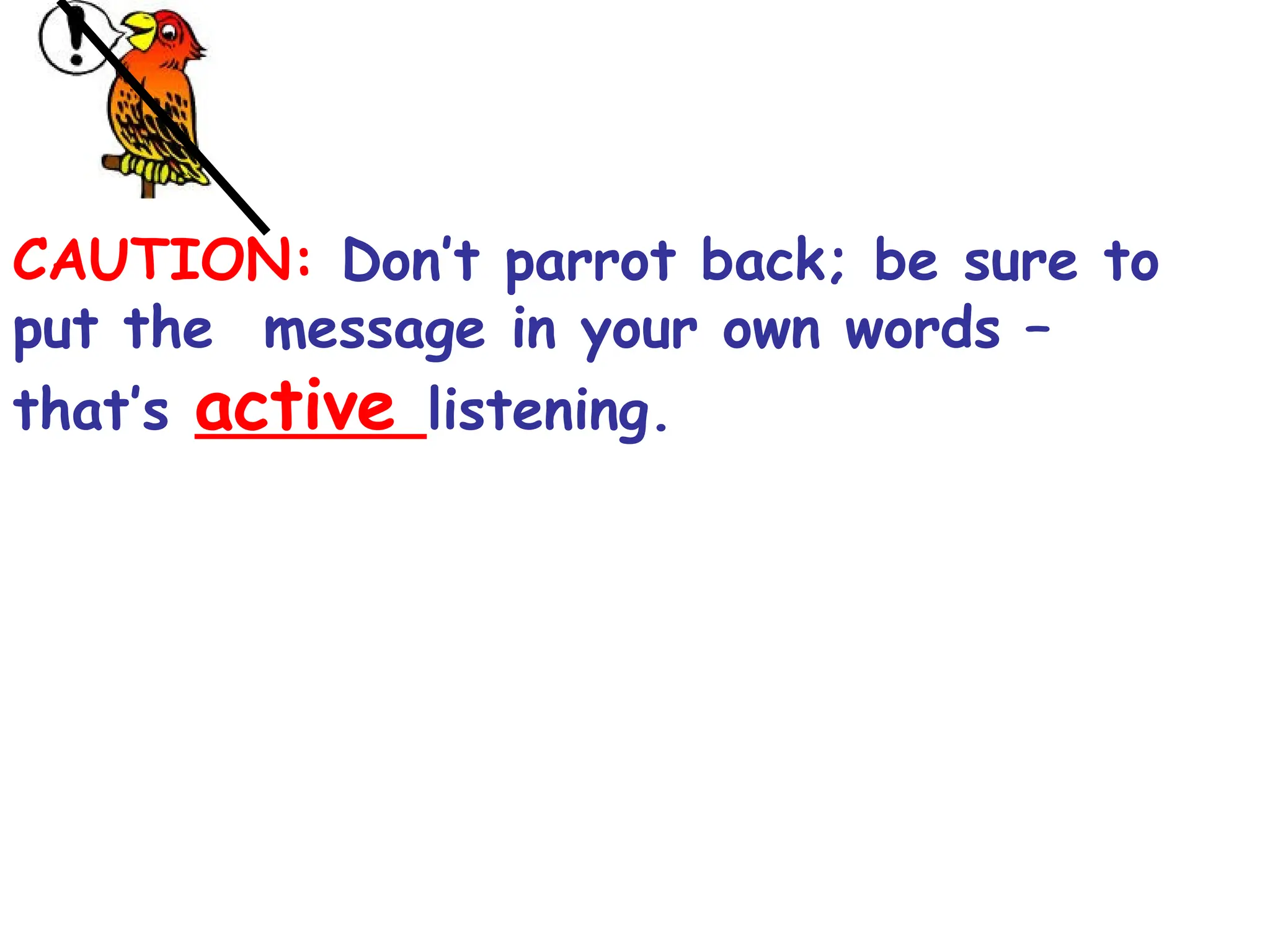
CAUTION: Don’t parrot back; be sure to
put the message in your own words –
that’s active listening.
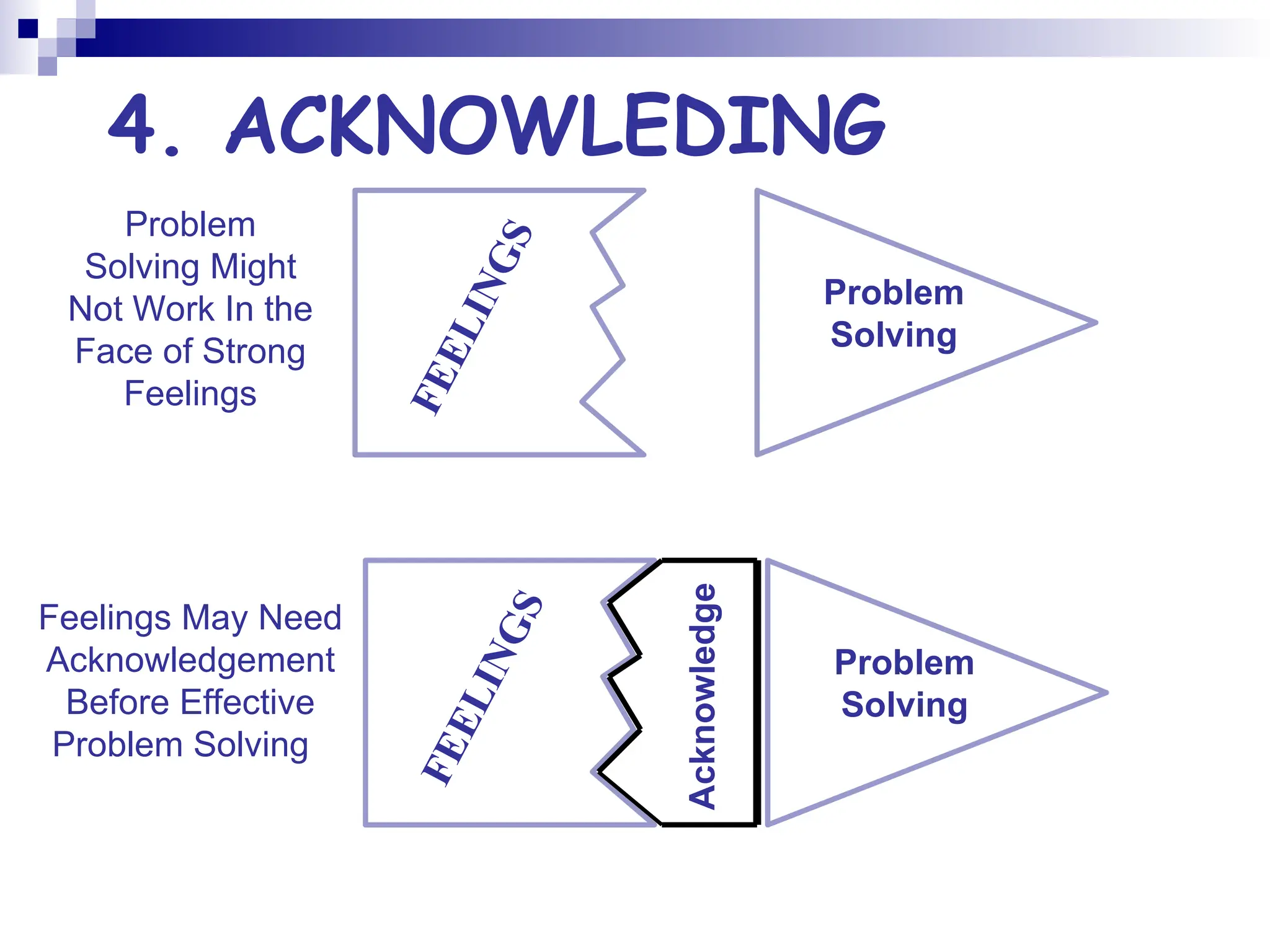
4. ACKNOWLEDING
F
E
E
L
I
N
G
S
Problem
Solving
F
E
E
L
I
N
G
S
Problem
Solving
Acknowledge
Problem
Solving Might
Not Work In the
Face of Strong
Feelings
Feelings May Need
Acknowledgement
Before Effective
Problem Solving
5.SUMMARIZE
Why You Do It?
•to review progress
•to pull together important
ideas and information
•to establish a foundation for
further discussion
How You Do It?
•restate the central ideas and
feelings you have heard
Example: “Let’s see if I have a clear understanding of
your experience at this point…”
“So basically what is most important to you is…”
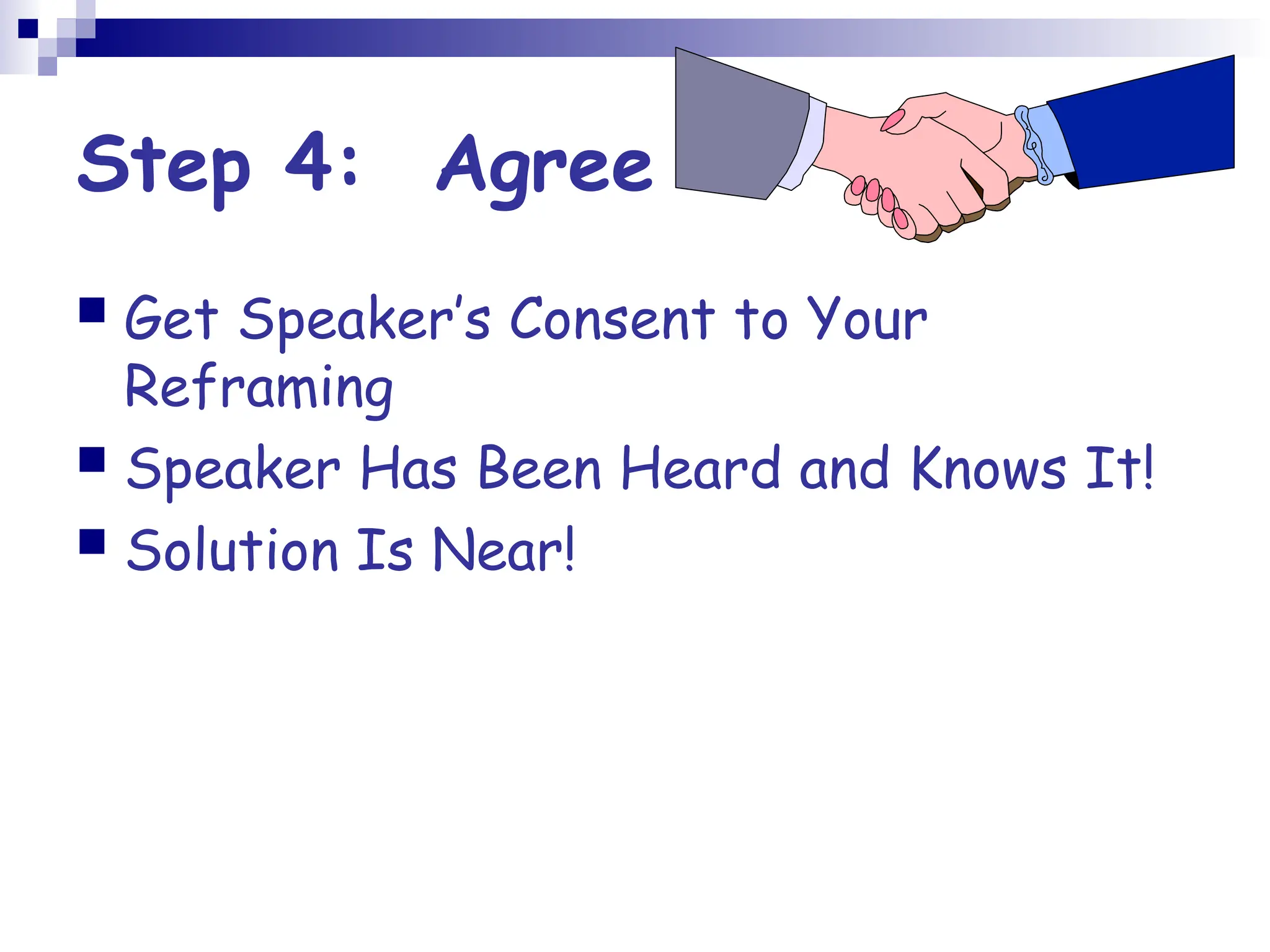
Step 4: Agree
 Get Speaker’s Consent to Your
Reframing
 Speaker Has Been Heard and Knows It!
 Solution Is Near!
Remember that the objective of all of this
is increase understanding of the other’s
point of view, not necessarily to agree
with it or support it.
“A good listener tries to
understand thoroughly what
the other person is saying. In
the end he may disagree
sharply, but before he
disagrees, he wants to know
exactly what it is he is
disagreeing with.”
Kenneth A. WELLS
Are You a Good Listener?
Do you frequently think of other things when others are talking to you?
Do you doodle, shuffle papers, look at the clock or out the window,
read the newspaper,or watch TV?
Do you silently argue with the talker?
Do you only selectively hear ideas that fit your beliefs?
Do you feel most people have little to talk about that is interesting or
important?
Do you listen passively without any facial expressions?
Do you frequently interrupt others as they are speaking?
Do you complete sentences or ideas for people when they pause to
think?
Do you silently criticize characteristics of the speaker: voice, looks,
manner of speaking?
Do you have to ask people to repeat what they said because you have
forgotten?
ACTIVE LISTENERS
1. Be there
2. Listen carefully to the person
3. Accept the person and his/her feelings
4. Stay with the other person's point of
view without becoming that person
5. Trust the person enough to keep out
of it
ACTIVE LISTENING
&NEGOTIATION
Active listening is important for
identifying and creating negotiating
goals, because listening helps to orient
the negotiator to the environment.
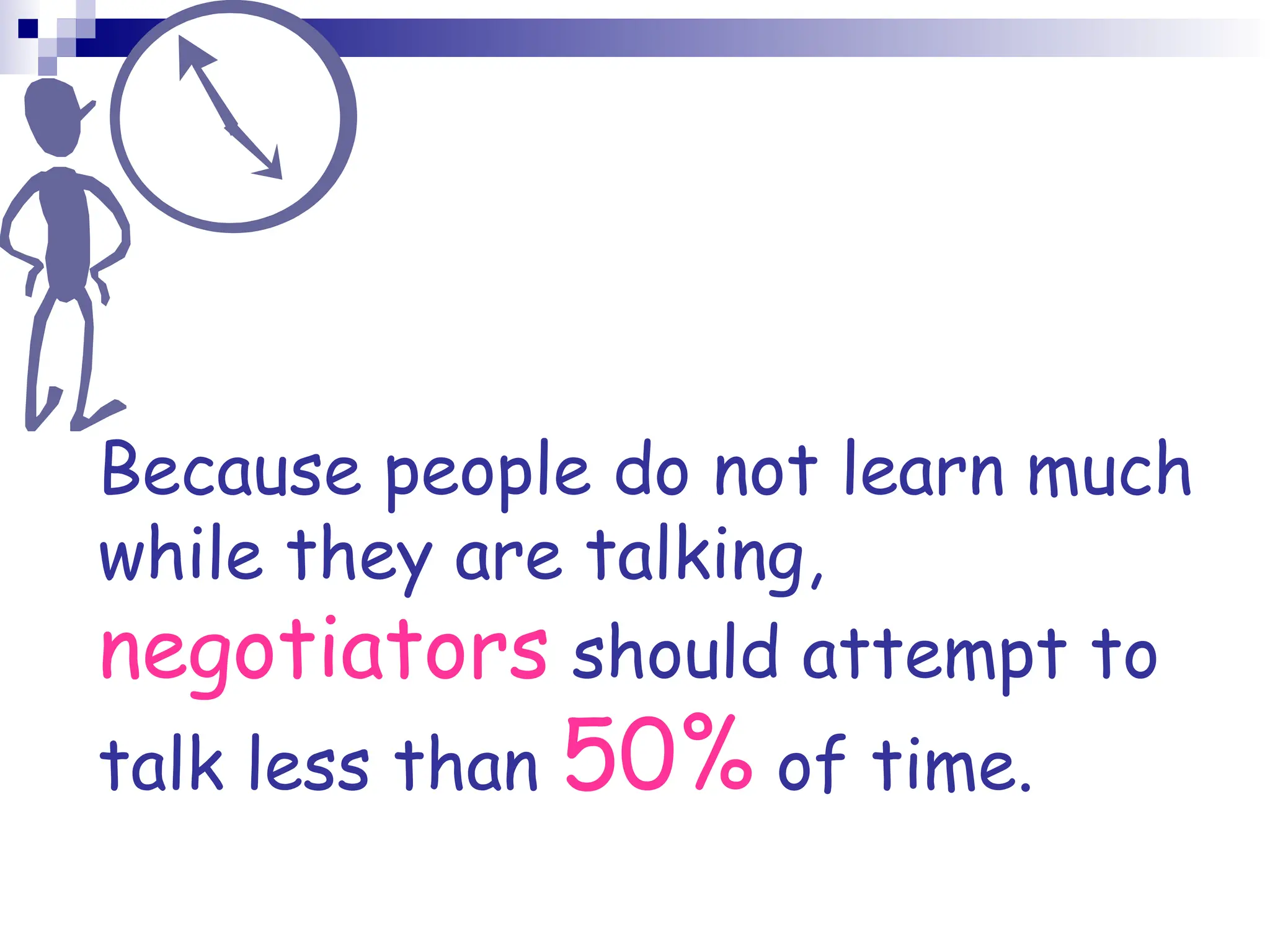
Because people do not learn much
while they are talking,
negotiators should attempt to
talk less than 50% of time.
In negotiation, there are FOUR major reasons to
listen:
1.To learn the other side’s proposals and
strengths;
2.To discover the needs of constituents and
teammates
3.To discern subtle position changes and
openings; and
4.To show other side that their proposals are
understood.
Active Listening LEC15.ppt Active Listening LEC15.ppt

Active Listening LEC15.ppt Active Listening LEC15.ppt

  • 1.
    ACTIVE ACTIVE LISTENING LISTENING DR.ABDUL RASHAD DR.ABDUL RASHAD ISRAINSTITUTE OF REHABILITATION ISRA INSTITUTE OF REHABILITATION SCIENCES SCIENCES
  • 2.
    WHAT IS LISTENING? If you ask a group of people to give a one word description of listening, some would say hearing.
  • 3.
    BUT LISTENING…  Isfollowing and understanding the sound---it is hearing with a purpose.
  • 4.
    DEFINITION OF LISTENING The process of receiving, constructing meaning from, and responding to spoken and/or nonverbal messages; to hear something with thoughtful attention
  • 5.
    Listening vs. Hearing • Hearing-physical process; natural; passive • Listening- physical & mental process; active; learned process; a skill • Listening is hard! You must choose to participate in the process of listening.
  • 6.
    Listening is aconscious activity based on three basic skills: 1) Attitude 2) Attention 3) Adjustment
  • 7.
    1)Attitude Maintain a constructiveAttitude 2)Attention Strive to pay Attention 3)Adjustment Cultivate a capacity for Adjustment
  • 8.
    Empathy What is it: Reflectionof content and feeling at a deeper level Purpose: To try and get an understanding of what may be deeper feelings
  • 9.
    HERE IS ANEXAMPLE OF HOW EMPATHIC LISTENING DIFFERS FROM THE OTHER TYPES OF LISTENING… A computer instructor explains with enthusiasm how to use a new word processing program
  • 10.
    Focuses on theProgram  She certainly enjoys teaching this word processing program.  I think she would enjoy teaching any subject.  She seems very impressed with the usefulness of this new version.
  • 11.
    Focuses on Person her feelings about teaching  the importance to her of teaching this particular program  her evaluation of the program
  • 12.
    Empathizing  Empathizing doesnot mean you need to agree with your partner  Empathizing does not mean you need to give in to your partner  Empathizing means you do not dismiss what your partner says as ridiculous or silly.
  • 13.
    It is easyto know when you are being empathic because:  1. Your body language and tone match  2. Your tone and your feelings match  3. You are focused on what your partner is saying and meaning.
  • 14.
    Listening is needed everywhere… Listening skills form the basis of:  Continued learning  Teamwork skills  Management skills Negotiation skills  Emotional intelligence
  • 15.
    … But notpracticed effectively  70% of all communication is Misunderstood Misinterpreted Rejected Distorted Not heard
  • 16.
    Listening is anactive process that has three basic steps. 1. Hearing 2. Understanding 3. Judging
  • 17.
    TYPES OF LISTENING 1. Inactive listening.  2. Selective listening.  3. Active listening  4. Reflective Listening
  • 18.
  • 19.
    WHAT IS ACTIVE LISTENING? A way of listening and responding to another person that improves mutual understanding.  A way of paying attention to other people that can make them feel that you are hearing them  This type of listening is called active because it requires certain behaviors of the listener.
  • 20.
    WHY LISTEN ACTIVELY?  Ourbrain works four times the speed that someone can speak. You have to actively focus on listening so that your mind doesn’t wander.  It enriches you and those around you, and guides other areas of your life.  It can build trust and respect between people, and prevent misunderstandings that can lead to conflict, frustration or hurt feelings.  While listening to other people’s point of view, you may just learn something new and fascinating!
  • 21.
    Do you knowthese?  We listen at 125-250 wpm, think at 1000- 3000 wpm  75% of the time we are distracted, preoccupied or forgetful  20% of the time, we remember what we hear  More than 35% of businesses think listening is a top skill for success  Less than 2% of people have had formal education with listening
  • 22.
    BENEFITS OF ACTIVE LISTENING It forces people to listen attentively to others.  It tends to open people up, to get them to say more.  Shows empathy  Builds relationships
  • 23.
    The Main Goalsto Active Listening  Maximize your understanding of the other’s perspective  Minimize their defensiveness (and your own, too)
  • 24.
    KEY CONCEPTS OFACTIVE LISTENING  1. Display involvement in what the person is saying  2. Carefully observe the person speaking  3. Resist distractions  4. Try to stay focused on what is being said  5. Ask for clarification of anything that you do not fully understand  6. Delay making judgments about what is said.
  • 25.
    Active listeners speak30% of the time and listen 70% of the time. Sometimes, we have to try hard not to interrupt – the only acceptable reason is to clarify or confirm what has been said.
  • 26.
    Why is activelistening difficult?  When people are preoccupied with current life stresses or difficult situations, it is hard for them to listen.  Anxiety can make it hard to listen.  Being angry at the person who is talking also makes it hard to listen.  Having an idea in mind of what a person “should do” makes it hard to listen to that person's point of view.
  • 27.
    ACTIVE LISTENING BARRIERS EXTERNALBARRIERS INTERNAL BARRIERS Internal Barriers Within The Listener Internal Barriers Within The Speaker
  • 28.
  • 29.
    Internal Barriers Withinthe Listener  Comparing  Personal Experience  Automatic Talking  Mind-Reading  Judging  Day Dreaming  Perceptual Errors
  • 30.
    Barriers Within theSpeaker  Expectations  Avoidance  Speaking in Code  Boundary
  • 31.
    When to UseActive Listening Inappropriate  Routine interactions  Physical emergencies Appropriate  Organizational Crises  Conflict situations  Giving and receiving feedback  Brainstorming, problem solving  Seeking peers’ cooperation
  • 32.
    STEPS OF ACTIVELISTENING 1) Listen 2) Question 3) Reflect-Paraphrase 4) Agree
  • 33.
    Step 1: Listen To Feelings As Well As Words  Words – Emotions -- Implications  Focus on Speaker  Don’t plan, speak, or get distracted  What Is Speaker Talking About?  Topic? Speaker? Listener? Others?  Look At Speaker  Use Verbal & Non-Verbal Encouragers
  • 34.
    Opening door togood conversation shows an interest…. But it must be done sincerely, without judgment. 1) Verbal&non-verbal encourages 2) Non-verbal behavior
  • 35.
    1 ) Encouragement Convey interest and Keep the person talking.  Concentrate attention upon the speaker  Don’t agree or disagree. Use noncommittal words in a positive tone of voice.  Repeat one or two words of the person's previous statement.  Be aware of your body language!  Use varying voice intonations
  • 36.
     “I see” “Right”  “Uh huh”…  “Okay”  “Sure”  “Yeah”  “Yes”  “Wow”  “Really?” Use varying voice intonations Use varying voice intonations
  • 37.
    2)Non-Verbal Behavior Non-Verbal ActiveListening Techniques:  Maintaining appropriate eye contact with the interviewee.  Occasionally nodding affirmatively to display understanding and interest.  Using expectant pauses to indicate to the interviewee that more is expected
  • 38.
    The various formsof NVC  touch  sound  smell  timing and speed of delivery of speech  proximity  posture  dress  eye contact  gestures  facial expressions  use of silence
  • 39.
    Step 3: Reflect-Paraphrase Inthat step we will use another techniques for active listening; 1. Reflecting 2. Reframing 3. Paraphrasing 4. Acknowleding 5. Summarizing
  • 40.
    1. REFLECTING  ReflectWhat Is Said (In your words)  Reflect Feelings
  • 41.
  • 42.
    REFLECTING FEELINGS  Someonemay say: “Don’t worry. I’m fine” (when she actually looks very upset)… Reflecting, you say  “You say you’re OK, but by the tone of your voice, you seem upset, correct?”
  • 43.
    Act like amirror and reflect feelings that you see and hear . This is particularly useful when the person’s tone of voice or gestures don’t match the person’s words. OR just as a check… “Seems like you had a fun time, right? OR “I sense you’ve become worried. Is that so?”
  • 44.
    2.REFRAMING Why You DoIt?  to help the other person see their concerns in a new light  to broaden the meaning of an issue to identify needs or interests  to diffuse negative feelings  to establish the focus for resolution How You Do It?  recognize underlying needs  re-word concerns from negative neutral/positive past → future; problem opportunity; interpersonal system → → → rights/wrongs impacts positions interests singular → → → multiple
  • 45.
    REFRAMING(cont.)  Concern: “Shealways talks to everyone else but me when there is a problem.”  Reframe: “It sounds as if you would like more direct communication to resolve concerns.”
  • 46.
    3.PARAPHASING PARAPHRASE the speakerto acknowledge the story and capture the content. EXAMPLE: “Let’s see if I got this right. You’re upset because you think we’re going off in the wrong direction and you want to clarify our objective before we write this assignment. Is that right”
  • 47.
    CAUTION: Don’t parrotback; be sure to put the message in your own words – that’s active listening.
  • 48.
    4. ACKNOWLEDING F E E L I N G S Problem Solving F E E L I N G S Problem Solving Acknowledge Problem Solving Might NotWork In the Face of Strong Feelings Feelings May Need Acknowledgement Before Effective Problem Solving
  • 49.
    5.SUMMARIZE Why You DoIt? •to review progress •to pull together important ideas and information •to establish a foundation for further discussion How You Do It? •restate the central ideas and feelings you have heard Example: “Let’s see if I have a clear understanding of your experience at this point…” “So basically what is most important to you is…”
  • 50.
    Step 4: Agree Get Speaker’s Consent to Your Reframing  Speaker Has Been Heard and Knows It!  Solution Is Near!
  • 51.
    Remember that theobjective of all of this is increase understanding of the other’s point of view, not necessarily to agree with it or support it.
  • 52.
    “A good listenertries to understand thoroughly what the other person is saying. In the end he may disagree sharply, but before he disagrees, he wants to know exactly what it is he is disagreeing with.” Kenneth A. WELLS
  • 53.
    Are You aGood Listener? Do you frequently think of other things when others are talking to you? Do you doodle, shuffle papers, look at the clock or out the window, read the newspaper,or watch TV? Do you silently argue with the talker? Do you only selectively hear ideas that fit your beliefs? Do you feel most people have little to talk about that is interesting or important? Do you listen passively without any facial expressions? Do you frequently interrupt others as they are speaking? Do you complete sentences or ideas for people when they pause to think? Do you silently criticize characteristics of the speaker: voice, looks, manner of speaking? Do you have to ask people to repeat what they said because you have forgotten?
  • 54.
    ACTIVE LISTENERS 1. Bethere 2. Listen carefully to the person 3. Accept the person and his/her feelings 4. Stay with the other person's point of view without becoming that person 5. Trust the person enough to keep out of it
  • 55.
    ACTIVE LISTENING &NEGOTIATION Active listeningis important for identifying and creating negotiating goals, because listening helps to orient the negotiator to the environment.
  • 56.
    Because people donot learn much while they are talking, negotiators should attempt to talk less than 50% of time.
  • 57.
    In negotiation, thereare FOUR major reasons to listen: 1.To learn the other side’s proposals and strengths; 2.To discover the needs of constituents and teammates 3.To discern subtle position changes and openings; and 4.To show other side that their proposals are understood.

Editor's Notes

  • #43 Hold a “mirror” up to the other person – describing how they look or act….
  • #46 When you get a clue about why the person is feeling as he or she does, put the message into your own words:
  • #48 Kindergarten story – son it’s the law