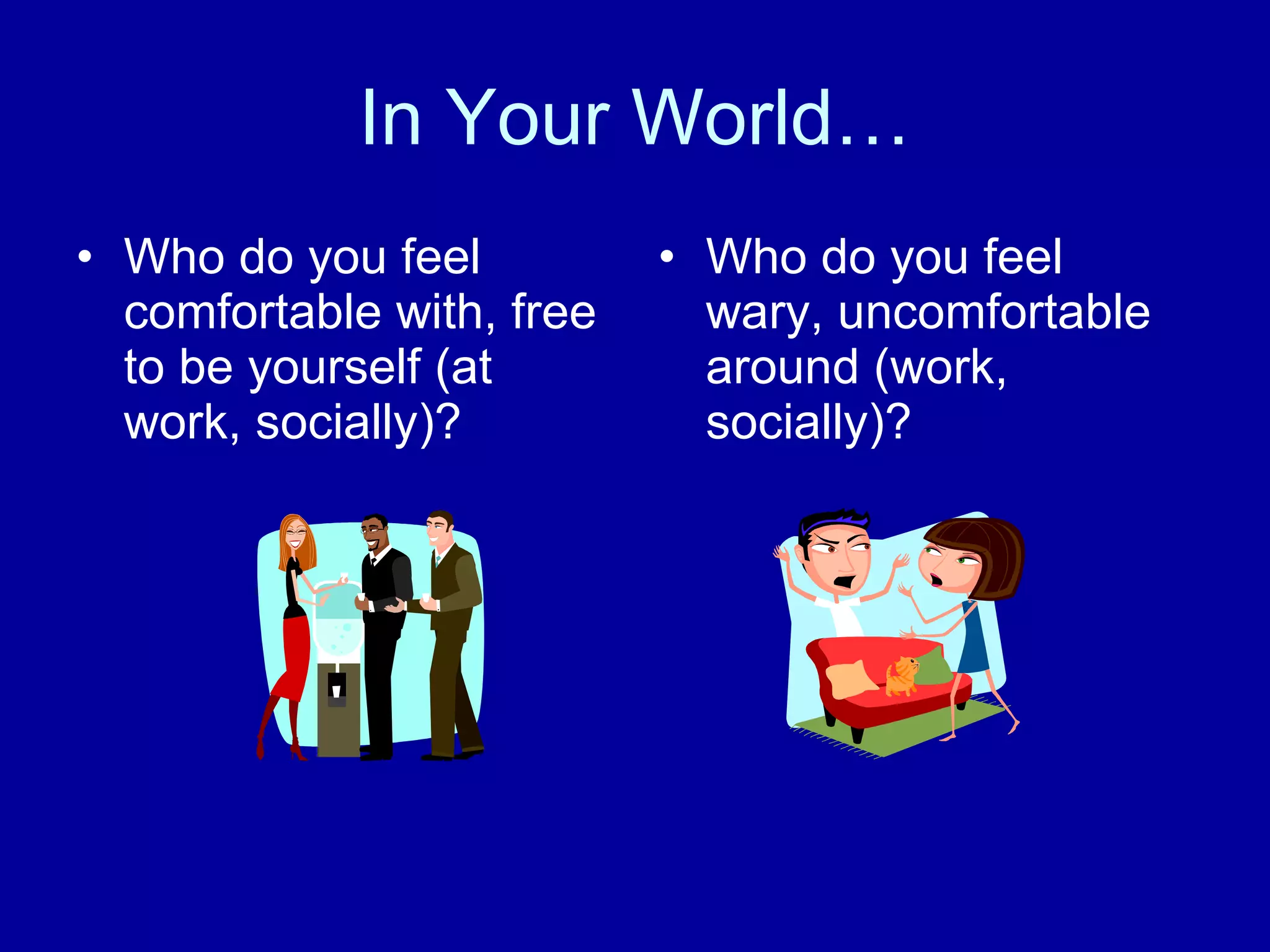
In Your World… Who do you feel comfortable with, free to be yourself (at work, socially)? Who do you feel  wary, uncomfortable  around (work, socially)?
WHY?  Let’s break it down… Behaviors? Verbal Nonverbal
The Gibb Categories of Defensive and Supportive Behaviors Jack Gibb 1914 – 1995 His Roots “From the hereafter to the here and now”
Published in 1978
What is a communication “climate?”
Communication Climate An atmosphere, an emotional “tone” in a relationship or situation Positive – “Face Saving” Low level of defensiveness  Negative – “Face Threatening” High level of defensiveness
Gibb’s Theory: You can alter the communication climate using Defensive and Supportive “Behaviors”
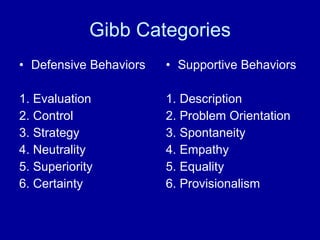
Gibb Categories Defensive Behaviors 1. Evaluation 2. Control 3. Strategy 4. Neutrality 5. Superiority 6. Certainty Supportive Behaviors 1. Description 2. Problem Orientation 3. Spontaneity 4. Empathy 5. Equality 6. Provisionalism
And this matters to me because? Competent Communicator Marital Satisfaction Job Satisfaction
Evaluation vs: Description Evaluation – arouses defensiveness “judgmental” statements “you” language “You make me so angry!” “You’re always late!”
Description Keep the focus on yourself (the speaker) “ I” language Describe, rather than “judge” “ I feel angry when you’re late and you don’t call, because I worry.” Note:  Nonverbal counts here, too!
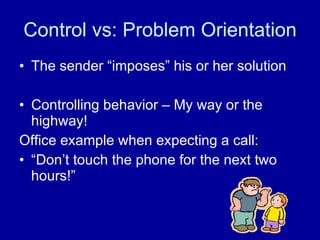
Control vs: Problem Orientation The sender “imposes” his or her solution Controlling behavior – My way or the highway! Office example when expecting a call: “Don’t touch the phone for the next two hours!”
Problem Orientation “We’re in this together” attitude Find a solution that meets the needs of all involved – not about “winning” “I’m expecting a really important call – is there a way we can keep the line open?”
Strategy vs: Spontaneity Defensiveness arises because speakers “hide” their ulterior motives Dishonest, manipulative A married couple: “Bernadette and Dan go out to dinner every week.”
Spontaneity  Say what you mean – simple honesty (careful here: this doesn’t mean every thought that pops into your head!) Don’t try to “package” your message for a desired response. “I’d really like to go out to dinner more often.” Note: Gibb is Western/low context – Cultural Component
Neutrality vs: Empathy “ Indifference” – impersonal Disconfirming  - conveys a lack of concern – the other person “doesn’t matter” A Student doesn’t get accepted to a 4 year school: “ Oh well, that’s the way it goes.” “ They treat me like a number”  UD vs.: NYU
Empathy  Accepting another’s feelings, putting  yourself in another’s place. Confirming because it shows support and understanding “ That’s really tough.  I know how hard you worked on your application.” Note: Nonverbal plays a huge role here
Superiority vs: Equality Recipe for defensiveness: Any message that suggests “I’m better than you.”  (Both verbal and nonverbal count) “ No, I just told you. That’s not the right way to do it.”
Equality You can be better at something, or know more, and still find ways to level the playing field, allow others to feel equal “If you want, I can show you a way that worked for me.”
Certainty vs: Provisionalism “I know it ALL.”  My opinion is correct, yours is not!”  Fundamentally disconfirming “That will never work!”
Provisionalism Speaker has opinions, but knows they don’t have a corner on the truth, willing to change their position “There could be some problems with that approach, but we could test it.” “I haven’t heard that before. Can you explain it a bit more?”
And remember: What works is not necessarily what comes naturally Becoming aware is the first step – do you see yourself ? It takes two, Gibb’s categories are not guaranteed BUT… The odds are in your favor when you take a supportive approach How would you like to be treated?
Thank you all for your time!

Supportive and defensive communication climates

  • 1.
    In Your World…Who do you feel comfortable with, free to be yourself (at work, socially)? Who do you feel wary, uncomfortable around (work, socially)?
  • 2.
    WHY? Let’sbreak it down… Behaviors? Verbal Nonverbal
  • 3.
    The Gibb Categoriesof Defensive and Supportive Behaviors Jack Gibb 1914 – 1995 His Roots “From the hereafter to the here and now”
  • 4.
  • 5.
    What is acommunication “climate?”
  • 6.
    Communication Climate Anatmosphere, an emotional “tone” in a relationship or situation Positive – “Face Saving” Low level of defensiveness Negative – “Face Threatening” High level of defensiveness
  • 7.
    Gibb’s Theory: Youcan alter the communication climate using Defensive and Supportive “Behaviors”
  • 8.
    Gibb Categories DefensiveBehaviors 1. Evaluation 2. Control 3. Strategy 4. Neutrality 5. Superiority 6. Certainty Supportive Behaviors 1. Description 2. Problem Orientation 3. Spontaneity 4. Empathy 5. Equality 6. Provisionalism
  • 9.
    And this mattersto me because? Competent Communicator Marital Satisfaction Job Satisfaction
  • 10.
    Evaluation vs: DescriptionEvaluation – arouses defensiveness “judgmental” statements “you” language “You make me so angry!” “You’re always late!”
  • 11.
    Description Keep thefocus on yourself (the speaker) “ I” language Describe, rather than “judge” “ I feel angry when you’re late and you don’t call, because I worry.” Note: Nonverbal counts here, too!
  • 12.
    Control vs: ProblemOrientation The sender “imposes” his or her solution Controlling behavior – My way or the highway! Office example when expecting a call: “Don’t touch the phone for the next two hours!”
  • 13.
    Problem Orientation “We’rein this together” attitude Find a solution that meets the needs of all involved – not about “winning” “I’m expecting a really important call – is there a way we can keep the line open?”
  • 14.
    Strategy vs: SpontaneityDefensiveness arises because speakers “hide” their ulterior motives Dishonest, manipulative A married couple: “Bernadette and Dan go out to dinner every week.”
  • 15.
    Spontaneity Saywhat you mean – simple honesty (careful here: this doesn’t mean every thought that pops into your head!) Don’t try to “package” your message for a desired response. “I’d really like to go out to dinner more often.” Note: Gibb is Western/low context – Cultural Component
  • 16.
    Neutrality vs: Empathy“ Indifference” – impersonal Disconfirming - conveys a lack of concern – the other person “doesn’t matter” A Student doesn’t get accepted to a 4 year school: “ Oh well, that’s the way it goes.” “ They treat me like a number” UD vs.: NYU
  • 17.
    Empathy Acceptinganother’s feelings, putting yourself in another’s place. Confirming because it shows support and understanding “ That’s really tough. I know how hard you worked on your application.” Note: Nonverbal plays a huge role here
  • 18.
    Superiority vs: EqualityRecipe for defensiveness: Any message that suggests “I’m better than you.” (Both verbal and nonverbal count) “ No, I just told you. That’s not the right way to do it.”
  • 19.
    Equality You canbe better at something, or know more, and still find ways to level the playing field, allow others to feel equal “If you want, I can show you a way that worked for me.”
  • 20.
    Certainty vs: Provisionalism“I know it ALL.” My opinion is correct, yours is not!” Fundamentally disconfirming “That will never work!”
  • 21.
    Provisionalism Speaker hasopinions, but knows they don’t have a corner on the truth, willing to change their position “There could be some problems with that approach, but we could test it.” “I haven’t heard that before. Can you explain it a bit more?”
  • 22.
    And remember: Whatworks is not necessarily what comes naturally Becoming aware is the first step – do you see yourself ? It takes two, Gibb’s categories are not guaranteed BUT… The odds are in your favor when you take a supportive approach How would you like to be treated?
  • 23.
    Thank you allfor your time!