





Listening SkillsPete Gowers
Marketing
September 2014
Introductions
• When the Ball is thrown to you:
• Tell us your name and something you like.
• Tell us the previous person’s name and what they like.
• Throw the ball back.
“There is a difference between listening and waiting for
your turn to speak.”
Simon Sinek
Why Listening?
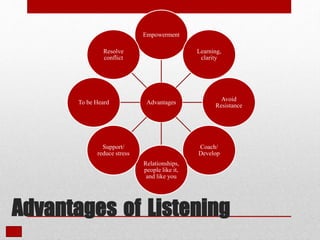
Advantages of Listening
Advantages
Empowerment
Learning,
clarity
Avoid
Resistance
Coach/
Develop
Relationships,
people like it,
and like you
Support/
reduce stress
To be Heard
Resolve
conflict
• Split into Pairs
• Either an A or a B – DON’T REVEAL YOUR
INSTRUCTIONS
• Follow the instructions
• You have 2 minutes
Listening Exercise
• A’s – Your job is simply to talk about yourself for 2
minutes. You can talk about what you did today or
yesterday or this week.
• B’s – The A’s are going to talk to you about their day or
week. Your job is to not listen. You shouldn’t make eye
contact, you shouldn’t show positive body language.
During the session, you should interject with something
about your day that ignores what they’ve said.
Listening Exercise
Listening Exercise Review
• How did it feel for the talkers?
• How did it feel for the listeners?
• Do we know anyone like that?
• No names please especially not us.
Listening
• Hearing- physical process; natural; passive
• Listening- physical & mental process; active; learned
process; a skill
Listening
How do you improve things?
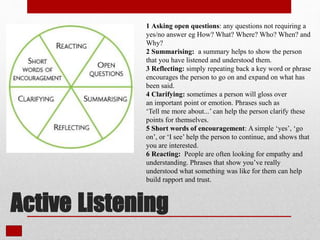
Active Listening
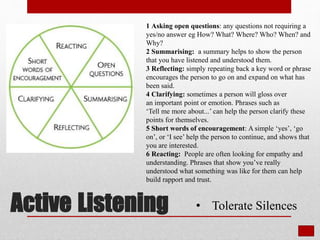
1 Asking open questions: any questions not requiring a
yes/no answer eg How? What? Where? Who? When? and
Why?
2 Summarising: a summary helps to show the person
that you have listened and understood them.
3 Reflecting: simply repeating back a key word or phrase
encourages the person to go on and expand on what has
been said.
4 Clarifying: sometimes a person will gloss over
an important point or emotion. Phrases such as
‘Tell me more about...’ can help the person clarify these
points for themselves.
5 Short words of encouragement: A simple ‘yes’, ‘go
on’, or ‘I see’ help the person to continue, and shows that
you are interested.
6 Reacting: People are often looking for empathy and
understanding. Phrases that show you’ve really
understood what something was like for them can help
build rapport and trust.
• Tolerate Silences
• This time, B’s use the active listening techniques
• 1 minute only
• How did it feel this time?
Repeat Listening exercise
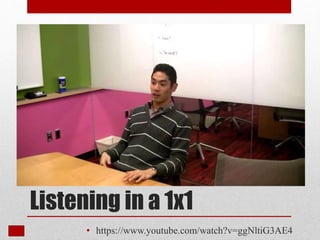
Listening in a 1x1
• https://www.youtube.com/watch?v=ggNltiG3AE4
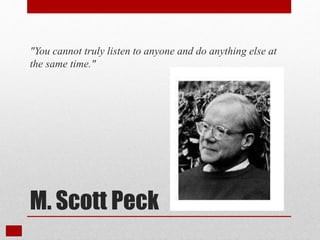
M. Scott Peck
"You cannot truly listen to anyone and do anything else at
the same time."
Problems in 1x1’s
• Unclear Objectives
• Missed Objectives/tasks
• Employee not feeling supported
• Supervisor can feel pressure to fix employee issues
• Feeling criticised – both sides?
• Lack of learning
Problems in 1x1’s
How do you improve things?
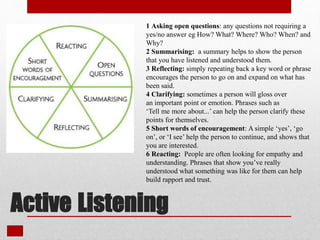
Active Listening
1 Asking open questions: any questions not requiring a
yes/no answer eg How? What? Where? Who? When? and
Why?
2 Summarising: a summary helps to show the person
that you have listened and understood them.
3 Reflecting: simply repeating back a key word or phrase
encourages the person to go on and expand on what has
been said.
4 Clarifying: sometimes a person will gloss over
an important point or emotion. Phrases such as
‘Tell me more about...’ can help the person clarify these
points for themselves.
5 Short words of encouragement: A simple ‘yes’, ‘go
on’, or ‘I see’ help the person to continue, and shows that
you are interested.
6 Reacting: People are often looking for empathy and
understanding. Phrases that show you’ve really
understood what something was like for them can help
build rapport and trust.
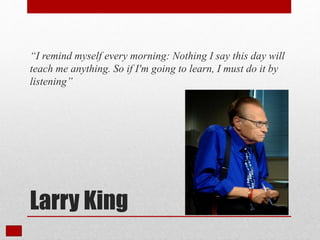
Larry King
“I remind myself every morning: Nothing I say this day will
teach me anything. So if I'm going to learn, I must do it by
listening”
Body Language
• http://www.youtube.com/watch?v=3sO84bGgra8
Body Language Discussion
• What did you think?
• Any other thoughts on body language?
• Focus
• Manage distractions
• Eye contact
• Mirroring
• Physical openness
• Aware of fiddling
• Cultural awareness – Not everyone is the same, eye contact in
particular tends to be a western thing
Body Language Discussion
https://www.youtube.com/watch?v=Qg8PIK74KO4
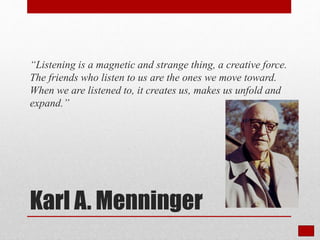
Karl A. Menninger
“Listening is a magnetic and strange thing, a creative force.
The friends who listen to us are the ones we move toward.
When we are listened to, it creates us, makes us unfold and
expand.”
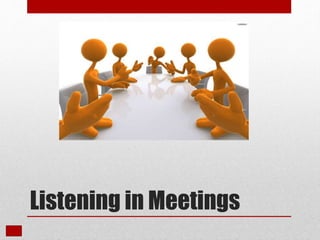
Listening in Meetings
• https://www.youtube.com/watch?v=IfsN_ijocCM&t=7s&list=PLW90tNRmbHi5CpUJAUO
UzttW4z6CG40Fr&index=2
Listening in Meetings
What can go wrong in Meetings?
Listening in Meetings
• Quiet people not heard
• Valuable meeting content lost
• Lack of agreement or moving forward to consensus
• Lack of buy in to agreements
• Emotive Language, frustration
• Lack of Learning
• Volume or personality wins over quality of idea/argument
• Individuals feeling unvalued
• Multiple conversations and distraction/lack of focus
• Don’t stop at yes
Listening in Meetings
How do you improve things?
Active Listening
1 Asking open questions: any questions not requiring a
yes/no answer eg How? What? Where? Who? When? and
Why?
2 Summarising: a summary helps to show the person
that you have listened and understood them.
3 Reflecting: simply repeating back a key word or phrase
encourages the person to go on and expand on what has
been said.
4 Clarifying: sometimes a person will gloss over
an important point or emotion. Phrases such as
‘Tell me more about...’ can help the person clarify these
points for themselves.
5 Short words of encouragement: A simple ‘yes’, ‘go
on’, or ‘I see’ help the person to continue, and shows that
you are interested.
6 Reacting: People are often looking for empathy and
understanding. Phrases that show you’ve really
understood what something was like for them can help
build rapport and trust.
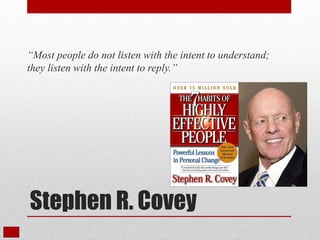
Stephen R. Covey
“Most people do not listen with the intent to understand;
they listen with the intent to reply.”
Supporting Others Scenarios
Scenarios where we may need or
want to support others?
Supporting Others Scenarios
• Overloaded
• Issues with others
• Issues outside of work
• Don’t know how to do something
• Feeling Alone
• Ruminating, not moving forward
• Stress/Anxiety/Depression
Supporting Others - Goes wrong
What can go wrong when
supporting others?
Supporting Others - Goes wrong
• People can feel judged
• People can feel you don’t believe in them
• People can’t take on board advice even if valuable
• Results of advice is givers fault
• People can feel they’re not important enough
• People can feel exposed by sharing
• People can feel unsupported even when someone is trying
• Dependency
Supporting Others - Goes wrong
How do you improve things?
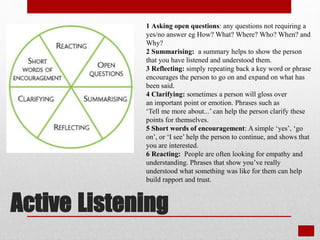
Active Listening
1 Asking open questions: any questions not requiring a
yes/no answer eg How? What? Where? Who? When? and
Why?
2 Summarising: a summary helps to show the person
that you have listened and understood them.
3 Reflecting: simply repeating back a key word or phrase
encourages the person to go on and expand on what has
been said.
4 Clarifying: sometimes a person will gloss over
an important point or emotion. Phrases such as
‘Tell me more about...’ can help the person clarify these
points for themselves.
5 Short words of encouragement: A simple ‘yes’, ‘go
on’, or ‘I see’ help the person to continue, and shows that
you are interested.
6 Reacting: People are often looking for empathy and
understanding. Phrases that show you’ve really
understood what something was like for them can help
build rapport and trust.
A Poem
"Will you please just listen?
When I ask you to listen and you start giving advice, you have not done what I have
asked.
When I ask you to listen and you start telling me why I shouldn't feel the way I do, you
are invalidating my feelings.
When I ask you to listen and you start trying to solve my problem, I feel underestimated
and disempowered.
When I ask you to listen and you start telling me what I need to do I feel offended,
pressured and controlled.
When I ask you to listen, it does not mean I am helpless. I may be faltering, depressed
or discouraged, but I am not helpless.
When I ask you to listen and you do things which I can and need to do for myself, you
hurt my self-esteem.
But when you accept the way I feel, then I don't need to spend time and energy trying to
defend myself or convince you, and I can focus on figuring out why I feel the way I feel
and what to do about it.
And when I do that, I don't need advice, just support, trust and encouragement.
Please remember that what you think are "irrational feelings" always make sense if you
take time to listen and understand me. “
Find Out More
• Youtube
• FLN/Skillsoft
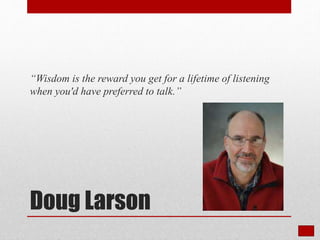
Doug Larson
“Wisdom is the reward you get for a lifetime of listening
when you'd have preferred to talk.”
Thank You!!
“Remember, you’re not missing a chance to make a point, you’re
creating a chance to make a better one.”
Unknown.

Listening skills

  • 1.
  • 2.
    Introductions • When theBall is thrown to you: • Tell us your name and something you like. • Tell us the previous person’s name and what they like. • Throw the ball back.
  • 3.
    “There is adifference between listening and waiting for your turn to speak.” Simon Sinek
  • 4.
  • 5.
  • 6.
    • Split intoPairs • Either an A or a B – DON’T REVEAL YOUR INSTRUCTIONS • Follow the instructions • You have 2 minutes Listening Exercise
  • 7.
    • A’s –Your job is simply to talk about yourself for 2 minutes. You can talk about what you did today or yesterday or this week. • B’s – The A’s are going to talk to you about their day or week. Your job is to not listen. You shouldn’t make eye contact, you shouldn’t show positive body language. During the session, you should interject with something about your day that ignores what they’ve said. Listening Exercise
  • 8.
    Listening Exercise Review •How did it feel for the talkers? • How did it feel for the listeners? • Do we know anyone like that? • No names please especially not us.
  • 9.
    Listening • Hearing- physicalprocess; natural; passive • Listening- physical & mental process; active; learned process; a skill
  • 10.
    Listening How do youimprove things?
  • 11.
    Active Listening 1 Askingopen questions: any questions not requiring a yes/no answer eg How? What? Where? Who? When? and Why? 2 Summarising: a summary helps to show the person that you have listened and understood them. 3 Reflecting: simply repeating back a key word or phrase encourages the person to go on and expand on what has been said. 4 Clarifying: sometimes a person will gloss over an important point or emotion. Phrases such as ‘Tell me more about...’ can help the person clarify these points for themselves. 5 Short words of encouragement: A simple ‘yes’, ‘go on’, or ‘I see’ help the person to continue, and shows that you are interested. 6 Reacting: People are often looking for empathy and understanding. Phrases that show you’ve really understood what something was like for them can help build rapport and trust. • Tolerate Silences
  • 12.
    • This time,B’s use the active listening techniques • 1 minute only • How did it feel this time? Repeat Listening exercise
  • 13.
    Listening in a1x1 • https://www.youtube.com/watch?v=ggNltiG3AE4
  • 14.
    M. Scott Peck "Youcannot truly listen to anyone and do anything else at the same time."
  • 15.
    Problems in 1x1’s •Unclear Objectives • Missed Objectives/tasks • Employee not feeling supported • Supervisor can feel pressure to fix employee issues • Feeling criticised – both sides? • Lack of learning
  • 16.
    Problems in 1x1’s Howdo you improve things?
  • 17.
    Active Listening 1 Askingopen questions: any questions not requiring a yes/no answer eg How? What? Where? Who? When? and Why? 2 Summarising: a summary helps to show the person that you have listened and understood them. 3 Reflecting: simply repeating back a key word or phrase encourages the person to go on and expand on what has been said. 4 Clarifying: sometimes a person will gloss over an important point or emotion. Phrases such as ‘Tell me more about...’ can help the person clarify these points for themselves. 5 Short words of encouragement: A simple ‘yes’, ‘go on’, or ‘I see’ help the person to continue, and shows that you are interested. 6 Reacting: People are often looking for empathy and understanding. Phrases that show you’ve really understood what something was like for them can help build rapport and trust.
  • 18.
    Larry King “I remindmyself every morning: Nothing I say this day will teach me anything. So if I'm going to learn, I must do it by listening”
  • 19.
  • 20.
    Body Language Discussion •What did you think? • Any other thoughts on body language? • Focus • Manage distractions • Eye contact • Mirroring • Physical openness • Aware of fiddling • Cultural awareness – Not everyone is the same, eye contact in particular tends to be a western thing
  • 21.
  • 22.
    Karl A. Menninger “Listeningis a magnetic and strange thing, a creative force. The friends who listen to us are the ones we move toward. When we are listened to, it creates us, makes us unfold and expand.”
  • 23.
  • 24.
    Listening in Meetings •https://www.youtube.com/watch?v=IfsN_ijocCM&t=7s&list=PLW90tNRmbHi5CpUJAUO UzttW4z6CG40Fr&index=2
  • 25.
    Listening in Meetings Whatcan go wrong in Meetings?
  • 26.
    Listening in Meetings •Quiet people not heard • Valuable meeting content lost • Lack of agreement or moving forward to consensus • Lack of buy in to agreements • Emotive Language, frustration • Lack of Learning • Volume or personality wins over quality of idea/argument • Individuals feeling unvalued • Multiple conversations and distraction/lack of focus • Don’t stop at yes
  • 27.
    Listening in Meetings Howdo you improve things?
  • 28.
    Active Listening 1 Askingopen questions: any questions not requiring a yes/no answer eg How? What? Where? Who? When? and Why? 2 Summarising: a summary helps to show the person that you have listened and understood them. 3 Reflecting: simply repeating back a key word or phrase encourages the person to go on and expand on what has been said. 4 Clarifying: sometimes a person will gloss over an important point or emotion. Phrases such as ‘Tell me more about...’ can help the person clarify these points for themselves. 5 Short words of encouragement: A simple ‘yes’, ‘go on’, or ‘I see’ help the person to continue, and shows that you are interested. 6 Reacting: People are often looking for empathy and understanding. Phrases that show you’ve really understood what something was like for them can help build rapport and trust.
  • 29.
    Stephen R. Covey “Mostpeople do not listen with the intent to understand; they listen with the intent to reply.”
  • 30.
    Supporting Others Scenarios Scenarioswhere we may need or want to support others?
  • 31.
    Supporting Others Scenarios •Overloaded • Issues with others • Issues outside of work • Don’t know how to do something • Feeling Alone • Ruminating, not moving forward • Stress/Anxiety/Depression
  • 32.
    Supporting Others -Goes wrong What can go wrong when supporting others?
  • 33.
    Supporting Others -Goes wrong • People can feel judged • People can feel you don’t believe in them • People can’t take on board advice even if valuable • Results of advice is givers fault • People can feel they’re not important enough • People can feel exposed by sharing • People can feel unsupported even when someone is trying • Dependency
  • 34.
    Supporting Others -Goes wrong How do you improve things?
  • 35.
    Active Listening 1 Askingopen questions: any questions not requiring a yes/no answer eg How? What? Where? Who? When? and Why? 2 Summarising: a summary helps to show the person that you have listened and understood them. 3 Reflecting: simply repeating back a key word or phrase encourages the person to go on and expand on what has been said. 4 Clarifying: sometimes a person will gloss over an important point or emotion. Phrases such as ‘Tell me more about...’ can help the person clarify these points for themselves. 5 Short words of encouragement: A simple ‘yes’, ‘go on’, or ‘I see’ help the person to continue, and shows that you are interested. 6 Reacting: People are often looking for empathy and understanding. Phrases that show you’ve really understood what something was like for them can help build rapport and trust.
  • 36.
    A Poem "Will youplease just listen? When I ask you to listen and you start giving advice, you have not done what I have asked. When I ask you to listen and you start telling me why I shouldn't feel the way I do, you are invalidating my feelings. When I ask you to listen and you start trying to solve my problem, I feel underestimated and disempowered. When I ask you to listen and you start telling me what I need to do I feel offended, pressured and controlled. When I ask you to listen, it does not mean I am helpless. I may be faltering, depressed or discouraged, but I am not helpless. When I ask you to listen and you do things which I can and need to do for myself, you hurt my self-esteem. But when you accept the way I feel, then I don't need to spend time and energy trying to defend myself or convince you, and I can focus on figuring out why I feel the way I feel and what to do about it. And when I do that, I don't need advice, just support, trust and encouragement. Please remember that what you think are "irrational feelings" always make sense if you take time to listen and understand me. “
  • 37.
    Find Out More •Youtube • FLN/Skillsoft
  • 38.
    Doug Larson “Wisdom isthe reward you get for a lifetime of listening when you'd have preferred to talk.”
  • 39.
    Thank You!! “Remember, you’renot missing a chance to make a point, you’re creating a chance to make a better one.” Unknown.

Editor's Notes