Dr R.K Ludam
Dept Of Community Medicine
V.S.S.M.C.H Burla
Housing And Ventilation
Housing
 “Housing “ in modern concept includes not
only the physical structure providing shelter
but also the immediate surroundings and the
related community services and facilities.
 It may be defined as-” all places in which a
group of people reside and pursue their life
goals; the size of settlement varies from a
single family to millions of people.
 The immediate surroundings of residential
building are often referred as neighborhood
 WHO expert group (1961) on public health
aspects of housing prefers to use the term
;residential environment’
Social Goals Of Housing-:
a) Shelter
b) Family Life
c) Access to community facilities
d) Family participation in community life
e) Economic Stability
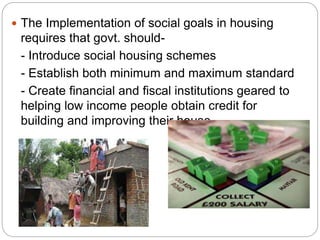
 The Implementation of social goals in housing
requires that govt. should-
- Introduce social housing schemes
- Establish both minimum and maximum standard
- Create financial and fiscal institutions geared to
helping low income people obtain credit for
building and improving their house.
Criteria for healthful housing-:
 Healthful housing provides physical protection and
shelter
 Provides adequately for cooking,eating,washing,and
excretory functions
 Is designed,constructed,mantained and used in a
manner such as to prevent the spread of
communicable diseases
 Provides for protection from hazards of exposure to
noise and pollution
 Is free from unsafe physical arrangements due to
construction or mantainance,and from toxic or
harmful materials
Housing Standard-:
 Social and economic characteristics such as family
income, family size and composition, standard of
living,lifestyle,stage in life cycle, education and
cultural factors are taken into account.
 Because of cultural diversity and other factors such
as climate and social traditions, standard of housing
varies from country to country and from region to
region.
 In short-there cannot be rigid, uniform standards
 The standards in India are those recommended by
the EHC(1947)
 Site-:
- should be elevated from its surroundings
- should have an independent access to a street of
adequate width
- should be away from breeding places of mosquito
and flies
- should be away from nuisances such as
dust,smoke,smell,excessive noise, and traffic.
- should be in pleasant surrounding
- soil should be dry and safe for founding the structure
and should be well drained.
- The sub-soil water should be below 1o feet
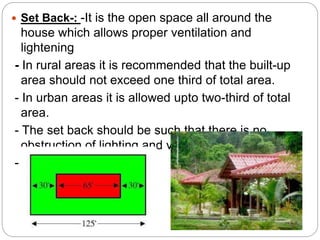
 Set Back-: -It is the open space all around the
house which allows proper ventilation and
lightening
- In rural areas it is recommended that the built-up
area should not exceed one third of total area.
- In urban areas it is allowed upto two-third of total
area.
- The set back should be such that there is no
obstruction of lighting and ventilation.
- e.g.
 Floor-: -Should be Pucca and satisfy the following
criteria-:
- should be impermeable ,so that easy to clean and
dry
- must be smooth and free from cracks and crevices
to prevent the breeding of insects and harbourage
of dust
- it should be damp-proof
- the height of the plinth should be 2-3 feet(0.6 t o 1
mtr)
 Walls-: - reasonably strong
- should have a low heat capacity
- weather resistance
- unsuitable for harbor of rats and vermin
 Roof-: -Should not be less than 10 feet (3 mtr) in the
absence of air-conditioning for comfort.
- should have a low heat transmittance co-efficient
 Rooms-: - should not be less than two,atleast one of
them can be closed for security
- the other may be open on one side if that side is a
private courtyard
- No. should be increased as per the family members
 Floor Area-: - should be at least 120 sq ft for more
than one person and at least 100 sq ft for single
person
- floor area per person should not be less than 50 sq
mtr
 Cubic Space-:at least 500 c.ft per capita preferably
1000 c.ft
 Windows-: every living room should be provided with
atleast 2 windows and one of them should open directly
on to an open space
- the windows should be placed at a height of more than
3 feet(1 m) above the ground in living rooms
- windows area should be 1/5th of the floor area doors
and windows combined should have 2/5th the floor area.
 Lighting-:the daylight factor should exceed 1 % over half
the floor area.
 Kitchen-: Must have a separate kitchen
- Must be protected against dust and smoke,
adequately lighted, provided with water supply, provided
with a sink for washing utensils and fitted with
arrangements for proper drainage
 Privy-: A sanitary privy is a must for every house,
belonging exclusively to it and readily accessible.
 Garbage and refuse-:Should be removed from the
dwelling at least daily and disposed of in a sanitary
manner
 Bathing and Washing-: house should have facility for
bathing and washing belonging exclusively to it and
providing proper privacy
 Water Supply-: House should have a safe and
adequate water supply available at all times.
RURAL HOUSING-: Minimum standard
suggested-:
- There should be at least two living rooms
- Ample verandah space may be provided
- The build-up area should not exceed one-third of total
area
- There should be a separate kitchen with a paved sink
or platform for washing utensils
 The house should be provided with a sanitary latrine
 The window area should be at least 10% of the floor
area
 There should be a sanitary well or a tube well within a
quarter of a ample from the house
 It is insanitary to keep cattle and livestock in dwelling
house. Cattle sheds should be at least 25 feet away
from dwelling houses. A cattle shed should be open on
all sides an area 8ft×4ft is sufficient for each head of
cattle
 There should be adequate arrangement for the disposal
of waste water, refuse and garbage.
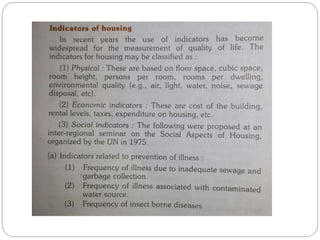
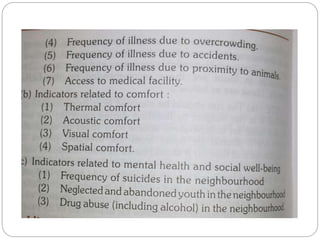
Housing and Health
- Poor housing is associated with the following health
conditions-:
 Respiratory Infection
 Skin infection
 Rat infestation
 Arthropods
 Accidents
 Morbidity and Mortality
 Psychological effects
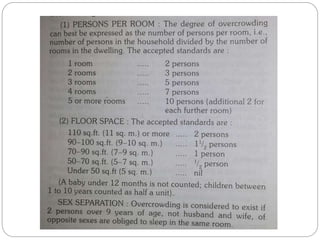
Overcrowding
 It refers to the situation in which more people and living
within a single dwelling than there is space for, so that
movement is restricted, privacy secluded, hygiene
impossible rest and sleep difficult.
 Overcrowding is a health problem in human dwelling.
 It may promote the spread of respiratory infections such
as TB,Influenza and Diphtheria.
Public Policy
 House site and construction assistance
 Indira Awas Yojna (IAY)-: Introduced in central sector in
1985-86 as part of the rural landless employment
guarantee programme.
-one room, one kitchen attached with latrine, bathroom
and a smokeless chullah.
-----------------XXXXX-------------------
VENTILATION
 It not only means the replacement of vitiated air by
a supply of fresh outdoor air but also control of the
quality of incoming air with regard to its
temperature, humidity and purity with a view to
provide a thermal environment that is comfortable
and free from risk of infection.
 Standards Of Ventilation-: Most of the standards
of ventilation have been based on the efficiency of
ventilation in removing body odour.
1) Cubic Space-: minimal fresh air supply ranging
from ‘300’ to ‘3000' c.ft. per hour per person
- De Chaumont advocated a fresh air supply of 3000
c.ft per person per hour.
2) Air Change-: Air change is more important than
the cubic space requirement.
- It is recommended that in the living rooms, there
should be 2 to 3 air changes in one hour; in work
rooms and assemblies 4 to 6 air changes.
 If the air is changed more frequently. i.e. More than
6 times in one hour, it is likely to produce a draught
and should be avoided.
 The number of air changes per hour is calculated by
dividing the total hourly air supply to the room by
the cubic capacity of the room
 a space of 1,000 to 1,200 c.ft. per person is quite
sufficient.
3)Floor space-:Floor space per person is even more
important than cubic space.
- The optimum floor space requirements per person
vary from 50 to 100 sq.ft.
Types Of Ventilation-:
1. Natural Ventilation-: Natural ventilation is the
simplest system of ventilating small dwellings,
schools and offices.
 A)The Wind-: The wind is an active force in
ventilation.
- when it blows through a room, it is called
perflation.
- When there is an obstruction, it bypasses and
exerts a suction action at its tail end - this is called
B) DIFFUSION : Air passes through the smallest
openings or spaces by diffusion.
- This is a slow process and therefore, is not relied
upon as the sole means of ventilation.
C) INEQUALITY OF TEMPERATURE : Air flows from
high density to low density
- The greater the temperature difference between
outside and inside air, the greater the velocity of the
incoming air
These properties of air are utilised to best
advantage by the proper location of windows,
doors,ventilaiors and skylights.
The chief drawback of natural ventilation is that it is
not possible to regulate the velocity
 Mechanical Ventilation-:
- Types-: 1) Exhaust ventilation (2) Plenum
ventilation 3) Balanced ventilation (4) Air
conditioning.
1)Exhaust Ventilation-: In this system, air is extracted
or exhausted to the outside by exhaust fans driven
by electricity.
- As air is exhausted, a vacuum is created which
induces fresh air to enter the room through
windows, doors and other inlets.
- Exhaust ventilation is generally provided in large
halls and auditoria for removal of vitiated air.
- The exhaust fans are housed in apertures in the
external walls, high up near the roof which facilitate
2)PLENUM VENTILATION-: In this system, fresh air
is blown into the room by centrifugal fans so as to
create a positive pressure, and displace the
vitiated air. Plenum or propulsion
- plenum is used for supplying air to air-conditioned
buildings and factories.
- Air is delivered through ducts at desired points.
3) BALANCED VENTILATION-: This is a
combination of the exhaust and plenum systems of
ventilation.
- The blowing fan must balance the exhaust fan.
 4) AIR CONDITIONING -: Air conditioning is defined
as "the simultaneous control of all”( i.e.-
temperature, humidity, air movement, distribution,
dust, bacteria, odours and toxic gases, most of
which affect in greater or lesser degree the human
health and comfort.)
- Air conditioning is popular in large institutions,
hospitals, industries and dwellings.
- Its use in operation theatres is of particular value in
control of pathogenic organisms in the air.
- Large institutions or hospitals often install central air
conditioning system for entire building
- Where the temperature difference is large between
outside atmosphere and air conditioned room,
"transition room" is sometimes provided.
Housing & Ventilation

Housing & Ventilation

  • 1.
    Dr R.K Ludam DeptOf Community Medicine V.S.S.M.C.H Burla Housing And Ventilation
  • 2.
    Housing  “Housing “in modern concept includes not only the physical structure providing shelter but also the immediate surroundings and the related community services and facilities.  It may be defined as-” all places in which a group of people reside and pursue their life goals; the size of settlement varies from a single family to millions of people.  The immediate surroundings of residential building are often referred as neighborhood
  • 3.
     WHO expertgroup (1961) on public health aspects of housing prefers to use the term ;residential environment’ Social Goals Of Housing-: a) Shelter b) Family Life c) Access to community facilities d) Family participation in community life e) Economic Stability
  • 4.
     The Implementationof social goals in housing requires that govt. should- - Introduce social housing schemes - Establish both minimum and maximum standard - Create financial and fiscal institutions geared to helping low income people obtain credit for building and improving their house.
  • 5.
    Criteria for healthfulhousing-:  Healthful housing provides physical protection and shelter  Provides adequately for cooking,eating,washing,and excretory functions  Is designed,constructed,mantained and used in a manner such as to prevent the spread of communicable diseases  Provides for protection from hazards of exposure to noise and pollution  Is free from unsafe physical arrangements due to construction or mantainance,and from toxic or harmful materials
  • 6.
    Housing Standard-:  Socialand economic characteristics such as family income, family size and composition, standard of living,lifestyle,stage in life cycle, education and cultural factors are taken into account.  Because of cultural diversity and other factors such as climate and social traditions, standard of housing varies from country to country and from region to region.  In short-there cannot be rigid, uniform standards  The standards in India are those recommended by the EHC(1947)
  • 7.
     Site-: - shouldbe elevated from its surroundings - should have an independent access to a street of adequate width - should be away from breeding places of mosquito and flies - should be away from nuisances such as dust,smoke,smell,excessive noise, and traffic. - should be in pleasant surrounding - soil should be dry and safe for founding the structure and should be well drained. - The sub-soil water should be below 1o feet
  • 8.
     Set Back-:-It is the open space all around the house which allows proper ventilation and lightening - In rural areas it is recommended that the built-up area should not exceed one third of total area. - In urban areas it is allowed upto two-third of total area. - The set back should be such that there is no obstruction of lighting and ventilation. - e.g.
  • 9.
     Floor-: -Shouldbe Pucca and satisfy the following criteria-: - should be impermeable ,so that easy to clean and dry - must be smooth and free from cracks and crevices to prevent the breeding of insects and harbourage of dust - it should be damp-proof - the height of the plinth should be 2-3 feet(0.6 t o 1 mtr)  Walls-: - reasonably strong - should have a low heat capacity - weather resistance - unsuitable for harbor of rats and vermin
  • 10.
     Roof-: -Shouldnot be less than 10 feet (3 mtr) in the absence of air-conditioning for comfort. - should have a low heat transmittance co-efficient  Rooms-: - should not be less than two,atleast one of them can be closed for security - the other may be open on one side if that side is a private courtyard - No. should be increased as per the family members  Floor Area-: - should be at least 120 sq ft for more than one person and at least 100 sq ft for single person - floor area per person should not be less than 50 sq mtr
  • 11.
     Cubic Space-:atleast 500 c.ft per capita preferably 1000 c.ft  Windows-: every living room should be provided with atleast 2 windows and one of them should open directly on to an open space - the windows should be placed at a height of more than 3 feet(1 m) above the ground in living rooms - windows area should be 1/5th of the floor area doors and windows combined should have 2/5th the floor area.
  • 12.
     Lighting-:the daylightfactor should exceed 1 % over half the floor area.  Kitchen-: Must have a separate kitchen - Must be protected against dust and smoke, adequately lighted, provided with water supply, provided with a sink for washing utensils and fitted with arrangements for proper drainage  Privy-: A sanitary privy is a must for every house, belonging exclusively to it and readily accessible.  Garbage and refuse-:Should be removed from the dwelling at least daily and disposed of in a sanitary manner
  • 13.
     Bathing andWashing-: house should have facility for bathing and washing belonging exclusively to it and providing proper privacy  Water Supply-: House should have a safe and adequate water supply available at all times. RURAL HOUSING-: Minimum standard suggested-: - There should be at least two living rooms - Ample verandah space may be provided - The build-up area should not exceed one-third of total area - There should be a separate kitchen with a paved sink or platform for washing utensils
  • 14.
     The houseshould be provided with a sanitary latrine  The window area should be at least 10% of the floor area  There should be a sanitary well or a tube well within a quarter of a ample from the house  It is insanitary to keep cattle and livestock in dwelling house. Cattle sheds should be at least 25 feet away from dwelling houses. A cattle shed should be open on all sides an area 8ft×4ft is sufficient for each head of cattle  There should be adequate arrangement for the disposal of waste water, refuse and garbage.
  • 15.
    Housing and Health -Poor housing is associated with the following health conditions-:  Respiratory Infection  Skin infection  Rat infestation  Arthropods  Accidents  Morbidity and Mortality  Psychological effects
  • 16.
    Overcrowding  It refersto the situation in which more people and living within a single dwelling than there is space for, so that movement is restricted, privacy secluded, hygiene impossible rest and sleep difficult.  Overcrowding is a health problem in human dwelling.  It may promote the spread of respiratory infections such as TB,Influenza and Diphtheria.
  • 20.
    Public Policy  Housesite and construction assistance  Indira Awas Yojna (IAY)-: Introduced in central sector in 1985-86 as part of the rural landless employment guarantee programme. -one room, one kitchen attached with latrine, bathroom and a smokeless chullah. -----------------XXXXX-------------------
  • 21.
  • 22.
     It notonly means the replacement of vitiated air by a supply of fresh outdoor air but also control of the quality of incoming air with regard to its temperature, humidity and purity with a view to provide a thermal environment that is comfortable and free from risk of infection.  Standards Of Ventilation-: Most of the standards of ventilation have been based on the efficiency of ventilation in removing body odour. 1) Cubic Space-: minimal fresh air supply ranging from ‘300’ to ‘3000' c.ft. per hour per person - De Chaumont advocated a fresh air supply of 3000 c.ft per person per hour.
  • 23.
    2) Air Change-:Air change is more important than the cubic space requirement. - It is recommended that in the living rooms, there should be 2 to 3 air changes in one hour; in work rooms and assemblies 4 to 6 air changes.  If the air is changed more frequently. i.e. More than 6 times in one hour, it is likely to produce a draught and should be avoided.  The number of air changes per hour is calculated by dividing the total hourly air supply to the room by the cubic capacity of the room  a space of 1,000 to 1,200 c.ft. per person is quite sufficient.
  • 24.
    3)Floor space-:Floor spaceper person is even more important than cubic space. - The optimum floor space requirements per person vary from 50 to 100 sq.ft. Types Of Ventilation-: 1. Natural Ventilation-: Natural ventilation is the simplest system of ventilating small dwellings, schools and offices.  A)The Wind-: The wind is an active force in ventilation. - when it blows through a room, it is called perflation. - When there is an obstruction, it bypasses and exerts a suction action at its tail end - this is called
  • 25.
    B) DIFFUSION :Air passes through the smallest openings or spaces by diffusion. - This is a slow process and therefore, is not relied upon as the sole means of ventilation. C) INEQUALITY OF TEMPERATURE : Air flows from high density to low density - The greater the temperature difference between outside and inside air, the greater the velocity of the incoming air These properties of air are utilised to best advantage by the proper location of windows, doors,ventilaiors and skylights. The chief drawback of natural ventilation is that it is not possible to regulate the velocity
  • 26.
     Mechanical Ventilation-: -Types-: 1) Exhaust ventilation (2) Plenum ventilation 3) Balanced ventilation (4) Air conditioning. 1)Exhaust Ventilation-: In this system, air is extracted or exhausted to the outside by exhaust fans driven by electricity. - As air is exhausted, a vacuum is created which induces fresh air to enter the room through windows, doors and other inlets. - Exhaust ventilation is generally provided in large halls and auditoria for removal of vitiated air. - The exhaust fans are housed in apertures in the external walls, high up near the roof which facilitate
  • 27.
    2)PLENUM VENTILATION-: Inthis system, fresh air is blown into the room by centrifugal fans so as to create a positive pressure, and displace the vitiated air. Plenum or propulsion - plenum is used for supplying air to air-conditioned buildings and factories. - Air is delivered through ducts at desired points. 3) BALANCED VENTILATION-: This is a combination of the exhaust and plenum systems of ventilation. - The blowing fan must balance the exhaust fan.
  • 28.
     4) AIRCONDITIONING -: Air conditioning is defined as "the simultaneous control of all”( i.e.- temperature, humidity, air movement, distribution, dust, bacteria, odours and toxic gases, most of which affect in greater or lesser degree the human health and comfort.) - Air conditioning is popular in large institutions, hospitals, industries and dwellings. - Its use in operation theatres is of particular value in control of pathogenic organisms in the air. - Large institutions or hospitals often install central air conditioning system for entire building - Where the temperature difference is large between outside atmosphere and air conditioned room, "transition room" is sometimes provided.