Housing
Dr. Novmeet
Assistant Professor
Community Medicine
MM Medical College & Hospital, Solan
Housing
 Housing “ in modern concept includes
 the physical structure providing shelter, as well as
 the immediate surroundings and the related community services
and facilities
In the past it was called as Human settlement which was
defined as- all places in which a group of people reside
and pursue their life goals.
But the size of settlement varies from a single family to
millions of people.
 WHO expert group (1961) on public health aspects
of housing prefers to use the term residential
environment, which is defined as the physical
structure including all necessary services,
facilities, equipment and devices needed or
desired for the physical and mental health and
social well being of the family and individual.
Social Goals Of Housing
 Shelter
 Family Life : Adequate space for family life and
related activities – preparation of food, meeting,
sleeping etc.
 Access to community facilities : such as Health
services, shopping area, school etc.
 Family participation in community life : family is a
part of larger community.
 Economic Stability :House is a form of investment of
personal savings.
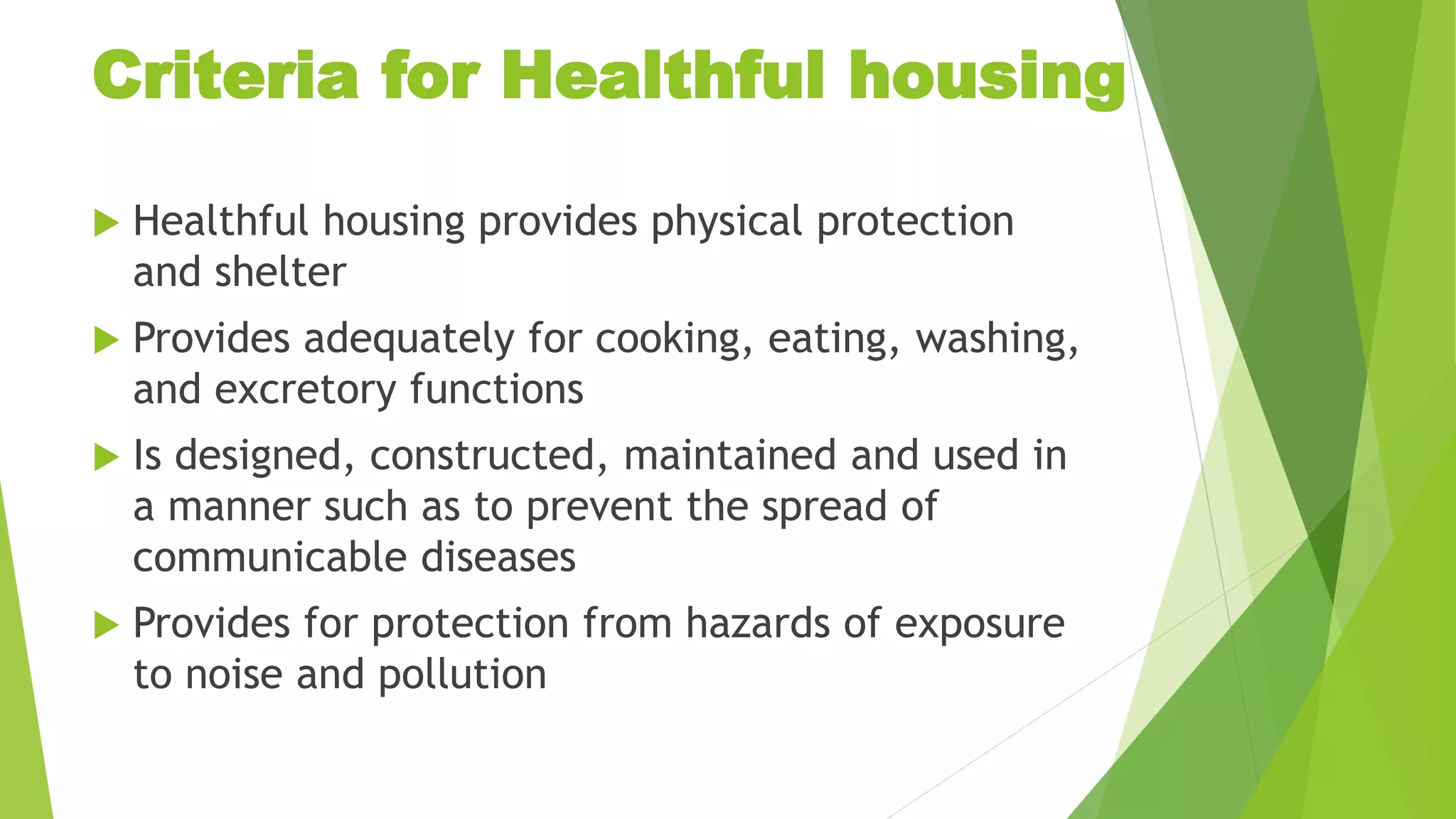
For the Implementation of these
goals, government should :
 Introduce social housing schemes
 Establish both minimum and
maximum standard
 Create financial and fiscal
institutions geared to helping low
income people obtain credit for
building and improving their
house.
Criteria for Healthful housing
 Healthful housing provides physical protection
and shelter
 Provides adequately for cooking, eating, washing,
and excretory functions
 Is designed, constructed, maintained and used in
a manner such as to prevent the spread of
communicable diseases
 Provides for protection from hazards of exposure
to noise and pollution
 Is free from unsafe physical arrangements
due to construction or maintenance, and
from toxic or harmful materials
 Encourages personal and community
development, Promotes social relationship
 Reflects regard to ecological principles.
 Promotes mental health.
Housing Standards
 Social and economic characteristics such as family
income, family size and composition, standard of
living, lifestyle, stage in life cycle, education and
cultural factors are taken into account.
 Because of cultural diversity and other factors such as
climate and social traditions, standard of housing
varies from country to country and from region to
region.
 In short-there cannot be rigid, uniform standards
 The standards in India are those recommended by the
EHC(1947)
Site
Should
 be elevated from its surroundings
 have an independent access to a street of adequate width
 be away from breeding places of mosquito and flies
 be away from nuisances such as dust, smoke, smell,
excessive noise, and traffic.
 be in pleasant surrounding
 Soil should be dry and safe for founding the structure and
should be well drained.
 The sub-soil water should be below 10 feet
Set Back
 It is the open space all around the
house which allows proper
ventilation and lightening
 In rural areas it is recommended
that the built-up area should not
exceed one third of total area.
 In urban areas it is allowed up to
two-third of total area.
 The set back should be such that
there is no obstruction of lighting
and ventilation
Floor should be Pucca and satisfy the
following criteria :-
 Should be impermeable, so that
it is easy to clean and dry
 Must be smooth and free from
cracks and crevices to prevent
the breeding of insects and
harbourage of dust
 Should be damp-proof
 The height of the plinth should
be 2-3 feet(0.6 t o 1 metre)
 Walls
• Reasonably strong should have a low heat capacity
• Weather resistance
• Unsuitable for harbour of rats and vermin
 Roof
• Should not be less than 10 feet (3 mtr) in the absence
of air-conditioning for comfort.
• Should have a low heat transmittance co-efficient
 Rooms
• Should not be less than two, at least one of them can
be closed for security
• The other may be open on one side if that side is a
private courtyard
• No. should be increased as per the family members
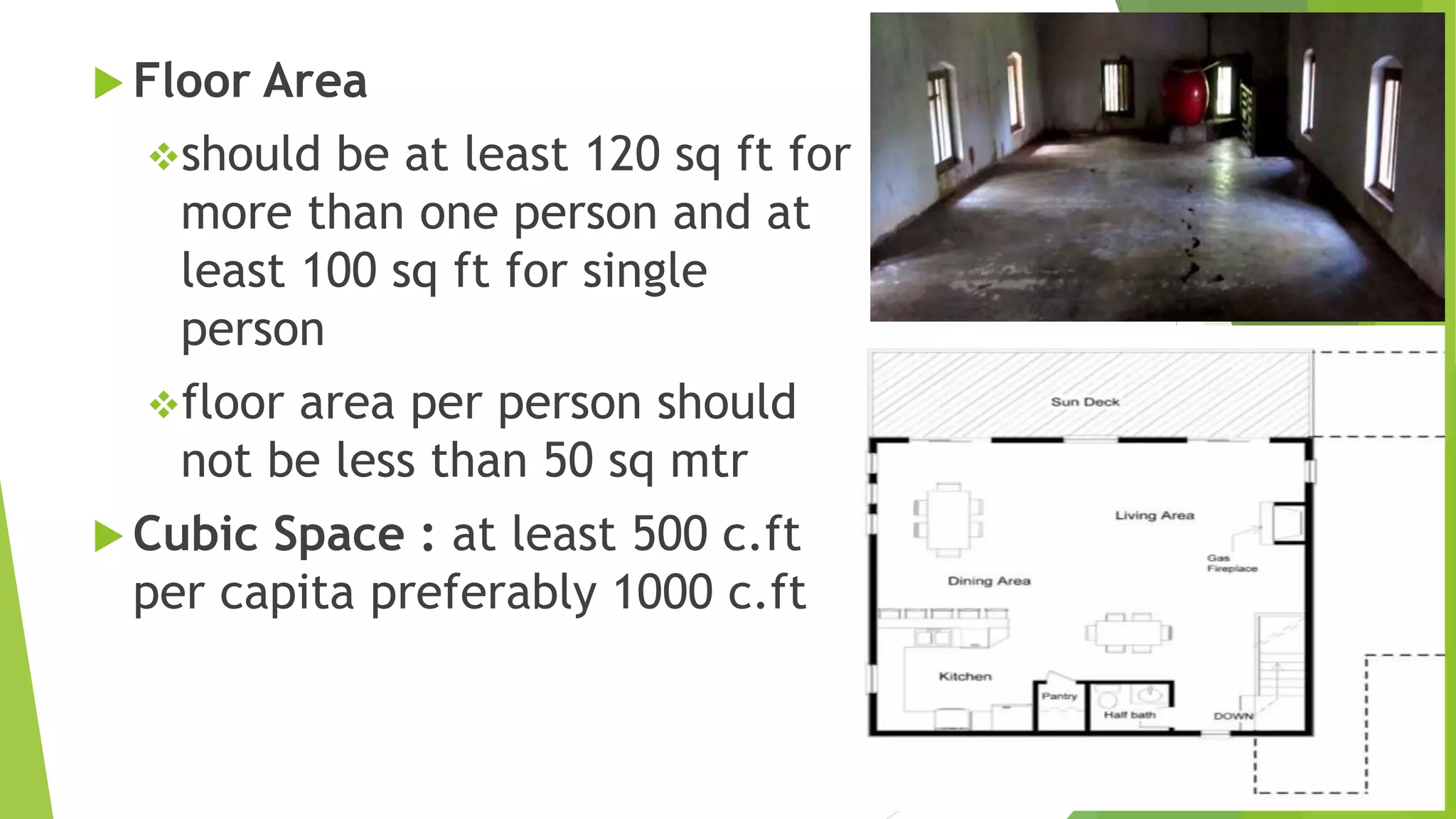
 Floor Area
should be at least 120 sq ft for
more than one person and at
least 100 sq ft for single
person
floor area per person should
not be less than 50 sq mtr
 Cubic Space : at least 500 c.ft
per capita preferably 1000 c.ft
 Windows
Every living room should be
provided with at least 2 windows
and one of them should open
directly on to an open space
The windows should be placed at
a height of more than 3 feet(1
m) above the ground in living
rooms
Windows area should be 1/5th of
the floor area doors and windows
combined should have 2/5th the
floor area.
 Lighting
• the daylight factor should exceed 1 % over half
the floor area.
 Kitchen
• Must have a separate kitchen
• Must be protected against dust and smoke,
adequately lighted, provided with water supply,
provided with a sink for washing utensils and
fitted with arrangements for proper drainage
 Privy
• A sanitary privy is a must for every house,
belonging exclusively to it and readily
accessible.
 Garbage and refuse
• Should be removed from the dwelling at least
daily and disposed of in a sanitary manner
 Bathing and Washing
 House should have facility
for bathing and washing
belonging exclusively to it
and providing proper privacy
 Water Supply
 House should have a safe
and adequate water supply
available at all times
RURAL HOUSING
 Minimum standard suggested
There should be at least two
living rooms
Ample verandah space may be
provided
The build-up area should not
exceed one-third of total area
There should be a separate
kitchen with a paved sink or
platform for washing utensils
The house should be provided
with a sanitary latrine
The window area should be at least 10% of the
floor area
There should be a sanitary well or a tube well
within a quarter of a ample from the house
It is insanitary to keep cattle and livestock in
dwelling house. Cattle sheds should be at least
25 feet away from dwelling houses. A cattle shed
should be open on all sides an area 8ft×4ft is
sufficient for each head of cattle
There should be adequate arrangement for the
disposal of waste water, refuse and garbage
Housing and Health
 Poor housing is associated with the following health
conditions :
 Respiratory Infection
 Skin infection
 Rat infestation
 Arthropods
 Accidents
 Morbidity and Mortality
 Psychological effects
Overcrowding
 It refers to the situation in which more people
and living within a single dwelling than there is
space for, so that movement is restricted, privacy
secluded, hygiene impossible rest and sleep
difficult.
 Overcrowding is a health problem in human
dwelling.
 It may promote the spread of respiratory
infections such as TB, Influenza and Diphtheria.
Indicators of Housing
 Classified as :
 Physical Indicators : Floor space, Cubic space,
Room height, Persons/room
 Economic Indicators : Cost of building, rent, taxes,
expenditure
 Social Indicators
 Indicators related to prevention
of illness :
o Frequency of illness due to
inadequate sewage and
garbage collection
o Frequency of illness due to
contaminated water
o Frequency of insect born
diseases
o Frequency of illness due to
overcrowding
o Frequency of accidents
 Indicators related to comfort :
o Thermal comfort
o Acoustic comfort
o Visual comfort
o Spatial comfort
 Indicators related to mental health
and social well being :
o Frequency of suicides in the
neighbourhood
o Neglected and abandoned youth
in neighborhood
o Drug abuse in neighborhood
Social indicators : according to united nations

Housing

  • 1.
    Housing Dr. Novmeet Assistant Professor CommunityMedicine MM Medical College & Hospital, Solan
  • 2.
    Housing  Housing “in modern concept includes  the physical structure providing shelter, as well as  the immediate surroundings and the related community services and facilities In the past it was called as Human settlement which was defined as- all places in which a group of people reside and pursue their life goals. But the size of settlement varies from a single family to millions of people.
  • 3.
     WHO expertgroup (1961) on public health aspects of housing prefers to use the term residential environment, which is defined as the physical structure including all necessary services, facilities, equipment and devices needed or desired for the physical and mental health and social well being of the family and individual.
  • 4.
    Social Goals OfHousing  Shelter  Family Life : Adequate space for family life and related activities – preparation of food, meeting, sleeping etc.  Access to community facilities : such as Health services, shopping area, school etc.  Family participation in community life : family is a part of larger community.  Economic Stability :House is a form of investment of personal savings.
  • 5.
    For the Implementationof these goals, government should :  Introduce social housing schemes  Establish both minimum and maximum standard  Create financial and fiscal institutions geared to helping low income people obtain credit for building and improving their house.
  • 6.
    Criteria for Healthfulhousing  Healthful housing provides physical protection and shelter  Provides adequately for cooking, eating, washing, and excretory functions  Is designed, constructed, maintained and used in a manner such as to prevent the spread of communicable diseases  Provides for protection from hazards of exposure to noise and pollution
  • 7.
     Is freefrom unsafe physical arrangements due to construction or maintenance, and from toxic or harmful materials  Encourages personal and community development, Promotes social relationship  Reflects regard to ecological principles.  Promotes mental health.
  • 8.
    Housing Standards  Socialand economic characteristics such as family income, family size and composition, standard of living, lifestyle, stage in life cycle, education and cultural factors are taken into account.  Because of cultural diversity and other factors such as climate and social traditions, standard of housing varies from country to country and from region to region.  In short-there cannot be rigid, uniform standards  The standards in India are those recommended by the EHC(1947)
  • 9.
    Site Should  be elevatedfrom its surroundings  have an independent access to a street of adequate width  be away from breeding places of mosquito and flies  be away from nuisances such as dust, smoke, smell, excessive noise, and traffic.  be in pleasant surrounding  Soil should be dry and safe for founding the structure and should be well drained.  The sub-soil water should be below 10 feet
  • 10.
    Set Back  Itis the open space all around the house which allows proper ventilation and lightening  In rural areas it is recommended that the built-up area should not exceed one third of total area.  In urban areas it is allowed up to two-third of total area.  The set back should be such that there is no obstruction of lighting and ventilation
  • 11.
    Floor should bePucca and satisfy the following criteria :-  Should be impermeable, so that it is easy to clean and dry  Must be smooth and free from cracks and crevices to prevent the breeding of insects and harbourage of dust  Should be damp-proof  The height of the plinth should be 2-3 feet(0.6 t o 1 metre)
  • 12.
     Walls • Reasonablystrong should have a low heat capacity • Weather resistance • Unsuitable for harbour of rats and vermin  Roof • Should not be less than 10 feet (3 mtr) in the absence of air-conditioning for comfort. • Should have a low heat transmittance co-efficient  Rooms • Should not be less than two, at least one of them can be closed for security • The other may be open on one side if that side is a private courtyard • No. should be increased as per the family members
  • 13.
     Floor Area shouldbe at least 120 sq ft for more than one person and at least 100 sq ft for single person floor area per person should not be less than 50 sq mtr  Cubic Space : at least 500 c.ft per capita preferably 1000 c.ft
  • 14.
     Windows Every livingroom should be provided with at least 2 windows and one of them should open directly on to an open space The windows should be placed at a height of more than 3 feet(1 m) above the ground in living rooms Windows area should be 1/5th of the floor area doors and windows combined should have 2/5th the floor area.
  • 15.
     Lighting • thedaylight factor should exceed 1 % over half the floor area.  Kitchen • Must have a separate kitchen • Must be protected against dust and smoke, adequately lighted, provided with water supply, provided with a sink for washing utensils and fitted with arrangements for proper drainage  Privy • A sanitary privy is a must for every house, belonging exclusively to it and readily accessible.  Garbage and refuse • Should be removed from the dwelling at least daily and disposed of in a sanitary manner
  • 16.
     Bathing andWashing  House should have facility for bathing and washing belonging exclusively to it and providing proper privacy  Water Supply  House should have a safe and adequate water supply available at all times
  • 17.
    RURAL HOUSING  Minimumstandard suggested There should be at least two living rooms Ample verandah space may be provided The build-up area should not exceed one-third of total area There should be a separate kitchen with a paved sink or platform for washing utensils The house should be provided with a sanitary latrine
  • 18.
    The window areashould be at least 10% of the floor area There should be a sanitary well or a tube well within a quarter of a ample from the house It is insanitary to keep cattle and livestock in dwelling house. Cattle sheds should be at least 25 feet away from dwelling houses. A cattle shed should be open on all sides an area 8ft×4ft is sufficient for each head of cattle There should be adequate arrangement for the disposal of waste water, refuse and garbage
  • 19.
    Housing and Health Poor housing is associated with the following health conditions :  Respiratory Infection  Skin infection  Rat infestation  Arthropods  Accidents  Morbidity and Mortality  Psychological effects
  • 20.
    Overcrowding  It refersto the situation in which more people and living within a single dwelling than there is space for, so that movement is restricted, privacy secluded, hygiene impossible rest and sleep difficult.  Overcrowding is a health problem in human dwelling.  It may promote the spread of respiratory infections such as TB, Influenza and Diphtheria.
  • 22.
    Indicators of Housing Classified as :  Physical Indicators : Floor space, Cubic space, Room height, Persons/room  Economic Indicators : Cost of building, rent, taxes, expenditure  Social Indicators
  • 23.
     Indicators relatedto prevention of illness : o Frequency of illness due to inadequate sewage and garbage collection o Frequency of illness due to contaminated water o Frequency of insect born diseases o Frequency of illness due to overcrowding o Frequency of accidents  Indicators related to comfort : o Thermal comfort o Acoustic comfort o Visual comfort o Spatial comfort  Indicators related to mental health and social well being : o Frequency of suicides in the neighbourhood o Neglected and abandoned youth in neighborhood o Drug abuse in neighborhood Social indicators : according to united nations