


HOUSING
Dr. Rahul B. Pandit
Faculty of Nursing
Sassoon General Hospital, Pune
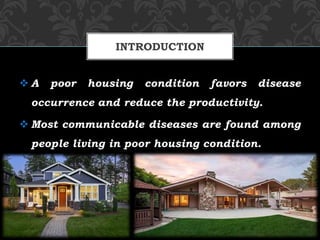
 A poor housing condition favors disease
occurrence and reduce the productivity.
 Most communicable diseases are found among
people living in poor housing condition.
INTRODUCTION
 Shelter
 Family Life
 Access to community facilities
 Family participation in community life
 Economic Stability.
SOCIAL GOALS OF
HOUSING
 There is a need to be a house for every family.
 House should have adequate space.
 Family should have access to various facility.
For example: school, hospital, bank etc.
 There should be chance to take part in
community life.
GOALS OF HOUSING
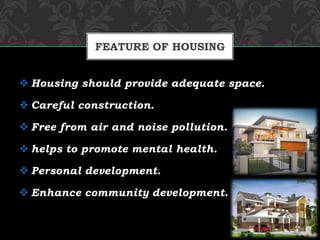
 Housing should provide adequate space.
 Careful construction.
 Free from air and noise pollution.
 helps to promote mental health.
 Personal development.
 Enhance community development.
FEATURE OF HOUSING
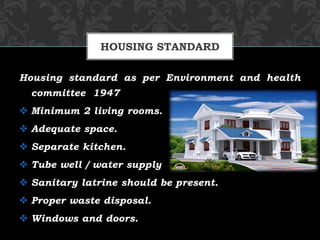
Housing standard as per Environment and health
committee 1947
 Minimum 2 living rooms.
 Adequate space.
 Separate kitchen.
 Tube well / water supply
 Sanitary latrine should be present.
 Proper waste disposal.
 Windows and doors.
HOUSING STANDARD
Site:
1. Elevated
2. Not subject to flooding
3. Away from vector breeding places and
nuisance.
4. Soil should be dry and safe for founding
the structure.
5. Subsoil water should be below 10 feet.
HOUSING STANDARD
Set back :
1. as open space around house with no
obstruction to lighting and ventilation
Floor :
1. Pucca
2. Impermeable
3. Easily washable.
4. Smooth and free of cracks and crevices.
5. Waterproof
HOUSING STANDARD
Walls:
1. Reasonably strong.
2. Low heat capacity.
3. Not easily damaged and should not
harbour rats or vermin.
Roof:
1. Height not less than 10 feet with low heat
transmittance coefficient
HOUSING STANDARD
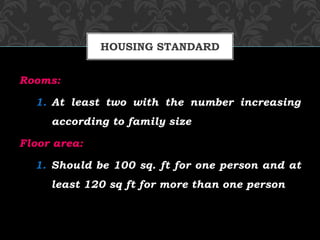
Rooms:
1. At least two with the number increasing
according to family size
Floor area:
1. Should be 100 sq. ft for one person and at
least 120 sq ft for more than one person
HOUSING STANDARD
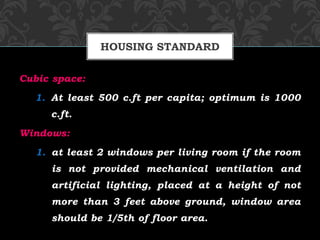
Cubic space:
1. At least 500 c.ft per capita; optimum is 1000
c.ft.
Windows:
1. at least 2 windows per living room if the room
is not provided mechanical ventilation and
artificial lighting, placed at a height of not
more than 3 feet above ground, window area
should be 1/5th of floor area.
HOUSING STANDARD
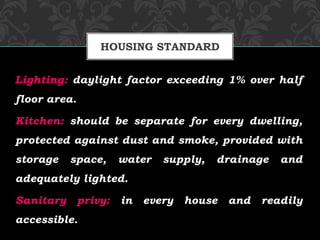
Lighting: daylight factor exceeding 1% over half
floor area.
Kitchen: should be separate for every dwelling,
protected against dust and smoke, provided with
storage space, water supply, drainage and
adequately lighted.
Sanitary privy: in every house and readily
accessible.
HOUSING STANDARD
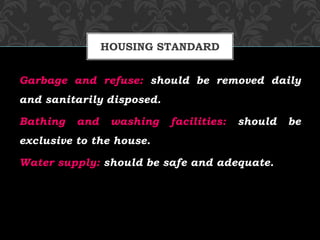
Garbage and refuse: should be removed daily
and sanitarily disposed.
Bathing and washing facilities: should be
exclusive to the house.
Water supply: should be safe and adequate.
HOUSING STANDARD
 People living on beds or mats should have
minimum of 3.5 sq. m of floor area or 10 cu m of
air space.
 Beds or mats separated by a minimum distance of
0.75 m.
 Buildings should have emergency exits and fire
escapes and people educated in fire safety drills.
HOUSING STANDARDS FOR
DISPLACED POPULATIONS
 One wash basin provided for every 10 people,
separate benches for men and women.
 One shower head is needed for every 50 people
in temperate climates and one for every 30
people in hot climates.
 Water flushed toilets may be made available
in existing buildings..
HOUSING STANDARDS FOR
DISPLACED POPULATIONS
 Respiratory Infection
 Skin infection
 Rat infestation
 Arthropods
 Accidents
 Morbidity and Mortality
 Psychological effects
HOUSE AND HEALTH
 It refers to the situation in which more people
and living within a single dwelling than there
is space for, so that movement is restricted,
privacy secluded, hygiene impossible, rest
and sleep difficult.
 It may promote the spread of respiratory
infections such as TB, Influenza and
Diphtheria.
OVERCROWDING
 Overcrowding is considered to exist if 2
person over 9 years of age, not husband and
wife , of opposite sexes are obliged to sleep in
one room .
OVERCROWDING
 Physical
 Economical
 Social
INDICATORS OF HOUSING
 Air
 Light
 Water
 Noise
 Sewage disposal
PHYSICAL
 Cost of the building
 Rental levels
 Taxes
 Expenditure on housing
ECONOMICAL
 Indicators related to prevention of disease
 Indicators related to comfort
 Indicators related to mental health and social
well- being
SOCIAL
Indicators related to prevention of disease
1. Inadequate sewage and garbage collection
2. Contaminated water source
3. Insect borne diseases
4. Overcrowding
5. Accidents
6. Proximity to animals
7. Assess to medical facility
SOCIAL
Indicators related to comfort
1. Thermal comfort
2. Acoustic comfort
3. Visual comfort
4. Spatial comfort
SOCIAL
Indicators related to mental health and social
wellbeing
1. Frequency of suicides in neighborhood
2. Neglected and abandoned youth in
neighborhood
3. Drug abuse in neighborhood
SOCIAL
 .
INTRODUCTION
 .
INTRODUCTION

Housing

  • 1.
    HOUSING Dr. Rahul B.Pandit Faculty of Nursing Sassoon General Hospital, Pune
  • 2.
     A poorhousing condition favors disease occurrence and reduce the productivity.  Most communicable diseases are found among people living in poor housing condition. INTRODUCTION
  • 3.
     Shelter  FamilyLife  Access to community facilities  Family participation in community life  Economic Stability. SOCIAL GOALS OF HOUSING
  • 4.
     There isa need to be a house for every family.  House should have adequate space.  Family should have access to various facility. For example: school, hospital, bank etc.  There should be chance to take part in community life. GOALS OF HOUSING
  • 5.
     Housing shouldprovide adequate space.  Careful construction.  Free from air and noise pollution.  helps to promote mental health.  Personal development.  Enhance community development. FEATURE OF HOUSING
  • 6.
    Housing standard asper Environment and health committee 1947  Minimum 2 living rooms.  Adequate space.  Separate kitchen.  Tube well / water supply  Sanitary latrine should be present.  Proper waste disposal.  Windows and doors. HOUSING STANDARD
  • 7.
    Site: 1. Elevated 2. Notsubject to flooding 3. Away from vector breeding places and nuisance. 4. Soil should be dry and safe for founding the structure. 5. Subsoil water should be below 10 feet. HOUSING STANDARD
  • 8.
    Set back : 1.as open space around house with no obstruction to lighting and ventilation Floor : 1. Pucca 2. Impermeable 3. Easily washable. 4. Smooth and free of cracks and crevices. 5. Waterproof HOUSING STANDARD
  • 9.
    Walls: 1. Reasonably strong. 2.Low heat capacity. 3. Not easily damaged and should not harbour rats or vermin. Roof: 1. Height not less than 10 feet with low heat transmittance coefficient HOUSING STANDARD
  • 10.
    Rooms: 1. At leasttwo with the number increasing according to family size Floor area: 1. Should be 100 sq. ft for one person and at least 120 sq ft for more than one person HOUSING STANDARD
  • 11.
    Cubic space: 1. Atleast 500 c.ft per capita; optimum is 1000 c.ft. Windows: 1. at least 2 windows per living room if the room is not provided mechanical ventilation and artificial lighting, placed at a height of not more than 3 feet above ground, window area should be 1/5th of floor area. HOUSING STANDARD
  • 12.
    Lighting: daylight factorexceeding 1% over half floor area. Kitchen: should be separate for every dwelling, protected against dust and smoke, provided with storage space, water supply, drainage and adequately lighted. Sanitary privy: in every house and readily accessible. HOUSING STANDARD
  • 13.
    Garbage and refuse:should be removed daily and sanitarily disposed. Bathing and washing facilities: should be exclusive to the house. Water supply: should be safe and adequate. HOUSING STANDARD
  • 14.
     People livingon beds or mats should have minimum of 3.5 sq. m of floor area or 10 cu m of air space.  Beds or mats separated by a minimum distance of 0.75 m.  Buildings should have emergency exits and fire escapes and people educated in fire safety drills. HOUSING STANDARDS FOR DISPLACED POPULATIONS
  • 15.
     One washbasin provided for every 10 people, separate benches for men and women.  One shower head is needed for every 50 people in temperate climates and one for every 30 people in hot climates.  Water flushed toilets may be made available in existing buildings.. HOUSING STANDARDS FOR DISPLACED POPULATIONS
  • 16.
     Respiratory Infection Skin infection  Rat infestation  Arthropods  Accidents  Morbidity and Mortality  Psychological effects HOUSE AND HEALTH
  • 17.
     It refersto the situation in which more people and living within a single dwelling than there is space for, so that movement is restricted, privacy secluded, hygiene impossible, rest and sleep difficult.  It may promote the spread of respiratory infections such as TB, Influenza and Diphtheria. OVERCROWDING
  • 18.
     Overcrowding isconsidered to exist if 2 person over 9 years of age, not husband and wife , of opposite sexes are obliged to sleep in one room . OVERCROWDING
  • 19.
     Physical  Economical Social INDICATORS OF HOUSING
  • 20.
     Air  Light Water  Noise  Sewage disposal PHYSICAL
  • 21.
     Cost ofthe building  Rental levels  Taxes  Expenditure on housing ECONOMICAL
  • 22.
     Indicators relatedto prevention of disease  Indicators related to comfort  Indicators related to mental health and social well- being SOCIAL
  • 23.
    Indicators related toprevention of disease 1. Inadequate sewage and garbage collection 2. Contaminated water source 3. Insect borne diseases 4. Overcrowding 5. Accidents 6. Proximity to animals 7. Assess to medical facility SOCIAL
  • 24.
    Indicators related tocomfort 1. Thermal comfort 2. Acoustic comfort 3. Visual comfort 4. Spatial comfort SOCIAL
  • 25.
    Indicators related tomental health and social wellbeing 1. Frequency of suicides in neighborhood 2. Neglected and abandoned youth in neighborhood 3. Drug abuse in neighborhood SOCIAL
  • 26.
  • 27.