HOUSING
INTRODUCTION
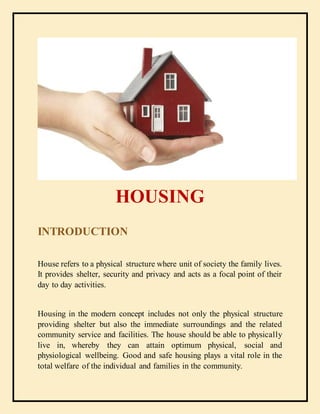
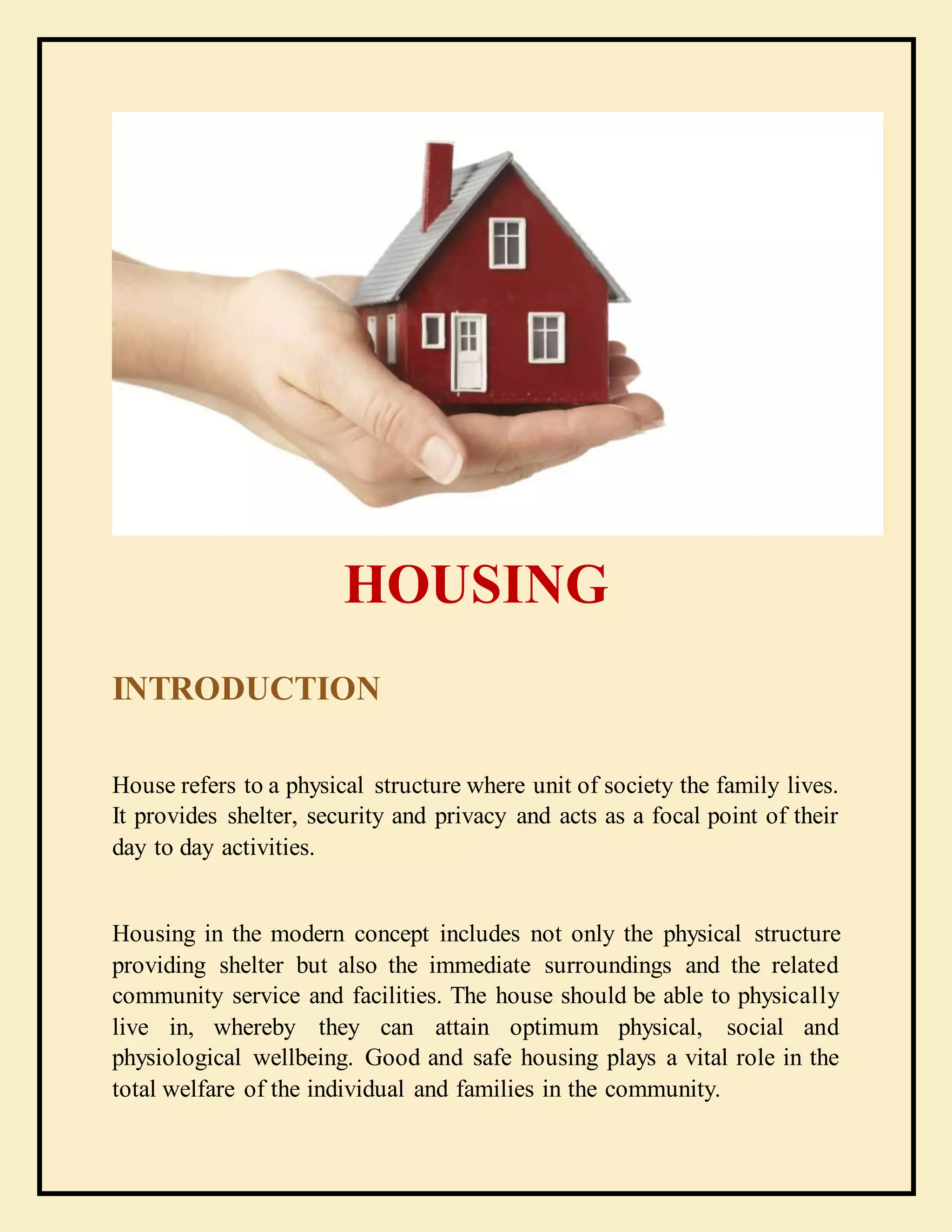
House refers to a physical structure where unit of society the family lives.
It provides shelter, security and privacy and acts as a focal point of their
day to day activities.
Housing in the modern concept includes not only the physical structure
providing shelter but also the immediate surroundings and the related
community service and facilities. The house should be able to physically
live in, whereby they can attain optimum physical, social and
physiological wellbeing. Good and safe housing plays a vital role in the
total welfare of the individual and families in the community.
A who expert group (1961) on public health aspect of housing use the
term ‘residential environment’ which can be defined as a physical
structure that man uses for shelter and the environs of that structure
including all necessary services, facilities, equipment and mental health
and social wellbeing of the family and individual.
GOALS
 Shelter
 Family life
 Access to community facilities
 Family participation in community life
 Economic security
 privacy
CRITERIA FOR HEALTHFUL HOUSING
Protection- Healthful housing provides physical protection
and shelter from heat, cold, damp, animals, insect and
invaders.
Adequate space- Provides adequate space for living rooms
according to number of people, kitchen guest room, study
room and place for recreation with sunlight and cross
ventilation as well as excretory function.
Adequate light and water- It should have adequate light
with water supply
Prevention of disease- It is designed, constructed,
maintained and used in a manner such to prevent the spread
of communicable disease.
Protection from pollution- It provides protection from
hazards of exposure to noise or pollution.
Separate from industrial works- It is free from unsafe
arrangements due to construction and from toxic or harmful
materials.
Promotion of self and community- It encourages personal
and community development promotes social relationship
and promotes mental health.
Refusal and disposal area- It should have proper place for
collection of refuse and its disposals.
Drainage system- It should have good drainage for water,
and roof should be damp proof.
Bathroom and sanitary facilities- It should have bathroom
and sanitary latrine with the reach of people in the house.
Encourage personal and community development-
Promotes social relationship and promotes mental health.
HOUSING NEEDS FOR HUMAN BEING
Following needs should be fulfilled through good housing;
Physiological needs-
- a house should be well constructed and well ventilated to
provide comfort by fresh air, adequate light and facilities to
rest play securities and other recreational activities which
helps man to provide satisfaction by promoting efficiency in
day to day activities.
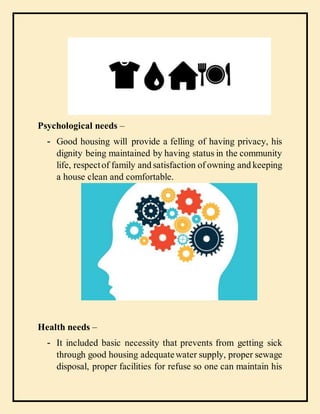
Psychological needs –
- Good housing will provide a felling of having privacy, his
dignity being maintained by having status in the community
life, respectof family and satisfaction of owning and keeping
a house clean and comfortable.
Health needs –
- It included basic necessity that prevents from getting sick
through good housing adequatewater supply, proper sewage
disposal, proper facilities for refuse so one can maintain his
health and prevent form getting sick. Similarly, facilities for
storing, cooking, washing will be made where hazard due to
insects, rodents etc. can be controlled.
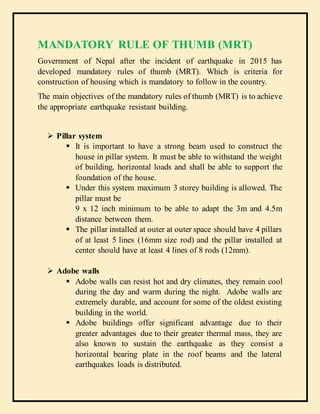
Protective needs –
- Good housing means to be safe from accidents from hazard,
poor flooring, defaults in electricity fixture etc.
- It includes these needs that protects the people from nature
elements like fire, wind, flood, hot, cold, accidents, wild
animals like elephants, tiger, etc.
- Not only protects from physical harm but also from mental
and social problems.
MANDATORY RULE OF THUMB (MRT)
Government of Nepal after the incident of earthquake in 2015 has
developed mandatory rules of thumb (MRT). Which is criteria for
construction of housing which is mandatory to follow in the country.
The main objectives of the mandatory rules of thumb (MRT) is to achieve
the appropriate earthquake resistant building.
 Pillar system
 It is important to have a strong beam used to construct the
house in pillar system. It must be able to withstand the weight
of building, horizontal loads and shall be able to support the
foundation of the house.
 Under this system maximum 3 storey building is allowed. The
pillar must be
9 x 12 inch minimum to be able to adapt the 3m and 4.5m
distance between them.
 The pillar installed at outer at outer space should have 4 pillars
of at least 5 lines (16mm size rod) and the pillar installed at
center should have at least 4 lines of 8 rods (12mm).
 Adobe walls
 Adobe walls can resist hot and dry climates, they remain cool
during the day and warm during the night. Adobe walls are
extremely durable, and account for some of the oldest existing
building in the world.
 Adobe buildings offer significant advantage due to their
greater advantages due to their greater thermal mass, they are
also known to sustain the earthquake as they consist a
horizontal bearing plate in the roof beams and the lateral
earthquakes loads is distributed.
 Three storey building are allowed to construct.
 The room width should be 3.5m
 Maximum height is 3.2m on the ground floor, 3m in the first
floor and 2.8m in the second floor.
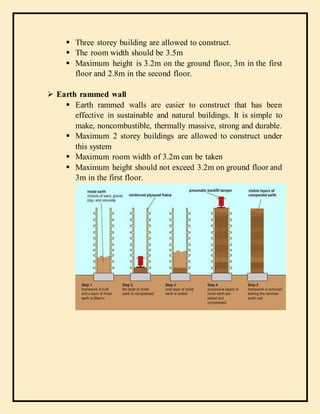
 Earth rammed wall
 Earth rammed walls are easier to construct that has been
effective in sustainable and natural buildings. It is simple to
make, noncombustible, thermally massive, strong and durable.
 Maximum 2 storey buildings are allowed to construct under
this system
 Maximum room width of 3.2m can be taken
 Maximum height should not exceed 3.2m on ground floor and
3m in the first floor.
Standards of housing
THE STANDARD OF HOUSING
The standard of housing is broadening according to changing
concepts, social and economic characteristics such as cultural
diversity, social and economic characteristic such as family
income, family size and composition, standards of living, socio-
economic status, climate factors. Standards of housing vary
substantially from country and from region to region so, it must
be taken into consideration in determining housing standard. In
short there can not be rigid, uniform standards for housing.
Except the above, minimum standards must be maintained by
building, regulation to improve the housing and environmental
condition within the limited availability of resources. The
standards are as follows.
1.Site
- The house should be located in the healthy locality that is
elevated from its surroundings so that it is not subjected to
flooding during heavy rainfall.
- the soil selected for housing should be dry and safe for laying
the structure and should be well drained. Made soil i.e
ground that is leveled by dumping refuse is very
unsatisfactory for building purpose for at least 20- 25 years.
- it should be away from health hazards such as dust, smell,
excessive noise and traffic.
- The site should have an independent access to a street of
adequate width.
- It should be away from breeding place of mosquito and flies.
- It should be in pleasant surroundings.
2. set back (open space around the house)
- For proper lighting and ventilation, there should be an open
space all around the house is call setback.
- The setback should be such that there is no obstruction to
lighting and ventilation.
- In rural area, it is recommended that the built up area should
not exceed one third of the total area as there is plenty of
land. In urban areas, where land is costly the built of area
may up to two-third.
3. walls
- Reasonably strong, not easily damaged and accumulation of
dust or no cracks or crevices. A 9-inch (22.5cm) brick wall
plastered smooth both inside and outside will meet the
above requirement.
- Weather resistance; should have low heat capacity i.e.
should not absorb heat and conduct the same.
- Colored cream or white
- Should be weather resistant
- Unsuitable for harborage of rats and vermin
4. floor
- The floor of the house should be impermeable e.g.-
cemented or stone floor. So that it can easily washed and
kept clean and dry. Mud floors break up and cause dust
hence they are not recommended.
- The height of one base should be 2-3 feet (0.6-1.0meter)
above ground.
- The floor must be smooth and free from cracks and crevices
to prevent the breeding of insect and harborage of dust.
- The floor must be damp proof so that it can easily be washed
and kept clean and dry.
5. floor space
- The floor area/ space of a living room should at least be 12
sq. feet for occupancy by more than one person and at least
100 sq. feet for occupancy by a single person.
- The floor area available in living rooms per person should
not be less than 50 sq. feet the optimum is 100 sq. feet
110 sq. floor /more – 2 people
90-100 sq. feet – 1.5 people
70-90 sq. feet – 1people
50-70 sq. feet – 0.5 person
<50 sq. feet – nil
(A baby under 12 months is not counted, children between 1-10
years counted as a half a unit)
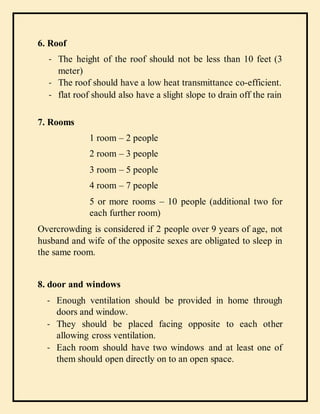
6. Roof
- The height of the roof should not be less than 10 feet (3
meter)
- The roof should have a low heat transmittance co-efficient.
- flat roof should also have a slight slope to drain off the rain
7. Rooms
1 room – 2 people
2 room – 3 people
3 room – 5 people
4 room – 7 people
5 or more rooms – 10 people (additional two for
each further room)
Overcrowding is considered if 2 people over 9 years of age, not
husband and wife of the opposite sexes are obligated to sleep in
the same room.
8. door and windows
- Enough ventilation should be provided in home through
doors and window.
- They should be placed facing opposite to each other
allowing cross ventilation.
- Each room should have two windows and at least one of
them should open directly on to an open space.
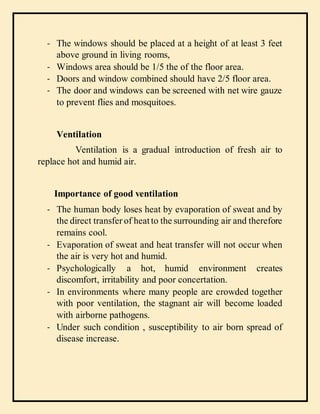
- The windows should be placed at a height of at least 3 feet
above ground in living rooms,
- Windows area should be 1/5 the of the floor area.
- Doors and window combined should have 2/5 floor area.
- The door and windows can be screened with net wire gauze
to prevent flies and mosquitoes.
Ventilation
Ventilation is a gradual introduction of fresh air to
replace hot and humid air.
Importance of good ventilation
- The human body loses heat by evaporation of sweat and by
the direct transfer of heatto the surrounding air and therefore
remains cool.
- Evaporation of sweat and heat transfer will not occur when
the air is very hot and humid.
- Psychologically a hot, humid environment creates
discomfort, irritability and poor concertation.
- In environments where many people are crowded together
with poor ventilation, the stagnant air will become loaded
with airborne pathogens.
- Under such condition , susceptibility to air born spread of
disease increase.
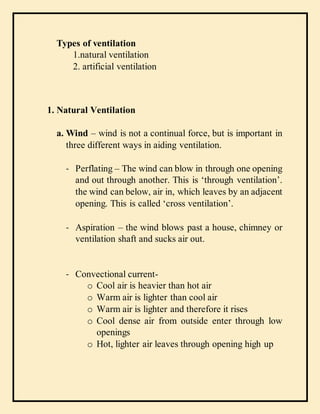
Types of ventilation
1.natural ventilation
2. artificial ventilation
1. Natural Ventilation
a. Wind – wind is not a continual force, but is important in
three different ways in aiding ventilation.
- Perflating – The wind can blow in through one opening
and out through another. This is ‘through ventilation’.
the wind can below, air in, which leaves by an adjacent
opening. This is called ‘cross ventilation’.
- Aspiration – the wind blows past a house, chimney or
ventilation shaft and sucks air out.
- Convectional current-
o Cool air is heavier than hot air
o Warm air is lighter than cool air
o Warm air is lighter and therefore it rises
o Cool dense air from outside enter through low
openings
o Hot, lighter air leaves through opening high up
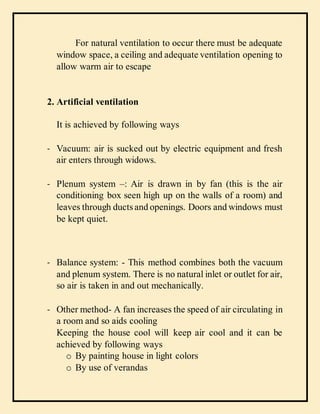
For natural ventilation to occur there must be adequate
window space, a ceiling and adequate ventilation opening to
allow warm air to escape
2. Artificial ventilation
It is achieved by following ways
- Vacuum: air is sucked out by electric equipment and fresh
air enters through widows.
- Plenum system –: Air is drawn in by fan (this is the air
conditioning box seen high up on the walls of a room) and
leaves through ducts and openings. Doors and windows must
be kept quiet.
- Balance system: - This method combines both the vacuum
and plenum system. There is no natural inlet or outlet for air,
so air is taken in and out mechanically.
- Other method- A fan increases the speed of air circulating in
a room and so aids cooling
Keeping the house cool will keep air cool and it can be
achieved by following ways
o By painting house in light colors
o By use of verandas
o By having green grass around the house
9. other facilities-
a. kitchen
- Kitchen should not be placed near a privy
- It should not be placed in such a way that no smoke,
smell etc. enters the rest of the home
- It should protect against the dust and smell
- It should be with adequate light with proper
arrangement for storage of food, fuel, water supply,
sink for washing utensils, and proper drainage system.
b. Privy- In every house there should be a sanitary latrine,
which is a fundamental necessity. This should be placed
in one part of the house and should be easily assessable.
c. Garbage and refuse disposal- The house should have the
facilities for garbage and refuse disposal at least daily and
disposal of it in a sanitation manner.
d. Facilities of washing and bathing- There should be
proper facilities of bathing and washing with the provision
to drain off used waster.
e. Water supply- Adequate and continuous safe water
supply should be made available to all the house as a first
priority.
Effects of poor housing on health
Healthy homes promote good physical and mental health.
Good health depends on having homes that are safe and free
from physical hazards. In contrast, poor quality and inadequate
housing contributes to health problems such as chronic
diseases and injuries, and can have harmful effects on
childhood development. Poor indoor air quality, lead paint, and
other hazards often coexist in homes, placing children and
families at great risk for multiple health problems.
1. Respiratory inflection
- If thereis overcrowding, infectious disease spread rapidly.
- Adequate ventilation is also associated with a higher risk
of airborne infectious disease transmission, including
tuberculosis, as well as accumulation of indoor pollutants
and dampness, which are factors in the development of
allergies and asthma.
- Poor housing quality and design also can exacerbate the
health impacts from exposure to temperature extremes,
which are occurring more frequently due to climate
change.
2. Skin infections
- Poor housing is the underlying cause of skin infection as
it mainly transmitted by direct skin to skin contact or by
sharing clothes, bedding or towels used by infected
person.
- Some common infection associated with poor housing are
Scabies, ringworm, impetigo, leprosy, etc.
- Contact dermatitis is a reaction that appears when the skin
comes in contact with an irritant or an allergen.
- Dust mite particles are often found in pillows, mattress,
carpeting and upholstered furniture which is often
common in poor housing with lack of cleanliness.
3. Rat infestation
- Lack of proper storage of food, poorly maintained floor,
wall and ceiling coverings and furniture attracts rats in
house
- The mode of disease transmission may be direct through
bite, some through contamination of food or water and rat
fleas. E.g. plague
4. Arthropods
- Arthropods are vectors in communicable disease which
transmit infection by inoculation into or through the skin,
mucous membrane via bite or by deposit of infective
organism on the food.
- Cracks, cervices, improper waste disposal and lack of
proper drainage system causes breeding of arthropods.
- Flies mainly lives and breed in human excreta,cow dung,
garbage and liquid waste and contaminate food.
5. Accidents
- a substantial pro-potion of housing accidents is case by
some defects in the room and its environments.
- Irregularities like uneven flooring, poorly installed doors
and loose tiles contribute to some of the worst falls.
- Slippery toilet cause injuries and even death of elderly.
- Poorly constructed housing is prone to natural disaster
and takes thousands of life each year.
- Home accidents are an important cause of defects and
disability.
6. Fecal borne disease
- poor housing with poor sanitation cause facial born
disease especially gastrointestinal problem like diarrheas,
dysentery due to improper management of sewage,
sullage, refuse and sludge
- fecal borne diseases are common in people who defecate
along the road on open ground and leave it uncovered.
- Inadequate handwashing after defecation by those who
prepare or serve food can infect others.
7. Phycological effects and psychological problem
- Growing up in bad housing also has a long-term impact
on children. They are particularly at disadvantage because
of disruption to their schooling.
- Living in poor or overcrowded housing condition also
affects a Childs ability to learn, which can have a lasting
impact on a Childs chances of succeeding in the life.
- Furthermore, the root cause of later problems, such as
offending behavior and behavior problem in adulthood
maybe linked to childhood experience.
- Neurosis, depression and many behavior disorders may
occur due to felling of isolation, inferiority complex
especially in urban areas.
- Excessive indoor temperature has been linked with
irritability and social intolerance.
- Damp, moldy and cold indoor conditions maybe
associated with anxiety and depression.
- If the lighting condition in not ideal, the visual apparatus
is put to strain which may lead to general fatigue and loss
of efficiency.
- Person, who lives in poor housing especially if they are
forced to share facilities such as kitchen, bathroom, with
non-family members will have little privacy.
8. Morbidity and mortality
- Morbidity is the stage of being sick. whereas mortality is
the incidence of death in the population in a given period
of time.
- high death rates and sickness rates have been observed in
are where housing is poor.
- Those who live in poor housing are at a greater risk of
developing chronic disease and premature death due to
inadequate ventilation, shared physical proximity and
overcrowding which contributes to the spread of
communicable disease.
- Cold homes are a significant contributor to the level of
excess winter deaths.

Housing

  • 1.
    HOUSING INTRODUCTION House refers toa physical structure where unit of society the family lives. It provides shelter, security and privacy and acts as a focal point of their day to day activities. Housing in the modern concept includes not only the physical structure providing shelter but also the immediate surroundings and the related community service and facilities. The house should be able to physically live in, whereby they can attain optimum physical, social and physiological wellbeing. Good and safe housing plays a vital role in the total welfare of the individual and families in the community.
  • 2.
    A who expertgroup (1961) on public health aspect of housing use the term ‘residential environment’ which can be defined as a physical structure that man uses for shelter and the environs of that structure including all necessary services, facilities, equipment and mental health and social wellbeing of the family and individual. GOALS  Shelter  Family life  Access to community facilities  Family participation in community life  Economic security  privacy
  • 3.
    CRITERIA FOR HEALTHFULHOUSING Protection- Healthful housing provides physical protection and shelter from heat, cold, damp, animals, insect and invaders. Adequate space- Provides adequate space for living rooms according to number of people, kitchen guest room, study room and place for recreation with sunlight and cross ventilation as well as excretory function. Adequate light and water- It should have adequate light with water supply Prevention of disease- It is designed, constructed, maintained and used in a manner such to prevent the spread of communicable disease. Protection from pollution- It provides protection from hazards of exposure to noise or pollution. Separate from industrial works- It is free from unsafe arrangements due to construction and from toxic or harmful materials.
  • 4.
    Promotion of selfand community- It encourages personal and community development promotes social relationship and promotes mental health. Refusal and disposal area- It should have proper place for collection of refuse and its disposals. Drainage system- It should have good drainage for water, and roof should be damp proof. Bathroom and sanitary facilities- It should have bathroom and sanitary latrine with the reach of people in the house. Encourage personal and community development- Promotes social relationship and promotes mental health. HOUSING NEEDS FOR HUMAN BEING Following needs should be fulfilled through good housing; Physiological needs- - a house should be well constructed and well ventilated to provide comfort by fresh air, adequate light and facilities to rest play securities and other recreational activities which helps man to provide satisfaction by promoting efficiency in day to day activities.
  • 5.
    Psychological needs – -Good housing will provide a felling of having privacy, his dignity being maintained by having status in the community life, respectof family and satisfaction of owning and keeping a house clean and comfortable. Health needs – - It included basic necessity that prevents from getting sick through good housing adequatewater supply, proper sewage disposal, proper facilities for refuse so one can maintain his
  • 6.
    health and preventform getting sick. Similarly, facilities for storing, cooking, washing will be made where hazard due to insects, rodents etc. can be controlled. Protective needs – - Good housing means to be safe from accidents from hazard, poor flooring, defaults in electricity fixture etc. - It includes these needs that protects the people from nature elements like fire, wind, flood, hot, cold, accidents, wild animals like elephants, tiger, etc. - Not only protects from physical harm but also from mental and social problems.
  • 7.
    MANDATORY RULE OFTHUMB (MRT) Government of Nepal after the incident of earthquake in 2015 has developed mandatory rules of thumb (MRT). Which is criteria for construction of housing which is mandatory to follow in the country. The main objectives of the mandatory rules of thumb (MRT) is to achieve the appropriate earthquake resistant building.  Pillar system  It is important to have a strong beam used to construct the house in pillar system. It must be able to withstand the weight of building, horizontal loads and shall be able to support the foundation of the house.  Under this system maximum 3 storey building is allowed. The pillar must be 9 x 12 inch minimum to be able to adapt the 3m and 4.5m distance between them.  The pillar installed at outer at outer space should have 4 pillars of at least 5 lines (16mm size rod) and the pillar installed at center should have at least 4 lines of 8 rods (12mm).  Adobe walls  Adobe walls can resist hot and dry climates, they remain cool during the day and warm during the night. Adobe walls are extremely durable, and account for some of the oldest existing building in the world.  Adobe buildings offer significant advantage due to their greater advantages due to their greater thermal mass, they are also known to sustain the earthquake as they consist a horizontal bearing plate in the roof beams and the lateral earthquakes loads is distributed.
  • 8.
     Three storeybuilding are allowed to construct.  The room width should be 3.5m  Maximum height is 3.2m on the ground floor, 3m in the first floor and 2.8m in the second floor.  Earth rammed wall  Earth rammed walls are easier to construct that has been effective in sustainable and natural buildings. It is simple to make, noncombustible, thermally massive, strong and durable.  Maximum 2 storey buildings are allowed to construct under this system  Maximum room width of 3.2m can be taken  Maximum height should not exceed 3.2m on ground floor and 3m in the first floor.
  • 9.
    Standards of housing THESTANDARD OF HOUSING The standard of housing is broadening according to changing concepts, social and economic characteristics such as cultural diversity, social and economic characteristic such as family income, family size and composition, standards of living, socio- economic status, climate factors. Standards of housing vary substantially from country and from region to region so, it must be taken into consideration in determining housing standard. In short there can not be rigid, uniform standards for housing. Except the above, minimum standards must be maintained by building, regulation to improve the housing and environmental condition within the limited availability of resources. The standards are as follows. 1.Site - The house should be located in the healthy locality that is elevated from its surroundings so that it is not subjected to flooding during heavy rainfall. - the soil selected for housing should be dry and safe for laying the structure and should be well drained. Made soil i.e ground that is leveled by dumping refuse is very unsatisfactory for building purpose for at least 20- 25 years. - it should be away from health hazards such as dust, smell, excessive noise and traffic.
  • 10.
    - The siteshould have an independent access to a street of adequate width. - It should be away from breeding place of mosquito and flies. - It should be in pleasant surroundings. 2. set back (open space around the house) - For proper lighting and ventilation, there should be an open space all around the house is call setback. - The setback should be such that there is no obstruction to lighting and ventilation. - In rural area, it is recommended that the built up area should not exceed one third of the total area as there is plenty of land. In urban areas, where land is costly the built of area may up to two-third. 3. walls - Reasonably strong, not easily damaged and accumulation of dust or no cracks or crevices. A 9-inch (22.5cm) brick wall plastered smooth both inside and outside will meet the above requirement. - Weather resistance; should have low heat capacity i.e. should not absorb heat and conduct the same. - Colored cream or white - Should be weather resistant - Unsuitable for harborage of rats and vermin 4. floor
  • 11.
    - The floorof the house should be impermeable e.g.- cemented or stone floor. So that it can easily washed and kept clean and dry. Mud floors break up and cause dust hence they are not recommended. - The height of one base should be 2-3 feet (0.6-1.0meter) above ground. - The floor must be smooth and free from cracks and crevices to prevent the breeding of insect and harborage of dust. - The floor must be damp proof so that it can easily be washed and kept clean and dry. 5. floor space - The floor area/ space of a living room should at least be 12 sq. feet for occupancy by more than one person and at least 100 sq. feet for occupancy by a single person. - The floor area available in living rooms per person should not be less than 50 sq. feet the optimum is 100 sq. feet 110 sq. floor /more – 2 people 90-100 sq. feet – 1.5 people 70-90 sq. feet – 1people 50-70 sq. feet – 0.5 person <50 sq. feet – nil (A baby under 12 months is not counted, children between 1-10 years counted as a half a unit)
  • 12.
    6. Roof - Theheight of the roof should not be less than 10 feet (3 meter) - The roof should have a low heat transmittance co-efficient. - flat roof should also have a slight slope to drain off the rain 7. Rooms 1 room – 2 people 2 room – 3 people 3 room – 5 people 4 room – 7 people 5 or more rooms – 10 people (additional two for each further room) Overcrowding is considered if 2 people over 9 years of age, not husband and wife of the opposite sexes are obligated to sleep in the same room. 8. door and windows - Enough ventilation should be provided in home through doors and window. - They should be placed facing opposite to each other allowing cross ventilation. - Each room should have two windows and at least one of them should open directly on to an open space.
  • 13.
    - The windowsshould be placed at a height of at least 3 feet above ground in living rooms, - Windows area should be 1/5 the of the floor area. - Doors and window combined should have 2/5 floor area. - The door and windows can be screened with net wire gauze to prevent flies and mosquitoes. Ventilation Ventilation is a gradual introduction of fresh air to replace hot and humid air. Importance of good ventilation - The human body loses heat by evaporation of sweat and by the direct transfer of heatto the surrounding air and therefore remains cool. - Evaporation of sweat and heat transfer will not occur when the air is very hot and humid. - Psychologically a hot, humid environment creates discomfort, irritability and poor concertation. - In environments where many people are crowded together with poor ventilation, the stagnant air will become loaded with airborne pathogens. - Under such condition , susceptibility to air born spread of disease increase.
  • 14.
    Types of ventilation 1.naturalventilation 2. artificial ventilation 1. Natural Ventilation a. Wind – wind is not a continual force, but is important in three different ways in aiding ventilation. - Perflating – The wind can blow in through one opening and out through another. This is ‘through ventilation’. the wind can below, air in, which leaves by an adjacent opening. This is called ‘cross ventilation’. - Aspiration – the wind blows past a house, chimney or ventilation shaft and sucks air out. - Convectional current- o Cool air is heavier than hot air o Warm air is lighter than cool air o Warm air is lighter and therefore it rises o Cool dense air from outside enter through low openings o Hot, lighter air leaves through opening high up
  • 15.
    For natural ventilationto occur there must be adequate window space, a ceiling and adequate ventilation opening to allow warm air to escape 2. Artificial ventilation It is achieved by following ways - Vacuum: air is sucked out by electric equipment and fresh air enters through widows. - Plenum system –: Air is drawn in by fan (this is the air conditioning box seen high up on the walls of a room) and leaves through ducts and openings. Doors and windows must be kept quiet. - Balance system: - This method combines both the vacuum and plenum system. There is no natural inlet or outlet for air, so air is taken in and out mechanically. - Other method- A fan increases the speed of air circulating in a room and so aids cooling Keeping the house cool will keep air cool and it can be achieved by following ways o By painting house in light colors o By use of verandas
  • 16.
    o By havinggreen grass around the house 9. other facilities- a. kitchen - Kitchen should not be placed near a privy - It should not be placed in such a way that no smoke, smell etc. enters the rest of the home - It should protect against the dust and smell - It should be with adequate light with proper arrangement for storage of food, fuel, water supply, sink for washing utensils, and proper drainage system. b. Privy- In every house there should be a sanitary latrine, which is a fundamental necessity. This should be placed in one part of the house and should be easily assessable. c. Garbage and refuse disposal- The house should have the facilities for garbage and refuse disposal at least daily and disposal of it in a sanitation manner. d. Facilities of washing and bathing- There should be proper facilities of bathing and washing with the provision to drain off used waster.
  • 17.
    e. Water supply-Adequate and continuous safe water supply should be made available to all the house as a first priority.
  • 18.
    Effects of poorhousing on health Healthy homes promote good physical and mental health. Good health depends on having homes that are safe and free from physical hazards. In contrast, poor quality and inadequate housing contributes to health problems such as chronic diseases and injuries, and can have harmful effects on childhood development. Poor indoor air quality, lead paint, and other hazards often coexist in homes, placing children and families at great risk for multiple health problems. 1. Respiratory inflection - If thereis overcrowding, infectious disease spread rapidly. - Adequate ventilation is also associated with a higher risk of airborne infectious disease transmission, including tuberculosis, as well as accumulation of indoor pollutants and dampness, which are factors in the development of allergies and asthma. - Poor housing quality and design also can exacerbate the health impacts from exposure to temperature extremes, which are occurring more frequently due to climate change. 2. Skin infections - Poor housing is the underlying cause of skin infection as it mainly transmitted by direct skin to skin contact or by sharing clothes, bedding or towels used by infected person.
  • 19.
    - Some commoninfection associated with poor housing are Scabies, ringworm, impetigo, leprosy, etc. - Contact dermatitis is a reaction that appears when the skin comes in contact with an irritant or an allergen. - Dust mite particles are often found in pillows, mattress, carpeting and upholstered furniture which is often common in poor housing with lack of cleanliness. 3. Rat infestation - Lack of proper storage of food, poorly maintained floor, wall and ceiling coverings and furniture attracts rats in house - The mode of disease transmission may be direct through bite, some through contamination of food or water and rat fleas. E.g. plague 4. Arthropods - Arthropods are vectors in communicable disease which transmit infection by inoculation into or through the skin, mucous membrane via bite or by deposit of infective organism on the food. - Cracks, cervices, improper waste disposal and lack of proper drainage system causes breeding of arthropods. - Flies mainly lives and breed in human excreta,cow dung, garbage and liquid waste and contaminate food. 5. Accidents
  • 20.
    - a substantialpro-potion of housing accidents is case by some defects in the room and its environments. - Irregularities like uneven flooring, poorly installed doors and loose tiles contribute to some of the worst falls. - Slippery toilet cause injuries and even death of elderly. - Poorly constructed housing is prone to natural disaster and takes thousands of life each year. - Home accidents are an important cause of defects and disability. 6. Fecal borne disease - poor housing with poor sanitation cause facial born disease especially gastrointestinal problem like diarrheas, dysentery due to improper management of sewage, sullage, refuse and sludge - fecal borne diseases are common in people who defecate along the road on open ground and leave it uncovered. - Inadequate handwashing after defecation by those who prepare or serve food can infect others. 7. Phycological effects and psychological problem - Growing up in bad housing also has a long-term impact on children. They are particularly at disadvantage because of disruption to their schooling. - Living in poor or overcrowded housing condition also affects a Childs ability to learn, which can have a lasting impact on a Childs chances of succeeding in the life.
  • 21.
    - Furthermore, theroot cause of later problems, such as offending behavior and behavior problem in adulthood maybe linked to childhood experience. - Neurosis, depression and many behavior disorders may occur due to felling of isolation, inferiority complex especially in urban areas. - Excessive indoor temperature has been linked with irritability and social intolerance. - Damp, moldy and cold indoor conditions maybe associated with anxiety and depression. - If the lighting condition in not ideal, the visual apparatus is put to strain which may lead to general fatigue and loss of efficiency. - Person, who lives in poor housing especially if they are forced to share facilities such as kitchen, bathroom, with non-family members will have little privacy. 8. Morbidity and mortality - Morbidity is the stage of being sick. whereas mortality is the incidence of death in the population in a given period of time. - high death rates and sickness rates have been observed in are where housing is poor. - Those who live in poor housing are at a greater risk of developing chronic disease and premature death due to inadequate ventilation, shared physical proximity and overcrowding which contributes to the spread of communicable disease.
  • 22.
    - Cold homesare a significant contributor to the level of excess winter deaths.