Hot Plate
analgesiometer
Presenter:-
Dr Arun Singh
Second Year Resident Doctor
Department of Pharmacology
SMS Medical College,Jaipur
Introduction
• The tested are done with the help of hot plate are used in basic pain
research and in testing the analgesics property of drug and theirs's
efficacy.
• The hot plate test is also a quick and relatively inexpensive way to
assess acute thermal pain.
• It was proposed by Eddy and Leimbach in 1953.
Parts of Hot
Plate
Instrument
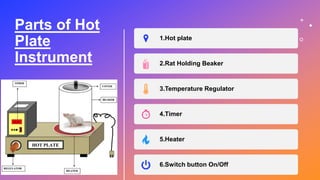
1.Hot plate
2.Rat Holding Beaker
3.Temperature Regulator
4.Timer
5.Heater
6.Switch button On/Off
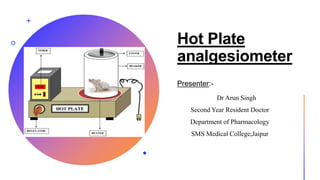
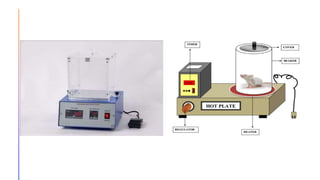
Hot plate meter is enabled with built in timer and foot switch.
• Built in timer- precisely helps to maintain the cut of time i.e., the
time of contact between rodent paw and thermal plate. It prevents
further damage to rodent biological tissues.
• Foot switch- Enable researcher to regulate the digital operations even
after his hands are engaged in handling of animal.
Thus, operator can instantly stop timer easily and conveniently with
help of foot switch.
• Hot plate instrument is enabled with electronic thermostat which
maintains the precise temperature of plate
• Temperature is displayed on wide digital screen.
• Plexiglass chamber over the thermal plate provides safety to the
researcher.
• The thermal plate has an advantage to maintain the uniform
temperature over its surface.
• The front panel timer displays the number of seconds the
animal took to react.
Screening of analgesic drug effects by Hot Plate
Method
• The hot plate test is a test of the pain response in animals, similar to
the tail flick method.
• Both hot plate and tail-flick methods are used generally for centrally
acting analgesic, while peripherally acting drugs are ineffective in
these tests but sensitive to acetic acid-induced writhing test.
Pain sensitivity is recorded at 55℃ usually
• Although, Hot plate instrument has facility to change the temperature
upto desire level (Max- 540℃ )
Rationale and Purpose
• Principle:- When rodents are placed onto a hot surface, they will
initially demonstrate the aversive effects of the thermal stimulus (Pain
by heat) by licking their paws and ultimately by overt attempts to
escape the environment (jumping).
• Substances that alter nociceptive threshold either increase the latency
(Reaction Time) to licking/jumping (analgesic effect) or decrease it
(hyperalgesia effect).
• Animal reaction time is a measurement of animal resistance to pain
and is used to measure efficacy of analgesics.
Requirements
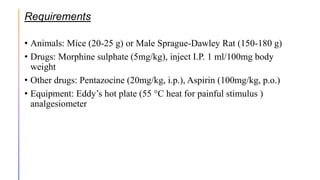
• Animals: Mice (20-25 g) or Male Sprague-Dawley Rat (150-180 g)
• Drugs: Morphine sulphate (5mg/kg), inject I.P. 1 ml/100mg body
weight
• Other drugs: Pentazocine (20mg/kg, i.p.), Aspirin (100mg/kg, p.o.)
• Equipment: Eddy’s hot plate (55 °C heat for painful stimulus )
analgesiometer
Procedure
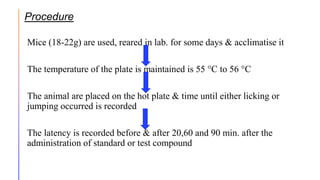
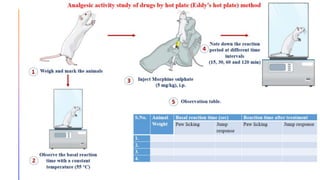
Mice (18-22g) are used, reared in lab. for some days & acclimatise it
The temperature of the plate is maintained is 55 °C to 56 °C
The animal are placed on the hot plate & time until either licking or
jumping occurred is recorded
The latency is recorded before & after 20,60 and 90 min. after the
administration of standard or test compound
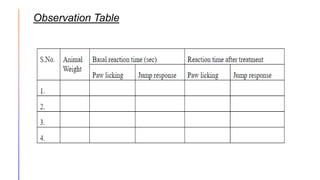
Observation Table
Conclusion
• From this experiment, we can conclude that, the drug inhibits pain
stimulus or not and drugs has analgesic property or not.
Hot plate analgesiometer

Hot plate analgesiometer

  • 1.
    Hot Plate analgesiometer Presenter:- Dr ArunSingh Second Year Resident Doctor Department of Pharmacology SMS Medical College,Jaipur
  • 2.
    Introduction • The testedare done with the help of hot plate are used in basic pain research and in testing the analgesics property of drug and theirs's efficacy. • The hot plate test is also a quick and relatively inexpensive way to assess acute thermal pain. • It was proposed by Eddy and Leimbach in 1953.
  • 3.
    Parts of Hot Plate Instrument 1.Hotplate 2.Rat Holding Beaker 3.Temperature Regulator 4.Timer 5.Heater 6.Switch button On/Off
  • 5.
    Hot plate meteris enabled with built in timer and foot switch. • Built in timer- precisely helps to maintain the cut of time i.e., the time of contact between rodent paw and thermal plate. It prevents further damage to rodent biological tissues. • Foot switch- Enable researcher to regulate the digital operations even after his hands are engaged in handling of animal. Thus, operator can instantly stop timer easily and conveniently with help of foot switch.
  • 6.
    • Hot plateinstrument is enabled with electronic thermostat which maintains the precise temperature of plate • Temperature is displayed on wide digital screen. • Plexiglass chamber over the thermal plate provides safety to the researcher. • The thermal plate has an advantage to maintain the uniform temperature over its surface. • The front panel timer displays the number of seconds the animal took to react.
  • 7.
    Screening of analgesicdrug effects by Hot Plate Method • The hot plate test is a test of the pain response in animals, similar to the tail flick method. • Both hot plate and tail-flick methods are used generally for centrally acting analgesic, while peripherally acting drugs are ineffective in these tests but sensitive to acetic acid-induced writhing test. Pain sensitivity is recorded at 55℃ usually • Although, Hot plate instrument has facility to change the temperature upto desire level (Max- 540℃ )
  • 8.
    Rationale and Purpose •Principle:- When rodents are placed onto a hot surface, they will initially demonstrate the aversive effects of the thermal stimulus (Pain by heat) by licking their paws and ultimately by overt attempts to escape the environment (jumping). • Substances that alter nociceptive threshold either increase the latency (Reaction Time) to licking/jumping (analgesic effect) or decrease it (hyperalgesia effect). • Animal reaction time is a measurement of animal resistance to pain and is used to measure efficacy of analgesics.
  • 9.
    Requirements • Animals: Mice(20-25 g) or Male Sprague-Dawley Rat (150-180 g) • Drugs: Morphine sulphate (5mg/kg), inject I.P. 1 ml/100mg body weight • Other drugs: Pentazocine (20mg/kg, i.p.), Aspirin (100mg/kg, p.o.) • Equipment: Eddy’s hot plate (55 °C heat for painful stimulus ) analgesiometer
  • 10.
    Procedure Mice (18-22g) areused, reared in lab. for some days & acclimatise it The temperature of the plate is maintained is 55 °C to 56 °C The animal are placed on the hot plate & time until either licking or jumping occurred is recorded The latency is recorded before & after 20,60 and 90 min. after the administration of standard or test compound
  • 12.
  • 13.
    Conclusion • From thisexperiment, we can conclude that, the drug inhibits pain stimulus or not and drugs has analgesic property or not.