

Recommended
More Related Content
Similar to Assay of Seretonin.pptx
Similar to Assay of Seretonin.pptx (20)
More from drarunsingh4
More from drarunsingh4 (19)
Recently uploaded
Recently uploaded (20)
Assay of Seretonin.pptx
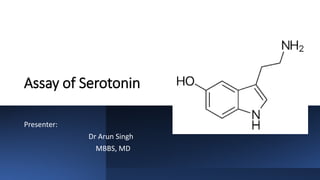
- 1. Assay of Serotonin Presenter: Dr Arun Singh MBBS, MD
- 2. • Aim: To determine unknown concentration of serotonin (5-HT) using rat stomach (fundus).
- 3. Background • Stomach fundus is useful in the bioassay of 5-HT which is considered to be most sensitive tissue among the three parts of stomach namely, fundus, corpus and pylorus. • Fundus is identified by its gray color and situated above the pink thick pyloric region.
- 4. Drugs like histamine are little or insensitive to he rat fundus due to the lack of H1 receptors in the stomach muscle. The other drugs which have sensitivity against the fundus are ACh, bradykinin and prostaglandin (PGE2). The muscle preparation is the important step in the bioassay using stomach fundus. Both longitudinal and circular muscle may be used in the experiment which depends on the transverse cut made to prepare the tissue (Figs 16.1A to E).
- 6. Materials and Method Animal/tissue : Rat/Stomach fundus PSS : Tyrode/deJalon/Krebs Lever : Frontal writing/ simple lever Magnification : 7-15x Tension : 1-4g Air : O2/Carbogen Temperature : 35-37°C Drug : Serotonin (5-HT) [M.wt: 176. 218] Acetylcholine chloride (ACh) [M. wt: 181.68]
- 7. Precautions before Experimentation Clean the organ bath before starting the experiment specially inner organ bath (chances of presence of previous drug used or to avoid any contamination) Clean Balance the simple writing lever, tangential to the rotating drum Balance Prepare PSS for the experiment, while taking exact quantity of chemicals (1% variability is acceptable) Prepare
- 8. Add the calcium chloride at the end of PSS preparation (to avoid any precipitation: PSS should be clear) Try to minimize the handling of tissue (especially at the middle part) Maintain the dose cycle properly (tissue sensitivity depend on this cycle) Animal should be fasted properly (any food present in the stomach may interfere with the assay) Carefully clean the fundus from the adjacent tissues.
- 9. Method Step III Rat is fixed on the DB by tying it legs with the help of thread. Step II Sacrifice the rat by stunning (a strong blow) on the head, and then keep on the dissecting board (DB). Step I Keep the animal (rat) fasting for at least 24hr, water is given ad libitum.
- 10. Step VI Cut and separate the stomach attachment at the end of esophagus and down at the duodenum. Step V Identify the stomach (just down the line of peritoneal cavity touches the liver and spleen. Step IV Cut open the abdomen of rat by a vertical long cut, and then expose the abdominal viscera.
- 11. Step IX Then, cut the fundus at the midline into two equal parts. Step VIII Wash the stomach contents properly with the PSS and then cut open the fundus by lesser curvature. Step VII Identify the fundus (grey part) which discriminates from the pyloric region that is pink in appearance.
- 12. Step XII Select the experimental design and get the response with standard and test drug. Step XI Then, attach into the organ bath and leave for relaxation at least 30-45 min. Step X For preserving the longitudinal muscle the alternate opposite vertical cut should be given (as shown in the figure) and then tie the thread on the either end of the muscle and stretch out the muscle.
- 13. Calculation and Result • The calculation and graph depend on the method / design of experimentation adopted either 3- point, 4-point or matching, etc. (see the bioassay section for calculation). • Inference Write the findings of the study.
- 14. Discussion Fundus contains the swallowed air and has functions mainly concerned with pressure changes. Its preparation is somewhat tedious than the other tissue preparations because it require alternate longitudinal cutting of tissue in which contraction of a circular muscle is measured in a longitudinal fashion.
- 15. It is a slow-contracting muscle hence, sometimes it needs a stretching weight to bring it to the baseline. Bradykinin produces slow contraction of stomach fundus whereas it is a strong stimulator of isolated intestinal tissue. This tissue well responds to tryptamine and prostacyclin (PGE2).