Submitted To :
Dr. KANCHAN VOHRA
Assistant Professor
Submitted By :
Mohd. Rafi Bhat
Hospital Waste Management
Hospital Waste is the waste produced
in the course of health care activities
during treating, diagnosing and
immunizing human beings or animals
or while doing study/research
activities.
75- 90% Non hazardous or General
waste
10-15% Hazardous or harmful waste
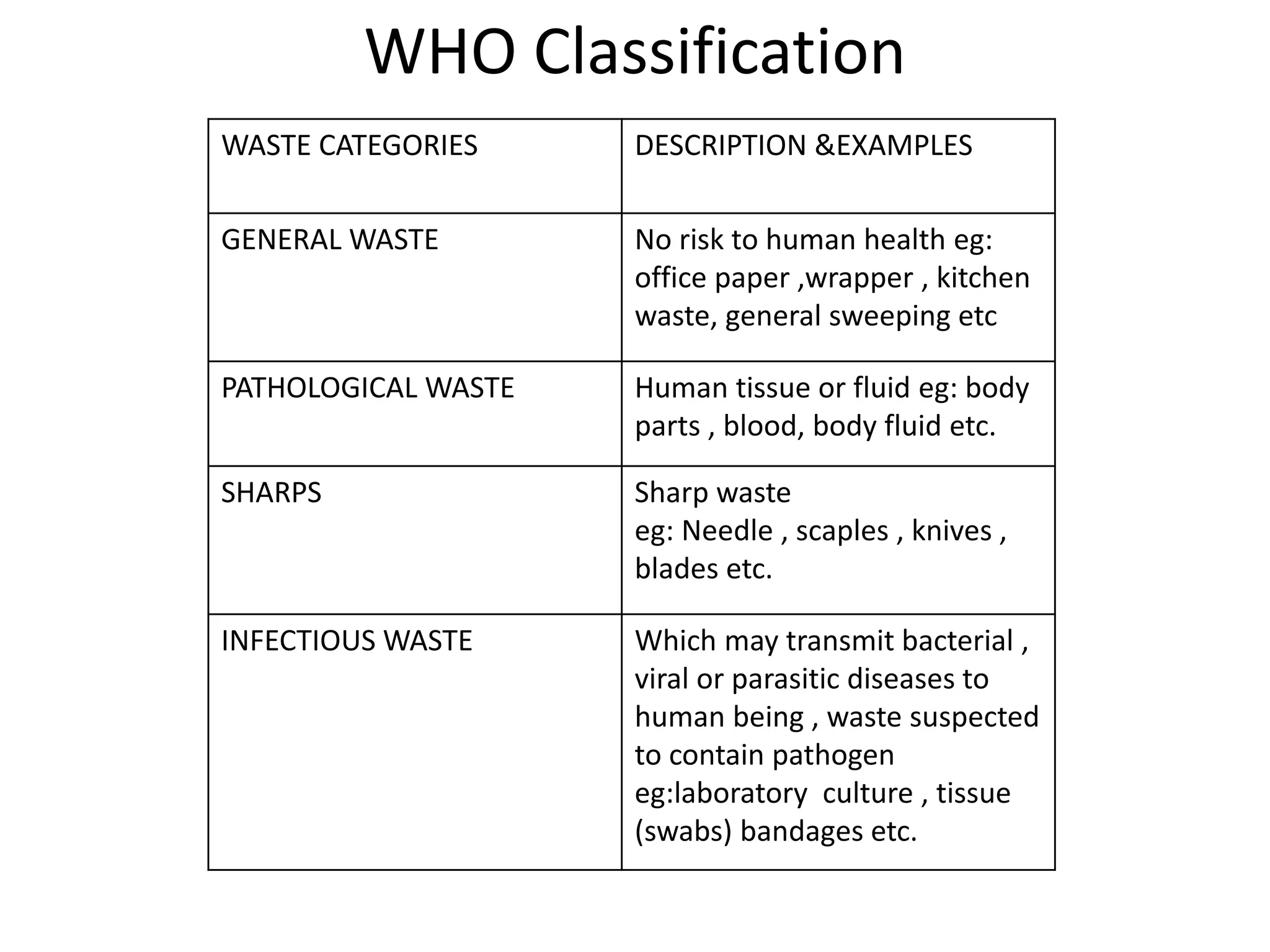
WHO Classification
WASTE CATEGORIES DESCRIPTION &EXAMPLES
GENERAL WASTE No risk to human health eg:
office paper ,wrapper , kitchen
waste, general sweeping etc
PATHOLOGICAL WASTE Human tissue or fluid eg: body
parts , blood, body fluid etc.
SHARPS Sharp waste
eg: Needle , scaples , knives ,
blades etc.
INFECTIOUS WASTE Which may transmit bacterial ,
viral or parasitic diseases to
human being , waste suspected
to contain pathogen
eg:laboratory culture , tissue
(swabs) bandages etc.
CHEMICAL WASTE Eg: Laboratory reagent ,
disinfectant ,film developer
RADIOACTIVE WASTE Eg: Unused liquid from
radiotherapy or lab research ,
contaminated glass wares
PHARMACEUTICAL WASTE Expired outdated drugs/
chemicals
PRESSURIZED CONTAINER Gas cylinder , aerosol cans
GENOTOXIC WASTE Waste containing cytotoxic
drugs (often used in cancer
therapy)
SOURCE OF HEALTH CARE WASTE
Governmental Hospitals
Private Hospitals
Nursing Homes
Physician’s office
Dentist office
Dispensaries
Blood bank &collection center
Animal houses
Research organizations
Categories of patients exposed to
risk of infections
SANITATION
WORKERS
MEDICAL
&PARAMEDICAL STAFF
PATIENTS +VISITORS
GENERATION,SEGREGATION,COLLEC
-TION,STORAGE,TRANSPORTATION
AND TREATMENT OF WASTE
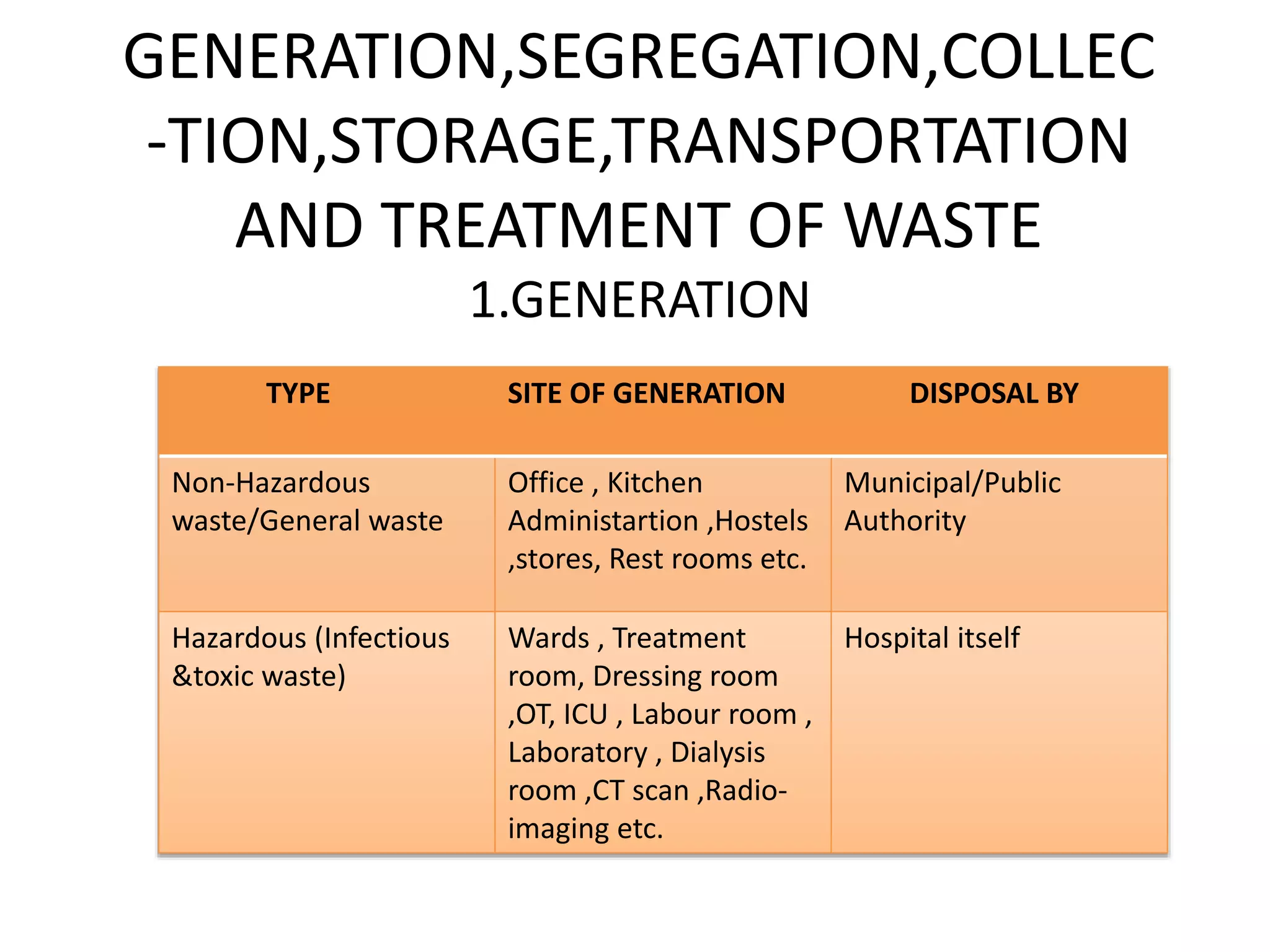
1.GENERATION
TYPE SITE OF GENERATION DISPOSAL BY
Non-Hazardous
waste/General waste
Office , Kitchen
Administartion ,Hostels
,stores, Rest rooms etc.
Municipal/Public
Authority
Hazardous (Infectious
&toxic waste)
Wards , Treatment
room, Dressing room
,OT, ICU , Labour room ,
Laboratory , Dialysis
room ,CT scan ,Radio-
imaging etc.
Hospital itself
2.SEGREGATION
Done at point of generation of waste
and put in separate color bags . Color
coding varies from nation to nation .
For eg. In AIIMS hospital , New delhi ,
Following color code bags are
practised
GENERAL WASTE
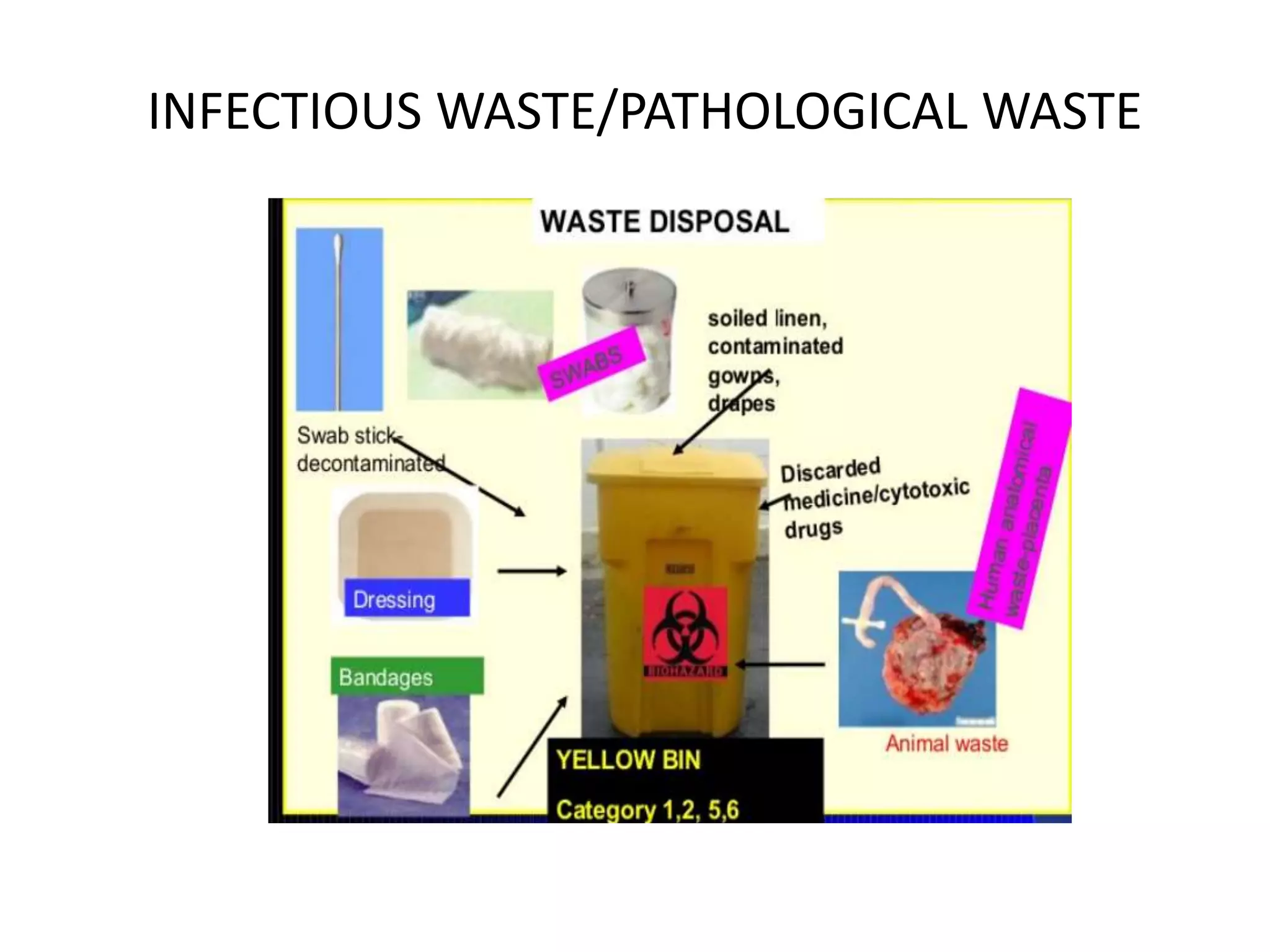
INFECTIOUS WASTE/PATHOLOGICAL WASTE
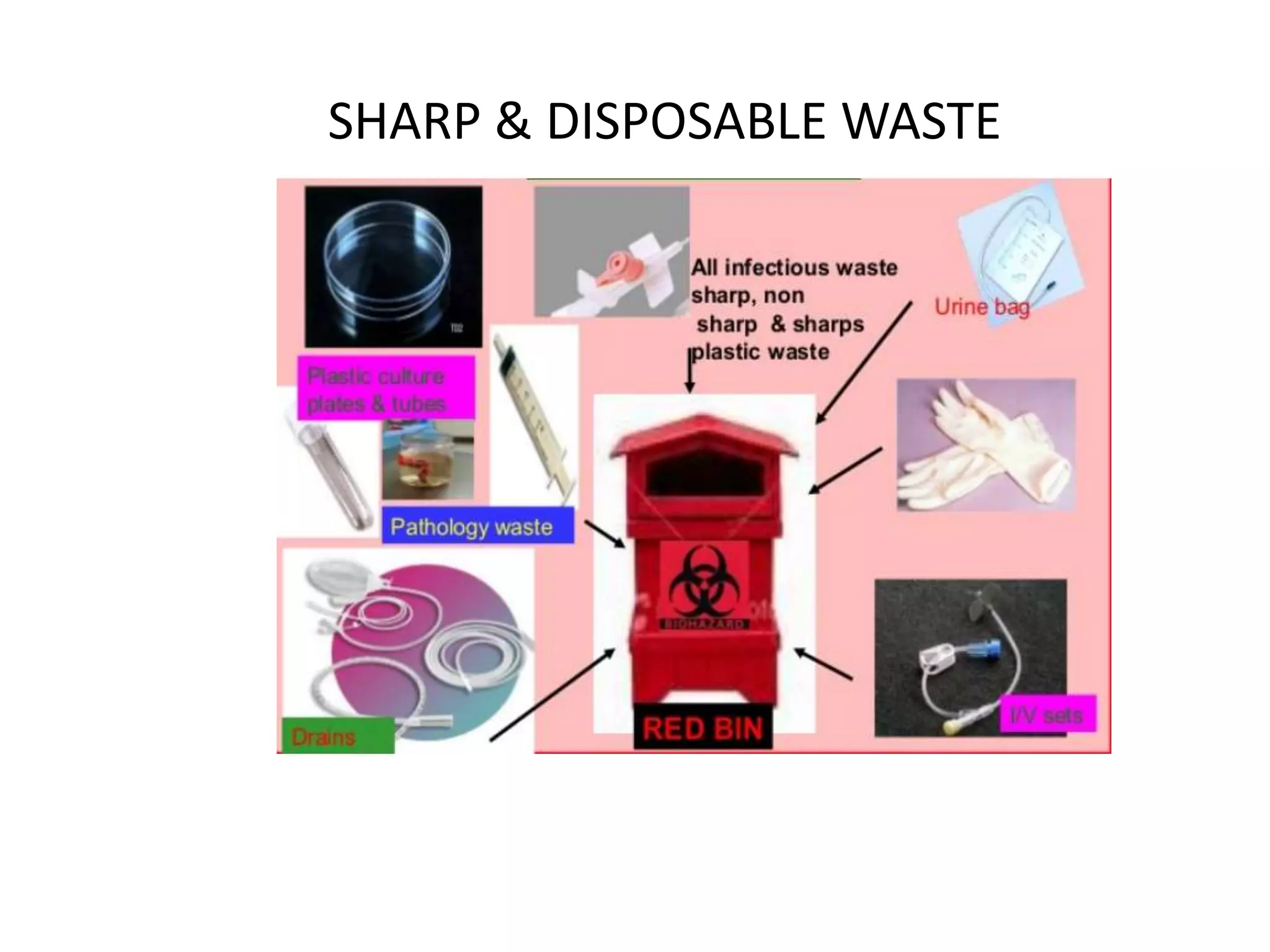
SHARP & DISPOSABLE WASTE
3.COLLECTION OF WASTE
Centralized sanitation staffs or any
other sanitation staffs should collect
the waste during morning , afternoon
or evening under the supervision of
nursing staff and sanitation
supervisior; documentation should
be done in register ; Garbage should
be cleaned and disinfected regularly.
4.STORAGE OF WASTE
Waste should not be stored in the
generation area for more than a
period of 4-6 hours.
It is responsibility of
paramedic/sanitation staff to check
for segregation.
Waste collected in various areas
should be transported for
disposal/treatment.
TRANSPORTATION
•There should be separate corridor and lift in
hospital to carry and transport waste.
•General waste are deposited at municipal dumps.
•Waste for autoclaving and incineration are
dumped at separate site for external waste
(should have separate colored plastic bag for
these waste).
•Transportation should be done in sealed
container, sanitation supervisor should ensure for
leakage.
TREATMENT & DISPOSAL
•General waste should be dumped at
municipal dumping site . Sanitation officer
should be responsible for proper
coordination between municipal & hospital.
•Use of label/symbol is useful in identifying
waste for treatment . Eg: risk of corrosion
,danger of infection, toxic hazards, glass
hazards, radioactive material
LABEL FOR BIO-MEDICAL WASTE
CONTAINERS/BAGS
TREATMENT &DISPOSAL
TECHNOLOGIES
Incineration
Chemical Disinfection
Wet &dry thermal treatment
Microwave irradiation
Land disposal
Inertization
INCINERATION
•High temperature dry oxidation process that
reduce organic and combustible waste into
incombustible matter.
•Resulting into significant reduction in waste
volume and weight.
•This process is selected to treat waste that
cannot be recycled, reused or can be
disposed in land.
TYPES OF INCINERATORS
•Double Chambered(for infectious
waste)
•Single Chambered
•Rotatory Kilns(for genotoxic waste)
CHEMICAL DISINFECTION
•Commonly used for treatment of liquid
infectious waste eg. Blood, urine, stool and
hospital sewage.
•Chemicals are added to waste to kill or
inactivate the pathogen it contains
WET & DRY THERMAL TREATMENT
•Wet thermal treatment/steam
disinfection is based on exposure if
infectious waste to high temperature and
high pressure steam similar to process of
autoclaving, inappropriate for treating
anatomical waste, chemical and
pharmaceutical waste.
•Screw feed technology: Dry thermal
treatment which waste is shredded and
heated in rotating auger. 80% volume and
20-35 weight is reduced, suitable for
infectious waste and sharps.
MICROWAVE IRRADIATION
•Microwave of frequency 2450MHZ and
wave length 12.24cm used to destroy the
microorganism . Water contained in the
waste is rapidly heated by microwave and
infectious component are destroyed by heat
conduction
LAND DISPOSAL
1.Open dumps : risk for public health
2.Sanitary landfills: designed and
constructed to prevent contamination of
soil , surface, ground water and direct
contact with public.
INERTIZATION
•Process of mixing waste with cement
and other substances before disposal in
order to minimize the risk of toxic
substance migrating in to surface water
or ground water and to prevent
scavenging
•Proportion of 65% waste, 15% lime,
15%cement and 5% water is used.
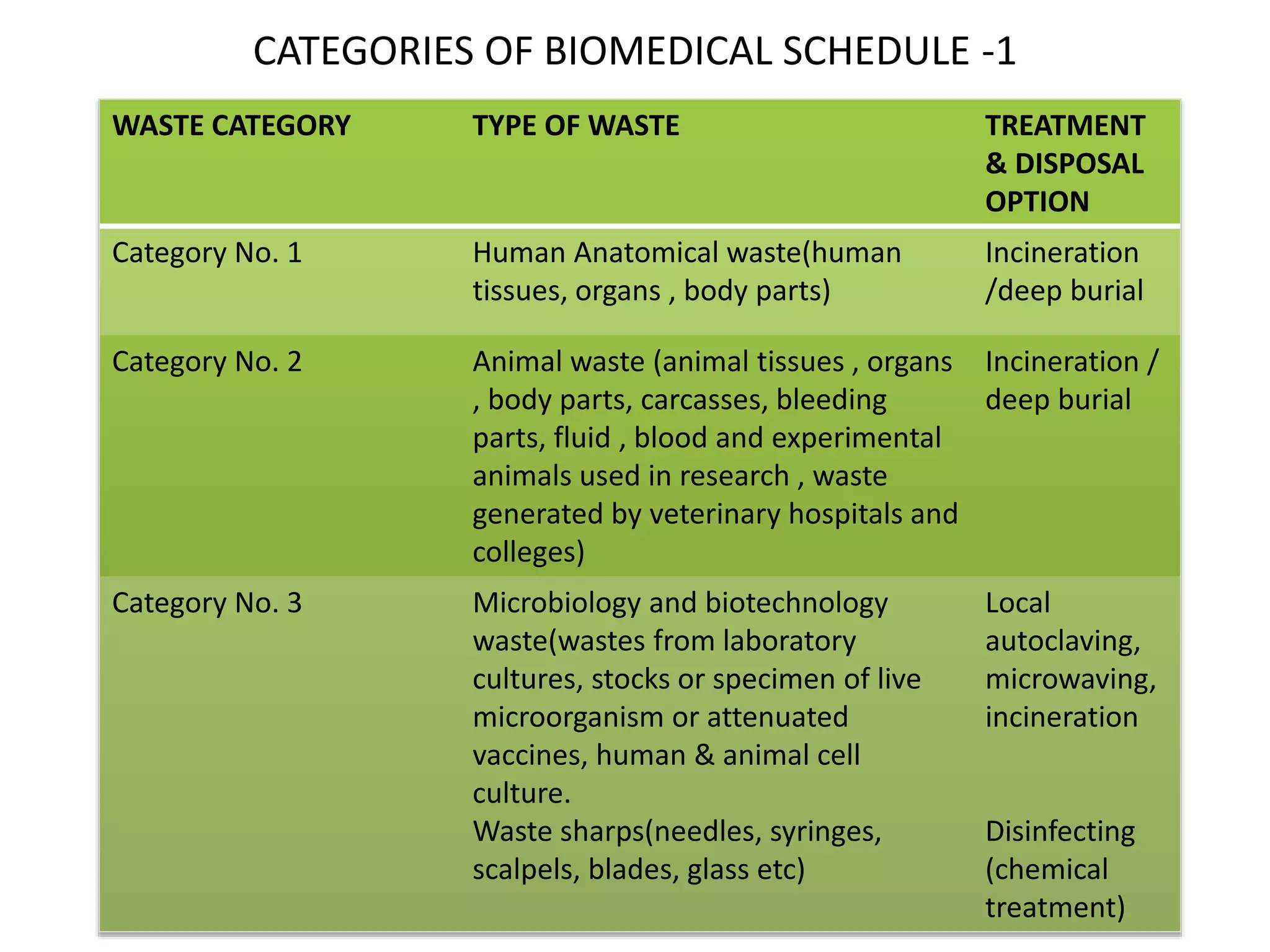
CATEGORIES OF BIOMEDICAL SCHEDULE -1
WASTE CATEGORY TYPE OF WASTE TREATMENT
& DISPOSAL
OPTION
Category No. 1 Human Anatomical waste(human
tissues, organs , body parts)
Incineration
/deep burial
Category No. 2 Animal waste (animal tissues , organs
, body parts, carcasses, bleeding
parts, fluid , blood and experimental
animals used in research , waste
generated by veterinary hospitals and
colleges)
Incineration /
deep burial
Category No. 3 Microbiology and biotechnology
waste(wastes from laboratory
cultures, stocks or specimen of live
microorganism or attenuated
vaccines, human & animal cell
culture.
Waste sharps(needles, syringes,
scalpels, blades, glass etc)
Local
autoclaving,
microwaving,
incineration
Disinfecting
(chemical
treatment)
Category No. 4 Cause puncture and cuts .
This include both used
and unused sharps.
Autoclaving and
microwaving
Category No. 5 Discarded medicine and
cytotoxic drugs(outdated,
contaminated and
discarded medicine)
Incineration/destruction
and drugs disposal in
secured landfills.
Category No.6 Soiled waste(items
contaminated with body
fluids including cotton
,dressing soiled plaster
casts other material
contaminated with blood)
Incineration/autoclaving/
microwaving
Category No. 7 Solid waste (waste
generated from
disposable items other
than the waste sharps
such as tubing ,catheters,
intravenous sets
Disinfecting by chemical
treatment , autoclaving ,
microwaving
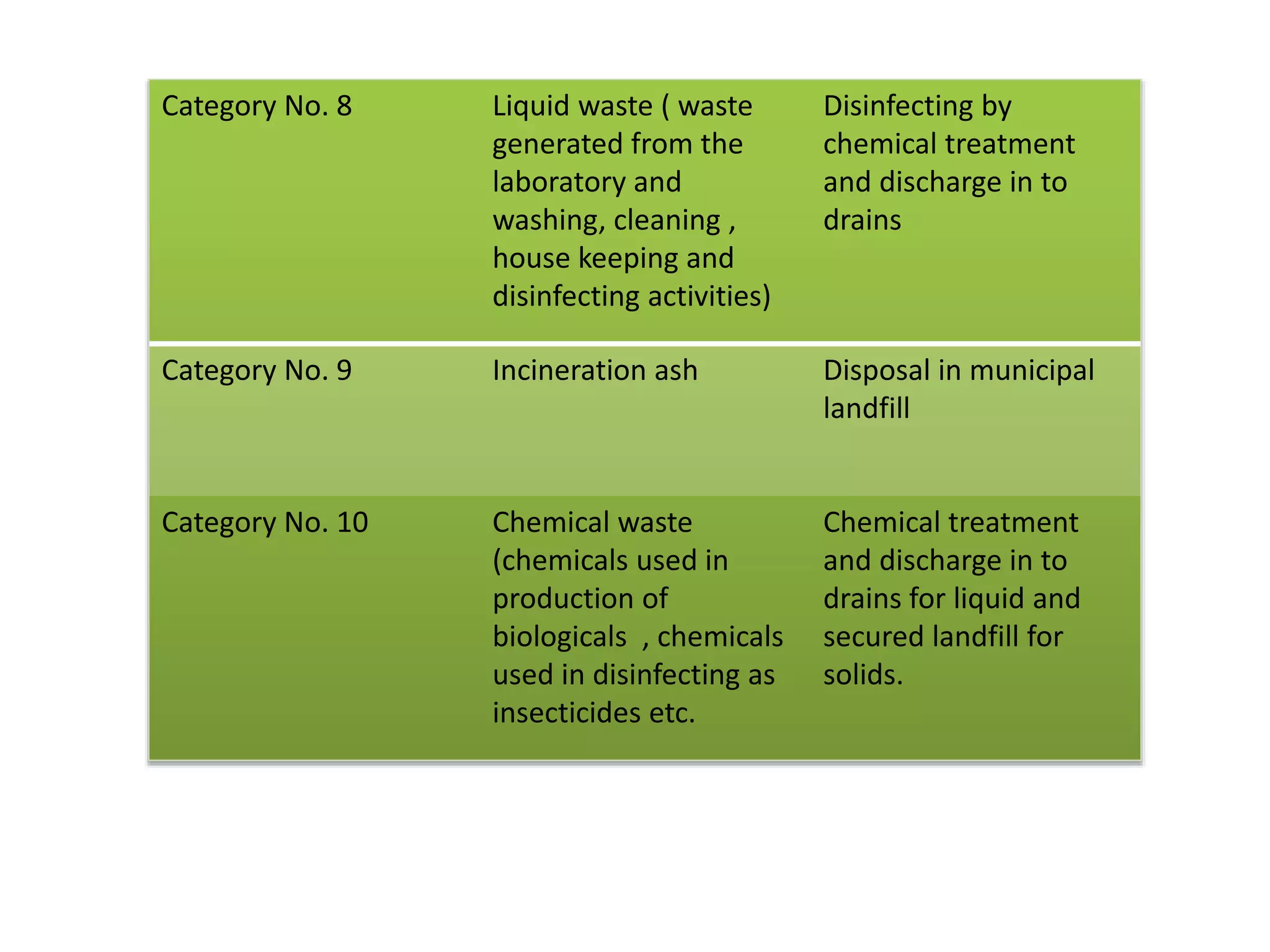
Category No. 8 Liquid waste ( waste
generated from the
laboratory and
washing, cleaning ,
house keeping and
disinfecting activities)
Disinfecting by
chemical treatment
and discharge in to
drains
Category No. 9 Incineration ash Disposal in municipal
landfill
Category No. 10 Chemical waste
(chemicals used in
production of
biologicals , chemicals
used in disinfecting as
insecticides etc.
Chemical treatment
and discharge in to
drains for liquid and
secured landfill for
solids.
Hospital waste management

Hospital waste management

  • 1.
    Submitted To : Dr.KANCHAN VOHRA Assistant Professor Submitted By : Mohd. Rafi Bhat Hospital Waste Management
  • 2.
    Hospital Waste isthe waste produced in the course of health care activities during treating, diagnosing and immunizing human beings or animals or while doing study/research activities. 75- 90% Non hazardous or General waste 10-15% Hazardous or harmful waste
  • 3.
    WHO Classification WASTE CATEGORIESDESCRIPTION &EXAMPLES GENERAL WASTE No risk to human health eg: office paper ,wrapper , kitchen waste, general sweeping etc PATHOLOGICAL WASTE Human tissue or fluid eg: body parts , blood, body fluid etc. SHARPS Sharp waste eg: Needle , scaples , knives , blades etc. INFECTIOUS WASTE Which may transmit bacterial , viral or parasitic diseases to human being , waste suspected to contain pathogen eg:laboratory culture , tissue (swabs) bandages etc.
  • 4.
    CHEMICAL WASTE Eg:Laboratory reagent , disinfectant ,film developer RADIOACTIVE WASTE Eg: Unused liquid from radiotherapy or lab research , contaminated glass wares PHARMACEUTICAL WASTE Expired outdated drugs/ chemicals PRESSURIZED CONTAINER Gas cylinder , aerosol cans GENOTOXIC WASTE Waste containing cytotoxic drugs (often used in cancer therapy)
  • 5.
    SOURCE OF HEALTHCARE WASTE Governmental Hospitals Private Hospitals Nursing Homes Physician’s office Dentist office Dispensaries Blood bank &collection center Animal houses Research organizations
  • 6.
    Categories of patientsexposed to risk of infections SANITATION WORKERS MEDICAL &PARAMEDICAL STAFF PATIENTS +VISITORS
  • 7.
    GENERATION,SEGREGATION,COLLEC -TION,STORAGE,TRANSPORTATION AND TREATMENT OFWASTE 1.GENERATION TYPE SITE OF GENERATION DISPOSAL BY Non-Hazardous waste/General waste Office , Kitchen Administartion ,Hostels ,stores, Rest rooms etc. Municipal/Public Authority Hazardous (Infectious &toxic waste) Wards , Treatment room, Dressing room ,OT, ICU , Labour room , Laboratory , Dialysis room ,CT scan ,Radio- imaging etc. Hospital itself
  • 8.
    2.SEGREGATION Done at pointof generation of waste and put in separate color bags . Color coding varies from nation to nation . For eg. In AIIMS hospital , New delhi , Following color code bags are practised
  • 9.
  • 10.
  • 11.
  • 12.
    3.COLLECTION OF WASTE Centralizedsanitation staffs or any other sanitation staffs should collect the waste during morning , afternoon or evening under the supervision of nursing staff and sanitation supervisior; documentation should be done in register ; Garbage should be cleaned and disinfected regularly.
  • 13.
    4.STORAGE OF WASTE Wasteshould not be stored in the generation area for more than a period of 4-6 hours. It is responsibility of paramedic/sanitation staff to check for segregation. Waste collected in various areas should be transported for disposal/treatment.
  • 14.
    TRANSPORTATION •There should beseparate corridor and lift in hospital to carry and transport waste. •General waste are deposited at municipal dumps. •Waste for autoclaving and incineration are dumped at separate site for external waste (should have separate colored plastic bag for these waste). •Transportation should be done in sealed container, sanitation supervisor should ensure for leakage.
  • 15.
    TREATMENT & DISPOSAL •Generalwaste should be dumped at municipal dumping site . Sanitation officer should be responsible for proper coordination between municipal & hospital. •Use of label/symbol is useful in identifying waste for treatment . Eg: risk of corrosion ,danger of infection, toxic hazards, glass hazards, radioactive material
  • 16.
    LABEL FOR BIO-MEDICALWASTE CONTAINERS/BAGS
  • 17.
    TREATMENT &DISPOSAL TECHNOLOGIES Incineration Chemical Disinfection Wet&dry thermal treatment Microwave irradiation Land disposal Inertization
  • 18.
    INCINERATION •High temperature dryoxidation process that reduce organic and combustible waste into incombustible matter. •Resulting into significant reduction in waste volume and weight. •This process is selected to treat waste that cannot be recycled, reused or can be disposed in land.
  • 19.
    TYPES OF INCINERATORS •DoubleChambered(for infectious waste) •Single Chambered •Rotatory Kilns(for genotoxic waste)
  • 20.
    CHEMICAL DISINFECTION •Commonly usedfor treatment of liquid infectious waste eg. Blood, urine, stool and hospital sewage. •Chemicals are added to waste to kill or inactivate the pathogen it contains
  • 21.
    WET & DRYTHERMAL TREATMENT •Wet thermal treatment/steam disinfection is based on exposure if infectious waste to high temperature and high pressure steam similar to process of autoclaving, inappropriate for treating anatomical waste, chemical and pharmaceutical waste. •Screw feed technology: Dry thermal treatment which waste is shredded and heated in rotating auger. 80% volume and 20-35 weight is reduced, suitable for infectious waste and sharps.
  • 22.
    MICROWAVE IRRADIATION •Microwave offrequency 2450MHZ and wave length 12.24cm used to destroy the microorganism . Water contained in the waste is rapidly heated by microwave and infectious component are destroyed by heat conduction
  • 23.
    LAND DISPOSAL 1.Open dumps: risk for public health 2.Sanitary landfills: designed and constructed to prevent contamination of soil , surface, ground water and direct contact with public.
  • 24.
    INERTIZATION •Process of mixingwaste with cement and other substances before disposal in order to minimize the risk of toxic substance migrating in to surface water or ground water and to prevent scavenging •Proportion of 65% waste, 15% lime, 15%cement and 5% water is used.
  • 25.
    CATEGORIES OF BIOMEDICALSCHEDULE -1 WASTE CATEGORY TYPE OF WASTE TREATMENT & DISPOSAL OPTION Category No. 1 Human Anatomical waste(human tissues, organs , body parts) Incineration /deep burial Category No. 2 Animal waste (animal tissues , organs , body parts, carcasses, bleeding parts, fluid , blood and experimental animals used in research , waste generated by veterinary hospitals and colleges) Incineration / deep burial Category No. 3 Microbiology and biotechnology waste(wastes from laboratory cultures, stocks or specimen of live microorganism or attenuated vaccines, human & animal cell culture. Waste sharps(needles, syringes, scalpels, blades, glass etc) Local autoclaving, microwaving, incineration Disinfecting (chemical treatment)
  • 26.
    Category No. 4Cause puncture and cuts . This include both used and unused sharps. Autoclaving and microwaving Category No. 5 Discarded medicine and cytotoxic drugs(outdated, contaminated and discarded medicine) Incineration/destruction and drugs disposal in secured landfills. Category No.6 Soiled waste(items contaminated with body fluids including cotton ,dressing soiled plaster casts other material contaminated with blood) Incineration/autoclaving/ microwaving Category No. 7 Solid waste (waste generated from disposable items other than the waste sharps such as tubing ,catheters, intravenous sets Disinfecting by chemical treatment , autoclaving , microwaving
  • 27.
    Category No. 8Liquid waste ( waste generated from the laboratory and washing, cleaning , house keeping and disinfecting activities) Disinfecting by chemical treatment and discharge in to drains Category No. 9 Incineration ash Disposal in municipal landfill Category No. 10 Chemical waste (chemicals used in production of biologicals , chemicals used in disinfecting as insecticides etc. Chemical treatment and discharge in to drains for liquid and secured landfill for solids.