HOSPITAL WASTE MANAGEMENT
Babol Noshirvani University of Tech.
Eng. Alireza Rezvani
Supervisor: Dr. Hassan Amini Rad
OBJECTIVES
 Classification of waste (WHO)
 Source of Health Care Waste
 Health care waste Management provision and study (Nepal Context)
 Magnitude of problem in developing and developed countries
 Problems associated with Health care waste
 Generation/Segregation/Storage/Transportion/Treat ment & Disposal of
waste
 Treatment technique & categorical treatment.
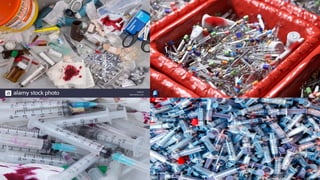
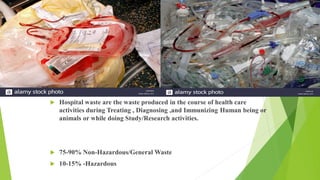
 Hospital waste are the waste produced in the course of health care
activities during Treating , Diagnosing ,and Immunizing Human being or
animals or while doing Study/Research activities.
 75-90% Non-Hazardous/General Waste
 10-15% -Hazardous
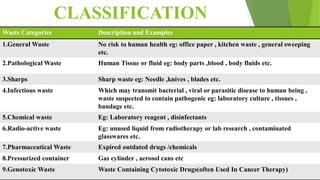
CLASSIFICATION
Description and ExamplesWaste Categories
No risk to human health eg: office paper , kitchen waste , general sweeping
etc.
1.General Waste
Human Tissue or fluid eg: body parts ,blood , body fluids etc.2.Pathological Waste
Sharp waste eg: Needle ,knives , blades etc.3.Sharps
Which may transmit bacterial , viral or parasitic disease to human being ,
waste suspected to contain pathogenic eg: laboratory culture , tissues ,
bandage etc.
4.Infectious waste
Eg: Laboratory reagent , disinfectants5.Chemical waste
Eg: unused liquid from radiotherapy or lab research , contaminated
glasswares etc.
6.Radio-active waste
Expired outdated drugs /chemicals7.Pharmaceutical Waste
Gas cylinder , aerosol cans etc8.Pressurized container
Waste Containing Cytotoxic Drugs(often Used In Cancer Therapy)9.Genotoxic Waste
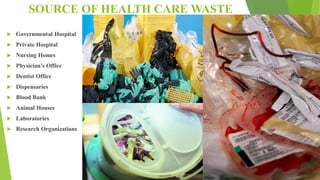
SOURCE OF HEALTH CARE WASTE
 Governmental Hospital
 Private Hospital
 Nursing Homes
 Physician’s Office
 Dentist Office
 Dispensaries
 Blood Bank
 Animal Houses
 Laboratories
 Research Organizations
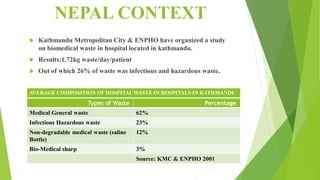
NEPAL CONTEXT
 Kathmandu Metropolitan City & ENPHO have organized a study
on biomedical waste in hospital located in kathmandu.
 Results:1.72kg waste/day/patient
 Out of which 26% of waste was infectious and hazardous waste.
PercentageTypes of Waste
62%Medical General waste
23%Infectious Hazardous waste
12%Non-degradable medical waste (saline
Bottle)
3%Bio-Medical sharp
Source: KMC & ENPHO 2001
AVERAGE COMPOSITION OF HOSPITAL WASTE IN HOSPITALS IN KATHMANDU
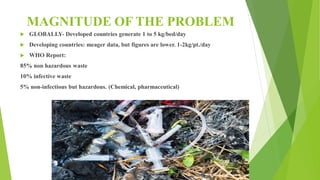
MAGNITUDE OF THE PROBLEM
 GLOBALLY- Developed countries generate 1 to 5 kg/bed/day
 Developing countries: meager data, but figures are lower. 1-2kg/pt./day
 WHO Report:
85% non hazardous waste
10% infective waste
5% non-infectious but hazardous. (Chemical, pharmaceutical)
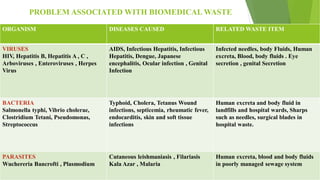
PROBLEM ASSOCIATED WITH BIOMEDICAL WASTE
RELATED WASTE ITEMDISEASES CAUSEDORGANISM
Infected needles, body Fluids, Human
excreta, Blood, body fluids . Eye
secretion , genital Secretion
AIDS, Infectious Hepatitis, Infectious
Hepatitis, Dengue, Japanese
encephalitis, Ocular infection , Genital
Infection
VIRUSES
HIV, Hepatitis B, Hepatitis A , C ,
Arboviruses , Enteroviruses , Herpes
Virus
Human excreta and body fluid in
landfills and hospital wards, Sharps
such as needles, surgical blades in
hospital waste.
Typhoid, Cholera, Tetanus Wound
infections, septicemia, rheumatic fever,
endocarditis, skin and soft tissue
infections
BACTERIA
Salmonella typhi, Vibrio cholerae,
Clostridium Tetani, Pseudomonas,
Streptococcus
Human excreta, blood and body fluids
in poorly managed sewage system
Cutaneous leishmaniasis , Filariasis
Kala Azar , Malaria
PARASITES
Wuchereria Bancrofti , Plasmodium
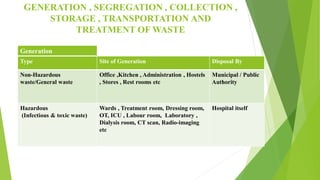
GENERATION , SEGREGATION , COLLECTION ,
STORAGE , TRANSPORTATION AND
TREATMENT OF WASTE
Disposal BySite of GenerationType
Municipal / Public
Authority
Office ,Kitchen , Administration , Hostels
, Stores , Rest rooms etc
Non-Hazardous
waste/General waste
Hospital itselfWards , Treatment room, Dressing room,
OT, ICU , Labour room, Laboratory ,
Dialysis room, CT scan, Radio-imaging
etc
Hazardous
(Infectious & toxic waste)
Generation
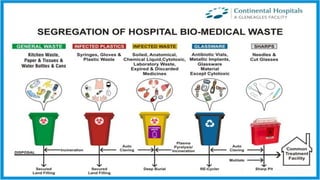
Segregation
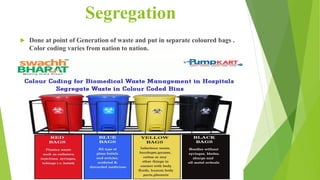
 Done at point of Generation of waste and put in separate coloured bags .
Color coding varies from nation to nation.
Collection of waste
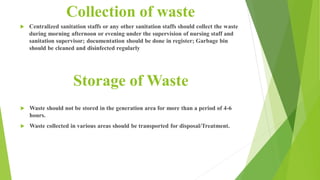
 Centralized sanitation staffs or any other sanitation staffs should collect the waste
during morning afternoon or evening under the supervision of nursing staff and
sanitation supervisor; documentation should be done in register; Garbage bin
should be cleaned and disinfected regularly
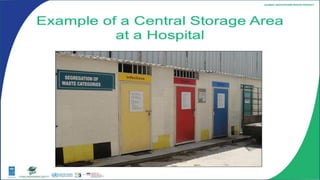
 Waste should not be stored in the generation area for more than a period of 4-6
hours.
 Waste collected in various areas should be transported for disposal/Treatment.
Storage of Waste
Transportation
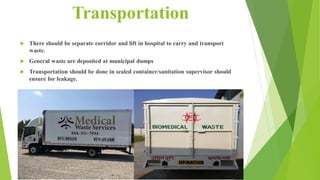
 There should be separate corridor and lift in hospital to carry and transport
waste.
 General waste are deposited at municipal dumps
 Transportation should be done in sealed container/sanitation supervisor should
ensure for leakage.
Treatment & Disposal
 General waste should be dumped at municipal dumping site. Sanitation
officer should be responsible for proper coordination between municipal
and hospital.
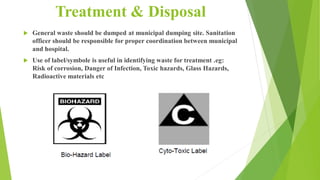
 Use of label/symbole is useful in identifying waste for treatment .eg:
Risk of corrosion, Danger of Infection, Toxic hazards, Glass Hazards,
Radioactive materials etc
TREATMENT & DISPOSAL TECHNOLOGIES
• 1. Incineration
• 2. Chemical Disinfection
• 3. Wet and dry thermal treatment
• 4. Microwave irradiation
• 5. Land disposal
• 6. Inertization
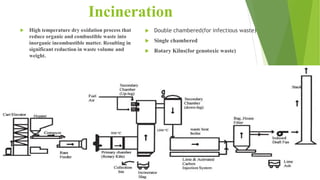
Incineration
 High temperature dry oxidation process that
reduce organic and combustible waste into
inorganic incombustible matter. Resulting in
significant reduction in waste volume and
weight.
 Double chambered(for infectious waste)
 Single chambered
 Rotary Kilns(for genotoxic waste)
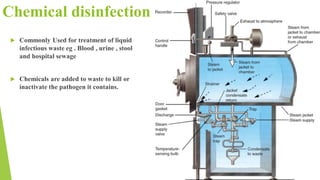
Chemical disinfection
 Commonly Used for treatment of liquid
infectious waste eg . Blood , urine , stool
and hospital sewage
 Chemicals are added to waste to kill or
inactivate the pathogen it contains.
Wet and Dry thermal treatment
 Wet thermal treatment/steam disinfection is based on exposure if infecious
waste to high tempreture and high pressure steam similar to process of
autoclaving, inapropriate for treating anatomical waste, chemical and
pharmaceutical waste.
 Screw feed technology: Dry thermal treatment in which waste is shredded
and heated in rotating auger.80% volume and 20-35 weight is reduced,
suitable for infectius waste and sharps.
Microwave irradiation
 Microwave of frequency 2450MHZ and wave length 12.24cm used to
destroy the microorganism. water contained in the waste is rapidly
heated by microwave and infectious components are destroyed by
heat conduction.
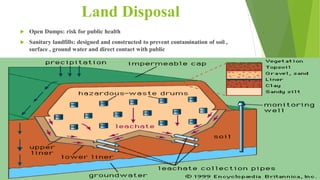
Land Disposal
 Open Dumps: risk for public health
 Sanitary landfills: designed and constructed to prevent contamination of soil ,
surface , ground water and direct contact with public
Inertization
 Process of mixing waste with cement and other substances
before disposal in order to minimize the risk of toxic
substance migrating into surface water or ground water and
to prevent scavenging.
 Proportion of 65% waste 15%lime 15% cement and 5%
water is used
The End

Hospital waste management PDF

  • 1.
    HOSPITAL WASTE MANAGEMENT BabolNoshirvani University of Tech. Eng. Alireza Rezvani Supervisor: Dr. Hassan Amini Rad
  • 3.
    OBJECTIVES  Classification ofwaste (WHO)  Source of Health Care Waste  Health care waste Management provision and study (Nepal Context)  Magnitude of problem in developing and developed countries  Problems associated with Health care waste  Generation/Segregation/Storage/Transportion/Treat ment & Disposal of waste  Treatment technique & categorical treatment.
  • 4.
     Hospital wasteare the waste produced in the course of health care activities during Treating , Diagnosing ,and Immunizing Human being or animals or while doing Study/Research activities.  75-90% Non-Hazardous/General Waste  10-15% -Hazardous
  • 5.
    CLASSIFICATION Description and ExamplesWasteCategories No risk to human health eg: office paper , kitchen waste , general sweeping etc. 1.General Waste Human Tissue or fluid eg: body parts ,blood , body fluids etc.2.Pathological Waste Sharp waste eg: Needle ,knives , blades etc.3.Sharps Which may transmit bacterial , viral or parasitic disease to human being , waste suspected to contain pathogenic eg: laboratory culture , tissues , bandage etc. 4.Infectious waste Eg: Laboratory reagent , disinfectants5.Chemical waste Eg: unused liquid from radiotherapy or lab research , contaminated glasswares etc. 6.Radio-active waste Expired outdated drugs /chemicals7.Pharmaceutical Waste Gas cylinder , aerosol cans etc8.Pressurized container Waste Containing Cytotoxic Drugs(often Used In Cancer Therapy)9.Genotoxic Waste
  • 6.
    SOURCE OF HEALTHCARE WASTE  Governmental Hospital  Private Hospital  Nursing Homes  Physician’s Office  Dentist Office  Dispensaries  Blood Bank  Animal Houses  Laboratories  Research Organizations
  • 7.
    NEPAL CONTEXT  KathmanduMetropolitan City & ENPHO have organized a study on biomedical waste in hospital located in kathmandu.  Results:1.72kg waste/day/patient  Out of which 26% of waste was infectious and hazardous waste. PercentageTypes of Waste 62%Medical General waste 23%Infectious Hazardous waste 12%Non-degradable medical waste (saline Bottle) 3%Bio-Medical sharp Source: KMC & ENPHO 2001 AVERAGE COMPOSITION OF HOSPITAL WASTE IN HOSPITALS IN KATHMANDU
  • 8.
    MAGNITUDE OF THEPROBLEM  GLOBALLY- Developed countries generate 1 to 5 kg/bed/day  Developing countries: meager data, but figures are lower. 1-2kg/pt./day  WHO Report: 85% non hazardous waste 10% infective waste 5% non-infectious but hazardous. (Chemical, pharmaceutical)
  • 9.
    PROBLEM ASSOCIATED WITHBIOMEDICAL WASTE RELATED WASTE ITEMDISEASES CAUSEDORGANISM Infected needles, body Fluids, Human excreta, Blood, body fluids . Eye secretion , genital Secretion AIDS, Infectious Hepatitis, Infectious Hepatitis, Dengue, Japanese encephalitis, Ocular infection , Genital Infection VIRUSES HIV, Hepatitis B, Hepatitis A , C , Arboviruses , Enteroviruses , Herpes Virus Human excreta and body fluid in landfills and hospital wards, Sharps such as needles, surgical blades in hospital waste. Typhoid, Cholera, Tetanus Wound infections, septicemia, rheumatic fever, endocarditis, skin and soft tissue infections BACTERIA Salmonella typhi, Vibrio cholerae, Clostridium Tetani, Pseudomonas, Streptococcus Human excreta, blood and body fluids in poorly managed sewage system Cutaneous leishmaniasis , Filariasis Kala Azar , Malaria PARASITES Wuchereria Bancrofti , Plasmodium
  • 10.
    GENERATION , SEGREGATION, COLLECTION , STORAGE , TRANSPORTATION AND TREATMENT OF WASTE Disposal BySite of GenerationType Municipal / Public Authority Office ,Kitchen , Administration , Hostels , Stores , Rest rooms etc Non-Hazardous waste/General waste Hospital itselfWards , Treatment room, Dressing room, OT, ICU , Labour room, Laboratory , Dialysis room, CT scan, Radio-imaging etc Hazardous (Infectious & toxic waste) Generation
  • 12.
    Segregation  Done atpoint of Generation of waste and put in separate coloured bags . Color coding varies from nation to nation.
  • 13.
    Collection of waste Centralized sanitation staffs or any other sanitation staffs should collect the waste during morning afternoon or evening under the supervision of nursing staff and sanitation supervisor; documentation should be done in register; Garbage bin should be cleaned and disinfected regularly  Waste should not be stored in the generation area for more than a period of 4-6 hours.  Waste collected in various areas should be transported for disposal/Treatment. Storage of Waste
  • 15.
    Transportation  There shouldbe separate corridor and lift in hospital to carry and transport waste.  General waste are deposited at municipal dumps  Transportation should be done in sealed container/sanitation supervisor should ensure for leakage.
  • 16.
    Treatment & Disposal General waste should be dumped at municipal dumping site. Sanitation officer should be responsible for proper coordination between municipal and hospital.  Use of label/symbole is useful in identifying waste for treatment .eg: Risk of corrosion, Danger of Infection, Toxic hazards, Glass Hazards, Radioactive materials etc
  • 17.
    TREATMENT & DISPOSALTECHNOLOGIES • 1. Incineration • 2. Chemical Disinfection • 3. Wet and dry thermal treatment • 4. Microwave irradiation • 5. Land disposal • 6. Inertization
  • 18.
    Incineration  High temperaturedry oxidation process that reduce organic and combustible waste into inorganic incombustible matter. Resulting in significant reduction in waste volume and weight.  Double chambered(for infectious waste)  Single chambered  Rotary Kilns(for genotoxic waste)
  • 19.
    Chemical disinfection  CommonlyUsed for treatment of liquid infectious waste eg . Blood , urine , stool and hospital sewage  Chemicals are added to waste to kill or inactivate the pathogen it contains.
  • 20.
    Wet and Drythermal treatment  Wet thermal treatment/steam disinfection is based on exposure if infecious waste to high tempreture and high pressure steam similar to process of autoclaving, inapropriate for treating anatomical waste, chemical and pharmaceutical waste.  Screw feed technology: Dry thermal treatment in which waste is shredded and heated in rotating auger.80% volume and 20-35 weight is reduced, suitable for infectius waste and sharps. Microwave irradiation  Microwave of frequency 2450MHZ and wave length 12.24cm used to destroy the microorganism. water contained in the waste is rapidly heated by microwave and infectious components are destroyed by heat conduction.
  • 21.
    Land Disposal  OpenDumps: risk for public health  Sanitary landfills: designed and constructed to prevent contamination of soil , surface , ground water and direct contact with public
  • 22.
    Inertization  Process ofmixing waste with cement and other substances before disposal in order to minimize the risk of toxic substance migrating into surface water or ground water and to prevent scavenging.  Proportion of 65% waste 15%lime 15% cement and 5% water is used
  • 23.