PREPARED BY,
MRS. BHATT PRIYANKA
I/C PRINCIPAL
BHAGWAN MAHAVIR COLLEGE OF
NURSING,
SURAT.
Bio medical waste management:
Definition:
 Any waste generated during the diagnosis,
treatment or immunization of human beings or
animals or in research activities.
Importance:
 wastes produced in the course of health care
activities carries a higher potential for infection.
 It is essential to have safe and reliable method for
its handling.
 Inadequate and inappropriate handling of health
care waste will have serious impact on the
environment.
Sources of health care waste:
 Government hospitals.
 Private hospital.
 Nursing homes.
 Clinics.
 Primary health centers.
 Medical research and training centers.
 Laboratories.
 Vaccination centers.
 Bio-technology units.
 Research organizations.
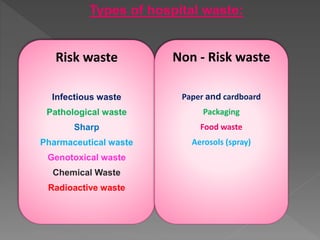
Types of hospital waste:
Risk waste
Infectious waste
Pathological waste
Sharp
Pharmaceutical waste
Genotoxical waste
Chemical Waste
Radioactive waste
Non - Risk waste
Paper and cardboard
Packaging
Food waste
Aerosols (spray)
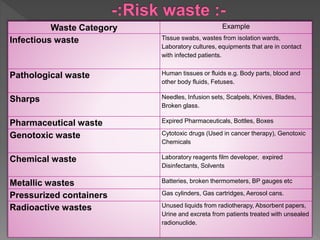
Waste Category Example
Infectious waste Tissue swabs, wastes from isolation wards,
Laboratory cultures, equipments that are in contact
with infected patients.
Pathological waste Human tissues or fluids e.g. Body parts, blood and
other body fluids, Fetuses.
Sharps Needles, Infusion sets, Scalpels, Knives, Blades,
Broken glass.
Pharmaceutical waste Expired Pharmaceuticals, Bottles, Boxes
Genotoxic waste Cytotoxic drugs (Used in cancer therapy), Genotoxic
Chemicals
Chemical waste Laboratory reagents film developer, expired
Disinfectants, Solvents
Metallic wastes Batteries, broken thermometers, BP gauges etc
Pressurized containers Gas cylinders, Gas cartridges, Aerosol cans.
Radioactive wastes Unused liquids from radiotherapy, Absorbent papers,
Urine and excreta from patients treated with unsealed
radionuclide.
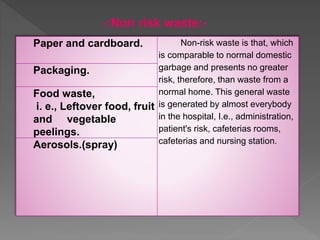
-:Non risk waste:-
Paper and cardboard. Non-risk waste is that, which
is comparable to normal domestic
garbage and presents no greater
risk, therefore, than waste from a
normal home. This general waste
is generated by almost everybody
in the hospital, I.e., administration,
patient's risk, cafeterias rooms,
cafeterias and nursing station.
Packaging.
Food waste,
i. e., Leftover food, fruit
and vegetable
peelings.
Aerosols.(spray)
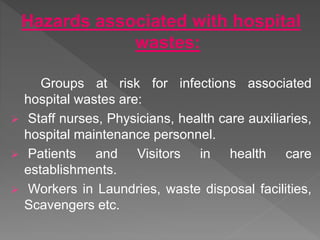
Hazards associated with hospital
wastes:
Groups at risk for infections associated
hospital wastes are:
 Staff nurses, Physicians, health care auxiliaries,
hospital maintenance personnel.
 Patients and Visitors in health care
establishments.
 Workers in Laundries, waste disposal facilities,
Scavengers etc.
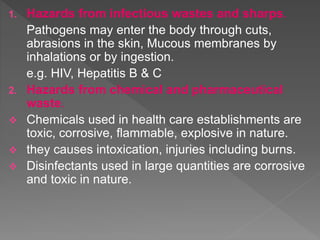
1. Hazards from infectious wastes and sharps.
Pathogens may enter the body through cuts,
abrasions in the skin, Mucous membranes by
inhalations or by ingestion.
e.g. HIV, Hepatitis B & C
2. Hazards from chemical and pharmaceutical
waste.
 Chemicals used in health care establishments are
toxic, corrosive, flammable, explosive in nature.
 they causes intoxication, injuries including burns.
 Disinfectants used in large quantities are corrosive
and toxic in nature.
3. Hazards from genotoxic wastes.
 Exposure to genotoxic wastes occur during the
preparation or treatment with particular drug or
chemical.
 the main path of exposure is inhalation of dust or
aerosols, absorption through the skin, inghestion of
food accidentally contaminated with cytotoxic drugs,
chemicals or wastes etc.
4. Hazards from radioactive wastes.
 the type of disease caused by radioactive waste is
determined by the type and extent of exposure.
 It ranges from headache, dizziness, vomiting etc
5. Public sensitivity.
 Apart from health hazards, the general public is
very sensitive to visual impact of health care
waste particularly anatomical wastes.
Decontamination of hospital wastes.
It is a high temperature dry oxidation
1. Incineration: process, that reduces organic and
combustible waste to inorganic incombustible
matter results in significant reduction of waste
volume and weight.
Types of incinerators:
a. Double chamber incinerators – to burn infectious health
care waste.
b. Single chamber furnaces.
c. Rotary Kilns operating at high temperatures capable of
decomposing heat resistant chemicals.
2. Chemical disinfection:
 Chemicals are added to kill or inactivate the pathogens
results in disinfection rather than sterilization.
 It is suitable for treating liquid wastes such as blood,
urine, stools or hospital sewage
 Some solid wastes can also be disinfected with certain
limitations.
3. Wet and Dry thermal treatment.
I. Wet thermal treatment (Steam disinfection):
 Infectious wastes are subjected to high
temperature, high pressure steam and is similar
to autoclave sterilization process.
 this process is inappropriate for the treatment of
anatomical wastes, chemicals and
pharmaceutical waste.
II. screw-feed technology:
 wastes such as sharps infectious wastes are
heated in a rotating auger.
 waste is reduced by 80% in volume and 20-
35% in weight.
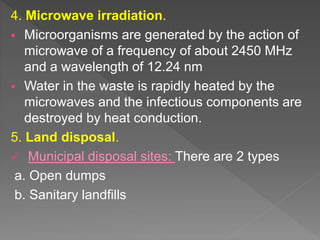
4. Microwave irradiation.
 Microorganisms are generated by the action of
microwave of a frequency of about 2450 MHz
and a wavelength of 12.24 nm
 Water in the waste is rapidly heated by the
microwaves and the infectious components are
destroyed by heat conduction.
5. Land disposal.
 Municipal disposal sites: There are 2 types
a. Open dumps
b. Sanitary landfills
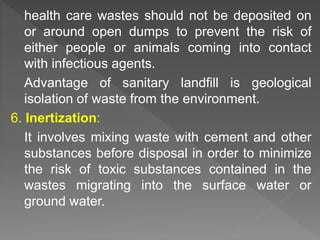
health care wastes should not be deposited on
or around open dumps to prevent the risk of
either people or animals coming into contact
with infectious agents.
Advantage of sanitary landfill is geological
isolation of waste from the environment.
6. Inertization:
It involves mixing waste with cement and other
substances before disposal in order to minimize
the risk of toxic substances contained in the
wastes migrating into the surface water or
ground water.
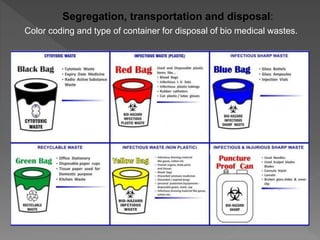
Segregation, transportation and disposal:
Color coding and type of container for disposal of bio medical wastes.
Color
coding
Type of
container
Waste category Treatment and
disposal
yellow Plastic bag Cat 1, Cat 2, Cat 3,
Cat 6
Incineration/Deep burial
Red Disinfected
container/Plastic
bag
Cat 3, Cat 6, Cat 7 Autoclaving/Microwavin
g/Chemical treatment
Blue/
White
Plastic
bag/Puncture
proof container
Cat 4, Cat 7 Autoclaving/Microwavin
g/Chemical treatment
and destruction
Black Plastic bag Cat 5, Cat 9, Cat 10 Disposal in secured
landfill
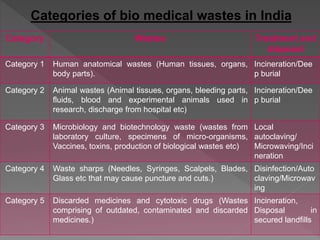
Categories of bio medical wastes in India
Category Wastes Treatment and
disposal
Category 1 Human anatomical wastes (Human tissues, organs,
body parts).
Incineration/Dee
p burial
Category 2 Animal wastes (Animal tissues, organs, bleeding parts,
fluids, blood and experimental animals used in
research, discharge from hospital etc)
Incineration/Dee
p burial
Category 3 Microbiology and biotechnology waste (wastes from
laboratory culture, specimens of micro-organisms,
Vaccines, toxins, production of biological wastes etc)
Local
autoclaving/
Microwaving/Inci
neration
Category 4 Waste sharps (Needles, Syringes, Scalpels, Blades,
Glass etc that may cause puncture and cuts.)
Disinfection/Auto
claving/Microwav
ing
Category 5 Discarded medicines and cytotoxic drugs (Wastes
comprising of outdated, contaminated and discarded
medicines.)
Incineration,
Disposal in
secured landfills
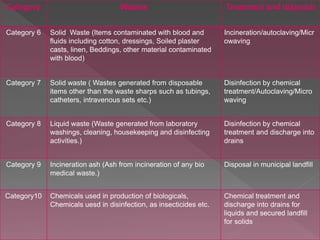
Category Wastes Treatment and disposal
Category 6 Solid Waste (Items contaminated with blood and
fluids including cotton, dressings, Soiled plaster
casts, linen, Beddings, other material contaminated
with blood)
Incineration/autoclaving/Micr
owaving
Category 7 Solid waste ( Wastes generated from disposable
items other than the waste sharps such as tubings,
catheters, intravenous sets etc.)
Disinfection by chemical
treatment/Autoclaving/Micro
waving
Category 8 Liquid waste (Waste generated from laboratory
washings, cleaning, housekeeping and disinfecting
activities.)
Disinfection by chemical
treatment and discharge into
drains
Category 9 Incineration ash (Ash from incineration of any bio
medical waste.)
Disposal in municipal landfill
Category10 Chemicals used in production of biologicals,
Chemicals uesd in disinfection, as insecticides etc.
Chemical treatment and
discharge into drains for
liquids and secured landfill
for solids
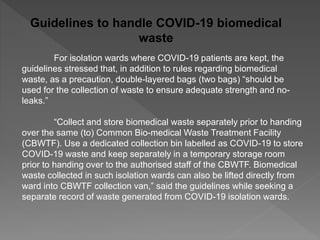
Guidelines to handle COVID-19 biomedical
waste
For isolation wards where COVID-19 patients are kept, the
guidelines stressed that, in addition to rules regarding biomedical
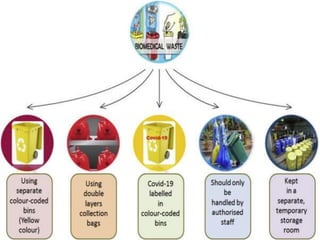
waste, as a precaution, double-layered bags (two bags) “should be
used for the collection of waste to ensure adequate strength and no-
leaks.”
“Collect and store biomedical waste separately prior to handing
over the same (to) Common Bio-medical Waste Treatment Facility
(CBWTF). Use a dedicated collection bin labelled as COVID-19 to store
COVID-19 waste and keep separately in a temporary storage room
prior to handing over to the authorised staff of the CBWTF. Biomedical
waste collected in such isolation wards can also be lifted directly from
ward into CBWTF collection van,” said the guidelines while seeking a
separate record of waste generated from COVID-19 isolation wards.
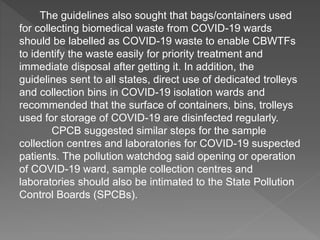
The guidelines also sought that bags/containers used
for collecting biomedical waste from COVID-19 wards
should be labelled as COVID-19 waste to enable CBWTFs
to identify the waste easily for priority treatment and
immediate disposal after getting it. In addition, the
guidelines sent to all states, direct use of dedicated trolleys
and collection bins in COVID-19 isolation wards and
recommended that the surface of containers, bins, trolleys
used for storage of COVID-19 are disinfected regularly.
CPCB suggested similar steps for the sample
collection centres and laboratories for COVID-19 suspected
patients. The pollution watchdog said opening or operation
of COVID-19 ward, sample collection centres and
laboratories should also be intimated to the State Pollution
Control Boards (SPCBs).
Biomedical waste management.

Biomedical waste management.

  • 1.
    PREPARED BY, MRS. BHATTPRIYANKA I/C PRINCIPAL BHAGWAN MAHAVIR COLLEGE OF NURSING, SURAT.
  • 2.
    Bio medical wastemanagement: Definition:  Any waste generated during the diagnosis, treatment or immunization of human beings or animals or in research activities. Importance:  wastes produced in the course of health care activities carries a higher potential for infection.  It is essential to have safe and reliable method for its handling.  Inadequate and inappropriate handling of health care waste will have serious impact on the environment.
  • 3.
    Sources of healthcare waste:  Government hospitals.  Private hospital.  Nursing homes.  Clinics.  Primary health centers.  Medical research and training centers.  Laboratories.  Vaccination centers.  Bio-technology units.  Research organizations.
  • 4.
    Types of hospitalwaste: Risk waste Infectious waste Pathological waste Sharp Pharmaceutical waste Genotoxical waste Chemical Waste Radioactive waste Non - Risk waste Paper and cardboard Packaging Food waste Aerosols (spray)
  • 5.
    Waste Category Example Infectiouswaste Tissue swabs, wastes from isolation wards, Laboratory cultures, equipments that are in contact with infected patients. Pathological waste Human tissues or fluids e.g. Body parts, blood and other body fluids, Fetuses. Sharps Needles, Infusion sets, Scalpels, Knives, Blades, Broken glass. Pharmaceutical waste Expired Pharmaceuticals, Bottles, Boxes Genotoxic waste Cytotoxic drugs (Used in cancer therapy), Genotoxic Chemicals Chemical waste Laboratory reagents film developer, expired Disinfectants, Solvents Metallic wastes Batteries, broken thermometers, BP gauges etc Pressurized containers Gas cylinders, Gas cartridges, Aerosol cans. Radioactive wastes Unused liquids from radiotherapy, Absorbent papers, Urine and excreta from patients treated with unsealed radionuclide.
  • 6.
    -:Non risk waste:- Paperand cardboard. Non-risk waste is that, which is comparable to normal domestic garbage and presents no greater risk, therefore, than waste from a normal home. This general waste is generated by almost everybody in the hospital, I.e., administration, patient's risk, cafeterias rooms, cafeterias and nursing station. Packaging. Food waste, i. e., Leftover food, fruit and vegetable peelings. Aerosols.(spray)
  • 7.
    Hazards associated withhospital wastes: Groups at risk for infections associated hospital wastes are:  Staff nurses, Physicians, health care auxiliaries, hospital maintenance personnel.  Patients and Visitors in health care establishments.  Workers in Laundries, waste disposal facilities, Scavengers etc.
  • 8.
    1. Hazards frominfectious wastes and sharps. Pathogens may enter the body through cuts, abrasions in the skin, Mucous membranes by inhalations or by ingestion. e.g. HIV, Hepatitis B & C 2. Hazards from chemical and pharmaceutical waste.  Chemicals used in health care establishments are toxic, corrosive, flammable, explosive in nature.  they causes intoxication, injuries including burns.  Disinfectants used in large quantities are corrosive and toxic in nature.
  • 9.
    3. Hazards fromgenotoxic wastes.  Exposure to genotoxic wastes occur during the preparation or treatment with particular drug or chemical.  the main path of exposure is inhalation of dust or aerosols, absorption through the skin, inghestion of food accidentally contaminated with cytotoxic drugs, chemicals or wastes etc. 4. Hazards from radioactive wastes.  the type of disease caused by radioactive waste is determined by the type and extent of exposure.  It ranges from headache, dizziness, vomiting etc
  • 10.
    5. Public sensitivity. Apart from health hazards, the general public is very sensitive to visual impact of health care waste particularly anatomical wastes. Decontamination of hospital wastes. It is a high temperature dry oxidation 1. Incineration: process, that reduces organic and combustible waste to inorganic incombustible matter results in significant reduction of waste volume and weight.
  • 11.
    Types of incinerators: a.Double chamber incinerators – to burn infectious health care waste. b. Single chamber furnaces. c. Rotary Kilns operating at high temperatures capable of decomposing heat resistant chemicals. 2. Chemical disinfection:  Chemicals are added to kill or inactivate the pathogens results in disinfection rather than sterilization.  It is suitable for treating liquid wastes such as blood, urine, stools or hospital sewage  Some solid wastes can also be disinfected with certain limitations.
  • 12.
    3. Wet andDry thermal treatment. I. Wet thermal treatment (Steam disinfection):  Infectious wastes are subjected to high temperature, high pressure steam and is similar to autoclave sterilization process.  this process is inappropriate for the treatment of anatomical wastes, chemicals and pharmaceutical waste. II. screw-feed technology:  wastes such as sharps infectious wastes are heated in a rotating auger.  waste is reduced by 80% in volume and 20- 35% in weight.
  • 13.
    4. Microwave irradiation. Microorganisms are generated by the action of microwave of a frequency of about 2450 MHz and a wavelength of 12.24 nm  Water in the waste is rapidly heated by the microwaves and the infectious components are destroyed by heat conduction. 5. Land disposal.  Municipal disposal sites: There are 2 types a. Open dumps b. Sanitary landfills
  • 14.
    health care wastesshould not be deposited on or around open dumps to prevent the risk of either people or animals coming into contact with infectious agents. Advantage of sanitary landfill is geological isolation of waste from the environment. 6. Inertization: It involves mixing waste with cement and other substances before disposal in order to minimize the risk of toxic substances contained in the wastes migrating into the surface water or ground water.
  • 15.
    Segregation, transportation anddisposal: Color coding and type of container for disposal of bio medical wastes.
  • 16.
    Color coding Type of container Waste categoryTreatment and disposal yellow Plastic bag Cat 1, Cat 2, Cat 3, Cat 6 Incineration/Deep burial Red Disinfected container/Plastic bag Cat 3, Cat 6, Cat 7 Autoclaving/Microwavin g/Chemical treatment Blue/ White Plastic bag/Puncture proof container Cat 4, Cat 7 Autoclaving/Microwavin g/Chemical treatment and destruction Black Plastic bag Cat 5, Cat 9, Cat 10 Disposal in secured landfill
  • 17.
    Categories of biomedical wastes in India Category Wastes Treatment and disposal Category 1 Human anatomical wastes (Human tissues, organs, body parts). Incineration/Dee p burial Category 2 Animal wastes (Animal tissues, organs, bleeding parts, fluids, blood and experimental animals used in research, discharge from hospital etc) Incineration/Dee p burial Category 3 Microbiology and biotechnology waste (wastes from laboratory culture, specimens of micro-organisms, Vaccines, toxins, production of biological wastes etc) Local autoclaving/ Microwaving/Inci neration Category 4 Waste sharps (Needles, Syringes, Scalpels, Blades, Glass etc that may cause puncture and cuts.) Disinfection/Auto claving/Microwav ing Category 5 Discarded medicines and cytotoxic drugs (Wastes comprising of outdated, contaminated and discarded medicines.) Incineration, Disposal in secured landfills
  • 18.
    Category Wastes Treatmentand disposal Category 6 Solid Waste (Items contaminated with blood and fluids including cotton, dressings, Soiled plaster casts, linen, Beddings, other material contaminated with blood) Incineration/autoclaving/Micr owaving Category 7 Solid waste ( Wastes generated from disposable items other than the waste sharps such as tubings, catheters, intravenous sets etc.) Disinfection by chemical treatment/Autoclaving/Micro waving Category 8 Liquid waste (Waste generated from laboratory washings, cleaning, housekeeping and disinfecting activities.) Disinfection by chemical treatment and discharge into drains Category 9 Incineration ash (Ash from incineration of any bio medical waste.) Disposal in municipal landfill Category10 Chemicals used in production of biologicals, Chemicals uesd in disinfection, as insecticides etc. Chemical treatment and discharge into drains for liquids and secured landfill for solids
  • 19.
    Guidelines to handleCOVID-19 biomedical waste For isolation wards where COVID-19 patients are kept, the guidelines stressed that, in addition to rules regarding biomedical waste, as a precaution, double-layered bags (two bags) “should be used for the collection of waste to ensure adequate strength and no- leaks.” “Collect and store biomedical waste separately prior to handing over the same (to) Common Bio-medical Waste Treatment Facility (CBWTF). Use a dedicated collection bin labelled as COVID-19 to store COVID-19 waste and keep separately in a temporary storage room prior to handing over to the authorised staff of the CBWTF. Biomedical waste collected in such isolation wards can also be lifted directly from ward into CBWTF collection van,” said the guidelines while seeking a separate record of waste generated from COVID-19 isolation wards.
  • 20.
    The guidelines alsosought that bags/containers used for collecting biomedical waste from COVID-19 wards should be labelled as COVID-19 waste to enable CBWTFs to identify the waste easily for priority treatment and immediate disposal after getting it. In addition, the guidelines sent to all states, direct use of dedicated trolleys and collection bins in COVID-19 isolation wards and recommended that the surface of containers, bins, trolleys used for storage of COVID-19 are disinfected regularly. CPCB suggested similar steps for the sample collection centres and laboratories for COVID-19 suspected patients. The pollution watchdog said opening or operation of COVID-19 ward, sample collection centres and laboratories should also be intimated to the State Pollution Control Boards (SPCBs).