6. Human Physiology

    6.6 Reproduction
Female reproductive system
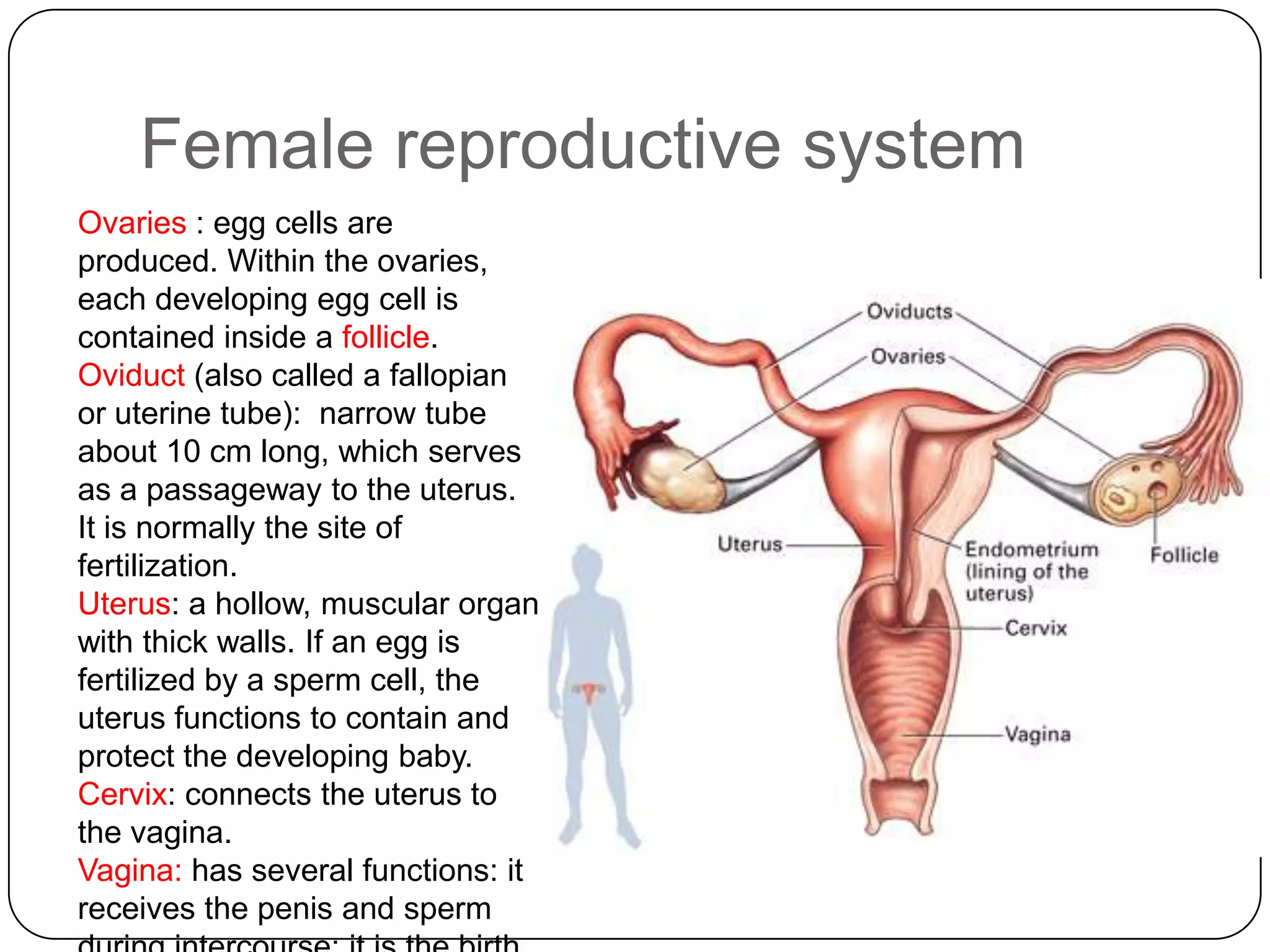
Ovaries : egg cells are
produced. Within the ovaries,
each developing egg cell is
contained inside a follicle.
Oviduct (also called a fallopian
or uterine tube): narrow tube
about 10 cm long, which serves
as a passageway to the uterus.
It is normally the site of
fertilization.
Uterus: a hollow, muscular organ
with thick walls. If an egg is
fertilized by a sperm cell, the
uterus functions to contain and
protect the developing baby.
Cervix: connects the uterus to
the vagina.
Vagina: has several functions: it
receives the penis and sperm
Male reproductive system
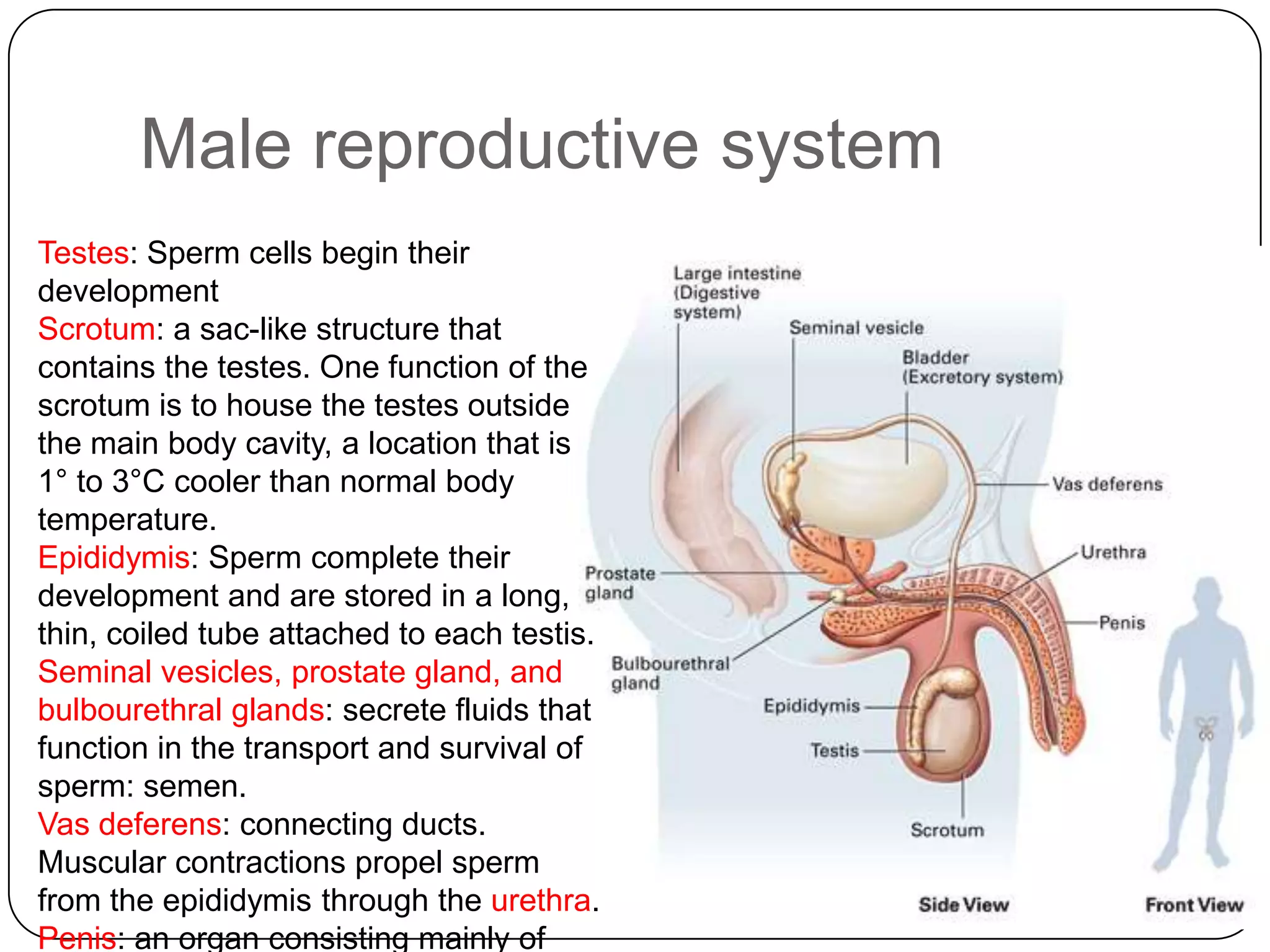
Testes: Sperm cells begin their
development
Scrotum: a sac-like structure that
contains the testes. One function of the
scrotum is to house the testes outside
the main body cavity, a location that is
1° to 3°C cooler than normal body
temperature.
Epididymis: Sperm complete their
development and are stored in a long,
thin, coiled tube attached to each testis.
Seminal vesicles, prostate gland, and
bulbourethral glands: secrete fluids that
function in the transport and survival of
sperm: semen.
Vas deferens: connecting ducts.
Muscular contractions propel sperm
from the epididymis through the urethra.
Penis: an organ consisting mainly of
Development of gametes
Development of egg cells
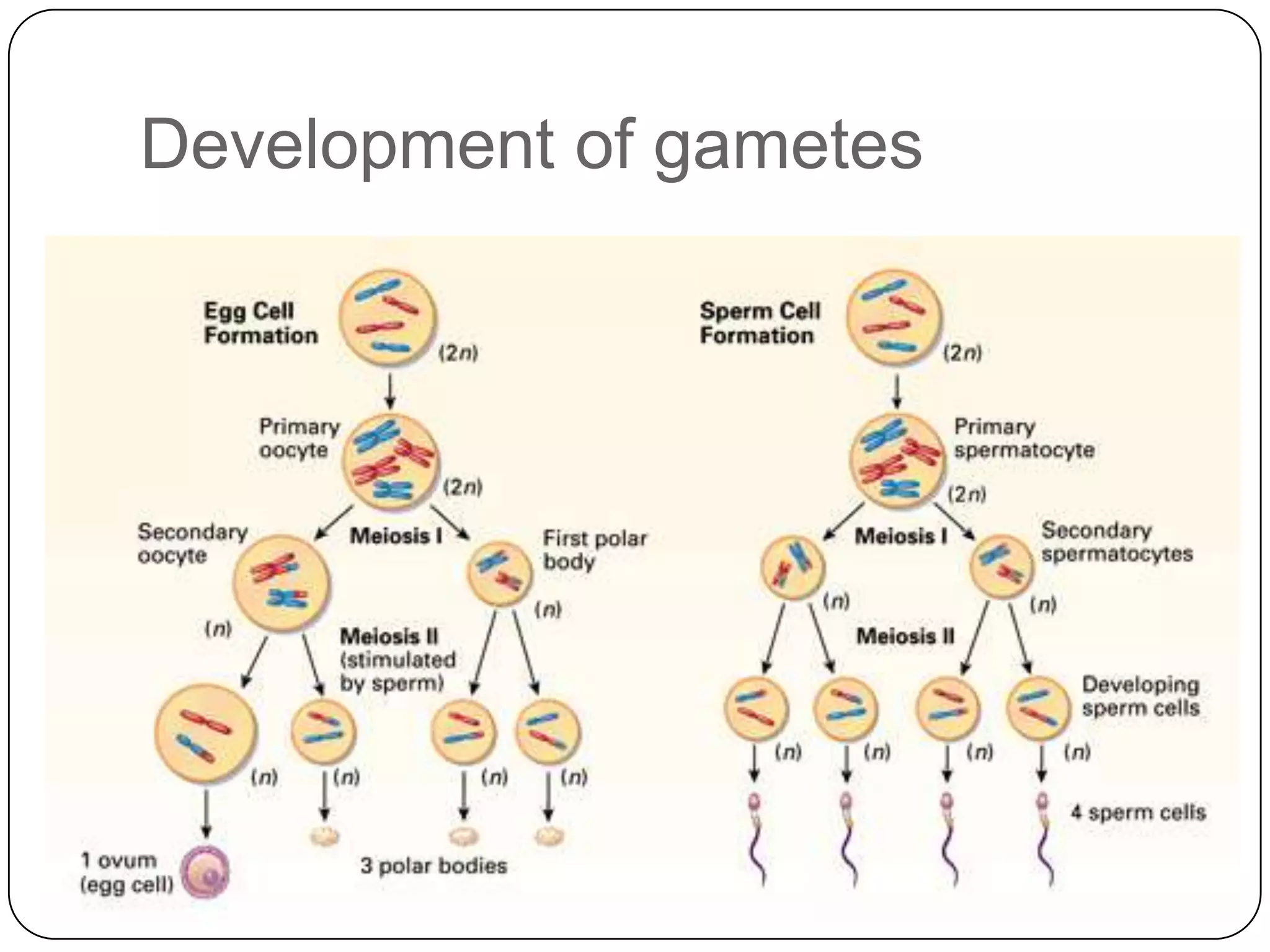
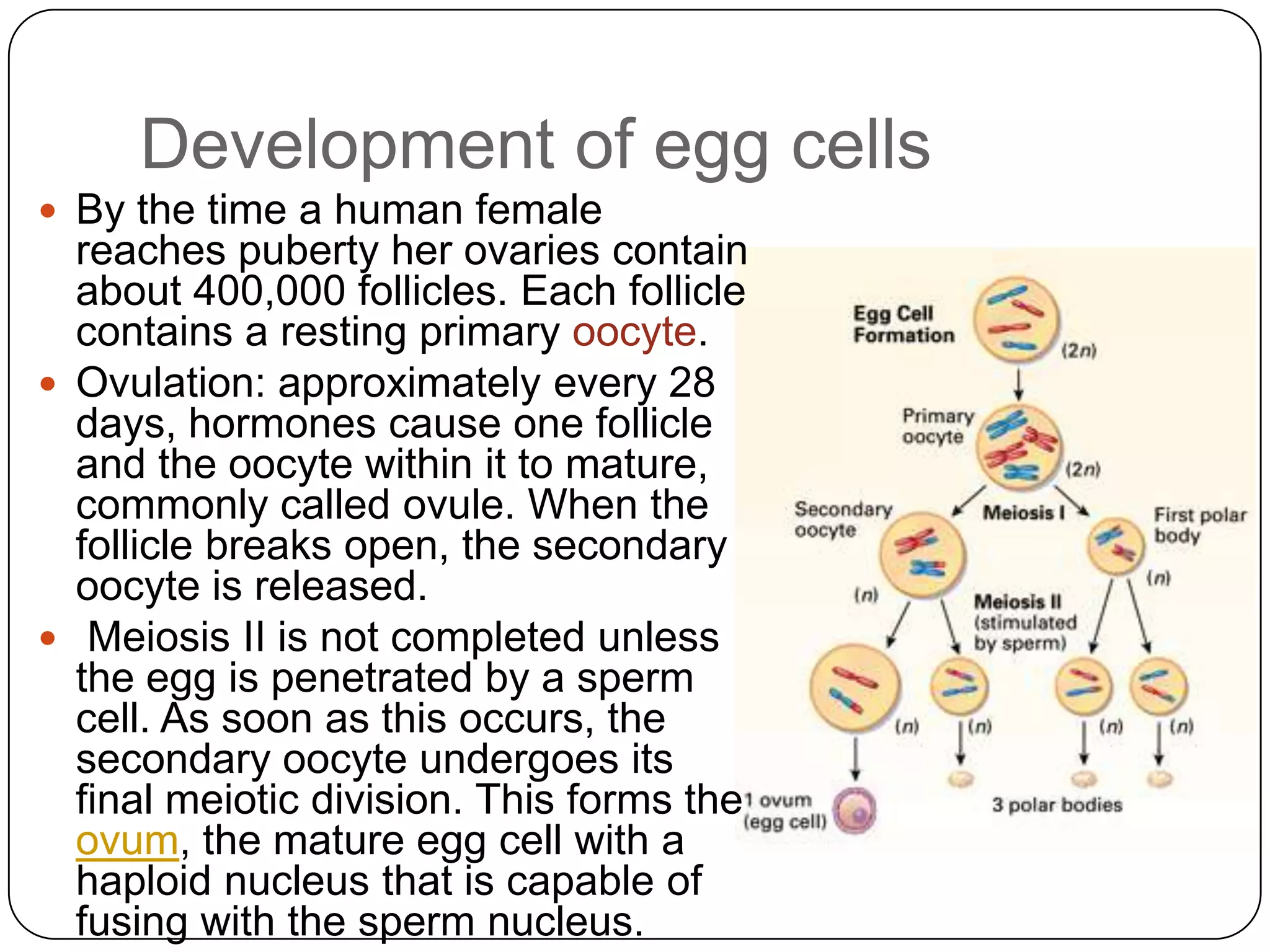
 By the time a human female
  reaches puberty her ovaries contain
  about 400,000 follicles. Each follicle
  contains a resting primary oocyte.
 Ovulation: approximately every 28
  days, hormones cause one follicle
  and the oocyte within it to mature,
  commonly called ovule. When the
  follicle breaks open, the secondary
  oocyte is released.
 Meiosis II is not completed unless
  the egg is penetrated by a sperm
  cell. As soon as this occurs, the
  secondary oocyte undergoes its
  final meiotic division. This forms the
  ovum, the mature egg cell with a
  haploid nucleus that is capable of
  fusing with the sperm nucleus.
Development of sperm cells
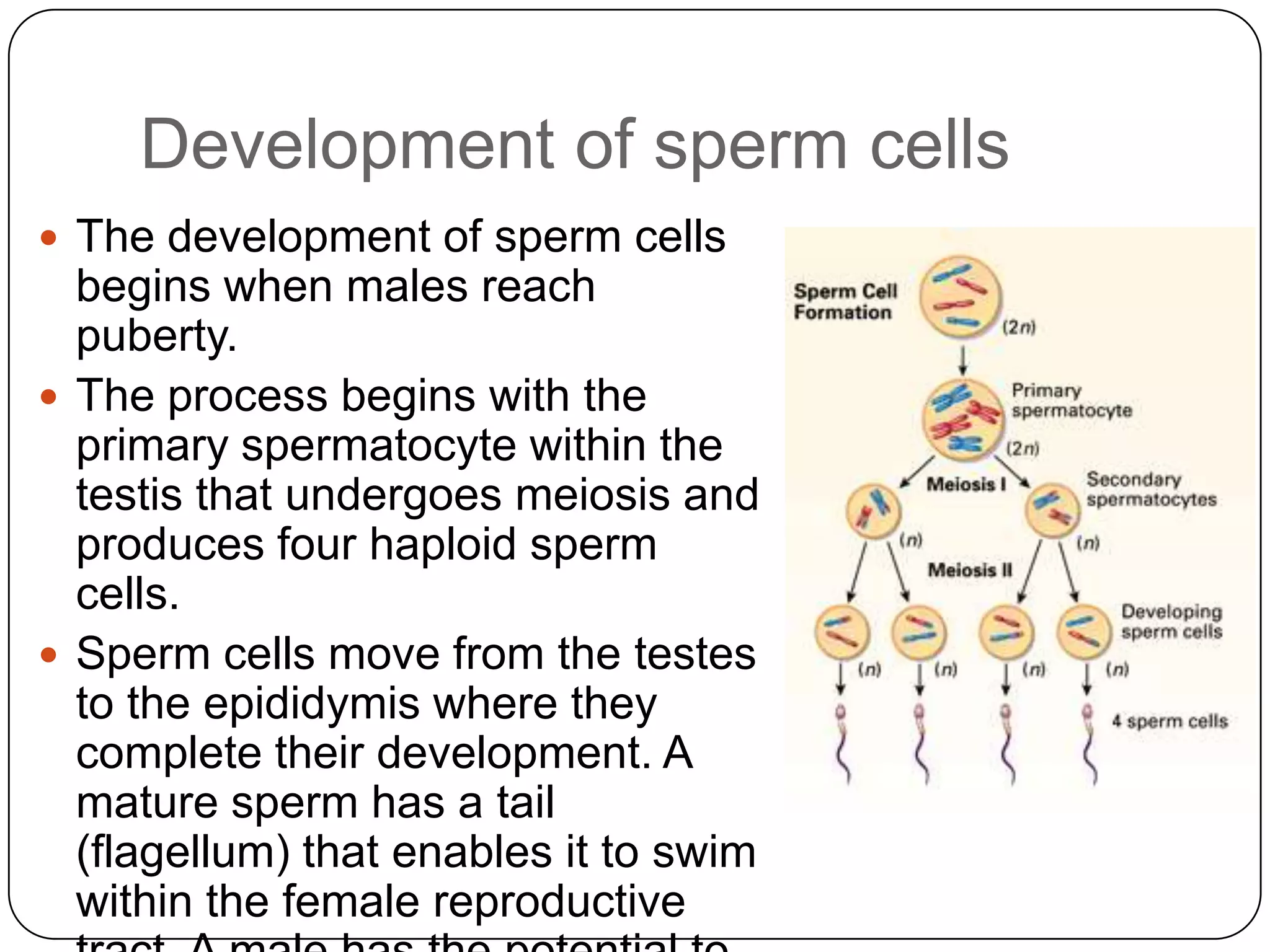
 The development of sperm cells
  begins when males reach
  puberty.
 The process begins with the
  primary spermatocyte within the
  testis that undergoes meiosis and
  produces four haploid sperm
  cells.
 Sperm cells move from the testes
  to the epididymis where they
  complete their development. A
  mature sperm has a tail
  (flagellum) that enables it to swim
  within the female reproductive
Hormonal control in females
                            • Sexual maturity in women is
                              marked by the beginning of the
                              menstrual cycles. These cycles
                              coordinate the development and
                              release of an egg with the
                              conditions required in the uterus
                              to support a pregnancy.

      Anterior pituitary hormones
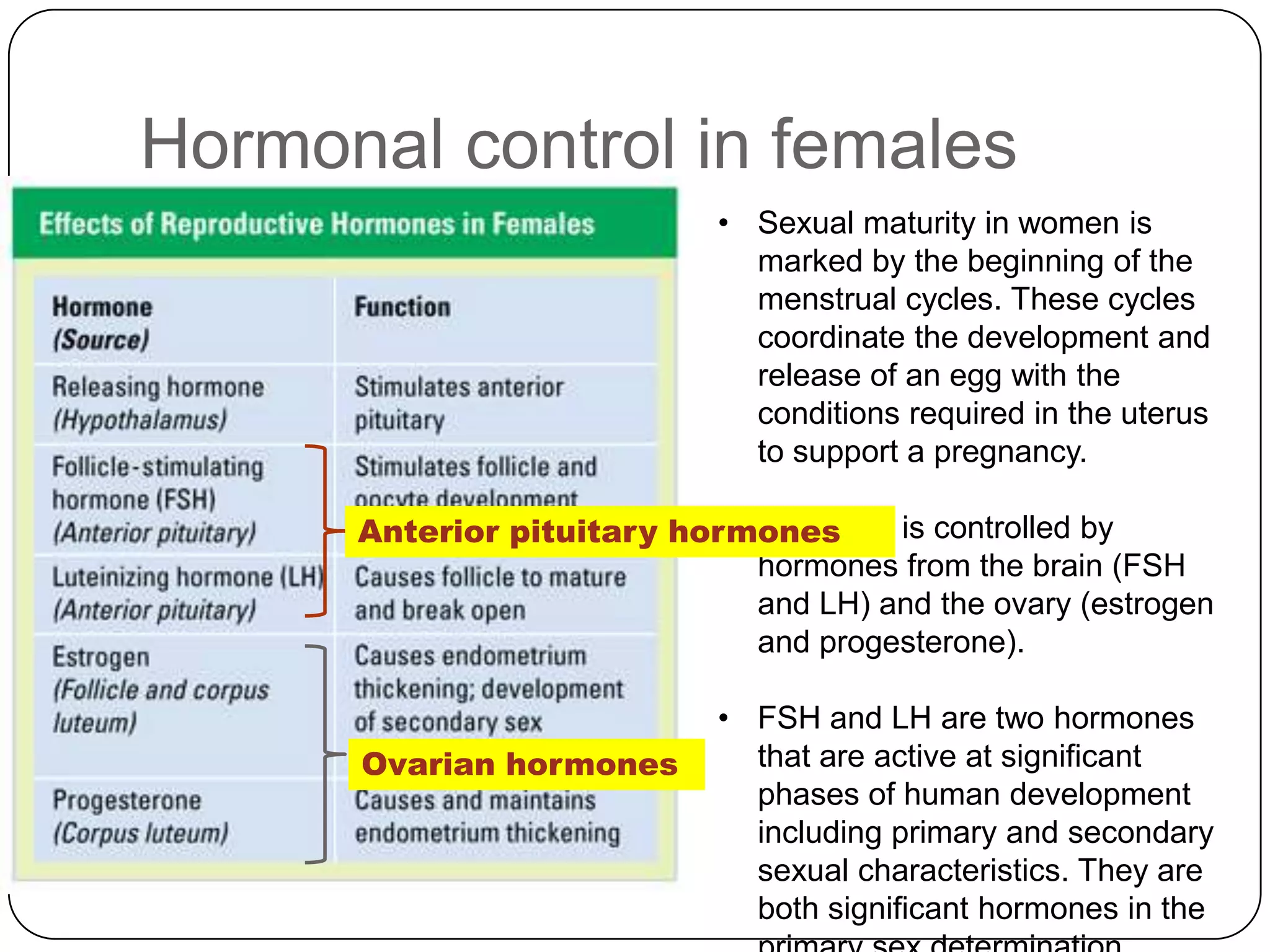
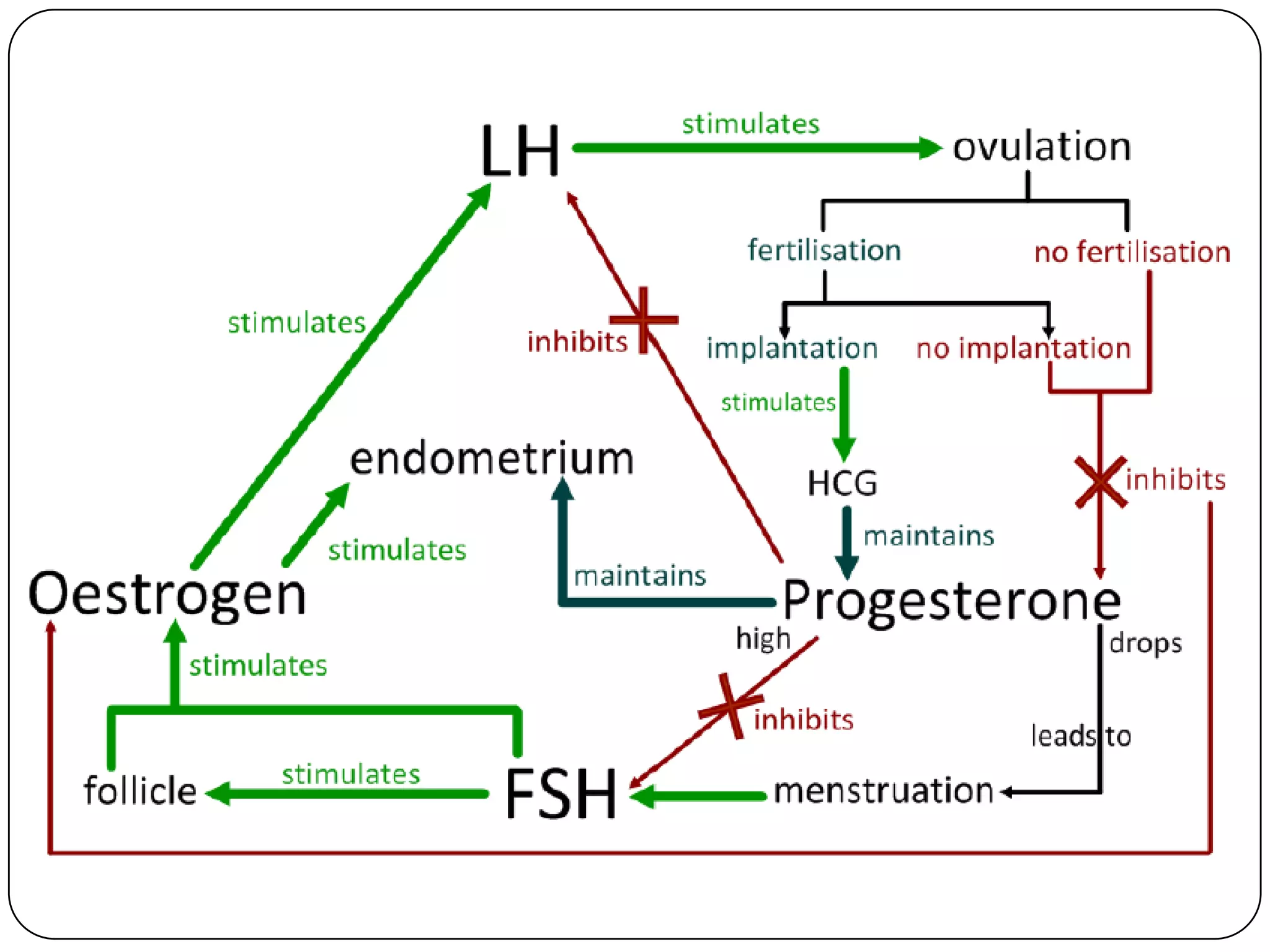
                           • The cycle is controlled by
                             hormones from the brain (FSH
                             and LH) and the ovary (estrogen
                             and progesterone).

                            • FSH and LH are two hormones
      Ovarian hormones        that are active at significant
                              phases of human development
                              including primary and secondary
                              sexual characteristics. They are
                              both significant hormones in the
http://kidshealth.org/misc/movie/bodybasics/bodybasics_female_repro.html
http://www.sumanasinc.com/webcontent/animations/content/ovarianuterine.
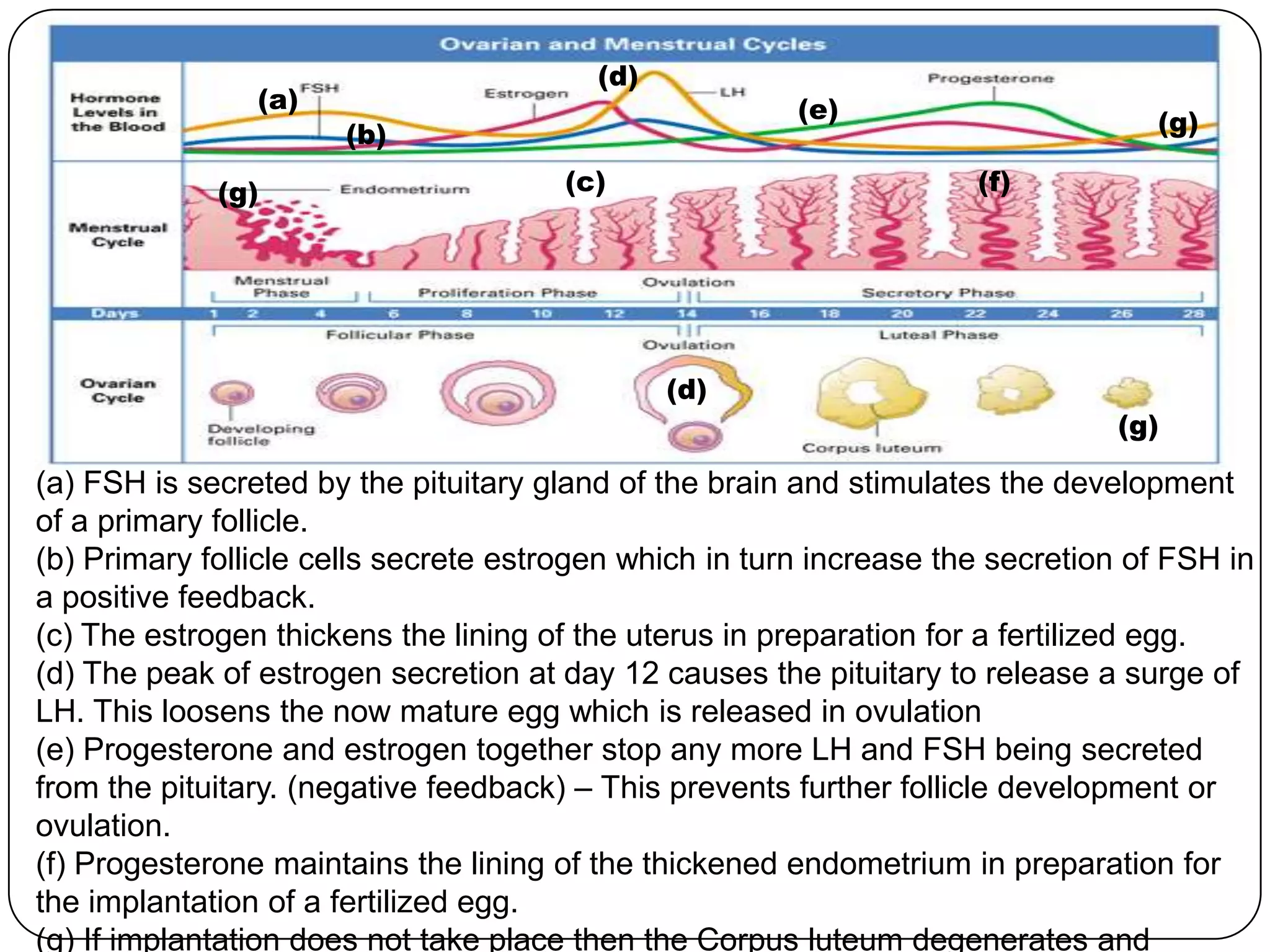
(d)
                (a)                                     (e)
                      (b)                                                         (g)

             (g)                       (c)                           (f)


                                               (d)
                                                                               (g)

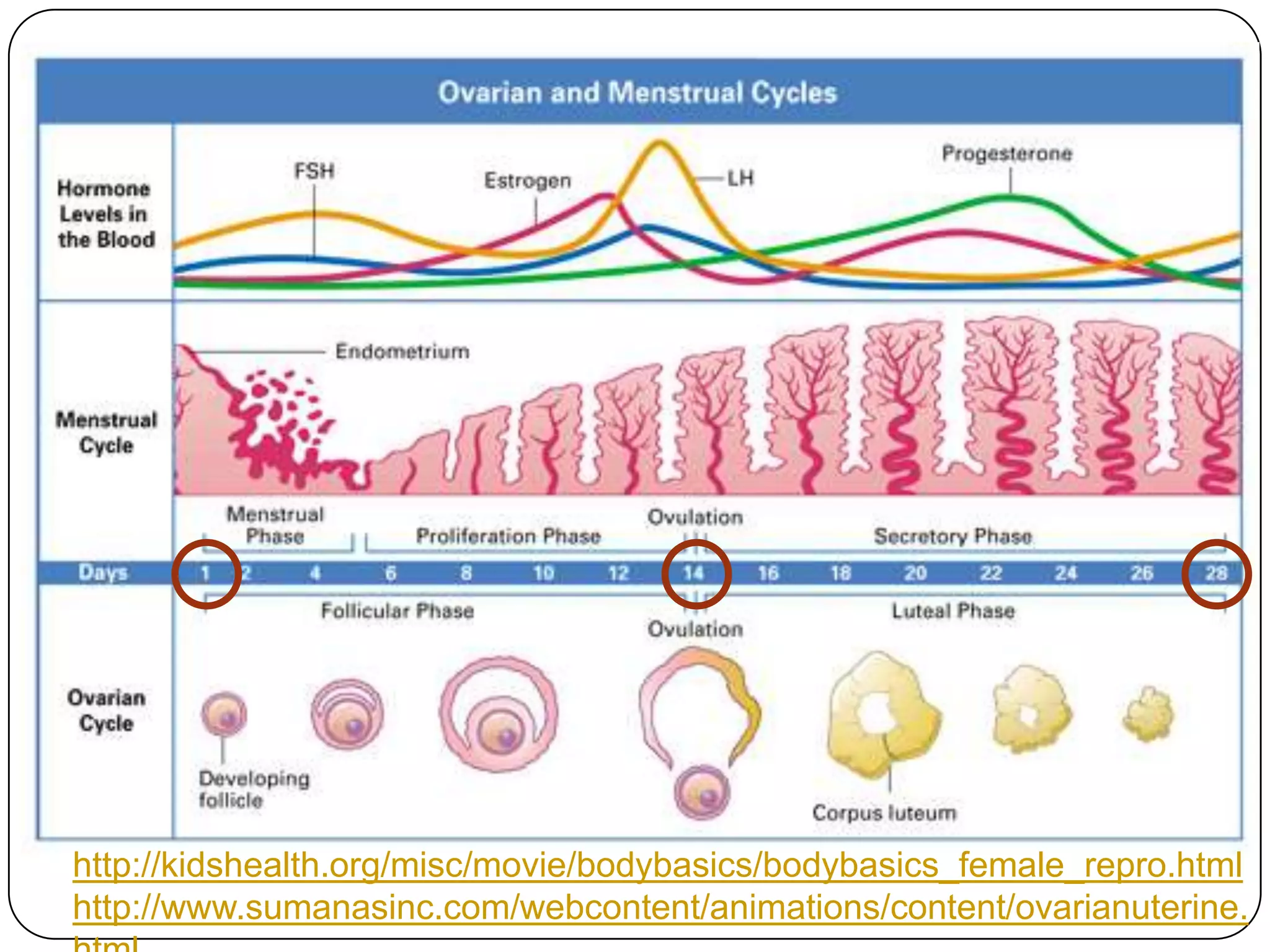
(a) FSH is secreted by the pituitary gland of the brain and stimulates the development
of a primary follicle.
(b) Primary follicle cells secrete estrogen which in turn increase the secretion of FSH in
a positive feedback.
(c) The estrogen thickens the lining of the uterus in preparation for a fertilized egg.
(d) The peak of estrogen secretion at day 12 causes the pituitary to release a surge of
LH. This loosens the now mature egg which is released in ovulation
(e) Progesterone and estrogen together stop any more LH and FSH being secreted
from the pituitary. (negative feedback) – This prevents further follicle development or
ovulation.
(f) Progesterone maintains the lining of the thickened endometrium in preparation for
the implantation of a fertilized egg.
(g) If implantation does not take place then the Corpus luteum degenerates and
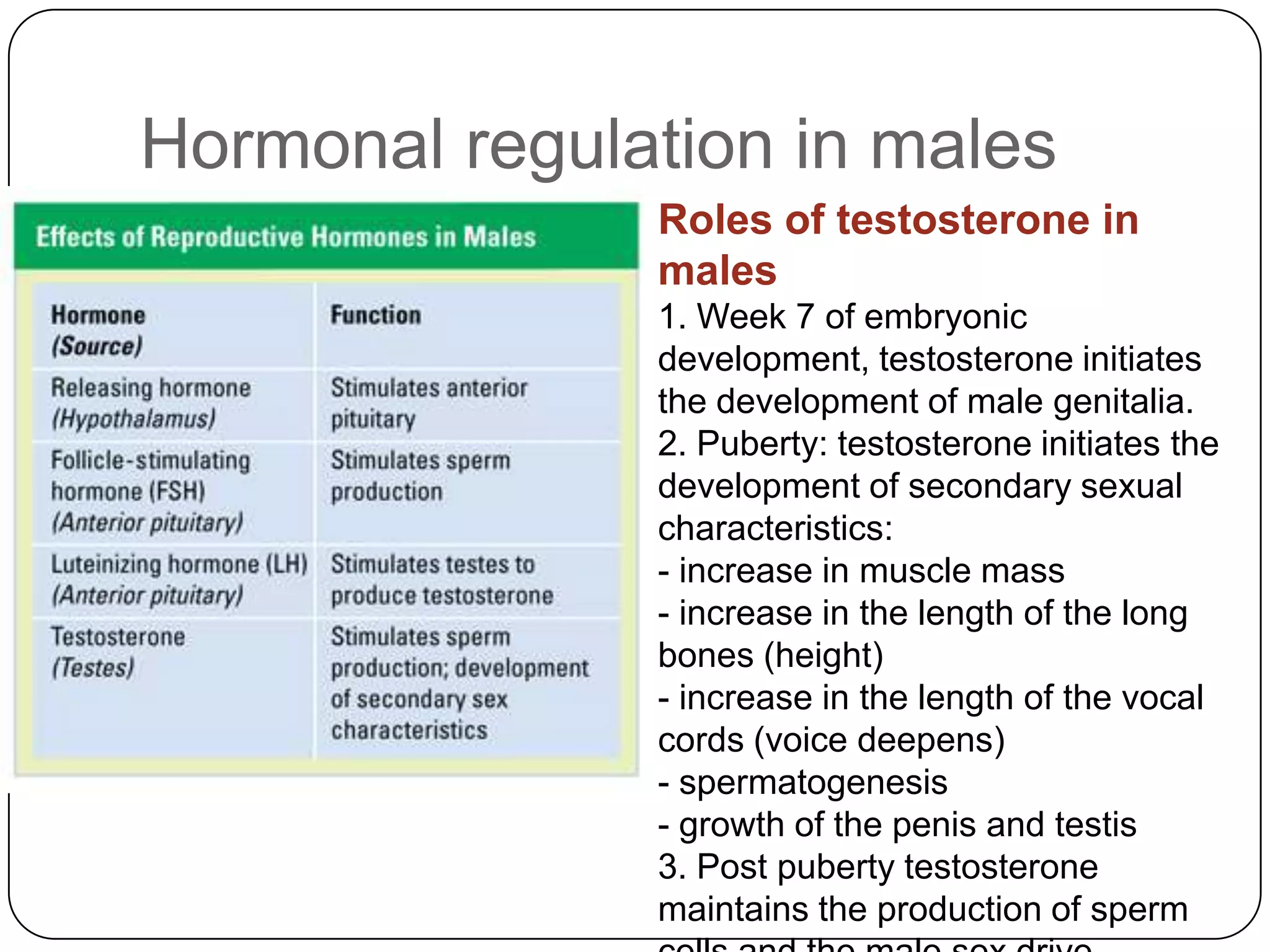
Hormonal regulation in males
               Roles of testosterone in
               males
               1. Week 7 of embryonic
               development, testosterone initiates
               the development of male genitalia.
               2. Puberty: testosterone initiates the
               development of secondary sexual
               characteristics:
               - increase in muscle mass
               - increase in the length of the long
               bones (height)
               - increase in the length of the vocal
               cords (voice deepens)
               - spermatogenesis
               - growth of the penis and testis
               3. Post puberty testosterone
               maintains the production of sperm
In Vitro Fertilization (IVF)
 IVF is a method where the eggs are removed from the
  ovaries to be fertilized in the laboratory.
 The eggs are then cultured for approx. 2 days and
  nights before the fertilized egg is transferred to the
  uterus for normal growth.
 At IVF the woman’s ovaries are stimulated to produce
  more and bigger eggs than at a normal cycle. This
  means that more than one egg can be removed for
  the treatment. More eggs improve the probability of
  finding suitable eggs for fertilization.
 IVF treatment is recommended in those cases where
  the woman has tubal blockage, the man has a poor
  sperm quality, or the cause of infertility is unexplained.
  There are a number of different medications for IVF
  treatment, which are to be adjusted to the individual
  need.
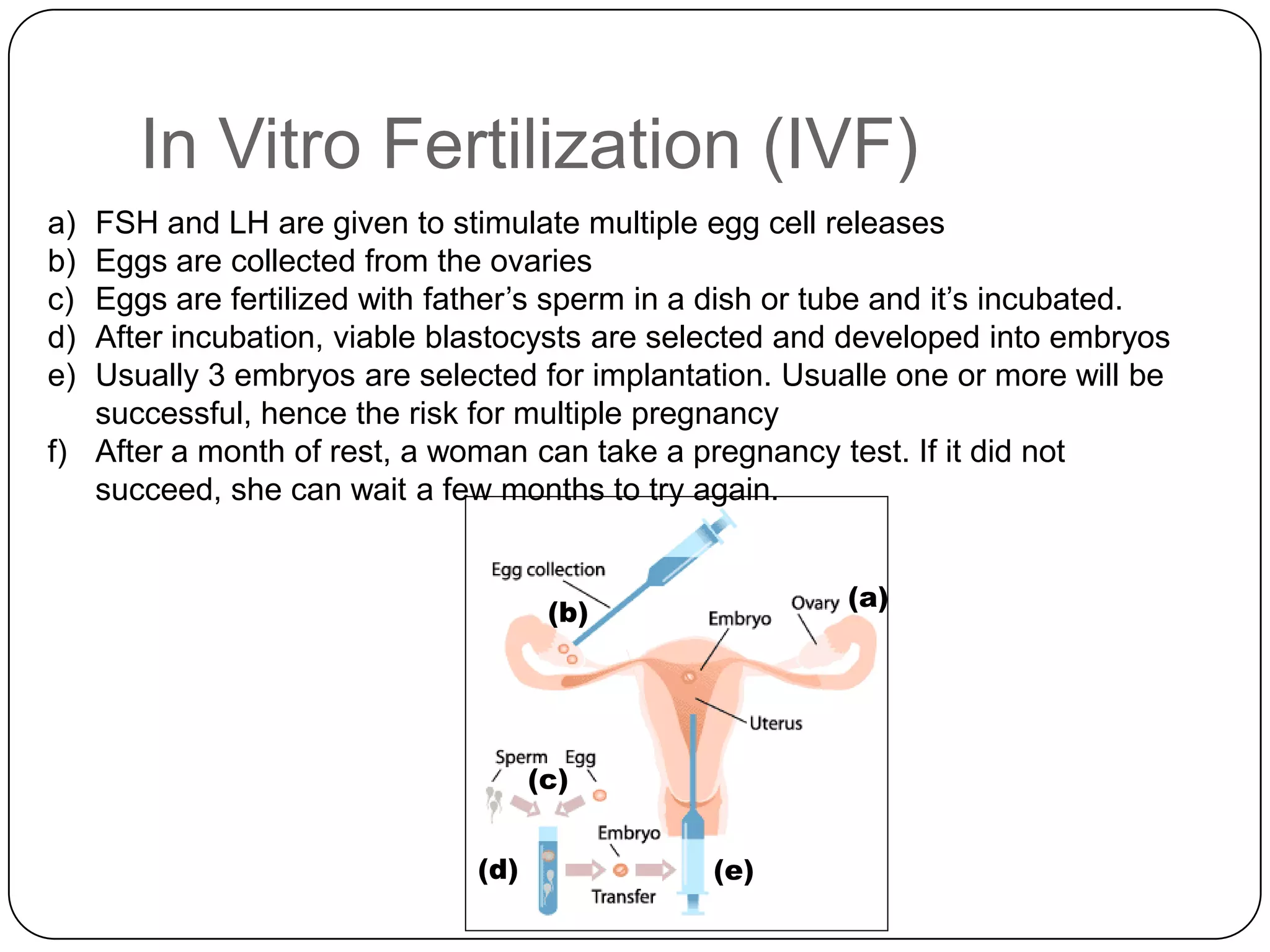
In Vitro Fertilization (IVF)
a) FSH and LH are given to stimulate multiple egg cell releases
b) Eggs are collected from the ovaries
c) Eggs are fertilized with father’s sperm in a dish or tube and it’s incubated.
d) After incubation, viable blastocysts are selected and developed into embryos
e) Usually 3 embryos are selected for implantation. Usualle one or more will be
   successful, hence the risk for multiple pregnancy
f) After a month of rest, a woman can take a pregnancy test. If it did not
   succeed, she can wait a few months to try again.


                                                         (a)
                                     (b)


                                    (c)


                              (d)              (e)
IVF
 Treatment with in vitro fertilization implies that:
 The man produces sperm cells, or has sperm
    cells that we in special cases can extract from the
    testicle or from the epididymis. If the man does
    not produce sperm cells, donor sperm cells can
    be used.
   The woman has ovulation, either by herself or
    through hormone treatment.
   The woman has a normal uterus.
   The couple has no incidence of venereal
    diseases or infections.
   You have received genetic counseling.
Ethical issues associated with
IVF
 FOR                       AGAINST
 Right to have children    Risk of mother and
 Provide a family for
                               fetuses of multiple
  radiation, chemo             pregnancy
  therapy cancer              Can be expensive
  patients.                   Emotional cost of
 Medical advances             failure can be high
  make it safer every         Does termination of
  time                         human embryos count
 Unused embryos can           as ending a human
  be stored (frozen) for       life?
  later use, donated for      Religious: are we
  research or as a             playing ‘God’?
  source of stem cells
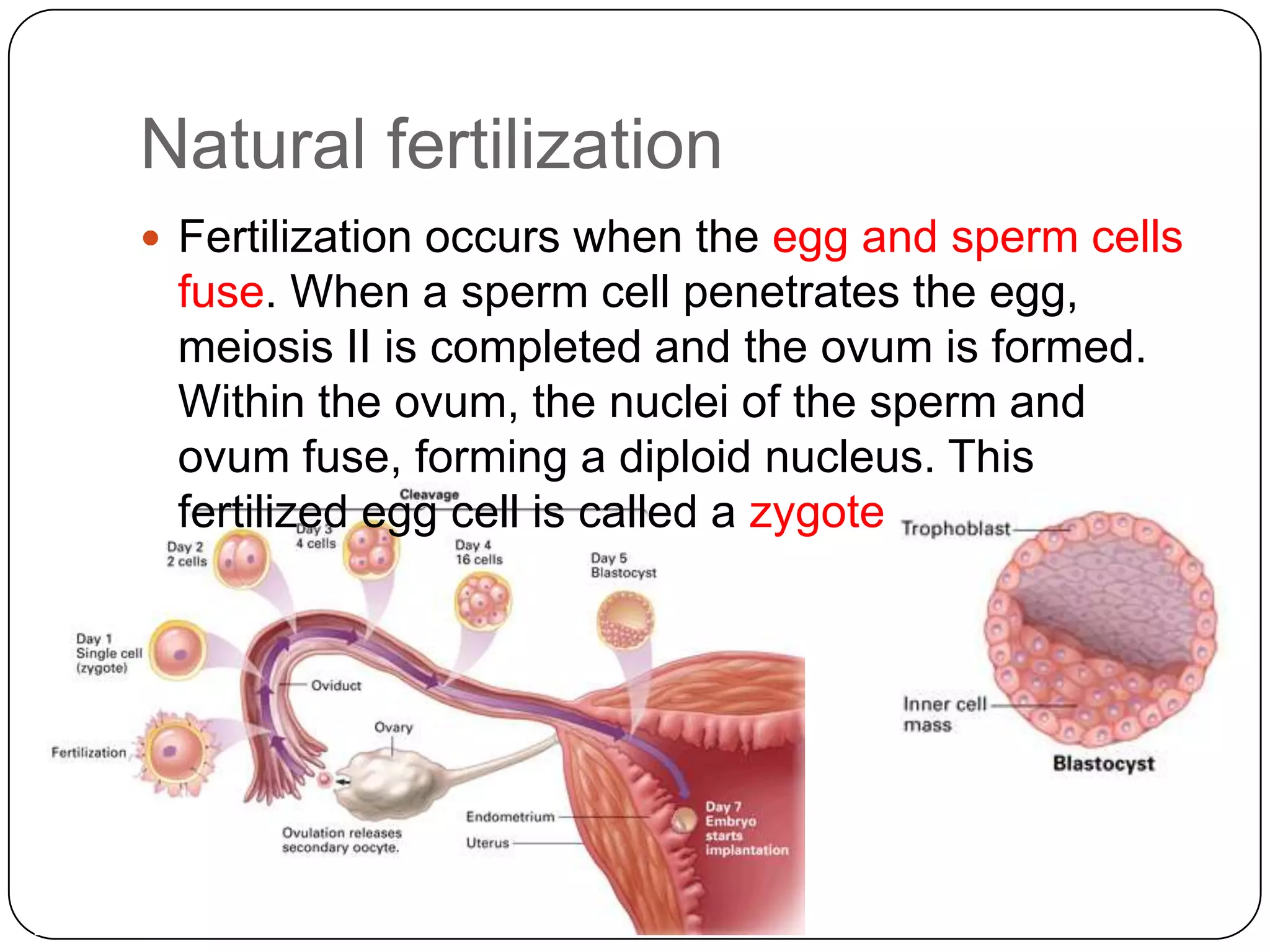
Natural fertilization
 Fertilization occurs when the egg and sperm cells
 fuse. When a sperm cell penetrates the egg,
 meiosis II is completed and the ovum is formed.
 Within the ovum, the nuclei of the sperm and
 ovum fuse, forming a diploid nucleus. This
 fertilized egg cell is called a zygote.
Human development, first trimester
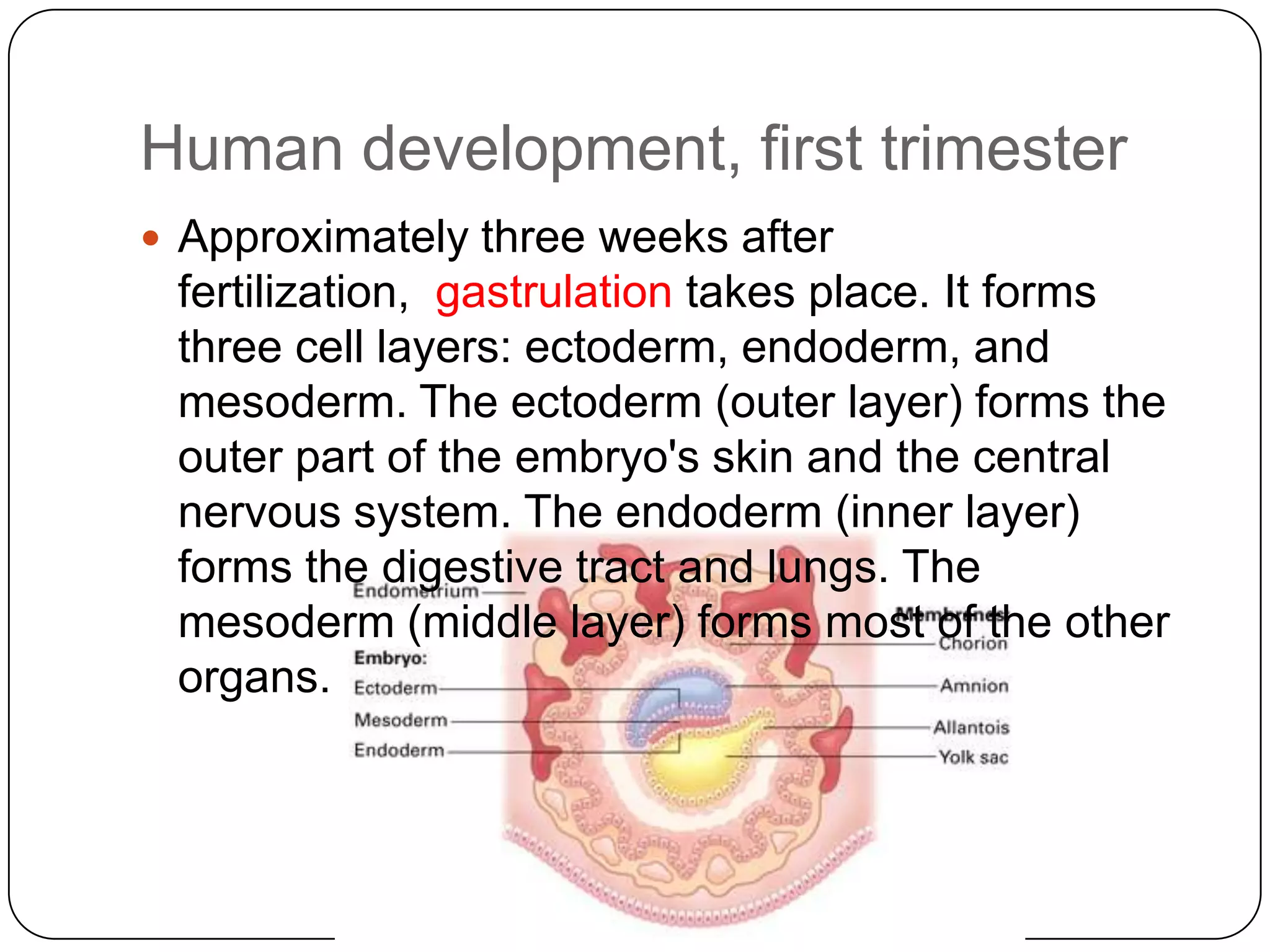
 Approximately three weeks after
 fertilization, gastrulation takes place. It forms
 three cell layers: ectoderm, endoderm, and
 mesoderm. The ectoderm (outer layer) forms the
 outer part of the embryo's skin and the central
 nervous system. The endoderm (inner layer)
 forms the digestive tract and lungs. The
 mesoderm (middle layer) forms most of the other
 organs.
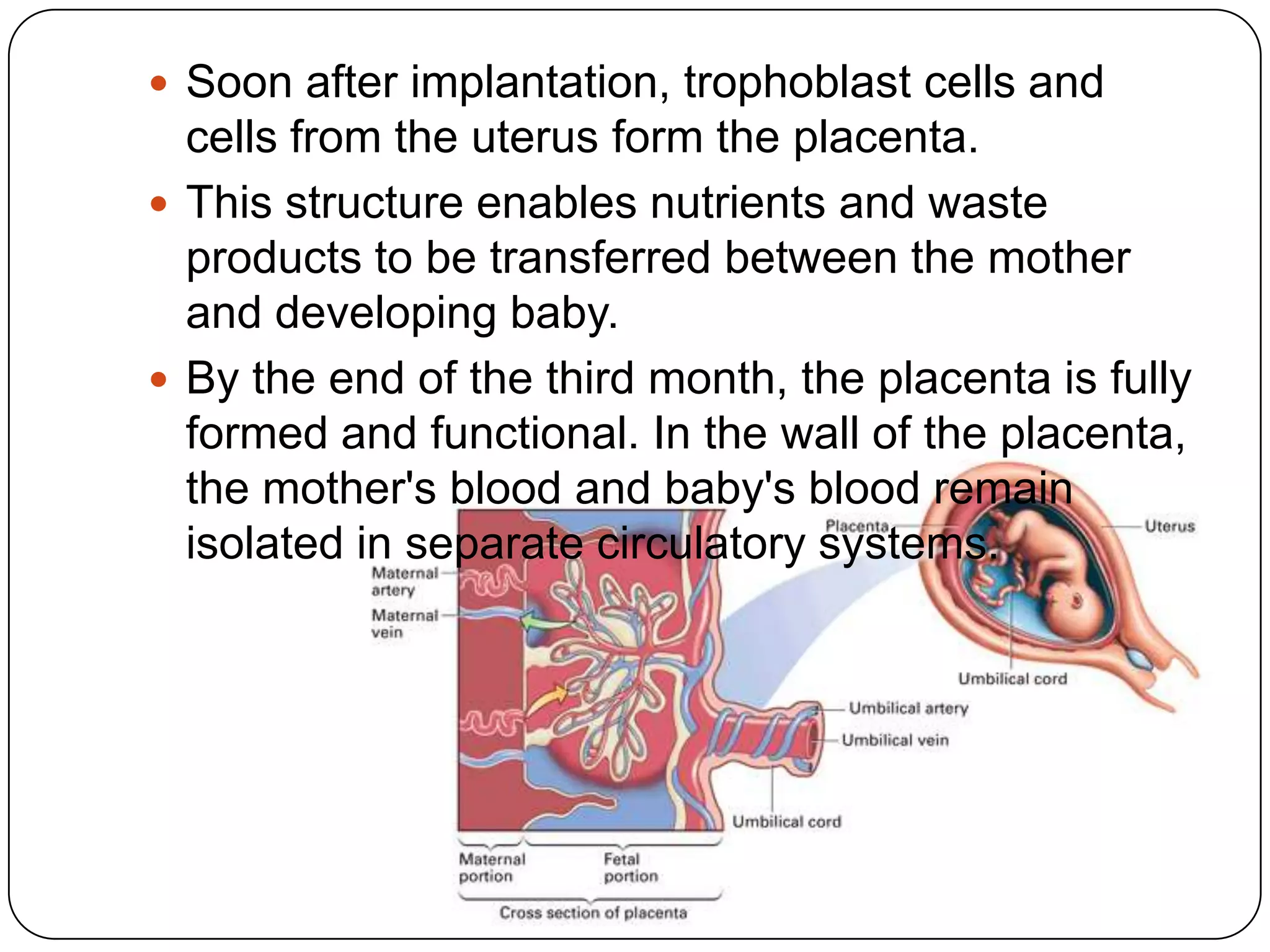
 Soon after implantation, trophoblast cells and
  cells from the uterus form the placenta.
 This structure enables nutrients and waste
  products to be transferred between the mother
  and developing baby.
 By the end of the third month, the placenta is fully
  formed and functional. In the wall of the placenta,
  the mother's blood and baby's blood remain
  isolated in separate circulatory systems.

6.6 Reproduction

  • 1.
    6. Human Physiology 6.6 Reproduction
  • 2.
    Female reproductive system Ovaries: egg cells are produced. Within the ovaries, each developing egg cell is contained inside a follicle. Oviduct (also called a fallopian or uterine tube): narrow tube about 10 cm long, which serves as a passageway to the uterus. It is normally the site of fertilization. Uterus: a hollow, muscular organ with thick walls. If an egg is fertilized by a sperm cell, the uterus functions to contain and protect the developing baby. Cervix: connects the uterus to the vagina. Vagina: has several functions: it receives the penis and sperm
  • 3.
    Male reproductive system Testes:Sperm cells begin their development Scrotum: a sac-like structure that contains the testes. One function of the scrotum is to house the testes outside the main body cavity, a location that is 1° to 3°C cooler than normal body temperature. Epididymis: Sperm complete their development and are stored in a long, thin, coiled tube attached to each testis. Seminal vesicles, prostate gland, and bulbourethral glands: secrete fluids that function in the transport and survival of sperm: semen. Vas deferens: connecting ducts. Muscular contractions propel sperm from the epididymis through the urethra. Penis: an organ consisting mainly of
  • 4.
  • 5.
    Development of eggcells  By the time a human female reaches puberty her ovaries contain about 400,000 follicles. Each follicle contains a resting primary oocyte.  Ovulation: approximately every 28 days, hormones cause one follicle and the oocyte within it to mature, commonly called ovule. When the follicle breaks open, the secondary oocyte is released.  Meiosis II is not completed unless the egg is penetrated by a sperm cell. As soon as this occurs, the secondary oocyte undergoes its final meiotic division. This forms the ovum, the mature egg cell with a haploid nucleus that is capable of fusing with the sperm nucleus.
  • 6.
    Development of spermcells  The development of sperm cells begins when males reach puberty.  The process begins with the primary spermatocyte within the testis that undergoes meiosis and produces four haploid sperm cells.  Sperm cells move from the testes to the epididymis where they complete their development. A mature sperm has a tail (flagellum) that enables it to swim within the female reproductive
  • 7.
    Hormonal control infemales • Sexual maturity in women is marked by the beginning of the menstrual cycles. These cycles coordinate the development and release of an egg with the conditions required in the uterus to support a pregnancy. Anterior pituitary hormones • The cycle is controlled by hormones from the brain (FSH and LH) and the ovary (estrogen and progesterone). • FSH and LH are two hormones Ovarian hormones that are active at significant phases of human development including primary and secondary sexual characteristics. They are both significant hormones in the
  • 8.
  • 9.
    (d) (a) (e) (b) (g) (g) (c) (f) (d) (g) (a) FSH is secreted by the pituitary gland of the brain and stimulates the development of a primary follicle. (b) Primary follicle cells secrete estrogen which in turn increase the secretion of FSH in a positive feedback. (c) The estrogen thickens the lining of the uterus in preparation for a fertilized egg. (d) The peak of estrogen secretion at day 12 causes the pituitary to release a surge of LH. This loosens the now mature egg which is released in ovulation (e) Progesterone and estrogen together stop any more LH and FSH being secreted from the pituitary. (negative feedback) – This prevents further follicle development or ovulation. (f) Progesterone maintains the lining of the thickened endometrium in preparation for the implantation of a fertilized egg. (g) If implantation does not take place then the Corpus luteum degenerates and
  • 11.
    Hormonal regulation inmales Roles of testosterone in males 1. Week 7 of embryonic development, testosterone initiates the development of male genitalia. 2. Puberty: testosterone initiates the development of secondary sexual characteristics: - increase in muscle mass - increase in the length of the long bones (height) - increase in the length of the vocal cords (voice deepens) - spermatogenesis - growth of the penis and testis 3. Post puberty testosterone maintains the production of sperm
  • 12.
    In Vitro Fertilization(IVF)  IVF is a method where the eggs are removed from the ovaries to be fertilized in the laboratory.  The eggs are then cultured for approx. 2 days and nights before the fertilized egg is transferred to the uterus for normal growth.  At IVF the woman’s ovaries are stimulated to produce more and bigger eggs than at a normal cycle. This means that more than one egg can be removed for the treatment. More eggs improve the probability of finding suitable eggs for fertilization.  IVF treatment is recommended in those cases where the woman has tubal blockage, the man has a poor sperm quality, or the cause of infertility is unexplained. There are a number of different medications for IVF treatment, which are to be adjusted to the individual need.
  • 13.
    In Vitro Fertilization(IVF) a) FSH and LH are given to stimulate multiple egg cell releases b) Eggs are collected from the ovaries c) Eggs are fertilized with father’s sperm in a dish or tube and it’s incubated. d) After incubation, viable blastocysts are selected and developed into embryos e) Usually 3 embryos are selected for implantation. Usualle one or more will be successful, hence the risk for multiple pregnancy f) After a month of rest, a woman can take a pregnancy test. If it did not succeed, she can wait a few months to try again. (a) (b) (c) (d) (e)
  • 14.
    IVF  Treatment within vitro fertilization implies that:  The man produces sperm cells, or has sperm cells that we in special cases can extract from the testicle or from the epididymis. If the man does not produce sperm cells, donor sperm cells can be used.  The woman has ovulation, either by herself or through hormone treatment.  The woman has a normal uterus.  The couple has no incidence of venereal diseases or infections.  You have received genetic counseling.
  • 15.
    Ethical issues associatedwith IVF  FOR  AGAINST  Right to have children  Risk of mother and  Provide a family for fetuses of multiple radiation, chemo pregnancy therapy cancer  Can be expensive patients.  Emotional cost of  Medical advances failure can be high make it safer every  Does termination of time human embryos count  Unused embryos can as ending a human be stored (frozen) for life? later use, donated for  Religious: are we research or as a playing ‘God’? source of stem cells
  • 16.
    Natural fertilization  Fertilizationoccurs when the egg and sperm cells fuse. When a sperm cell penetrates the egg, meiosis II is completed and the ovum is formed. Within the ovum, the nuclei of the sperm and ovum fuse, forming a diploid nucleus. This fertilized egg cell is called a zygote.
  • 17.
    Human development, firsttrimester  Approximately three weeks after fertilization, gastrulation takes place. It forms three cell layers: ectoderm, endoderm, and mesoderm. The ectoderm (outer layer) forms the outer part of the embryo's skin and the central nervous system. The endoderm (inner layer) forms the digestive tract and lungs. The mesoderm (middle layer) forms most of the other organs.
  • 18.
     Soon afterimplantation, trophoblast cells and cells from the uterus form the placenta.  This structure enables nutrients and waste products to be transferred between the mother and developing baby.  By the end of the third month, the placenta is fully formed and functional. In the wall of the placenta, the mother's blood and baby's blood remain isolated in separate circulatory systems.