 2 types of glands: exocrine and endocrine. 
 Exocrine glands secrete chemicals in ducts 
e.g. sweat glands and enzyme secreting 
acinar cells of pancreas. 
 Endocrine glands secrete chemicals 
(hormones) directly into the bloodstream. 
 Hormones circulate in the blood until they 
reach the receptors they act on where they 
have their physiological effect.
 3 types: amino acid derivatives, 
peptides/proteins, steroids. 
 Because of the overall protein nature of the first 
2 types they are generally hydrophilic and 
cannot penetrate the cell membrane: their 
receptors are usually on the cell surface 
(thyroxine is an exception) and because of this 
they have short lasting effects (think of 
adrenaline). 
 Steroid hormones are cholesterol derived 
molecules that are hydrophobic and usually act 
on receptors in the cell cytoplasm or nucleus 
where they influence gene expression and thus 
can have long lasting effects. 
 Sex hormones are steroids.
 Synthesised primarily in the gonads, (testes 
for men and ovaries for women). 
 3 main classes: androgens, oestrogens and 
progestins of which testosterone, oestradiol 
and progesterone are the most common of 
each respective class. 
 Zona reticularis of adrenal cortex also 
synthesises sex steroids but in smaller 
amounts. 
 Main role of testes and ovaries is to produce 
sperm and ova respectively, which are 
haploid sex cells created via meiosis.
 Divided into anterior and posterior (aka 
adneohypohysis and neurohypophysis). 
 Adenohypophysis derived from tissue that forms 
roof of mouth, fuses with neurohypophysis. 
 Adenohypophysis secretes tropic hormones which 
stimulates hormone secretion of other glands. 
 Secretes: Gonadotropin (LH and FSH) 
Somatotropin (GH) 
Thyrotropin 
Adrenocorticotropic hormone (ACTH) 
Prolactin
 Neurohypophysis formed from small 
outgrowth of hypothalamus. 
 Secretes vasopressin and oxytocin. 
 Vasopressin’s primary function is to increase 
kidney water reabsorption and increase 
blood pressure. 
 Oxytocin is involved in uterine smooth 
muscle contraction during labor, breast 
smooth muscle contraction during suckling 
and recently has been implicated in 
establishing feelings of trust and closeness.
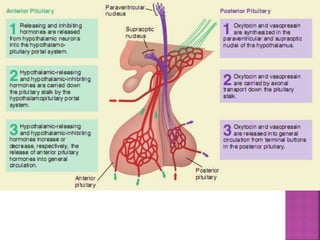
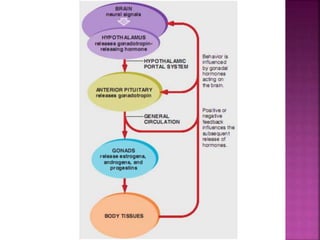
 Hypothalamus secretes tropin releasing 
hormones (e.g. gonadotropin releasing hormone) 
into the hypothalamopituitary portal system 
from which they reach the adenohypophysis and 
stimulate the secretion of the respective tropin 
hormone (In this case gonadotropin). 
 Neurohypophysis hormone secretion is such that 
the hormones themselves are synthesised in the 
cell bodies of neurons in the paraventricular and 
supraoptic nuclei of the hypothalamus and are 
then transported along the axons of these 
neurons down into the neurohypophysis where 
they are eventually secreted into the 
bloodstream from there.
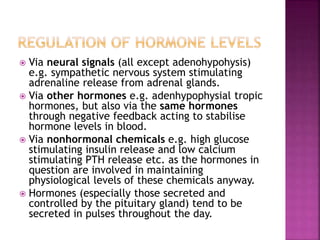
 Via neural signals (all except adenohypohysis) 
e.g. sympathetic nervous system stimulating 
adrenaline release from adrenal glands. 
 Via other hormones e.g. adenhypophysial tropic 
hormones, but also via the same hormones 
through negative feedback acting to stabilise 
hormone levels in blood. 
 Via nonhormonal chemicals e.g. high glucose 
stimulating insulin release and low calcium 
stimulating PTH release etc. as the hormones in 
question are involved in maintaining 
physiological levels of these chemicals anyway. 
 Hormones (especially those secreted and 
controlled by the pituitary gland) tend to be 
secreted in pulses throughout the day.
 All humans preprogrammed to develop as 
females. 
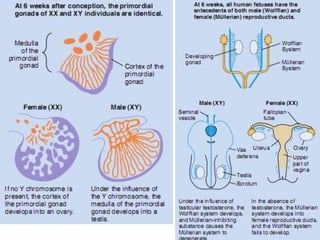
 Default mechanism is that cortex of 
primordial gonads grows to become an ovary. 
 SRY (Sex determining Region of the Y 
chromosome) gene on Y chromosome results 
in synthesis of SRY protein which stimulates 
medulla to grow instead and the formation of 
testes instead of ovaries. 
 This crucial determining event takes place 6 
weeks post fertilisation.
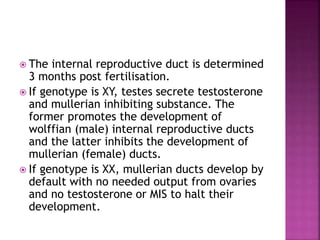
 The internal reproductive duct is determined 
3 months post fertilisation. 
 If genotype is XY, testes secrete testosterone 
and mullerian inhibiting substance. The 
former promotes the development of 
wolffian (male) internal reproductive ducts 
and the latter inhibits the development of 
mullerian (female) ducts. 
 If genotype is XX, mullerian ducts develop by 
default with no needed output from ovaries 
and no testosterone or MIS to halt their 
development.
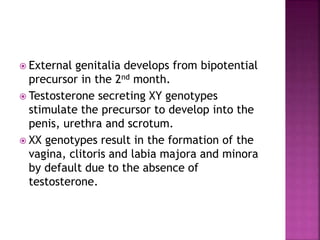
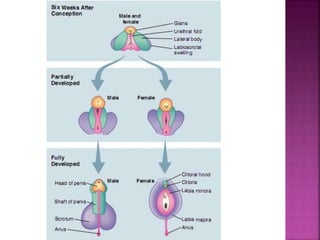
 External genitalia develops from bipotential 
precursor in the 2nd month. 
 Testosterone secreting XY genotypes 
stimulate the precursor to develop into the 
penis, urethra and scrotum. 
 XX genotypes result in the formation of the 
vagina, clitoris and labia majora and minora 
by default due to the absence of 
testosterone.
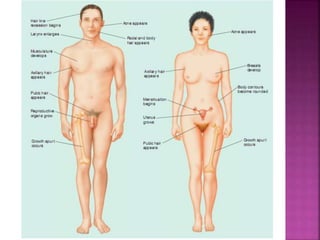
 Puberty is the period wherein an individual 
becomes sexually mature and starts to 
develop secondary sex characteristics. 
 Secondary sex characteristics are the 
physical traits that distinguish men from 
women 
 Gonadotropin induces sex steroid production 
which initiate sexual maturity while 
somatotropin and adrenocorticotropic 
hormone (ACTH) result in anabolic changes 
and the development of secondary sex 
characteristics respectively.
 Male and female brains are phenotypically different 
in terms of size, various tract and nucleus size etc. 
 We are still unsure as to how and when the different 
concentrations of sex steroids between men and 
women influence the development of these 
differences in the brain. 
 However, female rats ovariectomised at birth and 
given androgen injections upon reaching sexual 
maturity displayed male sexual behaviour but failed 
to exhibit as much female sexual behaviour if 
injected with progesterone and oestradiol. The same 
complementary scenario was seen with male rats 
undergoing the complementary treatment. 
 This perinatal critical time period has been estimated 
at 11 days, at least for mice.
 Castration has been seen to significantly reduce 
sexual interest and behaviour in adult human 
males to different degrees. 
 It is thought that this variation is the result of 
the adrenal cortex producing different amounts 
of testosterone in different individuals post 
orchidectomy. 
 Conversely and logically, adminstering 
testosterone to castrated individuals restores 
their libido and sexual behaviour. 
 However testosterone cannot restore fertility 
(gonadotropins and normal spermatogenesis are 
needed for that).
 Female guinea pig sexual behaviours have 
been seen to vary with the different 
hormone concentrations of their menstrual 
cycles. 
 Human females are much more complex and 
libido varies for different women at different 
points in their cycles. 
 Testosterone has been implicated in sexual 
drive as replacing low levels helps increase 
libido. 
 However many women lacking sexual interest 
have normal testosterone levels.
 Anabolic steroids are testosterone derived or 
testosterone related artificially synthesised 
molecules. 
 They stimulate anabolism, including muscle 
mass growth, bone growth (remodeling not 
height), body hair production etc. (i.e. 
amplifying secondary sex characteristics) 
 Because they are similar to testosterone, 
they have negative feedback effects on the 
pituitary and hypothalamus resulting in 
decreased gonadotropin release leading to 
testicular atrophy and sterility in men.
 In women they lead to amenorrhoea and 
sterility along with masculinisation of body 
features. 
 Other shared symptoms include muscle 
pains, spasms, haematuria, water retentions, 
nausea, vomiting and psychotic behaviours. 
 Chronic usage of anabolic steroids also 
decreases life expectancy in rodents. 
 No concrete evidence that they significantly 
increase aggression and sexual behaviour.
 Oestradiol reduces brain damage caused by 
neurodegenerative disorders. 
 Has neurotrophic effects ranging from 
reducing inflammation, increasing axonal 
generation and promote synaptogenesis 
among others. 
 Clinical trials have so far, unfortunately, 
been inconclusive.
 Sexual behaviours in humans are under 
complex control via association cortex. 
 Dimorphic nuclei identified in hypothalamus. 
 Much larger in male rats than in female ones. 
 Difference due to oestradiol from aromatised 
testosterone acting on neurons there. 
 In humans, preoptic, suprachiasmatic and 
anterior nuclei of hypothalamus are different 
between men and women.
 The medial preoptic area is heavily involved 
in male sexual behaviour. 
 Lesions covering this area result in complete 
cessation of male-associated sexual 
behaviours in both males and females. 
 Acts via dopamine dependent neural 
pathways. 
 Medial preoptic area projects to lateral 
tegmental field via tract. Destruction of this 
tract or various parts of it also lead to 
complete or specific loss of male-associated 
sexual behaviour.
 Sexual behaviour controlled by VentroMedial 
Nucleus (VMN). 
 Lesions reduce female-associated sexual 
behaviour in rodents. 
 Oestrogen and progesterone complement one 
another when acting on VMN to induce 
receptive sexual behaviour in rodents. 
 Cell bodies of VMN project to periaqueductal 
grey area of the tegmentum via white matter 
tract. 
 Damage to this tract results in decrease of 
sexual behaviours.
 Genes heavily implicated in sexual identity 
as twin studies show higher rates of 
concordance between monozygotic than 
dizygotic twins when it comes to 
homosexuality. 
 The fraternal birth order effect stipulates 
that a man has a significantly increased 
chance of being homosexual the more older 
brothers he has. Autoimmunity induced by 
successive male pregnancies is implicated as 
the underlying mechanism.
 Transsexualism is an example of confrontation 
between a person’s gender identity and their 
actual sex wherein people think they are 
actually of the opposite sex and are trapped in 
their pre-determined body. 
 Transsexuals engage in various, often harmful, 
behaviours to try and change their body into that 
of their desired sex. 
 No such behaviour has been observed in other 
animals. 
 Interestingly a transsexual’s sexual interest is 
Independent of their gender identity.

Hormones & sex

  • 2.
     2 typesof glands: exocrine and endocrine.  Exocrine glands secrete chemicals in ducts e.g. sweat glands and enzyme secreting acinar cells of pancreas.  Endocrine glands secrete chemicals (hormones) directly into the bloodstream.  Hormones circulate in the blood until they reach the receptors they act on where they have their physiological effect.
  • 3.
     3 types:amino acid derivatives, peptides/proteins, steroids.  Because of the overall protein nature of the first 2 types they are generally hydrophilic and cannot penetrate the cell membrane: their receptors are usually on the cell surface (thyroxine is an exception) and because of this they have short lasting effects (think of adrenaline).  Steroid hormones are cholesterol derived molecules that are hydrophobic and usually act on receptors in the cell cytoplasm or nucleus where they influence gene expression and thus can have long lasting effects.  Sex hormones are steroids.
  • 4.
     Synthesised primarilyin the gonads, (testes for men and ovaries for women).  3 main classes: androgens, oestrogens and progestins of which testosterone, oestradiol and progesterone are the most common of each respective class.  Zona reticularis of adrenal cortex also synthesises sex steroids but in smaller amounts.  Main role of testes and ovaries is to produce sperm and ova respectively, which are haploid sex cells created via meiosis.
  • 5.
     Divided intoanterior and posterior (aka adneohypohysis and neurohypophysis).  Adenohypophysis derived from tissue that forms roof of mouth, fuses with neurohypophysis.  Adenohypophysis secretes tropic hormones which stimulates hormone secretion of other glands.  Secretes: Gonadotropin (LH and FSH) Somatotropin (GH) Thyrotropin Adrenocorticotropic hormone (ACTH) Prolactin
  • 6.
     Neurohypophysis formedfrom small outgrowth of hypothalamus.  Secretes vasopressin and oxytocin.  Vasopressin’s primary function is to increase kidney water reabsorption and increase blood pressure.  Oxytocin is involved in uterine smooth muscle contraction during labor, breast smooth muscle contraction during suckling and recently has been implicated in establishing feelings of trust and closeness.
  • 7.
     Hypothalamus secretestropin releasing hormones (e.g. gonadotropin releasing hormone) into the hypothalamopituitary portal system from which they reach the adenohypophysis and stimulate the secretion of the respective tropin hormone (In this case gonadotropin).  Neurohypophysis hormone secretion is such that the hormones themselves are synthesised in the cell bodies of neurons in the paraventricular and supraoptic nuclei of the hypothalamus and are then transported along the axons of these neurons down into the neurohypophysis where they are eventually secreted into the bloodstream from there.
  • 9.
     Via neuralsignals (all except adenohypohysis) e.g. sympathetic nervous system stimulating adrenaline release from adrenal glands.  Via other hormones e.g. adenhypophysial tropic hormones, but also via the same hormones through negative feedback acting to stabilise hormone levels in blood.  Via nonhormonal chemicals e.g. high glucose stimulating insulin release and low calcium stimulating PTH release etc. as the hormones in question are involved in maintaining physiological levels of these chemicals anyway.  Hormones (especially those secreted and controlled by the pituitary gland) tend to be secreted in pulses throughout the day.
  • 11.
     All humanspreprogrammed to develop as females.  Default mechanism is that cortex of primordial gonads grows to become an ovary.  SRY (Sex determining Region of the Y chromosome) gene on Y chromosome results in synthesis of SRY protein which stimulates medulla to grow instead and the formation of testes instead of ovaries.  This crucial determining event takes place 6 weeks post fertilisation.
  • 12.
     The internalreproductive duct is determined 3 months post fertilisation.  If genotype is XY, testes secrete testosterone and mullerian inhibiting substance. The former promotes the development of wolffian (male) internal reproductive ducts and the latter inhibits the development of mullerian (female) ducts.  If genotype is XX, mullerian ducts develop by default with no needed output from ovaries and no testosterone or MIS to halt their development.
  • 14.
     External genitaliadevelops from bipotential precursor in the 2nd month.  Testosterone secreting XY genotypes stimulate the precursor to develop into the penis, urethra and scrotum.  XX genotypes result in the formation of the vagina, clitoris and labia majora and minora by default due to the absence of testosterone.
  • 16.
     Puberty isthe period wherein an individual becomes sexually mature and starts to develop secondary sex characteristics.  Secondary sex characteristics are the physical traits that distinguish men from women  Gonadotropin induces sex steroid production which initiate sexual maturity while somatotropin and adrenocorticotropic hormone (ACTH) result in anabolic changes and the development of secondary sex characteristics respectively.
  • 18.
     Male andfemale brains are phenotypically different in terms of size, various tract and nucleus size etc.  We are still unsure as to how and when the different concentrations of sex steroids between men and women influence the development of these differences in the brain.  However, female rats ovariectomised at birth and given androgen injections upon reaching sexual maturity displayed male sexual behaviour but failed to exhibit as much female sexual behaviour if injected with progesterone and oestradiol. The same complementary scenario was seen with male rats undergoing the complementary treatment.  This perinatal critical time period has been estimated at 11 days, at least for mice.
  • 19.
     Castration hasbeen seen to significantly reduce sexual interest and behaviour in adult human males to different degrees.  It is thought that this variation is the result of the adrenal cortex producing different amounts of testosterone in different individuals post orchidectomy.  Conversely and logically, adminstering testosterone to castrated individuals restores their libido and sexual behaviour.  However testosterone cannot restore fertility (gonadotropins and normal spermatogenesis are needed for that).
  • 20.
     Female guineapig sexual behaviours have been seen to vary with the different hormone concentrations of their menstrual cycles.  Human females are much more complex and libido varies for different women at different points in their cycles.  Testosterone has been implicated in sexual drive as replacing low levels helps increase libido.  However many women lacking sexual interest have normal testosterone levels.
  • 21.
     Anabolic steroidsare testosterone derived or testosterone related artificially synthesised molecules.  They stimulate anabolism, including muscle mass growth, bone growth (remodeling not height), body hair production etc. (i.e. amplifying secondary sex characteristics)  Because they are similar to testosterone, they have negative feedback effects on the pituitary and hypothalamus resulting in decreased gonadotropin release leading to testicular atrophy and sterility in men.
  • 22.
     In womenthey lead to amenorrhoea and sterility along with masculinisation of body features.  Other shared symptoms include muscle pains, spasms, haematuria, water retentions, nausea, vomiting and psychotic behaviours.  Chronic usage of anabolic steroids also decreases life expectancy in rodents.  No concrete evidence that they significantly increase aggression and sexual behaviour.
  • 23.
     Oestradiol reducesbrain damage caused by neurodegenerative disorders.  Has neurotrophic effects ranging from reducing inflammation, increasing axonal generation and promote synaptogenesis among others.  Clinical trials have so far, unfortunately, been inconclusive.
  • 24.
     Sexual behavioursin humans are under complex control via association cortex.  Dimorphic nuclei identified in hypothalamus.  Much larger in male rats than in female ones.  Difference due to oestradiol from aromatised testosterone acting on neurons there.  In humans, preoptic, suprachiasmatic and anterior nuclei of hypothalamus are different between men and women.
  • 25.
     The medialpreoptic area is heavily involved in male sexual behaviour.  Lesions covering this area result in complete cessation of male-associated sexual behaviours in both males and females.  Acts via dopamine dependent neural pathways.  Medial preoptic area projects to lateral tegmental field via tract. Destruction of this tract or various parts of it also lead to complete or specific loss of male-associated sexual behaviour.
  • 26.
     Sexual behaviourcontrolled by VentroMedial Nucleus (VMN).  Lesions reduce female-associated sexual behaviour in rodents.  Oestrogen and progesterone complement one another when acting on VMN to induce receptive sexual behaviour in rodents.  Cell bodies of VMN project to periaqueductal grey area of the tegmentum via white matter tract.  Damage to this tract results in decrease of sexual behaviours.
  • 27.
     Genes heavilyimplicated in sexual identity as twin studies show higher rates of concordance between monozygotic than dizygotic twins when it comes to homosexuality.  The fraternal birth order effect stipulates that a man has a significantly increased chance of being homosexual the more older brothers he has. Autoimmunity induced by successive male pregnancies is implicated as the underlying mechanism.
  • 28.
     Transsexualism isan example of confrontation between a person’s gender identity and their actual sex wherein people think they are actually of the opposite sex and are trapped in their pre-determined body.  Transsexuals engage in various, often harmful, behaviours to try and change their body into that of their desired sex.  No such behaviour has been observed in other animals.  Interestingly a transsexual’s sexual interest is Independent of their gender identity.

Editor's Notes

  • #3 Acinar cells are just cells in pancreas that secrete enzymes babe don’t worry about it I just thought I’d be clever (and thus make you look clever too).
  • #4 You might wanna split this slide into 2 babe seeing as it’s a bit too clunky and information dense. Don’t worry about thyroxine it’s from the thyroid gland, I just wanted to show off again. Hydrophilic and hydrophobic refers to how much these chemicals like being dissolved in water. So the hydrophobic ones basically means they’re fat based molecules that can pass through the cell membranes without a transporter which is how they get into the nucleus so easily. The protein ones cant. Gene expression means they alter what the cell does so as you know sex hormones act on different cells such that the end product is more muscle mass, bone growth (gain in height), pubic hair development etc. I’m sorry if I’m just telling you stuff you know but ou told me you had a blank face at some of the stuff I put down last time so I just want to make sure you’re covered just in case.
  • #5 Zona reticularis is basically one part of the cortex of the adrenal gland babe (again me showing off feel free to delete it if it pisses you off). Haploid just means they’ve got one set of chromosomes, i.e. on of each and one of either X or Y (I’m sure you know this, you know more about meiosis than I do but again just making sure 
  • #6 Adenohypohysis and neurohypohysis are just other names for anterior and posterior pituitary. If they ask: Gonadotropins are divided into leutenising hormone and follicle stimulating hormone (important in menstrual cycle) Somatotropin aka growth hormone is not just a tropic hormone but also acts on tissues itself. Thyrotropin actso n thyroid gland to cause thyroxine secretion Corticotropin acts on adrenal gland to stimulate cortisol production Prolactin is not a tropic hormone and acts primarily on breast tissue to stimulate milk development.
  • #7 In case they ask: vasopressin stimulates H2O reabsroption from kidney, vascular smooth muscle contraction (so high blood pressure) and non vascular smooth muscle relaxation (so stuff like diarrhoea) and loads of other things. Vasopressin causes contraction of breast and uterus to force baby out and eject milk when suckling.
  • #8 So basically hypothalamus--adenohypohysis--blood Gonadotropin releasing hormone--gonadotropin--blood I hope this helps. Ask me if it doesn’t.
  • #10 Negative feedback means that the bigger amount there is of a given substance, the more it acts on the thing that is producing or controlling it to make it so there is a smaller amount of it (or a “normal” amount, normal in this sense meaning what the body and the system controlling itself has defined as a normal level).
  • #11 This is an illustration of the “classic” endocrine pathway, with neural input from brain stimulating tropic hormone release which stimulates end hormone release which has both body effects and negatvie feedback effects.
  • #12 Cortex means outer part babe. I think it means crust or bark (of trees) in latin or something, think of it like that.
  • #14 This basically shows what last 2 slides were saying.
  • #16 Shows what last slide was about.
  • #19 Genotypically just means chromosome makeup so whether they’re 46XX or 46XY Phenotypically means what they actually look like upon inspection and phenotype is dependent on both genotype and environment. Critical time period is time period when you have to do something for effects to be seen. For example here if you do this operation after 11 days you won’t see these effects cos the window of opportunity is closed
  • #20 Castrations is the same thing as orchidectomy.
  • #21 Libido is the same thing as sexual drive/desire/interest i.e. how horny you feel.
  • #22 Anabolic means that the synthesis of new substances exceeds breakdown so you get overall growth of muscle and stuff like that i.e. it stimulates metabolism to synthesise more.
  • #23 Amenorrhoea means no periods. Haematuria means blood in urine
  • #24 Neurotrophic I tihnk means it stimulates nerves to grow/repair healthily and physiologically.
  • #25 Aromatised testosteron is testosterone that has been converted into oestradiol via enzyme aromatase.
  • #27 If they ask about more detail: oestrogen acts first on VMN causing increase in production of progesterone receptors. Progesterone then comes in and causes increase in actual sexual behaviour but you can’t have increase in sexual behaviour without both hormones and in that order.
  • #28 Concordance basically means what % of twins in the study develop in an identical way. So for example if you look at type 2 diabetes in twins we were taught that monozygotic twins (so identical twins) have almost 100% concordance for type 2 diabetes (so if you have identical twin and one gets type 2 diabetes you can be almost completely certain the other will get it too). So simply put if concordance is higher for monozygotic twins then genes have more of an effect on whether people get or become something than the environment. If it’s the same or lower then both genes and the environment are equally important or the environment is more important. Autoimmunity here I meant that because the mom has had so many boys and been exposed to their androgens produced by their glands (specifically adrenals I think). She develops antibodies against these androgens which are involved in masculinising the boy so they are more gay.