• Cells communicatewith other cells
and with their external environment
through signal mechanisms.
• Cellular communication- to
coordinate the activities needed for
an organism
»Grow
»Develop & function.
14.
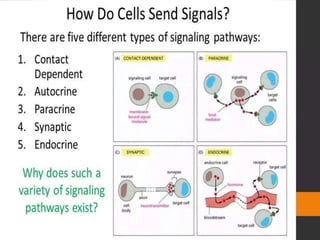
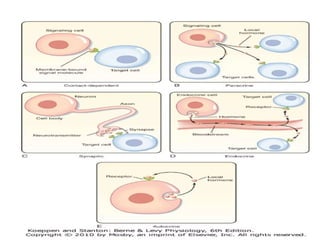
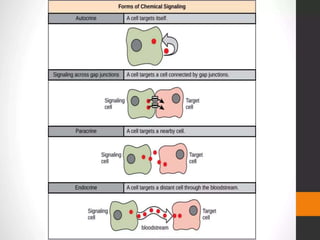
CONTACT DEPENDENT
SIGNALLING
• Signalmolecules remain bound to the surface
of the signalling cell & influence cells that are
in contact with it.
• Eg: immune response, development
17.
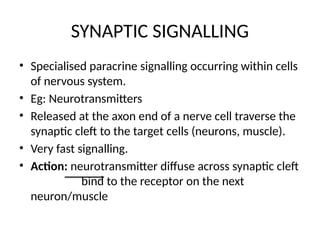
SYNAPTIC SIGNALLING
• Specialisedparacrine signalling occurring within cells
of nervous system.
• Eg: Neurotransmitters
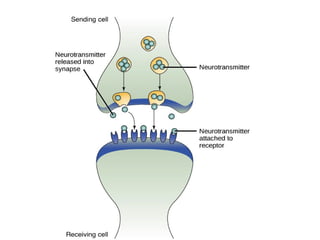
• Released at the axon end of a nerve cell traverse the
synaptic cleft to the target cells (neurons, muscle).
• Very fast signalling.
• Action: neurotransmitter diffuse across synaptic cleft
bind to the receptor on the next
neuron/muscle
25.
Ligands or signallingmolecules
• Cells in multicellular organisms communicate by using signalling molecules
• Ligands : Signaling molecules that bind receptors.
• Eg: small peptides, amino acids, proteins, nucleotides, retinoids, steroids,
fatty acid derivatives or even nitric oxide or carbon monoxide.
• In most cases signal molecules get out from the cell by exocytosis.
• Some molecules are released by diffusion through the plasma membrane
and some remain bound to the surface of the cell.
• Signal molecules or ligands binds to specific site on its receptor.
• Ligands may be large or small and polar or non-polar.
• Large or polar signal molecules cannot move through membranes and so
are generally bound by receptor molecules attached to the cell membrane.
• Small or non-polar ligands, diffuse through membranes and so may be
received by receptor molecules in the cytoplasm.
26.
Ligands or signallingmolecules
Hormones
Cytokines & Growth factors
Vitamin A & D derivatives
Nitric Oxide
27.
Molecules in signaling
1.Hormones
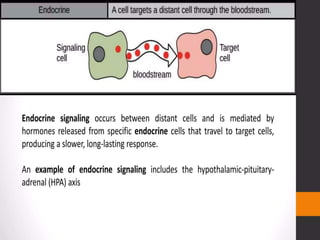
• Hormones are regarded as 'classical' signaling molecules.
• Hormones are produced by endocrine glands (Pancreas,
thyroid gland, Gonads) which secrete the hormones
into the circulation. They reach their target cells that are
even distant from the secreting gland.
• Target cells have specific receptors that pick up the
signal.
• Steroid hormones (Estrogen, Testosterone) and peptide
hormones (Insulin, glucagon) take different signaling
pathways.
28.
2. Cytokines andgrowth factors
• Cytokines and growth factors are regulatory
proteins or peptides secreted by many cell types.
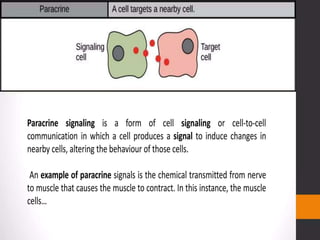
• Most cytokines or growth factors are paracrine in
their action.
• They diffuse short distance to act only on local
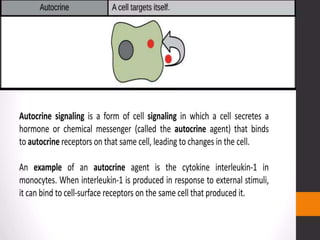
cells, while some are autocrine in action.
• Eg: Cytokines includes interleukin(IL), tumour
necrosis factor (TNFS) & interferons.
• They act in a paracrine or autocrine fashion.
• Cytokines are specific receptors on the cell surface
to which they bind.
29.
3. Vitamin Aand D derivatives
• Retinoic acid derived from vitamin A.
• Important as a signaling molecule in embryonic
development and normal cell growth.
• Vitamin D3 is involved in control of genes
involved in calcium absorption from the
intestine.
• These signalling molecules act on target cells
by binding intracellular receptors after entering
the cell by diffusion across the plasma
membrane.
30.
4. Nitric oxide
•Nitric oxide is a simple gas synthesized from the amino
acid L-arginine by the enzyme nitric oxide synthase.
• It acts as a paracrine signaling molecule in the nervous,
immune, and circulatory systems.
• Extremely unstable and acts locally to affect nearby cells.
• Like steroids they diffuse across the plasma membrane
of its target cell and instead of binding to a receptor, it
regulates the activity of intracellular target enzymes.
• Nitric oxide increases the activity of the second
messenger cyclic guanosine monophosphate (cGMP) in
smooth muscle cells, which then causes muscle cell
relaxation and blood vessel dilation.
31.
Receptors
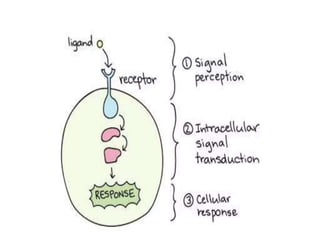
• Receptors aregenerally proteins or glycoproteins.
• Present on target cells that bind the signal molecule and begins
the response process within the target cell.
• Receptors might be located in the plasma membrane or within
the cytoplasm of the cell.
• In most cases the receptors that recognise the signal molecules
are transmembrane proteins on the surface of the target cell.
• Binding of a ligand causes a conformational or shape change
in the receptor molecule, it becomes active and produces a set
of intracellular signals.
• In some cases the receptors are located inside the target cell, so
that signal molecules have to be small enough to diffuse
through the plasma membrane.
33.
Cell surface receptors
•When a cell-signalling molecule binds to a
specific cell surface receptor, it activates a
series of intracellular targets located
downstream of the receptor.
34.
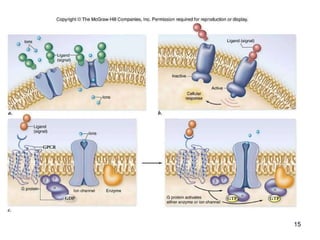
Ion-channel-linked receptors
• Theseare transmembrane protein acting as
ion-channels temporarily opened and closed
by a small amount of neurotransmitter binding
to them.
• This changes the ion permeability of the
plasma membrane as well as the excitability of
the post synaptic cell.
35.
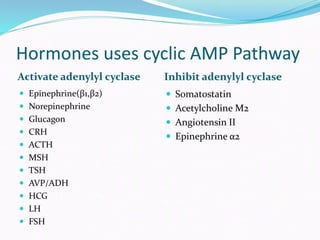
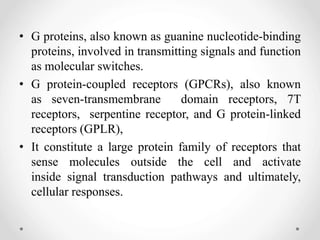
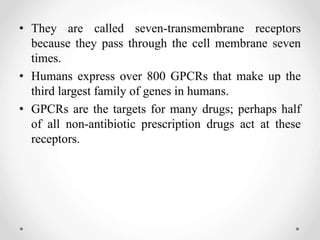
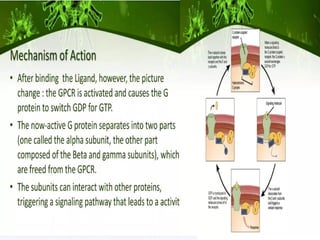
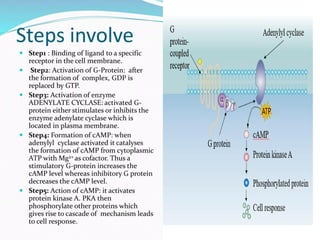
G-protein -coupled receptor(Guanine-nucleotide-
binding proteins)
• When a signalling molecule binds to the
extracellular portion of a cell surface
receptor, its cytosolic domain undergoes
conformational change that enables binding of
the receptor to a G protein.
• This activates the G protein, which then
dissociated and triggers an intracellular signal
to an enzyme.
37.
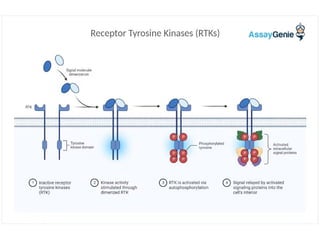
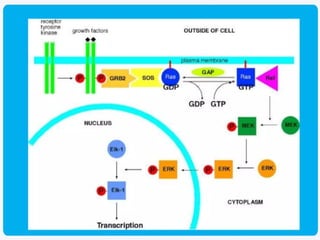
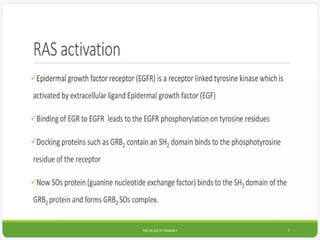
Tyrosine kinases asreceptor proteins
• These surface receptors are enzymes that
phosphorylates substrate proteins on tyrosine residues.
• Binding of a ligand (growth factor) to the
extracellular domain of these receptors induces
receptor dimerization that results in receptor
autophosphorylation (two polypeptide chains
phosphorylate one another).
• This determines the binding of the tyrosine kinase
domain to the down stream signaling molecules.
39.
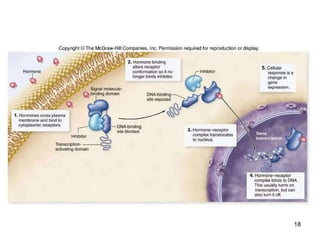
Intra cellular receptors
•Many lipid soluble hormones diffuse across the plasma
membrane and interact with receptors in the cytosol or
nucleus.
• Resulting hormone receptor complexes bind to transcription-
control regions in DNA thereby affecting expression of specific
genes.
• Hormones of this type include the steroids, thyroxin and retinoic
acid.
• Eg: Steroid hormones after crossing the plasma membrane interact
with intracellular receptors forming complexes that can increase
or decrease transcription of specific genes.
41.
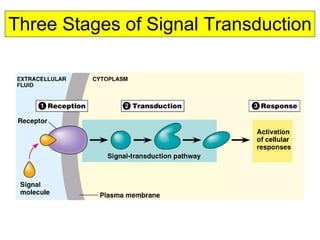
Intracellular Signalling Pathways
•Cell surface receptors stimulate intracellular target enzymes that
are directly or indirectly coupled to receptors by G proteins.
• These enzymes serve as downstream signalling elements that
propagate and amplify the signal initiated by ligand binding.
• This involves a process called intracellular signal transduction
which consists of a chain of reactions for transmitting the signal
from the cell surface to intracellular targets.
• The targets frequently include transcription factors that functions
to regulate gene expression.
• Intracellular signaling pathways connect the cell surface to the
nucleus, leading to changes in gene expression in response to
extracellular stimuli.
53.
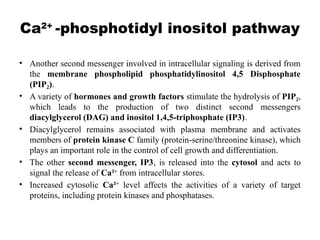
Ca2+
-phosphotidyl inositol pathway
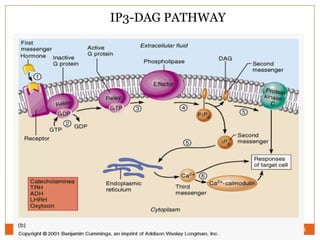
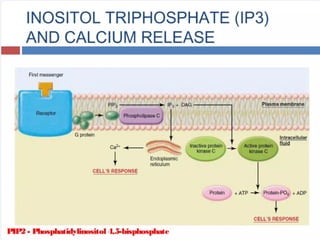
•Another second messenger involved in intracellular signaling is derived from
the membrane phospholipid phosphatidylinositol 4,5 Disphosphate
(PIP )
₂ .
• A variety of hormones and growth factors stimulate the hydrolysis of PIP₂,
which leads to the production of two distinct second messengers
diacylglycerol (DAG) and inositol 1,4,5-triphosphate (IP3).
• Diacylglycerol remains associated with plasma membrane and activates
members of protein kinase C family (protein-serine/threonine kinase), which
plays an important role in the control of cell growth and differentiation.
• The other second messenger, IP3, is released into the cytosol and acts to
signal the release of Ca²+
from intracellular stores.
• Increased cytosolic Ca²+
level affects the activities of a variety of target
proteins, including protein kinases and phosphatases.