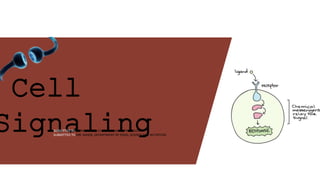
Cell
Signaling
SUBMITTED BY VIONA GUPTA, 218629 – HUMAN PHYSIOLOGY
SUBMITTED TO MR. ASHOK, DEPARTMENT OF FOOD, SCIENCE AND NUTRITION
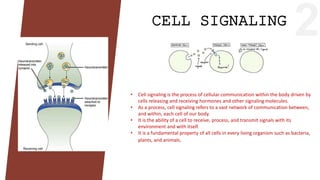
CELL SIGNALING
2
• Cell signaling is the process of cellular communication within the body driven by
cells releasing and receiving hormones and other signaling molecules.
• As a process, cell signaling refers to a vast network of communication between,
and within, each cell of our body.
• It is the ability of a cell to receive, process, and transmit signals with its
environment and with itself.
• It is a fundamental property of all cells in every living organism such as bacteria,
plants, and animals.
Why Do Cells Communicate?
• Maintenance Of Homeostasis
• Control Of Division And Cell Death
• Adaptation To Environmental Conditions
• Control Of Growth And Development And Growth
• Release And Production Of Hormones And Other Regulatory
Molecules
• Contraction And Expansion
• Secondary Sexual Characteristics
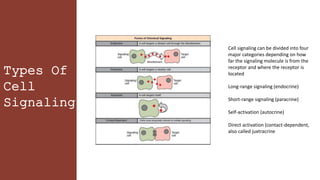
Cell signaling can be divided into four
major categories depending on how
far the signaling molecule is from the
receptor and where the receptor is
located
Long-range signaling (endocrine)
Short-range signaling (paracrine)
Self-activation (autocrine)
Direct activation (contact-dependent,
also called juxtracrine
Types Of
Cell
Signaling
• First, reception, whereby
the signal molecule binds
the receptor
• Then, signal
transduction, which is
where the chemical
signal results in a series
of enzyme activations
• Finally, the response,
which is the resulting
cellular responses.
Three
Stages of
Cell
Signaling
.
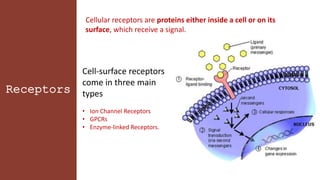
Cellular receptors are proteins either inside a cell or on its
surface, which receive a signal.
Receptors
Cell-surface receptors
come in three main
types
• Ion Channel Receptors
• GPCRs
• Enzyme-linked Receptors.
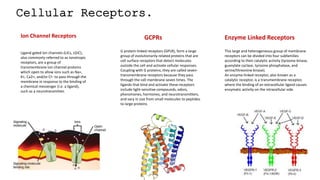
Cellular Receptors.
Ligand-gated ion channels (LICs, LGIC),
also commonly referred to as ionotropic
receptors, are a group of
transmembrane ion-channel proteins
which open to allow ions such as Na+,
K+, Ca2+, and/or Cl− to pass through the
membrane in response to the binding of
a chemical messenger (i.e. a ligand),
such as a neurotransmitter.
Ion Channel Receptors GCPRs
This large and heterogeneous group of membrane
receptors can be divided into four subfamilies
according to their catalytic activity (tyrosine kinase,
guanylate cyclase, tyrosine phosphatase, and
serine/threonine kinase).
An enzyme-linked receptor, also known as a
catalytic receptor, is a transmembrane receptor,
where the binding of an extracellular ligand causes
enzymatic activity on the intracellular side.
Enzyme Linked Receptors
G protein-linked receptors (GPLR), form a large
group of evolutionarily-related proteins that are
cell surface receptors that detect molecules
outside the cell and activate cellular responses.
Coupling with G proteins, they are called seven-
transmembrane receptors because they pass
through the cell membrane seven times. The
ligands that bind and activate these receptors
include light-sensitive compounds, odors,
pheromones, hormones, and neurotransmitters,
and vary in size from small molecules to peptides
to large proteins
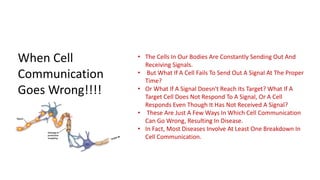
When Cell
Communication
Goes Wrong!!!!
• The Cells In Our Bodies Are Constantly Sending Out And
Receiving Signals.
• But What If A Cell Fails To Send Out A Signal At The Proper
Time?
• Or What If A Signal Doesn't Reach Its Target? What If A
Target Cell Does Not Respond To A Signal, Or A Cell
Responds Even Though It Has Not Received A Signal?
• These Are Just A Few Ways In Which Cell Communication
Can Go Wrong, Resulting In Disease.
• In Fact, Most Diseases Involve At Least One Breakdown In
Cell Communication.
Reference
• Bu Z, Callaway DJ (2011). “Proteins MOVE! Proteins dynamics
and long-range allostery in cell signaling”. Advances in
protein chemistry and structural biology. Advances in Protein
chemistry and structural biology 83:163-221
• https://en.wikipedia.org/wiki/Cell_signaling
• https://biologydictionary.net/cell-signaling/#receptor-
tyrosine-kinases
• https://www.ncbi.nlm.nih.gov/pmc/articles/PMC2914105/
• Rang and Dales' Pharmacology
• Genetic Science Learning Center. (2020, July 31) When Cell
Communication Goes Wrong. Retrieved January 26, 2022,
from https://learn.genetics.utah.edu/content/cells/badcom/
Thank
You.

cell signalling

  • 1.
    Cell Signaling SUBMITTED BY VIONAGUPTA, 218629 – HUMAN PHYSIOLOGY SUBMITTED TO MR. ASHOK, DEPARTMENT OF FOOD, SCIENCE AND NUTRITION
  • 2.
    CELL SIGNALING 2 • Cellsignaling is the process of cellular communication within the body driven by cells releasing and receiving hormones and other signaling molecules. • As a process, cell signaling refers to a vast network of communication between, and within, each cell of our body. • It is the ability of a cell to receive, process, and transmit signals with its environment and with itself. • It is a fundamental property of all cells in every living organism such as bacteria, plants, and animals.
  • 3.
    Why Do CellsCommunicate? • Maintenance Of Homeostasis • Control Of Division And Cell Death • Adaptation To Environmental Conditions • Control Of Growth And Development And Growth • Release And Production Of Hormones And Other Regulatory Molecules • Contraction And Expansion • Secondary Sexual Characteristics
  • 4.
    Cell signaling canbe divided into four major categories depending on how far the signaling molecule is from the receptor and where the receptor is located Long-range signaling (endocrine) Short-range signaling (paracrine) Self-activation (autocrine) Direct activation (contact-dependent, also called juxtracrine Types Of Cell Signaling
  • 5.
    • First, reception,whereby the signal molecule binds the receptor • Then, signal transduction, which is where the chemical signal results in a series of enzyme activations • Finally, the response, which is the resulting cellular responses. Three Stages of Cell Signaling .
  • 6.
    Cellular receptors areproteins either inside a cell or on its surface, which receive a signal. Receptors Cell-surface receptors come in three main types • Ion Channel Receptors • GPCRs • Enzyme-linked Receptors.
  • 7.
    Cellular Receptors. Ligand-gated ionchannels (LICs, LGIC), also commonly referred to as ionotropic receptors, are a group of transmembrane ion-channel proteins which open to allow ions such as Na+, K+, Ca2+, and/or Cl− to pass through the membrane in response to the binding of a chemical messenger (i.e. a ligand), such as a neurotransmitter. Ion Channel Receptors GCPRs This large and heterogeneous group of membrane receptors can be divided into four subfamilies according to their catalytic activity (tyrosine kinase, guanylate cyclase, tyrosine phosphatase, and serine/threonine kinase). An enzyme-linked receptor, also known as a catalytic receptor, is a transmembrane receptor, where the binding of an extracellular ligand causes enzymatic activity on the intracellular side. Enzyme Linked Receptors G protein-linked receptors (GPLR), form a large group of evolutionarily-related proteins that are cell surface receptors that detect molecules outside the cell and activate cellular responses. Coupling with G proteins, they are called seven- transmembrane receptors because they pass through the cell membrane seven times. The ligands that bind and activate these receptors include light-sensitive compounds, odors, pheromones, hormones, and neurotransmitters, and vary in size from small molecules to peptides to large proteins
  • 8.
    When Cell Communication Goes Wrong!!!! •The Cells In Our Bodies Are Constantly Sending Out And Receiving Signals. • But What If A Cell Fails To Send Out A Signal At The Proper Time? • Or What If A Signal Doesn't Reach Its Target? What If A Target Cell Does Not Respond To A Signal, Or A Cell Responds Even Though It Has Not Received A Signal? • These Are Just A Few Ways In Which Cell Communication Can Go Wrong, Resulting In Disease. • In Fact, Most Diseases Involve At Least One Breakdown In Cell Communication.
  • 9.
    Reference • Bu Z,Callaway DJ (2011). “Proteins MOVE! Proteins dynamics and long-range allostery in cell signaling”. Advances in protein chemistry and structural biology. Advances in Protein chemistry and structural biology 83:163-221 • https://en.wikipedia.org/wiki/Cell_signaling • https://biologydictionary.net/cell-signaling/#receptor- tyrosine-kinases • https://www.ncbi.nlm.nih.gov/pmc/articles/PMC2914105/ • Rang and Dales' Pharmacology • Genetic Science Learning Center. (2020, July 31) When Cell Communication Goes Wrong. Retrieved January 26, 2022, from https://learn.genetics.utah.edu/content/cells/badcom/
  • 10.