PARACRINE
FACTORS
PRESENTED BY NAVDEEP KAUR
M.Sc.ZOOLOGY
(1st semester)
DOLPHIN PG COLLEGEOF SCIENCE ANDAGRICULTURE
DATE- 21.10.2019
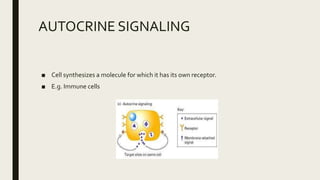
AUTOCRINE SIGNALING
■ Cell synthesizes a molecule for which it has its own receptor.
■ E.g. Immune cells
ENDOCRINE SIGNALING
■ Endocrine factors travel through the blood to exert their effect.
■ E.g.Insulin
JUXTACRINE SIGNALING
■ Cell membrane proteins on one cell surface interact with receptor proteins on adjacent cell
surfaces.
■ E.g. Notch signalling
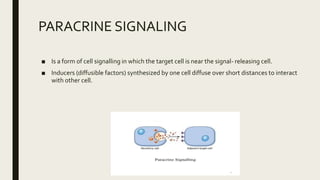
PARACRINE SIGNALING
■ Is a form of cell signalling in which the target cell is near the signal- releasing cell.
■ Inducers (diffusible factors) synthesized by one cell diffuse over short distances to interact
with other cell.
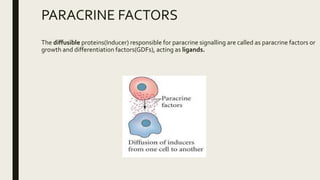
PARACRINE FACTORS
The diffusible proteins(Inducer) responsible for paracrine signalling are called as paracrine factors or
growth and differentiation factors(GDFs), acting as ligands.
PARACRINE FACTORS
■ Paracrine factors are secreted into the immediate spaces around the cell.
■ Paracrine factors function by binding to a receptor that initiates a series of enzymatic
reactions within the cell.
■ Paracrine factors act by signal transduction pathways either by activating a pathway
directly or by blocking the activity of an inhibitor of a pathway ( inhibiting an inhibitor,
as is the case with hedgehog signalling).
PARACRINE FACTORS FAMILIES
■ The four groups of GDFs include:
1. Fibroblast growth factor (FGF) family
2. The hedgehog family
3. TheWnt (Wingless) family
4. Transforming growth factor- β (TGF-β) families
FIBROBLAST GROWTH FACTOR
Approximately two dozen FGF genes that have been identified, and they can
produce hundreds of protein isoforms by altering their RNA splicing or their
initiation codons.
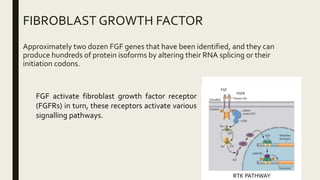
FGF activate fibroblast growth factor receptor
(FGFRs) in turn, these receptors activate various
signalling pathways.
FGFR
FGF
RTK PATHWAY
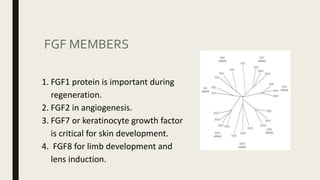
1. FGF1 protein is important during
regeneration.
2. FGF2 in angiogenesis.
3. FGF7 or keratinocyte growth factor
is critical for skin development.
4. FGF8 for limb development and
lens induction.
FGF MEMBERS
The receptor for the hedgehog family
is Patched , which binds to a protein
called Smoothened.
Works by inhibiting an inhibitor.
Hedgehog pathway
HEDGEHOG FAMILY
Constitute members which are used by : embryo to induce particular cell types
and to create boundries between tissues.
There are three hedgehog genes:
- Desert hedgehog (dhh) expressed in sertoli cells of
testes.
- Indian hedgehog (ihh) expressed in gut and in
cartilage and also important for postnatal bone
growth.
- Sonic hedgehog involved in :
Limb patterning
Neural tube induction
Somite differentiation
WNT FAMILY
• Wnts are a family of cysteine- rich glycoproteins.
• There are atleast 15 members of wnt family in vertebrates.
WNT PATHWAY
Wnt family intreract with transmembrane
receptors of the frizzled protein which
activates dishevelled protein.
Works by inhibiting an inhibitor.
WNT
PROTEINS
Wnt proteins are involved in regulating:
-specification of midbrain.
-somites.
-polarity of insect and vertebrate limbs.
-proliferation of stem cells.
-several steps in urinogenital system development.
TGF-β SUPERFAMILY
TheTGF-β superfamily has more than 30 members and includes:
1. Transforming growth factor β
(TGF-β) family
2. The activin family
3. Bone morphogenetic proteins
(BMPs)
4. Vg1 family
5. Glial- derived neurotrophic
factor (GNDF)
6. Mullerian inhibitory factor (MIF)
SMAD PATHWAY
TGF-β SUPERFAMILY
MEMBERS
TGF-β members are important for:
• Extracellular matrix formation
• Epithelial branching that occurs in lung, kidney
and salivary gland development
BMPs regulate:
• Cell division
• Apoptosis
• Cell migration and differentiation
• BMP4 bone development
Activin specify:
• Mesoderm (different region)
• Vertebrate axis (left and right sides)
Paracrine factors 2

Paracrine factors 2

  • 1.
    PARACRINE FACTORS PRESENTED BY NAVDEEPKAUR M.Sc.ZOOLOGY (1st semester) DOLPHIN PG COLLEGEOF SCIENCE ANDAGRICULTURE DATE- 21.10.2019
  • 2.
    AUTOCRINE SIGNALING ■ Cellsynthesizes a molecule for which it has its own receptor. ■ E.g. Immune cells
  • 3.
    ENDOCRINE SIGNALING ■ Endocrinefactors travel through the blood to exert their effect. ■ E.g.Insulin
  • 4.
    JUXTACRINE SIGNALING ■ Cellmembrane proteins on one cell surface interact with receptor proteins on adjacent cell surfaces. ■ E.g. Notch signalling
  • 5.
    PARACRINE SIGNALING ■ Isa form of cell signalling in which the target cell is near the signal- releasing cell. ■ Inducers (diffusible factors) synthesized by one cell diffuse over short distances to interact with other cell.
  • 6.
    PARACRINE FACTORS The diffusibleproteins(Inducer) responsible for paracrine signalling are called as paracrine factors or growth and differentiation factors(GDFs), acting as ligands.
  • 7.
    PARACRINE FACTORS ■ Paracrinefactors are secreted into the immediate spaces around the cell. ■ Paracrine factors function by binding to a receptor that initiates a series of enzymatic reactions within the cell. ■ Paracrine factors act by signal transduction pathways either by activating a pathway directly or by blocking the activity of an inhibitor of a pathway ( inhibiting an inhibitor, as is the case with hedgehog signalling).
  • 8.
    PARACRINE FACTORS FAMILIES ■The four groups of GDFs include: 1. Fibroblast growth factor (FGF) family 2. The hedgehog family 3. TheWnt (Wingless) family 4. Transforming growth factor- β (TGF-β) families
  • 9.
    FIBROBLAST GROWTH FACTOR Approximatelytwo dozen FGF genes that have been identified, and they can produce hundreds of protein isoforms by altering their RNA splicing or their initiation codons. FGF activate fibroblast growth factor receptor (FGFRs) in turn, these receptors activate various signalling pathways. FGFR FGF RTK PATHWAY
  • 10.
    1. FGF1 proteinis important during regeneration. 2. FGF2 in angiogenesis. 3. FGF7 or keratinocyte growth factor is critical for skin development. 4. FGF8 for limb development and lens induction. FGF MEMBERS
  • 11.
    The receptor forthe hedgehog family is Patched , which binds to a protein called Smoothened. Works by inhibiting an inhibitor. Hedgehog pathway HEDGEHOG FAMILY Constitute members which are used by : embryo to induce particular cell types and to create boundries between tissues.
  • 12.
    There are threehedgehog genes: - Desert hedgehog (dhh) expressed in sertoli cells of testes. - Indian hedgehog (ihh) expressed in gut and in cartilage and also important for postnatal bone growth. - Sonic hedgehog involved in : Limb patterning Neural tube induction Somite differentiation
  • 13.
    WNT FAMILY • Wntsare a family of cysteine- rich glycoproteins. • There are atleast 15 members of wnt family in vertebrates. WNT PATHWAY Wnt family intreract with transmembrane receptors of the frizzled protein which activates dishevelled protein. Works by inhibiting an inhibitor.
  • 14.
    WNT PROTEINS Wnt proteins areinvolved in regulating: -specification of midbrain. -somites. -polarity of insect and vertebrate limbs. -proliferation of stem cells. -several steps in urinogenital system development.
  • 15.
    TGF-β SUPERFAMILY TheTGF-β superfamilyhas more than 30 members and includes: 1. Transforming growth factor β (TGF-β) family 2. The activin family 3. Bone morphogenetic proteins (BMPs) 4. Vg1 family 5. Glial- derived neurotrophic factor (GNDF) 6. Mullerian inhibitory factor (MIF) SMAD PATHWAY
  • 16.
    TGF-β SUPERFAMILY MEMBERS TGF-β membersare important for: • Extracellular matrix formation • Epithelial branching that occurs in lung, kidney and salivary gland development BMPs regulate: • Cell division • Apoptosis • Cell migration and differentiation • BMP4 bone development Activin specify: • Mesoderm (different region) • Vertebrate axis (left and right sides)