What is Implicature?
Implicature is a concept in pragmatics that refers to the implied meaning of
an utterance that goes beyond its literal meaning. It was introduced by H.P.
Grice (1975) as part of his theory of conversation.
Unlike direct statements, implicatures rely on context, shared knowledge,
and inference to be understood.
3.
Types of Implicature
1. Conversational Implicature
A conversational implicature is a meaning that is implied rather than
directly stated in conversation. It occurs when a speaker suggests something
beyond the literal meaning of their words. Conversational implicatures are
based on context, shared knowledge, and inference rather than explicit
wording.
The concept was introduced by H.P. Grice (1975) in his theory of
conversation, where he explained how speakers follow or flout
conversational maxims to create indirect meanings.
4.
Conversational Implicature
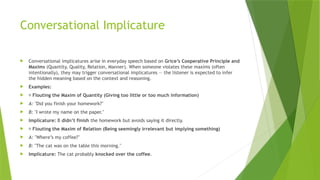
Conversationalimplicatures arise in everyday speech based on Grice’s Cooperative Principle and
Maxims (Quantity, Quality, Relation, Manner). When someone violates these maxims (often
intentionally), they may trigger conversational implicatures — the listener is expected to infer
the hidden meaning based on the context and reasoning.
Examples:
✅ Flouting the Maxim of Quantity (Giving too little or too much information)
A: "Did you finish your homework?"
B: "I wrote my name on the paper."
Implicature: B didn’t finish the homework but avoids saying it directly.
✅ Flouting the Maxim of Relation (Being seemingly irrelevant but implying something)
A: "Where’s my coffee?"
B: "The cat was on the table this morning."
Implicature: The cat probably knocked over the coffee.
5.
2. Conventional Implicature
Conventional implicature is a type of implied meaning that is directly
attached to specific words or phrases in a sentence. Unlike conversational
implicature, it does not depend on context but rather on the meaning of
certain words in the sentence itself.
The concept was introduced by H.P. Grice (1975) as part of his study on
implicatures.
But, Even Therefore Yet
She is rich, but kind.
6.
Key Features ofConversational
Implicatures
Context-Dependent
The meaning of a conversational implicature depends on the context of the
conversation.
2. Not Directly Stated (Requires Inference)
The speaker does not explicitly say the intended meaning; the listener must
infer it.
. Cancellable (Defeasibility)
A conversational implicature can be canceled or denied without
contradiction.
The speaker can clarify their meaning.
7.
4. Non-Conventional(Not Tied to Specific Words)
Unlike conventional implicatures, conversational implicatures do not rely on
specific words.
The meaning comes from the way the speaker uses language in context.
5. Derived from Grice’s Conversational Maxims
Conversational implicatures arise when speakers follow or flout Grice’s
Cooperative Principle and its four maxims:
GENERALIZED CONVERSATIONAL
IMPLICATURES
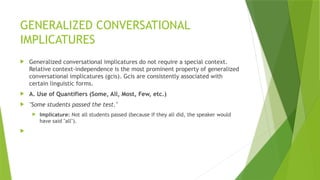
Generalizedconversational implicatures do not require a special context.
Relative context-independence is the most prominent property of generalized
conversational implicatures (gcis). Gcis are consistently associated with
certain linguistic forms.
A. Use of Quantifiers (Some, All, Most, Few, etc.)
"Some students passed the test."
Implicature: Not all students passed (because if they all did, the speaker would
have said "all").
10.
PARTICULARISED CONVERSATIONAL
IMPLICATURES.
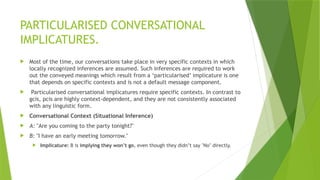
Mostof the time, our conversations take place in very specific contexts in which
locally recognized inferences are assumed. Such inferences are required to work
out the conveyed meanings which result from a ‘particularised’ implicature is one
that depends on specific contexts and is not a default message component.
Particularised conversational implicatures require specific contexts. In contrast to
gcis, pcis are highly context-dependent, and they are not consistently associated
with any linguistic form.
Conversational Context (Situational Inference)
A: "Are you coming to the party tonight?"
B: "I have an early meeting tomorrow."
Implicature: B is implying they won’t go, even though they didn’t say "No" directly.
11.
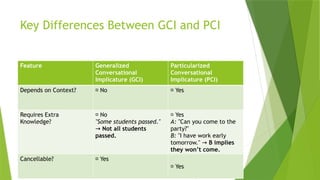
Key Differences BetweenGCI and PCI
Feature Generalized
Conversational
Implicature (GCI)
Particularized
Conversational
Implicature (PCI)
Depends on Context? ❌ No ✅ Yes
Requires Extra
Knowledge?
❌ No
"Some students passed."
→ Not all students
passed.
✅ Yes
A: "Can you come to the
party?"
B: "I have work early
tomorrow." → B implies
they won’t come.
Cancellable? ✅ Yes
✅ Yes