Phonetics & Phonology
      An Introduction

   Sarmad Hussain
   Center for Research in Urdu Language Processing,
   NUCES, Lahore, Pakistan
   sarmad.hussain@nu.edu.pk
Levels of Linguistic Analysis
               Pragmatics
               Semantics
                Syntax
              Morphology
               Phonology
               Phonetics


                www.PANL10n.net   2
Overview

 Phonetics
 Phonology
 Computational Phonology


                 www.PANL10n.net   3
Phonetics
What is Phonetics ?

 Study of human speech as a physical
 phenomenon

   Articulation

   Acoustics

   Perception


                  www.PANL10n.net      5
Articulatory Phonetics

 Study of how speech sounds are produced by
 human vocal apparatus

   Anatomy of vocal organs

   Air stream Mechanism

   Voicing

   Articulation


                    www.PANL10n.net           6
Anatomy of Vocal Organs


                                [2]


              www.PANL10n.net         7
Air-stream Mechanisms


 Pulmonic

 Glottic

 Velaric


              www.PANL10n.net   8
Pulmonic Sounds

 Air flow is directed outwards towards the oral
 cavity
 Pressure built by compression of lungs


   English [p], [n], [s], [l], [e]


                          www.PANL10n.net         9
Glottic Egressive Sounds

 Air flow is directed outwards towards the oral
 cavity
 Pressure built by pushing up closed glottis


   Georgian [p’], [t’], [k’]


                         www.PANL10n.net          10
Glottic Ingressive Sounds

 Air flow is directed inwards from the oral
 cavity
 Pressure reduced by pulling down closed
 glottis


   Hausa, Sindhi [ɓ,ɠ ]


                    www.PANL10n.net           11
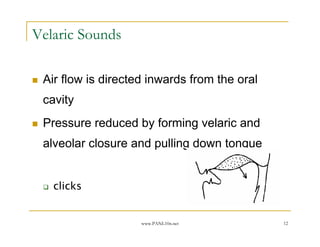
Velaric Sounds

 Air flow is directed inwards from the oral
 cavity
 Pressure reduced by forming velaric and
 alveolar closure and pulling down tongue


   clicks


                    www.PANL10n.net           12
Articulatory Phonetics

 Study of how speech sounds are produced by
 human vocal apparatus

   Anatomy of vocal organs

   Air stream Mechanism

   Voicing

   Articulation


                    www.PANL10n.net           13
Bernoulli Effect
  Air pumped from the lungs applies pressure on closed glottis
  High pressure opens vocal cords
  High velocity air flow creates low pressure region pulling vocal
  cords together again
  Process is repeated, producing vibrations in the vocal cords


                                                               [3]


                           www.PANL10n.net                       14
Voicing

      Voicelessness            p
      Voice                    b

      Aspirated                ph
      Breathy Voice            bh
      Creak
      Whisper                           [4]


                      www.PANL10n.net         15
Articulation


 Manners of Articulation


 Places of Articulation


                    www.PANL10n.net   16
Consonants – Manners of Articulation
     Stop                            p

     Fricative
     Affricate               tʃ      dʒ

     Approximant                     j
     Nasal                           m
     Tap
     Flap
     Trill
     Lateral                              [4]

                   www.PANL10n.net              17
Places of Articulation

          Alveolar        Palatal
                                          Velar


                                            Uvular
                                         Pharyngeal
 Labial     Labio-
            dental
                     Dental


                                          Laryngeal

                                                      [2]

                               www.PANL10n.net              18
Consonants – Places of Articulation


                                      [9]


                 www.PANL10n.net            19
Consonants – Places of Articulation
   Bilabial
   Labio-dental
   Dental
   Alveolar
   Retroflex
   Palatal                                   ʃ   dʒ
   Velar
   Uvular
   Pharyngeal
   Glottal
   Multiple Places of Articulation                    [4]

                           www.PANL10n.net                  20
Consonantal Sounds


                                [10]
              www.PANL10n.net    21
Vowel – Features

 Low / High
 Back / Front
 Round
 Nasal
 Long


                www.PANL10n.net   22
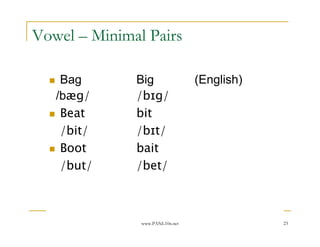
Vowel – Minimal Pairs

    Bag       Big                (English)
   /bæg/      /bɪg/
    Beat      bit
    /bit/     /bɪt/
    Boot      bait
    /but/     /bet/


               www.PANL10n.net               23
/a/ Vocal Tract Outline


                                 [11]


               www.PANL10n.net          24
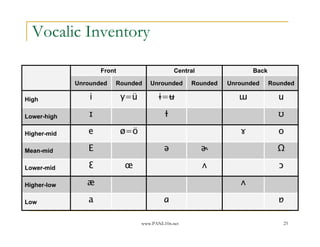
Vocalic Inventory

                     Front                      Central               Back

             Unrounded   Rounded      Unrounded      Rounded   Unrounded     Rounded

High             i           y=ü         ɨ=ʉ                      ɯ            u

Lower-high      ɪ                           Ɨ                                  ʊ

Higher-mid      e            ø=ö                                  ɤ            o

Mean-mid        E                           ə             ɚ                    Ω

Lower-mid       Ɛ            œ                            ʌ                    ɔ

Higher-low      æ                                                 ʌ

Low             a                           ɑ                                  ɒ

                                   www.PANL10n.net                               25
Vocalic Quadrilateral


                                  [12]


                www.PANL10n.net          26
Diphthongs

 Combination of two vocalic sounds
  English:          [aj]        I, eye   [aj]
                    [aw] cow             [kaw]


                  www.PANL10n.net                27
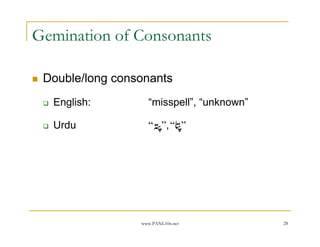
Gemination of Consonants

 Double/long consonants
  English:         “misspell”, “unknown”

  Urdu             “ê 6”, “ 6”


                 www.PANL10n.net           28
What is Phonetics ?

 Study of human speech as a physical
 phenomenon

   Articulation

   Acoustics

   Perception


                  www.PANL10n.net      29
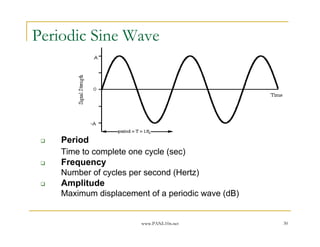
Periodic Sine Wave


    Period
    Time to complete one cycle (sec)
    Frequency
    Number of cycles per second (Hertz)
    Amplitude
    Maximum displacement of a periodic wave (dB)


                       www.PANL10n.net             30
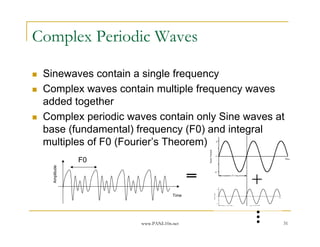
Complex Periodic Waves

 Sinewaves contain a single frequency
 Complex waves contain multiple frequency waves
 added together
 Complex periodic waves contain only Sine waves at
 base (fundamental) frequency (F0) and integral
 multiples of F0 (Fourier’s Theorem)
              F0
  Amplitude


                                Time


                    www.PANL10n.net              31
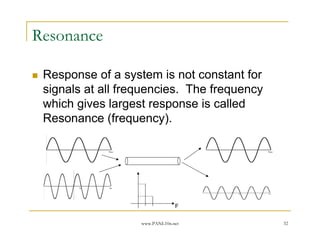
Resonance

 Response of a system is not constant for
 signals at all frequencies. The frequency
 which gives largest response is called
 Resonance (frequency).


                                F


                   www.PANL10n.net           32
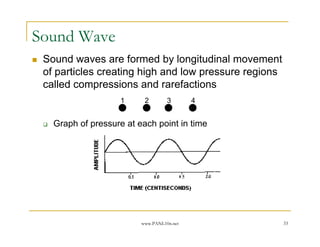
Sound Wave
 Sound waves are formed by longitudinal movement
 of particles creating high and low pressure regions
 called compressions and rarefactions
                    1     2        3       4


   Graph of pressure at each point in time


                         www.PANL10n.net               33
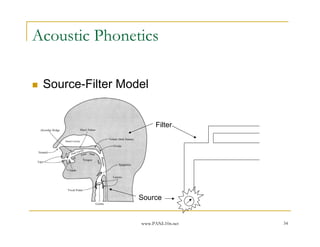
Acoustic Phonetics

 Source-Filter Model


                       Filter


                  Source


                  www.PANL10n.net   34
Source-Filter Theory: Filter

 Response curve with tongue in neutral position
 Resonances are called Formants (F1, F2, F3, …)

        F1
                       F2

                                      F3


                                                  [15]

                    www.PANL10n.net                 35
Source-Filter Theory: Source

 Waveform and spectrum of the glottal pulse

           Amplitude


                                              Time


                                                [15]

                       www.PANL10n.net               36
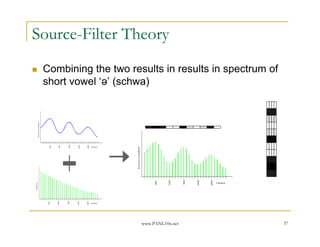
Source-Filter Theory
 Combining the two results in results in spectrum of
 short vowel ‘ə’ (schwa)


                      www.PANL10n.net                  37
Spectrogram
 A spectrogram is a time-frequency-amplitude graph
 representing sound


     “a      bab”     “a          dad”       “a   gag”


                                                         [16]
                           www.PANL10n.net               38
Spectrogram


              www.PANL10n.net   [16] [17]   39
What is Phonetics ?

 Study of human speech as a physical
 phenomenon

   Articulation

   Acoustics

   Perception


                  www.PANL10n.net      40
Speech Perception

 Acoustic signal is highly variable but perception is
 very stable (invariant)
 How do map physical variance to perceptual
 invariance?
   Intrinsic vs. extrinsic normalization
   Categorical perception
   Articulatory Invariance - recreation of articulatory gestures
   Acoustic Invariance - stable regions in speech within
   articulatory variability
   …?


                          www.PANL10n.net                          41
Phonology
What is Phonology?

 Study of how sounds interact in various languages
 (phonetics   conceptual representation)
   Segmental phenomena
     Phonemic Inventory and Allophony
     Sound-change rules and ordering
   Supra-segmental phenomena
     Syllabification
     Prominence
     Tones
     Intonation


                        www.PANL10n.net              43
Phoneme?

  Mental concept representing a physical sound
  Many to many mapping between phoneme and a
  phone within a language
  English /t/
    aspirated in “tunafish”
    unaspirated in “starfish”
    dental before labio-dental
    flapped in “buttercup”


                        www.PANL10n.net          44
Phonological Features

 Phoneme = set of features that are true at a given time for a
 particular phonemic unit (phonological features) (Auto-
 segmental theory)

 Values of features can by unary or binary ( +/- for
 present/absent)


                                                                 [18]


                          www.PANL10n.net                         45
Phonological Features
 Contrastive function:
 Each phoneme differs from others in at least one
 feature
 Descriptive function:
 Accurately describes phonetic nature of a sound
 (may include redundant, non-contrastive features)

 Classificatory function:
 Explains and allows generalizations and common
 phonological processes
                                                    [18]

                     www.PANL10n.net                   46
English Consonant Features


                                 [18]
               www.PANL10n.net          47
English Vowel Features


                                 [18]

               www.PANL10n.net      48
Phonological Rules

 Humans are lazy so compromise articulation to
 reduce effort
 Compromise in Articulation changes the sound
 Constituents of a phonological rules are
   Phonemes to be modified due to a rule
   Conditioning context in which the rule has to be fired
   Change that occurs in a sound after the rule has been fired
 Rules are sometimes ordered in a language


                         www.PANL10n.net                     49
Types of Phonological Rules

 Assimilation
   Addition of features due to neighboring phonemes


           n     [+bilabial] / __ [+bilabial, +voiced, +stop]
 Dissimilation
   Deletion of features due to neighboring phonemes


                                                                [7]

                           www.PANL10n.net                            50
Types of Phonological Rules

 Insertion / Deletion
    Addition or deletion of an entire phone


 Metathesis
   Change order of phonemes
             prescribe => perscribe
             ask => aks


                                              [7]


                          www.PANL10n.net           51
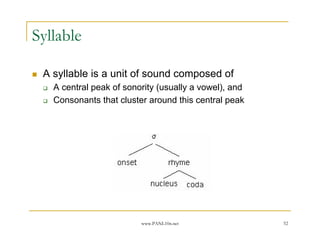
Syllable

 A syllable is a unit of sound composed of
   A central peak of sonority (usually a vowel), and
   Consonants that cluster around this central peak


                         www.PANL10n.net               52
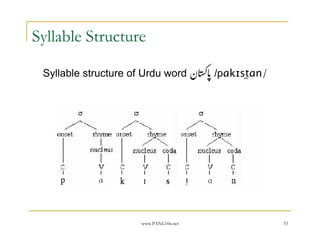
Syllable Structure

 Syllable structure of Urdu word ‫/ † ن‬pɑkɪst̪ɑn/


                     www.PANL10n.net               53
Syllabification

 Syllabification is the process of dividing
 words into syllables
   Nuclear Projection
     Maximal Onset Principle
     Sonority Sequencing Principle
   Template based Matching
     Templates: V, CV, CVC, CVCC
     Direction of largest template application: RTL, LTR


                        www.PANL10n.net                    54
Prominence
 Syllable(s) in a word may be more prominent
 than others
 Prominence can change meaning
     Spanish:
       término, 'end' (noun), termíno, 'I'm finishing'
       terminó, 'she/he finished’
     English
       ‘ob.ject, ob.’ject
       ‘con.tent, con.’tent
 Syllable vs. stress timed languages
     Final heavy syllable is stressed, no secondary stress
       Sensitive to segmental “quantity” or moras
     Every odd syllable is stress, First has primary stress
                              www.PANL10n.net                 55
Intonation

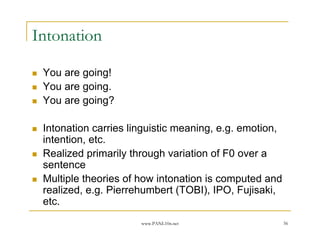
 You are going!
 You are going.
 You are going?

 Intonation carries linguistic meaning, e.g. emotion,
 intention, etc.
 Realized primarily through variation of F0 over a
 sentence
 Multiple theories of how intonation is computed and
 realized, e.g. Pierrehumbert (TOBI), IPO, Fujisaki,
 etc.
                      www.PANL10n.net                   56
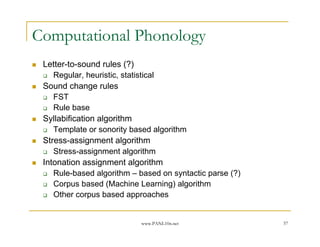
Computational Phonology
 Letter-to-sound rules (?)
    Regular, heuristic, statistical
 Sound change rules
    FST
    Rule base
 Syllabification algorithm
    Template or sonority based algorithm
 Stress-assignment algorithm
    Stress-assignment algorithm
 Intonation assignment algorithm
    Rule-based algorithm – based on syntactic parse (?)
    Corpus based (Machine Learning) algorithm
    Other corpus based approaches


                           www.PANL10n.net                57
Thank you
References
1.    http://www.mapsofworld.com/world-language-map.htm
2.    http://www.ling.upenn.edu/courses/Spring_2001/ling001/phonetics.html
3.    http://www.umanitoba.ca/faculties/arts/linguistics/russell/138/sec5/phonatio
      .htm
4.    http://web.uvic.ca/ling/resources/ipa/
5.    http://www.ling.mq.edu.au/speech/phonetics/phonetics/airstream_laryngeal
      /vot.html
6.    http://www.indiana.edu/~hlw/PhonUnits/consonants2.html
7.    http://www.ling.ohio-state.edu/~xflu/201/phonology.pdf
8.    http://encyclopedia.thefreedictionary.com/IPA%20in%20Unicode
9.    http://www.ling.upenn.edu/courses/Summer_2003/ling001/lecture4.html
10.   http://encyclopedia.thefreedictionary.com/International%20Phonetic%20Al
      phabet

                                   www.PANL10n.net                          59
References
11.   http://www.haskins.yale.edu/Haskins/MISC/ASY/VOWELS/ah.html
12.   http://www.sil.org/mexico/ling/glosario/E005ei-VowelsChart.htm
13.   http://people.deas.harvard.edu/~jones/cscie129/nu_lectures/lecture3%20/
      formants1.gif
14.   http://www.umanitoba.ca/faculties/arts/linguistics/russell/138/sec4/formant
      s.htm
15.   http://www.umanitoba.ca/faculties/arts/linguistics/russell/138/sec4/src-
      filt.htm
16.   A Course in Phonetics by Peter Ladefoged
      http://hctv.humnet.ucla.edu/departments/linguistics/VowelsandConsonant
      s/course/contents.html
17.   http://web.uvic.ca/ling/resources/ipa/
18.   Introduction to Phonetics and Phonology by Clark and Yallop
      http://ifla.uni-stuttgart.de/~jilka/teaching/intro1/i3_features.pdf

                                   www.PANL10n.net                               60

Phonetics&phonology

  • 1.
    Phonetics & Phonology An Introduction Sarmad Hussain Center for Research in Urdu Language Processing, NUCES, Lahore, Pakistan sarmad.hussain@nu.edu.pk
  • 2.
    Levels of LinguisticAnalysis Pragmatics Semantics Syntax Morphology Phonology Phonetics www.PANL10n.net 2
  • 3.
    Overview Phonetics Phonology Computational Phonology www.PANL10n.net 3
  • 4.
  • 5.
    What is Phonetics? Study of human speech as a physical phenomenon Articulation Acoustics Perception www.PANL10n.net 5
  • 6.
    Articulatory Phonetics Studyof how speech sounds are produced by human vocal apparatus Anatomy of vocal organs Air stream Mechanism Voicing Articulation www.PANL10n.net 6
  • 7.
    Anatomy of VocalOrgans [2] www.PANL10n.net 7
  • 8.
    Air-stream Mechanisms Pulmonic Glottic Velaric www.PANL10n.net 8
  • 9.
    Pulmonic Sounds Airflow is directed outwards towards the oral cavity Pressure built by compression of lungs English [p], [n], [s], [l], [e] www.PANL10n.net 9
  • 10.
    Glottic Egressive Sounds Air flow is directed outwards towards the oral cavity Pressure built by pushing up closed glottis Georgian [p’], [t’], [k’] www.PANL10n.net 10
  • 11.
    Glottic Ingressive Sounds Air flow is directed inwards from the oral cavity Pressure reduced by pulling down closed glottis Hausa, Sindhi [ɓ,ɠ ] www.PANL10n.net 11
  • 12.
    Velaric Sounds Airflow is directed inwards from the oral cavity Pressure reduced by forming velaric and alveolar closure and pulling down tongue clicks www.PANL10n.net 12
  • 13.
    Articulatory Phonetics Studyof how speech sounds are produced by human vocal apparatus Anatomy of vocal organs Air stream Mechanism Voicing Articulation www.PANL10n.net 13
  • 14.
    Bernoulli Effect Air pumped from the lungs applies pressure on closed glottis High pressure opens vocal cords High velocity air flow creates low pressure region pulling vocal cords together again Process is repeated, producing vibrations in the vocal cords [3] www.PANL10n.net 14
  • 15.
    Voicing Voicelessness p Voice b Aspirated ph Breathy Voice bh Creak Whisper [4] www.PANL10n.net 15
  • 16.
    Articulation Manners ofArticulation Places of Articulation www.PANL10n.net 16
  • 17.
    Consonants – Mannersof Articulation Stop p Fricative Affricate tʃ dʒ Approximant j Nasal m Tap Flap Trill Lateral [4] www.PANL10n.net 17
  • 18.
    Places of Articulation Alveolar Palatal Velar Uvular Pharyngeal Labial Labio- dental Dental Laryngeal [2] www.PANL10n.net 18
  • 19.
    Consonants – Placesof Articulation [9] www.PANL10n.net 19
  • 20.
    Consonants – Placesof Articulation Bilabial Labio-dental Dental Alveolar Retroflex Palatal ʃ dʒ Velar Uvular Pharyngeal Glottal Multiple Places of Articulation [4] www.PANL10n.net 20
  • 21.
    Consonantal Sounds [10] www.PANL10n.net 21
  • 22.
    Vowel – Features Low / High Back / Front Round Nasal Long www.PANL10n.net 22
  • 23.
    Vowel – MinimalPairs Bag Big (English) /bæg/ /bɪg/ Beat bit /bit/ /bɪt/ Boot bait /but/ /bet/ www.PANL10n.net 23
  • 24.
    /a/ Vocal TractOutline [11] www.PANL10n.net 24
  • 25.
    Vocalic Inventory Front Central Back Unrounded Rounded Unrounded Rounded Unrounded Rounded High i y=ü ɨ=ʉ ɯ u Lower-high ɪ Ɨ ʊ Higher-mid e ø=ö ɤ o Mean-mid E ə ɚ Ω Lower-mid Ɛ œ ʌ ɔ Higher-low æ ʌ Low a ɑ ɒ www.PANL10n.net 25
  • 26.
    Vocalic Quadrilateral [12] www.PANL10n.net 26
  • 27.
    Diphthongs Combination oftwo vocalic sounds English: [aj] I, eye [aj] [aw] cow [kaw] www.PANL10n.net 27
  • 28.
    Gemination of Consonants Double/long consonants English: “misspell”, “unknown” Urdu “ê 6”, “ 6” www.PANL10n.net 28
  • 29.
    What is Phonetics? Study of human speech as a physical phenomenon Articulation Acoustics Perception www.PANL10n.net 29
  • 30.
    Periodic Sine Wave Period Time to complete one cycle (sec) Frequency Number of cycles per second (Hertz) Amplitude Maximum displacement of a periodic wave (dB) www.PANL10n.net 30
  • 31.
    Complex Periodic Waves Sinewaves contain a single frequency Complex waves contain multiple frequency waves added together Complex periodic waves contain only Sine waves at base (fundamental) frequency (F0) and integral multiples of F0 (Fourier’s Theorem) F0 Amplitude Time www.PANL10n.net 31
  • 32.
    Resonance Response ofa system is not constant for signals at all frequencies. The frequency which gives largest response is called Resonance (frequency). F www.PANL10n.net 32
  • 33.
    Sound Wave Soundwaves are formed by longitudinal movement of particles creating high and low pressure regions called compressions and rarefactions 1 2 3 4 Graph of pressure at each point in time www.PANL10n.net 33
  • 34.
    Acoustic Phonetics Source-FilterModel Filter Source www.PANL10n.net 34
  • 35.
    Source-Filter Theory: Filter Response curve with tongue in neutral position Resonances are called Formants (F1, F2, F3, …) F1 F2 F3 [15] www.PANL10n.net 35
  • 36.
    Source-Filter Theory: Source Waveform and spectrum of the glottal pulse Amplitude Time [15] www.PANL10n.net 36
  • 37.
    Source-Filter Theory Combiningthe two results in results in spectrum of short vowel ‘ə’ (schwa) www.PANL10n.net 37
  • 38.
    Spectrogram A spectrogramis a time-frequency-amplitude graph representing sound “a bab” “a dad” “a gag” [16] www.PANL10n.net 38
  • 39.
    Spectrogram www.PANL10n.net [16] [17] 39
  • 40.
    What is Phonetics? Study of human speech as a physical phenomenon Articulation Acoustics Perception www.PANL10n.net 40
  • 41.
    Speech Perception Acousticsignal is highly variable but perception is very stable (invariant) How do map physical variance to perceptual invariance? Intrinsic vs. extrinsic normalization Categorical perception Articulatory Invariance - recreation of articulatory gestures Acoustic Invariance - stable regions in speech within articulatory variability …? www.PANL10n.net 41
  • 42.
  • 43.
    What is Phonology? Study of how sounds interact in various languages (phonetics conceptual representation) Segmental phenomena Phonemic Inventory and Allophony Sound-change rules and ordering Supra-segmental phenomena Syllabification Prominence Tones Intonation www.PANL10n.net 43
  • 44.
    Phoneme? Mentalconcept representing a physical sound Many to many mapping between phoneme and a phone within a language English /t/ aspirated in “tunafish” unaspirated in “starfish” dental before labio-dental flapped in “buttercup” www.PANL10n.net 44
  • 45.
    Phonological Features Phoneme= set of features that are true at a given time for a particular phonemic unit (phonological features) (Auto- segmental theory) Values of features can by unary or binary ( +/- for present/absent) [18] www.PANL10n.net 45
  • 46.
    Phonological Features Contrastivefunction: Each phoneme differs from others in at least one feature Descriptive function: Accurately describes phonetic nature of a sound (may include redundant, non-contrastive features) Classificatory function: Explains and allows generalizations and common phonological processes [18] www.PANL10n.net 46
  • 47.
    English Consonant Features [18] www.PANL10n.net 47
  • 48.
    English Vowel Features [18] www.PANL10n.net 48
  • 49.
    Phonological Rules Humansare lazy so compromise articulation to reduce effort Compromise in Articulation changes the sound Constituents of a phonological rules are Phonemes to be modified due to a rule Conditioning context in which the rule has to be fired Change that occurs in a sound after the rule has been fired Rules are sometimes ordered in a language www.PANL10n.net 49
  • 50.
    Types of PhonologicalRules Assimilation Addition of features due to neighboring phonemes n [+bilabial] / __ [+bilabial, +voiced, +stop] Dissimilation Deletion of features due to neighboring phonemes [7] www.PANL10n.net 50
  • 51.
    Types of PhonologicalRules Insertion / Deletion Addition or deletion of an entire phone Metathesis Change order of phonemes prescribe => perscribe ask => aks [7] www.PANL10n.net 51
  • 52.
    Syllable A syllableis a unit of sound composed of A central peak of sonority (usually a vowel), and Consonants that cluster around this central peak www.PANL10n.net 52
  • 53.
    Syllable Structure Syllablestructure of Urdu word ‫/ † ن‬pɑkɪst̪ɑn/ www.PANL10n.net 53
  • 54.
    Syllabification Syllabification isthe process of dividing words into syllables Nuclear Projection Maximal Onset Principle Sonority Sequencing Principle Template based Matching Templates: V, CV, CVC, CVCC Direction of largest template application: RTL, LTR www.PANL10n.net 54
  • 55.
    Prominence Syllable(s) ina word may be more prominent than others Prominence can change meaning Spanish: término, 'end' (noun), termíno, 'I'm finishing' terminó, 'she/he finished’ English ‘ob.ject, ob.’ject ‘con.tent, con.’tent Syllable vs. stress timed languages Final heavy syllable is stressed, no secondary stress Sensitive to segmental “quantity” or moras Every odd syllable is stress, First has primary stress www.PANL10n.net 55
  • 56.
    Intonation You aregoing! You are going. You are going? Intonation carries linguistic meaning, e.g. emotion, intention, etc. Realized primarily through variation of F0 over a sentence Multiple theories of how intonation is computed and realized, e.g. Pierrehumbert (TOBI), IPO, Fujisaki, etc. www.PANL10n.net 56
  • 57.
    Computational Phonology Letter-to-soundrules (?) Regular, heuristic, statistical Sound change rules FST Rule base Syllabification algorithm Template or sonority based algorithm Stress-assignment algorithm Stress-assignment algorithm Intonation assignment algorithm Rule-based algorithm – based on syntactic parse (?) Corpus based (Machine Learning) algorithm Other corpus based approaches www.PANL10n.net 57
  • 58.
  • 59.
    References 1. http://www.mapsofworld.com/world-language-map.htm 2. http://www.ling.upenn.edu/courses/Spring_2001/ling001/phonetics.html 3. http://www.umanitoba.ca/faculties/arts/linguistics/russell/138/sec5/phonatio .htm 4. http://web.uvic.ca/ling/resources/ipa/ 5. http://www.ling.mq.edu.au/speech/phonetics/phonetics/airstream_laryngeal /vot.html 6. http://www.indiana.edu/~hlw/PhonUnits/consonants2.html 7. http://www.ling.ohio-state.edu/~xflu/201/phonology.pdf 8. http://encyclopedia.thefreedictionary.com/IPA%20in%20Unicode 9. http://www.ling.upenn.edu/courses/Summer_2003/ling001/lecture4.html 10. http://encyclopedia.thefreedictionary.com/International%20Phonetic%20Al phabet www.PANL10n.net 59
  • 60.
    References 11. http://www.haskins.yale.edu/Haskins/MISC/ASY/VOWELS/ah.html 12. http://www.sil.org/mexico/ling/glosario/E005ei-VowelsChart.htm 13. http://people.deas.harvard.edu/~jones/cscie129/nu_lectures/lecture3%20/ formants1.gif 14. http://www.umanitoba.ca/faculties/arts/linguistics/russell/138/sec4/formant s.htm 15. http://www.umanitoba.ca/faculties/arts/linguistics/russell/138/sec4/src- filt.htm 16. A Course in Phonetics by Peter Ladefoged http://hctv.humnet.ucla.edu/departments/linguistics/VowelsandConsonant s/course/contents.html 17. http://web.uvic.ca/ling/resources/ipa/ 18. Introduction to Phonetics and Phonology by Clark and Yallop http://ifla.uni-stuttgart.de/~jilka/teaching/intro1/i3_features.pdf www.PANL10n.net 60