Student Activity: Read and take notes.
How to share with students: These slides can
be assigned digitally using an LMS (like Google
Classroom), where students can work on their
own slide decks via “Make a Copy for Each
Student.” Each slide is set up with text boxes
for students to type in.
Please Note: Because Diffit resources can vary
in length, be sure to check the formatting on
each slide.
Learn More: Please reach out with any
questions or feedback. You can also learn
more on our FAQ page, or get more resources
at Diffit.me!
Suggested Lesson Flow:
1. Preview Vocabulary with students prior
to reading.
2. A title image is available for you to use.
3. Have students read
4. Have students go through the
Multiple Choice Questions.
5. Have students complete the
Short Answer Questions.
6. Have students complete the Open Ended
Questions
Feel free to edit, remix, and use this resource
however works best for you and your
students!
TEACHER INSTRUCTION PAGE (delete this slide)
Basic Interactive Slide Deck
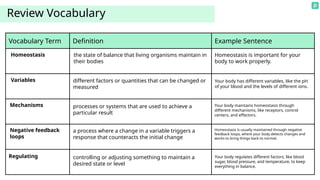
Vocabulary Term Definition Example Sentence
Homeostasis
Variables
Mechanisms
Negative feedback
loops
Regulating
the state of balance that living organisms maintain in
their bodies
Homeostasis is important for your
body to work properly.
Review Vocabulary
different factors or quantities that can be changed or
measured
processes or systems that are used to achieve a
particular result
a process where a change in a variable triggers a
response that counteracts the initial change
controlling or adjusting something to maintain a
desired state or level
Your body has different variables, like the pH
of your blood and the levels of different ions.
Your body maintains homeostasis through
different mechanisms, like receptors, control
centers, and effectors.
Homeostasis is usually maintained through negative
feedback loops, where your body detects changes and
works to bring things back to normal.
Your body regulates different factors, like blood
sugar, blood pressure, and temperature, to keep
everything in balance.
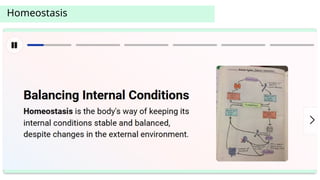
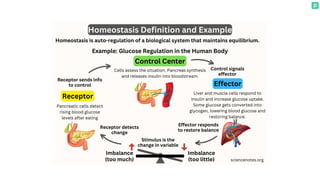
Homeostasis
Homeostasis is the state of balance that living organisms maintain in
their bodies. It's like when your body keeps everything just right, like
your temperature and fluid levels. Your body has different variables,
like the pH of your blood and the levels of different ions, that it needs
to keep within certain limits. Even when things change, like when you
eat different foods or do different activities, your body still works hard
to keep everything in balance. It does this through different
mechanisms, like receptors that sense changes in the environment,
control centers that set the limits for each variable, and effectors that
bring things back to normal. One example of this is how your liver
controls the levels of bile acids.
Reading
Homeostasis is really important for your body to work properly. It's not
just about keeping your temperature steady, but also things like the
concentration of ions in your blood and the pH levels. If these things get
too high or too low, you can get really sick. Your body works at many levels
to maintain homeostasis, not just the whole body, but also individual cells
and organs. For example, your stomach has a different pH than other
organs, and each cell has different ion concentrations. Keeping everything
in balance is key for your body to function well. Homeostasis is usually
maintained through negative feedback loops, where your body detects
changes and works to bring things back to normal. An example of this is
when your body temperature gets too high, and your body works to bring
it back down.
Reading
Your body is always working to maintain homeostasis, even when
things change. For example, when you exercise, your body
temperature goes up, but your body works to bring it back down. And
when you eat something, your blood glucose levels go up, but your
body works to bring them back down too. This is all done through
negative feedback loops, where your body detects changes and works
to reverse them. It's like when your body uses sensors to detect
changes, and then sends signals to different parts of your body to
make the necessary changes. This helps to keep everything in balance
and working properly. Homeostasis is really important for your body
to stay healthy and function well.
Reading
So, homeostasis is all about keeping your body in balance. It's like
when your body makes changes to stay healthy and survive. Your body
does this by regulating different factors, like blood sugar, blood
pressure, and temperature. It's like when your body senses changes
and reacts to bring things back to normal. This happens through
different processes, like feedback control, where your body responds
to changes and creates a new balance. An example of this is how a
thermostat controls the temperature in a room. Your body does
similar things, like regulating your energy levels and body
temperature, to keep everything in balance. Homeostasis is really
important for your body to keep working the right way and stay
healthy.
Reading
Multiple Choice Question
A) Homeostasis is the state of balance that living organisms maintain in their bodies. It is
important because it helps regulate factors like blood sugar, blood pressure, and temperature.
B) Homeostasis is the process of maintaining a stable internal environment in the body. It is
important because it helps prevent sickness and allows the body to function properly.
C) Homeostasis is the ability of the body to adapt to changes in the environment. It is important
because it helps the body survive in different conditions.
D) Homeostasis is the process of keeping the body in balance. It is important because it helps
maintain energy levels and body temperature.
1. What is homeostasis and why is it important for the body?
Multiple Choice Question
A) The body maintains homeostasis through positive feedback loops, where the body
detects changes and amplifies them.
B) The body maintains homeostasis through negative feedback loops, where the body
detects changes and works to reverse them.
C) The body maintains homeostasis by constantly changing its internal environment to
adapt to external conditions.
D) The body maintains homeostasis by regulating only the whole body, not individual cells
or organs.
2. How does the body maintain homeostasis?
Multiple Choice Question
A) When you exercise, your body temperature goes up, but your body works to
bring it back down.
B) When you eat something, your blood glucose levels go up, but your body
works to keep them high.
C) When you sleep, your body shuts down all processes to conserve energy.
D) When you are dehydrated, your body stops producing urine to conserve
water.
3. Give an example of how the body maintains homeostasis.
Short Answer Question
1. What is homeostasis and
why is it important for the
body?
Short Answer Question
2. How does the body
maintain homeostasis?
Short Answer Question
3. Can you give an example
of how the body maintains
homeostasis?
Open Ended Question
1. How does homeostasis
relate to your own body
and health?
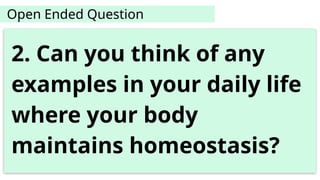
Open Ended Question
2. Can you think of any
examples in your daily life
where your body
maintains homeostasis?
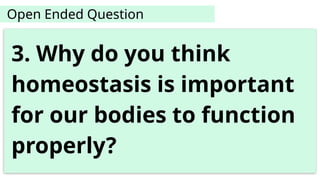
Open Ended Question
3. Why do you think
homeostasis is important
for our bodies to function
properly?

homeostasis -basic interactive slide deck.pptx

  • 1.
    Student Activity: Readand take notes. How to share with students: These slides can be assigned digitally using an LMS (like Google Classroom), where students can work on their own slide decks via “Make a Copy for Each Student.” Each slide is set up with text boxes for students to type in. Please Note: Because Diffit resources can vary in length, be sure to check the formatting on each slide. Learn More: Please reach out with any questions or feedback. You can also learn more on our FAQ page, or get more resources at Diffit.me! Suggested Lesson Flow: 1. Preview Vocabulary with students prior to reading. 2. A title image is available for you to use. 3. Have students read 4. Have students go through the Multiple Choice Questions. 5. Have students complete the Short Answer Questions. 6. Have students complete the Open Ended Questions Feel free to edit, remix, and use this resource however works best for you and your students! TEACHER INSTRUCTION PAGE (delete this slide) TEACHER INSTRUCTION PAGE (delete this slide) Basic Interactive Slide Deck
  • 2.
    Vocabulary Term DefinitionExample Sentence Homeostasis Variables Mechanisms Negative feedback loops Regulating the state of balance that living organisms maintain in their bodies Homeostasis is important for your body to work properly. Review Vocabulary different factors or quantities that can be changed or measured processes or systems that are used to achieve a particular result a process where a change in a variable triggers a response that counteracts the initial change controlling or adjusting something to maintain a desired state or level Your body has different variables, like the pH of your blood and the levels of different ions. Your body maintains homeostasis through different mechanisms, like receptors, control centers, and effectors. Homeostasis is usually maintained through negative feedback loops, where your body detects changes and works to bring things back to normal. Your body regulates different factors, like blood sugar, blood pressure, and temperature, to keep everything in balance.
  • 3.
  • 5.
    Homeostasis is thestate of balance that living organisms maintain in their bodies. It's like when your body keeps everything just right, like your temperature and fluid levels. Your body has different variables, like the pH of your blood and the levels of different ions, that it needs to keep within certain limits. Even when things change, like when you eat different foods or do different activities, your body still works hard to keep everything in balance. It does this through different mechanisms, like receptors that sense changes in the environment, control centers that set the limits for each variable, and effectors that bring things back to normal. One example of this is how your liver controls the levels of bile acids. Reading
  • 6.
    Homeostasis is reallyimportant for your body to work properly. It's not just about keeping your temperature steady, but also things like the concentration of ions in your blood and the pH levels. If these things get too high or too low, you can get really sick. Your body works at many levels to maintain homeostasis, not just the whole body, but also individual cells and organs. For example, your stomach has a different pH than other organs, and each cell has different ion concentrations. Keeping everything in balance is key for your body to function well. Homeostasis is usually maintained through negative feedback loops, where your body detects changes and works to bring things back to normal. An example of this is when your body temperature gets too high, and your body works to bring it back down. Reading
  • 7.
    Your body isalways working to maintain homeostasis, even when things change. For example, when you exercise, your body temperature goes up, but your body works to bring it back down. And when you eat something, your blood glucose levels go up, but your body works to bring them back down too. This is all done through negative feedback loops, where your body detects changes and works to reverse them. It's like when your body uses sensors to detect changes, and then sends signals to different parts of your body to make the necessary changes. This helps to keep everything in balance and working properly. Homeostasis is really important for your body to stay healthy and function well. Reading
  • 8.
    So, homeostasis isall about keeping your body in balance. It's like when your body makes changes to stay healthy and survive. Your body does this by regulating different factors, like blood sugar, blood pressure, and temperature. It's like when your body senses changes and reacts to bring things back to normal. This happens through different processes, like feedback control, where your body responds to changes and creates a new balance. An example of this is how a thermostat controls the temperature in a room. Your body does similar things, like regulating your energy levels and body temperature, to keep everything in balance. Homeostasis is really important for your body to keep working the right way and stay healthy. Reading
  • 9.
    Multiple Choice Question A)Homeostasis is the state of balance that living organisms maintain in their bodies. It is important because it helps regulate factors like blood sugar, blood pressure, and temperature. B) Homeostasis is the process of maintaining a stable internal environment in the body. It is important because it helps prevent sickness and allows the body to function properly. C) Homeostasis is the ability of the body to adapt to changes in the environment. It is important because it helps the body survive in different conditions. D) Homeostasis is the process of keeping the body in balance. It is important because it helps maintain energy levels and body temperature. 1. What is homeostasis and why is it important for the body?
  • 10.
    Multiple Choice Question A)The body maintains homeostasis through positive feedback loops, where the body detects changes and amplifies them. B) The body maintains homeostasis through negative feedback loops, where the body detects changes and works to reverse them. C) The body maintains homeostasis by constantly changing its internal environment to adapt to external conditions. D) The body maintains homeostasis by regulating only the whole body, not individual cells or organs. 2. How does the body maintain homeostasis?
  • 11.
    Multiple Choice Question A)When you exercise, your body temperature goes up, but your body works to bring it back down. B) When you eat something, your blood glucose levels go up, but your body works to keep them high. C) When you sleep, your body shuts down all processes to conserve energy. D) When you are dehydrated, your body stops producing urine to conserve water. 3. Give an example of how the body maintains homeostasis.
  • 12.
    Short Answer Question 1.What is homeostasis and why is it important for the body?
  • 13.
    Short Answer Question 2.How does the body maintain homeostasis?
  • 14.
    Short Answer Question 3.Can you give an example of how the body maintains homeostasis?
  • 15.
    Open Ended Question 1.How does homeostasis relate to your own body and health?
  • 16.
    Open Ended Question 2.Can you think of any examples in your daily life where your body maintains homeostasis?
  • 17.
    Open Ended Question 3.Why do you think homeostasis is important for our bodies to function properly?

Editor's Notes