








RTPM-DSHS
Compiled by Sue Quirante
USAGE NOTES
These slides were prepared by Ms. Sue Quirante, a
secondary public school teacher in the Philippines.
All copyrighted material were lifted by her in the
spirit of fair use. As such, this presentation should
not be used for any commercial purpose.
Last updated October 9, 2016
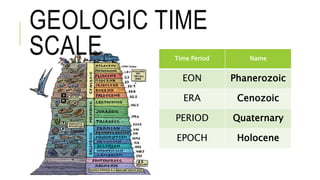
GEOLOGIC TIME
SCALE
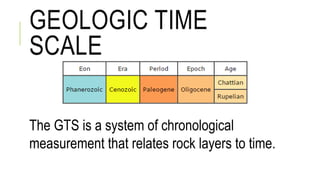
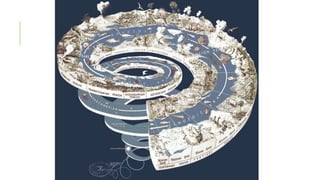
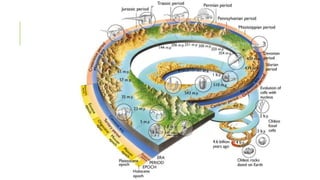
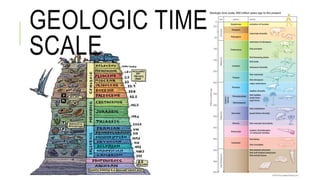
The GTS is a system of chronological
measurement that relates rock layers to time.
GEOLOGIC TIME
SCALE
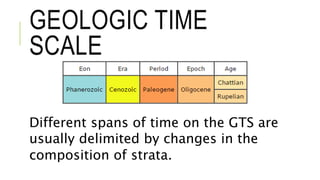
Different spans of time on the GTS are
usually delimited by changes in the
composition of strata.
GEOLOGIC TIME
SCALE
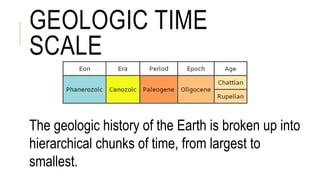
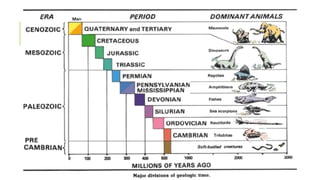
The geologic history of the Earth is broken up into
hierarchical chunks of time, from largest to
smallest.
GEOLOGIC TIME
SCALE
GEOLOGIC TIME
SCALE Time Period Name
EON Phanerozoic
ERA Cenozoic
PERIOD Quaternary
EPOCH Holocene
PLEISTOCENE
pleistos : most
kainos : new
CENOZOIC
ceno : new
zoion : animal
HOLOCENE
holo : whole
kainos : new
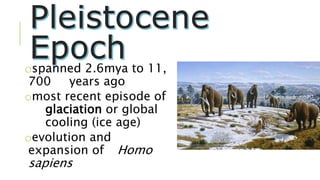
ospanned 2.6mya to 11,
700 years ago
omost recent episode of
glaciation or global
cooling (ice age)
oevolution and
expansion of Homo
sapiens
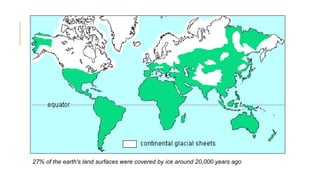
27% of the earth's land surfaces were covered by ice around 20,000 years ago
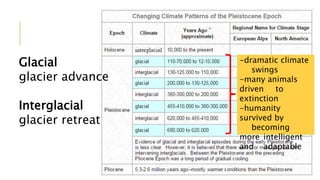
Glacial
glacier advance
Interglacial
glacier retreat
-dramatic climate
swings
-many animals
driven to
extinction
-humanity
survived by
becoming
more intelligent
and adaptable
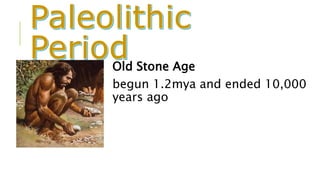
Old Stone Age
begun 1.2mya and ended 10,000
years ago
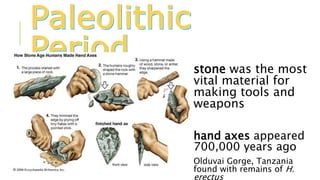
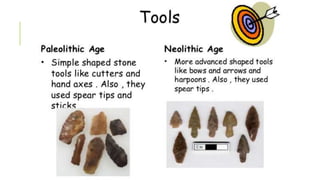
stone was the most
vital material for
making tools and
weapons
hand axes appeared
700,000 years ago
Olduvai Gorge, Tanzania
found with remains of H.
erectus
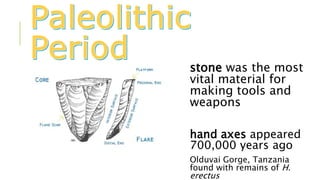
stone was the most
vital material for
making tools and
weapons
hand axes appeared
700,000 years ago
Olduvai Gorge, Tanzania
found with remains of H.
erectus
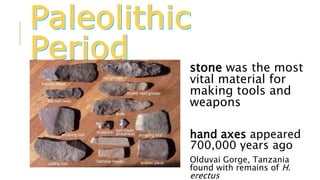
stone was the most
vital material for
making tools and
weapons
hand axes appeared
700,000 years ago
Olduvai Gorge, Tanzania
found with remains of H.
erectus
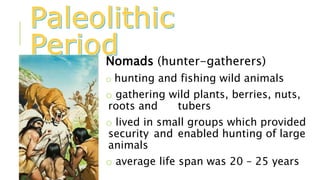
Nomads (hunter-gatherers)
o hunting and fishing wild animals
o gathering wild plants, berries, nuts,
roots and tubers
o lived in small groups which provided
security and enabled hunting of large
animals
o average life span was 20 – 25 years
There was a video here but I took it out to reduce file
size.
It talked about two evolutionary strategies for
surviving colder climates: 1) growing robust bodies
(“toughening yourself up” or 2) growing larger brains
(intelligence allowed humans to develop
cultural/technological adaptations such as use of fire
and clothing in cold climates.
You can view the video here:
https://www.youtube.com/watch?v=ndwzAw8fchU
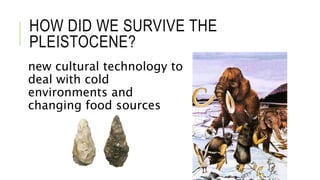
HOW DID WE SURVIVE THE
PLEISTOCENE?
new cultural technology to
deal with cold
environments and
changing food sources
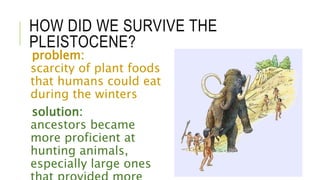
HOW DID WE SURVIVE THE
PLEISTOCENE?
problem:
scarcity of plant foods
that humans could eat
during the winters
solution:
ancestors became
more proficient at
hunting animals,
especially large ones
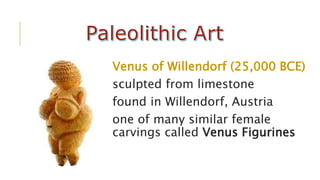
Venus of Willendorf (25,000 BCE)
sculpted from limestone
found in Willendorf, Austria
one of many similar female
carvings called Venus Figurines
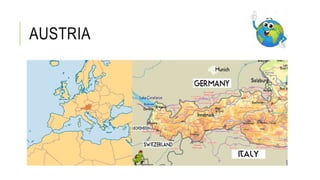
AUSTRIA
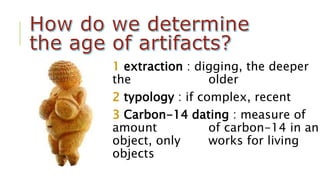
1 extraction : digging, the deeper
the older
2 typology : if complex, recent
3 Carbon-14 dating : measure of
amount of carbon-14 in an
object, only works for living
objects
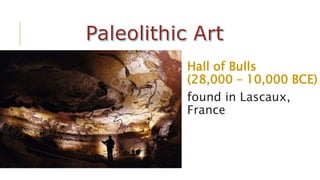
Hall of Bulls
(28,000 – 10,000 BCE)
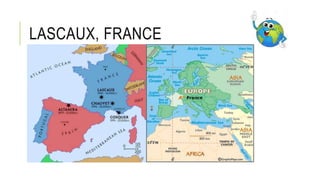
found in Lascaux,
France
LASCAUX, FRANCE
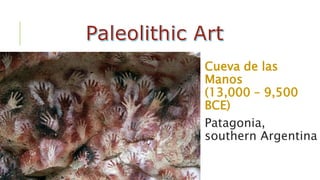
Cueva de las
Manos
(13,000 – 9,500
BCE)
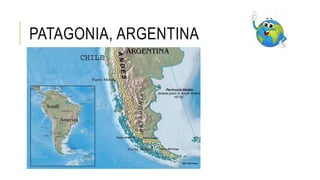
Patagonia,
southern Argentina
PATAGONIA, ARGENTINA
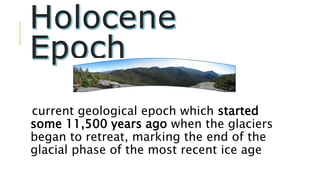
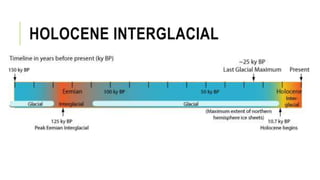
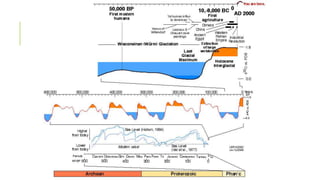
current geological epoch which started
some 11,500 years ago when the glaciers
began to retreat, marking the end of the
glacial phase of the most recent ice age
HOLOCENE INTERGLACIAL
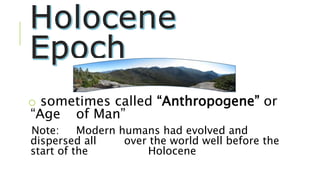
o sometimes called “Anthropogene” or
“Age of Man”
Note: Modern humans had evolved and
dispersed all over the world well before the
start of the Holocene
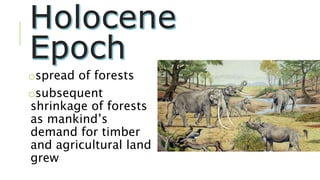
ospread of forests
osubsequent
shrinkage of forests
as mankind’s
demand for timber
and agricultural land
grew
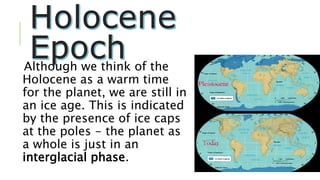
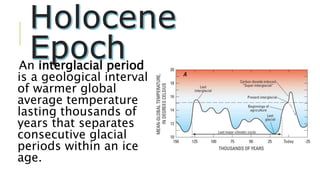
Although we think of the
Holocene as a warm time
for the planet, we are still in
an ice age. This is indicated
by the presence of ice caps
at the poles - the planet as
a whole is just in an
interglacial phase.
An interglacial period
is a geological interval
of warmer global
average temperature
lasting thousands of
years that separates
consecutive glacial
periods within an ice
age.
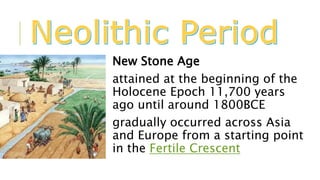
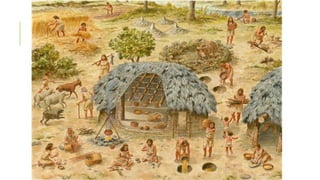
New Stone Age
attained at the beginning of the
Holocene Epoch 11,700 years
ago until around 1800BCE
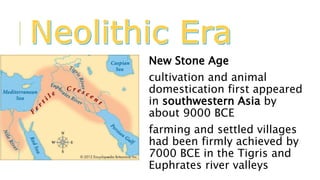
gradually occurred across Asia
and Europe from a starting point
in the Fertile Crescent
New Stone Age
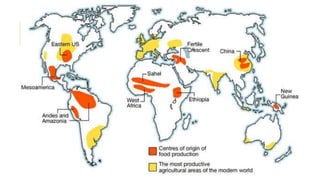
cultivation and animal
domestication first appeared
in southwestern Asia by
about 9000 BCE
farming and settled villages
had been firmly achieved by
7000 BCE in the Tigris and
Euphrates river valleys
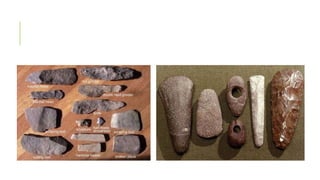
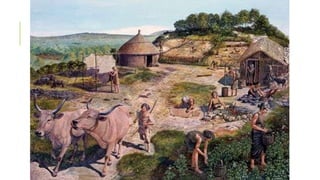
New Stone Age
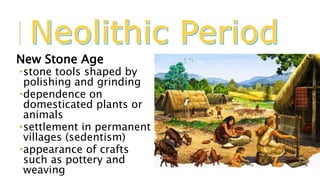
stone tools shaped by
polishing and grinding
dependence on
domesticated plants or
animals
settlement in permanent
villages (sedentism)
appearance of crafts
such as pottery and
weaving
What’s the
difference
between
Horticulture &
Agriculture?
(as used in archaeology
and anthropology)
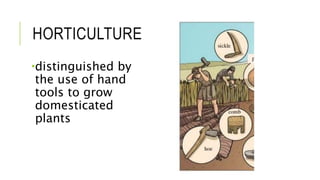
HORTICULTURE
distinguished by
the use of hand
tools to grow
domesticated
plants
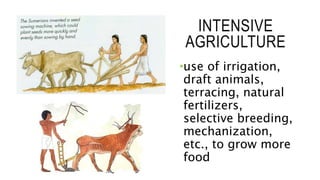
INTENSIVE
AGRICULTURE
use of irrigation,
draft animals,
terracing, natural
fertilizers,
selective breeding,
mechanization,
etc., to grow more
food
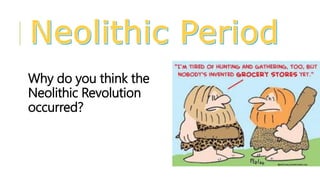
Why do you think the
Neolithic Revolution
occurred?
REFERENCES
University of California Museum of Paleontology
http://www.ucmp.berkeley.edu/exhibit/histgeoscale.php
BBC
http://www.bbc.co.uk/nature/history_of_the_earth/Holocene
Mr. Giotto’s Site
http://www.penfield.edu/webpages/jgiotto/onlinetextbook.cfm?subp
age=1525824
Brittanica
http://www.britannica.com/event/Paleolithic-Period
Climate Change and Human Evolution
http://anthro.palomar.edu/homo/homo_3.htm

Holocene Period

  • 1.
  • 2.
    USAGE NOTES These slideswere prepared by Ms. Sue Quirante, a secondary public school teacher in the Philippines. All copyrighted material were lifted by her in the spirit of fair use. As such, this presentation should not be used for any commercial purpose. Last updated October 9, 2016
  • 3.
    GEOLOGIC TIME SCALE The GTSis a system of chronological measurement that relates rock layers to time.
  • 5.
    GEOLOGIC TIME SCALE Different spansof time on the GTS are usually delimited by changes in the composition of strata.
  • 6.
    GEOLOGIC TIME SCALE The geologichistory of the Earth is broken up into hierarchical chunks of time, from largest to smallest.
  • 11.
  • 12.
    GEOLOGIC TIME SCALE TimePeriod Name EON Phanerozoic ERA Cenozoic PERIOD Quaternary EPOCH Holocene
  • 13.
  • 14.
  • 15.
  • 16.
    ospanned 2.6mya to11, 700 years ago omost recent episode of glaciation or global cooling (ice age) oevolution and expansion of Homo sapiens
  • 17.
    27% of theearth's land surfaces were covered by ice around 20,000 years ago
  • 18.
    Glacial glacier advance Interglacial glacier retreat -dramaticclimate swings -many animals driven to extinction -humanity survived by becoming more intelligent and adaptable
  • 19.
    Old Stone Age begun1.2mya and ended 10,000 years ago
  • 20.
    stone was themost vital material for making tools and weapons hand axes appeared 700,000 years ago Olduvai Gorge, Tanzania found with remains of H. erectus
  • 21.
    stone was themost vital material for making tools and weapons hand axes appeared 700,000 years ago Olduvai Gorge, Tanzania found with remains of H. erectus
  • 22.
    stone was themost vital material for making tools and weapons hand axes appeared 700,000 years ago Olduvai Gorge, Tanzania found with remains of H. erectus
  • 23.
    Nomads (hunter-gatherers) o huntingand fishing wild animals o gathering wild plants, berries, nuts, roots and tubers o lived in small groups which provided security and enabled hunting of large animals o average life span was 20 – 25 years
  • 24.
    There was avideo here but I took it out to reduce file size. It talked about two evolutionary strategies for surviving colder climates: 1) growing robust bodies (“toughening yourself up” or 2) growing larger brains (intelligence allowed humans to develop cultural/technological adaptations such as use of fire and clothing in cold climates. You can view the video here: https://www.youtube.com/watch?v=ndwzAw8fchU
  • 25.
    HOW DID WESURVIVE THE PLEISTOCENE? new cultural technology to deal with cold environments and changing food sources
  • 26.
    HOW DID WESURVIVE THE PLEISTOCENE? problem: scarcity of plant foods that humans could eat during the winters solution: ancestors became more proficient at hunting animals, especially large ones
  • 27.
    Venus of Willendorf(25,000 BCE) sculpted from limestone found in Willendorf, Austria one of many similar female carvings called Venus Figurines
  • 28.
  • 29.
    1 extraction :digging, the deeper the older 2 typology : if complex, recent 3 Carbon-14 dating : measure of amount of carbon-14 in an object, only works for living objects
  • 30.
    Hall of Bulls (28,000– 10,000 BCE) found in Lascaux, France
  • 31.
  • 32.
    Cueva de las Manos (13,000– 9,500 BCE) Patagonia, southern Argentina
  • 33.
  • 35.
    current geological epochwhich started some 11,500 years ago when the glaciers began to retreat, marking the end of the glacial phase of the most recent ice age
  • 36.
  • 37.
    o sometimes called“Anthropogene” or “Age of Man” Note: Modern humans had evolved and dispersed all over the world well before the start of the Holocene
  • 38.
    ospread of forests osubsequent shrinkageof forests as mankind’s demand for timber and agricultural land grew
  • 39.
    Although we thinkof the Holocene as a warm time for the planet, we are still in an ice age. This is indicated by the presence of ice caps at the poles - the planet as a whole is just in an interglacial phase.
  • 40.
    An interglacial period isa geological interval of warmer global average temperature lasting thousands of years that separates consecutive glacial periods within an ice age.
  • 41.
    New Stone Age attainedat the beginning of the Holocene Epoch 11,700 years ago until around 1800BCE gradually occurred across Asia and Europe from a starting point in the Fertile Crescent
  • 45.
    New Stone Age cultivationand animal domestication first appeared in southwestern Asia by about 9000 BCE farming and settled villages had been firmly achieved by 7000 BCE in the Tigris and Euphrates river valleys
  • 49.
    New Stone Age stonetools shaped by polishing and grinding dependence on domesticated plants or animals settlement in permanent villages (sedentism) appearance of crafts such as pottery and weaving
  • 51.
  • 52.
    HORTICULTURE distinguished by the useof hand tools to grow domesticated plants
  • 53.
    INTENSIVE AGRICULTURE use of irrigation, draftanimals, terracing, natural fertilizers, selective breeding, mechanization, etc., to grow more food
  • 55.
    Why do youthink the Neolithic Revolution occurred?
  • 56.
    REFERENCES University of CaliforniaMuseum of Paleontology http://www.ucmp.berkeley.edu/exhibit/histgeoscale.php BBC http://www.bbc.co.uk/nature/history_of_the_earth/Holocene Mr. Giotto’s Site http://www.penfield.edu/webpages/jgiotto/onlinetextbook.cfm?subp age=1525824 Brittanica http://www.britannica.com/event/Paleolithic-Period Climate Change and Human Evolution http://anthro.palomar.edu/homo/homo_3.htm

Editor's Notes

  • #25 During ice ages, those species that were not driven to extinction by the cold commonly evolved larger, more massive bodies as a means of producing and retaining more heat.  This was especially true of mammals in the northern hemisphere.  This is to be expected, given the predictions of Bergmann's rule.  Humans evolved larger bodies during the Pleistocene as well.
  • #27 required inventing more sophisticated hunting skills as well as better weapons and butchering tools
  • #42 transition from food-collecting cultures to food-producing ones
  • #44 made more-useful stone tools by grinding and polishing relatively hard rocks rather than merely chipping softer ones down to the desired shape
  • #50 transition from food-collecting cultures to food-producing ones
  • #56 transition from food-collecting cultures to food-producing ones