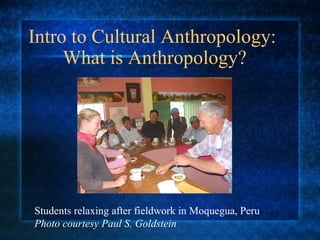
Intro to Cultural Anthropology:  What is Anthropology? Students relaxing after fieldwork in Moquegua, Peru Photo courtesy Paul S. Goldstein
Objectives Understand that anthropology is holistic and comparative study of humanity Identify, distinguish, & describe the 4 subfields of anthropology Distinguish ethnology from ethnography Understand that anthropology is both a science & an art
Lecture Outline Overview Human Diversity General Anthropology The Subdisciplines of Anthropology Anthropology a nd Other Academic Fields Scientific Methods
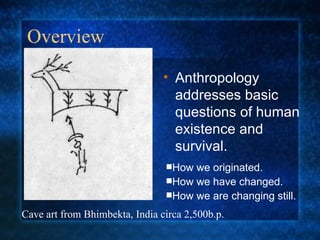
Overview How we originated. How we have changed. How we are changing still. Anthropology addresses basic questions of human existence and survival. Cave art from Bhimbekta, India circa 2,500b.p.
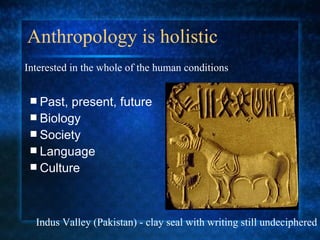
Anthropology is holistic Past, present, future Biology Society Language Culture Interested in the whole of the human conditions Indus Valley (Pakistan) - clay seal with writing still undeciphered
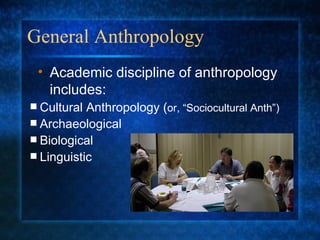
General Anthropology Cultural Anthropology ( or, “Sociocultural Anth”) Archaeological Biological Linguistic Academic discipline of anthropology includes:
Four subfields Cultural anthropology  – examines human diversity of the present and recent past. Archaeology  – reconstructs behavior by studying material remains
Four subfields Biological anthropology  – study of human fossils, genetics, and bodily growth and nonhuman primates Linguistic anthropology  – considers how speech varies with social factors and over time
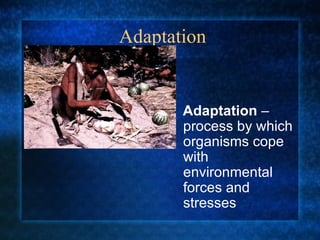
Adaptation Adaptation  – process by which organisms cope with environmental forces and stresses
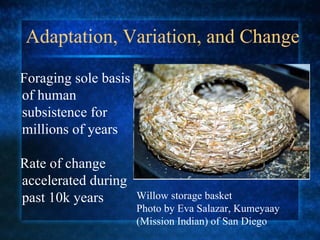
Adaptation, Variation, and Change Foraging sole basis of human subsistence for millions of years Rate of change accelerated during past 10k years Willow storage basket  Photo by Eva Salazar, Kumeyaay (Mission Indian) of San Diego
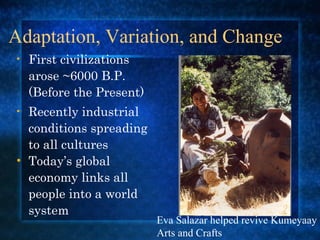
Adaptation, Variation, and Change First civilizations arose ~6000 B.P. (Before the Present)  Recently industrial conditions spreading to all cultures Today’s global economy links all people into a world system Eva Salazar helped revive Kumeyaay Arts and Crafts
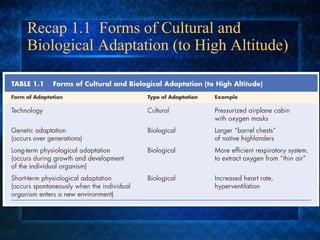
Recap 1.1  Forms of Cultural and Biological Adaptation (to High Altitude)
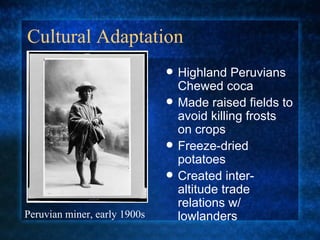
Cultural Adaptation Highland Peruvians Chewed coca Made raised fields to avoid killing frosts on crops Freeze-dried potatoes Created inter-altitude trade relations w/ lowlanders Peruvian miner, early 1900s
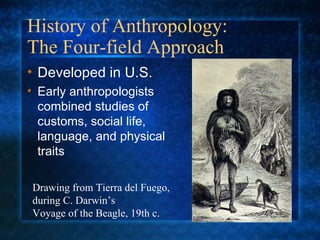
History of Anthropology:  The Four-field Approach Developed in U.S.  Early anthropologists combined studies of customs, social life, language, and physical traits Drawing from Tierra del Fuego,  during C. Darwin’s Voyage of the Beagle, 19th c.
Cultural Anthropology Ethnography  – Fieldwork in a particular culture; provides account of that community, society, or culture Ethnology  – cross cultural comparison; the comparative study of ethnographic data, of society and of culture Describes, analyzes, interprets, and explains social and cultural similarities and differences
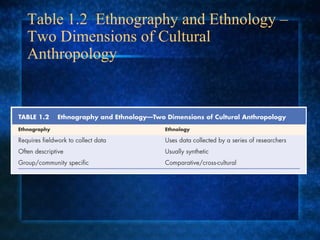
Table 1.2  Ethnography and Ethnology – Two Dimensions of Cultural Anthropology

Anth1 Wk1 Pt1

  • 1.
    Intro to CulturalAnthropology: What is Anthropology? Students relaxing after fieldwork in Moquegua, Peru Photo courtesy Paul S. Goldstein
  • 2.
    Objectives Understand thatanthropology is holistic and comparative study of humanity Identify, distinguish, & describe the 4 subfields of anthropology Distinguish ethnology from ethnography Understand that anthropology is both a science & an art
  • 3.
    Lecture Outline OverviewHuman Diversity General Anthropology The Subdisciplines of Anthropology Anthropology a nd Other Academic Fields Scientific Methods
  • 4.
    Overview How weoriginated. How we have changed. How we are changing still. Anthropology addresses basic questions of human existence and survival. Cave art from Bhimbekta, India circa 2,500b.p.
  • 5.
    Anthropology is holisticPast, present, future Biology Society Language Culture Interested in the whole of the human conditions Indus Valley (Pakistan) - clay seal with writing still undeciphered
  • 6.
    General Anthropology CulturalAnthropology ( or, “Sociocultural Anth”) Archaeological Biological Linguistic Academic discipline of anthropology includes:
  • 7.
    Four subfields Culturalanthropology – examines human diversity of the present and recent past. Archaeology – reconstructs behavior by studying material remains
  • 8.
    Four subfields Biologicalanthropology – study of human fossils, genetics, and bodily growth and nonhuman primates Linguistic anthropology – considers how speech varies with social factors and over time
  • 9.
    Adaptation Adaptation – process by which organisms cope with environmental forces and stresses
  • 10.
    Adaptation, Variation, andChange Foraging sole basis of human subsistence for millions of years Rate of change accelerated during past 10k years Willow storage basket Photo by Eva Salazar, Kumeyaay (Mission Indian) of San Diego
  • 11.
    Adaptation, Variation, andChange First civilizations arose ~6000 B.P. (Before the Present) Recently industrial conditions spreading to all cultures Today’s global economy links all people into a world system Eva Salazar helped revive Kumeyaay Arts and Crafts
  • 12.
    Recap 1.1 Forms of Cultural and Biological Adaptation (to High Altitude)
  • 13.
    Cultural Adaptation HighlandPeruvians Chewed coca Made raised fields to avoid killing frosts on crops Freeze-dried potatoes Created inter-altitude trade relations w/ lowlanders Peruvian miner, early 1900s
  • 14.
    History of Anthropology: The Four-field Approach Developed in U.S. Early anthropologists combined studies of customs, social life, language, and physical traits Drawing from Tierra del Fuego, during C. Darwin’s Voyage of the Beagle, 19th c.
  • 15.
    Cultural Anthropology Ethnography – Fieldwork in a particular culture; provides account of that community, society, or culture Ethnology – cross cultural comparison; the comparative study of ethnographic data, of society and of culture Describes, analyzes, interprets, and explains social and cultural similarities and differences
  • 16.
    Table 1.2 Ethnography and Ethnology – Two Dimensions of Cultural Anthropology