Mahatma
Gandhi Institute
of Technical
Education and
Research
Centre, Navsari
Prepared By: Tanvi Patel
Assistant Professor
Computer Department
Technical
Writing
Subject: Effective Technical
Communication
Subject Code: 3130004
Outline
– Agenda of Meeting
– Minutes of Meeting
MGITER/CE/TANVI PATEL
3
Define Agenda of Meeting
– An agenda is a list of meeting activities in the order in which they are to be
taken up, beginning with the call to order and ending with adjournment.
– It usually includes one or more specific items of business to be acted upon.
– It may, but is not required to, include specific times for one or more
activities.
– An agenda may also be called a docket, schedule, or calendar.
– It may also contain a listing of an order of business.
MGITER/CE/TANVI PATEL
4
Continue…
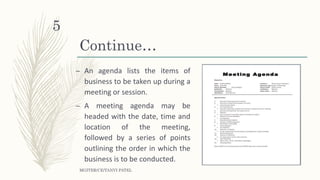
– An agenda lists the items of
business to be taken up during a
meeting or session.
– A meeting agenda may be
headed with the date, time and
location of the meeting,
followed by a series of points
outlining the order in which the
business is to be conducted.
MGITER/CE/TANVI PATEL
5
Continue…
– Steps on any agenda can
include any type of schedule or
order the group wants to
follow.
– Agendas may take different
forms depending on the
specific purpose of the group
and may include any number of
the items.
– In business meetings of
a deliberative assembly, the items
on the agenda are also known as
the orders of the day.
– The agenda is distributed to a
meeting's participants prior to the
meeting, so that they will be
aware of the subjects to be
discussed, and are able to prepare
for the meeting accordingly.MGITER/CE/TANVI PATEL
6
Developing a Meeting Agenda
– First, identify whether other
employees are needed to
help you plan the meeting.
Then, decide what you hope
to accomplish by holding the
meeting, and establish
doable goals for your
meeting.
– The goals you set will
establish the framework for
an effective meeting plan.
Make certain that you have
not planned more than is
reasonably achievable within
the timeframe of your
meeting.
MGITER/CE/TANVI PATEL
7
Example:
MGITER/CE/TANVI PATEL
8
Continue…
– Your meeting purpose will determine
the meeting focus, the meeting
agenda, and the meeting
participants.
– Then, consider how much time you
expect to need for each agenda item.
If the meeting is to last one hour and
you have five agenda items, that
gives you a general idea of the
timeframe you're working with.
MGITER/CE/TANVI PATEL
9
What Decision to make?
– After determining your overall
goal, you or your team need to
make certain decisions.
– In addition to the purpose or goal
of the meeting, also include
following points with your agenda:
– A date, time, and location for
the meeting.
– Participants needed in the
meeting
– Items for discussion
– The amount of time that you anticipate the
group will need to discuss each item
– Pre-work for the meeting. This will include
any reading, documentation, data, meeting
minutes from a prior meeting, or any other
preparation that will make your actual
meeting successful. Relevant documents
should be attached to the meeting notice
and agenda when you distribute them to
invited participants.
MGITER/CE/TANVI PATEL
10
Identifying Participants
– Once you have decided that a meeting is necessary to accomplish your goal, you
need to develop a list of participants.
– Not every employee can or should participate in every meeting, but inviting the
right participants will enhance your likelihood of success.
– Determine your participants by asking yourself some questions:
– Who must own the solution the group develops?
– Who owns the process the group is discussing?
– Who needs to know the information you are distributing?
MGITER/CE/TANVI PATEL
11
Continue…
– Who can provide data and facts to
guide decision making?
– Who has experience or expertise to
share with the group?
– Who must support the implementation
of any solutions or tasks?
– Who must provide permission or
resources to accomplish the meeting
outcome?
– Who might oppose the implementation
of any solutions or direction?MGITER/CE/TANVI PATEL
12
Regularly Schedule Meetings
– Not every meeting needs a
custom developed agenda. Most
employees have regularly
scheduled meetings for their
departments or workgroups.
– The regularly scheduled
employee meeting is divided into
three segments for which each
has standard agenda items:
– Informational items: Write
out any agenda items that
are informational for every
meeting.
– For example, the manager
updates the group on the
outcomes of the senior
management meeting.
MGITER/CE/TANVI PATEL
13
Continue…
– Action items: Place on the
agenda any items that you
expect the group will want to
review at every regularly
scheduled meeting. For
example, performance to
budget for the time period and
the identification of cost savings
and continuous improvements
the group plans to achieve.MGITER/CE/TANVI PATEL
14
Continue…
– Forward planning: Place on
the agenda any items that
the group wants to plan for
or prepare for in advance.
– For example, the short-term
goals for the next month or
the need for co-worker
assistance on upcoming
assignments.
MGITER/CE/TANVI PATEL
15
What to Include
– An agenda for a regularly scheduled meeting can help produce the results you
seek by including some basic items:
– Warm-up and greetings. Consider a brief ice breaker depending on how frequently

the group meets.
– Review the meeting’s purpose, agenda, and expected outcomes and product.
– Review, correct (if necessary), and approve the minutes of the prior meeting.
– Provide appropriate departmental and company information that the team needs.
– Review progress on action items, action plans, and commitments. Review group
progress on goals.
MGITER/CE/TANVI PATEL
16
Continue…
– Review progress on action items, action plans, and commitments. Review group
progress on goals.
– Discuss and make decisions about the agenda items for this meeting, Identify next
steps. Identify the purpose, outcome, and agenda for the next meeting.
– At the end of the meeting, the note taker should review the commitments made by
people during the meeting.
– Determine if any outside of the meeting participants needs to know what and decide
how you will accomplish the communication.
– Distribute minutes within 24 hours of the meeting or immediately if the note taker
took them electronically.
MGITER/CE/TANVI PATEL
17
Example:
MGITER/CE/TANVI PATEL
18
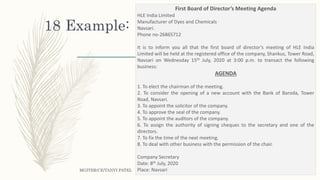
First Board of Director’s Meeting Agenda
HLE India Limited
Manufacturer of Dyes and Chemicals
Navsari.
Phone no-26865712
It is to inform you all that the first board of director’s meeting of HLE India
Limited will be held at the registered office of the company, Shankus, Tower Road,
Navsari on Wednesday 15th July, 2020 at 3:00 p.m. to transact the following
business:
AGENDA
1. To elect the chairman of the meeting.
2. To consider the opening of a new account with the Bank of Baroda, Tower
Road, Navsari.
3. To appoint the solicitor of the company.
4. To approve the seal of the company.
5. To appoint the auditors of the company.
6. To assign the authority of signing cheques to the secretary and one of the
directors.
7. To fix the time of the next meeting.
8. To deal with other business with the permission of the chair.
Company Secretary
Date: 8th July, 2020
Place: Navsari
Exercise to Solve
– Your Club is going to host the art and craft event for disable
children. Draft an agenda for meeting.
– Draft an agenda for decline in sales of book of your publication.
MGITER/CE/TANVI PATEL
19
– Minutes of Meeting
MGITER/CE/TANVI PATEL
20
Define Minutes of Meeting
– Minutes, also known as minutes of meeting (abbreviation MoM), protocols or,
informally, notes, are the instant written record of a meeting or hearing.
– They typically describe the events of the meeting and may include a list of
attendees, a statement of the issues considered by the participants, and related
responses or decisions for the issues.
– Minutes may be created during the meeting by a typist or court reporter, who
may use shorthand notation and then prepare the minutes and issue them to
the participants afterwards.
MGITER/CE/TANVI PATEL
21
Continue…
– Alternatively, the meeting can
be audio recorded, video recorded,
or a group's appointed or
informally assigned secretary may
take notes, with minutes prepared
later. Many government agencies
use minutes recording software to
record and prepare all minutes
in real-time.
MGITER/CE/TANVI PATEL
22
Continue…
– Minutes are the official written
record of the meetings of an
organization or group.
– The minutes of certain groups,
such as a corporate board of
directors, must be kept on file and
are important legal documents.
– minutes of executive sessions may
be kept separately.
– Minutes from board meetings are
kept separately from minutes of
general membership meetings
within the same organization.
MGITER/CE/TANVI PATEL
23
Format for MoM
– The format of the minutes can vary
depending on the standards
established by an organization,
although there are general
guidelines.
– Generally, minutes begin with the
name of the body holding the
meeting (e.g., a board) and may also
include the place, date, list of people
present, and the time that
the chair called the meeting to order.
– The primary function of minutes is to
record the decisions made, all official
decisions must be included.
– Minutes are sometimes submitted by
the person who is responsible for them
(often the secretary) at a subsequent
meeting for review. The traditional
closing phrase is "Respectfully
submitted" (although this is no longer
common), followed by the officer's
signature, his or her typed (or printed)
name, and his or her title.MGITER/CE/TANVI PATEL
24
Before the Meeting
– Choose your recording tool. Will you go old school and use a pen
and paper or will you go high-tech and use a laptop
computer, tablet, or smartphone? Check with your boss to see if
they prefer that you use a particular method.
– Make sure your tool of choice is in working order, and have a
backup just in case your original one fails. If you bring a laptop, for
instance, have a pen and paper handy as well. You don't want to
have to stop the meeting while you search for something to write
on if your computer crashes.
MGITER/CE/TANVI PATEL
25
Continue…
– Read the meeting agenda before the meeting starts. It will allow
you to formulate an outline for your minutes. Leave some space
below each item on it and write your notes there. Doing this will
make your job a little easier, as long as the person running the
meeting sticks to the agenda.
MGITER/CE/TANVI PATEL
26
During the Meeting
– Pass around an attendance sheet and make sure everyone signs in. You will
need to include a list of all attendees in the official meeting minutes.
– Make sure you know who everyone is. That way you will be able to identify who
is speaking and correctly record that information.
– Note the time the meeting begins.
– Don't try to write down every single comment. It is okay to include only the
main ideas. Be very careful not to leave out items with which you disagree. Your
biases shouldn't influence you. Remember this is an official account, not your
opinion of what happened.
MGITER/CE/TANVI PATEL
27
Continue…
– Write down all motions, who made them, and the results of votes, if any; you
don't need to write down who seconded a motion. Of course, the rules of your
organization may differ so verify those with your boss first.
– If votes on any motions or discussions are deferred until the next meeting,
make a note of that.
– Record the ending time of the meeting.
MGITER/CE/TANVI PATEL
28
After the Meeting
– Type up the minutes as soon as possible after the meeting while everything is
still fresh in your mind. If you find an error in your meeting notes or you have a
question, you can clear it up quickly by talking to other attendees.
– On the final copy of the minutes, Include the name of the organization, title of
the committee, type of meeting (daily, weekly, monthly, annual, or special), and
its purpose.
– Give the times it began and ended.
MGITER/CE/TANVI PATEL
29
Continue…
– Provide the list of attendees and a note about who ran the meeting. Include
your name on the list of participants and, in parentheses after your name, say
that you took the minutes. Alternatively, at the end of the document, you can
sign off by writing "Respectively submitted by," followed by your name.
– Proofread the minutes before you submit them. Ask someone else who
attended to look them over as well. They will be able to let you know if you
accidentally left something out.
– Submit them to the person who ran the meeting unless instructed to do
otherwise.
MGITER/CE/TANVI PATEL
30
Example:
MGITER/CE/TANVI PATEL
31
Routine meeting of Staff Welfare Society of Education Trust
Staff Welfare Society
Education Trust Building
Ring Road, Navsari-396436.
Minutes of the monthly meeting of the Managing Committee of the Staff Welfare
Society, Education trust held at the convention centre, Agriculture University on
Thursday 9th July, 2020 at 3:00 p.m.
Present: Prin. Peeti Patel
Prof. Twinkal Patel
Prof. Arpita Patel
1. Minutes of last meeting of the managing committee held on 29th June, 2020
was read, confirmed and signed by the chairman.
2. Prof. Twinkal Patel’s letter of resignation was read but not accepted. It was
decided after request that he would continue as the Honorary Secretary till the
next Annual General Meeting.
3. It was resolved that Rs. 10,00,000 be and is herby sanctioned as a housing loan
for members.
4. It was resolved that the Annual Report be prepared by both the secretaries and
placed before the meeting prior to Annual General Meeting.
5. As there was no other business. The meeting ended with the vote of thanks to
the chair.
Date:
Secretary Chairman
Exercise to Solve
– Write minutes of meeting conducted to enhance business sales
target.
– Write minutes of meeting conducted in your collage for choosing
collage representative.
MGITER/CE/TANVI PATEL
32
MGITER/CE/TANVI PATEL
33

Technical Writing

  • 1.
    Mahatma Gandhi Institute of Technical Educationand Research Centre, Navsari Prepared By: Tanvi Patel Assistant Professor Computer Department
  • 2.
  • 3.
    Outline – Agenda ofMeeting – Minutes of Meeting MGITER/CE/TANVI PATEL 3
  • 4.
    Define Agenda ofMeeting – An agenda is a list of meeting activities in the order in which they are to be taken up, beginning with the call to order and ending with adjournment. – It usually includes one or more specific items of business to be acted upon. – It may, but is not required to, include specific times for one or more activities. – An agenda may also be called a docket, schedule, or calendar. – It may also contain a listing of an order of business. MGITER/CE/TANVI PATEL 4
  • 5.
    Continue… – An agendalists the items of business to be taken up during a meeting or session. – A meeting agenda may be headed with the date, time and location of the meeting, followed by a series of points outlining the order in which the business is to be conducted. MGITER/CE/TANVI PATEL 5
  • 6.
    Continue… – Steps onany agenda can include any type of schedule or order the group wants to follow. – Agendas may take different forms depending on the specific purpose of the group and may include any number of the items. – In business meetings of a deliberative assembly, the items on the agenda are also known as the orders of the day. – The agenda is distributed to a meeting's participants prior to the meeting, so that they will be aware of the subjects to be discussed, and are able to prepare for the meeting accordingly.MGITER/CE/TANVI PATEL 6
  • 7.
    Developing a MeetingAgenda – First, identify whether other employees are needed to help you plan the meeting. Then, decide what you hope to accomplish by holding the meeting, and establish doable goals for your meeting. – The goals you set will establish the framework for an effective meeting plan. Make certain that you have not planned more than is reasonably achievable within the timeframe of your meeting. MGITER/CE/TANVI PATEL 7
  • 8.
  • 9.
    Continue… – Your meetingpurpose will determine the meeting focus, the meeting agenda, and the meeting participants. – Then, consider how much time you expect to need for each agenda item. If the meeting is to last one hour and you have five agenda items, that gives you a general idea of the timeframe you're working with. MGITER/CE/TANVI PATEL 9
  • 10.
    What Decision tomake? – After determining your overall goal, you or your team need to make certain decisions. – In addition to the purpose or goal of the meeting, also include following points with your agenda: – A date, time, and location for the meeting. – Participants needed in the meeting – Items for discussion – The amount of time that you anticipate the group will need to discuss each item – Pre-work for the meeting. This will include any reading, documentation, data, meeting minutes from a prior meeting, or any other preparation that will make your actual meeting successful. Relevant documents should be attached to the meeting notice and agenda when you distribute them to invited participants. MGITER/CE/TANVI PATEL 10
  • 11.
    Identifying Participants – Onceyou have decided that a meeting is necessary to accomplish your goal, you need to develop a list of participants. – Not every employee can or should participate in every meeting, but inviting the right participants will enhance your likelihood of success. – Determine your participants by asking yourself some questions: – Who must own the solution the group develops? – Who owns the process the group is discussing? – Who needs to know the information you are distributing? MGITER/CE/TANVI PATEL 11
  • 12.
    Continue… – Who canprovide data and facts to guide decision making? – Who has experience or expertise to share with the group? – Who must support the implementation of any solutions or tasks? – Who must provide permission or resources to accomplish the meeting outcome? – Who might oppose the implementation of any solutions or direction?MGITER/CE/TANVI PATEL 12
  • 13.
    Regularly Schedule Meetings –Not every meeting needs a custom developed agenda. Most employees have regularly scheduled meetings for their departments or workgroups. – The regularly scheduled employee meeting is divided into three segments for which each has standard agenda items: – Informational items: Write out any agenda items that are informational for every meeting. – For example, the manager updates the group on the outcomes of the senior management meeting. MGITER/CE/TANVI PATEL 13
  • 14.
    Continue… – Action items:Place on the agenda any items that you expect the group will want to review at every regularly scheduled meeting. For example, performance to budget for the time period and the identification of cost savings and continuous improvements the group plans to achieve.MGITER/CE/TANVI PATEL 14
  • 15.
    Continue… – Forward planning:Place on the agenda any items that the group wants to plan for or prepare for in advance. – For example, the short-term goals for the next month or the need for co-worker assistance on upcoming assignments. MGITER/CE/TANVI PATEL 15
  • 16.
    What to Include –An agenda for a regularly scheduled meeting can help produce the results you seek by including some basic items: – Warm-up and greetings. Consider a brief ice breaker depending on how frequently the group meets. – Review the meeting’s purpose, agenda, and expected outcomes and product. – Review, correct (if necessary), and approve the minutes of the prior meeting. – Provide appropriate departmental and company information that the team needs. – Review progress on action items, action plans, and commitments. Review group progress on goals. MGITER/CE/TANVI PATEL 16

  • 17.
    Continue… – Review progresson action items, action plans, and commitments. Review group progress on goals. – Discuss and make decisions about the agenda items for this meeting, Identify next steps. Identify the purpose, outcome, and agenda for the next meeting. – At the end of the meeting, the note taker should review the commitments made by people during the meeting. – Determine if any outside of the meeting participants needs to know what and decide how you will accomplish the communication. – Distribute minutes within 24 hours of the meeting or immediately if the note taker took them electronically. MGITER/CE/TANVI PATEL 17
  • 18.
    Example: MGITER/CE/TANVI PATEL 18 First Boardof Director’s Meeting Agenda HLE India Limited Manufacturer of Dyes and Chemicals Navsari. Phone no-26865712 It is to inform you all that the first board of director’s meeting of HLE India Limited will be held at the registered office of the company, Shankus, Tower Road, Navsari on Wednesday 15th July, 2020 at 3:00 p.m. to transact the following business: AGENDA 1. To elect the chairman of the meeting. 2. To consider the opening of a new account with the Bank of Baroda, Tower Road, Navsari. 3. To appoint the solicitor of the company. 4. To approve the seal of the company. 5. To appoint the auditors of the company. 6. To assign the authority of signing cheques to the secretary and one of the directors. 7. To fix the time of the next meeting. 8. To deal with other business with the permission of the chair. Company Secretary Date: 8th July, 2020 Place: Navsari
  • 19.
    Exercise to Solve –Your Club is going to host the art and craft event for disable children. Draft an agenda for meeting. – Draft an agenda for decline in sales of book of your publication. MGITER/CE/TANVI PATEL 19
  • 20.
    – Minutes ofMeeting MGITER/CE/TANVI PATEL 20
  • 21.
    Define Minutes ofMeeting – Minutes, also known as minutes of meeting (abbreviation MoM), protocols or, informally, notes, are the instant written record of a meeting or hearing. – They typically describe the events of the meeting and may include a list of attendees, a statement of the issues considered by the participants, and related responses or decisions for the issues. – Minutes may be created during the meeting by a typist or court reporter, who may use shorthand notation and then prepare the minutes and issue them to the participants afterwards. MGITER/CE/TANVI PATEL 21
  • 22.
    Continue… – Alternatively, themeeting can be audio recorded, video recorded, or a group's appointed or informally assigned secretary may take notes, with minutes prepared later. Many government agencies use minutes recording software to record and prepare all minutes in real-time. MGITER/CE/TANVI PATEL 22
  • 23.
    Continue… – Minutes arethe official written record of the meetings of an organization or group. – The minutes of certain groups, such as a corporate board of directors, must be kept on file and are important legal documents. – minutes of executive sessions may be kept separately. – Minutes from board meetings are kept separately from minutes of general membership meetings within the same organization. MGITER/CE/TANVI PATEL 23
  • 24.
    Format for MoM –The format of the minutes can vary depending on the standards established by an organization, although there are general guidelines. – Generally, minutes begin with the name of the body holding the meeting (e.g., a board) and may also include the place, date, list of people present, and the time that the chair called the meeting to order. – The primary function of minutes is to record the decisions made, all official decisions must be included. – Minutes are sometimes submitted by the person who is responsible for them (often the secretary) at a subsequent meeting for review. The traditional closing phrase is "Respectfully submitted" (although this is no longer common), followed by the officer's signature, his or her typed (or printed) name, and his or her title.MGITER/CE/TANVI PATEL 24
  • 25.
    Before the Meeting –Choose your recording tool. Will you go old school and use a pen and paper or will you go high-tech and use a laptop computer, tablet, or smartphone? Check with your boss to see if they prefer that you use a particular method. – Make sure your tool of choice is in working order, and have a backup just in case your original one fails. If you bring a laptop, for instance, have a pen and paper handy as well. You don't want to have to stop the meeting while you search for something to write on if your computer crashes. MGITER/CE/TANVI PATEL 25
  • 26.
    Continue… – Read themeeting agenda before the meeting starts. It will allow you to formulate an outline for your minutes. Leave some space below each item on it and write your notes there. Doing this will make your job a little easier, as long as the person running the meeting sticks to the agenda. MGITER/CE/TANVI PATEL 26
  • 27.
    During the Meeting –Pass around an attendance sheet and make sure everyone signs in. You will need to include a list of all attendees in the official meeting minutes. – Make sure you know who everyone is. That way you will be able to identify who is speaking and correctly record that information. – Note the time the meeting begins. – Don't try to write down every single comment. It is okay to include only the main ideas. Be very careful not to leave out items with which you disagree. Your biases shouldn't influence you. Remember this is an official account, not your opinion of what happened. MGITER/CE/TANVI PATEL 27
  • 28.
    Continue… – Write downall motions, who made them, and the results of votes, if any; you don't need to write down who seconded a motion. Of course, the rules of your organization may differ so verify those with your boss first. – If votes on any motions or discussions are deferred until the next meeting, make a note of that. – Record the ending time of the meeting. MGITER/CE/TANVI PATEL 28
  • 29.
    After the Meeting –Type up the minutes as soon as possible after the meeting while everything is still fresh in your mind. If you find an error in your meeting notes or you have a question, you can clear it up quickly by talking to other attendees. – On the final copy of the minutes, Include the name of the organization, title of the committee, type of meeting (daily, weekly, monthly, annual, or special), and its purpose. – Give the times it began and ended. MGITER/CE/TANVI PATEL 29
  • 30.
    Continue… – Provide thelist of attendees and a note about who ran the meeting. Include your name on the list of participants and, in parentheses after your name, say that you took the minutes. Alternatively, at the end of the document, you can sign off by writing "Respectively submitted by," followed by your name. – Proofread the minutes before you submit them. Ask someone else who attended to look them over as well. They will be able to let you know if you accidentally left something out. – Submit them to the person who ran the meeting unless instructed to do otherwise. MGITER/CE/TANVI PATEL 30
  • 31.
    Example: MGITER/CE/TANVI PATEL 31 Routine meetingof Staff Welfare Society of Education Trust Staff Welfare Society Education Trust Building Ring Road, Navsari-396436. Minutes of the monthly meeting of the Managing Committee of the Staff Welfare Society, Education trust held at the convention centre, Agriculture University on Thursday 9th July, 2020 at 3:00 p.m. Present: Prin. Peeti Patel Prof. Twinkal Patel Prof. Arpita Patel 1. Minutes of last meeting of the managing committee held on 29th June, 2020 was read, confirmed and signed by the chairman. 2. Prof. Twinkal Patel’s letter of resignation was read but not accepted. It was decided after request that he would continue as the Honorary Secretary till the next Annual General Meeting. 3. It was resolved that Rs. 10,00,000 be and is herby sanctioned as a housing loan for members. 4. It was resolved that the Annual Report be prepared by both the secretaries and placed before the meeting prior to Annual General Meeting. 5. As there was no other business. The meeting ended with the vote of thanks to the chair. Date: Secretary Chairman
  • 32.
    Exercise to Solve –Write minutes of meeting conducted to enhance business sales target. – Write minutes of meeting conducted in your collage for choosing collage representative. MGITER/CE/TANVI PATEL 32
  • 33.