GLOBE
PRESENTED BY
KATO HANIFAH NABANKEMA
AYEBARE EUNICE
NANGOBI REHEMA
MUSUYA WANADA PATRICIA
1
BACKGROUND
G: GLOBAL
L: LEADERSHIP and
O: ORGANIZATIONAL
B: BEHAVIOR
E: EFFECTIVENESS
• Conceived in 1991 by Robert J House, completed in 1993
• To analyze the organizational norms , values and beliefs of
leaders in various societies
• Preparing future leaders ethnocentrism vs. cultural relativity
2
BACKGROUND
• Data from 825 organizations in over 60 countries
• Aimed to examine how people from different cultures viewed
leadership
• Focus > relationship between effective leadership behavior and
specific leadership attributes
• Push Factor > a greater need for effective international and cross
cultural communication, collaboration and cooperation for effective
management and human conditions
• Concluding with nine cultural dimensions.
3
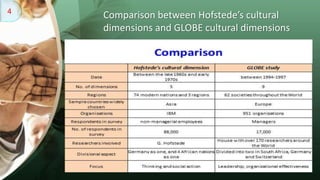
Comparison between Hofstede’s cultural
dimensions and GLOBE cultural dimensions
4
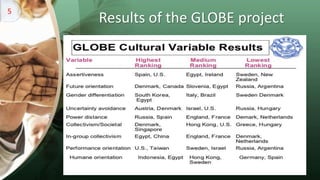
Results of the GLOBE project
5
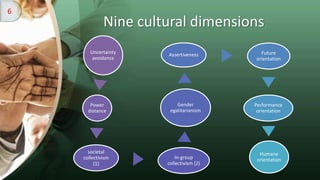
Nine cultural dimensions
Uncertainty
avoidance
Power
distance
societal
collectivism
(1)
In-group
collectivism (2)
Gender
egalitarianism
Assertiveness Future
orientation
Performance
orientation
Humane
orientation
6
Power distance
High power distance
• Society has classes>
dictatorship by the boss
• Wide distribution in power
and income> social order
• Resources belong to a few
Low power distance
• Society has large middle class>
more equality .
• Power is linked to corruption.
• Resources are available to all.
Degree of inequality among people viewed as acceptable
Spain, Russia , Malaysia, Philippines. Norway, Denmark, Scandinavia, Israel
7
Uncertainty avoidance
High uncertainty avoidance
• Use formalities and rigid
rules to structure life.
• Orderly and keep
meticulous records
• Value of naturalness and
freshness
Low uncertainty avoidance
• Easy going ,innovative and
entrepreneur citizens
• Less orderly and keep few
records
• Less calculating while taking
risks
Fear of risks > society support on procedures to alleviate the impulsive of future unfavorable
events
Japan, Portugal, Greece, France, Spain Russia, Hungary, India, Britain, Singapore
8
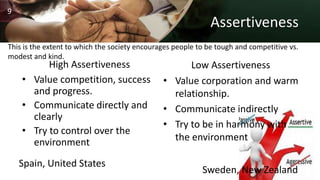
Assertiveness
High Assertiveness
• Value competition, success
and progress.
• Communicate directly and
clearly
• Try to control over the
environment
Low Assertiveness
• Value corporation and warm
relationship.
• Communicate indirectly
• Try to be in harmony with
the environment
This is the extent to which the society encourages people to be tough and competitive vs.
modest and kind.
Spain, United States
Sweden, New Zealand
9
In group collectivism
High in group collectivism
• Self pride and relation to
family
• Identities are closely tied to
each other
• Strong attachment is
desired
Low in group collectivism
• People are largely
independent
• Individual identities differ
from group
• Voluntary and allegiance to
relation is not expected
Extent to which people express pride ,loyalty and solidarity with their family or a similar group
Georgia, Philippines,
Finland, new Zealand
10
• What is good for an
individual is all that maters.
• Every body is responsible
for himself.
societal collectivism
High societal collectivism
• Activities are done
considerably implicate
• its all about team work and
cooperation
Low societal collectivism
Japan, Qatar
Italy
Greece
11
Gender egalitarianism
High gender egalitarianism
• Equality in gender is
maintained
• In equality constitutes to
discrimination
Low gender egalitarianism
• Have a divergence in gender
roles and it is normal
• Men and women are
treated specially more
attention to the men
The extent to which a culture minimizes differences in gender between men and women
Poland , Hungary Egypt, Australia
12
Performance orientation
high
• Status is based on accomplishment
• School is essential for success
• Expectations from people are high
• Family, seniority, loyalty, and tradition are
important
• Time is more valuable and punctuality is
preferred
low
• People feel controlled by nature
and want to live by spiritual
environment.
• Relationships are more important
than getting the job done.
• Desire for achievement and
competition is low
Degree to which culture encourages and rewards people for their achievements
Canada, Singapore Colombia, Guatemala
13
Future orientation
high
• Current pleasures are less
important but the future is.
• Plan, have self control, do
activities with delayed impacts
• Strategic planning, value
economic success.
low
• Spend a lot rather than save
for later.
• Prefer to enjoy full
experiences, respect of
tomorrow.> live the
moment.
Extent to which culture is planned and prepared for future events. Long term planning.
Portugal , Venezuela.Iran, Hong Kong
14
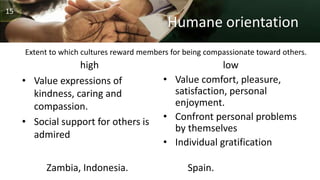
Humane orientation
high
• Value expressions of
kindness, caring and
compassion.
• Social support for others is
admired
low
• Value comfort, pleasure,
satisfaction, personal
enjoyment.
• Confront personal problems
by themselves
• Individual gratification
Extent to which cultures reward members for being compassionate toward others.
Zambia, Indonesia. Spain.
15
The GLOBE research helps clarify our understanding of cultural patterns in
two ways ;
1. It separates cultural practices from cultural values
(the ways people typically (what people regard as important
behave in everyday and believe is ideal)
communication)
E.g: In Spain, power distance is very high but the
Ideal power distance is low
16
2. It helps to explain the complex nature of cultural patterns by;
• Providing information on a wide range of cultures
• Refining the distinctions that differentiate cultures
• Expanding the cultural dimension knowledge
17
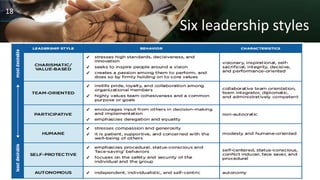
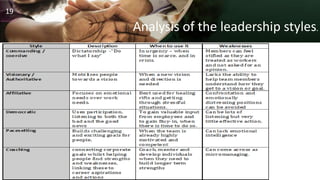
Six leadership styles
18
Analysis of the leadership styles.
19
Criticisms
The Globe project is U.S. centric
Very wide and diverse> lacks parsimony. direct course
Direct differences between Hofstede were just disproving and not adding to the study.
20
Relevance to global managers and scholars
Negotiations> potential clients, partners, suppliers, competitors
Public relations> advertising, sales promotion, press conferences, marketing.
Communication> government, customers, employees and suppliers.
GLOBE studies provide an empirical base on which researchers can build across a wide
range of international business topics.
21
GLOBE 2020 is the next phase of GLOBE project consisting of two major demanding
studies.
Study 1 focuses on the drivers and dynamics of culture change and trust building in
societies.
Study 2 focuses on the relationship between national culture, leadership and
important organizational practices, i.e., cultural influences on leadership with regards
to specific HR practices, employee career strategies, attitudes, and performance.
22
Major demanding studies of GLOBE 2020 project
GLOBE PROJECT
Presented by
Ayebare Eunice
Kato Hanifah Nabankema
Nangobi Rehema
Musuya Wananda Patricia
23

GLOBE CULTURAL PROJECT AND STUDY

  • 1.
    GLOBE PRESENTED BY KATO HANIFAHNABANKEMA AYEBARE EUNICE NANGOBI REHEMA MUSUYA WANADA PATRICIA 1
  • 2.
    BACKGROUND G: GLOBAL L: LEADERSHIPand O: ORGANIZATIONAL B: BEHAVIOR E: EFFECTIVENESS • Conceived in 1991 by Robert J House, completed in 1993 • To analyze the organizational norms , values and beliefs of leaders in various societies • Preparing future leaders ethnocentrism vs. cultural relativity 2
  • 3.
    BACKGROUND • Data from825 organizations in over 60 countries • Aimed to examine how people from different cultures viewed leadership • Focus > relationship between effective leadership behavior and specific leadership attributes • Push Factor > a greater need for effective international and cross cultural communication, collaboration and cooperation for effective management and human conditions • Concluding with nine cultural dimensions. 3
  • 4.
    Comparison between Hofstede’scultural dimensions and GLOBE cultural dimensions 4
  • 5.
    Results of theGLOBE project 5
  • 6.
    Nine cultural dimensions Uncertainty avoidance Power distance societal collectivism (1) In-group collectivism(2) Gender egalitarianism Assertiveness Future orientation Performance orientation Humane orientation 6
  • 7.
    Power distance High powerdistance • Society has classes> dictatorship by the boss • Wide distribution in power and income> social order • Resources belong to a few Low power distance • Society has large middle class> more equality . • Power is linked to corruption. • Resources are available to all. Degree of inequality among people viewed as acceptable Spain, Russia , Malaysia, Philippines. Norway, Denmark, Scandinavia, Israel 7
  • 8.
    Uncertainty avoidance High uncertaintyavoidance • Use formalities and rigid rules to structure life. • Orderly and keep meticulous records • Value of naturalness and freshness Low uncertainty avoidance • Easy going ,innovative and entrepreneur citizens • Less orderly and keep few records • Less calculating while taking risks Fear of risks > society support on procedures to alleviate the impulsive of future unfavorable events Japan, Portugal, Greece, France, Spain Russia, Hungary, India, Britain, Singapore 8
  • 9.
    Assertiveness High Assertiveness • Valuecompetition, success and progress. • Communicate directly and clearly • Try to control over the environment Low Assertiveness • Value corporation and warm relationship. • Communicate indirectly • Try to be in harmony with the environment This is the extent to which the society encourages people to be tough and competitive vs. modest and kind. Spain, United States Sweden, New Zealand 9
  • 10.
    In group collectivism Highin group collectivism • Self pride and relation to family • Identities are closely tied to each other • Strong attachment is desired Low in group collectivism • People are largely independent • Individual identities differ from group • Voluntary and allegiance to relation is not expected Extent to which people express pride ,loyalty and solidarity with their family or a similar group Georgia, Philippines, Finland, new Zealand 10
  • 11.
    • What isgood for an individual is all that maters. • Every body is responsible for himself. societal collectivism High societal collectivism • Activities are done considerably implicate • its all about team work and cooperation Low societal collectivism Japan, Qatar Italy Greece 11
  • 12.
    Gender egalitarianism High genderegalitarianism • Equality in gender is maintained • In equality constitutes to discrimination Low gender egalitarianism • Have a divergence in gender roles and it is normal • Men and women are treated specially more attention to the men The extent to which a culture minimizes differences in gender between men and women Poland , Hungary Egypt, Australia 12
  • 13.
    Performance orientation high • Statusis based on accomplishment • School is essential for success • Expectations from people are high • Family, seniority, loyalty, and tradition are important • Time is more valuable and punctuality is preferred low • People feel controlled by nature and want to live by spiritual environment. • Relationships are more important than getting the job done. • Desire for achievement and competition is low Degree to which culture encourages and rewards people for their achievements Canada, Singapore Colombia, Guatemala 13
  • 14.
    Future orientation high • Currentpleasures are less important but the future is. • Plan, have self control, do activities with delayed impacts • Strategic planning, value economic success. low • Spend a lot rather than save for later. • Prefer to enjoy full experiences, respect of tomorrow.> live the moment. Extent to which culture is planned and prepared for future events. Long term planning. Portugal , Venezuela.Iran, Hong Kong 14
  • 15.
    Humane orientation high • Valueexpressions of kindness, caring and compassion. • Social support for others is admired low • Value comfort, pleasure, satisfaction, personal enjoyment. • Confront personal problems by themselves • Individual gratification Extent to which cultures reward members for being compassionate toward others. Zambia, Indonesia. Spain. 15
  • 16.
    The GLOBE researchhelps clarify our understanding of cultural patterns in two ways ; 1. It separates cultural practices from cultural values (the ways people typically (what people regard as important behave in everyday and believe is ideal) communication) E.g: In Spain, power distance is very high but the Ideal power distance is low 16
  • 17.
    2. It helpsto explain the complex nature of cultural patterns by; • Providing information on a wide range of cultures • Refining the distinctions that differentiate cultures • Expanding the cultural dimension knowledge 17
  • 18.
  • 19.
    Analysis of theleadership styles. 19
  • 20.
    Criticisms The Globe projectis U.S. centric Very wide and diverse> lacks parsimony. direct course Direct differences between Hofstede were just disproving and not adding to the study. 20
  • 21.
    Relevance to globalmanagers and scholars Negotiations> potential clients, partners, suppliers, competitors Public relations> advertising, sales promotion, press conferences, marketing. Communication> government, customers, employees and suppliers. GLOBE studies provide an empirical base on which researchers can build across a wide range of international business topics. 21
  • 22.
    GLOBE 2020 isthe next phase of GLOBE project consisting of two major demanding studies. Study 1 focuses on the drivers and dynamics of culture change and trust building in societies. Study 2 focuses on the relationship between national culture, leadership and important organizational practices, i.e., cultural influences on leadership with regards to specific HR practices, employee career strategies, attitudes, and performance. 22 Major demanding studies of GLOBE 2020 project
  • 23.
    GLOBE PROJECT Presented by AyebareEunice Kato Hanifah Nabankema Nangobi Rehema Musuya Wananda Patricia 23