Hofstede's Cultural Dimensions
Understanding Workplace Values Around the World

© iStockphoto
We know we are living in a global age. Technology has brought the world much closer
together. This means that people of different cultures find themselves working together and
communicating more and more.
This is exciting and interesting, but it can also be frustrating and fraught with uncertainty.
How do you relate to someone of another culture? What do you say, or not say, to start a
conversation off right? Are there cultural taboos you need to be aware of?
Building connections with people from around the world is just one dimension of cultural
diversity. You also have issues like motivating people, structuring projects, and developing
strategy.
What works in one location may or may not work somewhere else. The question is, "How can
I come to understand these cultural differences?" Are we relegated to learning from our
mistakes or are there generalized guidelines to follow?
Fortunately, a psychologist named Dr Geert Hofstede asked himself this question in the
1970s. What emerged after a decade of research and thousands of interviews is a model of
cultural dimensions that has become an internationally recognized standard.
With access to people working for the same organization in over 40 countries of the world,
Hofstede collected cultural data and analyzed his findings. He initially identified four distinct
cultural dimensions that served to distinguish one culture from another. Later he added a fifth
dimension and that is how the model stands today.
He scored each country using a scale of roughly 0 to 100 for each dimension. The higher the
score, the more that dimension is exhibited in society.

The Five Dimensions of Culture
Armed with a large database of cultural statistics, Hofstede analyzed the results and found
clear patterns of similarity and difference amid the responses along these five dimensions.
Interestingly, his research was done on employees of IBM only, which allowed him to
attribute the patterns to national differences in culture, largely eliminating the problem of
differences in company culture.
The five dimensions are:
1. Power/Distance (PD) – This refers to the degree of inequality that exists – and is accepted
– among people with and without power. A high PD score indicates that society accepts an
unequal distribution of power and people understand "their place" in the system. Low PD
means that power is shared and well dispersed. It also means that society members view
themselves as equals.
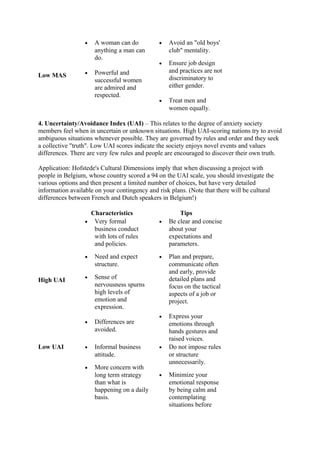
Application: According to Hofstede's model, in a high PD country like Malaysia (104), you
would probably send reports only to top management and have closed door meetings where
only a select few, powerful leaders were in attendance.

•

Characteristics
Centralized
companies.

•

Strong hierarchies.

•

Large gaps in
compensation,
authority, and
respect.
Flatter
organizations.

•

Tips
Acknowledge a
leader's power.

•

Low PD

•

Supervisors and
employees are
considered almost as
equals.

•

Be aware that you
may need to go to
the top for answers

•

Use teamwork

•

High PD

Involve as many
people as possible in
decision making.

2. Individualism (IDV) – This refers to the strength of the ties people have to others within
the community. A high IDV score indicates a loose connection with people. In countries with
a high IDV score there is a lack of interpersonal connection and little sharing of
responsibility, beyond family and perhaps a few close friends. A society with a low IDV score
would have strong group cohesion, and there would be a large amount of loyalty and respect
for members of the group. The group itself is also larger and people take more responsibility
for each other's well being.
Application: Hofstede's analysis suggests that in the Central American countries of Panama
and Guatemala where the IDV scores are very low (11 and 6, respectively), a marketing
campaign that emphasized benefits to the community or that tied into a popular political
movement would likely be understood and well-received.
Characteristics

Tips
High IDV

•

•
•

High valuation on
people's time and
their need for
freedom.
An enjoyment of
challenges, and an
expectation of
rewards for hard
work.
Respect for privacy.
Emphasis on
building skills and
becoming masters of
something.

•

Acknowledge
accomplishments.

•

Don't ask for too
much personal
information.

•

Encourage debate
and expression of
own ideas.

•

Show respect for
age and wisdom.

•

Suppress feelings
and emotions to
work in harmony.
Respect traditions
and introduce
change slowly.

Work for intrinsic
rewards.

•

Low IDV

•

•

•

Harmony more
important than
honesty.

3. Masculinity (MAS) – This refers to how much a society sticks with, and values, traditional
male and female roles. High MAS scores are found in countries where men are expected to be
tough, to be the provider, to be assertive and to be strong. If women work outside the home,
they have separate professions from men. Low MAS scores do not reverse the gender roles. In
a low MAS society, the roles are simply blurred. You see women and men working together
equally across many professions. Men are allowed to be sensitive and women can work hard
for professional success.
Application: Japan is highly masculine with a score of 95 whereas Sweden has the lowest
measured value (5). According to Hofstede's analysis, if you were to open an office in Japan,
you might have greater success if you appointed a male employee to lead the team and had a
strong male contingent on the team. In Sweden, on the other hand, you would aim for a team
that was balanced in terms of skill rather than gender.
Characteristics
• Men are masculine
and women are
feminine.
•

High MAS

There is a well
defined distinction
between men's work
and women's work.

•

•

Tips
Be aware that
people may expect
male and female
roles to be distinct.
Advise men to avoid
discussing emotions
or making
emotionally-based
decisions or
arguments.
•

Low MAS

•

A woman can do
anything a man can
do.
Powerful and
successful women
are admired and
respected.

•

Avoid an "old boys'
club" mentality.

•

Ensure job design
and practices are not
discriminatory to
either gender.

•

Treat men and
women equally.

4. Uncertainty/Avoidance Index (UAI) – This relates to the degree of anxiety society
members feel when in uncertain or unknown situations. High UAI-scoring nations try to avoid
ambiguous situations whenever possible. They are governed by rules and order and they seek
a collective "truth". Low UAI scores indicate the society enjoys novel events and values
differences. There are very few rules and people are encouraged to discover their own truth.
Application: Hofstede's Cultural Dimensions imply that when discussing a project with
people in Belgium, whose country scored a 94 on the UAI scale, you should investigate the
various options and then present a limited number of choices, but have very detailed
information available on your contingency and risk plans. (Note that there will be cultural
differences between French and Dutch speakers in Belgium!)
Characteristics
• Very formal
business conduct
with lots of rules
and policies.
•

Low UAI

•

Sense of
nervousness spurns
high levels of
emotion and
expression.

•

High UAI

Need and expect
structure.

Differences are
avoided.

•

Informal business
attitude.

•

More concern with
long term strategy
than what is
happening on a daily
basis.

•

Tips
Be clear and concise
about your
expectations and
parameters.

•

Plan and prepare,
communicate often
and early, provide
detailed plans and
focus on the tactical
aspects of a job or
project.

•

Express your
emotions through
hands gestures and
raised voices.
Do not impose rules
or structure
unnecessarily.

•

•

Minimize your
emotional response
by being calm and
contemplating
situations before
•

Accepting of change
and risk.

speaking.
•

Express curiosity
when you discover
differences.

5. Long Term Orientation (LTO) – This refers to how much society values long-standing –
as opposed to short term – traditions and values. This is the fifth dimension that Hofstede
added in the 1990s after finding that Asian countries with a strong link to Confucian
philosophy acted differently from western cultures. In countries with a high LTO score,
delivering on social obligations and avoiding "loss of face" are considered very important.
Application: According to Hofstede's analysis, people in the United States and United
Kingdom have low LTO scores. This suggests that you can pretty much expect anything in
this culture in terms of creative expression and novel ideas. The model implies that people in
the US and UK don't value tradition as much as many others, and are therefore likely to be
willing to help you execute the most innovative plans as long as they get to participate fully.
(This may be surprising to people in the UK, with its associations of tradition!)
Characteristics
• Family is the basis
of society.
•

•

Strong work ethic.

•

High LTO

Parents and men
have more authority
than young people
and women.

High value placed
on education and
training.

•

Promotion of
equality.

•

Low LTO

•

High creativity,
individualism.

•

•

Treat others as you
would like to be
treated.
Self-actualization is
sought.

Tips
Show respect for
traditions.

•

Do not display
extravagance or act
frivolously.

•

Reward
perseverance,
loyalty, and
commitment.

•

Avoid doing
anything that would
cause another to
"lose face".
Expect to live by the
same standards and
rules you create.

•

•

Be respectful of
others.

•

Do not hesitate to
introduce necessary
changes.

For a list of scores by dimension per country and more detailed information about Hofstede's
research, visit his website. You can also find out more about his research in the books
"Culture's Consequences: Comparing Values, Behaviors, Institutions and Organizations
Across Nations" and "Cultures and Organizations: Software of the Mind."

Note:
Hofstede's analysis is done by country. While this is valid for many countries, it does not hold
in the countries where there are strong subcultures that are based on ethnicity of origin or
geography. In Canada, for instance, there is a distinct French Canadian culture that has quite a
different set of norms compared to English-speaking Canada. And in Italy, masculinity scores
would differ between North and South.

Key Points:
Cultural norms play a large part in the mechanics and interpersonal relationships at work.
When you grow up in a culture you take your norms of behavior for granted. You don't have
to think about your reactions, preferences, and feelings.
When you step into a foreign culture, suddenly things seem different. You don't know what to
do or say. Using Hofstede's Cultural Dimensions as a starting point, you can evaluate your
approach, your decisions, and actions based on a general sense of how the society might think
and react to you.
Of course, no society is homogenous and there will be deviations from the norms Hofstede
found, however, with this as your guide you won't be going in blind. The unknown will be a
little less intimidating and you'll get a much-needed boost of confidence and security from
studying this cultural model.
Hofstede's Country Index
100
90
80
70
JAPAN

60

CHINA

50

GERMANY
SWEDEN

40

US

30
20
10
0
PDI

IDV

MAS

UAI

LTO

Hofstede

  • 1.
    Hofstede's Cultural Dimensions UnderstandingWorkplace Values Around the World © iStockphoto We know we are living in a global age. Technology has brought the world much closer together. This means that people of different cultures find themselves working together and communicating more and more. This is exciting and interesting, but it can also be frustrating and fraught with uncertainty. How do you relate to someone of another culture? What do you say, or not say, to start a conversation off right? Are there cultural taboos you need to be aware of? Building connections with people from around the world is just one dimension of cultural diversity. You also have issues like motivating people, structuring projects, and developing strategy. What works in one location may or may not work somewhere else. The question is, "How can I come to understand these cultural differences?" Are we relegated to learning from our mistakes or are there generalized guidelines to follow? Fortunately, a psychologist named Dr Geert Hofstede asked himself this question in the 1970s. What emerged after a decade of research and thousands of interviews is a model of cultural dimensions that has become an internationally recognized standard. With access to people working for the same organization in over 40 countries of the world, Hofstede collected cultural data and analyzed his findings. He initially identified four distinct cultural dimensions that served to distinguish one culture from another. Later he added a fifth dimension and that is how the model stands today. He scored each country using a scale of roughly 0 to 100 for each dimension. The higher the score, the more that dimension is exhibited in society. The Five Dimensions of Culture
  • 2.
    Armed with alarge database of cultural statistics, Hofstede analyzed the results and found clear patterns of similarity and difference amid the responses along these five dimensions. Interestingly, his research was done on employees of IBM only, which allowed him to attribute the patterns to national differences in culture, largely eliminating the problem of differences in company culture. The five dimensions are: 1. Power/Distance (PD) – This refers to the degree of inequality that exists – and is accepted – among people with and without power. A high PD score indicates that society accepts an unequal distribution of power and people understand "their place" in the system. Low PD means that power is shared and well dispersed. It also means that society members view themselves as equals. Application: According to Hofstede's model, in a high PD country like Malaysia (104), you would probably send reports only to top management and have closed door meetings where only a select few, powerful leaders were in attendance. • Characteristics Centralized companies. • Strong hierarchies. • Large gaps in compensation, authority, and respect. Flatter organizations. • Tips Acknowledge a leader's power. • Low PD • Supervisors and employees are considered almost as equals. • Be aware that you may need to go to the top for answers • Use teamwork • High PD Involve as many people as possible in decision making. 2. Individualism (IDV) – This refers to the strength of the ties people have to others within the community. A high IDV score indicates a loose connection with people. In countries with a high IDV score there is a lack of interpersonal connection and little sharing of responsibility, beyond family and perhaps a few close friends. A society with a low IDV score would have strong group cohesion, and there would be a large amount of loyalty and respect for members of the group. The group itself is also larger and people take more responsibility for each other's well being. Application: Hofstede's analysis suggests that in the Central American countries of Panama and Guatemala where the IDV scores are very low (11 and 6, respectively), a marketing campaign that emphasized benefits to the community or that tied into a popular political movement would likely be understood and well-received. Characteristics Tips
  • 3.
    High IDV • • • High valuationon people's time and their need for freedom. An enjoyment of challenges, and an expectation of rewards for hard work. Respect for privacy. Emphasis on building skills and becoming masters of something. • Acknowledge accomplishments. • Don't ask for too much personal information. • Encourage debate and expression of own ideas. • Show respect for age and wisdom. • Suppress feelings and emotions to work in harmony. Respect traditions and introduce change slowly. Work for intrinsic rewards. • Low IDV • • • Harmony more important than honesty. 3. Masculinity (MAS) – This refers to how much a society sticks with, and values, traditional male and female roles. High MAS scores are found in countries where men are expected to be tough, to be the provider, to be assertive and to be strong. If women work outside the home, they have separate professions from men. Low MAS scores do not reverse the gender roles. In a low MAS society, the roles are simply blurred. You see women and men working together equally across many professions. Men are allowed to be sensitive and women can work hard for professional success. Application: Japan is highly masculine with a score of 95 whereas Sweden has the lowest measured value (5). According to Hofstede's analysis, if you were to open an office in Japan, you might have greater success if you appointed a male employee to lead the team and had a strong male contingent on the team. In Sweden, on the other hand, you would aim for a team that was balanced in terms of skill rather than gender. Characteristics • Men are masculine and women are feminine. • High MAS There is a well defined distinction between men's work and women's work. • • Tips Be aware that people may expect male and female roles to be distinct. Advise men to avoid discussing emotions or making emotionally-based decisions or arguments.
  • 4.
    • Low MAS • A womancan do anything a man can do. Powerful and successful women are admired and respected. • Avoid an "old boys' club" mentality. • Ensure job design and practices are not discriminatory to either gender. • Treat men and women equally. 4. Uncertainty/Avoidance Index (UAI) – This relates to the degree of anxiety society members feel when in uncertain or unknown situations. High UAI-scoring nations try to avoid ambiguous situations whenever possible. They are governed by rules and order and they seek a collective "truth". Low UAI scores indicate the society enjoys novel events and values differences. There are very few rules and people are encouraged to discover their own truth. Application: Hofstede's Cultural Dimensions imply that when discussing a project with people in Belgium, whose country scored a 94 on the UAI scale, you should investigate the various options and then present a limited number of choices, but have very detailed information available on your contingency and risk plans. (Note that there will be cultural differences between French and Dutch speakers in Belgium!) Characteristics • Very formal business conduct with lots of rules and policies. • Low UAI • Sense of nervousness spurns high levels of emotion and expression. • High UAI Need and expect structure. Differences are avoided. • Informal business attitude. • More concern with long term strategy than what is happening on a daily basis. • Tips Be clear and concise about your expectations and parameters. • Plan and prepare, communicate often and early, provide detailed plans and focus on the tactical aspects of a job or project. • Express your emotions through hands gestures and raised voices. Do not impose rules or structure unnecessarily. • • Minimize your emotional response by being calm and contemplating situations before
  • 5.
    • Accepting of change andrisk. speaking. • Express curiosity when you discover differences. 5. Long Term Orientation (LTO) – This refers to how much society values long-standing – as opposed to short term – traditions and values. This is the fifth dimension that Hofstede added in the 1990s after finding that Asian countries with a strong link to Confucian philosophy acted differently from western cultures. In countries with a high LTO score, delivering on social obligations and avoiding "loss of face" are considered very important. Application: According to Hofstede's analysis, people in the United States and United Kingdom have low LTO scores. This suggests that you can pretty much expect anything in this culture in terms of creative expression and novel ideas. The model implies that people in the US and UK don't value tradition as much as many others, and are therefore likely to be willing to help you execute the most innovative plans as long as they get to participate fully. (This may be surprising to people in the UK, with its associations of tradition!) Characteristics • Family is the basis of society. • • Strong work ethic. • High LTO Parents and men have more authority than young people and women. High value placed on education and training. • Promotion of equality. • Low LTO • High creativity, individualism. • • Treat others as you would like to be treated. Self-actualization is sought. Tips Show respect for traditions. • Do not display extravagance or act frivolously. • Reward perseverance, loyalty, and commitment. • Avoid doing anything that would cause another to "lose face". Expect to live by the same standards and rules you create. • • Be respectful of others. • Do not hesitate to introduce necessary changes. For a list of scores by dimension per country and more detailed information about Hofstede's research, visit his website. You can also find out more about his research in the books
  • 6.
    "Culture's Consequences: ComparingValues, Behaviors, Institutions and Organizations Across Nations" and "Cultures and Organizations: Software of the Mind." Note: Hofstede's analysis is done by country. While this is valid for many countries, it does not hold in the countries where there are strong subcultures that are based on ethnicity of origin or geography. In Canada, for instance, there is a distinct French Canadian culture that has quite a different set of norms compared to English-speaking Canada. And in Italy, masculinity scores would differ between North and South. Key Points: Cultural norms play a large part in the mechanics and interpersonal relationships at work. When you grow up in a culture you take your norms of behavior for granted. You don't have to think about your reactions, preferences, and feelings. When you step into a foreign culture, suddenly things seem different. You don't know what to do or say. Using Hofstede's Cultural Dimensions as a starting point, you can evaluate your approach, your decisions, and actions based on a general sense of how the society might think and react to you. Of course, no society is homogenous and there will be deviations from the norms Hofstede found, however, with this as your guide you won't be going in blind. The unknown will be a little less intimidating and you'll get a much-needed boost of confidence and security from studying this cultural model.
  • 7.