The Study of Language Change

                             By
         Sk. Shafiqur Rahman
               ID- 121 1218 055
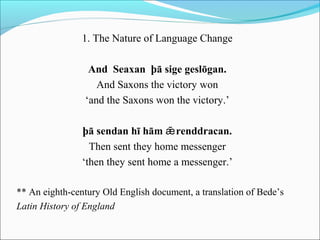
1. The Nature of Language Change

                 And Seaxan þā sige geslōgan.
                   And Saxons the victory won
                ‘and the Saxons won the victory.’

                þā sendan hī hām ǣ renddracan.
                  Then sent they home messenger
                ‘then they sent home a messenger.’

** An eighth-century Old English document, a translation of Bede’s
Latin History of England
• The letter þ called ‘thorn’, represented the phoneme /Ɵ/ in Old
  English.
• hām (OE) > ‘home’ [ME]


• The suffix –an on the OE indicates past tense. sendan > sent


• Differences in word order.
   • S+O+V ……… in the first sentence
   • V+S+O……….. In the second sentence
And Seaxan þā sige geslōgan.
                   And Saxons the victory won
                ‘and the Saxons won the victory.’

                þā sendan hī hām ǣ renddracan.
                  Then sent they home messenger
                ‘then they sent home a messenger.’

** An eighth-century Old English document, a translation of Bede’s
Latin History of England
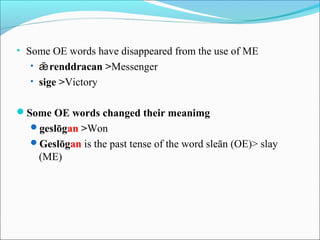
• Some OE words have disappeared from the use of ME
  • ǣ renddracan >Messenger
  • sige >Victory


Some OE words changed their meanimg
  geslōgan >Won
  Geslōgan is the past tense of the word sleān (OE)> slay
    (ME)
And Seaxan þā sige geslōgan.
                   And Saxons the victory won
                ‘and the Saxons won the victory.’

                þā sendan hī hām ǣ renddracan.
                  Then sent they home messenger
                ‘then they sent home a messenger.’

** An eighth-century Old English document, a translation of Bede’s
Latin History of England
The Causes of Language change

a. Language is ‘handed down’ from one generation to the next.
b. Children do not begin language learning with an intact grammar.
c. People construct grammar on the basis of the available data.


                        Articulatory Simplification

a. Related to the idea of ‘ease of articulation’.
b. The deletion of a consonant in a complex cluster
               [fifθs] > [fifs]…………….. ‘fifths’
c. The insertion of a vowel to break up a complex cluster
               [æθli:t] > [æθəli:t]………….. ‘athlete’
Spelling Pronunciation

 The written form of a word can differ from the way it is pronounced.
 A new pronunciation can arise to reflect more closely the spelling of
    the word.
   ‘Often’ was pronounced with a [t] in earlier English.
   In ME it is [ɒfən]
   Since the letter ‘t’ was retained in the spelling, [t] has been
    reintroduced into many speakers’ pronunciation.
   In the pronunciation of [s] in words such as ‘assume’ and ‘consume’ ,
    sound change resulted in a pronunciation with [ ʃ] like ‘shoe’ [ ʃʊ:].
   Arbitrariness of the relationship between spelling and pronunciation.
   ‘Menzies’ , the Scottish surname , used to be pronounced like [m ɪɳɪs]
    or [meɳɪs] is now a days pronounced [menzɪz].
Spelling Pronunciation

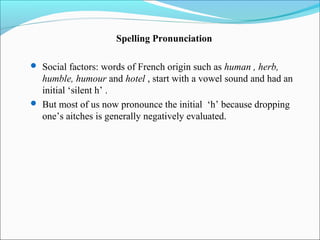
 Social factors: words of French origin such as human , herb,
  humble, humour and hotel , start with a vowel sound and had an
  initial ‘silent h’ .
 But most of us now pronounce the initial ‘h’ because dropping
  one’s aitches is generally negatively evaluated.
Analogy and reanalysis

                           Analogy
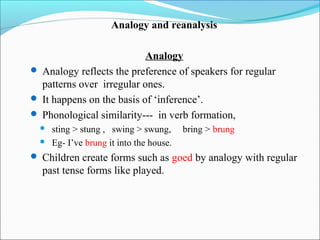
 Analogy reflects the preference of speakers for regular
  patterns over irregular ones.
 It happens on the basis of ‘inference’.
 Phonological similarity--- in verb formation,
     sting > stung , swing > swung,      bring > brung
     Eg- I’ve brung it into the house.
 Children create forms such as goed by analogy with regular
  past tense forms like played.
Analogy and reanalysis

                        Reanalysis
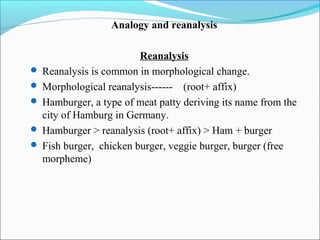
 Reanalysis is common in morphological change.
 Morphological reanalysis------ (root+ affix)
 Hamburger, a type of meat patty deriving its name from the
  city of Hamburg in Germany.
 Hamburger > reanalysis (root+ affix) > Ham + burger
 Fish burger, chicken burger, veggie burger, burger (free
  morpheme)
Language Contact

 Language contact occurs when speakers of one language
  frequently interact with the speakers of another language or
  dialect.
 Borrowing – language user ( bilingual or multilingual)
 English has borrowed many French words such as – parent,
  cousin, animal, soup, colour, major.
 Hypercorrection occurs when a speaker who is attempting
  to speak another language or dialect.
 The north of England have the vowel [ʊ] in words like cut,
  grumpy, stump where RP and other dialects have [ʌ].
Language Contact

 In present-day English there is no way of distinguishing
  between words that belong to the cut /kʌt/ class, which
  underwent the change of /ʊ/ to /ʌ/ from words in the put
  /pʊt/ class that evade the change.
 the result is the hypercorrect pronunciation of a word like-
  butcher as [bʌtʃə] , rubella [rʊbelə] as [rʌbelə].
2. Sound Change
                         Assimilation

 Assimilation- the effect of increasing the efficiency of
  articulation through a simplification of articulatory
  movements.

 Partial assimilation involving place or manner of
  articulation is a very common change which, over time,
  can result in total assimilation.
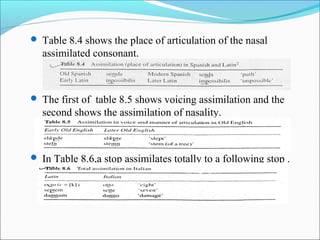
 Table 8.4 shows the place of articulation of the nasal
  assimilated consonant.


 The first of table 8.5 shows voicing assimilation and the
  second shows the assimilation of nasality.


 In Table 8.6,a stop assimilates totally to a following stop .
Dissimilation

 Dissimilation, the process whereby one segment is made
  less like another segment.

 This type of change typically occurs when it would be
  difficult to articulate two similar sounds on close
  proximity.
 Avoiding two consecutive nasal consonants
     Anma ‘soul’ (Late Latin Word) > alma ( Spanish)

 Avoiding two instances of [r] in neighboring syllables
     Arbor ‘tree’ (Latin word) > arbol (spanish) > alboro
      (Italian) > arbre (French)
     By contrast, dissimilation did not occur in French where
      arbre has retained both instances of [r].
Epenthesis

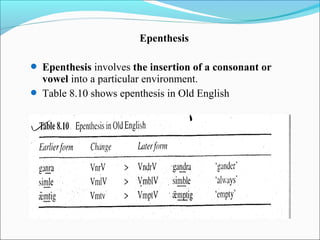
 Epenthesis involves the insertion of a consonant or
  vowel into a particular environment.
 Table 8.10 shows epenthesis in Old English
 Vowel epenthesis serves to break up a sequence of sounds
  which would otherwise be difficult to pronounce or even
  inconsistent with the phonetic pattern of the language
  ( Table8.12)
 Some English speakers avoid [ɵ] clusters by inserting an
  epenthetic [ə] in their pronunciation of words such as
  athlete as ath[ə]lete .
 Table 8.12 shows examples of epenthesis
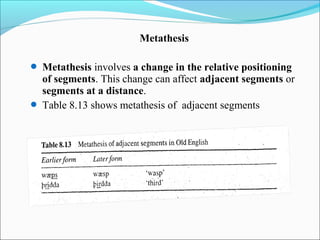
Metathesis

 Metathesis involves a change in the relative positioning
  of segments. This change can affect adjacent segments or
  segments at a distance.
 Table 8.13 shows metathesis of adjacent segments
 Metathesis at a distance is found in the change from Latin
  miraculum ‘miracle’ to Spanish milagro, in which [r] and
  [l] have changed places although they were not adjacent.
Weakening and deletion

 Verb deletion involves a word –final vowel (apocope) or a
  word-initial vowel (syncopy).
 A vowel in an unstressed syllable is particularly susceptible
  to deletion, especially when a nearby neighboring syllable
  is stressed.
 The effects of syncopy are also apparent in the loss of the
  middle vowel in Modern English words such as vegetable ,
  interest, and family, which are frequently pronounced as
  [védʒtəbl], [íntrest], and [fæmlɪ].
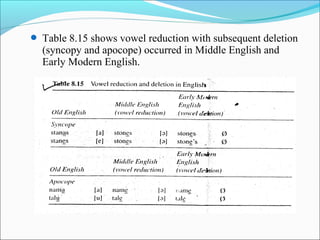
 Table 8.15 shows vowel reduction with subsequent deletion
  (syncopy and apocope) occurred in Middle English and
  Early Modern English.
 Consonant deletion is also a very common sound change.
  For example , the word-initial cluster [kn] was found in
  Old and Middle English, as the spelling of such words as
  Knight, Knit, Knot and Knee implies, but the [k] was
  subsequently lost giving us our modern pronunciation.
Auditory-base change

 Substitution involves the replacement of one segment with
  another similar sounding segment.
 A common type of substitution involves [f] replacing either
  [x] or [ɵ].
Phonological Change

 In a phonological split, allophones of the same phoneme
  come to contrast with each other due to the loss of the
  conditioning environment.


 [ɳ] was simply the allophone of /n/.
 The loss of the final [g] in words created minimal pairs
  such as sin /sɪn/ and sing /sɪɳ/.
Phonological Change

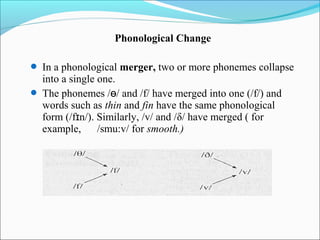
 In a phonological merger, two or more phonemes collapse
  into a single one.
 The phonemes /ɵ/ and /f/ have merged into one (/f/) and
  words such as thin and fin have the same phonological
  form (/fɪn/). Similarly, /v/ and /δ/ have merged ( for
  example,      /smu:v/ for smooth.)
Phonological Change

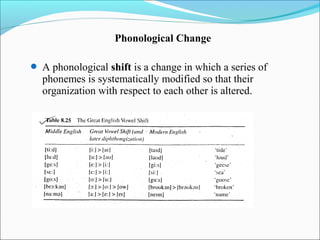
 A phonological shift is a change in which a series of
  phonemes is systematically modified so that their
  organization with respect to each other is altered.
Thank U

Historical Linguistics

  • 1.
    The Study ofLanguage Change By Sk. Shafiqur Rahman ID- 121 1218 055
  • 2.
    1. The Natureof Language Change And Seaxan þā sige geslōgan. And Saxons the victory won ‘and the Saxons won the victory.’ þā sendan hī hām ǣ renddracan. Then sent they home messenger ‘then they sent home a messenger.’ ** An eighth-century Old English document, a translation of Bede’s Latin History of England
  • 3.
    • The letterþ called ‘thorn’, represented the phoneme /Ɵ/ in Old English. • hām (OE) > ‘home’ [ME] • The suffix –an on the OE indicates past tense. sendan > sent • Differences in word order. • S+O+V ……… in the first sentence • V+S+O……….. In the second sentence
  • 4.
    And Seaxan þāsige geslōgan. And Saxons the victory won ‘and the Saxons won the victory.’ þā sendan hī hām ǣ renddracan. Then sent they home messenger ‘then they sent home a messenger.’ ** An eighth-century Old English document, a translation of Bede’s Latin History of England
  • 5.
    • Some OEwords have disappeared from the use of ME • ǣ renddracan >Messenger • sige >Victory Some OE words changed their meanimg geslōgan >Won Geslōgan is the past tense of the word sleān (OE)> slay (ME)
  • 6.
    And Seaxan þāsige geslōgan. And Saxons the victory won ‘and the Saxons won the victory.’ þā sendan hī hām ǣ renddracan. Then sent they home messenger ‘then they sent home a messenger.’ ** An eighth-century Old English document, a translation of Bede’s Latin History of England
  • 7.
    The Causes ofLanguage change a. Language is ‘handed down’ from one generation to the next. b. Children do not begin language learning with an intact grammar. c. People construct grammar on the basis of the available data. Articulatory Simplification a. Related to the idea of ‘ease of articulation’. b. The deletion of a consonant in a complex cluster [fifθs] > [fifs]…………….. ‘fifths’ c. The insertion of a vowel to break up a complex cluster [æθli:t] > [æθəli:t]………….. ‘athlete’
  • 8.
    Spelling Pronunciation  Thewritten form of a word can differ from the way it is pronounced.  A new pronunciation can arise to reflect more closely the spelling of the word.  ‘Often’ was pronounced with a [t] in earlier English.  In ME it is [ɒfən]  Since the letter ‘t’ was retained in the spelling, [t] has been reintroduced into many speakers’ pronunciation.  In the pronunciation of [s] in words such as ‘assume’ and ‘consume’ , sound change resulted in a pronunciation with [ ʃ] like ‘shoe’ [ ʃʊ:].  Arbitrariness of the relationship between spelling and pronunciation.  ‘Menzies’ , the Scottish surname , used to be pronounced like [m ɪɳɪs] or [meɳɪs] is now a days pronounced [menzɪz].
  • 9.
    Spelling Pronunciation  Socialfactors: words of French origin such as human , herb, humble, humour and hotel , start with a vowel sound and had an initial ‘silent h’ .  But most of us now pronounce the initial ‘h’ because dropping one’s aitches is generally negatively evaluated.
  • 10.
    Analogy and reanalysis Analogy  Analogy reflects the preference of speakers for regular patterns over irregular ones.  It happens on the basis of ‘inference’.  Phonological similarity--- in verb formation,  sting > stung , swing > swung, bring > brung  Eg- I’ve brung it into the house.  Children create forms such as goed by analogy with regular past tense forms like played.
  • 11.
    Analogy and reanalysis Reanalysis  Reanalysis is common in morphological change.  Morphological reanalysis------ (root+ affix)  Hamburger, a type of meat patty deriving its name from the city of Hamburg in Germany.  Hamburger > reanalysis (root+ affix) > Ham + burger  Fish burger, chicken burger, veggie burger, burger (free morpheme)
  • 12.
    Language Contact  Languagecontact occurs when speakers of one language frequently interact with the speakers of another language or dialect.  Borrowing – language user ( bilingual or multilingual)  English has borrowed many French words such as – parent, cousin, animal, soup, colour, major.  Hypercorrection occurs when a speaker who is attempting to speak another language or dialect.  The north of England have the vowel [ʊ] in words like cut, grumpy, stump where RP and other dialects have [ʌ].
  • 13.
    Language Contact  Inpresent-day English there is no way of distinguishing between words that belong to the cut /kʌt/ class, which underwent the change of /ʊ/ to /ʌ/ from words in the put /pʊt/ class that evade the change.  the result is the hypercorrect pronunciation of a word like- butcher as [bʌtʃə] , rubella [rʊbelə] as [rʌbelə].
  • 14.
    2. Sound Change Assimilation  Assimilation- the effect of increasing the efficiency of articulation through a simplification of articulatory movements.  Partial assimilation involving place or manner of articulation is a very common change which, over time, can result in total assimilation.
  • 15.
     Table 8.4shows the place of articulation of the nasal assimilated consonant.  The first of table 8.5 shows voicing assimilation and the second shows the assimilation of nasality.  In Table 8.6,a stop assimilates totally to a following stop .
  • 16.
    Dissimilation  Dissimilation, theprocess whereby one segment is made less like another segment.  This type of change typically occurs when it would be difficult to articulate two similar sounds on close proximity.
  • 17.
     Avoiding twoconsecutive nasal consonants  Anma ‘soul’ (Late Latin Word) > alma ( Spanish)  Avoiding two instances of [r] in neighboring syllables  Arbor ‘tree’ (Latin word) > arbol (spanish) > alboro (Italian) > arbre (French)  By contrast, dissimilation did not occur in French where arbre has retained both instances of [r].
  • 18.
    Epenthesis  Epenthesis involvesthe insertion of a consonant or vowel into a particular environment.  Table 8.10 shows epenthesis in Old English
  • 19.
     Vowel epenthesisserves to break up a sequence of sounds which would otherwise be difficult to pronounce or even inconsistent with the phonetic pattern of the language ( Table8.12)  Some English speakers avoid [ɵ] clusters by inserting an epenthetic [ə] in their pronunciation of words such as athlete as ath[ə]lete .  Table 8.12 shows examples of epenthesis
  • 20.
    Metathesis  Metathesis involvesa change in the relative positioning of segments. This change can affect adjacent segments or segments at a distance.  Table 8.13 shows metathesis of adjacent segments
  • 21.
     Metathesis ata distance is found in the change from Latin miraculum ‘miracle’ to Spanish milagro, in which [r] and [l] have changed places although they were not adjacent.
  • 22.
    Weakening and deletion Verb deletion involves a word –final vowel (apocope) or a word-initial vowel (syncopy).  A vowel in an unstressed syllable is particularly susceptible to deletion, especially when a nearby neighboring syllable is stressed.  The effects of syncopy are also apparent in the loss of the middle vowel in Modern English words such as vegetable , interest, and family, which are frequently pronounced as [védʒtəbl], [íntrest], and [fæmlɪ].
  • 23.
     Table 8.15shows vowel reduction with subsequent deletion (syncopy and apocope) occurred in Middle English and Early Modern English.
  • 24.
     Consonant deletionis also a very common sound change. For example , the word-initial cluster [kn] was found in Old and Middle English, as the spelling of such words as Knight, Knit, Knot and Knee implies, but the [k] was subsequently lost giving us our modern pronunciation.
  • 25.
    Auditory-base change  Substitutioninvolves the replacement of one segment with another similar sounding segment.  A common type of substitution involves [f] replacing either [x] or [ɵ].
  • 26.
    Phonological Change  Ina phonological split, allophones of the same phoneme come to contrast with each other due to the loss of the conditioning environment.  [ɳ] was simply the allophone of /n/.  The loss of the final [g] in words created minimal pairs such as sin /sɪn/ and sing /sɪɳ/.
  • 27.
    Phonological Change  Ina phonological merger, two or more phonemes collapse into a single one.  The phonemes /ɵ/ and /f/ have merged into one (/f/) and words such as thin and fin have the same phonological form (/fɪn/). Similarly, /v/ and /δ/ have merged ( for example, /smu:v/ for smooth.)
  • 28.
    Phonological Change  Aphonological shift is a change in which a series of phonemes is systematically modified so that their organization with respect to each other is altered.
  • 29.