
COMPUTATIONAL LINGUISTICS
QUESTIONS AND ANSWERS
WHAT IS COMPUTATIONAL LINGUISTICS ALL
ABOUT?
 Computational linguistics is the application of linguistic
theories and computational techniques to natural
language processing.
 Ralph Grishman, the author of the book, Computational
Linguistics defined CL as the study of computer systems
for the purpose of understanding and generating natural
language.
ORIGIN OF CL
 Computational linguistics originated with efforts in the
United States in the 1950s to use computers to
automatically translate texts from foreign languages
 In order to translate one language into another, it was
observed that one had to understand the grammar of both
languages, including both morphology (the grammar of
word forms) and syntax (the grammar of sentence
structure).
 In order to understand syntax, one had to also understand
the semantics and the lexicon(or 'vocabulary'), and even to
understand something of the pragmatics of language use.
 Thus, what started as an effort to translate between
languages evolved into an entire discipline devoted to
understanding how to represent and process natural
languages using computers.
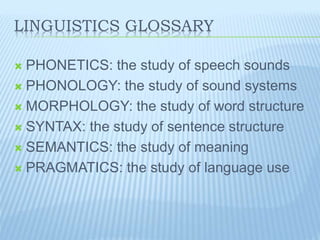
LINGUISTICS GLOSSARY
 PHONETICS: the study of speech sounds
 PHONOLOGY: the study of sound systems
 MORPHOLOGY: the study of word structure
 SYNTAX: the study of sentence structure
 SEMANTICS: the study of meaning
 PRAGMATICS: the study of language use
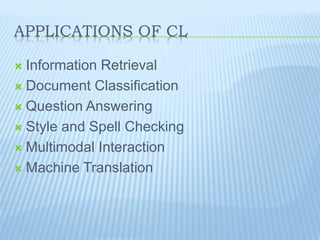
APPLICATIONS OF CL
 Information Retrieval
 Document Classification
 Question Answering
 Style and Spell Checking
 Multimodal Interaction
 Machine Translation
THANK YOU!!

COMPUTATIONAL LINGUISTICS

  • 1.
  • 2.
    WHAT IS COMPUTATIONALLINGUISTICS ALL ABOUT?  Computational linguistics is the application of linguistic theories and computational techniques to natural language processing.  Ralph Grishman, the author of the book, Computational Linguistics defined CL as the study of computer systems for the purpose of understanding and generating natural language.
  • 3.
    ORIGIN OF CL Computational linguistics originated with efforts in the United States in the 1950s to use computers to automatically translate texts from foreign languages  In order to translate one language into another, it was observed that one had to understand the grammar of both languages, including both morphology (the grammar of word forms) and syntax (the grammar of sentence structure).  In order to understand syntax, one had to also understand the semantics and the lexicon(or 'vocabulary'), and even to understand something of the pragmatics of language use.  Thus, what started as an effort to translate between languages evolved into an entire discipline devoted to understanding how to represent and process natural languages using computers.
  • 4.
    LINGUISTICS GLOSSARY  PHONETICS:the study of speech sounds  PHONOLOGY: the study of sound systems  MORPHOLOGY: the study of word structure  SYNTAX: the study of sentence structure  SEMANTICS: the study of meaning  PRAGMATICS: the study of language use
  • 5.
    APPLICATIONS OF CL Information Retrieval  Document Classification  Question Answering  Style and Spell Checking  Multimodal Interaction  Machine Translation
  • 6.