The Civilization of the Greeks 4
Early Greece Importance of geography in Greek history Sea, mountains, and topography Minoan Crete, 2000-1450  B.C.E. Sea empire based on trade Palace of Knossus Sudden and catastrophic collapse around 1450  B.C.E. Mycenaean Greeks, 1600-1100 B.C.E. Indo-European / warrior people Agamemnon Mycenae torched about 1190  B.C.E.
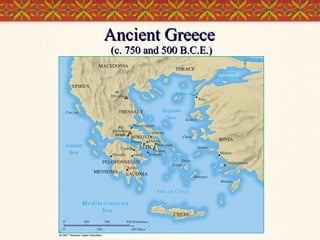
Ancient Greece  (c. 750 and 500 B.C.E.)
The Greek Dark Age  (c. 1100-c. 750 B.C.E.) Collapse of agricultural production Migration east across the Aegean Sea Ionian Greeks  Aeolian Greeks - Lesbos Dorians Greeks – Peloponnesus and Crete Homer Iliad Odyssey Heroic values formed the core of aristocratic virtue
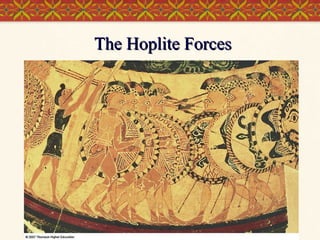
The Greek City-States (750 -500 B.C.E.) The  Polis a small, autonomous political unit in which political, social, and religious activities were carried out in one central location  Acropolis and Agora Citizens, non-citizens: rights + responsibilities A New Military System:  The Hoplites heavily armed infantrymen formed a phalanx, 8 deep Political and military repercussions
Colonization and the  Growth of Trade Colonization Gulf between rich and poor, overpopulation, and trade Migration, established colonies – independent  polis Spread of Greek culture Trade and industry increased creating a ‘new rich’ craving power Tyranny in the Greek  Polis A tyrant is a ruler who came to power in unconstitutional ways ‘ New Rich’ and poor peasants supported the tyrants who opposed the ‘old aristocracy’ Extinguished by end of 6 th  century B.C.E., but: Ended the rule of aristocratic oligarchies Opened the door to open participation by the citizens - democracy
The Hoplite Forces
Sparta Southeastern Peloponnesus Conquered neighboring Laconia and Messenia The New Sparta Reforms by Lycurgus:  Spartan life was rigidly organized and controlled Military society Women Spartan State Government was an oligarchy Kings, ephors, council of elders Banned foreign travel or study of philosophy, literature of arts to preserve Spartan ideal of “The Art of War”
Athens Polis e stablished by 700  B.C.E . Political turmoil because of farmers sold into slavery for not paying land debts Reformer, Solon  Canceled all debts, outlawed new loans based on human collateral, freed debt-slaves  Carried out land redistribution Pisistratus seized power and pursued policies to aid trade Cleisthenes took power in 508  B.C.E.   Created the foundation of Athenian democracy “ Council of 500” supervised foreign affairs and treasury Free and open debates were allowed before laws were passed by Athenian assembly
Challenge of Persia Darius (522-486  B.C.E.) Unsuccessful revolt of Ionian cities Revenge attack on the mainland Greeks Battle of Marathon, 490 B.C.E. Xerxes (486-465  B.C.E.) Invasion of Greece, 480-479 B.C.E. Spartan league and Athenian navy Battle of Thermopylae, 480 B.C.E. Battle of Salamis, 480 B.C.E. Battle of Plataea, 479 B.C.E.
The Growth of an Athenian Empire in the Age of Pericles Delian League formed 478-77 B.C.E. Defensive alliance formed and pursued the Persians All Greek city-states freed Athenians came to control the League creating an empire in Athens Pericles Expanded democracy at home and its empire abroad “School of Greece” - Art, architecture, and philosophy flourished
The Great Peloponnesian War and the Decline of the Greek States Sparta and allies vs. Athenian maritime empire Athens afraid of open battle, the strength of Spartan, hid behind its walls Plague within the city walls kills 1/3 of population Pericles dies Battle of Aegospotami, 405  B.C.E. Surrender of Athens, 404  B.C.E . Petty wars for 70 years: Sparta, Athens, Thebes
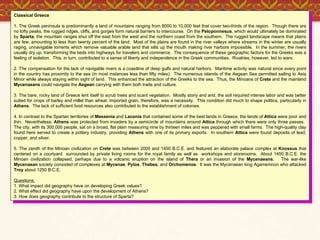
Classical Greece 1. The Greek peninsula is predominantly a land of mountains ranging from 8000 to 10,000 feet that cover two-thirds of the region.  Though there are no lofty peaks, the rugged ridges, cliffs, and gorges form natural barriers to intercourse.  On the  Peloponnesus , which would ultimately be dominated by  Sparta , the mountain ranges shut off the east from the west and the northern coast from the southern.  The rugged landscape means that plains are few, amounting to less than twenty percent of the land.  Most of the plains are found in the river valleys where streams in the winter are usually raging, unnavigable torrents which remove valuable arable land that silts up the mouth making river harbors impossible.  In the summer, the rivers usually dry up, transforming the beds into highways for travelers and commerce.  The consequence of these geographic factors for the Greeks was a feeling of isolation.  This, in turn, contributed to a sense of liberty and independence in the Greek communities.  Rivalries, however, led to wars. 2. The compensation for the lack of navigable rivers is a coastline of deep gulfs and natural harbors.  Maritime activity was natural since every point in the country has proximity to the sea (in most instances less than fifty miles).  The numerous islands of the Aegean Sea permitted sailing to Asia Minor while always staying within sight of land.  This enhanced the attraction of the Greeks to the sea.  Thus, the Minoans of  Crete  and the mainland  Mycenaeans  could navigate the  Aegean  carrying with them both trade and culture. 3. The bare, rocky land of Greece lent itself to scrub trees and scant vegetation.  Mostly stony and arid, the soil required intense labor and was better suited for crops of barley and millet than wheat. Imported grain, therefore, was a necessity.  This condition did much to shape politics, particularly in  Athens .  The lack of sufficient food resources also contributed to the establishment of colonies. 4. In contrast to the Spartan territories of  Messenia  and  Laconia  that contained some of the best lands in Greece, the lands of  Attica  were poor and thin.  Nevertheless,  Athens  was protected from invaders by a semicircle of mountains around  Attica  through which there were only three passes.  The city, with its 300,000 people, sat on a broad, flat plain measuring nine by thirteen miles and was peppered with small farms.  The high-quality clay found here served to create a pottery industry, providing  Athens  with one of its primary exports.  In southern  Attica  were found deposits of lead, copper, and silver. 5. The zenith of the Minoan civilization on  Crete  was between 2000 and 1450 B.C.E. and featured an elaborate palace complex at  Knossus  that centered on a courtyard  surrounded by private living rooms for the royal family as well as  workshops and storerooms.  About 1450 B.C.E. the Minoan civilization collapsed, perhaps due to a volcanic eruption on the island of  Thera  or an invasion of the  Mycenaeans .  The war-like  Mycenaean  society consisted of complexes at  Mycenae ,  Pylos ,  Thebes , and  Orchomenos .  It was the Mycenaean king Agamemnon who attacked  Troy  about 1250 B.C.E.  Questions: 1. What impact did geography have on developing Greek values? 2. What effect did geography have upon the development of Athens? 3. How does geography contribute to the structure of Sparta?
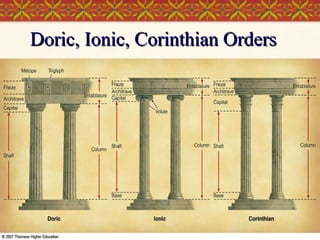
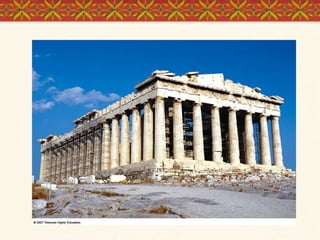
Culture of Classical Greece The Writing of History First Historians:  Herodotus and Thucydides Greek Drama Playwrights:  Aeschylus, Sophocles, Euripides The Arts: The Classical Ideal Architecture Artistic standards:  clarity, calmness, without details Parthenon, 447 and 432  B.C.E. Doric, Ionic, and Corinthian columns Sculpture Ideal beauty: male nudes in proportion and lifelike
Doric, Ionic, Corinthian Orders
 
The Greek Love of Wisdom Philosophy means “love of wisdom” Socrates (469-399  B.C.E .) Socratic method Goal of education was to improve the individual Questioned authority Plato (c. 429-347 B.C.E.) The Republic The Academy Aristotle (384-322 B.C.E.) Analyzed and classified ideas based on research and investigation Philosophical and political ideas major influence on Western thought
Greek Religion A civic cult necessary for the state’s well-being 12 chief gods on Mount Olympus No body of doctrine or focus on morality Festivals to honor gods/goddesses Olympics Oracle of Apollo at Delphi
Daily Life in Classical Athens 150,000 citizens, 43,000 of which were adult males who exercised political power Economy based on agriculture and trade Family the central institution  Women held traditional role Male homosexuality a prominent feature
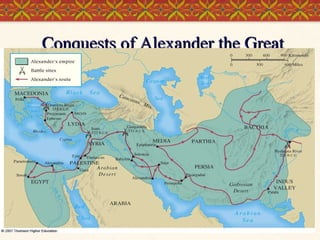
Rise of Macedonia and the Conquests of Alexander Philip II (359-336 B.C.E.) Battle of Chaeronea Assassinated Alexander the Great (336-323 B.C.E.) Invasion of the Persian Empire Invasion of Asia, 334 B.C.E. Battle of Issus, 333 B.C.E. Controlled Palestine, Syria, Egypt, 332 B.C.E. Conquered Babylon and Persian capitals, 330 B.C.E. Entered Pakistan and India, 327 B.C.E. Death of Alexander, 323 B.C.E.
Conquests of Alexander the Great
Legacy of Alexander Hellenistic Age, “to imitate Greeks” Dispersion of Greek engineers, intellectuals, merchants, administrators, and soldiers Diffusion of Greek art, architecture, language, literature Fusion of different cultures A example of a “empire” for the Romans
The Hellenistic Kingdoms Four Hellenistic kingdoms emerged Macedonia under the Antigonid dynasty Syria and the east under the Seleucids Attalid kingdom of Pergamum in western Asia Minor Egypt under the Ptolemies Greeks and Macedonians formed the new ruling class Encouraged colonizing the Middle East by providing army recruits and civilian administrators and workers
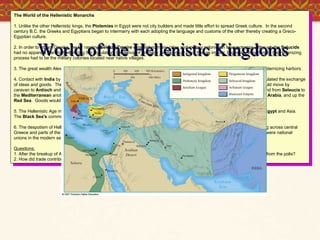
World of the Hellenistic Kingdoms The World of the Hellenistic Monarchs 1. Unlike the other Hellenistic kings, the  Ptolemies  in Egypt were not city builders and made little effort to spread Greek culture.  In the second century B.C. the Greeks and Egyptians began to intermarry with each adopting the language and customs of the other thereby creating a Greco-Egyptian culture. 2. In order to attract Greeks, the far ranging  Selucid Empire  established many cities and military colonies in Mesopotamia. Although the  Selucids  had no apparent plan for Hellenizing the population, the arrival of so many Greeks must have had an impact. Especially important in the Hellenizing process had to be the military colonies located near native villages. 3. The great wealth Alexander found in the Persian capitals was used to finance the creation of new cities, building roads, and modernizing harbors. 4. Contact with  India  by sea was established by the  Ptolemies  who learned to utilize the monsoon winds.  This route further stimulated the exchange of ideas and goods.  The commerce came by sea into the  Persian Gulf , up the  Tigris  to  Seleucia .  From  Seleucia , the trade would move by caravan to  Antioch  and  Ephesus  on the west coast of Asia Minor.  By land, the trip from the  Indus  to  Seleucia  took forty days and from  Seleucia  to the  Mediterranean  another fifteen.  The longer alternate southern route wound its way by sea along the coast from  India , around  Arabia , and up the  Red Sea .  Goods would be transferred by caravan to the  Nile  and floated down to  Alexandria  and the  Mediterranean . 5. The Hellenistic Age marked a shift in the center of eastern  Mediterranean  trade from  Athens  to Corinth and the new cities of  Egypt  and Asia.  The  Black Sea's  commercial importance was reduced due to the Gallic and Scythian invasions. 6. The despotism of Hellenistic kingdoms was countered by a city-state federalism established by the  Aetolian League  (stretching across central Greece and parts of the Peloponnesus) and the  Aechean League  (including much of the Peloponnesus).  These confederations were national unions in the modern sense. Questions: 1. After the breakup of Alexander's empire, how did the new kingdoms approach their political organization?  How was it different from the polis? 2. How did trade contribute to the development of the Hellenistic Age?
Culture in the Hellenistic World Spread of Greek culture in new cosmopolitan world provided sense of unity Golden Age of Science Separation of science and philosophy Archimedes (287-212  B.C.E.) Philosophy Athens still the center of philosophy Epicurus (341-270  B.C.E.) Zeno (335-263  B.C.E.)
Discussion Questions How did the geography of Greece affect Greek history, and why was Homer used as the basis for Greek education? What did the Greeks mean by democracy, and in what ways was the Athenian political system a democracy? How was Alexander the Great able to amass his empire, and what was his legacy?

His 2001 4

  • 1.
    The Civilization ofthe Greeks 4
  • 2.
    Early Greece Importanceof geography in Greek history Sea, mountains, and topography Minoan Crete, 2000-1450 B.C.E. Sea empire based on trade Palace of Knossus Sudden and catastrophic collapse around 1450 B.C.E. Mycenaean Greeks, 1600-1100 B.C.E. Indo-European / warrior people Agamemnon Mycenae torched about 1190 B.C.E.
  • 3.
    Ancient Greece (c. 750 and 500 B.C.E.)
  • 4.
    The Greek DarkAge (c. 1100-c. 750 B.C.E.) Collapse of agricultural production Migration east across the Aegean Sea Ionian Greeks Aeolian Greeks - Lesbos Dorians Greeks – Peloponnesus and Crete Homer Iliad Odyssey Heroic values formed the core of aristocratic virtue
  • 5.
    The Greek City-States(750 -500 B.C.E.) The Polis a small, autonomous political unit in which political, social, and religious activities were carried out in one central location Acropolis and Agora Citizens, non-citizens: rights + responsibilities A New Military System: The Hoplites heavily armed infantrymen formed a phalanx, 8 deep Political and military repercussions
  • 6.
    Colonization and the Growth of Trade Colonization Gulf between rich and poor, overpopulation, and trade Migration, established colonies – independent polis Spread of Greek culture Trade and industry increased creating a ‘new rich’ craving power Tyranny in the Greek Polis A tyrant is a ruler who came to power in unconstitutional ways ‘ New Rich’ and poor peasants supported the tyrants who opposed the ‘old aristocracy’ Extinguished by end of 6 th century B.C.E., but: Ended the rule of aristocratic oligarchies Opened the door to open participation by the citizens - democracy
  • 7.
  • 8.
    Sparta Southeastern PeloponnesusConquered neighboring Laconia and Messenia The New Sparta Reforms by Lycurgus: Spartan life was rigidly organized and controlled Military society Women Spartan State Government was an oligarchy Kings, ephors, council of elders Banned foreign travel or study of philosophy, literature of arts to preserve Spartan ideal of “The Art of War”
  • 9.
    Athens Polis established by 700 B.C.E . Political turmoil because of farmers sold into slavery for not paying land debts Reformer, Solon Canceled all debts, outlawed new loans based on human collateral, freed debt-slaves Carried out land redistribution Pisistratus seized power and pursued policies to aid trade Cleisthenes took power in 508 B.C.E. Created the foundation of Athenian democracy “ Council of 500” supervised foreign affairs and treasury Free and open debates were allowed before laws were passed by Athenian assembly
  • 10.
    Challenge of PersiaDarius (522-486 B.C.E.) Unsuccessful revolt of Ionian cities Revenge attack on the mainland Greeks Battle of Marathon, 490 B.C.E. Xerxes (486-465 B.C.E.) Invasion of Greece, 480-479 B.C.E. Spartan league and Athenian navy Battle of Thermopylae, 480 B.C.E. Battle of Salamis, 480 B.C.E. Battle of Plataea, 479 B.C.E.
  • 11.
    The Growth ofan Athenian Empire in the Age of Pericles Delian League formed 478-77 B.C.E. Defensive alliance formed and pursued the Persians All Greek city-states freed Athenians came to control the League creating an empire in Athens Pericles Expanded democracy at home and its empire abroad “School of Greece” - Art, architecture, and philosophy flourished
  • 12.
    The Great PeloponnesianWar and the Decline of the Greek States Sparta and allies vs. Athenian maritime empire Athens afraid of open battle, the strength of Spartan, hid behind its walls Plague within the city walls kills 1/3 of population Pericles dies Battle of Aegospotami, 405 B.C.E. Surrender of Athens, 404 B.C.E . Petty wars for 70 years: Sparta, Athens, Thebes
  • 13.
    Classical Greece 1.The Greek peninsula is predominantly a land of mountains ranging from 8000 to 10,000 feet that cover two-thirds of the region. Though there are no lofty peaks, the rugged ridges, cliffs, and gorges form natural barriers to intercourse. On the Peloponnesus , which would ultimately be dominated by Sparta , the mountain ranges shut off the east from the west and the northern coast from the southern. The rugged landscape means that plains are few, amounting to less than twenty percent of the land. Most of the plains are found in the river valleys where streams in the winter are usually raging, unnavigable torrents which remove valuable arable land that silts up the mouth making river harbors impossible. In the summer, the rivers usually dry up, transforming the beds into highways for travelers and commerce. The consequence of these geographic factors for the Greeks was a feeling of isolation. This, in turn, contributed to a sense of liberty and independence in the Greek communities. Rivalries, however, led to wars. 2. The compensation for the lack of navigable rivers is a coastline of deep gulfs and natural harbors. Maritime activity was natural since every point in the country has proximity to the sea (in most instances less than fifty miles). The numerous islands of the Aegean Sea permitted sailing to Asia Minor while always staying within sight of land. This enhanced the attraction of the Greeks to the sea. Thus, the Minoans of Crete and the mainland Mycenaeans could navigate the Aegean carrying with them both trade and culture. 3. The bare, rocky land of Greece lent itself to scrub trees and scant vegetation. Mostly stony and arid, the soil required intense labor and was better suited for crops of barley and millet than wheat. Imported grain, therefore, was a necessity. This condition did much to shape politics, particularly in Athens . The lack of sufficient food resources also contributed to the establishment of colonies. 4. In contrast to the Spartan territories of Messenia and Laconia that contained some of the best lands in Greece, the lands of Attica were poor and thin. Nevertheless, Athens was protected from invaders by a semicircle of mountains around Attica through which there were only three passes. The city, with its 300,000 people, sat on a broad, flat plain measuring nine by thirteen miles and was peppered with small farms. The high-quality clay found here served to create a pottery industry, providing Athens with one of its primary exports. In southern Attica were found deposits of lead, copper, and silver. 5. The zenith of the Minoan civilization on Crete was between 2000 and 1450 B.C.E. and featured an elaborate palace complex at Knossus that centered on a courtyard surrounded by private living rooms for the royal family as well as workshops and storerooms. About 1450 B.C.E. the Minoan civilization collapsed, perhaps due to a volcanic eruption on the island of Thera or an invasion of the Mycenaeans . The war-like Mycenaean society consisted of complexes at Mycenae , Pylos , Thebes , and Orchomenos . It was the Mycenaean king Agamemnon who attacked Troy about 1250 B.C.E. Questions: 1. What impact did geography have on developing Greek values? 2. What effect did geography have upon the development of Athens? 3. How does geography contribute to the structure of Sparta?
  • 14.
    Culture of ClassicalGreece The Writing of History First Historians: Herodotus and Thucydides Greek Drama Playwrights: Aeschylus, Sophocles, Euripides The Arts: The Classical Ideal Architecture Artistic standards: clarity, calmness, without details Parthenon, 447 and 432 B.C.E. Doric, Ionic, and Corinthian columns Sculpture Ideal beauty: male nudes in proportion and lifelike
  • 15.
  • 16.
  • 17.
    The Greek Loveof Wisdom Philosophy means “love of wisdom” Socrates (469-399 B.C.E .) Socratic method Goal of education was to improve the individual Questioned authority Plato (c. 429-347 B.C.E.) The Republic The Academy Aristotle (384-322 B.C.E.) Analyzed and classified ideas based on research and investigation Philosophical and political ideas major influence on Western thought
  • 18.
    Greek Religion Acivic cult necessary for the state’s well-being 12 chief gods on Mount Olympus No body of doctrine or focus on morality Festivals to honor gods/goddesses Olympics Oracle of Apollo at Delphi
  • 19.
    Daily Life inClassical Athens 150,000 citizens, 43,000 of which were adult males who exercised political power Economy based on agriculture and trade Family the central institution Women held traditional role Male homosexuality a prominent feature
  • 20.
    Rise of Macedoniaand the Conquests of Alexander Philip II (359-336 B.C.E.) Battle of Chaeronea Assassinated Alexander the Great (336-323 B.C.E.) Invasion of the Persian Empire Invasion of Asia, 334 B.C.E. Battle of Issus, 333 B.C.E. Controlled Palestine, Syria, Egypt, 332 B.C.E. Conquered Babylon and Persian capitals, 330 B.C.E. Entered Pakistan and India, 327 B.C.E. Death of Alexander, 323 B.C.E.
  • 21.
  • 22.
    Legacy of AlexanderHellenistic Age, “to imitate Greeks” Dispersion of Greek engineers, intellectuals, merchants, administrators, and soldiers Diffusion of Greek art, architecture, language, literature Fusion of different cultures A example of a “empire” for the Romans
  • 23.
    The Hellenistic KingdomsFour Hellenistic kingdoms emerged Macedonia under the Antigonid dynasty Syria and the east under the Seleucids Attalid kingdom of Pergamum in western Asia Minor Egypt under the Ptolemies Greeks and Macedonians formed the new ruling class Encouraged colonizing the Middle East by providing army recruits and civilian administrators and workers
  • 24.
    World of theHellenistic Kingdoms The World of the Hellenistic Monarchs 1. Unlike the other Hellenistic kings, the Ptolemies in Egypt were not city builders and made little effort to spread Greek culture. In the second century B.C. the Greeks and Egyptians began to intermarry with each adopting the language and customs of the other thereby creating a Greco-Egyptian culture. 2. In order to attract Greeks, the far ranging Selucid Empire established many cities and military colonies in Mesopotamia. Although the Selucids had no apparent plan for Hellenizing the population, the arrival of so many Greeks must have had an impact. Especially important in the Hellenizing process had to be the military colonies located near native villages. 3. The great wealth Alexander found in the Persian capitals was used to finance the creation of new cities, building roads, and modernizing harbors. 4. Contact with India by sea was established by the Ptolemies who learned to utilize the monsoon winds. This route further stimulated the exchange of ideas and goods. The commerce came by sea into the Persian Gulf , up the Tigris to Seleucia . From Seleucia , the trade would move by caravan to Antioch and Ephesus on the west coast of Asia Minor. By land, the trip from the Indus to Seleucia took forty days and from Seleucia to the Mediterranean another fifteen. The longer alternate southern route wound its way by sea along the coast from India , around Arabia , and up the Red Sea . Goods would be transferred by caravan to the Nile and floated down to Alexandria and the Mediterranean . 5. The Hellenistic Age marked a shift in the center of eastern Mediterranean trade from Athens to Corinth and the new cities of Egypt and Asia. The Black Sea's commercial importance was reduced due to the Gallic and Scythian invasions. 6. The despotism of Hellenistic kingdoms was countered by a city-state federalism established by the Aetolian League (stretching across central Greece and parts of the Peloponnesus) and the Aechean League (including much of the Peloponnesus). These confederations were national unions in the modern sense. Questions: 1. After the breakup of Alexander's empire, how did the new kingdoms approach their political organization? How was it different from the polis? 2. How did trade contribute to the development of the Hellenistic Age?
  • 25.
    Culture in theHellenistic World Spread of Greek culture in new cosmopolitan world provided sense of unity Golden Age of Science Separation of science and philosophy Archimedes (287-212 B.C.E.) Philosophy Athens still the center of philosophy Epicurus (341-270 B.C.E.) Zeno (335-263 B.C.E.)
  • 26.
    Discussion Questions Howdid the geography of Greece affect Greek history, and why was Homer used as the basis for Greek education? What did the Greeks mean by democracy, and in what ways was the Athenian political system a democracy? How was Alexander the Great able to amass his empire, and what was his legacy?