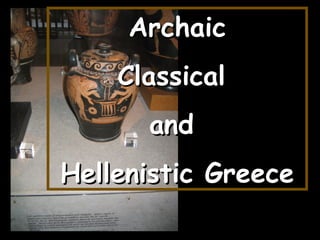
ArchaicArchaic
ClassicalClassical
andand
Hellenistic GreeceHellenistic Greece
From early beginnings to long lasting legacy
• Indo-Europeans move into
region conflict and
geography creates
separate city-states
joined by a common
culture (language, religion
and heritage)
• Join together in leagues
during the Golden Age
• Culture spread by
Alexander the Great
during Hellenistic Era
• Eventually absorbed into
the Roman Empire
Greeks came together at
the Olympics
Eras in Development of Greek Civilization
• Minoan Civilization-
• 2000-1400BC flourished on Island of Crete.Great trading power..
• Myceneans (Achaeans)- 2000 BC I
• nvaded Greece from the north. They built on the achievements of the Minoans.
• Around 1250 BC they banded together under the leadership of the king of Mycenae to attack
troy, a rival power. Troy controlled trading routes between the Aegean and Black seas. This
war is told in Homers Iliad and the Odyssey. Composed about 750 BC According to Iliad
Paris, a Trojan prince kidnaped Helen wife of the King of Sparta. The Spartan King and his
brother Agamemnon, of Mycenae involved all of Greece in the effort to rescue Helen. After
ten years of war Troy destroyed and drove the Trojans into exile. Heinrich Schliemann
excavated a site in northwestern Asia Minor which is accepted as the ancient city of Troy.
Found nine cities had been built at different times on the same spot. charred wood and
destruction convinced him that this was the layer of Troy.
• Dorians came down from the north.
• Settled further to the south on the Pelopennisus Peninsula. Conquered many of the
regions occupied by the Myceneans. The art of writing was lost during this time. This
period is called the “Dark Age”
• Age of the City States
• Small city states or monarchies formed instead of a great empire. Golden Age of
Greece
• Delian League - Persian and Peloponesian Wars create a new era of differing alliances
in the Aegean Sea. Trade provided wealth and some stablity. Also known as Classical
Greece.
• Hellenistic Greece
• Persian occupation after the conquest of Greece by the Macedonian, Alexander the
Great. Greek civilization spread throughout the world but mixed with other
civilizations and changed.
• Roman - Greco Civilization
Crete: Minoan
Civilization
(Palace at Knossos)
Minoan Civilization
Fresco – bull leaping
Knossos: Minoan
Civilization
The Mask of Agamemnon
The Mycenaean Civilization
Geographic Influences
• Many islands in the Aegean Sea were close
together.
• This made trade and cultural exchange easier.
• Short mountain ranges divided the country.
• They prevented the development of a sense of Greek
unity.
• The Greeks could not produce enough food for
their own needs.
• They had to become traders.
• The long coastline brought every part of the
mainland close to the sea.
• Greeks became fishermen, sailors and traders.
Homer:
The
“Heroic
/Homeric Age”
Dark Age
Bronze Age Greece
Greek City States
Hellos
Greece changes Geographically
Characteristics of all Greek city states
• Small Size
• Small population
• An original polis (acropolis or high up
place)
• A public meeting place called an agora
• This is how we identified whether or not
it was a “Greek” city state.
Factors that brought them together and Factors
that kept them apart
• Common Language,
Religion, and festivals
• Co-operative
supervision of certain
temples
• Belief that the Greeks
were descended from
the same ancestors
• Rugged Mountains
separating the valleys
• Rivalries between city-
states
• separate legal systems
• independent calendars,
money, weights and
measures
• Fierce spirit of
Greek Philosophy
• Popular government - is the idea that
people could and should rule themselves
rather than be ruled by others.
• This is the foundation of Greek
Democracy but is not really a type of
government.
• It is more of a philosophy
Greek Systems of Government
• Monarchy- is a government by a royal family-in ancient
Greece a King. established a dynasty.
• Autocracy- (rule by one person who has total control over all
others)
• Aristocracy- (government ruled by the wealthy or upper
class) was comprised of the nobility, or landowning class
that ruled the city-state.
• Oligarchy - absolute rule by a few
• Tyranny - (Tyrant) seized power, gaining popular support
by promising to defend the poor from the aristocracy.
• Democracy- the council of citizens helped form laws and
limited the power of rulers.
• Theocracy- government in which the clergy rules or in
which a “god” is the civil ruler.
Geographic and historical influences in the development of Greek city
states
• Sparta was located on the Peloponnesus Peninsula, an
area that was good for growing grain but did not provide
the protection of an acropolis.
• The ruling class of citizens of Sparta was small in
numbers compared with the slaves, or helots.
• Due in part to a constant fear of outside invaders and of
inside slave revolts, the Spartan aristocracy empathized
military strength and uniformity.
• The government controlled all phases of life for both
citizens and slaves.
• By doing so, art, literature, philosophy, and science were
present only as they supported the military and only in a
practical nature. Military might, as shown by strength,
courage, endurance, and cleverness, along with devotion
to Sparta were the most important values.
• Individual freedoms were sacrificed.
4 Reformers/Tyrants
• Draco
• Solon
• Pisistratus
• Cleisthenes
Evolution of the system to a democracy
• Draco
• Wrote harsh code of laws
• Solon
• Canceled debts of the poor
• Set up a court of appeals for citizens
• Stopped debt slavery
• CLEISTHENES
• Determined that all male citizens over age 20 could be in
the Assembly
• Set up the Council of 500
• PISISTRATUS
• Created a following among lower classes
• Exiled nobles who disagreed with his policies
Athenian Government
• In early times ruled by kings
• Later, the aristocracy, selected
representatives called archons
• Merchants later replaced some of the
nobility
• Finally, the four reformers (tyrannts) and
we have Periclean democracy
Spartan social stratification
• Privileged rules class – spartiates
• About 10% of population
• Descendants of Dorian invaders
• Small landholders, tradesmen, artisans – perioeci
• Native prior to Dorian invasion
• Enjoyed rights of citizenship only in their own home
communities
• Between 10 – 15 % of population
• Attached to the soil and provide auxiliary military
service – helots
• Could become citizens and enter the perioeci class for military
bravery
• Slaves
Spartan Government
• First the Council of Old which had to have
approval of the popular assembly of
spartiates over 30 years of age
• Later, 5 ephors ruled
Athenian social classes
• Nobility
• Merchants, Artisans
• Peasant
• Slaves – common Athenian practice to
free their slaves
• Metics – foreigners allowed to live in
Athens but could not become citizens
Citizen Rights
a) access to courts
b) no enslavement (but the very creation of
citizen class makes the distinction that
other people are slaves - that's what
makes citizenship a privilege)
c) religious and cultural participation
d) death penalty was rare
e) becoming a citizen was nearly impossible
f) citizen duties - taxes, military service
Characteristics of Greek Art
(mostly Athenian)
• Expressed ideals of
harmony, balance, order
and moderation.
• Glorified humans
• Combined beauty and
usefulness
• Symbolized pride of
people in their city-
states
Golden Mean
•Nothing in excess,
everything in
moderation
Architecture
• Doric
• Corinthian
• Ionic
Architecture
• Doric
• Corinthian
• Ionic
Architecture
• Doric
• Corinthian
• Ionic
Red Figure Style
Black Figure Style
Practical but beautiful
Hellenic to Hellenistic Era
• Greece has an archaic era
• Minoans
• Myceneans
• Dorians
• Age of the City-states
• Greek – Persian Wars bring them together under
Athenian rule to defeat the Persians
• Golden Age of Greece
• Hellenistic Era
• Greek values and way of life spread by Alexander the
Great
Greeks become teachers of me
• Great Philosophers (SPA)
• Socrates
• Plato
• Aristotle
• Greece absorbed into the Roman Empire and
the Greeks teach the Romans
• Later the de Medici’s of Florence rediscover
the teachings and treasures of the Greeks and
use them to form modern Europe
ATHENS
Golden Age
Today
Piraeus: Athens’ Port
City
Persian Wars:499 BCE – 480 BCE
Persian Wars
• Marathon (490 BCE)
- 26 miles from Athens
• Thermopylae (480 BCE)
- 300 Spartans at the mountain pass
• Salamis (480 BCE)
- Athenian navy victorious
Golden “Age of Pericles”:
460 BCE – 429 BCE
Great Athenian Philosophers
• Socrates
- Know thyself!
- question everything
- only the pursuit of goodness
brings happiness.
• Plato
- The Academy
- the world of the FORMS
- The Republic  philosopher-king
• Aristotle
- the Lyceum
- “Golden Mean” [everything in moderation]
- Logic
- Scientific method.
Socrates (470BCE-399 BCE)
• He wrote nothing, but was a skilled
debater.
• He opposed the moral relativism and
skepticism of many of the sophists.
• He used the method of rational debate to
seek essential definitions of truth, beauty,
justice, goodness, and virtue.
• The oracle at Delphi pronounced him the
wisest of all.
• He was executed by his fellow Athenians
for impiety and for corrupting the young.
Plato
• The Allegory of the Cave
& The Republic
• There is a higher world of
eternal, unchanging Forms that has always existed.
• These Forms make up reality and only a trained mind
can understand them.
• What we see is but a reflection of that reality, a
shadow of the true Form.
• Government works best when divided into three groups.
• At the top are philosopher-kings who must rule with
wisdom and inspiration.
• Warriors encompass the second group, and the third
includes everyone else.
• Finally, men and women should have equal access to
positions.
Athens: The Arts & Sciences
• DRAMA (tragedians):
- Aeschylus
- Sophocles
- Euripides
• THE SCIENCES:
- Pythagoras
• - Democritus  all matter made up of
small atoms.
- Hippocrates  “Father of Medicine”
Acropolis
The Acropolis Today
The Parthenon
The Agora
The Classical Greek “Ideal”
SPARTA
Delian and Archeon Leagues
• 499 BCE beginning of Persian wars which
lasted throughout the 5th
century
resulting in a unification of the Greek
city states under first Athenian
hegemony
• The predominant influence, as of a state,
region, or group, over another or others.
• then under Sparta influence finally ending
with the defeat of both and Thebes
controlling before the ascension of
Macedonia throughout the Agean Sea
Peloponnesian Wars
Macedonia Under Philip
II
Alexander the Great
Alexander the Great’s Empire
Alexander the Great in
Persia
The Hellenization of Asia
Pergamum: A Hellenistic City
Economy of the Hellenistic
World
Hellenistic
Philosophers• Cynics  Diogenes
- ignore social conventions &
avoid luxuries.
- citizens of the world.
- live a humble, simple life.
• Epicurians  Epicurus
- avoid pain & seek pleasure.
- all excess leads to pain!
- politics should be avoided.
Hellenistic Philosophers
• Stoics  Zeno
- nature is the expansion of
divine will.
- concept of natural law.
- get involved in politics, not
for personal gain, but to
perform virtuous acts for
the good of all.
- true happiness is found in
great achievements.
Hellenism: Arts & Sciences
• Scientists / Mathematicians:
- Aristarchus heliocentric theory
- Euclid  geometry
- Archimedes  pulley
• Hellenistic Art:
- more realistic; less ideal than Hellenic art.
- showed individual emotions, wrinkles and age
Division of Alexander’s Empire

Greece

  • 1.
  • 2.
    From early beginningsto long lasting legacy • Indo-Europeans move into region conflict and geography creates separate city-states joined by a common culture (language, religion and heritage) • Join together in leagues during the Golden Age • Culture spread by Alexander the Great during Hellenistic Era • Eventually absorbed into the Roman Empire
  • 3.
    Greeks came togetherat the Olympics
  • 4.
    Eras in Developmentof Greek Civilization • Minoan Civilization- • 2000-1400BC flourished on Island of Crete.Great trading power.. • Myceneans (Achaeans)- 2000 BC I • nvaded Greece from the north. They built on the achievements of the Minoans. • Around 1250 BC they banded together under the leadership of the king of Mycenae to attack troy, a rival power. Troy controlled trading routes between the Aegean and Black seas. This war is told in Homers Iliad and the Odyssey. Composed about 750 BC According to Iliad Paris, a Trojan prince kidnaped Helen wife of the King of Sparta. The Spartan King and his brother Agamemnon, of Mycenae involved all of Greece in the effort to rescue Helen. After ten years of war Troy destroyed and drove the Trojans into exile. Heinrich Schliemann excavated a site in northwestern Asia Minor which is accepted as the ancient city of Troy. Found nine cities had been built at different times on the same spot. charred wood and destruction convinced him that this was the layer of Troy. • Dorians came down from the north. • Settled further to the south on the Pelopennisus Peninsula. Conquered many of the regions occupied by the Myceneans. The art of writing was lost during this time. This period is called the “Dark Age” • Age of the City States • Small city states or monarchies formed instead of a great empire. Golden Age of Greece • Delian League - Persian and Peloponesian Wars create a new era of differing alliances in the Aegean Sea. Trade provided wealth and some stablity. Also known as Classical Greece. • Hellenistic Greece • Persian occupation after the conquest of Greece by the Macedonian, Alexander the Great. Greek civilization spread throughout the world but mixed with other civilizations and changed. • Roman - Greco Civilization
  • 6.
  • 7.
  • 8.
  • 9.
  • 10.
    The Mask ofAgamemnon
  • 11.
  • 12.
    Geographic Influences • Manyislands in the Aegean Sea were close together. • This made trade and cultural exchange easier. • Short mountain ranges divided the country. • They prevented the development of a sense of Greek unity. • The Greeks could not produce enough food for their own needs. • They had to become traders. • The long coastline brought every part of the mainland close to the sea. • Greeks became fishermen, sailors and traders.
  • 13.
  • 14.
  • 16.
  • 17.
  • 18.
    Characteristics of allGreek city states • Small Size • Small population • An original polis (acropolis or high up place) • A public meeting place called an agora • This is how we identified whether or not it was a “Greek” city state.
  • 19.
    Factors that broughtthem together and Factors that kept them apart • Common Language, Religion, and festivals • Co-operative supervision of certain temples • Belief that the Greeks were descended from the same ancestors • Rugged Mountains separating the valleys • Rivalries between city- states • separate legal systems • independent calendars, money, weights and measures • Fierce spirit of
  • 20.
    Greek Philosophy • Populargovernment - is the idea that people could and should rule themselves rather than be ruled by others. • This is the foundation of Greek Democracy but is not really a type of government. • It is more of a philosophy
  • 21.
    Greek Systems ofGovernment • Monarchy- is a government by a royal family-in ancient Greece a King. established a dynasty. • Autocracy- (rule by one person who has total control over all others) • Aristocracy- (government ruled by the wealthy or upper class) was comprised of the nobility, or landowning class that ruled the city-state. • Oligarchy - absolute rule by a few • Tyranny - (Tyrant) seized power, gaining popular support by promising to defend the poor from the aristocracy. • Democracy- the council of citizens helped form laws and limited the power of rulers. • Theocracy- government in which the clergy rules or in which a “god” is the civil ruler.
  • 22.
    Geographic and historicalinfluences in the development of Greek city states • Sparta was located on the Peloponnesus Peninsula, an area that was good for growing grain but did not provide the protection of an acropolis. • The ruling class of citizens of Sparta was small in numbers compared with the slaves, or helots. • Due in part to a constant fear of outside invaders and of inside slave revolts, the Spartan aristocracy empathized military strength and uniformity. • The government controlled all phases of life for both citizens and slaves. • By doing so, art, literature, philosophy, and science were present only as they supported the military and only in a practical nature. Military might, as shown by strength, courage, endurance, and cleverness, along with devotion to Sparta were the most important values. • Individual freedoms were sacrificed.
  • 23.
    4 Reformers/Tyrants • Draco •Solon • Pisistratus • Cleisthenes
  • 24.
    Evolution of thesystem to a democracy • Draco • Wrote harsh code of laws • Solon • Canceled debts of the poor • Set up a court of appeals for citizens • Stopped debt slavery • CLEISTHENES • Determined that all male citizens over age 20 could be in the Assembly • Set up the Council of 500 • PISISTRATUS • Created a following among lower classes • Exiled nobles who disagreed with his policies
  • 25.
    Athenian Government • Inearly times ruled by kings • Later, the aristocracy, selected representatives called archons • Merchants later replaced some of the nobility • Finally, the four reformers (tyrannts) and we have Periclean democracy
  • 26.
    Spartan social stratification •Privileged rules class – spartiates • About 10% of population • Descendants of Dorian invaders • Small landholders, tradesmen, artisans – perioeci • Native prior to Dorian invasion • Enjoyed rights of citizenship only in their own home communities • Between 10 – 15 % of population • Attached to the soil and provide auxiliary military service – helots • Could become citizens and enter the perioeci class for military bravery • Slaves
  • 27.
    Spartan Government • Firstthe Council of Old which had to have approval of the popular assembly of spartiates over 30 years of age • Later, 5 ephors ruled
  • 28.
    Athenian social classes •Nobility • Merchants, Artisans • Peasant • Slaves – common Athenian practice to free their slaves • Metics – foreigners allowed to live in Athens but could not become citizens
  • 29.
    Citizen Rights a) accessto courts b) no enslavement (but the very creation of citizen class makes the distinction that other people are slaves - that's what makes citizenship a privilege) c) religious and cultural participation d) death penalty was rare e) becoming a citizen was nearly impossible f) citizen duties - taxes, military service
  • 31.
    Characteristics of GreekArt (mostly Athenian) • Expressed ideals of harmony, balance, order and moderation. • Glorified humans • Combined beauty and usefulness • Symbolized pride of people in their city- states
  • 32.
    Golden Mean •Nothing inexcess, everything in moderation
  • 33.
  • 34.
  • 35.
  • 36.
  • 37.
  • 38.
  • 39.
    Hellenic to HellenisticEra • Greece has an archaic era • Minoans • Myceneans • Dorians • Age of the City-states • Greek – Persian Wars bring them together under Athenian rule to defeat the Persians • Golden Age of Greece • Hellenistic Era • Greek values and way of life spread by Alexander the Great
  • 40.
    Greeks become teachersof me • Great Philosophers (SPA) • Socrates • Plato • Aristotle • Greece absorbed into the Roman Empire and the Greeks teach the Romans • Later the de Medici’s of Florence rediscover the teachings and treasures of the Greeks and use them to form modern Europe
  • 41.
  • 42.
  • 43.
  • 44.
    Persian Wars • Marathon(490 BCE) - 26 miles from Athens • Thermopylae (480 BCE) - 300 Spartans at the mountain pass • Salamis (480 BCE) - Athenian navy victorious
  • 45.
    Golden “Age ofPericles”: 460 BCE – 429 BCE
  • 46.
    Great Athenian Philosophers •Socrates - Know thyself! - question everything - only the pursuit of goodness brings happiness. • Plato - The Academy - the world of the FORMS - The Republic  philosopher-king • Aristotle - the Lyceum - “Golden Mean” [everything in moderation] - Logic - Scientific method.
  • 47.
    Socrates (470BCE-399 BCE) •He wrote nothing, but was a skilled debater. • He opposed the moral relativism and skepticism of many of the sophists. • He used the method of rational debate to seek essential definitions of truth, beauty, justice, goodness, and virtue. • The oracle at Delphi pronounced him the wisest of all. • He was executed by his fellow Athenians for impiety and for corrupting the young.
  • 48.
    Plato • The Allegoryof the Cave & The Republic • There is a higher world of eternal, unchanging Forms that has always existed. • These Forms make up reality and only a trained mind can understand them. • What we see is but a reflection of that reality, a shadow of the true Form. • Government works best when divided into three groups. • At the top are philosopher-kings who must rule with wisdom and inspiration. • Warriors encompass the second group, and the third includes everyone else. • Finally, men and women should have equal access to positions.
  • 49.
    Athens: The Arts& Sciences • DRAMA (tragedians): - Aeschylus - Sophocles - Euripides • THE SCIENCES: - Pythagoras • - Democritus  all matter made up of small atoms. - Hippocrates  “Father of Medicine”
  • 50.
  • 51.
  • 52.
  • 53.
  • 54.
  • 55.
  • 56.
    Delian and ArcheonLeagues • 499 BCE beginning of Persian wars which lasted throughout the 5th century resulting in a unification of the Greek city states under first Athenian hegemony • The predominant influence, as of a state, region, or group, over another or others. • then under Sparta influence finally ending with the defeat of both and Thebes controlling before the ascension of Macedonia throughout the Agean Sea
  • 57.
  • 58.
  • 60.
  • 61.
  • 62.
  • 63.
  • 64.
  • 65.
    Economy of theHellenistic World
  • 66.
    Hellenistic Philosophers• Cynics Diogenes - ignore social conventions & avoid luxuries. - citizens of the world. - live a humble, simple life. • Epicurians  Epicurus - avoid pain & seek pleasure. - all excess leads to pain! - politics should be avoided.
  • 67.
    Hellenistic Philosophers • Stoics Zeno - nature is the expansion of divine will. - concept of natural law. - get involved in politics, not for personal gain, but to perform virtuous acts for the good of all. - true happiness is found in great achievements.
  • 68.
    Hellenism: Arts &Sciences • Scientists / Mathematicians: - Aristarchus heliocentric theory - Euclid  geometry - Archimedes  pulley • Hellenistic Art: - more realistic; less ideal than Hellenic art. - showed individual emotions, wrinkles and age
  • 69.