©2003 Pearson Education, Inc., publishing as Long
The Art of Being Human,
7/e
Chapter 3 –
Myth
PowerPoint by Julie Rodakowski
©2003 Pearson Education, Inc., publishing as Long
POPULAR
MYTHOLOGY
is A KEY to evaluating thought
and emotional patterns
©2003 Pearson Education, Inc., publishing as Longman Publishers.
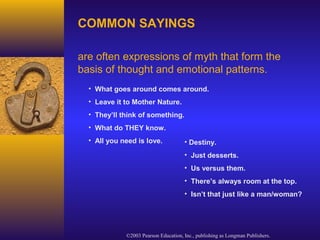
• What goes around comes around.
• Leave it to Mother Nature.
• They’ll think of something.
• What do THEY know.
• All you need is love. • Destiny.
• Just desserts.
• Us versus them.
• There’s always room at the top.
• Isn’t that just like a man/woman?
COMMON SAYINGS
are often expressions of myth that form the
basis of thought and emotional patterns.
©2003 Pearson Education, Inc., publishing as Longman Publishers.
MYTHS OF CHILDHOOD
offer
• A reassurance of safety and love
• A recognition of stereotypical gender roles,
class distinctions, and
the notion that good and evil are based
on physical appearance
• A recognition of the importance of names
• A recognition of the dark side
©2003 Pearson Education, Inc., publishing as Long
MYTH AS EXPLANATION
• to understanding
natural phenomena
&
• to understanding
human tragedy
is A KEY
©2003 Pearson Education, Inc., publishing as Longman Publishers.
• The natural world
• The origins of evil
• The myth of the doomed family
MYTHS OF EXPLANATION HELP
PEOPLE UNDERSTAND
©2003 Pearson Education, Inc., publishing as Long
ARCHETYPES IN
MYTHOLOGY
are KEYS
to understanding the
common threads that
link people of all
cultures and all times.
©2003 Pearson Education, Inc., publishing as Longman Publishers.
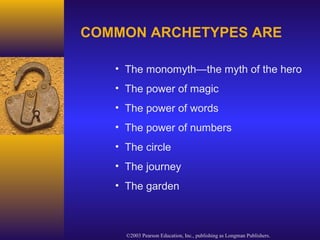
COMMON ARCHETYPES ARE
• The monomyth—the myth of the hero
• The power of magic
• The power of words
• The power of numbers
• The circle
• The journey
• The garden

Myth

  • 1.
    ©2003 Pearson Education,Inc., publishing as Long The Art of Being Human, 7/e Chapter 3 – Myth PowerPoint by Julie Rodakowski
  • 2.
    ©2003 Pearson Education,Inc., publishing as Long POPULAR MYTHOLOGY is A KEY to evaluating thought and emotional patterns
  • 3.
    ©2003 Pearson Education,Inc., publishing as Longman Publishers. • What goes around comes around. • Leave it to Mother Nature. • They’ll think of something. • What do THEY know. • All you need is love. • Destiny. • Just desserts. • Us versus them. • There’s always room at the top. • Isn’t that just like a man/woman? COMMON SAYINGS are often expressions of myth that form the basis of thought and emotional patterns.
  • 4.
    ©2003 Pearson Education,Inc., publishing as Longman Publishers. MYTHS OF CHILDHOOD offer • A reassurance of safety and love • A recognition of stereotypical gender roles, class distinctions, and the notion that good and evil are based on physical appearance • A recognition of the importance of names • A recognition of the dark side
  • 5.
    ©2003 Pearson Education,Inc., publishing as Long MYTH AS EXPLANATION • to understanding natural phenomena & • to understanding human tragedy is A KEY
  • 6.
    ©2003 Pearson Education,Inc., publishing as Longman Publishers. • The natural world • The origins of evil • The myth of the doomed family MYTHS OF EXPLANATION HELP PEOPLE UNDERSTAND
  • 7.
    ©2003 Pearson Education,Inc., publishing as Long ARCHETYPES IN MYTHOLOGY are KEYS to understanding the common threads that link people of all cultures and all times.
  • 8.
    ©2003 Pearson Education,Inc., publishing as Longman Publishers. COMMON ARCHETYPES ARE • The monomyth—the myth of the hero • The power of magic • The power of words • The power of numbers • The circle • The journey • The garden