Classical Greece 
Including CULTURE
1. Migration INTO Greece 
 *Indo-European Invasions* 
2000 – 1000 BCE 
 Minoans 
 Anatolian Invaders 
included: 
– Dorians  Sparta 
– Ionians  Athens
2. Greece: Product of its Geography 
 Peninsula 
 Dry rocky soil 
 Steep high 
mountains, low 
valleys; not much flat 
terrain or rich soil 
 Almost no rivers – 
none navigable
The Mediterranean Sea…
Geography 
 Coastal Location  
– Sea trade 
– Cultural Diffusion 
 Exports: Ag. Products: 
– Wine, Olive oil, Wool. 
 Imports: 
– GRAIN!! 
– Metals! 
– Wood!
THE MAP
Greek & Phoenician Colonies 
due to : 
- Shortage of Land for Agriculture 
- Demand for Raw Materials 
- Markets for their goods.
More Effects of Geography 
  COLONIES 
– Excess population 
– Plantations to raise grain to 
sell in Greece 
– Political time out! 
– Markets for Greek goods 
– Access to raw materials 
 Trading alliances necessary! 
– To be able to count on trade. 
  Powerful Military! 
– Just in case.
Significance of Colonization 
 Cultural Diffusion 
– Mediterranean 
Rise of non-aristocrats 
to 
power !! 
– Trade led to wealth, and 
wealth began to rival birth 
as basis of political power… 
Plaka, Athens 
750- 550 BCE
Archons 
Archons – noblemen 
 Draco (c. 622 BCE) 
 Draconian (harsh) Laws 
 Solon (594 BCE) 
 Cleisthenes - “one Greek is as capable 
as another” 
– Citizen=all natural born males over 18 
(10%) 
– Constitution- 508 BCE- Much power in hands of citizens: 
– Ostracize one man per yr by popular vote (ten year period). 
– Legislative Council - 500 citizen - administrative officials chosen by 
lot for 1 yr terms 
– Popular court of 6000 citizens- rotation in office. 
– Army - board of 10 generals elected by citizens. 
Ostraka
600- 500 BCE 
Tyrant: sole ruler in a Greek 
polis, who came to power illegally. 
 First step toward democracy! 
– Opposition to power of nobility 
 Merchants and others in rising middle class 
– extended social rights, 
– patronized the arts, 
– encouraged development of law, 
– Encouraged trade.
 Monarchy – rule by “one” (mono); 
in usage, by a king 
 Aristocracy – rule by aristocrats; nobility 
 Oligarchy – rule by a “group”; in practice, by an 
elite, either military or wealthy 
 Democracy - rule by the “people” (demos) 
Amphora
(Poleis, plural) 
 Small, informed population 
NECESSARY: 
– Debate & decisions by 
assembly of ALL citizens. 
– 500-5,000 / polis 
 “All”…“Greeks:” 
FREE & RATIONAL:
750 – 500 BCE 
 Government DECENTRALIZED 
– never unified 
 Frequent competition / 
conflict with other poleis
Still, A Sense of Greek Unity… 
Arete… 
Greek Language 
 Oracle at Delphi 
 Festivals & Meetings
Greek Religion 
 Polytheistic 
 Humanlike gods with 
human emotions. 
 Immortal. 
 12 most powerful “lived” 
on Mt. Olympus 
Each Polis had its own 
god/goddess: Athena… 
Also thematically-based 
deities: Eros, Aphrodite…
Mountains in Northern Greece
Social Hierarchy of the Polis 
1. Citizens = STAKE HOLDERS – 10% 
– Adult males, NOT WOMEN! 
– Stake holders engaged in commerce, agriculture 
– NOT foreigners!! 
2. Free People with no rights 
– Underage men 
– Women 
– Men without a “stake” in the politics 
– and future of the polis 
3. Non-citizens 
– Slaves, who accounted for about 1/3 of people in 
Athens 
– Foreigners
Slavery in Athens 
 How did one become a slave? 
– Born to slaves 
– POW 
– Criminal  mines, ship’s crew 
– Exposed as an infant 
– Sold by a parent in debt 
(daughter, usually) 
– Kidnapping 
Aphora: Slave nanny 
takes baby from 
her mistress
Slavery in Athens 
How did it differ from slavery of helots in Sparta? 
Private property - “Chattel” 
– Unskilled 
– Skilled and educated 
– Some bought their own freedom 
– Publicly owned slaves 
– Professionals / Specialists: 
Lived separately
Sparta 
 Dorians conquered and enslaved 
inhabitants “helots” for hard 
labor. 
 Spartan citizens = 10% 
of pop! 
 Militarist/physical training from 
young age 
 Little literature, art, architecture 
 Totalitarian Government
THIS IS Sparta! 
 Military Oligarchy 
 Political organization: 
– 2 figurehead kings 
– An aristocratic council 
– Assembly of citizens over the age of 30 
– 5 “ephors” elected annually by the assembly 
and were the actual rulers of Sparta. 
– No discord/political revolution allowed 
– Commerce & outside contact discouraged - to 
guard against corrupting influence of wealth & 
new ideas
Comparing Sparta & Athens 
 Education- state 
controlled 
– emphasized physical training 
& military discipline. 
– Children of 7 selected for 
army and left homes 
 Women had all rights 
except voting 
– Physical training 
– Purpose: raise strong boys to 
be future soldiers 
 Little trade, contact with 
outside world- mostly 
agricultural & militaristic 
 Education private - 
emphasized personal, 
intellectual, & physical 
development: 
– Music, literature, art 
– 2 years mandatory military 
service at age 18 
 Women not citizens and 
had few rights. 
– Educated in household duties 
only 
 Active in trade & 
commerce with colonies, 
other countries.
Art & Architecture 
Culture 
Athens - Acropolis
Athens today
Persian Wars 
550- 400 BCE 
 Reported by Herodotus 
 Greek Ionians Revolted 
against Persian overlords in 
Asia Minor (now Turkey). 
 Athens supported the 
revolt.
Greek War Technology 
 Battle of Thermopylae Pass- 300 
Spartans slaughtered. Athenians 
evacuated while city burned. 
 Brilliant Athenian naval victory at 
Straits of Salamis 
 Battle of Platea- combined Greek force 
defeated Persians, forcing Persia to 
retreat, and liberation of Ionia.
Significance of Greek Victory 
over Persians 
 Aegean Sea controlled 
by Athens  
 Spread of Athenian 
commerce  
 Spread of Athenian 
culture 
Golden Age of Pericles – “Classical” 
(461- 429 BCE) 
Pericles dominated 
Athens for 30 years 
– Strengthened democracy 
in Athens 
– Built a Commercial 
Empire 
– Glorified & Beautified 
Athens (ie: built 
Parthenon)
The Beginning of the End for the Athenian Empire… 
 Delian League 477 BCE 
– 140 eastern city-states 
 Defensive measure 
 Ships & money from member city-states 
 became foundation of Athenian 
Empire (treasury moved to Athens)... 
 Athens forcibly prevented secession 
from League…
Delian League
A Question of POV 
Sparta 
 Militaristic POV 
– Saw Athens spreading 
commercially 
– Saw Athens control dependent 
states 
 Government by elites – “old 
world view” – security, 
isolation… 
– Concerned that Athens was 
strong enough to beat 
Persia… 
 SUSPICIOUS! 
Athens 
 Trade, Cultural Interests 
– Building military might for 
defense against 
Persia…and…squelching 
uprisings…. 
 Government by Popular 
Democracy 
– Concerned about 
GROWTH! for trade… 
 Naïve - spreading colonies 
& military / trade alliances 
even around areas Sparta 
considered its sphere of 
influence.
• Peloponnesian League 
Sparta & 
Corinth- 
Rivals of 
Athens. 
431 BCE-Wars 
began
Athens Lost Hegemony! 
The Four P’s 
 Plague - killed ¼- 1/3 Athens population, 
including Pericles  Power Vacuum  Panic, 
lawlessness, terror in Athens 421- 415 BCE-Temporary 
Peace 
 Poor Judgement- 415 BCE- Under new 
leadership, Athens attacked Sicily  escalation 
of war during time of temporary negotiated peace 
Persia allied with Sparta - Athens surrendered, 
becoming a puppet state of Sparta. 
 
 Phillip of Macedon, 338, BCE, with the assistance of 
his son, Alexander. Defeated the exhausted Greeks.
Legacy of Classical Greece 
Culture
1. Philosophy 
Philosopher= One who 
Loves Wisdom 
Based on two assumptions: 
– The universe is orderly 
with unchanging laws 
– People can understand 
these laws through 
REASON
Sophists (arrived from Ionia during Peloponnesian War) 
 Brought skeptical humanism: 
Elevated mankind to a central place in the Universe. 
“Man is the measure of all 
things.” 
 Made a living teaching discourse & rhetoric to wealthy 
young men - important skills in a democracy. 
 Questioned supremacy of the gods during the stalemated 
Peloponnesian war
Plato (427- 347 BCE) 
Established the basis for Western philosophy. 
The Republic 
State’s function: to satisfy the common good. 
Common man is unfit to govern himself. 
Outlined a Utopia founded on justice, with: 
– workers providing the necessities of life, 
– warriors acting as guards, 
– Philosophers as kings. 
– No private property or family organization 
– education regulated by the state.
Aristotle (384- 322 BCE) 
 Helped develop rational, scientific 
thought… Scientific Method: based on 
OBSERVATION 
 The Politics - the first analytical examination of 
politics as a social science.
Plato 
Aristotle 
School of Athens 
Raphael
Socrates (from Athens) 
To Define, through ceaseless 
questioning, what was good in the 
soul. 
–Socratic Method
Death of Socrates 
by Jaques Louis David 
Brought to trial for 
corrupting the minds of 
the Young. 
501 jurors heard the case. 
Defense: his teachings were 
good as they encouraged 
people to think about their 
values and actions. 
Condemned to either 
ostracism or death by poison.
2. Drama 
 Religious festivals… 
 Moved into entertainment 
realm…
Drama 
Public Education 
– Power of the people, and of the leaders 
– Justice, morality, War & Peace, Duty to the 
Gods, Family 
– Importance of the Polis 
Festivals like Olympics for Drama- 
– Aeschylus (525- 455 BCE) – 
won 13x, wrote over 30 plays (only 7 
survived). Tragedies. Favored by Pericles. 
– Sophocles (497- 405 BCE) – 
wrote 100 plays- “Oedipus” most 
famous. (Antigone is Odeipus’ 
daughter)
Euripides 
 Tragedies 
 Euripides' greatest works include 
Alcestis, Medea, Trojan Women, and 
the Bacchae. 
 Strong female characters, 
intelligent slaves. 
 Satirized many heroes of Greek mythology. His 
plays seem modern by comparison with those 
of his contemporaries, focusing on the inner 
lives and motives of his characters in a way 
previously unknown to Greek audiences.
Amphitheatre at the Acropolis
Amphitheatre at Delphi
3. Literature 
– Aristophanes- first 
comedic play: political 
satire 
– Sappho- female poet 
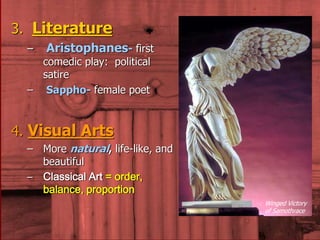
4. Visual Arts 
– More natural, life-like, and 
beautiful 
– Classical Art = order, 
balance, proportion 
Winged Victory 
of Samothrace
Classical Greek Sculpture 
 Goal: 
Portrayal of 
perfect 
balance & 
harmony - 
mirrors Greek 
philosophy.
Contraposto 
 Most significant change 
in sculpture to that date. 
–Counterbalance / 
s-curve of the body. 
– Perfect Ideal of the 
Human Body
Archaic 
“Contraposto” 
Classical Period: IDEALIZATION 
the Eternal Pose & Aloof Expression = reasoned control
430-323 BCE 
Late Classical 
 Thinner, more graceful, 
sinuous 
 Seen from all angles, 
just as real, beautiful, 
correct, and natural – 
more 3-D…. they seem 
to be alive!
Hellenistic 
 Poses were 
– Even less rigid & more fluid 
– More lifelike 
– More emotion exhibited 
 Hellenistic period: so much 
personality that they could be 
whimsical, passionate… 
 A single moment in 
real time
Hellenistic 
Almost classical in 
serene expressions 
Natural poses 
& drape of 
clothes
Laocoon and His Sons 
Subject of a lost play by Sophocles 
“Beware of Greeks bearing gifts.” Punished for advising Trojans not to accept 
Trojan Horse, and for having sons… 
Classical topic, 
Hellenistic treatment 
Now in Vatican Museum
Quiz: Archaic, Early Classical, Late 
Classical? 
Eros Sleeping 
The Charioteer 
Mars 
The Thorn 
The Dying Gaul
5. History 
 Herodotus 
(485- 425 BCE) 
– The “father of history” 
– Wrote “The History of the Persian Wars” 
 Thucydides (460- 400 BCE) 
– One of 10 generals of Athens exiled for 20 yrs 
– Wrote about Peloponnesian Wars and was 1st 
scientifically critical historian. 
– Considered History utilitarian: one could learn 
from study of the past.
6. Mathematics 
 Euclid & Pythagoras 
– laid foundations of 
mathematical sciences 
– Worked out the 
principles of Geometry 
 Erastothenes- 
– Earth is a sphere & 
computed its size 
 Strabo- Geography 
 Ptolemy- astronomy 
 Galen- medicine
Medicine 
 Hypocrites 
– Physician - Age of Pericles 
– Medicine as disciplined 
profession, not 
philosophy or art 
– Hippocratic Oath 
– Borrowed heavily from 
Egyptian medicine 
- Professional tools
Greek Technologies 
Water Technologies: 
 Aqueducts 
 Fire hoses 
 Sewer & drainage 
systems 
 Fountains 
 Baths & showers 
 Sanitary facilities 
 Water clock 
 Water Organ 
 Cranes, winches, levers, 
fulcrum 
 Torsion catapult 
 Lighthouse 
 Water / Steam-operated 
machines and toys 
 Automatic Door 
 Central Heating 
 Astrolabe 
 The Gear, Screw, Rotary 
Mills, Screw Press…
Archimedes 
Mathematician, Physicist, Engineer, 
Inventor, Astronomer 
“Give me a place to stand on, and I 
will move the earth!”
Architecture 
 Moderation, Balance, 
Proportion, Poise 
– Themes of famous buildings 
such as the Parthenon & 
Erecthion.
Greek Columns 
Doric 
The Doric style is rather sturdy and its 
top (the capital), is plain. This style was 
used in mainland Greece and the 
colonies in southern Italy and Sicily. 
Ionic 
The Ionic style is thinner and more 
elegant. Its capital is decorated with a 
scroll-like design (a volute). This style 
was found in eastern Greece and the 
islands. 
Corinthian 
The Corinthian style is seldom used in 
the Greek world, but often seen on 
Roman temples. Its capital is very 
elaborate and decorated with acanthus 
leaves.
The Golden Ratio 
“Some of the greatest mathematical minds of all ages, from 
Pythagoras and Euclid in Ancient Greece, through the medieval 
Italian mathematician Leonardo of Pisa and the Renaissance 
astronomer Johannes Kepler, to present-day scientific figures such 
as Oxford physicist Roger Penrose, have spent endless hours over 
this simple ratio and its properties. 
But the fascination with the Golden Ratio is not confined just to 
mathematicians. Biologists, artists, musicians, historians, architects, 
psychologists, and even mystics have pondered and debated the 
basis of its …appeal. In fact, it is probably fair to say that the 
Golden Ratio has inspired thinkers of all disciplines like no other 
number in the history of mathematics.” 
— Mario Livio, The Golden Ratio: The Story of Phi, The 
World's Most Astonishing Number
 DaVinci’s Vitruvius Man “Divine Proportion” 
…Art, 
Architecture, 
Math, Nature!
Listen to the “Music of the Spheres” for 
yourself: 
http://www.youtube.com/watch?v=5BSGdX7eNn4&feature=related 
http://www.youtube.com/watch?v=jYq3g_zhbTo&feature=related
Emergence of 
Hellenistic Greece
Emergence of Hellenic Greece: 
Macedonian Ascendancy 
Phillip II of Macedonia- 
- 338 BCE- defeated forces of 
Thebes/Athens 
– Assassinated 336 BCE and 
Alexander, his son, acceded to 
throne.
Alexander the Great 
 King at age 20 
 Brilliant strategist 
& inspired leader 
 Conquered Greece 
 Punished Thebes 
by making slaves 
of citizens  
other poleis did 
not resist him. 
Tutor – Aristotle 
Carried Greek values , technology, culture everywhere he went: “Hellenizing”
Alexander the Great 
– Freed Egypt from 
Persian rule 
– Married an 
Egyptian 
Princess and 
became Pharaoh 
 Alexander as pharaoh 
on a relief in Luxor in the 
temple of Amenhotep III
Alexandria, Egypt 
 Light House 
 Library with 500,000 papyrus 
scrolls used for research 
 Art Gallery 
 Zoo 
 Gardens 
 Observatory 
… the BEST of MANY Alexandrias!
Library of Alexandria
Defeat of Persia 
 Continued East…conquering and 
Helenizing and urbanizing as 
he went… all the way to Bactria, in 
Northern India. 
 Defeated Persia 
 Married Persian princess, 
Roxane 
 Wanted troops to intermarry with 
conquered peoples to create a ruling 
class combining Greek, Macedonian, 
and Persian ancestry… to rule the 
“world.”
Alexander 
He and his soldiers 
traveled 7 years, and 
11,000 miles. 
His goal was to 
conquer all the way 
to CHINA… Why? 
What were his troops’ 
goals?
Death of Alexander 
 On the way home, died of a 
“fever”…or?... on June 10, 
323 BCE at age 33. 
Last words of Alexander: When 
asked who should inherit his 
empire he answered “..the 
strong ones…” 
His generals took his words to 
mean that he intended them 
to divide his empire among 
themselves... What do YOU 
think?
Dividing an Empire
Meanwhile, in Rome… 
Roman Culture was 
built on Greek Ideals

Greece 2014

  • 1.
  • 2.
    1. Migration INTOGreece  *Indo-European Invasions* 2000 – 1000 BCE  Minoans  Anatolian Invaders included: – Dorians  Sparta – Ionians  Athens
  • 3.
    2. Greece: Productof its Geography  Peninsula  Dry rocky soil  Steep high mountains, low valleys; not much flat terrain or rich soil  Almost no rivers – none navigable
  • 4.
  • 5.
    Geography  CoastalLocation  – Sea trade – Cultural Diffusion  Exports: Ag. Products: – Wine, Olive oil, Wool.  Imports: – GRAIN!! – Metals! – Wood!
  • 6.
  • 7.
    Greek & PhoenicianColonies due to : - Shortage of Land for Agriculture - Demand for Raw Materials - Markets for their goods.
  • 8.
    More Effects ofGeography   COLONIES – Excess population – Plantations to raise grain to sell in Greece – Political time out! – Markets for Greek goods – Access to raw materials  Trading alliances necessary! – To be able to count on trade.   Powerful Military! – Just in case.
  • 9.
    Significance of Colonization  Cultural Diffusion – Mediterranean Rise of non-aristocrats to power !! – Trade led to wealth, and wealth began to rival birth as basis of political power… Plaka, Athens 750- 550 BCE
  • 10.
    Archons Archons –noblemen  Draco (c. 622 BCE)  Draconian (harsh) Laws  Solon (594 BCE)  Cleisthenes - “one Greek is as capable as another” – Citizen=all natural born males over 18 (10%) – Constitution- 508 BCE- Much power in hands of citizens: – Ostracize one man per yr by popular vote (ten year period). – Legislative Council - 500 citizen - administrative officials chosen by lot for 1 yr terms – Popular court of 6000 citizens- rotation in office. – Army - board of 10 generals elected by citizens. Ostraka
  • 11.
    600- 500 BCE Tyrant: sole ruler in a Greek polis, who came to power illegally.  First step toward democracy! – Opposition to power of nobility  Merchants and others in rising middle class – extended social rights, – patronized the arts, – encouraged development of law, – Encouraged trade.
  • 12.
     Monarchy –rule by “one” (mono); in usage, by a king  Aristocracy – rule by aristocrats; nobility  Oligarchy – rule by a “group”; in practice, by an elite, either military or wealthy  Democracy - rule by the “people” (demos) Amphora
  • 13.
    (Poleis, plural) Small, informed population NECESSARY: – Debate & decisions by assembly of ALL citizens. – 500-5,000 / polis  “All”…“Greeks:” FREE & RATIONAL:
  • 14.
    750 – 500BCE  Government DECENTRALIZED – never unified  Frequent competition / conflict with other poleis
  • 15.
    Still, A Senseof Greek Unity… Arete… Greek Language  Oracle at Delphi  Festivals & Meetings
  • 16.
    Greek Religion Polytheistic  Humanlike gods with human emotions.  Immortal.  12 most powerful “lived” on Mt. Olympus Each Polis had its own god/goddess: Athena… Also thematically-based deities: Eros, Aphrodite…
  • 17.
  • 18.
    Social Hierarchy ofthe Polis 1. Citizens = STAKE HOLDERS – 10% – Adult males, NOT WOMEN! – Stake holders engaged in commerce, agriculture – NOT foreigners!! 2. Free People with no rights – Underage men – Women – Men without a “stake” in the politics – and future of the polis 3. Non-citizens – Slaves, who accounted for about 1/3 of people in Athens – Foreigners
  • 19.
    Slavery in Athens  How did one become a slave? – Born to slaves – POW – Criminal  mines, ship’s crew – Exposed as an infant – Sold by a parent in debt (daughter, usually) – Kidnapping Aphora: Slave nanny takes baby from her mistress
  • 20.
    Slavery in Athens How did it differ from slavery of helots in Sparta? Private property - “Chattel” – Unskilled – Skilled and educated – Some bought their own freedom – Publicly owned slaves – Professionals / Specialists: Lived separately
  • 22.
    Sparta  Doriansconquered and enslaved inhabitants “helots” for hard labor.  Spartan citizens = 10% of pop!  Militarist/physical training from young age  Little literature, art, architecture  Totalitarian Government
  • 23.
    THIS IS Sparta!  Military Oligarchy  Political organization: – 2 figurehead kings – An aristocratic council – Assembly of citizens over the age of 30 – 5 “ephors” elected annually by the assembly and were the actual rulers of Sparta. – No discord/political revolution allowed – Commerce & outside contact discouraged - to guard against corrupting influence of wealth & new ideas
  • 24.
    Comparing Sparta &Athens  Education- state controlled – emphasized physical training & military discipline. – Children of 7 selected for army and left homes  Women had all rights except voting – Physical training – Purpose: raise strong boys to be future soldiers  Little trade, contact with outside world- mostly agricultural & militaristic  Education private - emphasized personal, intellectual, & physical development: – Music, literature, art – 2 years mandatory military service at age 18  Women not citizens and had few rights. – Educated in household duties only  Active in trade & commerce with colonies, other countries.
  • 25.
    Art & Architecture Culture Athens - Acropolis
  • 26.
  • 30.
    Persian Wars 550-400 BCE  Reported by Herodotus  Greek Ionians Revolted against Persian overlords in Asia Minor (now Turkey).  Athens supported the revolt.
  • 31.
    Greek War Technology  Battle of Thermopylae Pass- 300 Spartans slaughtered. Athenians evacuated while city burned.  Brilliant Athenian naval victory at Straits of Salamis  Battle of Platea- combined Greek force defeated Persians, forcing Persia to retreat, and liberation of Ionia.
  • 32.
    Significance of GreekVictory over Persians  Aegean Sea controlled by Athens   Spread of Athenian commerce   Spread of Athenian culture 
  • 33.
    Golden Age ofPericles – “Classical” (461- 429 BCE) Pericles dominated Athens for 30 years – Strengthened democracy in Athens – Built a Commercial Empire – Glorified & Beautified Athens (ie: built Parthenon)
  • 34.
    The Beginning ofthe End for the Athenian Empire…  Delian League 477 BCE – 140 eastern city-states  Defensive measure  Ships & money from member city-states  became foundation of Athenian Empire (treasury moved to Athens)...  Athens forcibly prevented secession from League…
  • 35.
  • 36.
    A Question ofPOV Sparta  Militaristic POV – Saw Athens spreading commercially – Saw Athens control dependent states  Government by elites – “old world view” – security, isolation… – Concerned that Athens was strong enough to beat Persia…  SUSPICIOUS! Athens  Trade, Cultural Interests – Building military might for defense against Persia…and…squelching uprisings….  Government by Popular Democracy – Concerned about GROWTH! for trade…  Naïve - spreading colonies & military / trade alliances even around areas Sparta considered its sphere of influence.
  • 37.
    • Peloponnesian League Sparta & Corinth- Rivals of Athens. 431 BCE-Wars began
  • 38.
    Athens Lost Hegemony! The Four P’s  Plague - killed ¼- 1/3 Athens population, including Pericles  Power Vacuum  Panic, lawlessness, terror in Athens 421- 415 BCE-Temporary Peace  Poor Judgement- 415 BCE- Under new leadership, Athens attacked Sicily  escalation of war during time of temporary negotiated peace Persia allied with Sparta - Athens surrendered, becoming a puppet state of Sparta.   Phillip of Macedon, 338, BCE, with the assistance of his son, Alexander. Defeated the exhausted Greeks.
  • 39.
    Legacy of ClassicalGreece Culture
  • 40.
    1. Philosophy Philosopher=One who Loves Wisdom Based on two assumptions: – The universe is orderly with unchanging laws – People can understand these laws through REASON
  • 41.
    Sophists (arrived fromIonia during Peloponnesian War)  Brought skeptical humanism: Elevated mankind to a central place in the Universe. “Man is the measure of all things.”  Made a living teaching discourse & rhetoric to wealthy young men - important skills in a democracy.  Questioned supremacy of the gods during the stalemated Peloponnesian war
  • 42.
    Plato (427- 347BCE) Established the basis for Western philosophy. The Republic State’s function: to satisfy the common good. Common man is unfit to govern himself. Outlined a Utopia founded on justice, with: – workers providing the necessities of life, – warriors acting as guards, – Philosophers as kings. – No private property or family organization – education regulated by the state.
  • 43.
    Aristotle (384- 322BCE)  Helped develop rational, scientific thought… Scientific Method: based on OBSERVATION  The Politics - the first analytical examination of politics as a social science.
  • 44.
    Plato Aristotle Schoolof Athens Raphael
  • 45.
    Socrates (from Athens) To Define, through ceaseless questioning, what was good in the soul. –Socratic Method
  • 46.
    Death of Socrates by Jaques Louis David Brought to trial for corrupting the minds of the Young. 501 jurors heard the case. Defense: his teachings were good as they encouraged people to think about their values and actions. Condemned to either ostracism or death by poison.
  • 47.
    2. Drama Religious festivals…  Moved into entertainment realm…
  • 48.
    Drama Public Education – Power of the people, and of the leaders – Justice, morality, War & Peace, Duty to the Gods, Family – Importance of the Polis Festivals like Olympics for Drama- – Aeschylus (525- 455 BCE) – won 13x, wrote over 30 plays (only 7 survived). Tragedies. Favored by Pericles. – Sophocles (497- 405 BCE) – wrote 100 plays- “Oedipus” most famous. (Antigone is Odeipus’ daughter)
  • 49.
    Euripides  Tragedies  Euripides' greatest works include Alcestis, Medea, Trojan Women, and the Bacchae.  Strong female characters, intelligent slaves.  Satirized many heroes of Greek mythology. His plays seem modern by comparison with those of his contemporaries, focusing on the inner lives and motives of his characters in a way previously unknown to Greek audiences.
  • 50.
  • 51.
  • 52.
    3. Literature –Aristophanes- first comedic play: political satire – Sappho- female poet 4. Visual Arts – More natural, life-like, and beautiful – Classical Art = order, balance, proportion Winged Victory of Samothrace
  • 53.
    Classical Greek Sculpture  Goal: Portrayal of perfect balance & harmony - mirrors Greek philosophy.
  • 54.
    Contraposto  Mostsignificant change in sculpture to that date. –Counterbalance / s-curve of the body. – Perfect Ideal of the Human Body
  • 55.
    Archaic “Contraposto” ClassicalPeriod: IDEALIZATION the Eternal Pose & Aloof Expression = reasoned control
  • 56.
    430-323 BCE LateClassical  Thinner, more graceful, sinuous  Seen from all angles, just as real, beautiful, correct, and natural – more 3-D…. they seem to be alive!
  • 58.
    Hellenistic  Poseswere – Even less rigid & more fluid – More lifelike – More emotion exhibited  Hellenistic period: so much personality that they could be whimsical, passionate…  A single moment in real time
  • 59.
    Hellenistic Almost classicalin serene expressions Natural poses & drape of clothes
  • 60.
    Laocoon and HisSons Subject of a lost play by Sophocles “Beware of Greeks bearing gifts.” Punished for advising Trojans not to accept Trojan Horse, and for having sons… Classical topic, Hellenistic treatment Now in Vatican Museum
  • 61.
    Quiz: Archaic, EarlyClassical, Late Classical? Eros Sleeping The Charioteer Mars The Thorn The Dying Gaul
  • 62.
    5. History Herodotus (485- 425 BCE) – The “father of history” – Wrote “The History of the Persian Wars”  Thucydides (460- 400 BCE) – One of 10 generals of Athens exiled for 20 yrs – Wrote about Peloponnesian Wars and was 1st scientifically critical historian. – Considered History utilitarian: one could learn from study of the past.
  • 63.
    6. Mathematics Euclid & Pythagoras – laid foundations of mathematical sciences – Worked out the principles of Geometry  Erastothenes- – Earth is a sphere & computed its size  Strabo- Geography  Ptolemy- astronomy  Galen- medicine
  • 64.
    Medicine  Hypocrites – Physician - Age of Pericles – Medicine as disciplined profession, not philosophy or art – Hippocratic Oath – Borrowed heavily from Egyptian medicine - Professional tools
  • 65.
    Greek Technologies WaterTechnologies:  Aqueducts  Fire hoses  Sewer & drainage systems  Fountains  Baths & showers  Sanitary facilities  Water clock  Water Organ  Cranes, winches, levers, fulcrum  Torsion catapult  Lighthouse  Water / Steam-operated machines and toys  Automatic Door  Central Heating  Astrolabe  The Gear, Screw, Rotary Mills, Screw Press…
  • 66.
    Archimedes Mathematician, Physicist,Engineer, Inventor, Astronomer “Give me a place to stand on, and I will move the earth!”
  • 67.
    Architecture  Moderation,Balance, Proportion, Poise – Themes of famous buildings such as the Parthenon & Erecthion.
  • 68.
    Greek Columns Doric The Doric style is rather sturdy and its top (the capital), is plain. This style was used in mainland Greece and the colonies in southern Italy and Sicily. Ionic The Ionic style is thinner and more elegant. Its capital is decorated with a scroll-like design (a volute). This style was found in eastern Greece and the islands. Corinthian The Corinthian style is seldom used in the Greek world, but often seen on Roman temples. Its capital is very elaborate and decorated with acanthus leaves.
  • 70.
    The Golden Ratio “Some of the greatest mathematical minds of all ages, from Pythagoras and Euclid in Ancient Greece, through the medieval Italian mathematician Leonardo of Pisa and the Renaissance astronomer Johannes Kepler, to present-day scientific figures such as Oxford physicist Roger Penrose, have spent endless hours over this simple ratio and its properties. But the fascination with the Golden Ratio is not confined just to mathematicians. Biologists, artists, musicians, historians, architects, psychologists, and even mystics have pondered and debated the basis of its …appeal. In fact, it is probably fair to say that the Golden Ratio has inspired thinkers of all disciplines like no other number in the history of mathematics.” — Mario Livio, The Golden Ratio: The Story of Phi, The World's Most Astonishing Number
  • 71.
     DaVinci’s VitruviusMan “Divine Proportion” …Art, Architecture, Math, Nature!
  • 72.
    Listen to the“Music of the Spheres” for yourself: http://www.youtube.com/watch?v=5BSGdX7eNn4&feature=related http://www.youtube.com/watch?v=jYq3g_zhbTo&feature=related
  • 73.
  • 74.
    Emergence of HellenicGreece: Macedonian Ascendancy Phillip II of Macedonia- - 338 BCE- defeated forces of Thebes/Athens – Assassinated 336 BCE and Alexander, his son, acceded to throne.
  • 76.
    Alexander the Great  King at age 20  Brilliant strategist & inspired leader  Conquered Greece  Punished Thebes by making slaves of citizens  other poleis did not resist him. Tutor – Aristotle Carried Greek values , technology, culture everywhere he went: “Hellenizing”
  • 77.
    Alexander the Great – Freed Egypt from Persian rule – Married an Egyptian Princess and became Pharaoh  Alexander as pharaoh on a relief in Luxor in the temple of Amenhotep III
  • 78.
    Alexandria, Egypt Light House  Library with 500,000 papyrus scrolls used for research  Art Gallery  Zoo  Gardens  Observatory … the BEST of MANY Alexandrias!
  • 79.
  • 80.
    Defeat of Persia  Continued East…conquering and Helenizing and urbanizing as he went… all the way to Bactria, in Northern India.  Defeated Persia  Married Persian princess, Roxane  Wanted troops to intermarry with conquered peoples to create a ruling class combining Greek, Macedonian, and Persian ancestry… to rule the “world.”
  • 82.
    Alexander He andhis soldiers traveled 7 years, and 11,000 miles. His goal was to conquer all the way to CHINA… Why? What were his troops’ goals?
  • 83.
    Death of Alexander  On the way home, died of a “fever”…or?... on June 10, 323 BCE at age 33. Last words of Alexander: When asked who should inherit his empire he answered “..the strong ones…” His generals took his words to mean that he intended them to divide his empire among themselves... What do YOU think?
  • 84.
  • 85.
    Meanwhile, in Rome… Roman Culture was built on Greek Ideals