
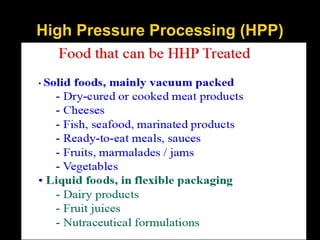
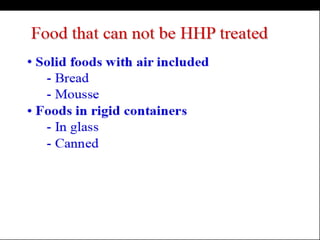
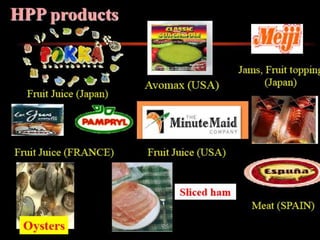
High Pressure Processing (HPP)
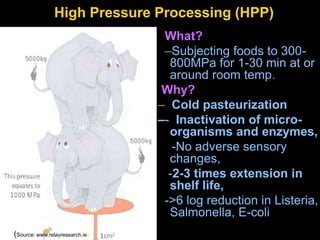
What?
–Subjecting foods to 300-
800MPa for 1-30 min at or
around room temp.
Why?
– Cold pasteurization
–- Inactivation of micro-
organisms and enzymes,
-No adverse sensory
changes,
-2-3 times extension in
shelf life,
->6 log reduction in Listeria,
Salmonella, E-coli
(Source: www.relayresearch.ie).
High Pressure Processing (HPP)
History
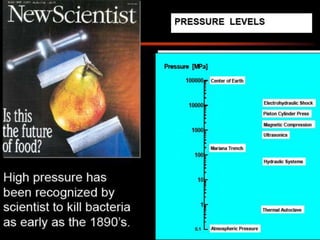
• HPP has been recognized by scientist to kill bacteria as
early as the 1890’s.
Effects of HHP on organisms
• Viable bacteria on water samples collected from 5100 m
depth ( 50 MPa) . Certes, 1883
• Reduction of spoilage organism by HHP (Hite 1899)-1st
time in food
• From Milk and meat products to fruits and vegetables ( Hite
et.al,1914)
• Peaches and pears treated at 400 MPa for 30 min at room
temperature – good after 5 years of storage
• European, Japanese and US food Industries are investing
on HPP research
High Pressure Processing (HPP)
• Non thermal in nature
• Inactivates the vegetative microorganisms, spores
and enzymes
• Increase in shelf life of foods
• Denatures proteins and polysaccharides
• Interesting application in the area of food
texturization
• Development of novel foods of superior nutritional
and sensory quality
• Higher safety
• Increased ambient shelf life
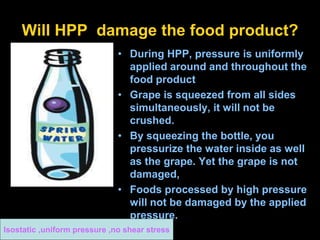
Will HPP damage the food product?
• During HPP, pressure is uniformly
applied around and throughout the
food product
• Grape is squeezed from all sides
simultaneously, it will not be
crushed.
• By squeezing the bottle, you
pressurize the water inside as well
as the grape. Yet the grape is not
damaged,
• Foods processed by high pressure
will not be damaged by the applied
pressure.
Isostatic ,uniform pressure ,no shear stress
High Pressure Processing (HPP)
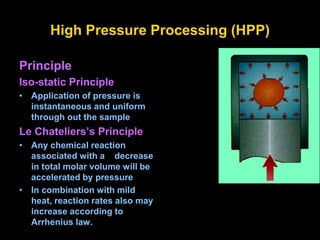
Principle
Iso-static Principle
• Application of pressure is
instantaneous and uniform
through out the sample
Le Chateliers’s Principle
• Any chemical reaction
associated with a decrease
in total molar volume will be
accelerated by pressure
• In combination with mild
heat, reaction rates also may
increase according to
Arrhenius law.
• Electrostriction
• Pressure leads to ionisation-water molecules
arrange compactly around the electric charge
leading to destruction of m.o
• Compression energy
• The compression energy contained in the
pressure vessel is approximated as 2/5CPV0
• Adiabatic heating
• There is no net heat heat transfer between the
system and sorrounding
High Pressure Processing (HPP)
• What functional properties does HPP impart to food
products?
• High pressure treatment is expected to be less
detrimental than conventional processes to low
molecular weight food compounds such as flavouring
agents, pigments, vitamins, etc., as covalent bondings
are not affected by pressure
• Heat-sensitive, antimutagenic and therefore health-
promoting substances in fruit and vegetables are also
largely retained.
High Pressure Processing (HPP)
• What functional
properties does HPP
impart to food
products?
High Pressure Processing (HPP)
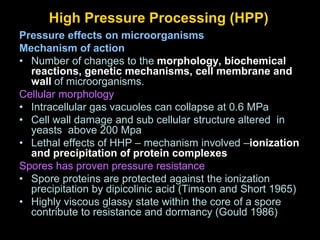
Pressure effects on microorganisms
Mechanism of action
• Number of changes to the morphology, biochemical
reactions, genetic mechanisms, cell membrane and
wall of microorganisms.
Cellular morphology
• Intracellular gas vacuoles can collapse at 0.6 MPa
• Cell wall damage and sub cellular structure altered in
yeasts above 200 Mpa
• Lethal effects of HHP – mechanism involved –ionization
and precipitation of protein complexes
Spores has proven pressure resistance
• Spore proteins are protected against the ionization
precipitation by dipicolinic acid (Timson and Short 1965)
• Highly viscous glassy state within the core of a spore
contribute to resistance and dormancy (Gould 1986)
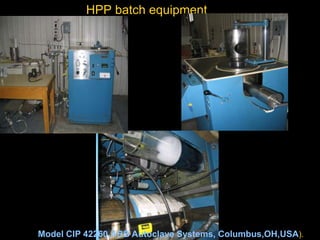
HPP batch equipment
Model CIP 42260,ABB Autoclave Systems, Columbus,OH,USA).
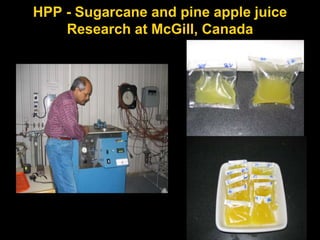
HPP - Sugarcane and pine apple juice
Research at McGill, Canada
• Research at
McGill,canada
• Pressure – 100-
400 MPa
• Holding time
15-45 min
• Storage studies
HPP – Sugarcane and Pine apple juice
• Pressure – 100- 400 MPa
• Holding time 15-45 min
• Storage studies
• Microbial reduction of 4 log cycle at 400
MPa and 45 min time
• Pressure reduced the Polyphenoloxidase
activity
• Bromelin activity increased up to 100 MPa
stabilized from 100-300 and increased
after 300MPA

High pressure processing in food ppt

  • 1.
  • 2.
    High Pressure Processing(HPP) What? –Subjecting foods to 300- 800MPa for 1-30 min at or around room temp. Why? – Cold pasteurization –- Inactivation of micro- organisms and enzymes, -No adverse sensory changes, -2-3 times extension in shelf life, ->6 log reduction in Listeria, Salmonella, E-coli (Source: www.relayresearch.ie).
  • 4.
    High Pressure Processing(HPP) History • HPP has been recognized by scientist to kill bacteria as early as the 1890’s. Effects of HHP on organisms • Viable bacteria on water samples collected from 5100 m depth ( 50 MPa) . Certes, 1883 • Reduction of spoilage organism by HHP (Hite 1899)-1st time in food • From Milk and meat products to fruits and vegetables ( Hite et.al,1914) • Peaches and pears treated at 400 MPa for 30 min at room temperature – good after 5 years of storage • European, Japanese and US food Industries are investing on HPP research
  • 5.
    High Pressure Processing(HPP) • Non thermal in nature • Inactivates the vegetative microorganisms, spores and enzymes • Increase in shelf life of foods • Denatures proteins and polysaccharides • Interesting application in the area of food texturization • Development of novel foods of superior nutritional and sensory quality • Higher safety • Increased ambient shelf life
  • 6.
    Will HPP damagethe food product? • During HPP, pressure is uniformly applied around and throughout the food product • Grape is squeezed from all sides simultaneously, it will not be crushed. • By squeezing the bottle, you pressurize the water inside as well as the grape. Yet the grape is not damaged, • Foods processed by high pressure will not be damaged by the applied pressure. Isostatic ,uniform pressure ,no shear stress
  • 7.
    High Pressure Processing(HPP) Principle Iso-static Principle • Application of pressure is instantaneous and uniform through out the sample Le Chateliers’s Principle • Any chemical reaction associated with a decrease in total molar volume will be accelerated by pressure • In combination with mild heat, reaction rates also may increase according to Arrhenius law.
  • 8.
    • Electrostriction • Pressureleads to ionisation-water molecules arrange compactly around the electric charge leading to destruction of m.o • Compression energy • The compression energy contained in the pressure vessel is approximated as 2/5CPV0 • Adiabatic heating • There is no net heat heat transfer between the system and sorrounding
  • 9.
    High Pressure Processing(HPP) • What functional properties does HPP impart to food products? • High pressure treatment is expected to be less detrimental than conventional processes to low molecular weight food compounds such as flavouring agents, pigments, vitamins, etc., as covalent bondings are not affected by pressure • Heat-sensitive, antimutagenic and therefore health- promoting substances in fruit and vegetables are also largely retained.
  • 10.
    High Pressure Processing(HPP) • What functional properties does HPP impart to food products?
  • 12.
    High Pressure Processing(HPP) Pressure effects on microorganisms Mechanism of action • Number of changes to the morphology, biochemical reactions, genetic mechanisms, cell membrane and wall of microorganisms. Cellular morphology • Intracellular gas vacuoles can collapse at 0.6 MPa • Cell wall damage and sub cellular structure altered in yeasts above 200 Mpa • Lethal effects of HHP – mechanism involved –ionization and precipitation of protein complexes Spores has proven pressure resistance • Spore proteins are protected against the ionization precipitation by dipicolinic acid (Timson and Short 1965) • Highly viscous glassy state within the core of a spore contribute to resistance and dormancy (Gould 1986)
  • 14.
    HPP batch equipment ModelCIP 42260,ABB Autoclave Systems, Columbus,OH,USA).
  • 15.
    HPP - Sugarcaneand pine apple juice Research at McGill, Canada • Research at McGill,canada • Pressure – 100- 400 MPa • Holding time 15-45 min • Storage studies
  • 16.
    HPP – Sugarcaneand Pine apple juice • Pressure – 100- 400 MPa • Holding time 15-45 min • Storage studies • Microbial reduction of 4 log cycle at 400 MPa and 45 min time • Pressure reduced the Polyphenoloxidase activity • Bromelin activity increased up to 100 MPa stabilized from 100-300 and increased after 300MPA