HIGH POTENTIAL TEST
General:
The high potential test (applied voltage test) is used to detect weak spots in the insulation of stator
windings, or rotor windings (wound rotor windings, field windings) and of some machine components
(e.g. bearing insulation).
Introduction
During the service-life-time of machines a degradation of the dielectric strength of the insulation
cannot be excluded. To minimize unexpected forced outages, the high-potential test is used: weak
spots in the insulation will lead to a voltage-break-down during this test; now the insulation at these
spots of failure can be reinforced and can be tested again. Doing this gives some certainty that the
insulation under test will withstand the normal operation voltage during the following operation period
till the next scheduled inspection.
The High-Potential Test
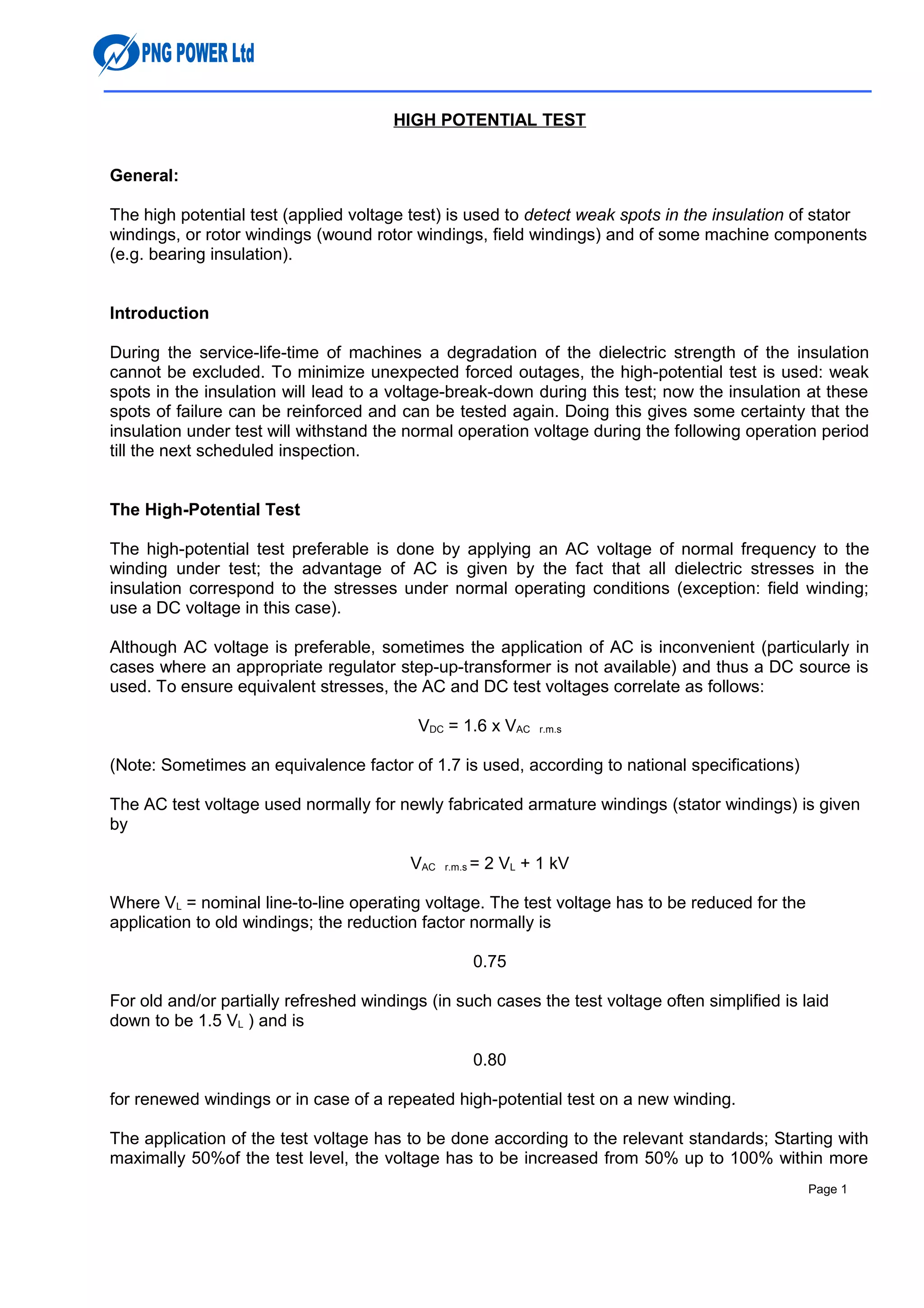
The high-potential test preferable is done by applying an AC voltage of normal frequency to the
winding under test; the advantage of AC is given by the fact that all dielectric stresses in the
insulation correspond to the stresses under normal operating conditions (exception: field winding;
use a DC voltage in this case).
Although AC voltage is preferable, sometimes the application of AC is inconvenient (particularly in
cases where an appropriate regulator step-up-transformer is not available) and thus a DC source is
used. To ensure equivalent stresses, the AC and DC test voltages correlate as follows:
VDC = 1.6 x VAC r.m.s
(Note: Sometimes an equivalence factor of 1.7 is used, according to national specifications)
The AC test voltage used normally for newly fabricated armature windings (stator windings) is given
by
VAC r.m.s = 2 VL + 1 kV
Where VL = nominal line-to-line operating voltage. The test voltage has to be reduced for the
application to old windings; the reduction factor normally is
0.75
For old and/or partially refreshed windings (in such cases the test voltage often simplified is laid
down to be 1.5 VL ) and is
0.80
for renewed windings or in case of a repeated high-potential test on a new winding.
The application of the test voltage has to be done according to the relevant standards; Starting with
maximally 50%of the test level, the voltage has to be increased from 50% up to 100% within more
Page 1
than 10 seconds and the insulation must withstand the voltage for 1 minute without any break-down
or flash-over.
General Requirements
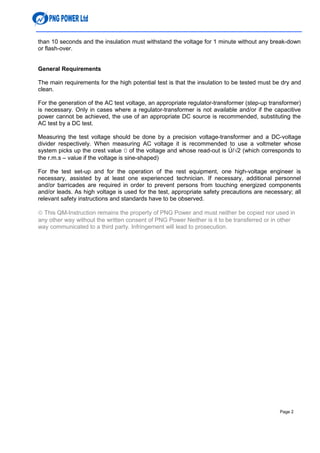
The main requirements for the high potential test is that the insulation to be tested must be dry and
clean.
For the generation of the AC test voltage, an appropriate regulator-transformer (step-up transformer)
is necessary. Only in cases where a regulator-transformer is not available and/or if the capacitive
power cannot be achieved, the use of an appropriate DC source is recommended, substituting the
AC test by a DC test.
Measuring the test voltage should be done by a precision voltage-transformer and a DC-voltage
divider respectively. When measuring AC voltage it is recommended to use a voltmeter whose
system picks up the crest value Ú of the voltage and whose read-out is Ú/√2 (which corresponds to
the r.m.s – value if the voltage is sine-shaped)
For the test set-up and for the operation of the rest equipment, one high-voltage engineer is
necessary, assisted by at least one experienced technician. If necessary, additional personnel
and/or barricades are required in order to prevent persons from touching energized components
and/or leads. As high voltage is used for the test, appropriate safety precautions are necessary; all
relevant safety instructions and standards have to be observed.
© This QM-Instruction remains the property of PNG Power and must neither be copied nor used in
any other way without the written consent of PNG Power Neither is it to be transferred or in other
way communicated to a third party. Infringement will lead to prosecution.
Page 2

High potential test

  • 1.
    HIGH POTENTIAL TEST General: Thehigh potential test (applied voltage test) is used to detect weak spots in the insulation of stator windings, or rotor windings (wound rotor windings, field windings) and of some machine components (e.g. bearing insulation). Introduction During the service-life-time of machines a degradation of the dielectric strength of the insulation cannot be excluded. To minimize unexpected forced outages, the high-potential test is used: weak spots in the insulation will lead to a voltage-break-down during this test; now the insulation at these spots of failure can be reinforced and can be tested again. Doing this gives some certainty that the insulation under test will withstand the normal operation voltage during the following operation period till the next scheduled inspection. The High-Potential Test The high-potential test preferable is done by applying an AC voltage of normal frequency to the winding under test; the advantage of AC is given by the fact that all dielectric stresses in the insulation correspond to the stresses under normal operating conditions (exception: field winding; use a DC voltage in this case). Although AC voltage is preferable, sometimes the application of AC is inconvenient (particularly in cases where an appropriate regulator step-up-transformer is not available) and thus a DC source is used. To ensure equivalent stresses, the AC and DC test voltages correlate as follows: VDC = 1.6 x VAC r.m.s (Note: Sometimes an equivalence factor of 1.7 is used, according to national specifications) The AC test voltage used normally for newly fabricated armature windings (stator windings) is given by VAC r.m.s = 2 VL + 1 kV Where VL = nominal line-to-line operating voltage. The test voltage has to be reduced for the application to old windings; the reduction factor normally is 0.75 For old and/or partially refreshed windings (in such cases the test voltage often simplified is laid down to be 1.5 VL ) and is 0.80 for renewed windings or in case of a repeated high-potential test on a new winding. The application of the test voltage has to be done according to the relevant standards; Starting with maximally 50%of the test level, the voltage has to be increased from 50% up to 100% within more Page 1
  • 2.
    than 10 secondsand the insulation must withstand the voltage for 1 minute without any break-down or flash-over. General Requirements The main requirements for the high potential test is that the insulation to be tested must be dry and clean. For the generation of the AC test voltage, an appropriate regulator-transformer (step-up transformer) is necessary. Only in cases where a regulator-transformer is not available and/or if the capacitive power cannot be achieved, the use of an appropriate DC source is recommended, substituting the AC test by a DC test. Measuring the test voltage should be done by a precision voltage-transformer and a DC-voltage divider respectively. When measuring AC voltage it is recommended to use a voltmeter whose system picks up the crest value Ú of the voltage and whose read-out is Ú/√2 (which corresponds to the r.m.s – value if the voltage is sine-shaped) For the test set-up and for the operation of the rest equipment, one high-voltage engineer is necessary, assisted by at least one experienced technician. If necessary, additional personnel and/or barricades are required in order to prevent persons from touching energized components and/or leads. As high voltage is used for the test, appropriate safety precautions are necessary; all relevant safety instructions and standards have to be observed. © This QM-Instruction remains the property of PNG Power and must neither be copied nor used in any other way without the written consent of PNG Power Neither is it to be transferred or in other way communicated to a third party. Infringement will lead to prosecution. Page 2