ADVANCED HIGH VOLTAGE TECHNIQUE
Assistant Professor Suna BOLAT
Office: ee 106
Phone: 366 2197
REVIEW
What is high voltage?
What is voltage for that matter?
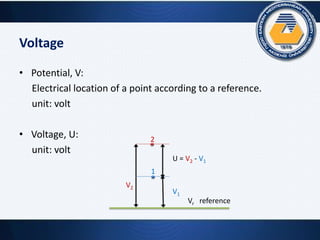
Voltage
• Potential, V:
Electrical location of a point according to a reference.
unit: volt
• Voltage, U:
unit: volt
2
1
V2
V1
U = V2 - V1
referenceVr
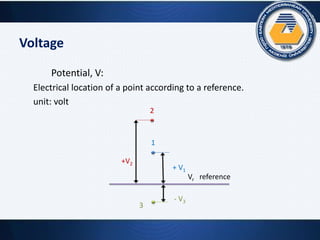
Potential, V:
Electrical location of a point according to a reference.
unit: volt
Voltage
2
1
+V2
+ V1
- V3
referenceVr
3
Voltage
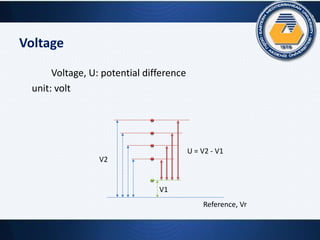
Voltage, U: potential difference
unit: volt
Reference, Vr
V1
V2
U = V2 - V1
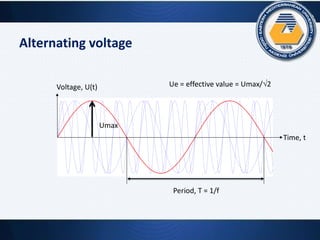
Alternating voltage
0 1000 2000 3000 4000 5000 6000 7000 8000 9000 10000
-1.5
-1
-0.5
0
0.5
1
1.5
Umax
Voltage, U(t)
Time, t
Period, T = 1/f
Ue = effective value = Umax/2
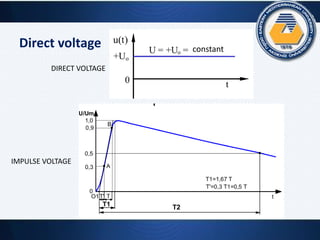
Direct voltage constant
DIRECT VOLTAGE
IMPULSE VOLTAGE
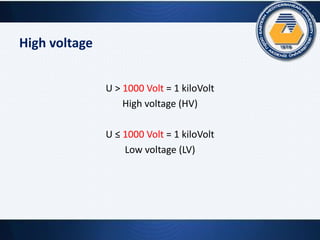
High voltage
U > 1000 Volt = 1 kiloVolt
High voltage (HV)
U ≤ 1000 Volt = 1 kiloVolt
Low voltage (LV)
High voltage levels in Turkey
Nominal
voltage, Un
kV
Permissible
maximum
operating voltage,
Umax [kV]
Medium
voltage
3 3.6
6 7.2
10 12
15 17.5
20 24
30 (34.5) 36
High
voltage
66 72
154 170
Extra high
voltage
380 420 (400)
High voltage levels in TRNC
Nominal
voltage, Un
kV
Permissible
maximum
operating voltage,
Umax [kV]
Medium
voltage
11 12
22 24
High
voltage
66 72
132 145
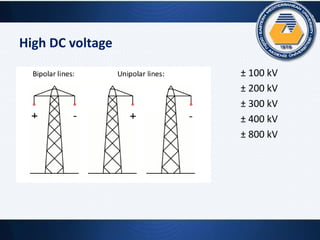
High DC voltage
± 100 kV
± 200 kV
± 300 kV
± 400 kV
± 800 kV
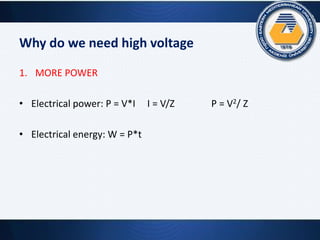
Why do we need high voltage
1. MORE POWER
• Electrical power: P = V*I I = V/Z P = V2/ Z
• Electrical energy: W = P*t
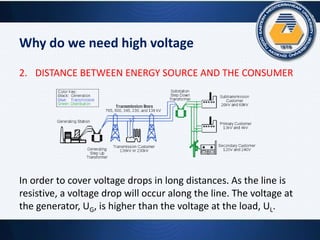
Why do we need high voltage
2. DISTANCE BETWEEN ENERGY SOURCE AND THE CONSUMER
In order to cover voltage drops in long distances. As the line is
resistive, a voltage drop will occur along the line. The voltage at
the generator, UG, is higher than the voltage at the load, UL.
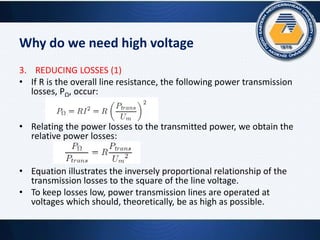
Why do we need high voltage
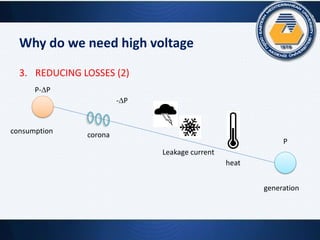
3. REDUCING LOSSES (1)
• If R is the overall line resistance, the following power transmission
losses, PΩ, occur:
• Relating the power losses to the transmitted power, we obtain the
relative power losses:
• Equation illustrates the inversely proportional relationship of the
transmission losses to the square of the line voltage.
• To keep losses low, power transmission lines are operated at
voltages which should, theoretically, be as high as possible.
Why do we need high voltage
3. REDUCING LOSSES (2)
coronaconsumption
generation
-P
P
P-P
heat
Leakage current
Why do we need high voltage
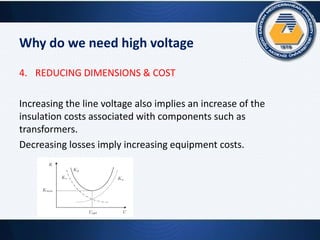
4. REDUCING DIMENSIONS & COST
Increasing the line voltage also implies an increase of the
insulation costs associated with components such as
transformers.
Decreasing losses imply increasing equipment costs.
REVIEW
Basic concepts and terminology
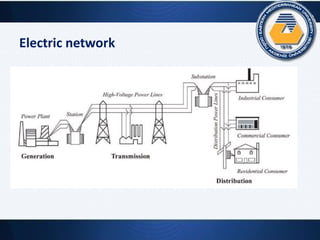
Electric network
Operating equipment
All the components that are connected to the electric power
system and carry high voltage and currents.
• Generator (supply)
• Transformer (conversion)
• Lines, cables, conductors, switchgears
• Measurement transformers, devices
Electrical network
Electrical installations with the same operating voltage
Insulation
Precaution against network faults between phases or phase to
neutral
Insulator
Material used for precaution in the insulation system
• Gas
• Liquid
• Solid
• Vacuum
Nominal system voltage, Un
The RMS phase to phase voltage by which an operating
equipment is designated and named.
Nominal voltage should be compatible with the operating
voltage
Operating voltage, Uop
It is the voltage by which an operating equipment is operated or
used.
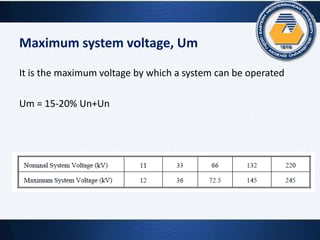
Maximum system voltage, Um
It is the maximum voltage by which a system can be operated
Um = 15-20% Un+Un
Nominal withstand voltage
It is the voltage without resulting in short-circuit
• Nominal alternating-current withstand voltage
• Nominal impulse withstand voltage
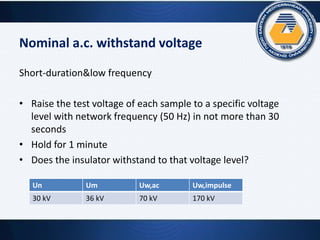
Nominal a.c. withstand voltage
Short-duration&low frequency
• Raise the test voltage of each sample to a specific voltage
level with network frequency (50 Hz) in not more than 30
seconds
• Hold for 1 minute
• Does the insulator withstand to that voltage level?
Un Um Uw,ac Uw,impulse
30 kV 36 kV 70 kV 170 kV
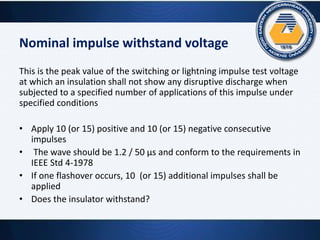
Nominal impulse withstand voltage
This is the peak value of the switching or lightning impulse test voltage
at which an insulation shall not show any disruptive discharge when
subjected to a specified number of applications of this impulse under
specified conditions
• Apply 10 (or 15) positive and 10 (or 15) negative consecutive
impulses
• The wave should be 1.2 / 50 µs and conform to the requirements in
IEEE Std 4-1978
• If one flashover occurs, 10 (or 15) additional impulses shall be
applied
• Does the insulator withstand?
REVIEW
What does withstand mean?
What is withstanding to what?
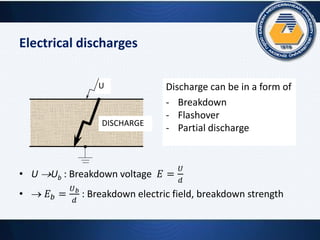
Electrical discharges
• U Ub : Breakdown voltage 𝐸 =
𝑈
𝑑
•  𝐸 𝑏 =
𝑈 𝑏
𝑑
: Breakdown electric field, breakdown strength
U
DISCHARGE
Discharge can be in a form of
- Breakdown
- Flashover
- Partial discharge
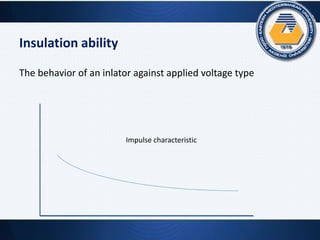
Insulation ability
The behavior of an inlator against applied voltage type
Impulse characteristic
Insulation level
The threshold voltage for an insulator without any discharges
Insulation level
• Every electrical equipment has to undergo different abnormal transient
over voltage situation in different times during its total service life period.
• lightning impulses, switching impulses and/or short duration power
frequency over voltages.
• Depending upon the maximum level of impulse voltages and short
duration power frequency over voltages that one power system
component can withstand, the insulation level of high voltage power
system is determined.
• For the system rated less than 300 kV, the lightning impulse withstand
voltage and short duration power frequency withstand voltage are
considered.
• For equipment rated more or equal 300 kV, switching impulse withstand
voltage and short duration power frequency withstand voltage are
considered
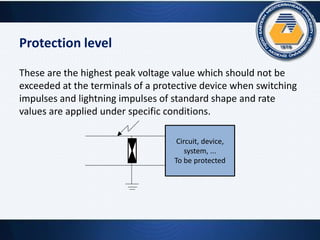
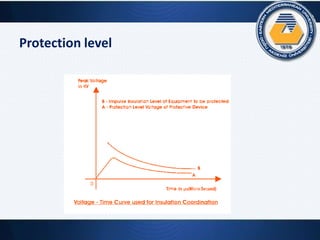
Protection level
These are the highest peak voltage value which should not be
exceeded at the terminals of a protective device when switching
impulses and lightning impulses of standard shape and rate
values are applied under specific conditions.
Circuit, device,
system, ...
To be protected
Protection level
Insulation co-ordination
The selection of the electric strength of equipment in relation to the
voltages which can appear on the system for which the equipment is
intended.
The overall aim is to reduce to
• an economically and operationally acceptable level the cost and
disturbance caused by insulation failure and resulting system
outages.
• To keep interruptions to a minimum, the insulation of the various
parts of the system must be so graded that flashovers only occur at
intended points.
• With increasing system voltage, the need to reduce the amount of
insulation in the system, by proper co-ordination of the insulating
levels become more critical
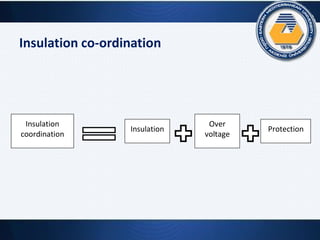
Insulation co-ordination
Insulation
coordination
Insulation
Over
voltage
Protection
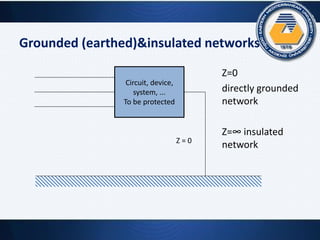
Grounded (earthed)&insulated networks
Z=0
directly grounded
network
Z=∞ insulated
network
Circuit, device,
system, ...
To be protected
Z = 0
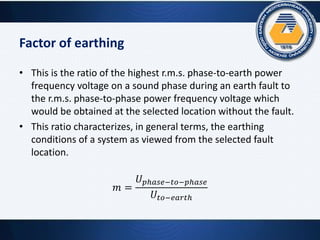
Factor of earthing
• This is the ratio of the highest r.m.s. phase-to-earth power
frequency voltage on a sound phase during an earth fault to
the r.m.s. phase-to-phase power frequency voltage which
would be obtained at the selected location without the fault.
• This ratio characterizes, in general terms, the earthing
conditions of a system as viewed from the selected fault
location.
𝑚 =
𝑈 𝑝ℎ𝑎𝑠𝑒−𝑡𝑜−𝑝ℎ𝑎𝑠𝑒
𝑈𝑡𝑜−𝑒𝑎𝑟𝑡ℎ
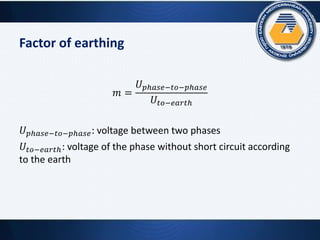
Factor of earthing
𝑚 =
𝑈 𝑝ℎ𝑎𝑠𝑒−𝑡𝑜−𝑝ℎ𝑎𝑠𝑒
𝑈𝑡𝑜−𝑒𝑎𝑟𝑡ℎ
𝑈 𝑝ℎ𝑎𝑠𝑒−𝑡𝑜−𝑝ℎ𝑎𝑠𝑒: voltage between two phases
𝑈𝑡𝑜−𝑒𝑎𝑟𝑡ℎ: voltage of the phase without short circuit according
to the earth
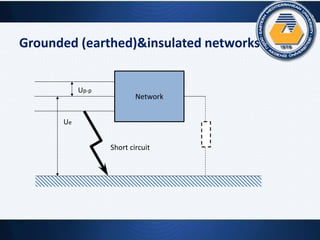
Network
Grounded (earthed)&insulated networks
Up-p
Ue
Short circuit
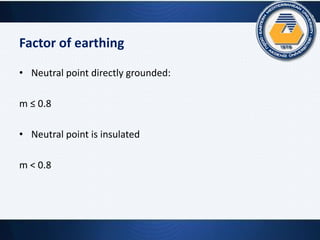
Factor of earthing
• Neutral point directly grounded:
m ≤ 0.8
• Neutral point is insulated
m < 0.8
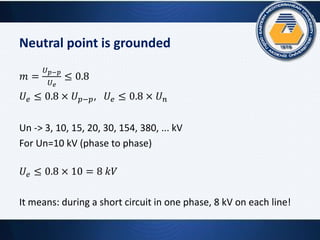
Neutral point is grounded
𝑚 =
𝑈 𝑝−𝑝
𝑈 𝑒
≤ 0.8
𝑈𝑒 ≤ 0.8 × 𝑈 𝑝−𝑝, 𝑈𝑒 ≤ 0.8 × 𝑈 𝑛
Un -> 3, 10, 15, 20, 30, 154, 380, ... kV
For Un=10 kV (phase to phase)
𝑈𝑒 ≤ 0.8 × 10 = 8 𝑘𝑉
It means: during a short circuit in one phase, 8 kV on each line!
OVERVOLTAGES
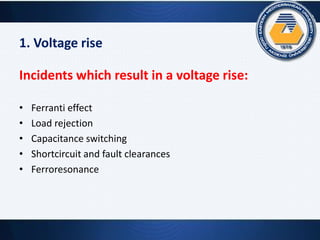
1. Voltage rise
Incidents which result in a voltage rise:
• Ferranti effect
• Load rejection
• Capacitance switching
• Shortcircuit and fault clearances
• Ferroresonance
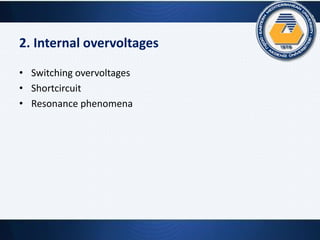
2. Internal overvoltages
• Switching overvoltages
• Shortcircuit
• Resonance phenomena
3. External overvoltages
• Overvoltages as a consequence of direct lightning strokes.

Turkey hv

  • 1.
    ADVANCED HIGH VOLTAGETECHNIQUE Assistant Professor Suna BOLAT Office: ee 106 Phone: 366 2197
  • 2.
    REVIEW What is highvoltage? What is voltage for that matter?
  • 3.
    Voltage • Potential, V: Electricallocation of a point according to a reference. unit: volt • Voltage, U: unit: volt 2 1 V2 V1 U = V2 - V1 referenceVr
  • 4.
    Potential, V: Electrical locationof a point according to a reference. unit: volt Voltage 2 1 +V2 + V1 - V3 referenceVr 3
  • 5.
    Voltage Voltage, U: potentialdifference unit: volt Reference, Vr V1 V2 U = V2 - V1
  • 6.
    Alternating voltage 0 10002000 3000 4000 5000 6000 7000 8000 9000 10000 -1.5 -1 -0.5 0 0.5 1 1.5 Umax Voltage, U(t) Time, t Period, T = 1/f Ue = effective value = Umax/2
  • 7.
    Direct voltage constant DIRECTVOLTAGE IMPULSE VOLTAGE
  • 8.
    High voltage U >1000 Volt = 1 kiloVolt High voltage (HV) U ≤ 1000 Volt = 1 kiloVolt Low voltage (LV)
  • 9.
    High voltage levelsin Turkey Nominal voltage, Un kV Permissible maximum operating voltage, Umax [kV] Medium voltage 3 3.6 6 7.2 10 12 15 17.5 20 24 30 (34.5) 36 High voltage 66 72 154 170 Extra high voltage 380 420 (400)
  • 10.
    High voltage levelsin TRNC Nominal voltage, Un kV Permissible maximum operating voltage, Umax [kV] Medium voltage 11 12 22 24 High voltage 66 72 132 145
  • 11.
    High DC voltage ±100 kV ± 200 kV ± 300 kV ± 400 kV ± 800 kV
  • 12.
    Why do weneed high voltage 1. MORE POWER • Electrical power: P = V*I I = V/Z P = V2/ Z • Electrical energy: W = P*t
  • 13.
    Why do weneed high voltage 2. DISTANCE BETWEEN ENERGY SOURCE AND THE CONSUMER In order to cover voltage drops in long distances. As the line is resistive, a voltage drop will occur along the line. The voltage at the generator, UG, is higher than the voltage at the load, UL.
  • 14.
    Why do weneed high voltage 3. REDUCING LOSSES (1) • If R is the overall line resistance, the following power transmission losses, PΩ, occur: • Relating the power losses to the transmitted power, we obtain the relative power losses: • Equation illustrates the inversely proportional relationship of the transmission losses to the square of the line voltage. • To keep losses low, power transmission lines are operated at voltages which should, theoretically, be as high as possible.
  • 15.
    Why do weneed high voltage 3. REDUCING LOSSES (2) coronaconsumption generation -P P P-P heat Leakage current
  • 16.
    Why do weneed high voltage 4. REDUCING DIMENSIONS & COST Increasing the line voltage also implies an increase of the insulation costs associated with components such as transformers. Decreasing losses imply increasing equipment costs.
  • 17.
  • 18.
  • 19.
    Operating equipment All thecomponents that are connected to the electric power system and carry high voltage and currents. • Generator (supply) • Transformer (conversion) • Lines, cables, conductors, switchgears • Measurement transformers, devices
  • 20.
    Electrical network Electrical installationswith the same operating voltage
  • 21.
    Insulation Precaution against networkfaults between phases or phase to neutral
  • 22.
    Insulator Material used forprecaution in the insulation system • Gas • Liquid • Solid • Vacuum
  • 23.
    Nominal system voltage,Un The RMS phase to phase voltage by which an operating equipment is designated and named. Nominal voltage should be compatible with the operating voltage
  • 24.
    Operating voltage, Uop Itis the voltage by which an operating equipment is operated or used.
  • 25.
    Maximum system voltage,Um It is the maximum voltage by which a system can be operated Um = 15-20% Un+Un
  • 26.
    Nominal withstand voltage Itis the voltage without resulting in short-circuit • Nominal alternating-current withstand voltage • Nominal impulse withstand voltage
  • 27.
    Nominal a.c. withstandvoltage Short-duration&low frequency • Raise the test voltage of each sample to a specific voltage level with network frequency (50 Hz) in not more than 30 seconds • Hold for 1 minute • Does the insulator withstand to that voltage level? Un Um Uw,ac Uw,impulse 30 kV 36 kV 70 kV 170 kV
  • 28.
    Nominal impulse withstandvoltage This is the peak value of the switching or lightning impulse test voltage at which an insulation shall not show any disruptive discharge when subjected to a specified number of applications of this impulse under specified conditions • Apply 10 (or 15) positive and 10 (or 15) negative consecutive impulses • The wave should be 1.2 / 50 µs and conform to the requirements in IEEE Std 4-1978 • If one flashover occurs, 10 (or 15) additional impulses shall be applied • Does the insulator withstand?
  • 29.
    REVIEW What does withstandmean? What is withstanding to what?
  • 30.
    Electrical discharges • UUb : Breakdown voltage 𝐸 = 𝑈 𝑑 •  𝐸 𝑏 = 𝑈 𝑏 𝑑 : Breakdown electric field, breakdown strength U DISCHARGE Discharge can be in a form of - Breakdown - Flashover - Partial discharge
  • 31.
    Insulation ability The behaviorof an inlator against applied voltage type Impulse characteristic
  • 32.
    Insulation level The thresholdvoltage for an insulator without any discharges
  • 33.
    Insulation level • Everyelectrical equipment has to undergo different abnormal transient over voltage situation in different times during its total service life period. • lightning impulses, switching impulses and/or short duration power frequency over voltages. • Depending upon the maximum level of impulse voltages and short duration power frequency over voltages that one power system component can withstand, the insulation level of high voltage power system is determined. • For the system rated less than 300 kV, the lightning impulse withstand voltage and short duration power frequency withstand voltage are considered. • For equipment rated more or equal 300 kV, switching impulse withstand voltage and short duration power frequency withstand voltage are considered
  • 34.
    Protection level These arethe highest peak voltage value which should not be exceeded at the terminals of a protective device when switching impulses and lightning impulses of standard shape and rate values are applied under specific conditions. Circuit, device, system, ... To be protected
  • 35.
  • 36.
    Insulation co-ordination The selectionof the electric strength of equipment in relation to the voltages which can appear on the system for which the equipment is intended. The overall aim is to reduce to • an economically and operationally acceptable level the cost and disturbance caused by insulation failure and resulting system outages. • To keep interruptions to a minimum, the insulation of the various parts of the system must be so graded that flashovers only occur at intended points. • With increasing system voltage, the need to reduce the amount of insulation in the system, by proper co-ordination of the insulating levels become more critical
  • 37.
  • 38.
    Grounded (earthed)&insulated networks Z=0 directlygrounded network Z=∞ insulated network Circuit, device, system, ... To be protected Z = 0
  • 39.
    Factor of earthing •This is the ratio of the highest r.m.s. phase-to-earth power frequency voltage on a sound phase during an earth fault to the r.m.s. phase-to-phase power frequency voltage which would be obtained at the selected location without the fault. • This ratio characterizes, in general terms, the earthing conditions of a system as viewed from the selected fault location. 𝑚 = 𝑈 𝑝ℎ𝑎𝑠𝑒−𝑡𝑜−𝑝ℎ𝑎𝑠𝑒 𝑈𝑡𝑜−𝑒𝑎𝑟𝑡ℎ
  • 40.
    Factor of earthing 𝑚= 𝑈 𝑝ℎ𝑎𝑠𝑒−𝑡𝑜−𝑝ℎ𝑎𝑠𝑒 𝑈𝑡𝑜−𝑒𝑎𝑟𝑡ℎ 𝑈 𝑝ℎ𝑎𝑠𝑒−𝑡𝑜−𝑝ℎ𝑎𝑠𝑒: voltage between two phases 𝑈𝑡𝑜−𝑒𝑎𝑟𝑡ℎ: voltage of the phase without short circuit according to the earth
  • 41.
  • 42.
    Factor of earthing •Neutral point directly grounded: m ≤ 0.8 • Neutral point is insulated m < 0.8
  • 43.
    Neutral point isgrounded 𝑚 = 𝑈 𝑝−𝑝 𝑈 𝑒 ≤ 0.8 𝑈𝑒 ≤ 0.8 × 𝑈 𝑝−𝑝, 𝑈𝑒 ≤ 0.8 × 𝑈 𝑛 Un -> 3, 10, 15, 20, 30, 154, 380, ... kV For Un=10 kV (phase to phase) 𝑈𝑒 ≤ 0.8 × 10 = 8 𝑘𝑉 It means: during a short circuit in one phase, 8 kV on each line!
  • 45.
  • 46.
    1. Voltage rise Incidentswhich result in a voltage rise: • Ferranti effect • Load rejection • Capacitance switching • Shortcircuit and fault clearances • Ferroresonance
  • 47.
    2. Internal overvoltages •Switching overvoltages • Shortcircuit • Resonance phenomena
  • 48.
    3. External overvoltages •Overvoltages as a consequence of direct lightning strokes.