HIGH PERFORMANCE LIQUID CHROMATOGRAPHY
1
 HPLC is a form of liquid chromatography used
to separate compounds that are dissolved in
solution.
 It is also known as High speed or high pressure
liquid chromatography.
 In principle, LC and HPLC work the same way
except the speed , efficiency, sensitivity and
ease of operation
INTRODUCTION
2
➢ Liquid chromatography is a separation
technique that involves:
 the placement (injection) of a small volume of
liquid sample
 into a tube packed with porous particles
(stationary phase)
 where individual components of the sample
are transported along the
 packed tube (column) by a liquid moved by
gravity.
3
➢It is a separation technique that involves:
 the injection of a small volume of liquid
sample
 into a tube packed with tiny particles (3 to 5
micron (μm) in diameter called the stationary
phase)
 where individual components of the sample are
moved down the packed tube (column) with a
liquid (mobile phase) forced through the
column by high pressure delivered by a pump.
HPLC
4
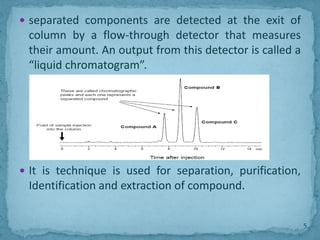
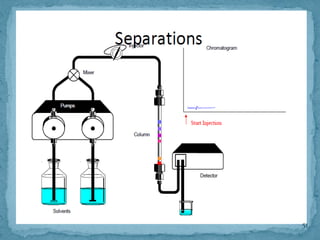
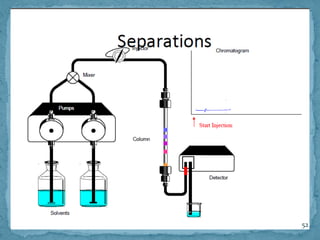
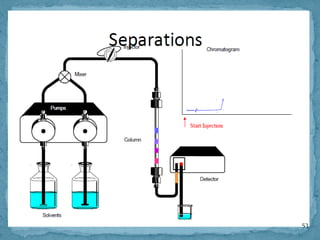
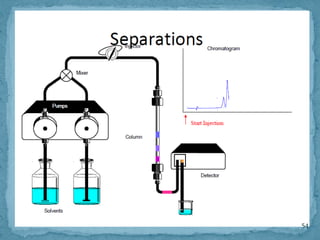
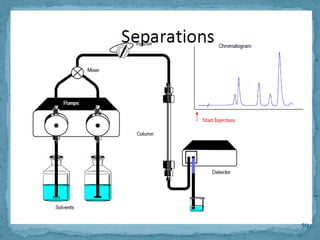
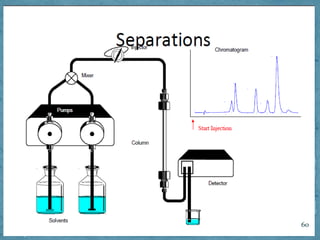
 separated components are detected at the exit of
column by a flow-through detector that measures
their amount. An output from this detector is called a
“liquid chromatogram”.
 It is technique is used for separation, purification,
Identification and extraction of compound.
5
 Principle of separation in normal phase mode and
reverse phase mode is adsorption.
 When a mixture of components are introduced into
column , they travel according to their relative
affinities towards the adsorbent.
 The component having less affinity towards
stationary phase travels faster.
 No two components have same affinity towards the
stationary phase, the components are separated.
PRINCIPLE
6
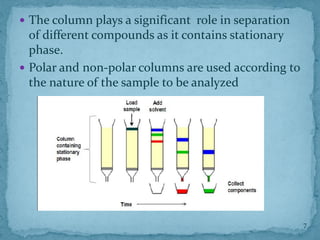
 The column plays a significant role in separation
of different compounds as it contains stationary
phase.
 Polar and non-polar columns are used according to
the nature of the sample to be analyzed
7
NORMAL PHASE
 Stationary Phase : Polar
➢ silica , alumina.
 Mobile Phase : Non polar
➢ Heptane, Hexane, Cyclohexane ,CHCl3 ,
CH3OH.
REVERSE PHASE
 Stationary Phase : Non polar
➢ n-octadecyl, n-octyl, ethyl, phenyl diol,
hydrophobic polymers.
 Mobile Phase : Polar
➢ methanol or acetonitrile /water or buffer
sometimes with additives of THF or dioxane .
8
 Based on modes of chromatography
1. Normal phase mode
2. Reverse phase mode
 Based on principle of separation
1. Adsorption chromatography
2. Ion exchange chromatography
3. Partition chromatography
4. Size Exclusion chromatography
5. Affinity chromatography
TYPES
9
 Based On Scale Of Operation
1. Analytical
2. Preparative
 Based on elution technique
1. Isocratic separation
2. Gradient separation
 Based on type of analysis
1. Quantitative analysis
2. Quanlitative analysis
10
I.BASED ON MODE OF SEPERATION
1.Normal phase chromatography - stationary
phase(polar) most commonly used unmodified silica
because of its high surface area and functional
group responsible is silanol
 mobile phase is organic and a single binary mixture of
miscible solvent.
2.Reverse phase chromatography-
 stationary phase(non polar) is silica chemically
bounded through a siloxane
 mobile phase is water and less polar organic
solvents such as methanol and acetonitrite.
 Reverse phase chromatography is more commonly
used as drugs are usually hydrophilic ( polar )
MODES OF CHROMATOGRAPHY
11
II.BASED ON PRINCIPLE OF SEPERATION
1.Adsorption Chromatography
 In this , solute molecules bond directly to the surface
of the stationary phase
 the component which has more affinity towards
mobile phase elutes first & the component which has
more affinity towards stationary phase elutes later.
 No two components have same affinity towards
mobile phase & stationary phase.
12
2. Partition chromatography
 The solid support is silica gel((it absorbs water
strongly.)
 The mobile phase may be pure solvent or a mixture
of solvent.
 In liquid- liquid p.c the support is coated with a
layer of polymer such as polyethylene glycol or a
liquid which is immiscible with the mobile phase.
 The mobile phase
13
3. Ion Exchange Chromatography
 allows separation of ions and polar molecules
based on their charge.
 Used for almost any kind of charged molecule like
large proteins, small nucleotides and amino acids.
 Strong cation exchangers containing sulphate
groups and strong anion exchangers containing
tetra alkyl groups
 The mobile phase is aqueous media used wwith a
mixture of aq. Buffer and organic solvent . 14
4. Size exclusion chromatography
 In this, HPLC column consist of substances which
have controlled pore sizes and is able to filter
according to its molecular size.
 Small molecules penetrate into the pores within the
packing while larger molecules only partially
penetrate the pores. The large molecules elute
before the smaller molecules.
15
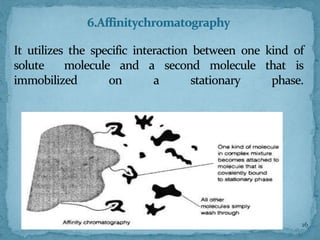
6.Affinitychromatography
It utilizes the specific interaction between one kind of
solute molecule and a second molecule that is
immobilized on a stationary phase.
16
BASED ON ELUTION TECHNIQUE
1.Isocratic elution
 A separation in which the mobile phase composition
remains constant throughout the procedure is termed
isocratic elutionIn isocratic elution, peak width
increases with retention time linearly with the number
of theoretical plates. ( ̽flat and board)
2. Gradient elution
 A separation in which the mobile phase composition is
changed during the separation process is described as a
gradient elution
 Gradient elution decreases the retention of the later-
eluting components so that they elute faster, giving
narrower peaks . This also improves the peak shape and
the peak height
17
1.Qualitative analysis
 Analysis of a substance in order to ascertain the
nature of its chemical constituents
 We can separate individual components but cannot
assess the quantity in this analysis
2.Quantitaive analysis
 Determining the amounts and proportions of its
chemical constituents .
 Quantity of the impurity and individual components
can be assessed
Based On Type Of Analysis
18
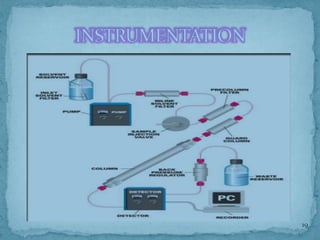
INSTRUMENTATION
19
 Solvent delivery system including
pump
 Mixing unit , gradient controller and
solvent degassing
 Sample injecting system
 Chromatographic columns
 Detector
 Recorder and integrator.
20
 The mobile phase in HPLC refers to the solvent
being continuously applied to the column or
stationary phase
 The mobile phase acts as a carrier to the sample
solution.
 It passes through the column at high pressure of about
1000 to 3000psi , because the particle size of stationary
phase is few μ ( 5-10 μ) , the resistance to the flow is
high .
 Eluting power depends upon the polarity of
stationary phase and nature of components
SOLVENT DELIVERY SYSTEM
21
 It is to force liquid (called the mobile phase)through the
liquid chromatograph at a specific flow rate, expressed in
milliliters per min (mL/min).
 Normal flow rates in HPLC are in the 1 to 2 mL/min range
➢ Pump Module–types:
✓ Isocratic pump - Delivers constant mobile phase
composition; solvent must be pre-mixed and lowest cost
pump
✓ Gradient pump - Delivers variable mobile phase
composition; can be used to mix and deliver an isocratic
mobile phase or a gradient mobile phase
PUMPS
22
Types of HPLC pumps
There are several types of pumps used for HPLC
analysis, most commonly used are reciprocating piston
pump,syringe pump and constant pressure pump
1.Reciprocating piston pumps:
• Consists of a small motor driven piston which moves
rapidly back and forth in a hydraulic chamber.
• On the back stroke , the separation column valve is
closed , and the piston pulls in solvent from the mobile
phase reservoir.
• On the forward stroke, the pump pushes solvent out
of the column from the reservoir.
23
2.Syringe type pump
• These are most suitable for small bore column
because this pump delivers only a finite volume of
mobile phase before it has to be refilled. These pumps
have a volume between 250 to 500mL.
3.Constant pressure pump
• In these types of pumps , the mobile phase is driven
through the column with the use of pressure from the gas
cylinder
4. Dual piston pump
 It produce pulse free flow because two pistons are
carefully phased. So that one is filling and other is
pumping
24
MIXING UNIT:
 It is used to mix solvents in different proportions and
pass through column .
 It is of 2 types : 1) low pressure mixing chamber
2) high pressure mixing chamber
 Low pressure uses helium for solvent degassing
GRADIENT CONTROLLER:
 In isocratic elution – solvent of same eluting power or
polarity is used.
 In gradient eluting technique – solvent polarity is
gradually increased : so gradient controller is used .
25
SOLVENT DEGASSING:
When solvents pumped under high pressure
Gas bubbles are formed --- it interfere with the
 separation process
 Steady baseline
 Shape of the peak
➢ This can be done by :
 vacuum filtration
 Helium purging
 Ultrasonication
26
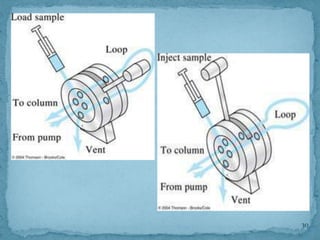
 To introduce liquid sample into flow stream of
mobile phase for analysis.
 Equipped with 6 port valves so a sample can be
injected into flow path at continuous pressure
 For a manual injector, knob operated to
deliver the sample to column
 The knob is set to LOAD position for sample
injection using a syringe the sample is injected
into the sample loop, which is separated from the
flow path
SAMPLE INJECTING SYSTEM
27
 The knob is turned to INJECT position & eluent
travels through loop from pump & delivers
sample to column.
 It must also be able to withstand the high
pressures of the liquid system.
➢ Manual Injector:
1. User manually loads sample into the injector using
a syringe
2.Then turns handle to inject sample into the
flowing mobile phase…which transports the
sample into the beginning (head) of the column,
at high pressure
28
➢Auto sampler:
1.User loads vials filled with sample solution into the
auto sampler tray (100 samples)
2.And the auto sampler automatically
a. measures the appropriate sample volume,
b. injects the sample,
c. then flushes the injector to be ready for the
next sample.
29
30
 the “heart of the chromatograph”
 the column’s stationary phase separates the sample
components using various physical and chemical
parameters.
 usually made of stainless steel to withstand high
pressure caused by the pump to move the mobile
phase through the column packing .
 The small particles inside the column are called the
“packing”.
 Column packing is usually silica gel because of its
particle shape, surface properties, and pore
structure give us a good separation
COLUMNS
31
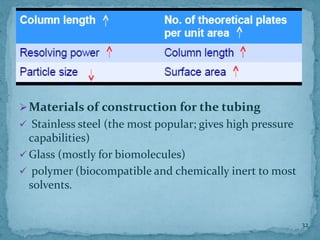
➢Materials of construction for the tubing
✓ Stainless steel (the most popular; gives high pressure
capabilities)
✓ Glass (mostly for biomolecules)
✓ polymer (biocompatible and chemically inert to most
solvents.
32
➢Packing material:
✓The packing material is prepared from SILICA
particle,
✓ALUMINA particle
✓and ion exchange RESIN.
✓Porous plug of stainless steel or Teflon are used
in the end of the columns to retain the packing
material.
✓According to the mode of HPLC , they are available
in different size , diameters, pore size or they can
have special materials attached.
33
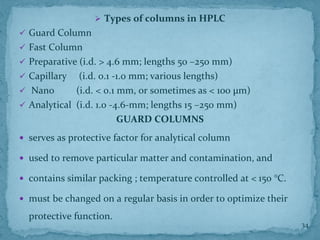
➢ Types of columns in HPLC
✓ Guard Column
✓ Fast Column
✓ Preparative (i.d. > 4.6 mm; lengths 50 –250 mm)
✓ Capillary (i.d. 0.1 -1.0 mm; various lengths)
✓ Nano (i.d. < 0.1 mm, or sometimes as < 100 μm)
✓ Analytical (i.d. 1.0 -4.6-mm; lengths 15 –250 mm)
GUARD COLUMNS
 serves as protective factor for analytical column
 used to remove particular matter and contamination, and
 contains similar packing ; temperature controlled at < 150 °C.
 must be changed on a regular basis in order to optimize their
protective function.
34
FAST COLUMN
 are designed to decrease time of chromatographic
analysis
 internal diameter is same but length is short and
 packed with smaller particles , that are 3 μm diameter
 Advantages-
✓ Increased sensitivity
✓ Decreased analysis time
✓ Decreased mobile phase usage
✓ Increase reproducibility
35
CAPILLARY COLUMNS
 It is also known as micro columns
 It has a diameter much less than a millimeter and there 3
types:
✓ Open tubular
✓ Partially packed
✓ Tightly packed
 They allow the user to work with nanoliter sample volume ,
 Decreased flow rate
 decreased solvent usage volume ,
 led to cost effectiveness
PREPARATORY COLUMNS
 It has usually a large column diameter , which is designed
to facilitate large volume injections into the HPLC system.
36
DETECTOR
 detect individual molecules that elute from column
and convert the data into an electrical signal
 measure the amount of those molecules
 Provides an output to a recorder or computer that
results in the liquid chromatogram
 It is selected based on the analyte or the sample
under detection.
 Photometric detectors are based on 4 types:
1. Single wavelength : equiped with low pressure
mercury discharge lamp
37
2. Multi wavelength : employ mercury and other source in
combination with interference filter.
3. Variable wavelength : use a deuterium light source and
grating monochromator for selection of any wavelength
4. Programmable : allow automatic change of wavelength
 The DETECTOS ARE :
➢ Mass Spectrometer
➢ Ultra violet
➢ Refractive Index
➢ Fluorescence
➢ Radioactivity
➢ Conductivity
➢ Electrochemical Light Scattering
38
ULTRA VIOLET
 responds to substances that absorb light.
 it will change the amount of light energy falling on
the sensor.
 The resulting change in this electrical signal is
amplified and directed to a recorder or data system.
 cannot be used for testing substances that are low in
chromophores (colorless or virtually colorless) as they
cannot absorb light at low range.
 They are cost-effective and popular and are widely
used in industry.
39
MASS SPECTROMETRY
 coupled with HPLC is called HPLC-MS.
 HPLC-MS is the most powerful detector, widely
used in pharmaceutical laboratories and research
and development.
 it is capable of analyzing and providing
molecular identity of a wide range of
components.
 It senses a compound eluting from the HPLC
column first by ionizing it then by measuring
it’s mass or fragmenting the molecule into
smaller pieces that are unique to the compound.
40
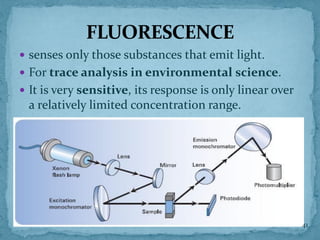
FLUORESCENCE
 senses only those substances that emit light.
 For trace analysis in environmental science.
 It is very sensitive, its response is only linear over
a relatively limited concentration range.
41
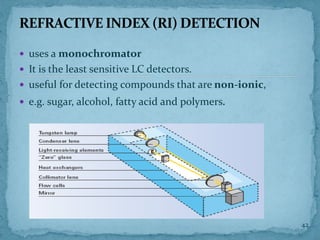
 uses a monochromator
 It is the least sensitive LC detectors.
 useful for detecting compounds that are non-ionic,
 e.g. sugar, alcohol, fatty acid and polymers.
REFRACTIVE INDEX (RI) DETECTION
42
 •Frequently called the data system,
 it takes the signal from the detector and uses it to
determine the time of elution (retention time) of
the sample components (qualitative analysis) and
the amount of sample (quantitative analysis).
 The concentration of each detected component is
calculated from the area or height of the
corresponding peak and reported.
DATA PROCESSING UNIT (COMPUTER)
43
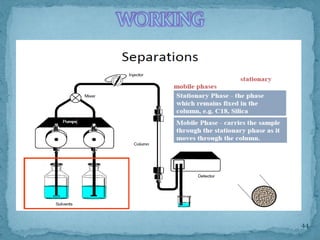
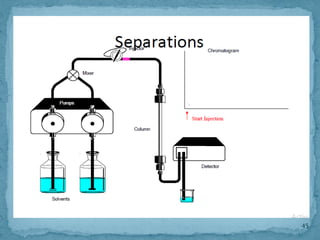
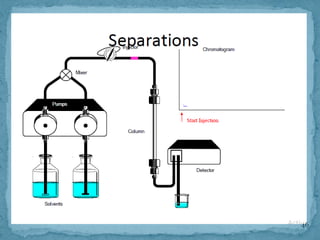
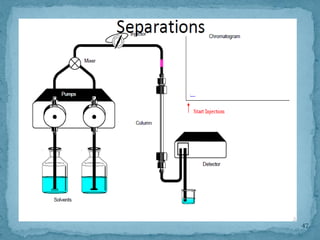
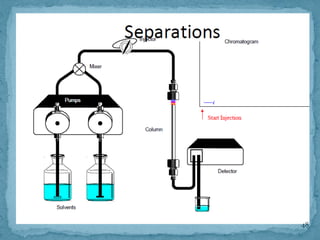
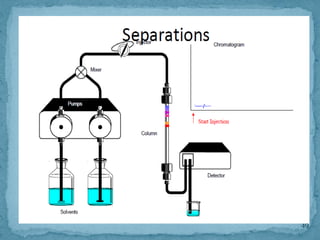
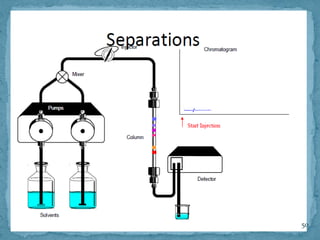
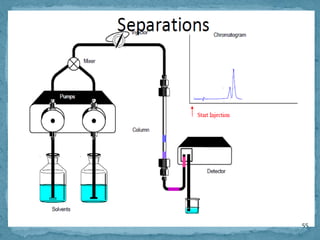
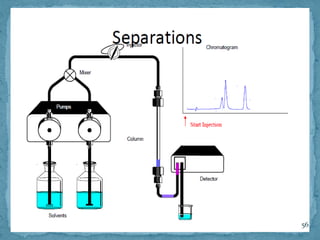
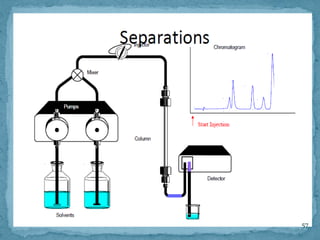
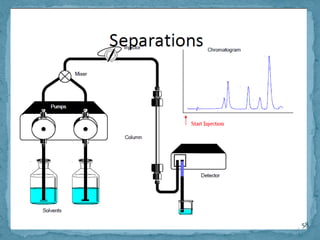
WORKING
44
45
46
47
48
49
50
51
52
53
54
55
56
57
58
59
60
WHY HPLC ?
1.Separations fast and efficient (high resolution power)
2. Continuous monitoring of the column effluent
3. It can be applied to the separation and analysis of complex
mixtures
4. Accurate quantitative measurements.
5. Repetitive and reproducible analysis using the same
column.
6. Adsorption, partition, ion exchange and exclusion column
separations are excellently made.
7. HPLC is more versatile because of not being restricted to
volatile and thermally stable solute
8. The choice of mobile and stationary phases is much wider
in HPLC
61
PARAMETERS
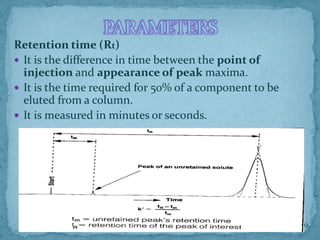
Retention time (Rt)
 It is the difference in time between the point of
injection and appearance of peak maxima.
 It is the time required for 50% of a component to be
eluted from a column.
 It is measured in minutes or seconds.
62
RETENTION VOLUME(Vr)
 It is the volume of carrier gas required to elute 50%
of the component from the column .
 It is the product of retention time and flow rate.
 Retention volume = retention time × flow rate
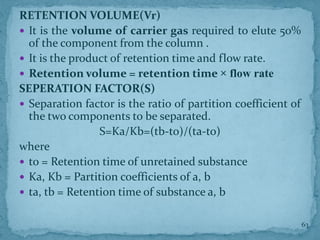
SEPERATION FACTOR(S)
 Separation factor is the ratio of partition coefficient of
the two components to be separated.
S=Ka/Kb=(tb-to)/(ta-to)
where
 to = Retention time of unretained substance
 Ka, Kb = Partition coefficients of a, b
 ta, tb = Retention time of substance a, b
63
 If there is more difference in partition
coefficient – the peaks are far apart and the
separation factors is more
 If p.c is similar the peaks are closer and
separation factor is less.
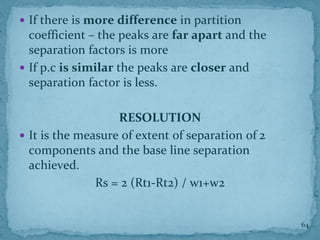
RESOLUTION
 It is the measure of extent of separation of 2
components and the base line separation
achieved.
Rs = 2 (Rt1-Rt2) / w1+w2
64
HEIGHT EQUIVALENT TO A THEORETICAL
PLATE (HETP)
 It is an imaginary or hypothetical unit of a column
where distribution of solute between stationary
phase and mobile phase has attained equilibrium.
 It can also be called as a functional unit of the
column.
 It can be of any height- describes the efficiency of
separation.
 If HETP is less --column is more efficient.
 If HETP is more -- column is less efficient.
65
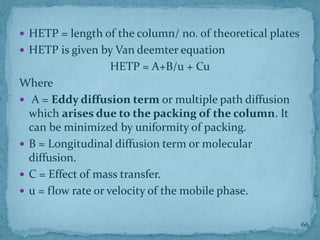
 HETP = length of the column/ no. of theoretical plates
 HETP is given by Van deemter equation
HETP = A+B/u + Cu
Where
 A = Eddy diffusion term or multiple path diffusion
which arises due to the packing of the column. It
can be minimized by uniformity of packing.
 B = Longitudinal diffusion term or molecular
diffusion.
 C = Effect of mass transfer.
 u = flow rate or velocity of the mobile phase.
66
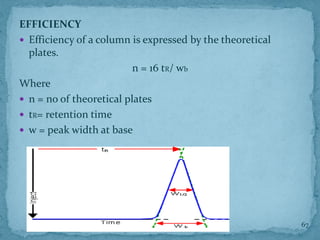
EFFICIENCY
 Efficiency of a column is expressed by the theoretical
plates.
n = 16 tR/ wb
Where
 n = no of theoretical plates
 tR= retention time
 w = peak width at base
67
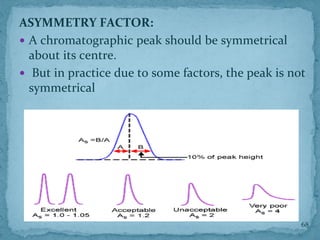
ASYMMETRY FACTOR:
 A chromatographic peak should be symmetrical
about its centre.
 But in practice due to some factors, the peak is not
symmetrical
68
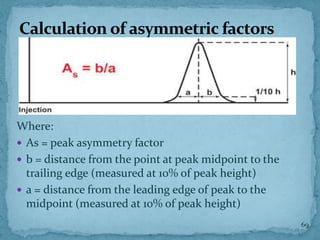
Calculation of asymmetric factors
Where:
 As = peak asymmetry factor
 b = distance from the point at peak midpoint to the
trailing edge (measured at 10% of peak height)
 a = distance from the leading edge of peak to the
midpoint (measured at 10% of peak height)
69
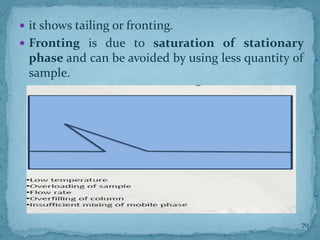
 it shows tailing or fronting.
 Fronting is due to saturation of stationary
phase and can be avoided by using less quantity of
sample.
70
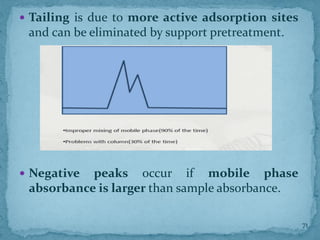
 Tailing is due to more active adsorption sites
and can be eliminated by support pretreatment.
 Negative peaks occur if mobile phase
absorbance is larger than sample absorbance.
71
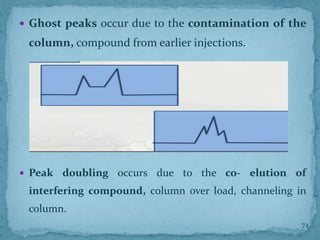
 Ghost peaks occur due to the contamination of the
column, compound from earlier injections.
 Peak doubling occurs due to the co- elution of
interfering compound, column over load, channeling in
column.
72
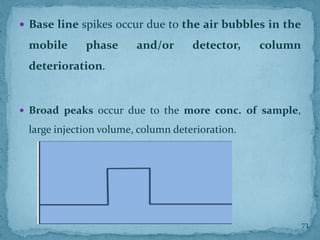
 Base line spikes occur due to the air bubbles in the
mobile phase and/or detector, column
deterioration.
 Broad peaks occur due to the more conc. of sample,
large injection volume, column deterioration.
73
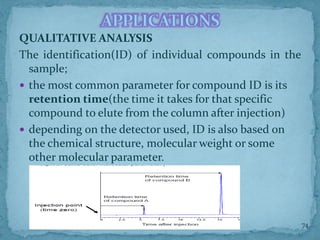
QUALITATIVE ANALYSIS
The identification(ID) of individual compounds in the
sample;
 the most common parameter for compound ID is its
retention time(the time it takes for that specific
compound to elute from the column after injection)
 depending on the detector used, ID is also based on
the chemical structure, molecular weight or some
other molecular parameter.
APPLICATIONS
74
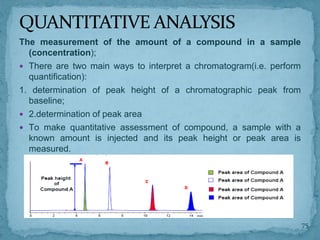
The measurement of the amount of a compound in a sample
(concentration);
 There are two main ways to interpret a chromatogram(i.e. perform
quantification):
1. determination of peak height of a chromatographic peak from
baseline;
 2.determination of peak area
 To make quantitative assessment of compound, a sample with a
known amount is injected and its peak height or peak area is
measured.
QUANTITATIVE ANALYSIS
75
 By collecting the chromatographic peaks at the exit of
the detector,
 concentrating the compound (analyte) by
removing/evaporating the solvent,
 a pure substance can be prepared for later use (e.g.
organic synthesis, clinical studies, toxicology studies,
etc.).
 This methodology is called preparative
chromatography
PREPARATION OF PURE COMPOUNDS
76
Environmental
 Phenols in Drinking Water.
 Identification of diphenhydramine in sediment sample
 Estrogens in coastal waters - The sewage source.
 Toxicity of tetracyclines and tetracycline degradation
products to environmentally relevant bacteria.
Clinical
 Analysis of antibiotics.
 Increased urinary excretion of aquaporin 2 in patients
with liver cirrhosis.
 Detection of endogenous neuropeptides in brain
extracellular fluids.
77

High pressure liquid chromatography, B.Pharm

  • 1.
    HIGH PERFORMANCE LIQUIDCHROMATOGRAPHY 1
  • 2.
     HPLC isa form of liquid chromatography used to separate compounds that are dissolved in solution.  It is also known as High speed or high pressure liquid chromatography.  In principle, LC and HPLC work the same way except the speed , efficiency, sensitivity and ease of operation INTRODUCTION 2
  • 3.
    ➢ Liquid chromatographyis a separation technique that involves:  the placement (injection) of a small volume of liquid sample  into a tube packed with porous particles (stationary phase)  where individual components of the sample are transported along the  packed tube (column) by a liquid moved by gravity. 3
  • 4.
    ➢It is aseparation technique that involves:  the injection of a small volume of liquid sample  into a tube packed with tiny particles (3 to 5 micron (μm) in diameter called the stationary phase)  where individual components of the sample are moved down the packed tube (column) with a liquid (mobile phase) forced through the column by high pressure delivered by a pump. HPLC 4
  • 5.
     separated componentsare detected at the exit of column by a flow-through detector that measures their amount. An output from this detector is called a “liquid chromatogram”.  It is technique is used for separation, purification, Identification and extraction of compound. 5
  • 6.
     Principle ofseparation in normal phase mode and reverse phase mode is adsorption.  When a mixture of components are introduced into column , they travel according to their relative affinities towards the adsorbent.  The component having less affinity towards stationary phase travels faster.  No two components have same affinity towards the stationary phase, the components are separated. PRINCIPLE 6
  • 7.
     The columnplays a significant role in separation of different compounds as it contains stationary phase.  Polar and non-polar columns are used according to the nature of the sample to be analyzed 7
  • 8.
    NORMAL PHASE  StationaryPhase : Polar ➢ silica , alumina.  Mobile Phase : Non polar ➢ Heptane, Hexane, Cyclohexane ,CHCl3 , CH3OH. REVERSE PHASE  Stationary Phase : Non polar ➢ n-octadecyl, n-octyl, ethyl, phenyl diol, hydrophobic polymers.  Mobile Phase : Polar ➢ methanol or acetonitrile /water or buffer sometimes with additives of THF or dioxane . 8
  • 9.
     Based onmodes of chromatography 1. Normal phase mode 2. Reverse phase mode  Based on principle of separation 1. Adsorption chromatography 2. Ion exchange chromatography 3. Partition chromatography 4. Size Exclusion chromatography 5. Affinity chromatography TYPES 9
  • 10.
     Based OnScale Of Operation 1. Analytical 2. Preparative  Based on elution technique 1. Isocratic separation 2. Gradient separation  Based on type of analysis 1. Quantitative analysis 2. Quanlitative analysis 10
  • 11.
    I.BASED ON MODEOF SEPERATION 1.Normal phase chromatography - stationary phase(polar) most commonly used unmodified silica because of its high surface area and functional group responsible is silanol  mobile phase is organic and a single binary mixture of miscible solvent. 2.Reverse phase chromatography-  stationary phase(non polar) is silica chemically bounded through a siloxane  mobile phase is water and less polar organic solvents such as methanol and acetonitrite.  Reverse phase chromatography is more commonly used as drugs are usually hydrophilic ( polar ) MODES OF CHROMATOGRAPHY 11
  • 12.
    II.BASED ON PRINCIPLEOF SEPERATION 1.Adsorption Chromatography  In this , solute molecules bond directly to the surface of the stationary phase  the component which has more affinity towards mobile phase elutes first & the component which has more affinity towards stationary phase elutes later.  No two components have same affinity towards mobile phase & stationary phase. 12
  • 13.
    2. Partition chromatography The solid support is silica gel((it absorbs water strongly.)  The mobile phase may be pure solvent or a mixture of solvent.  In liquid- liquid p.c the support is coated with a layer of polymer such as polyethylene glycol or a liquid which is immiscible with the mobile phase.  The mobile phase 13
  • 14.
    3. Ion ExchangeChromatography  allows separation of ions and polar molecules based on their charge.  Used for almost any kind of charged molecule like large proteins, small nucleotides and amino acids.  Strong cation exchangers containing sulphate groups and strong anion exchangers containing tetra alkyl groups  The mobile phase is aqueous media used wwith a mixture of aq. Buffer and organic solvent . 14
  • 15.
    4. Size exclusionchromatography  In this, HPLC column consist of substances which have controlled pore sizes and is able to filter according to its molecular size.  Small molecules penetrate into the pores within the packing while larger molecules only partially penetrate the pores. The large molecules elute before the smaller molecules. 15
  • 16.
    6.Affinitychromatography It utilizes thespecific interaction between one kind of solute molecule and a second molecule that is immobilized on a stationary phase. 16
  • 17.
    BASED ON ELUTIONTECHNIQUE 1.Isocratic elution  A separation in which the mobile phase composition remains constant throughout the procedure is termed isocratic elutionIn isocratic elution, peak width increases with retention time linearly with the number of theoretical plates. ( ̽flat and board) 2. Gradient elution  A separation in which the mobile phase composition is changed during the separation process is described as a gradient elution  Gradient elution decreases the retention of the later- eluting components so that they elute faster, giving narrower peaks . This also improves the peak shape and the peak height 17
  • 18.
    1.Qualitative analysis  Analysisof a substance in order to ascertain the nature of its chemical constituents  We can separate individual components but cannot assess the quantity in this analysis 2.Quantitaive analysis  Determining the amounts and proportions of its chemical constituents .  Quantity of the impurity and individual components can be assessed Based On Type Of Analysis 18
  • 19.
  • 20.
     Solvent deliverysystem including pump  Mixing unit , gradient controller and solvent degassing  Sample injecting system  Chromatographic columns  Detector  Recorder and integrator. 20
  • 21.
     The mobilephase in HPLC refers to the solvent being continuously applied to the column or stationary phase  The mobile phase acts as a carrier to the sample solution.  It passes through the column at high pressure of about 1000 to 3000psi , because the particle size of stationary phase is few μ ( 5-10 μ) , the resistance to the flow is high .  Eluting power depends upon the polarity of stationary phase and nature of components SOLVENT DELIVERY SYSTEM 21
  • 22.
     It isto force liquid (called the mobile phase)through the liquid chromatograph at a specific flow rate, expressed in milliliters per min (mL/min).  Normal flow rates in HPLC are in the 1 to 2 mL/min range ➢ Pump Module–types: ✓ Isocratic pump - Delivers constant mobile phase composition; solvent must be pre-mixed and lowest cost pump ✓ Gradient pump - Delivers variable mobile phase composition; can be used to mix and deliver an isocratic mobile phase or a gradient mobile phase PUMPS 22
  • 23.
    Types of HPLCpumps There are several types of pumps used for HPLC analysis, most commonly used are reciprocating piston pump,syringe pump and constant pressure pump 1.Reciprocating piston pumps: • Consists of a small motor driven piston which moves rapidly back and forth in a hydraulic chamber. • On the back stroke , the separation column valve is closed , and the piston pulls in solvent from the mobile phase reservoir. • On the forward stroke, the pump pushes solvent out of the column from the reservoir. 23
  • 24.
    2.Syringe type pump •These are most suitable for small bore column because this pump delivers only a finite volume of mobile phase before it has to be refilled. These pumps have a volume between 250 to 500mL. 3.Constant pressure pump • In these types of pumps , the mobile phase is driven through the column with the use of pressure from the gas cylinder 4. Dual piston pump  It produce pulse free flow because two pistons are carefully phased. So that one is filling and other is pumping 24
  • 25.
    MIXING UNIT:  Itis used to mix solvents in different proportions and pass through column .  It is of 2 types : 1) low pressure mixing chamber 2) high pressure mixing chamber  Low pressure uses helium for solvent degassing GRADIENT CONTROLLER:  In isocratic elution – solvent of same eluting power or polarity is used.  In gradient eluting technique – solvent polarity is gradually increased : so gradient controller is used . 25
  • 26.
    SOLVENT DEGASSING: When solventspumped under high pressure Gas bubbles are formed --- it interfere with the  separation process  Steady baseline  Shape of the peak ➢ This can be done by :  vacuum filtration  Helium purging  Ultrasonication 26
  • 27.
     To introduceliquid sample into flow stream of mobile phase for analysis.  Equipped with 6 port valves so a sample can be injected into flow path at continuous pressure  For a manual injector, knob operated to deliver the sample to column  The knob is set to LOAD position for sample injection using a syringe the sample is injected into the sample loop, which is separated from the flow path SAMPLE INJECTING SYSTEM 27
  • 28.
     The knobis turned to INJECT position & eluent travels through loop from pump & delivers sample to column.  It must also be able to withstand the high pressures of the liquid system. ➢ Manual Injector: 1. User manually loads sample into the injector using a syringe 2.Then turns handle to inject sample into the flowing mobile phase…which transports the sample into the beginning (head) of the column, at high pressure 28
  • 29.
    ➢Auto sampler: 1.User loadsvials filled with sample solution into the auto sampler tray (100 samples) 2.And the auto sampler automatically a. measures the appropriate sample volume, b. injects the sample, c. then flushes the injector to be ready for the next sample. 29
  • 30.
  • 31.
     the “heartof the chromatograph”  the column’s stationary phase separates the sample components using various physical and chemical parameters.  usually made of stainless steel to withstand high pressure caused by the pump to move the mobile phase through the column packing .  The small particles inside the column are called the “packing”.  Column packing is usually silica gel because of its particle shape, surface properties, and pore structure give us a good separation COLUMNS 31
  • 32.
    ➢Materials of constructionfor the tubing ✓ Stainless steel (the most popular; gives high pressure capabilities) ✓ Glass (mostly for biomolecules) ✓ polymer (biocompatible and chemically inert to most solvents. 32
  • 33.
    ➢Packing material: ✓The packingmaterial is prepared from SILICA particle, ✓ALUMINA particle ✓and ion exchange RESIN. ✓Porous plug of stainless steel or Teflon are used in the end of the columns to retain the packing material. ✓According to the mode of HPLC , they are available in different size , diameters, pore size or they can have special materials attached. 33
  • 34.
    ➢ Types ofcolumns in HPLC ✓ Guard Column ✓ Fast Column ✓ Preparative (i.d. > 4.6 mm; lengths 50 –250 mm) ✓ Capillary (i.d. 0.1 -1.0 mm; various lengths) ✓ Nano (i.d. < 0.1 mm, or sometimes as < 100 μm) ✓ Analytical (i.d. 1.0 -4.6-mm; lengths 15 –250 mm) GUARD COLUMNS  serves as protective factor for analytical column  used to remove particular matter and contamination, and  contains similar packing ; temperature controlled at < 150 °C.  must be changed on a regular basis in order to optimize their protective function. 34
  • 35.
    FAST COLUMN  aredesigned to decrease time of chromatographic analysis  internal diameter is same but length is short and  packed with smaller particles , that are 3 μm diameter  Advantages- ✓ Increased sensitivity ✓ Decreased analysis time ✓ Decreased mobile phase usage ✓ Increase reproducibility 35
  • 36.
    CAPILLARY COLUMNS  Itis also known as micro columns  It has a diameter much less than a millimeter and there 3 types: ✓ Open tubular ✓ Partially packed ✓ Tightly packed  They allow the user to work with nanoliter sample volume ,  Decreased flow rate  decreased solvent usage volume ,  led to cost effectiveness PREPARATORY COLUMNS  It has usually a large column diameter , which is designed to facilitate large volume injections into the HPLC system. 36
  • 37.
    DETECTOR  detect individualmolecules that elute from column and convert the data into an electrical signal  measure the amount of those molecules  Provides an output to a recorder or computer that results in the liquid chromatogram  It is selected based on the analyte or the sample under detection.  Photometric detectors are based on 4 types: 1. Single wavelength : equiped with low pressure mercury discharge lamp 37
  • 38.
    2. Multi wavelength: employ mercury and other source in combination with interference filter. 3. Variable wavelength : use a deuterium light source and grating monochromator for selection of any wavelength 4. Programmable : allow automatic change of wavelength  The DETECTOS ARE : ➢ Mass Spectrometer ➢ Ultra violet ➢ Refractive Index ➢ Fluorescence ➢ Radioactivity ➢ Conductivity ➢ Electrochemical Light Scattering 38
  • 39.
    ULTRA VIOLET  respondsto substances that absorb light.  it will change the amount of light energy falling on the sensor.  The resulting change in this electrical signal is amplified and directed to a recorder or data system.  cannot be used for testing substances that are low in chromophores (colorless or virtually colorless) as they cannot absorb light at low range.  They are cost-effective and popular and are widely used in industry. 39
  • 40.
    MASS SPECTROMETRY  coupledwith HPLC is called HPLC-MS.  HPLC-MS is the most powerful detector, widely used in pharmaceutical laboratories and research and development.  it is capable of analyzing and providing molecular identity of a wide range of components.  It senses a compound eluting from the HPLC column first by ionizing it then by measuring it’s mass or fragmenting the molecule into smaller pieces that are unique to the compound. 40
  • 41.
    FLUORESCENCE  senses onlythose substances that emit light.  For trace analysis in environmental science.  It is very sensitive, its response is only linear over a relatively limited concentration range. 41
  • 42.
     uses amonochromator  It is the least sensitive LC detectors.  useful for detecting compounds that are non-ionic,  e.g. sugar, alcohol, fatty acid and polymers. REFRACTIVE INDEX (RI) DETECTION 42
  • 43.
     •Frequently calledthe data system,  it takes the signal from the detector and uses it to determine the time of elution (retention time) of the sample components (qualitative analysis) and the amount of sample (quantitative analysis).  The concentration of each detected component is calculated from the area or height of the corresponding peak and reported. DATA PROCESSING UNIT (COMPUTER) 43
  • 44.
  • 45.
  • 46.
  • 47.
  • 48.
  • 49.
  • 50.
  • 51.
  • 52.
  • 53.
  • 54.
  • 55.
  • 56.
  • 57.
  • 58.
  • 59.
  • 60.
  • 61.
    WHY HPLC ? 1.Separationsfast and efficient (high resolution power) 2. Continuous monitoring of the column effluent 3. It can be applied to the separation and analysis of complex mixtures 4. Accurate quantitative measurements. 5. Repetitive and reproducible analysis using the same column. 6. Adsorption, partition, ion exchange and exclusion column separations are excellently made. 7. HPLC is more versatile because of not being restricted to volatile and thermally stable solute 8. The choice of mobile and stationary phases is much wider in HPLC 61
  • 62.
    PARAMETERS Retention time (Rt) It is the difference in time between the point of injection and appearance of peak maxima.  It is the time required for 50% of a component to be eluted from a column.  It is measured in minutes or seconds. 62
  • 63.
    RETENTION VOLUME(Vr)  Itis the volume of carrier gas required to elute 50% of the component from the column .  It is the product of retention time and flow rate.  Retention volume = retention time × flow rate SEPERATION FACTOR(S)  Separation factor is the ratio of partition coefficient of the two components to be separated. S=Ka/Kb=(tb-to)/(ta-to) where  to = Retention time of unretained substance  Ka, Kb = Partition coefficients of a, b  ta, tb = Retention time of substance a, b 63
  • 64.
     If thereis more difference in partition coefficient – the peaks are far apart and the separation factors is more  If p.c is similar the peaks are closer and separation factor is less. RESOLUTION  It is the measure of extent of separation of 2 components and the base line separation achieved. Rs = 2 (Rt1-Rt2) / w1+w2 64
  • 65.
    HEIGHT EQUIVALENT TOA THEORETICAL PLATE (HETP)  It is an imaginary or hypothetical unit of a column where distribution of solute between stationary phase and mobile phase has attained equilibrium.  It can also be called as a functional unit of the column.  It can be of any height- describes the efficiency of separation.  If HETP is less --column is more efficient.  If HETP is more -- column is less efficient. 65
  • 66.
     HETP =length of the column/ no. of theoretical plates  HETP is given by Van deemter equation HETP = A+B/u + Cu Where  A = Eddy diffusion term or multiple path diffusion which arises due to the packing of the column. It can be minimized by uniformity of packing.  B = Longitudinal diffusion term or molecular diffusion.  C = Effect of mass transfer.  u = flow rate or velocity of the mobile phase. 66
  • 67.
    EFFICIENCY  Efficiency ofa column is expressed by the theoretical plates. n = 16 tR/ wb Where  n = no of theoretical plates  tR= retention time  w = peak width at base 67
  • 68.
    ASYMMETRY FACTOR:  Achromatographic peak should be symmetrical about its centre.  But in practice due to some factors, the peak is not symmetrical 68
  • 69.
    Calculation of asymmetricfactors Where:  As = peak asymmetry factor  b = distance from the point at peak midpoint to the trailing edge (measured at 10% of peak height)  a = distance from the leading edge of peak to the midpoint (measured at 10% of peak height) 69
  • 70.
     it showstailing or fronting.  Fronting is due to saturation of stationary phase and can be avoided by using less quantity of sample. 70
  • 71.
     Tailing isdue to more active adsorption sites and can be eliminated by support pretreatment.  Negative peaks occur if mobile phase absorbance is larger than sample absorbance. 71
  • 72.
     Ghost peaksoccur due to the contamination of the column, compound from earlier injections.  Peak doubling occurs due to the co- elution of interfering compound, column over load, channeling in column. 72
  • 73.
     Base linespikes occur due to the air bubbles in the mobile phase and/or detector, column deterioration.  Broad peaks occur due to the more conc. of sample, large injection volume, column deterioration. 73
  • 74.
    QUALITATIVE ANALYSIS The identification(ID)of individual compounds in the sample;  the most common parameter for compound ID is its retention time(the time it takes for that specific compound to elute from the column after injection)  depending on the detector used, ID is also based on the chemical structure, molecular weight or some other molecular parameter. APPLICATIONS 74
  • 75.
    The measurement ofthe amount of a compound in a sample (concentration);  There are two main ways to interpret a chromatogram(i.e. perform quantification): 1. determination of peak height of a chromatographic peak from baseline;  2.determination of peak area  To make quantitative assessment of compound, a sample with a known amount is injected and its peak height or peak area is measured. QUANTITATIVE ANALYSIS 75
  • 76.
     By collectingthe chromatographic peaks at the exit of the detector,  concentrating the compound (analyte) by removing/evaporating the solvent,  a pure substance can be prepared for later use (e.g. organic synthesis, clinical studies, toxicology studies, etc.).  This methodology is called preparative chromatography PREPARATION OF PURE COMPOUNDS 76
  • 77.
    Environmental  Phenols inDrinking Water.  Identification of diphenhydramine in sediment sample  Estrogens in coastal waters - The sewage source.  Toxicity of tetracyclines and tetracycline degradation products to environmentally relevant bacteria. Clinical  Analysis of antibiotics.  Increased urinary excretion of aquaporin 2 in patients with liver cirrhosis.  Detection of endogenous neuropeptides in brain extracellular fluids. 77