Presented By Group 11:
Sijawal Ali CHEM19131094
Adnan Sohail Akhtar CHEM19131110
Syed Irshad Bukhari CHEM19131113
Kaleem Ullah CHEM19131116
Muhammad Nazim CHEM19131119
Presented To : Dr.Ahmad Mudassir
Introduction:
Sample preparation is an essential part of
HPLC analysis intended to provide a
reproducible and homogenous that is suitable
for injection on the column.
SAMPLE PREPRATION:
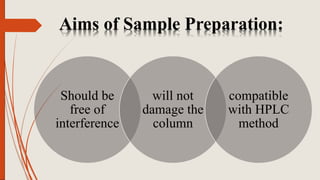
Aims of Sample Preparation:
Should be
free of
interference
will not
damage the
column
compatible
with HPLC
method
Types of Samples:
Sample matrices can be classified as
1) Organic
2) Inorganic.
Further Divided Into:
Solids, semisolids (gels, creams and suspensions)
Liquids
Gases.
Gaseous samples are usually by GC but sample which is
labile and thermally unstable or prone to absorb are better
by HPLC.
Compared to gaseous or solids, liquids are much easier to
prepare for HPLC.
Preliminary processing of solids and semisolids, reducing
sample particle size is required.
It is homogeneous allowing more sampling with greater
accuracy and precious.
Methods to reduce particle size are blending, chopping,
cutting, grinding and milling etc.
Drying a Sample:
Drying the sampling is usually necessary for
reliable for reliable assay.
Filtration:
Particle should be removed prior to injection
because of their adverse effect on column.
HPLC filters in the range of 0.25 to 2μm.
INSTRUMENTAION:
(1) Solvent Reservoir
Solvent reservoir used to store the mobile phase in
HPLC. Two types of solvent reservoir.
i. Binary System
ii. Quaternary System
i. Binary System:
Two reservoirs or bottles will be there.
ii. Quaternary System:
Two reservoirs or bottles will be there.
Four bottles or reservoirs will be there.
HPLC grade solvents are used.
These solvents are highly pure.
(2) Degasser:
For removal of gases with are dissolve in our mobile phase
or solvent is done by vacuum pump.
(3) Solvent Mixing Valve:
For mixing of the solvents.
All solvents are run by the pipe diameter of this pipe is ⅛ inch
made up of PTFE (poly tetra floro ethylene) is also called Teflon.
(4) HPLC Pump:
There are two types.
1. Constant pressure pump
2. Constant flow rate pump
1) Constant Pressure Pump:
Constant pressure pump means pressure of the pump will be
constant so flow rate may vary and this will not give proper
separation.
2) Constant Flow Rate Pump
Flow rate will be constant and pressure may be change
means according to our column resistance pressure will be
change and due to that pressure change our flow rate will
not effect.
Means column resistance will be higher and pressure will
be higher to maintain flow rate, if column resistance will
be lower pressure will also be lower to maintain constant
flow rate.
Generally, we are using 1 ml/min flow rate in HPLC. One
problem which face in HPLC.
Back Pressure:
Due to resistance of the column.
Low back pressure in new column.
High back pressure in used column.
It is due to blockage of the pores of stationary phase.
(5) Precolumn/Guard Column
Precolumn used to protect analytical column. So, any type
of concentration present in our solvent will be removed by
precolumn.
Internal diameter is 4-5 mm and length are 2-10 cm.
(6) Sample Injector:
There are three types.
1) Septum injector
2) Stop flow septum less injection
3) Microvolume sampling
1) Septum Injector:
Auto selling septum will be there, we will injection our sample
by using micro string.
2) Stop Flow Septum Less Injection:
In this type of injection first we will stop the flow of mobile
phase then we will open the upper part of our column after that
we will put our sample here.
(7) Analytical column:
3) Microvolume Sampling:
This is modern sample injector. By using this sample
injector highest accuracy will be achieved and auto
sampling technique is use by using this sample injection
method.
Length 10-30 cm
Internal diameter 4-5 mm
External diameter 6.35 mm
14000-15000 psi pressure is applied during packing.
The separation is performed inside the column.
The recent columns are often prepared in a stainless steel
housing, instead of glass columns.
This column is made up of stainless steel is a very solid
alloy which can resist the high pressure.
The packing material generally used is silica or polymer
gels compared to calcium carbonate.
The eluent used for LC varies from acidic to basic
solvents.
Most column housing is made of stainless steel since
stainless is tolerant towards a large variety of solvents.
(8) Column Heater:
The LC separation is often largely influenced by the column
temperature.
In order to obtain repeatable results, it is important to keep
consistent temperature conditions.
Also for some analysis, such as sugar and organic acid,
better resolutions can be obtained at elevated temperatures
(50 to 80°C).
Thus columns are generally kept inside the column oven
(column heater).
(9) Detectors:
Various detectors use in HPLC.
1. Refractive Index Detector
2. Conductivity Detector
3. UV Visible Detector
4. Fluorescence Detector
5. Mass Detector
6. Amperometric Detector
(10) Recorder:
The change in eluent detected by a detector is in the form of
an electronic signal, and thus it is still not visible to our eyes.
In older days, the pen (paper)-chart recorder was popularly
used. Nowadays, a computer-based data processor (integrator)
is more common.
There are various types of data processors; from a simple
system consisting of the in-built printer and word processor
while those with software that are specifically designed for an
LC system which not only data acquisition but features like
peak-fitting, baseline correction, automatic concentration
calculation, molecular weight determination, etc.
HPLC Sample Preparation and Instrumentatio

HPLC Sample Preparation and Instrumentatio

  • 1.
    Presented By Group11: Sijawal Ali CHEM19131094 Adnan Sohail Akhtar CHEM19131110 Syed Irshad Bukhari CHEM19131113 Kaleem Ullah CHEM19131116 Muhammad Nazim CHEM19131119 Presented To : Dr.Ahmad Mudassir
  • 2.
    Introduction: Sample preparation isan essential part of HPLC analysis intended to provide a reproducible and homogenous that is suitable for injection on the column. SAMPLE PREPRATION:
  • 3.
    Aims of SamplePreparation: Should be free of interference will not damage the column compatible with HPLC method
  • 4.
    Types of Samples: Samplematrices can be classified as 1) Organic 2) Inorganic. Further Divided Into: Solids, semisolids (gels, creams and suspensions) Liquids Gases.
  • 5.
    Gaseous samples areusually by GC but sample which is labile and thermally unstable or prone to absorb are better by HPLC. Compared to gaseous or solids, liquids are much easier to prepare for HPLC. Preliminary processing of solids and semisolids, reducing sample particle size is required. It is homogeneous allowing more sampling with greater accuracy and precious. Methods to reduce particle size are blending, chopping, cutting, grinding and milling etc.
  • 6.
    Drying a Sample: Dryingthe sampling is usually necessary for reliable for reliable assay. Filtration: Particle should be removed prior to injection because of their adverse effect on column. HPLC filters in the range of 0.25 to 2μm.
  • 7.
    INSTRUMENTAION: (1) Solvent Reservoir Solventreservoir used to store the mobile phase in HPLC. Two types of solvent reservoir. i. Binary System ii. Quaternary System
  • 8.
    i. Binary System: Tworeservoirs or bottles will be there. ii. Quaternary System: Two reservoirs or bottles will be there. Four bottles or reservoirs will be there. HPLC grade solvents are used. These solvents are highly pure. (2) Degasser: For removal of gases with are dissolve in our mobile phase or solvent is done by vacuum pump.
  • 9.
    (3) Solvent MixingValve: For mixing of the solvents. All solvents are run by the pipe diameter of this pipe is ⅛ inch made up of PTFE (poly tetra floro ethylene) is also called Teflon. (4) HPLC Pump: There are two types. 1. Constant pressure pump 2. Constant flow rate pump 1) Constant Pressure Pump: Constant pressure pump means pressure of the pump will be constant so flow rate may vary and this will not give proper separation.
  • 10.
    2) Constant FlowRate Pump Flow rate will be constant and pressure may be change means according to our column resistance pressure will be change and due to that pressure change our flow rate will not effect. Means column resistance will be higher and pressure will be higher to maintain flow rate, if column resistance will be lower pressure will also be lower to maintain constant flow rate. Generally, we are using 1 ml/min flow rate in HPLC. One problem which face in HPLC.
  • 11.
    Back Pressure: Due toresistance of the column. Low back pressure in new column. High back pressure in used column. It is due to blockage of the pores of stationary phase. (5) Precolumn/Guard Column Precolumn used to protect analytical column. So, any type of concentration present in our solvent will be removed by precolumn. Internal diameter is 4-5 mm and length are 2-10 cm.
  • 12.
    (6) Sample Injector: Thereare three types. 1) Septum injector 2) Stop flow septum less injection 3) Microvolume sampling 1) Septum Injector: Auto selling septum will be there, we will injection our sample by using micro string. 2) Stop Flow Septum Less Injection: In this type of injection first we will stop the flow of mobile phase then we will open the upper part of our column after that we will put our sample here.
  • 13.
    (7) Analytical column: 3)Microvolume Sampling: This is modern sample injector. By using this sample injector highest accuracy will be achieved and auto sampling technique is use by using this sample injection method. Length 10-30 cm Internal diameter 4-5 mm External diameter 6.35 mm 14000-15000 psi pressure is applied during packing.
  • 14.
    The separation isperformed inside the column. The recent columns are often prepared in a stainless steel housing, instead of glass columns. This column is made up of stainless steel is a very solid alloy which can resist the high pressure. The packing material generally used is silica or polymer gels compared to calcium carbonate. The eluent used for LC varies from acidic to basic solvents. Most column housing is made of stainless steel since stainless is tolerant towards a large variety of solvents.
  • 15.
    (8) Column Heater: TheLC separation is often largely influenced by the column temperature. In order to obtain repeatable results, it is important to keep consistent temperature conditions. Also for some analysis, such as sugar and organic acid, better resolutions can be obtained at elevated temperatures (50 to 80°C). Thus columns are generally kept inside the column oven (column heater).
  • 16.
    (9) Detectors: Various detectorsuse in HPLC. 1. Refractive Index Detector 2. Conductivity Detector 3. UV Visible Detector 4. Fluorescence Detector 5. Mass Detector 6. Amperometric Detector
  • 17.
    (10) Recorder: The changein eluent detected by a detector is in the form of an electronic signal, and thus it is still not visible to our eyes. In older days, the pen (paper)-chart recorder was popularly used. Nowadays, a computer-based data processor (integrator) is more common. There are various types of data processors; from a simple system consisting of the in-built printer and word processor while those with software that are specifically designed for an LC system which not only data acquisition but features like peak-fitting, baseline correction, automatic concentration calculation, molecular weight determination, etc.