ARCHANA.K.R
PHYSICAL SCIENCE
HPLC
 It is the most versatile & widely used type of
elution chromatography.
 The technique is used by chemists to
separate and determine species in a variety
of organic, inorganic and biological
materials.
i. HPLC can be defined as the technique for the
separation of components of mixtures by differential
migration through a column containing a
microparticulate solid stationary phase.
ii. To obtain satisfactory flow rates, the liquid must be
pressurized.
iii. Originally it was referred to as high pressure liquid
chromatography.But now a days the term high
performance liquid cromatography is preferred.
CLASSIFICATION
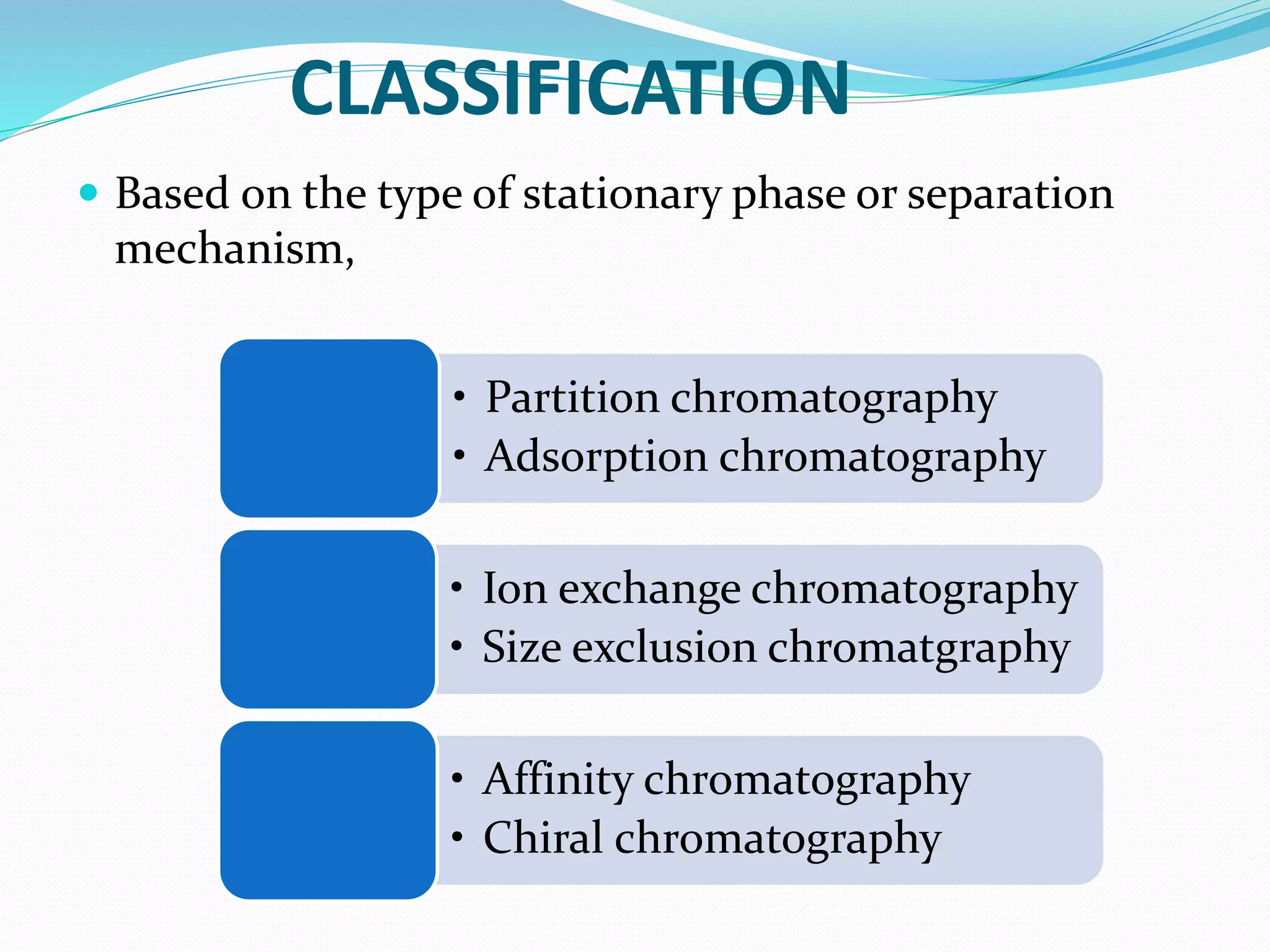
 Based on the type of stationary phase or separation
mechanism,
• Partition chromatography
• Adsorption chromatography
• Ion exchange chromatography
• Size exclusion chromatgraphy
• Affinity chromatography
• Chiral chromatography
PRINCIPLE
•HPLC relies on pumps to pass a pressurized liquid and a
Sample mixture through a column filled with a sorbent.
•The components of the sample mixture are separated from
each other due to their different degrees of interaction with
the sorbent particles.
INSRTUMENTATION
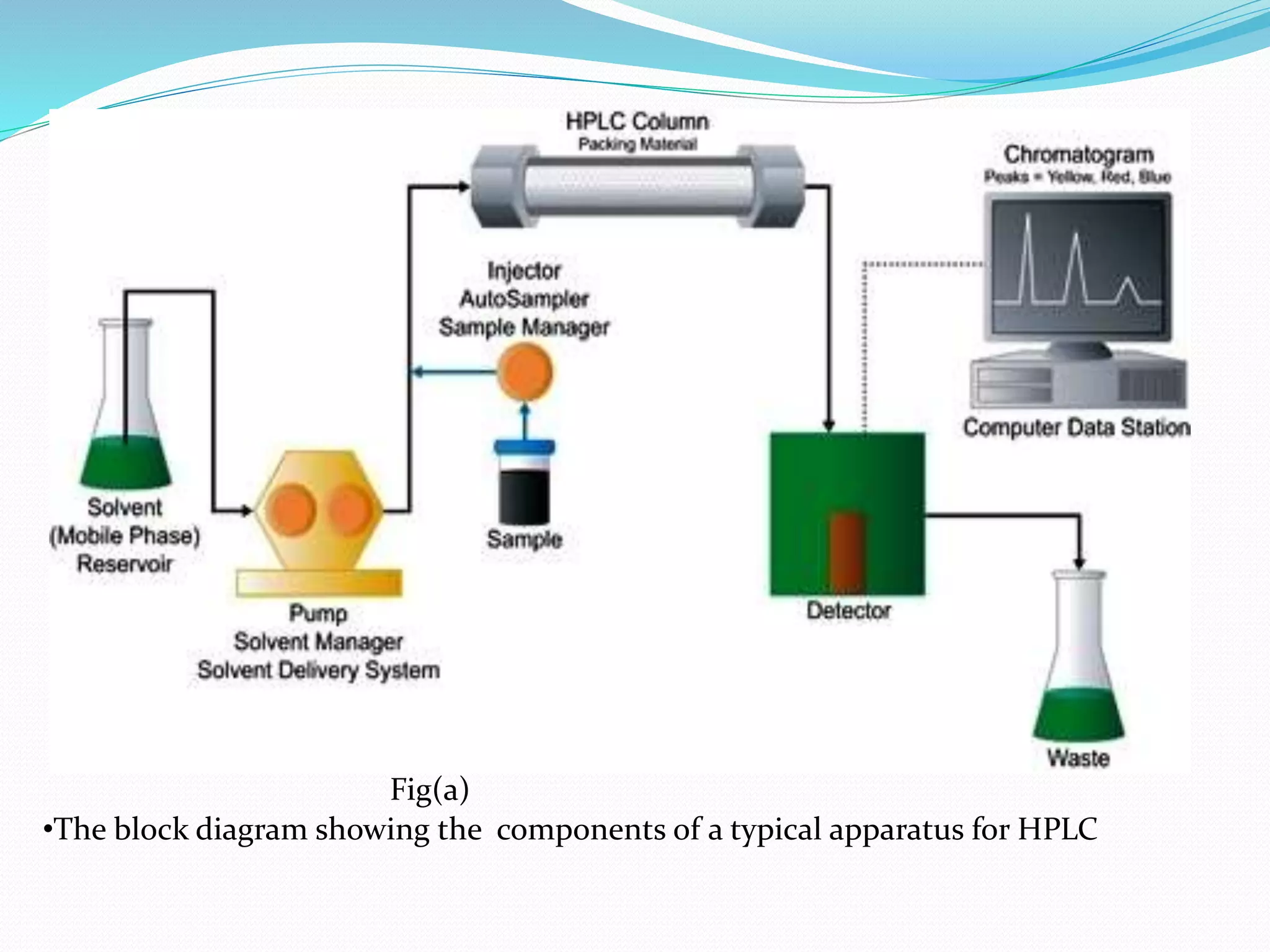
The components of a typical apparatus for
HPLC are,
 Mobile phase reservoirs and solvent treatment
System
 Pumping systems
 Sample injection system
 Columns for HPLC
 Detectors
•The block diagram showing the components of a typical apparatus for HPLC
Fig(a)
1.MOBILE PHASE RESERVOIRS AND SOLVENT
TREATMENT SYSTEM.
A modern HPLC apparatus is eqipped withone or more
glass reservoirs,each of which contains 500 mL or more
of a solvent.
Provisions are often included to remove dissolved
gases and dust from the liquids.(Degassers)
Sparging is a process in which dissolved gases are
swept out of a solvent by bubbles of an inert, insoluble
gas.
ISOCRATIC AND GRADIENT ELUTION
An isocratic elution in which the solvent composition
remains constant.
A gradient elution in HPLC is one in which the
composition of the solvent is changed continuously or
in a series of steps.
In gradient elution, two or sometimes more solvent
systems that differ significantly in polarity are used.
Gradient elution frequently improves separation
efficiency.
2. PUMPING SYSTEMS
The pumping system is one of the most important
features of an HPLC.
The main features of a good pumping system are,
 It is capable of outputs of at least 3.4*107Pa(5000p.s.i)
 Pulse-free output.
 There must be a flow delivery of at least 10cm3 min-1
for normal analysis.
 Resistance to corrosion by a variety of solvents.
There are three major types of pumps;
 Screw-driven syringe type:-produce pulse free
delivery whose flow rate is readily controlled.
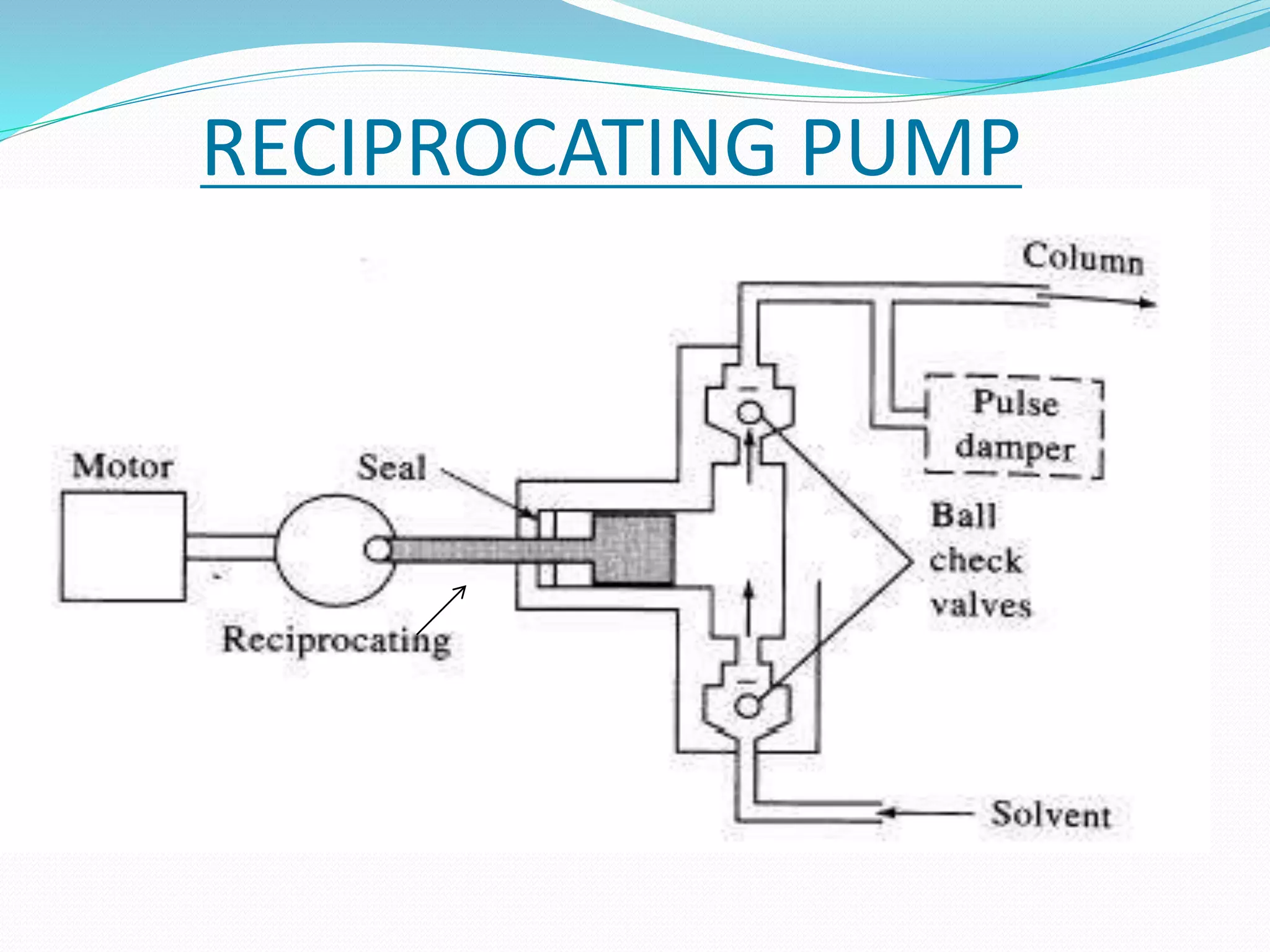
Recipocating pump :-most widely used type of
pump.
Pneumatic pump:-These pumps operate by the
introduction of high pressure gas in the pump, and
the gas in turn forces the solvent from the pump
chamber into the column.
RECIPROCATING PUMP
HOW IT WORKS?...........
•The device consist of a small cylindrical chamber that is
filled and then emptied by the back- and- forth motion of
a piston.
•The pumping motion produces a pulsed flow that must
be subsequently damped.
•Advantages of reciprocating pump are,
1. Small internal volume
2. High output pressure(up to 10,000psi)
3. Ready adaptability to gradient elution
4. Constant flow rates
3. SAMPLE INJECTION SYSTEM
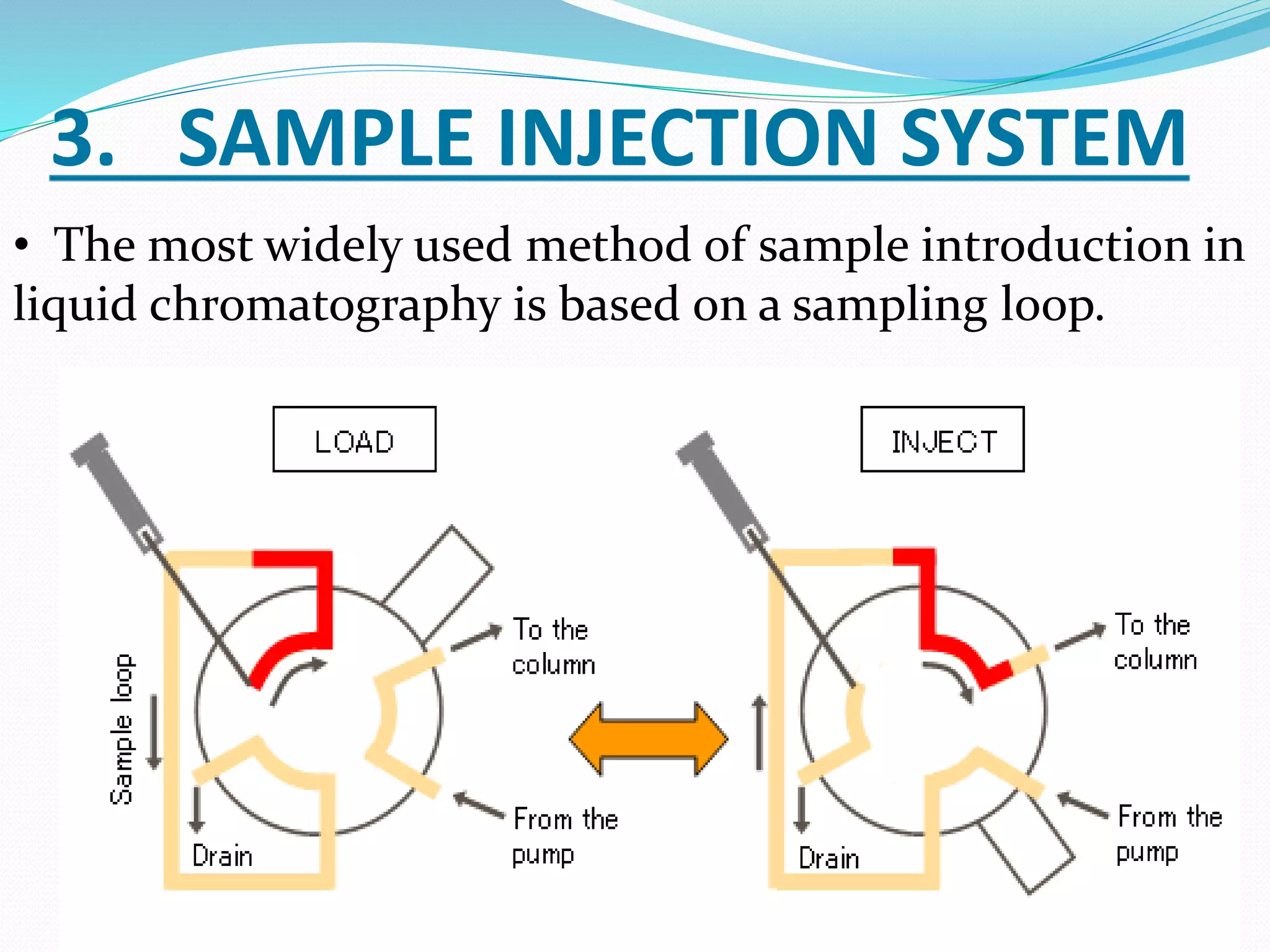
• The most widely used method of sample introduction in
liquid chromatography is based on a sampling loop.
•This devices are an integral part of some liquid
chromatography equipment.
•Interchangeable loops are available to provide a choice
of sample sizes ranging from 5 to 500
•The loop is first filled with sample from a syringe while
the mobile phase flows directly to the column.
•By turning a handle to rotate the body of the valve,the
mobile phase is diverted through the loop thus injecting
the sample on to the top of the column with out stopping
the flow .
4.COLUMNS FOR HPLC
•Columns used for HPLC are generally made of stainless
steel.
•Most columns range in length from 10 to 30 cm &have
inside diameters of 2 to 5mm
•Column packings typically have particles size of 3 to 10
micrometers.
•The most common packing for liquid chromatography is
prepared from silica particles.Other packing material
include alumina particles,ion-exchange resins....
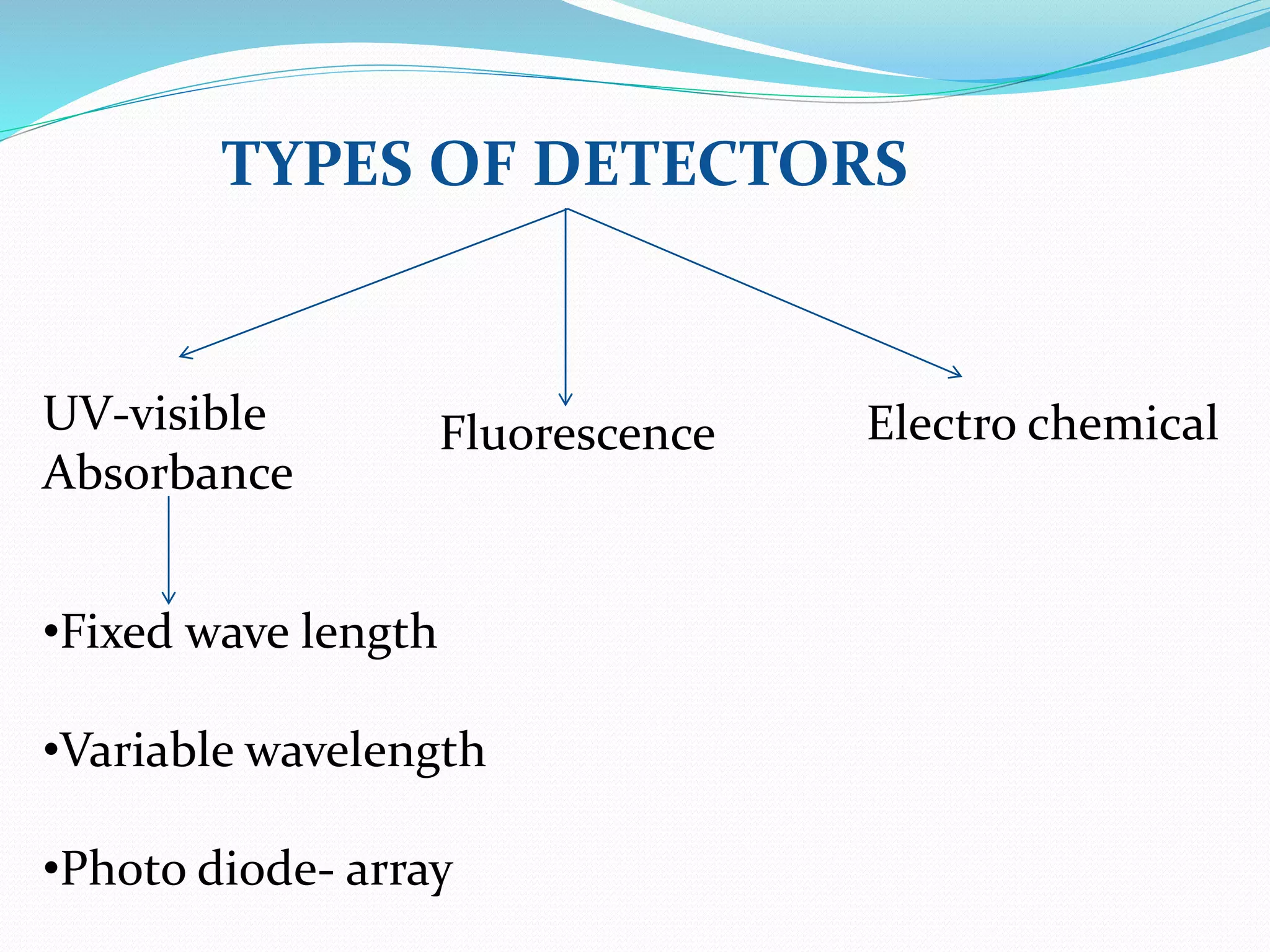
5.DETECTORS
Detectors are based on a selective response for the solute,such
as UV- absorbance or fluorescence ,or on a bulk property of the
mobile phase which is modified by the solute,such as refractive
index.
Charecteristics of detectors
Rapid and reproducible response to solutes
High sensitivity, i.e, able to detect very low levels of
solute
stability in operation
A cell design that does not entrap air bubbles that outgas
from the mobile phase at the end of the column.
A signal directly proportional to solute concentration
TYPES OF DETECTORS
UV-visible
Absorbance
Fluorescence Electro chemical
•Fixed wave length
•Variable wavelength
•Photo diode- array
REFERENCE
• Instrumental methods of chemical analysis-
Gurudeep.R.Chatwal & Sham.K.Chand
• Fundamentals of analytical chemistry-S.A.Skoog,West&Holler
• Internet
HPLC

HPLC

  • 1.
  • 2.
    HPLC  It isthe most versatile & widely used type of elution chromatography.  The technique is used by chemists to separate and determine species in a variety of organic, inorganic and biological materials.
  • 3.
    i. HPLC canbe defined as the technique for the separation of components of mixtures by differential migration through a column containing a microparticulate solid stationary phase. ii. To obtain satisfactory flow rates, the liquid must be pressurized. iii. Originally it was referred to as high pressure liquid chromatography.But now a days the term high performance liquid cromatography is preferred.
  • 4.
    CLASSIFICATION  Based onthe type of stationary phase or separation mechanism, • Partition chromatography • Adsorption chromatography • Ion exchange chromatography • Size exclusion chromatgraphy • Affinity chromatography • Chiral chromatography
  • 5.
    PRINCIPLE •HPLC relies onpumps to pass a pressurized liquid and a Sample mixture through a column filled with a sorbent. •The components of the sample mixture are separated from each other due to their different degrees of interaction with the sorbent particles.
  • 6.
    INSRTUMENTATION The components ofa typical apparatus for HPLC are,  Mobile phase reservoirs and solvent treatment System  Pumping systems  Sample injection system  Columns for HPLC  Detectors
  • 7.
    •The block diagramshowing the components of a typical apparatus for HPLC Fig(a)
  • 8.
    1.MOBILE PHASE RESERVOIRSAND SOLVENT TREATMENT SYSTEM. A modern HPLC apparatus is eqipped withone or more glass reservoirs,each of which contains 500 mL or more of a solvent. Provisions are often included to remove dissolved gases and dust from the liquids.(Degassers) Sparging is a process in which dissolved gases are swept out of a solvent by bubbles of an inert, insoluble gas.
  • 9.
    ISOCRATIC AND GRADIENTELUTION An isocratic elution in which the solvent composition remains constant. A gradient elution in HPLC is one in which the composition of the solvent is changed continuously or in a series of steps. In gradient elution, two or sometimes more solvent systems that differ significantly in polarity are used. Gradient elution frequently improves separation efficiency.
  • 10.
    2. PUMPING SYSTEMS Thepumping system is one of the most important features of an HPLC. The main features of a good pumping system are,  It is capable of outputs of at least 3.4*107Pa(5000p.s.i)  Pulse-free output.  There must be a flow delivery of at least 10cm3 min-1 for normal analysis.  Resistance to corrosion by a variety of solvents.
  • 11.
    There are threemajor types of pumps;  Screw-driven syringe type:-produce pulse free delivery whose flow rate is readily controlled. Recipocating pump :-most widely used type of pump. Pneumatic pump:-These pumps operate by the introduction of high pressure gas in the pump, and the gas in turn forces the solvent from the pump chamber into the column.
  • 12.
  • 13.
    HOW IT WORKS?........... •Thedevice consist of a small cylindrical chamber that is filled and then emptied by the back- and- forth motion of a piston. •The pumping motion produces a pulsed flow that must be subsequently damped. •Advantages of reciprocating pump are, 1. Small internal volume 2. High output pressure(up to 10,000psi) 3. Ready adaptability to gradient elution 4. Constant flow rates
  • 14.
    3. SAMPLE INJECTIONSYSTEM • The most widely used method of sample introduction in liquid chromatography is based on a sampling loop.
  • 15.
    •This devices arean integral part of some liquid chromatography equipment. •Interchangeable loops are available to provide a choice of sample sizes ranging from 5 to 500 •The loop is first filled with sample from a syringe while the mobile phase flows directly to the column. •By turning a handle to rotate the body of the valve,the mobile phase is diverted through the loop thus injecting the sample on to the top of the column with out stopping the flow .
  • 17.
    4.COLUMNS FOR HPLC •Columnsused for HPLC are generally made of stainless steel. •Most columns range in length from 10 to 30 cm &have inside diameters of 2 to 5mm •Column packings typically have particles size of 3 to 10 micrometers. •The most common packing for liquid chromatography is prepared from silica particles.Other packing material include alumina particles,ion-exchange resins....
  • 18.
    5.DETECTORS Detectors are basedon a selective response for the solute,such as UV- absorbance or fluorescence ,or on a bulk property of the mobile phase which is modified by the solute,such as refractive index. Charecteristics of detectors Rapid and reproducible response to solutes High sensitivity, i.e, able to detect very low levels of solute stability in operation A cell design that does not entrap air bubbles that outgas from the mobile phase at the end of the column. A signal directly proportional to solute concentration
  • 19.
    TYPES OF DETECTORS UV-visible Absorbance FluorescenceElectro chemical •Fixed wave length •Variable wavelength •Photo diode- array
  • 20.
    REFERENCE • Instrumental methodsof chemical analysis- Gurudeep.R.Chatwal & Sham.K.Chand • Fundamentals of analytical chemistry-S.A.Skoog,West&Holler • Internet