QUALITY MAINTAINANCE
1
PRESENTED BY:
Mr. Ankush P. Jadhav & Miss. Tejashree R. Kedar
M. Pharm (PQA)
Email id: jadhavbrand@gmail.com, tejashrikedar@gmail.com
1
CONTENTS
• INTRODUCTION
• DEFINITION AND IMPLEMENTATION
• MAINTENACE AND QUALITY POLICY
• MAINTENCE QUALITY OBJECTIVES
• HVAC
• CONCLUSION
2
INTRODUCTION
• There is an important correlation between quality and maintenance.
• Maintenance management has become an essential part of quality
systems.
• It is an invested rather than cost.
• Improving the quality of maintenance will lead to improved
effectiveness.
• Maintaining perfect equipment to maintain perfect quality of products.
3
DEFINITION
• Quality of maintenance is defined by Japanese institute of plant
maintenance as: create the conditions that prevent and control defects
in the process and systems to get to the zero defects stage.
4
IMPLEMENTATION
• MAINTANACE QUALITY APPLIED IN TWO PHASES:
1) PHASE I : QUALITY CONTROL PHASE
2) PHASE 2 : QUALITY ASSURANCE STAGE
• Use of preventive, predictive and proactive maintenance strategies.
5
MAINTENANCE QUALITY POLICIES
• The equipment shall be free from defects and under quality control
• Focus of the errors prevention
• Divides the defects in to main groups
• Effective application of quality assurance agent
6
OBJECTIVES
• To run the operation the longest possible time without breakdowns
• Keep the equipment maintained and fully functional at the time of
customer request
• Reducing cost of maintenance
7
THE REQUIRED INFORMATION
First : information of product
1. Number of defects and their impact on the product
2. Defects in each stage of the measurement
Second : special operation information
1. operating conditions for each sub-process
2. Prepared for the situation of the implementation of sub-module
8
APPLICATION OF TOTAL QUALITY
MANAGEMENT SYSTEM
• Link between quality and productivity
• Global quality system which is a feature of modern times
• The feasibility of some prevailing administrative systems
• The success of the application of the system comprehensive quality in
many educational institutions
9
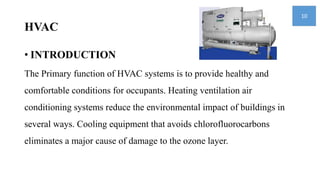
HVAC
• INTRODUCTION
The Primary function of HVAC systems is to provide healthy and
comfortable conditions for occupants. Heating ventilation air
conditioning systems reduce the environmental impact of buildings in
several ways. Cooling equipment that avoids chlorofluorocarbons
eliminates a major cause of damage to the ozone layer.
10
HVAC system types
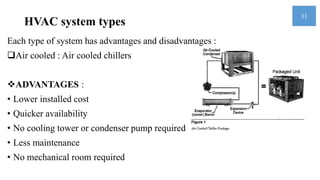
Each type of system has advantages and disadvantages :
Air cooled : Air cooled chillers
ADVANTAGES :
• Lower installed cost
• Quicker availability
• No cooling tower or condenser pump required
• Less maintenance
• No mechanical room required
11
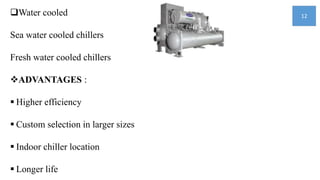
Water cooled
Sea water cooled chillers
Fresh water cooled chillers
ADVANTAGES :
 Higher efficiency
 Custom selection in larger sizes
 Indoor chiller location
 Longer life
12
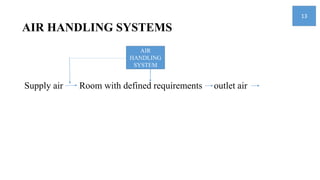
AIR HANDLING SYSTEMS
Supply air Room with defined requirements outlet air
AIR
HANDLING
SYSTEM
13
OBJECTIVES
We will study the components air handling systems in order to :
• Become familiar with the components
• Know their functions
• Become aware of possible problems
14
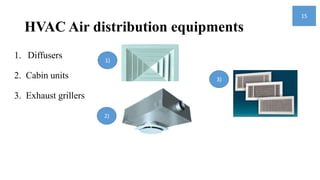
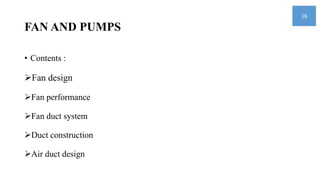
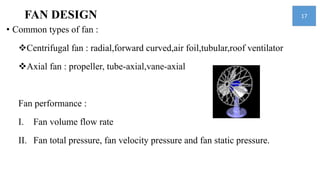
HVAC Air distribution equipments
1. Diffusers
2. Cabin units
3. Exhaust grillers
15
1)
2)
3)
FAN AND PUMPS
• Contents :
Fan design
Fan performance
Fan duct system
Duct construction
Air duct design
16
FAN DESIGN
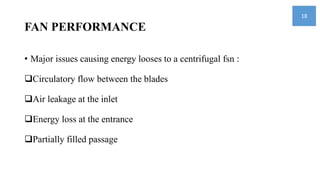
• Common types of fan :
Centrifugal fan : radial,forward curved,air foil,tubular,roof ventilator
Axial fan : propeller, tube-axial,vane-axial
Fan performance :
I. Fan volume flow rate
II. Fan total pressure, fan velocity pressure and fan static pressure.
17
FAN PERFORMANCE
• Major issues causing energy looses to a centrifugal fsn :
Circulatory flow between the blades
Air leakage at the inlet
Energy loss at the entrance
Partially filled passage
18
FAN DUCT SYSTEM
• Duct pressure changes
Static pressure
Velocity pressure
Total pressure
19
DUCT CONSTRUCTION
• Types of air duct
Supply air duct
Return sir duct
Outdoor air duct
Exhaust air
20
AIR DUCT DESIGN
• Systematic layout is easier to balance
• For exposed ducts appearance with the structure is important
• Compare alternative layouts and reduce fittings.
21
CONCLUSION
• The main objective of this study was accomplished the development of a
prototype QA programme for high maintenance. This is described and
illustrated in a two volume instructional document, titled maintenance QA
programme implementation manual.at the heart of the programme is an LOS
rating system that enables agencies to produce long term, end result
maintenance quality
22
REFERENCE
• Manohar A. Potdar “Pharmaceutical Quality Assurance” Nirali Publications, 6th
edition, 2017.
• Sawant R., Hapse S., “Fundamentals of Quality Assurance Techniques” 2nd
edition, Career Publications, May 2016.
23

Quality maintenance

  • 1.
    QUALITY MAINTAINANCE 1 PRESENTED BY: Mr.Ankush P. Jadhav & Miss. Tejashree R. Kedar M. Pharm (PQA) Email id: jadhavbrand@gmail.com, tejashrikedar@gmail.com 1
  • 2.
    CONTENTS • INTRODUCTION • DEFINITIONAND IMPLEMENTATION • MAINTENACE AND QUALITY POLICY • MAINTENCE QUALITY OBJECTIVES • HVAC • CONCLUSION 2
  • 3.
    INTRODUCTION • There isan important correlation between quality and maintenance. • Maintenance management has become an essential part of quality systems. • It is an invested rather than cost. • Improving the quality of maintenance will lead to improved effectiveness. • Maintaining perfect equipment to maintain perfect quality of products. 3
  • 4.
    DEFINITION • Quality ofmaintenance is defined by Japanese institute of plant maintenance as: create the conditions that prevent and control defects in the process and systems to get to the zero defects stage. 4
  • 5.
    IMPLEMENTATION • MAINTANACE QUALITYAPPLIED IN TWO PHASES: 1) PHASE I : QUALITY CONTROL PHASE 2) PHASE 2 : QUALITY ASSURANCE STAGE • Use of preventive, predictive and proactive maintenance strategies. 5
  • 6.
    MAINTENANCE QUALITY POLICIES •The equipment shall be free from defects and under quality control • Focus of the errors prevention • Divides the defects in to main groups • Effective application of quality assurance agent 6
  • 7.
    OBJECTIVES • To runthe operation the longest possible time without breakdowns • Keep the equipment maintained and fully functional at the time of customer request • Reducing cost of maintenance 7
  • 8.
    THE REQUIRED INFORMATION First: information of product 1. Number of defects and their impact on the product 2. Defects in each stage of the measurement Second : special operation information 1. operating conditions for each sub-process 2. Prepared for the situation of the implementation of sub-module 8
  • 9.
    APPLICATION OF TOTALQUALITY MANAGEMENT SYSTEM • Link between quality and productivity • Global quality system which is a feature of modern times • The feasibility of some prevailing administrative systems • The success of the application of the system comprehensive quality in many educational institutions 9
  • 10.
    HVAC • INTRODUCTION The Primaryfunction of HVAC systems is to provide healthy and comfortable conditions for occupants. Heating ventilation air conditioning systems reduce the environmental impact of buildings in several ways. Cooling equipment that avoids chlorofluorocarbons eliminates a major cause of damage to the ozone layer. 10
  • 11.
    HVAC system types Eachtype of system has advantages and disadvantages : Air cooled : Air cooled chillers ADVANTAGES : • Lower installed cost • Quicker availability • No cooling tower or condenser pump required • Less maintenance • No mechanical room required 11
  • 12.
    Water cooled Sea watercooled chillers Fresh water cooled chillers ADVANTAGES :  Higher efficiency  Custom selection in larger sizes  Indoor chiller location  Longer life 12
  • 13.
    AIR HANDLING SYSTEMS Supplyair Room with defined requirements outlet air AIR HANDLING SYSTEM 13
  • 14.
    OBJECTIVES We will studythe components air handling systems in order to : • Become familiar with the components • Know their functions • Become aware of possible problems 14
  • 15.
    HVAC Air distributionequipments 1. Diffusers 2. Cabin units 3. Exhaust grillers 15 1) 2) 3)
  • 16.
    FAN AND PUMPS •Contents : Fan design Fan performance Fan duct system Duct construction Air duct design 16
  • 17.
    FAN DESIGN • Commontypes of fan : Centrifugal fan : radial,forward curved,air foil,tubular,roof ventilator Axial fan : propeller, tube-axial,vane-axial Fan performance : I. Fan volume flow rate II. Fan total pressure, fan velocity pressure and fan static pressure. 17
  • 18.
    FAN PERFORMANCE • Majorissues causing energy looses to a centrifugal fsn : Circulatory flow between the blades Air leakage at the inlet Energy loss at the entrance Partially filled passage 18
  • 19.
    FAN DUCT SYSTEM •Duct pressure changes Static pressure Velocity pressure Total pressure 19
  • 20.
    DUCT CONSTRUCTION • Typesof air duct Supply air duct Return sir duct Outdoor air duct Exhaust air 20
  • 21.
    AIR DUCT DESIGN •Systematic layout is easier to balance • For exposed ducts appearance with the structure is important • Compare alternative layouts and reduce fittings. 21
  • 22.
    CONCLUSION • The mainobjective of this study was accomplished the development of a prototype QA programme for high maintenance. This is described and illustrated in a two volume instructional document, titled maintenance QA programme implementation manual.at the heart of the programme is an LOS rating system that enables agencies to produce long term, end result maintenance quality 22
  • 23.
    REFERENCE • Manohar A.Potdar “Pharmaceutical Quality Assurance” Nirali Publications, 6th edition, 2017. • Sawant R., Hapse S., “Fundamentals of Quality Assurance Techniques” 2nd edition, Career Publications, May 2016. 23