High frequency oscillations
Dr Vaishal Shah
SR Neurology
GMC, kota
Introduction
• For successful surgical treatment, it is critical to determine the
epileptogenic zone as precisely as possible.
• No diagnostic modality available today to clearly delineate the
epileptogenic zone.
• Throughout the last one & a half decades, increasing attention has
been paid to fast and ultrafast EEG oscillations as a measurable
electrophysiological component of potentially pathological brain
activity.
Introduction
• A new biomarker for epileptogenic tissue has emerged.
• It consists of high-frequency oscillations (HFOs) above 80Hz, which
require the EEG to be sampled at a frequency above the usual 200Hz
or 500Hz.
• This biomarker can be found in brief intracranial EEG recordings and
possibly even in extracranial magnetoencephalography (MEG) or EEG.
Introduction
• In epilepsy surgery, removal of tissue with HFOs seems to predict
good surgical outcome, even better than removal of the ictal onset
zone.
• Feasible, because HFOs can be visualized and detected relatively
easily.
Epileptic HFOs
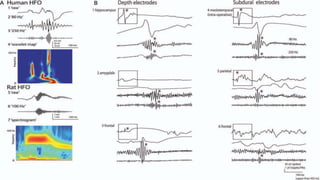
• At present, HFOs are further subclassified in
1. Ripples (80 –250Hz)
2. Fast ripples (250 – 600Hz).
• Recently, epileptic very-high-frequency oscillations (above 1,000Hz)
have been added to the spectrum.
Epileptic HFOs
• HFOs have been observed between seizures, at seizure onset, and
during seizures. Interictal HFOs mostly occur during slow-wave sleep.
• Normal neuronal circuits can generate epileptic HFOs under specific
conditions (increased extracellular potassium, decreased extracellular
calcium, blocked inhibition), but more in the ripple band.
Physiological and Epileptic HFOs
• Physiological ripples (200Hz) were primarily described in the CA1
region of the hippocampus and entorhinal cortex.
• Mesiotemporal HFOs are involved in memory formation and
reactivation of previous experiences.
• Low amplitude physiological HF activity in extratemporal neocortex
seems related with information processing functions, such as during
somatosensory evoked potentials (600Hz).
Physiological and Epileptic HFOs
• Specific regional and laminar distribution of physiological HFOs,
their shape, and other properties allow distinction from epileptic
HFOs in experimental settings, when recorded using microelectrodes.
• However, in clinical settings and recorded with macroelectrodes, it
may be challenging.
HFOs in Presurgical Evaluation
• Presurgical localization of the epileptogenic zone is based on
identifying other zones that are spatially related to the epileptogenic
zone: the irritative zone, the seizure onset zone, the epileptogenic
lesion, and the functional deficit zone.
• Together, these zones create 1 HFO zone.
HFOs in Presurgical Evaluation
• Several studies with microelectrodes conclude that fast ripples are
most specific for the epileptogenic zone
• In clinical studies with macroelectrodes it is useful to include both
ripples and fast ripples in the evaluation of the potential
epileptogenic region and future studies are needed to explore the
importance of discriminating between the two.
HFOs and the Irritative Zone
• The irritative zone is the area of cortex generating interictal
discharges (spikes).
• It overlaps with the epileptogenic zone and it is accepted that it is not
necessary to remove the entire irritative zone, but including part of it
often helps to achieve a better outcome.
• HFOs can occur in isolation but are often superimposed on interictal
spikes.
HFOs and the Irritative Zone
• Currently it is not known whether it is beneficial to distinguish
between HFOs with and without spikes.
• It was suggested that the presence of HFOs may discriminate
between so called ‘‘green’’ and ‘‘red’’ spikes, generated in
epileptogenic cortex.
HFOs and the Irritative Zone
• The localization of HFOs remains relatively fixed over a long period
with disease and under different circumstances.
• In contrast, interictal spikes are more labile
HFOs and the Seizure Onset Zone
• The seizure onset zone is the area where seizures originate and in
certain cases it involves areas of cortex of early propagation.
• In the majority of surgical cases the seizure onset zone is included in
the resection, but removing the entire seizure onset zone does not
always result in successful surgical outcome.
HFOs and the Seizure Onset Zone
• Explanation being different seizures can originate from different areas
within the epileptogenic zone, the recorded seizure onsets may not
represent the full extent of the epileptogenic area
• Another difficulty can result from early seizure spread or seizure
onset with a widespread spike, making the definition of the seizure
onset zone difficult.
HFOs and the Seizure Onset Zone
• Strengths of interictal HFOs is that they have been shown to be
reliable markers of the seizure onset zone, better than epileptic
spikes.
• Further confirmation of this finding may reduce time duration &
complication of invasive monitoring.
HFOs and the Seizure Onset Zone
• HFOs occur in regions where the threshold is low for cortical
stimulation to give rise to after-discharges or evoked seizures, even
outside the seizure onset zone. This suggests a correlation of HFOs
with endogenous epileptogenicity.
• Ictal onset HFOs are somewhat more specific for the seizure onset
zone than interictal HFOs, but occur mostly in similar channels.
HFOs and the Epileptogenic Lesion
• The epileptogenic lesion is a structural brain abnormality that causes
epileptic seizures.
• Initially, HFOs were described in temporal lobe epilepsy.
• However, HFOs are also present in extratemporal epilepsies
associated with different types of lesions, such as tumors, focal
cortical dysplasias, and nodular heterotopias.
• Therefore, HFOs are thought to represent the tissue’s intrinsic
epileptogenicity.
HFOs and the Epileptogenic Lesion
• HFOs even occur in epilepsy without an obvious lesion.
• Nonlesional epilepsies represent a future challenge for improvement
of epilepsy surgery and HFOs could help localize the epileptogenic
zone in this type of epilepsy.
How Can HFOs Be Visualized and
Detected?
• HFOs can be recorded with different types of intracranial electrodes
Microelectrodes and macroelectrodes
Depth and subdural electrodes (corticography).
• The EEG needs to be sampled at about 4 times the upper frequency
of interest. Preferentially, a sample frequency of 2,000Hz or above
should be used
How Can HFOs Be Visualized and
Detected?
• Recorded with macroelectrodes and after filtering, HFOs have been
defined as: events with at least 4 consecutive oscillations between
80Hz and 500Hz that clearly rise above baseline.
Conclusion
• It is still unknown to what extent the area showing HFOs should be
included in the resected region.
• Fast ripples probably result from structural tissue changes, whereas
ripples may signify a broader area of normal appearing tissue with a
low seizure-generation threshold. Both ripples and fast ripples are
important to consider.
Conclusion
• The HFO zones might already replace the irritative zone in the
presurgical decisions, especially in areas where the irritative zone is
often widespread, such as in frontal lobe epilepsy.
• Prospective studies are needed.
THANK YOU

High frequency oscillations

  • 1.
    High frequency oscillations DrVaishal Shah SR Neurology GMC, kota
  • 2.
    Introduction • For successfulsurgical treatment, it is critical to determine the epileptogenic zone as precisely as possible. • No diagnostic modality available today to clearly delineate the epileptogenic zone. • Throughout the last one & a half decades, increasing attention has been paid to fast and ultrafast EEG oscillations as a measurable electrophysiological component of potentially pathological brain activity.
  • 3.
    Introduction • A newbiomarker for epileptogenic tissue has emerged. • It consists of high-frequency oscillations (HFOs) above 80Hz, which require the EEG to be sampled at a frequency above the usual 200Hz or 500Hz. • This biomarker can be found in brief intracranial EEG recordings and possibly even in extracranial magnetoencephalography (MEG) or EEG.
  • 4.
    Introduction • In epilepsysurgery, removal of tissue with HFOs seems to predict good surgical outcome, even better than removal of the ictal onset zone. • Feasible, because HFOs can be visualized and detected relatively easily.
  • 5.
    Epileptic HFOs • Atpresent, HFOs are further subclassified in 1. Ripples (80 –250Hz) 2. Fast ripples (250 – 600Hz). • Recently, epileptic very-high-frequency oscillations (above 1,000Hz) have been added to the spectrum.
  • 6.
    Epileptic HFOs • HFOshave been observed between seizures, at seizure onset, and during seizures. Interictal HFOs mostly occur during slow-wave sleep. • Normal neuronal circuits can generate epileptic HFOs under specific conditions (increased extracellular potassium, decreased extracellular calcium, blocked inhibition), but more in the ripple band.
  • 8.
    Physiological and EpilepticHFOs • Physiological ripples (200Hz) were primarily described in the CA1 region of the hippocampus and entorhinal cortex. • Mesiotemporal HFOs are involved in memory formation and reactivation of previous experiences. • Low amplitude physiological HF activity in extratemporal neocortex seems related with information processing functions, such as during somatosensory evoked potentials (600Hz).
  • 9.
    Physiological and EpilepticHFOs • Specific regional and laminar distribution of physiological HFOs, their shape, and other properties allow distinction from epileptic HFOs in experimental settings, when recorded using microelectrodes. • However, in clinical settings and recorded with macroelectrodes, it may be challenging.
  • 10.
    HFOs in PresurgicalEvaluation • Presurgical localization of the epileptogenic zone is based on identifying other zones that are spatially related to the epileptogenic zone: the irritative zone, the seizure onset zone, the epileptogenic lesion, and the functional deficit zone. • Together, these zones create 1 HFO zone.
  • 11.
    HFOs in PresurgicalEvaluation • Several studies with microelectrodes conclude that fast ripples are most specific for the epileptogenic zone • In clinical studies with macroelectrodes it is useful to include both ripples and fast ripples in the evaluation of the potential epileptogenic region and future studies are needed to explore the importance of discriminating between the two.
  • 12.
    HFOs and theIrritative Zone • The irritative zone is the area of cortex generating interictal discharges (spikes). • It overlaps with the epileptogenic zone and it is accepted that it is not necessary to remove the entire irritative zone, but including part of it often helps to achieve a better outcome. • HFOs can occur in isolation but are often superimposed on interictal spikes.
  • 13.
    HFOs and theIrritative Zone • Currently it is not known whether it is beneficial to distinguish between HFOs with and without spikes. • It was suggested that the presence of HFOs may discriminate between so called ‘‘green’’ and ‘‘red’’ spikes, generated in epileptogenic cortex.
  • 14.
    HFOs and theIrritative Zone • The localization of HFOs remains relatively fixed over a long period with disease and under different circumstances. • In contrast, interictal spikes are more labile
  • 15.
    HFOs and theSeizure Onset Zone • The seizure onset zone is the area where seizures originate and in certain cases it involves areas of cortex of early propagation. • In the majority of surgical cases the seizure onset zone is included in the resection, but removing the entire seizure onset zone does not always result in successful surgical outcome.
  • 16.
    HFOs and theSeizure Onset Zone • Explanation being different seizures can originate from different areas within the epileptogenic zone, the recorded seizure onsets may not represent the full extent of the epileptogenic area • Another difficulty can result from early seizure spread or seizure onset with a widespread spike, making the definition of the seizure onset zone difficult.
  • 17.
    HFOs and theSeizure Onset Zone • Strengths of interictal HFOs is that they have been shown to be reliable markers of the seizure onset zone, better than epileptic spikes. • Further confirmation of this finding may reduce time duration & complication of invasive monitoring.
  • 18.
    HFOs and theSeizure Onset Zone • HFOs occur in regions where the threshold is low for cortical stimulation to give rise to after-discharges or evoked seizures, even outside the seizure onset zone. This suggests a correlation of HFOs with endogenous epileptogenicity. • Ictal onset HFOs are somewhat more specific for the seizure onset zone than interictal HFOs, but occur mostly in similar channels.
  • 19.
    HFOs and theEpileptogenic Lesion • The epileptogenic lesion is a structural brain abnormality that causes epileptic seizures. • Initially, HFOs were described in temporal lobe epilepsy. • However, HFOs are also present in extratemporal epilepsies associated with different types of lesions, such as tumors, focal cortical dysplasias, and nodular heterotopias. • Therefore, HFOs are thought to represent the tissue’s intrinsic epileptogenicity.
  • 20.
    HFOs and theEpileptogenic Lesion • HFOs even occur in epilepsy without an obvious lesion. • Nonlesional epilepsies represent a future challenge for improvement of epilepsy surgery and HFOs could help localize the epileptogenic zone in this type of epilepsy.
  • 21.
    How Can HFOsBe Visualized and Detected? • HFOs can be recorded with different types of intracranial electrodes Microelectrodes and macroelectrodes Depth and subdural electrodes (corticography). • The EEG needs to be sampled at about 4 times the upper frequency of interest. Preferentially, a sample frequency of 2,000Hz or above should be used
  • 22.
    How Can HFOsBe Visualized and Detected? • Recorded with macroelectrodes and after filtering, HFOs have been defined as: events with at least 4 consecutive oscillations between 80Hz and 500Hz that clearly rise above baseline.
  • 23.
    Conclusion • It isstill unknown to what extent the area showing HFOs should be included in the resected region. • Fast ripples probably result from structural tissue changes, whereas ripples may signify a broader area of normal appearing tissue with a low seizure-generation threshold. Both ripples and fast ripples are important to consider.
  • 24.
    Conclusion • The HFOzones might already replace the irritative zone in the presurgical decisions, especially in areas where the irritative zone is often widespread, such as in frontal lobe epilepsy. • Prospective studies are needed.
  • 26.

Editor's Notes

  • #8 Examples of HFOs. (A) HFOs recorded with depth macroelectrode in human (1–4) and rat (5–7) hippocampal area. Raw intracranial EEG with sharp wave from human hippocampal area (macroelectrode) (2 and 3) Filtered with high-pass filter of 80Hz and 250Hz. Note the differences in amplitude scales. Such an event would not stand out in normal EEG. (4) Wavelet transform of frequencies up to 500Hz. (5) Raw intracranial EEG data from rat with right intrahippocampal injection of tetanus toxin (microelectrode). A fast ripple with peak frequency 359Hz followed by activity at 240Hz is visible in the raw data. (6) Filtered with high-pass filter of 100Hz. (7) Spectrogram up to 500Hz after Fourier transformation. (B) HFOs recorded with depth and subdural macroelectrodes, in mesiotemporal areas and neocortical areas in patients with epilepsy. For each event the display shows the standard EEG signal, the same signal with extended time scale and this signal after 80Hz and 250Hz high-pass filtering. Different examples are shown from different sites. This illustrates that all combinations are possible: spike with ripple and fast ripple (1-4), ripple and fast ripple without spike (2), spike with ripple without fast ripple (3-5) and fast ripple without ripple or spike (6)