HH204
HOUSEKEEPING
MANAGEMENT

LINEN AND
FABRIC HANDLING
2.1.1 INTRODUCTION








Linen and fabrics supply is important ensure the effectiveness of a hotel’s
operation.
Without linen and fabric a hotel cannot provid service that we lead to
customer satisfaction.
Linen and fabric involves hundred thousands of dollars.
Housekeeping department’s responsibility to protect this investment.
This responsibility involves proper selection of linen and using proper
procedurs for linen and fabric handling.
WHAT IS LINEN and fabric?






Linen is normally known as cloth or thread made of Flax.
Flax is a plant of natural fiber (cellulose fiber).
The another meaning for linens is widely use in hospitality context,which is
household ar ticle made of cloth .
Fabrics are material made usually by weaving or knitting fibers.
HOW TO CHOOSE LINENS?


To choose linens,we must understand that every attribute of the products
affects the QUALITY and PRICE.

THERE ARE SEVERAL FACTORS TO CONSIDER :
 Fiber content
 Fabric quality
 Thread count and yarn count
 Type of weave
 Fabric finish
 Dyes and printing quality
 Texture
 Size
 Reconizing quality
 Caring for fine linens
Types of linen and fabric
The fibers that are most commonly used today can be divided into two categories:
o
Natural fibers (vegetables and animal)
o
Man-made fibers(regenerated or synthetic)

NATURAL FIBERS
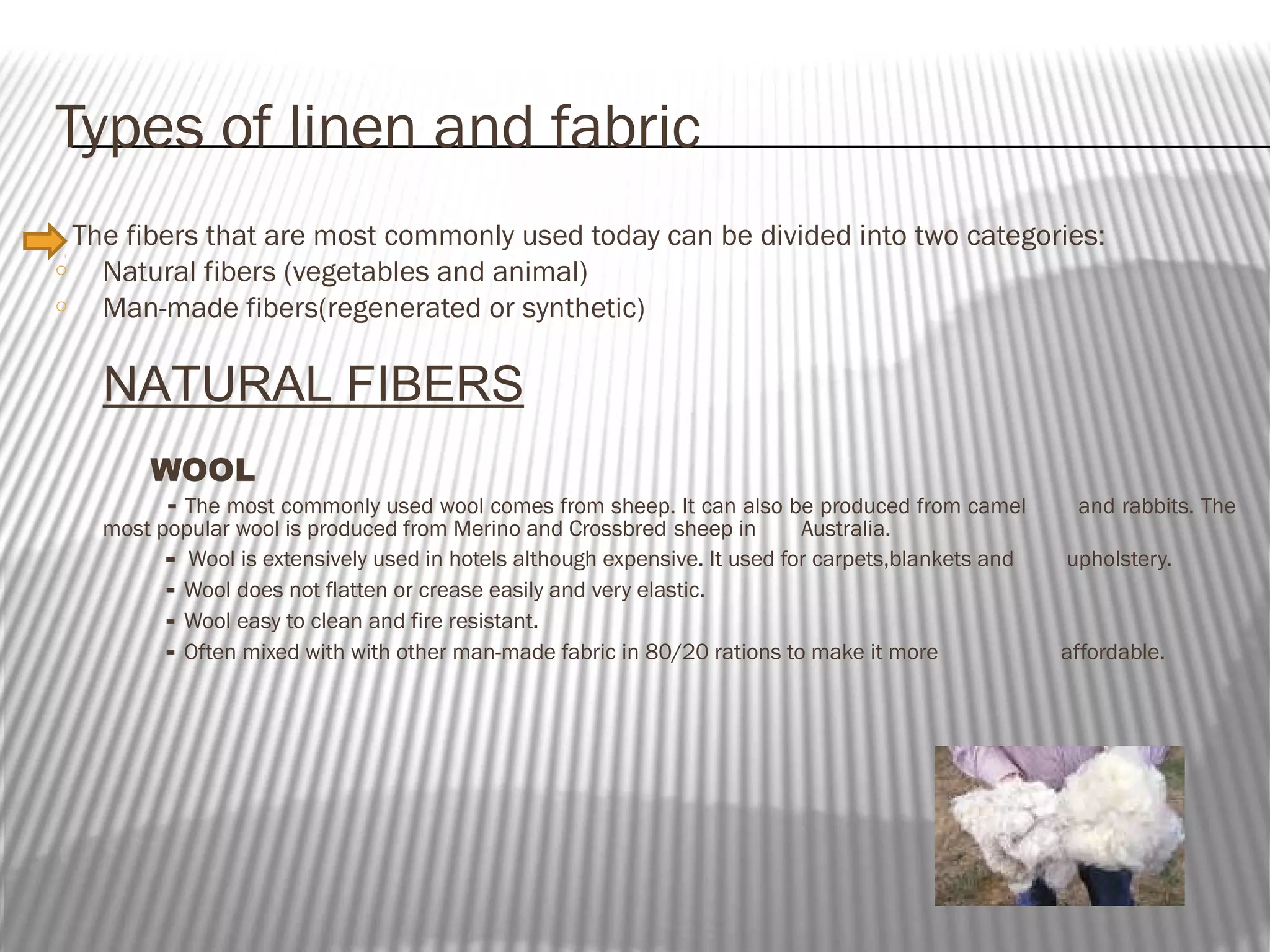
WOOL

- The most commonly used wool comes from sheep. It can also be produced from camel
most popular wool is produced from Merino and Crossbred sheep in
Australia.
- Wool is extensively used in hotels although expensive. It used for carpets,blankets and
- Wool does not flatten or crease easily and very elastic.
- Wool easy to clean and fire resistant.
- Often mixed with with other man-made fabric in 80/20 rations to make it more

and rabbits. The
upholstery.

affordable.
SILK
- Silk is the strongest of natural fibers and a very light fabric.
- Some of its usage in hotel include wall covering,cushion cover and bed
- Silk has a draping power – which means it retains shape and caresses
also an elastic fabric.
- It is a very expensive and seldom used in hospitality except for luxury
apartments.

sheets.
the body. It
suites and

COTTON
-Cotton comes from the cotton plant seed grown in
India,USA,Egypt,West
Indies and
China.
-Cotton is used for bed linen,table linen,towel and uniform.
-very absorbent,easily laundered and more resistant to bleaches and
alkalis. Cotton
is
stronger when wet than dry.
-Nowdays a man-made fiber polyester is added to cotton to make it resistant to wrinkle.
- All cotton tend to shrink during the first few washings unless they
have been preshrunk.
LINEN
-Linen comes from the stalk of flax plant (a plant fiber used especially
ropes).
-Linen is hard-wearing and easily washed but requires careful finishing.
-Famous for making napkin and table linen.
-Good quality linen has a smooth appearance and cool to the touch.
-Linen can be easily dyed and the colour does not fade when wash.

for making
02/25/14

MAN-MADE FIBRRES
Made by regenereting(combining with other
substance)
 Synthetic(from chemicals)
 Man fibers are normally made from some these
substances:
-wood pulp/cottion linters
-Rubber
-Oil by-products
-Chemicals

02/25/14



MAN-MADE also called as manufactured
fabrics.



This fabrics start as liquid and their fibers are
colored before they are woven into fabrics.
02/25/14

LETS LOOK AT SOME OF THE POPULAR MAN-MADE


ACETATE
-from cotton linters plus chemicals.
-look like silk but do not wear like silk.
-sensitive to nail,polish,nail polish remover and perfumes.
-strong when dry.
-in hotel,normally they use as a curtain and furnishing.
-should be washed in:
-warm water
-moderate drying
-lowest tmperature when ironing
02/25/14

ACRYLIC
-looks like wool and washable
-made from chemicals
-strong when wet and dry
-hotel's blanket and carpet normally from acrylic
because they are cheap,do not shrink and and
easily maintained
-should be iron with low heat or at times not
should ironing at all


02/25/14

POLYESTER
-synthetic fiber
-added to cotton and wool so it easily to laundered
-used in pillows,upholstery,bed linen and table linen
-not shrink or strecth and is very elastic
-resistant to crease and can retain its shape
-polyester is versatile and important man-made fabric.


02/25/14

RAYON
-made from wood pulp an cotton linters
-looks like silk and has draping qualities
-used for curtains and bedspreads
-requires cool iron
-strong,extremely absorbent and burn easily in high
temperature
-wrinkled easily and will stretch when wet and shrink
when washed


02/25/14

SPANDEX
-made by mixture of rubber and chemicals
-very elastics fiber
-streched many times its length and spring back to
original length
-resistant to washing,perspiration and heat
-used in foundation garments:
-swimming suit
-hoseiery

02/25/14

NYLON
-made from chemicals
-elastics,resilient,smooth,non-absorbent
and dry quickly.
-used in hoisery,netting for bridal veils,carpeting
and socks
-use a low temperature on the wrong side when
oroning nylon.


LINEN AND FABRIC
HANDLING

02/25/14

2.1.2 LABEL IDENTIFICATION AND
LINEN CARE
•

To assist consumers in getting proper information about
clothing care.

•

Requires manufactures and importers to attach care
labels and giving full instruction for at least one
satisfactory method for clothing care.

•

The rule also requires that the manufacturer or importer
possess, prior to sale.
02/25/14

To be more specific, let’s look at the reason for
putting label on fabrics.
a)Fabric

no need to identification since we can read the label
and understand the characteristics of the fabrics.
b)Fabric

no need to complicate of sorting by type of fabrics and
washing process will be easy.
c)Save

time when trying to figure out the exact type of fabrics
for quality, checking, washing and knowledge purposes.
d)Able

to retain the white and coloured fabrics. This eventually
will make them look whiter and brighter.

HH204- FABRIC AND LINEN HANDLING PRESENTATION

  • 1.
  • 2.
    2.1.1 INTRODUCTION      Linen andfabrics supply is important ensure the effectiveness of a hotel’s operation. Without linen and fabric a hotel cannot provid service that we lead to customer satisfaction. Linen and fabric involves hundred thousands of dollars. Housekeeping department’s responsibility to protect this investment. This responsibility involves proper selection of linen and using proper procedurs for linen and fabric handling.
  • 3.
    WHAT IS LINENand fabric?     Linen is normally known as cloth or thread made of Flax. Flax is a plant of natural fiber (cellulose fiber). The another meaning for linens is widely use in hospitality context,which is household ar ticle made of cloth . Fabrics are material made usually by weaving or knitting fibers.
  • 4.
    HOW TO CHOOSELINENS?  To choose linens,we must understand that every attribute of the products affects the QUALITY and PRICE. THERE ARE SEVERAL FACTORS TO CONSIDER :  Fiber content  Fabric quality  Thread count and yarn count  Type of weave  Fabric finish  Dyes and printing quality  Texture  Size  Reconizing quality  Caring for fine linens
  • 5.
    Types of linenand fabric The fibers that are most commonly used today can be divided into two categories: o Natural fibers (vegetables and animal) o Man-made fibers(regenerated or synthetic) NATURAL FIBERS WOOL - The most commonly used wool comes from sheep. It can also be produced from camel most popular wool is produced from Merino and Crossbred sheep in Australia. - Wool is extensively used in hotels although expensive. It used for carpets,blankets and - Wool does not flatten or crease easily and very elastic. - Wool easy to clean and fire resistant. - Often mixed with with other man-made fabric in 80/20 rations to make it more and rabbits. The upholstery. affordable.
  • 6.
    SILK - Silk isthe strongest of natural fibers and a very light fabric. - Some of its usage in hotel include wall covering,cushion cover and bed - Silk has a draping power – which means it retains shape and caresses also an elastic fabric. - It is a very expensive and seldom used in hospitality except for luxury apartments. sheets. the body. It suites and COTTON -Cotton comes from the cotton plant seed grown in India,USA,Egypt,West Indies and China. -Cotton is used for bed linen,table linen,towel and uniform. -very absorbent,easily laundered and more resistant to bleaches and alkalis. Cotton is stronger when wet than dry. -Nowdays a man-made fiber polyester is added to cotton to make it resistant to wrinkle. - All cotton tend to shrink during the first few washings unless they have been preshrunk.
  • 7.
    LINEN -Linen comes fromthe stalk of flax plant (a plant fiber used especially ropes). -Linen is hard-wearing and easily washed but requires careful finishing. -Famous for making napkin and table linen. -Good quality linen has a smooth appearance and cool to the touch. -Linen can be easily dyed and the colour does not fade when wash. for making
  • 8.
    02/25/14 MAN-MADE FIBRRES Made byregenereting(combining with other substance)  Synthetic(from chemicals)  Man fibers are normally made from some these substances: -wood pulp/cottion linters -Rubber -Oil by-products -Chemicals 
  • 9.
    02/25/14  MAN-MADE also calledas manufactured fabrics.  This fabrics start as liquid and their fibers are colored before they are woven into fabrics.
  • 10.
    02/25/14 LETS LOOK ATSOME OF THE POPULAR MAN-MADE  ACETATE -from cotton linters plus chemicals. -look like silk but do not wear like silk. -sensitive to nail,polish,nail polish remover and perfumes. -strong when dry. -in hotel,normally they use as a curtain and furnishing. -should be washed in: -warm water -moderate drying -lowest tmperature when ironing
  • 11.
    02/25/14 ACRYLIC -looks like wooland washable -made from chemicals -strong when wet and dry -hotel's blanket and carpet normally from acrylic because they are cheap,do not shrink and and easily maintained -should be iron with low heat or at times not should ironing at all 
  • 12.
    02/25/14 POLYESTER -synthetic fiber -added tocotton and wool so it easily to laundered -used in pillows,upholstery,bed linen and table linen -not shrink or strecth and is very elastic -resistant to crease and can retain its shape -polyester is versatile and important man-made fabric. 
  • 13.
    02/25/14 RAYON -made from woodpulp an cotton linters -looks like silk and has draping qualities -used for curtains and bedspreads -requires cool iron -strong,extremely absorbent and burn easily in high temperature -wrinkled easily and will stretch when wet and shrink when washed 
  • 14.
    02/25/14 SPANDEX -made by mixtureof rubber and chemicals -very elastics fiber -streched many times its length and spring back to original length -resistant to washing,perspiration and heat -used in foundation garments: -swimming suit -hoseiery 
  • 15.
    02/25/14 NYLON -made from chemicals -elastics,resilient,smooth,non-absorbent anddry quickly. -used in hoisery,netting for bridal veils,carpeting and socks -use a low temperature on the wrong side when oroning nylon. 
  • 16.
    LINEN AND FABRIC HANDLING 02/25/14 2.1.2LABEL IDENTIFICATION AND LINEN CARE • To assist consumers in getting proper information about clothing care. • Requires manufactures and importers to attach care labels and giving full instruction for at least one satisfactory method for clothing care. • The rule also requires that the manufacturer or importer possess, prior to sale.
  • 17.
    02/25/14 To be morespecific, let’s look at the reason for putting label on fabrics. a)Fabric no need to identification since we can read the label and understand the characteristics of the fabrics. b)Fabric no need to complicate of sorting by type of fabrics and washing process will be easy. c)Save time when trying to figure out the exact type of fabrics for quality, checking, washing and knowledge purposes. d)Able to retain the white and coloured fabrics. This eventually will make them look whiter and brighter.