Fabric study
for 1st
year TVET Garment
By Yosef Taye
2015 E.C
COURSE OBJECTIVES
At the end of this course, students are expected to:
To identify fabric types for apparel.
Understand and realize woven fabric manufacturing processes.
Demonstrate comparison of textile fabric .
Assessment method
• Mid exam 20%
• Final exam 40%
• Continuous assessment 40%
Unite one
fabric and fiber
Fiber properties
• Properties of a fabric depends on fiber and yarn
• Fiber → polymer property
• Yarn → fiber property
• Fabric → yarn property
• Fiber properties contribute to the properties of a fabric
• Length. Fibers are sold by the fiber producer as filament, staple,
...cont...
• A fiber can be defined as a “pliable” hair like strand that is very small in
diameter in relation to its length”
• Yarns are produced by twisting or spinning of the textile fibers and in
turn fabric is a structure produced by interlacing or interloping of the
yarns..
• Fabric is made from fibers. Each fiber is like a small hair. A great
number are twisted together to make a yarn, which can then be woven
or knitted into fabric. Whether making clothes,
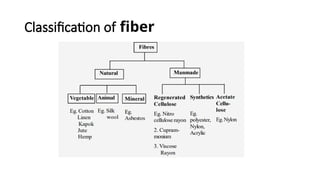
Classification of fiber
Properties of fiber
• Vegetable fibers, common properties like low resilience, high density,
and good conductor of heat.
• Animal fiber, Animal fibers have high resiliency but weak when wet
because they are bad conductors of heat.
• Mineral fibers, They are the inorganic materials shaped in to fibers
and are mainly used in the fire proof fabrics.
• Man made fibers, Man made fibers have high strength, strong when
wet low moisture absorption characteristics.
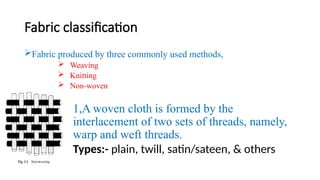
Fabric classification
Fabric produced by three commonly used methods,
 Weaving
 Knitting
 Non-woven
 1,A woven cloth is formed by the
interlacement of two sets of threads, namely,
warp and weft threads.
 Types:- plain, twill, satin/sateen, & others
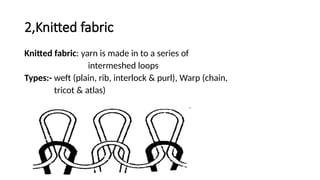
2,Knitted fabric
Knitted fabric: yarn is made in to a series of
intermeshed loops
Types:- weft (plain, rib, interlock & purl), Warp (chain,
tricot & atlas)
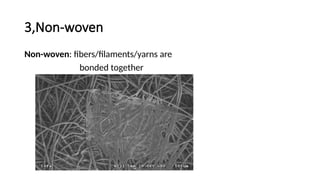
3,Non-woven
Non-woven: fibers/filaments/yarns are
bonded together
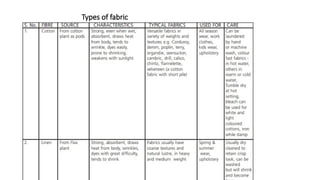
Types of fabric
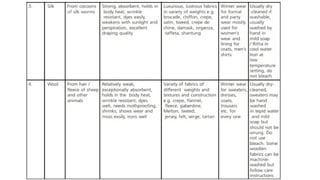
Wool fabrics
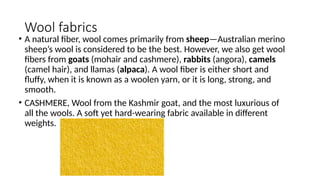
• A natural fiber, wool comes primarily from sheep—Australian merino
sheep’s wool is considered to be the best. However, we also get wool
fibers from goats (mohair and cashmere), rabbits (angora), camels
(camel hair), and llamas (alpaca). A wool fiber is either short and
fluffy, when it is known as a woolen yarn, or it is long, strong, and
smooth.
• CASHMERE, Wool from the Kashmir goat, and the most luxurious of
all the wools. A soft yet hard-wearing fabric available in different
weights.
..cont.
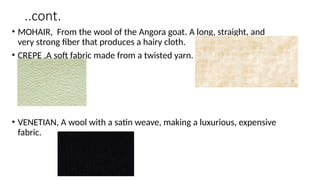
• MOHAIR, From the wool of the Angora goat. A long, straight, and
very strong fiber that produces a hairy cloth.
• CREPE ,A soft fabric made from a twisted yarn.
• VENETIAN, A wool with a satin weave, making a luxurious, expensive
fabric.
Cotton fabrics
• One of the most versatile and popular of all fabrics, cotton is a natural fiber
that comes from the seed pods, or bolls, of the cotton plant.
• absorbs moisture well and carries heat away from the body, stronger wet than
dry, dyes well
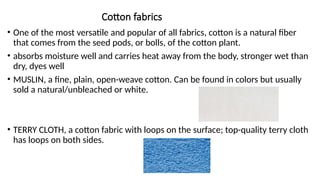
• MUSLIN, a fine, plain, open-weave cotton. Can be found in colors but usually
sold a natural/unbleached or white.
• TERRY CLOTH, a cotton fabric with loops on the surface; top-quality terry cloth
has loops on both sides.
..cont.
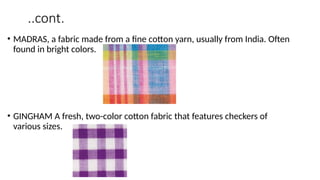
• MADRAS, a fabric made from a fine cotton yarn, usually from India. Often
found in bright colors.
• GINGHAM A fresh, two-color cotton fabric that features checkers of
various sizes.
.Cont..
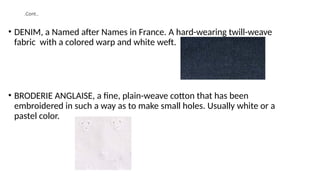
• DENIM, a Named after Names in France. A hard-wearing twill-weave
fabric with a colored warp and white weft.
• BRODERIE ANGLAISE, a fine, plain-weave cotton that has been
embroidered in such a way as to make small holes. Usually white or a
pastel color.
Silk fabrics
• Often referred to as the queen of all fabrics, silk is made from the fibers of the
silkworm’s.
• keeps you warm in winter and cool in summer, absorbs moisture and dries quickly,
dyes well, producing deep, rich colors, will fade in prolonged strong sunlight
• CHIFFON, a very strong and very fine, transparent silk with a plain weave. Will
gather and ruffle well.
• GEORGETTE, a soft, filmy silk fabric that has a slight transparency. Does not crease
easily.
• SATIN, a silk with a satin weave that can be very light to quite heavy in weight.
• ORGANZA, a sheer fabric with a crisp appearance that will crease easily
Linen fabrics
• Linen is a natural fiber that is derived from the stem of the flax plant. It is
available in a variety of qualities and weights.
• cool and comfortable to wear, absorbs moisture well, shrinks when
washed, has a tendency to wrinkle, prone to fraying • resists moths but is
damaged by mildew.
• PRINTED LINENS, Many linens today feature prints or even embroidery.
• SUITING LINEN, a heavier yarn is used to produce a linen suitable for suits
for men and women.
• COTTON AND LINEN MIX, a Two fibers may have been mixed together in
the yarn or may have mixed warp and weft yarns.
Manmade fabrics
Some manmade fabrics are made from natural elements mixed with
chemicals while others are made entirely from non-natural substances. The
properties of manmade fabrics vary from fabric to fabric.
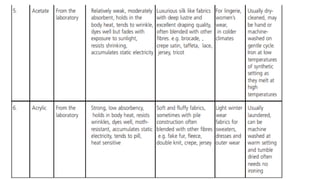
• ACRYLIC, acrylic fibers are made, The fabric resembles wool and makes a
good substitute for machine-washable wool.
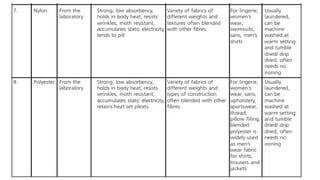
• NYLON, Developed by DuPont in 1938, the fabric takes its name from a
collaboration between New York (NY) and London (LON), very hard-wearing.
• POLYESTER One of the most popular of the manmade fibers, polyester was
introduced in 1951, as a washable man’s suit.
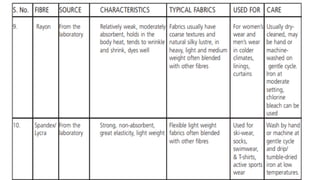
• RAYON Also known as viscose and often referred to as artificial silk.
• SPANDEX, this is a lightweight, soft fiber than can be stretched 500%
without breaking. A small amount of spandex is often mixed with other
fibers to produce woven with a slight stretch.
Properties of fiber affect on fabric properties
• Vegetable fibers, common properties like low resilience, high density,
and good conductor of heat.
• Animal fiber, Animal fibers have high resiliency but weak when wet
because they are bad conductors of heat.
• Mineral fibers, They are the inorganic materials shaped in to fibers
and are mainly used in the fire proof fabrics. Asbestos
• Man made fibers, Man made fibers have high strength, strong when
wet low moisture absorption characteristics.
Factors that affect fabric strength
fiber type, length, strength
 twist level, strength,
 fabric structure, weight,
 Dyeing and finishing process
Factors for reduction in serviceable life/wear
• Wearing of edges…- Abrasion (nylon & polyster high resistance but natural
fiber low )
• Little balls of fibers collected on the fabric- Pilling(The higher yarn twist, 100% wool
fabrics have little )
• Little fibers or yarns form loops – Snagging (kint fabric, filament yarn & satin
weave )
• Fading of the color
• Failure of the seam
• Shrinkage/Short fabrics/size
• Tearing
Types of pressing for fabric
 The amounts of heat, moisture and pressure needed for a
good pressing job must be determined with care.
 The amounts used will depend on the way the garment is
made as well as the fibre content, weave, texture and finish.
Cont..
Incorrect pressing can
 pull fabric out of line and give it a shiny “ironed” look.
 It will flatten curves, stretch the neckline, ripple the skirt hem.
 And generally change the shape of the garment.
• So, Temperatures must be selected to suit the fibres, yarns,
and fabrics used in a particular style.
• Then follow these general pressing suggestions for popular
fabrics
Cont..
• Acetate—(Lace)Use a press cloth when using steam. Place
paper under seam allowances and darts to prevent imprints.
• Blends—Set the iron according to the fibre requiring lowest
temperature. Press on wrong side or use press cloth on right
side.
• Cotton—Press on either side with steam or after fabric is
dampened with sponge or by sprinkling. If fabric shine occurs,
use a press cloth.
Cont..
• Linen—Highest setting on iron is used along with dampened
press cloth or steam. Press on wrong side to prevent shine.
• Polyester—Press on wrong side or with press cloth. Use
steam and dampened press cloth to smooth seams and set
creases.
• Rayon—Use a moderately warm iron with press cloth; do
not use steam directly on the fabric.
• Silk—For sheer fabric, use dry iron only; for heavier fabric,
use light steam and press cloth.
• Wool—Iron should not be placed directly on fabric; use
steam and press cloth. A damp press cloth may be used to
help shrink out ease in sleeve cap, curved seams and hem
edges.
Fabric weave pattern
• weave is the interlacing pattern of the warp and weft.
Two kinds of interlacing are possible :
1.Warp overlap in which warp is above weft
2.Weft overlap in which weft is above warp
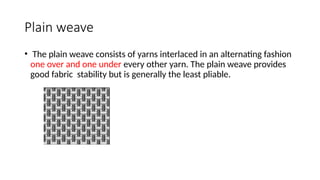
• Plain The plain weave consists of yarns interlaced in an alternating
fashion one over and one under every other yarn. The plain weave
provides good fabric stability but is generally the least pliable.
Plain weave
• The plain weave consists of yarns interlaced in an alternating fashion
one over and one under every other yarn. The plain weave provides
good fabric stability but is generally the least pliable.
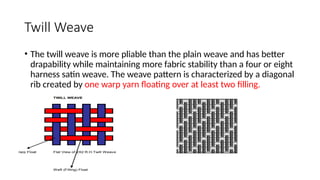
Twill Weave
• The twill weave is more pliable than the plain weave and has better
drapability while maintaining more fabric stability than a four or eight
harness satin weave. The weave pattern is characterized by a diagonal
rib created by one warp yarn floating over at least two filling.
•
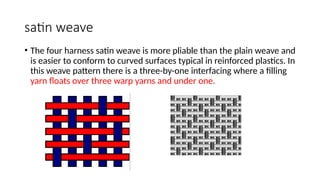
satin weave
• The four harness satin weave is more pliable than the plain weave and
is easier to conform to curved surfaces typical in reinforced plastics. In
this weave pattern there is a three-by-one interfacing where a filling
yarn floats over three warp yarns and under one.
Fabric & Technical Textiles
• Technical Textiles are textiles that are primarily used for
their performance or functional properties.
• Classified according to the end use, Divided into 12
different categories.
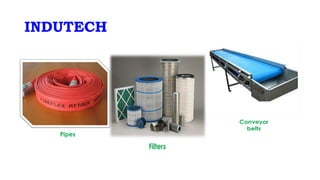
INDUTECH
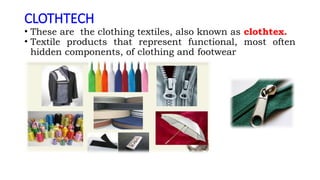
CLOTHTECH
• These are the clothing textiles, also known as clothtex.
• Textile products that represent functional, most often
hidden components, of clothing and footwear
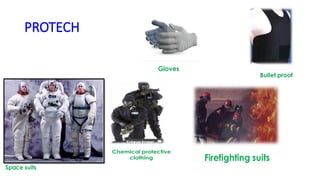
PROTECH
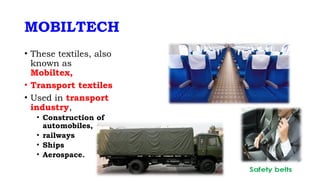
MOBILTECH
• These textiles, also
known as
Mobiltex,
• Transport textiles
• Used in transport
industry,
• Construction of
automobiles,
• railways
• Ships
• Aerospace.
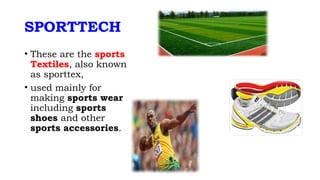
SPORTTECH
• These are the sports
Textiles, also known
as sporttex,
• used mainly for
making sports wear
including sports
shoes and other
sports accessories.
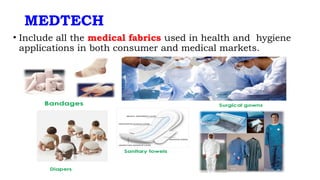
MEDTECH
• Include all the medical fabrics used in health and hygiene
applications in both consumer and medical markets.
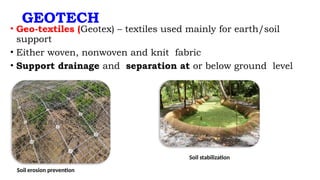
GEOTECH
• Geo-textiles (Geotex) – textiles used mainly for earth/soil
support
• Either woven, nonwoven and knit fabric
• Support drainage and separation at or below ground level
Soil erosion prevention
Soil stabilization
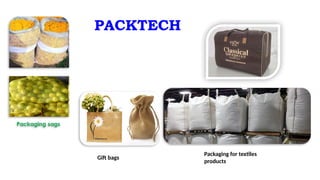
PACKTECH
Gift bags
Packaging for textiles
products
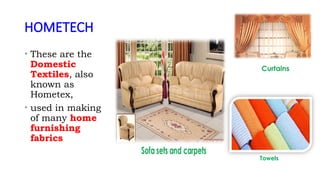
HOMETECH
• These are the
Domestic
Textiles, also
known as
Hometex,
• used in making
of many home
furnishing
fabrics
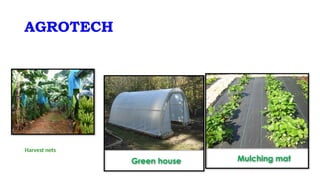
AGROTECH
Harvest nets
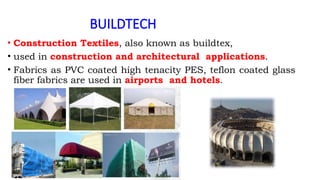
BUILDTECH
• Construction Textiles, also known as buildtex,
• used in construction and architectural applications.
• Fabrics as PVC coated high tenacity PES, teflon coated glass
fiber fabrics are used in airports and hotels.
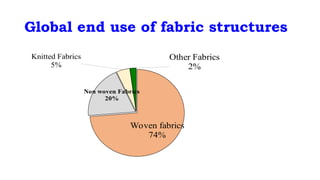
Global end use of fabric structures
Woven fabrics
74%
Non woven Fabrics
20%
Knitted Fabrics
5%
Other Fabrics
2%
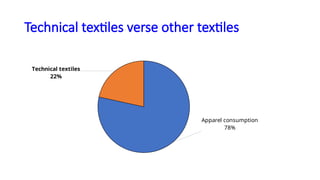
Technical textiles verse other textiles
Apparel consumption
78%
Technical textiles
22%
unit 2
Fabric sample and specification
• Sample is small amount of fabric (product) people find out and
investigate
• Specification is detailed instruction about how fabric (something )
should be design or mad
• Designers have to investigate deep understanding of the qualities of
fabrics
• technical document that contains the construction details of the
product and communication tool between manufacture.
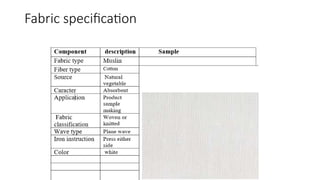
Fabric specification
The Nature of Fabric Packages
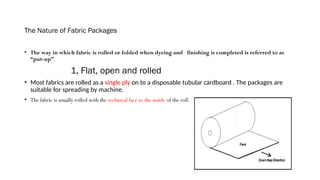
• The way in which fabric is rolled or folded when dyeing and finishing is completed is referred to as
“put-up”.
1, Flat, open and rolled
• Most fabrics are rolled as a single ply on to a disposable tubular cardboard . The packages are
suitable for spreading by machine.
• The fabric is usually rolled with the technical face to the inside of the roll.
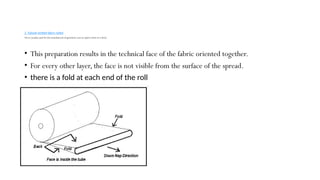
2. Tubular knitted fabric rolled
This is usually used for the manufacture of garments such as sports shirts or t-shirts
• This preparation results in the technical face of the fabric oriented together.
• For every other layer, the face is not visible from the surface of the spread.
• there is a fold at each end of the roll
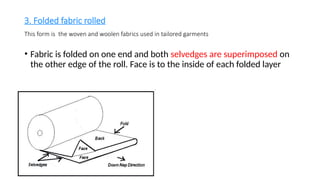
3. Folded fabric rolled
This form is the woven and woolen fabrics used in tailored garments
• Fabric is folded on one end and both selvedges are superimposed on
the other edge of the roll. Face is to the inside of each folded layer
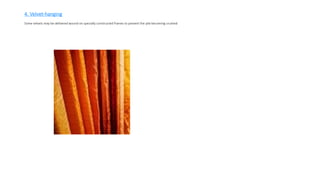
4. Velvet-hanging
Some velvets may be delivered wound on specially constructed frames to prevent the pile becoming crushed
Face of Fabric
• Right Side: refers to the fabric side one sees when wearing the garment.
• Wrong Side: refers to the fabric side that faces towards the body of the
wearer. The inside side of the fabric in a garment is wrong side unless it
covered with linings
• The side of the fabric facing towards the body is not the wrong side in
some parts of the fabric, e.g. collar, cuffs and facings

textile producing fabric type study 2.pptx

  • 1.
    Fabric study for 1st yearTVET Garment By Yosef Taye 2015 E.C
  • 2.
    COURSE OBJECTIVES At theend of this course, students are expected to: To identify fabric types for apparel. Understand and realize woven fabric manufacturing processes. Demonstrate comparison of textile fabric .
  • 3.
    Assessment method • Midexam 20% • Final exam 40% • Continuous assessment 40%
  • 4.
    Unite one fabric andfiber Fiber properties • Properties of a fabric depends on fiber and yarn • Fiber → polymer property • Yarn → fiber property • Fabric → yarn property • Fiber properties contribute to the properties of a fabric • Length. Fibers are sold by the fiber producer as filament, staple,
  • 5.
    ...cont... • A fibercan be defined as a “pliable” hair like strand that is very small in diameter in relation to its length” • Yarns are produced by twisting or spinning of the textile fibers and in turn fabric is a structure produced by interlacing or interloping of the yarns.. • Fabric is made from fibers. Each fiber is like a small hair. A great number are twisted together to make a yarn, which can then be woven or knitted into fabric. Whether making clothes,
  • 6.
  • 7.
    Properties of fiber •Vegetable fibers, common properties like low resilience, high density, and good conductor of heat. • Animal fiber, Animal fibers have high resiliency but weak when wet because they are bad conductors of heat. • Mineral fibers, They are the inorganic materials shaped in to fibers and are mainly used in the fire proof fabrics. • Man made fibers, Man made fibers have high strength, strong when wet low moisture absorption characteristics.
  • 8.
    Fabric classification Fabric producedby three commonly used methods,  Weaving  Knitting  Non-woven  1,A woven cloth is formed by the interlacement of two sets of threads, namely, warp and weft threads.  Types:- plain, twill, satin/sateen, & others
  • 9.
    2,Knitted fabric Knitted fabric:yarn is made in to a series of intermeshed loops Types:- weft (plain, rib, interlock & purl), Warp (chain, tricot & atlas)
  • 10.
  • 11.
  • 16.
    Wool fabrics • Anatural fiber, wool comes primarily from sheep—Australian merino sheep’s wool is considered to be the best. However, we also get wool fibers from goats (mohair and cashmere), rabbits (angora), camels (camel hair), and llamas (alpaca). A wool fiber is either short and fluffy, when it is known as a woolen yarn, or it is long, strong, and smooth. • CASHMERE, Wool from the Kashmir goat, and the most luxurious of all the wools. A soft yet hard-wearing fabric available in different weights.
  • 17.
    ..cont. • MOHAIR, Fromthe wool of the Angora goat. A long, straight, and very strong fiber that produces a hairy cloth. • CREPE ,A soft fabric made from a twisted yarn. • VENETIAN, A wool with a satin weave, making a luxurious, expensive fabric.
  • 18.
    Cotton fabrics • Oneof the most versatile and popular of all fabrics, cotton is a natural fiber that comes from the seed pods, or bolls, of the cotton plant. • absorbs moisture well and carries heat away from the body, stronger wet than dry, dyes well • MUSLIN, a fine, plain, open-weave cotton. Can be found in colors but usually sold a natural/unbleached or white. • TERRY CLOTH, a cotton fabric with loops on the surface; top-quality terry cloth has loops on both sides.
  • 19.
    ..cont. • MADRAS, afabric made from a fine cotton yarn, usually from India. Often found in bright colors. • GINGHAM A fresh, two-color cotton fabric that features checkers of various sizes.
  • 20.
    .Cont.. • DENIM, aNamed after Names in France. A hard-wearing twill-weave fabric with a colored warp and white weft. • BRODERIE ANGLAISE, a fine, plain-weave cotton that has been embroidered in such a way as to make small holes. Usually white or a pastel color.
  • 21.
    Silk fabrics • Oftenreferred to as the queen of all fabrics, silk is made from the fibers of the silkworm’s. • keeps you warm in winter and cool in summer, absorbs moisture and dries quickly, dyes well, producing deep, rich colors, will fade in prolonged strong sunlight • CHIFFON, a very strong and very fine, transparent silk with a plain weave. Will gather and ruffle well. • GEORGETTE, a soft, filmy silk fabric that has a slight transparency. Does not crease easily. • SATIN, a silk with a satin weave that can be very light to quite heavy in weight. • ORGANZA, a sheer fabric with a crisp appearance that will crease easily
  • 22.
    Linen fabrics • Linenis a natural fiber that is derived from the stem of the flax plant. It is available in a variety of qualities and weights. • cool and comfortable to wear, absorbs moisture well, shrinks when washed, has a tendency to wrinkle, prone to fraying • resists moths but is damaged by mildew. • PRINTED LINENS, Many linens today feature prints or even embroidery. • SUITING LINEN, a heavier yarn is used to produce a linen suitable for suits for men and women. • COTTON AND LINEN MIX, a Two fibers may have been mixed together in the yarn or may have mixed warp and weft yarns.
  • 23.
    Manmade fabrics Some manmadefabrics are made from natural elements mixed with chemicals while others are made entirely from non-natural substances. The properties of manmade fabrics vary from fabric to fabric. • ACRYLIC, acrylic fibers are made, The fabric resembles wool and makes a good substitute for machine-washable wool. • NYLON, Developed by DuPont in 1938, the fabric takes its name from a collaboration between New York (NY) and London (LON), very hard-wearing. • POLYESTER One of the most popular of the manmade fibers, polyester was introduced in 1951, as a washable man’s suit. • RAYON Also known as viscose and often referred to as artificial silk. • SPANDEX, this is a lightweight, soft fiber than can be stretched 500% without breaking. A small amount of spandex is often mixed with other fibers to produce woven with a slight stretch.
  • 24.
    Properties of fiberaffect on fabric properties • Vegetable fibers, common properties like low resilience, high density, and good conductor of heat. • Animal fiber, Animal fibers have high resiliency but weak when wet because they are bad conductors of heat. • Mineral fibers, They are the inorganic materials shaped in to fibers and are mainly used in the fire proof fabrics. Asbestos • Man made fibers, Man made fibers have high strength, strong when wet low moisture absorption characteristics.
  • 25.
    Factors that affectfabric strength fiber type, length, strength  twist level, strength,  fabric structure, weight,  Dyeing and finishing process
  • 26.
    Factors for reductionin serviceable life/wear • Wearing of edges…- Abrasion (nylon & polyster high resistance but natural fiber low ) • Little balls of fibers collected on the fabric- Pilling(The higher yarn twist, 100% wool fabrics have little ) • Little fibers or yarns form loops – Snagging (kint fabric, filament yarn & satin weave ) • Fading of the color • Failure of the seam • Shrinkage/Short fabrics/size • Tearing
  • 27.
    Types of pressingfor fabric  The amounts of heat, moisture and pressure needed for a good pressing job must be determined with care.  The amounts used will depend on the way the garment is made as well as the fibre content, weave, texture and finish.
  • 28.
    Cont.. Incorrect pressing can pull fabric out of line and give it a shiny “ironed” look.  It will flatten curves, stretch the neckline, ripple the skirt hem.  And generally change the shape of the garment. • So, Temperatures must be selected to suit the fibres, yarns, and fabrics used in a particular style. • Then follow these general pressing suggestions for popular fabrics
  • 29.
    Cont.. • Acetate—(Lace)Use apress cloth when using steam. Place paper under seam allowances and darts to prevent imprints. • Blends—Set the iron according to the fibre requiring lowest temperature. Press on wrong side or use press cloth on right side. • Cotton—Press on either side with steam or after fabric is dampened with sponge or by sprinkling. If fabric shine occurs, use a press cloth.
  • 30.
    Cont.. • Linen—Highest settingon iron is used along with dampened press cloth or steam. Press on wrong side to prevent shine. • Polyester—Press on wrong side or with press cloth. Use steam and dampened press cloth to smooth seams and set creases. • Rayon—Use a moderately warm iron with press cloth; do not use steam directly on the fabric. • Silk—For sheer fabric, use dry iron only; for heavier fabric, use light steam and press cloth. • Wool—Iron should not be placed directly on fabric; use steam and press cloth. A damp press cloth may be used to help shrink out ease in sleeve cap, curved seams and hem edges.
  • 31.
    Fabric weave pattern •weave is the interlacing pattern of the warp and weft. Two kinds of interlacing are possible : 1.Warp overlap in which warp is above weft 2.Weft overlap in which weft is above warp • Plain The plain weave consists of yarns interlaced in an alternating fashion one over and one under every other yarn. The plain weave provides good fabric stability but is generally the least pliable.
  • 32.
    Plain weave • Theplain weave consists of yarns interlaced in an alternating fashion one over and one under every other yarn. The plain weave provides good fabric stability but is generally the least pliable.
  • 33.
    Twill Weave • Thetwill weave is more pliable than the plain weave and has better drapability while maintaining more fabric stability than a four or eight harness satin weave. The weave pattern is characterized by a diagonal rib created by one warp yarn floating over at least two filling. •
  • 34.
    satin weave • Thefour harness satin weave is more pliable than the plain weave and is easier to conform to curved surfaces typical in reinforced plastics. In this weave pattern there is a three-by-one interfacing where a filling yarn floats over three warp yarns and under one.
  • 35.
    Fabric & TechnicalTextiles • Technical Textiles are textiles that are primarily used for their performance or functional properties. • Classified according to the end use, Divided into 12 different categories.
  • 36.
  • 37.
    CLOTHTECH • These arethe clothing textiles, also known as clothtex. • Textile products that represent functional, most often hidden components, of clothing and footwear
  • 38.
  • 39.
    MOBILTECH • These textiles,also known as Mobiltex, • Transport textiles • Used in transport industry, • Construction of automobiles, • railways • Ships • Aerospace.
  • 40.
    SPORTTECH • These arethe sports Textiles, also known as sporttex, • used mainly for making sports wear including sports shoes and other sports accessories.
  • 41.
    MEDTECH • Include allthe medical fabrics used in health and hygiene applications in both consumer and medical markets.
  • 42.
    GEOTECH • Geo-textiles (Geotex)– textiles used mainly for earth/soil support • Either woven, nonwoven and knit fabric • Support drainage and separation at or below ground level Soil erosion prevention Soil stabilization
  • 43.
  • 44.
    HOMETECH • These arethe Domestic Textiles, also known as Hometex, • used in making of many home furnishing fabrics
  • 45.
  • 46.
    BUILDTECH • Construction Textiles,also known as buildtex, • used in construction and architectural applications. • Fabrics as PVC coated high tenacity PES, teflon coated glass fiber fabrics are used in airports and hotels.
  • 47.
    Global end useof fabric structures Woven fabrics 74% Non woven Fabrics 20% Knitted Fabrics 5% Other Fabrics 2%
  • 48.
    Technical textiles verseother textiles Apparel consumption 78% Technical textiles 22%
  • 49.
    unit 2 Fabric sampleand specification • Sample is small amount of fabric (product) people find out and investigate • Specification is detailed instruction about how fabric (something ) should be design or mad • Designers have to investigate deep understanding of the qualities of fabrics • technical document that contains the construction details of the product and communication tool between manufacture.
  • 50.
  • 51.
    The Nature ofFabric Packages • The way in which fabric is rolled or folded when dyeing and finishing is completed is referred to as “put-up”. 1, Flat, open and rolled • Most fabrics are rolled as a single ply on to a disposable tubular cardboard . The packages are suitable for spreading by machine. • The fabric is usually rolled with the technical face to the inside of the roll.
  • 52.
    2. Tubular knittedfabric rolled This is usually used for the manufacture of garments such as sports shirts or t-shirts • This preparation results in the technical face of the fabric oriented together. • For every other layer, the face is not visible from the surface of the spread. • there is a fold at each end of the roll
  • 53.
    3. Folded fabricrolled This form is the woven and woolen fabrics used in tailored garments • Fabric is folded on one end and both selvedges are superimposed on the other edge of the roll. Face is to the inside of each folded layer
  • 54.
    4. Velvet-hanging Some velvetsmay be delivered wound on specially constructed frames to prevent the pile becoming crushed
  • 55.
    Face of Fabric •Right Side: refers to the fabric side one sees when wearing the garment. • Wrong Side: refers to the fabric side that faces towards the body of the wearer. The inside side of the fabric in a garment is wrong side unless it covered with linings • The side of the fabric facing towards the body is not the wrong side in some parts of the fabric, e.g. collar, cuffs and facings