BY MAMTA PARIHAR
MSC.NSG PREVIOUS YEAR
G.C.O.N.JODHPUR.
“It’s supposed to be a professional secret,
but I’ll tell you anyway. We doctors do
nothing. We only help and encourage the
doctor within.
-Albert Schweitzer
Hernia is derived from a Latin word
meaning "rupture”.
What is a hernia
 A hernia occurs when an organ pushes
through an opening in the muscle or tissue
that holds it in place. For example, the
intestines may break through a weakened
area in the abdominal wall.
 It is the protrusion of an organ or part of
an organ through a defect in the wall of the
cavity normally containing it.
Occurs when there is a weakness or hole
in the muscular wall that usually keeps
Abdominal organs in place - the
peritoneum.
This defect allows organs and tissues to
push through
This weakened area cannot hold in the
abdominal contents and it protrudes, or
herniated, through the defect.
A hernia is the protrusion of an organ or the
fascia of an organ through the wall of the
cavity that normally contains ,It from within.
A hernia occurs when part of the internal
tissues (usually the intestines) poke out
through a hole .
PATHOPHYSIOLOGY
Due to etiological factors (coughing, obesity, etc)
Defects in the muscular wall
Weakened tissue
Increased Intra-abdominal pressure
When 2 of these factors coexist, with tissue
weakness
The person may acquire a hernia.
Hernia can be classified acc.
to :
By site
By severity
By anatomical position
Classification of hernia by SITE
INGUINAL
 UMBILICAL
FEMORAL
PARAUMBLICAL
EPIGASTRIC
INCISIONAL or
VENTRAL
PERISTOMAL
SPIGELIAN
INGUINAL 75%
Divided into
Indirect inguinal hernia,
in which the inguinal canal
is entered via a congenital
weakness at its entrance
(the internal inguinal ring)
into scrotum or labia.
Direct inguinal hernia
where the hernia contents
push through a weak spot
in the back wall of the
inguinal canal into the
groin.
FEMORAL
Occur just below the
inguinal ligament,
when abdominal
contents pass into
the weak area at the
posterior wall of the
femoral canal.
However, they
generally appear
more rounded, and,
in contrast to
inguinal hernias.
UMBILICAL
 Involve protrusion of intra-abdominal contents
through a weakness at the site of umbilicus due to
failure of umbilical orifice to close through the
abdominal wall.
 Umbilical hernias in adults are largely acquired
 more frequent in obese
or pregnant women
 Abnormal decussation
of fibers at the linea alba
may contribute.
PARAUMBLICAL
 Its occurs upper side of the umbilicus and its of
three types small medium and large.
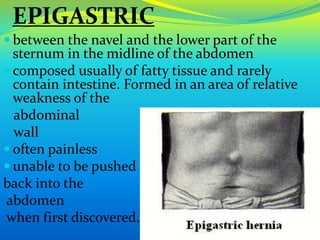
EPIGASTRIC
 between the navel and the lower part of the
sternum in the midline of the abdomen
 composed usually of fatty tissue and rarely
contain intestine. Formed in an area of relative
weakness of the
abdominal
wall
 often painless
 unable to be pushed
back into the
abdomen
when first discovered.
Umbilical
& Inguinal
&
Epigastric
Hernias
INCISIONAL or VENTRAL
Results of an incompletely healed surgical wound
When these occur in median laparotomy incisions in the
linea alba, they are termed ventral hernias. These can be
the most frustrating and difficult to treat, as the repair
utilizes already attenuated tissue.
OTHER HERNIAS
PERISTOMAL
 Fascial defect around a
stoma and into the
subcutaneous tissue.
SPIGELIAN
 Rare hernia
 occurs along the edge of
the rectus abdominus
muscle, which are
several inches to the side
of the middle of the
abdomen.
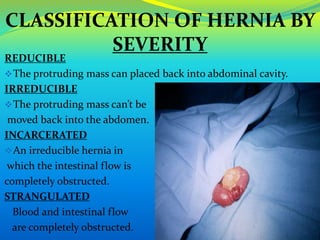
CLASSIFICATION OF HERNIA BY
SEVERITY
REDUCIBLE
The protruding mass can placed back into abdominal cavity.
IRREDUCIBLE
The protruding mass can’t be
moved back into the abdomen.
INCARCERATED
An irreducible hernia in
which the intestinal flow is
completely obstructed.
STRANGULATED
Blood and intestinal flow
are completely obstructed.
CLASSIFICATION BY
ANATOMICAL LOCATION
Abdominal hernias
Pelvic hernias, for example, obturator
hernia
Anal hernias
Nucleus pulposus of the intervertebral
discs
Intracranial hernias
Diaphragmatic hernia
DIAPHRAGMATIC HERNIA
Higher in the abdomen, an (internal)
"diaphragmatic hernia" results when part of
the stomach or intestine protrudes into the
chest cavity through a defect in the
diaphragm.
It is divided in:-
HIATUS HERNIA
CONGENITAL DIAPHRAGMATIC HERNIA
HIATUS HERNIA
The passageway through
which the esophagus
meets the stomach
(esophageal hiatus) serves
as a functional "defect",
allowing part of the
stomach to (periodically)
"herniated" into the chest.
 Hiatus may be either
 SLIDING H HERNIA
 ROLLING H HERNIA
"SLIDING“in which the
gastroesophageal junction
itself slides through the
defect into the chest.
ROLLING, or Para-
esophageal in which case
the junction remains fixed
while another portion of
the stomach moves up
through the defect.
dangerous as they may
allow the stomach to
rotate and obstruct.
CONGENITAL
DIAPHRAGMATIC HERNIA
 An uncommon birth defect, a
malformation that affects the lungs as well
as producing a hole in the diaphragm,
The pressure on growing lungs can affect
their normal development
EPIDEMIOLOGY
In 95% of cases, hernias are external,
5% they are internal.
Of all hernias, 75% are inguinal (two thirds
indirect and one third direct);
 10% are incisional,
5–7% are umbilical, femoral, or in other, rare
locations.
Whereas 80–90% of inguinal hernias occur in
males,
75% of all femoral hernias found in females.
CAUSES OF HERNIA
Idiopathic
Congenital
complication of abdominal surgery
constipation
Long-term cough
Enlarged prostate
Straining to urinate
Being overweight or obese
Lifting heavy items
Peritoneal dialysis
Smoking
Physical exertion
SIGN AND SYMPTOMS
IN ABDOMINAL HERNIAS THE S/S
WILL BE
 Abdominal pain
Bulging mass in abdominal wall,
Mass that enlarges with straining
May be palpable or not palpable disappear
when lie down and may be tender.
Vomiting
Abdominal distension.
In inguinal hernia s/s will be
Mass in groin region
Persistent pain
In umbilical hernia s/s will be
Pain at the time of injury - often when
lifting something heavy or straining.
The lump may come and go, especially
when laying down or coughing.
In a strangulated hernia s/s will be
Blockage of the intestines.
If not relieved, the contents of the hernia
can swell
lose its blood supply
experience severe abdominal pain
 persistent vomiting
Fever
loss of consciousness
And death.
In hiatus hernia the s/s may
include
heartburn and
Upper abdominal pain.
DIAGNOSIS OF HERNIA
Physical examination-
inspection
Palpitation
Auscultation
Tests and Lab investigations
X-ray
Ultra sound
Ct scan
C.B.C etc
MANAGEMENT OF
HERNIA
Medical management
Surgical management
Nursing management
MEDICAL MANAGEMENT
Truss to hold the
hernia in place until
surgery.
Symptomatic
treatment
Conventional
medicine for a
hernia health care
provider, may
manually press
hernia back into
place and
SURGICAL MANAGEMENT
There are two types of surgical intervention:
Open surgery
Laparoscopic operation ('keyhole surgery')
Recent developments in hernia treatment
A study published in the Archives of Surgery in
2012 made a randomized comparison between
open and Laparoscopic surgery for inguinal
hernia repair.
The large analysis of 660 operations found in
favour of the minimally invasive approach.
Herniorrhaphy
Herniotomy
Hernioplasty
HERNIORRHAPHY
 Traditionally has been repaired by sewing the
edges of healthy muscle tissue together.
HERNIOTOMY
The surgical correction of a hernia by cutting
through a band of tissue that constricts it. Also
called celotomy.
HERNIOPLASTY
Mesh patches of synthetic material are used to
repair for large and reoccur hernias
Patches decreases the tension on the weakened
wall
NURSING MANAGEMENT
NURSING ASSESSMENT:-
Physical examination
Disease history
Assess bowel sounds and determine bowel
pattern.
signs and symptoms of strangulation, such
as distention, fever, nausea and vomiting.
Assess the level of pain and anxiety in the
patient.
NURSING DIAGNOSIS:-
Chronic pain related to bulging hernia.
Acute pain related to surgical procedure.
Risk for infection related to emergency
procedure for strangulated or incarcerated
hernia.
Activity intolerance related to disease
condition
NURSING INTERVENTIONS
PREOPERATIVE PHASE
Monitor vital signs
Wear a truss
Assess the skin daily and apply powder for
protection because the truss may be irritating
Trendelenburg’s position
Give stool softeners
Evaluation for signs and symptoms of hernia
incarceration or strangulation.
Insert NG tube for incarcerated hernia to relieve
intra-abdominal pressure on hernial sac.
INTRA OPERATIVE PHASE
Administer medications as prescribed
Help in maintenance of proper airway,
breathing and respiration.
Provide maximum comfort achievements.
POST OPERATIVE PHASE
Routine postoperative care
 Support the patient on the incision site
Encourage deep breathing and frequent turning.
Apply ice bags to reduce swelling and relieve
pain.
Proper pain management
Fluid intake and output are carefully recorded,
Encourage ambulation
Promote elimination to avoid discomfort
Catheterize if necessary.
PATIENT EDUCATION &
HEALTH MAINTENANCE
Explain pain may be present for 24 to 48 hr
Apply ice intermittently
Teach to monitor self for signs of infection:
pain, drainage from incision, temperature
elevation
Report continued voiding
Inform that heavy lifting is avoided for 4 to
6 weeks.
PREVENTION
Exercise to maintain the strength of
the abdominal muscles.
Walking, running, bicycling and
swimming
Weight control
Stop smoking
COMPLICATIONS
 Rejection of the mesh
 Irreducibility
 Haemorrhage
 intestinal obstruction,
 Infection
 gangrene
 intestinal perforation
 Shock
 or even death.
SUMMARY
Hernias are abnormal bulges
The main types of hernia are femoral,
inguinal, hiatus, umbilical and incisional.
They are usually straightforward to diagnose
simply by feeling and looking for the bulge.
Treatment is a choice between watchful
waiting and corrective surgery, either via an
open or keyhole operation.
THANKS FOR
YOUR
PATIENCE
any ?

Hernia

  • 1.
    BY MAMTA PARIHAR MSC.NSGPREVIOUS YEAR G.C.O.N.JODHPUR.
  • 2.
    “It’s supposed tobe a professional secret, but I’ll tell you anyway. We doctors do nothing. We only help and encourage the doctor within. -Albert Schweitzer
  • 3.
    Hernia is derivedfrom a Latin word meaning "rupture”.
  • 4.
    What is ahernia  A hernia occurs when an organ pushes through an opening in the muscle or tissue that holds it in place. For example, the intestines may break through a weakened area in the abdominal wall.  It is the protrusion of an organ or part of an organ through a defect in the wall of the cavity normally containing it.
  • 5.
    Occurs when thereis a weakness or hole in the muscular wall that usually keeps Abdominal organs in place - the peritoneum. This defect allows organs and tissues to push through This weakened area cannot hold in the abdominal contents and it protrudes, or herniated, through the defect.
  • 6.
    A hernia isthe protrusion of an organ or the fascia of an organ through the wall of the cavity that normally contains ,It from within. A hernia occurs when part of the internal tissues (usually the intestines) poke out through a hole .
  • 7.
    PATHOPHYSIOLOGY Due to etiologicalfactors (coughing, obesity, etc) Defects in the muscular wall Weakened tissue Increased Intra-abdominal pressure When 2 of these factors coexist, with tissue weakness The person may acquire a hernia.
  • 9.
    Hernia can beclassified acc. to : By site By severity By anatomical position
  • 11.
    Classification of herniaby SITE INGUINAL  UMBILICAL FEMORAL PARAUMBLICAL EPIGASTRIC INCISIONAL or VENTRAL PERISTOMAL SPIGELIAN
  • 12.
    INGUINAL 75% Divided into Indirectinguinal hernia, in which the inguinal canal is entered via a congenital weakness at its entrance (the internal inguinal ring) into scrotum or labia. Direct inguinal hernia where the hernia contents push through a weak spot in the back wall of the inguinal canal into the groin.
  • 13.
    FEMORAL Occur just belowthe inguinal ligament, when abdominal contents pass into the weak area at the posterior wall of the femoral canal. However, they generally appear more rounded, and, in contrast to inguinal hernias.
  • 14.
    UMBILICAL  Involve protrusionof intra-abdominal contents through a weakness at the site of umbilicus due to failure of umbilical orifice to close through the abdominal wall.  Umbilical hernias in adults are largely acquired  more frequent in obese or pregnant women  Abnormal decussation of fibers at the linea alba may contribute.
  • 15.
    PARAUMBLICAL  Its occursupper side of the umbilicus and its of three types small medium and large.
  • 16.
    EPIGASTRIC  between thenavel and the lower part of the sternum in the midline of the abdomen  composed usually of fatty tissue and rarely contain intestine. Formed in an area of relative weakness of the abdominal wall  often painless  unable to be pushed back into the abdomen when first discovered.
  • 17.
  • 18.
    INCISIONAL or VENTRAL Resultsof an incompletely healed surgical wound When these occur in median laparotomy incisions in the linea alba, they are termed ventral hernias. These can be the most frustrating and difficult to treat, as the repair utilizes already attenuated tissue.
  • 19.
    OTHER HERNIAS PERISTOMAL  Fascialdefect around a stoma and into the subcutaneous tissue. SPIGELIAN  Rare hernia  occurs along the edge of the rectus abdominus muscle, which are several inches to the side of the middle of the abdomen.
  • 20.
    CLASSIFICATION OF HERNIABY SEVERITY REDUCIBLE The protruding mass can placed back into abdominal cavity. IRREDUCIBLE The protruding mass can’t be moved back into the abdomen. INCARCERATED An irreducible hernia in which the intestinal flow is completely obstructed. STRANGULATED Blood and intestinal flow are completely obstructed.
  • 21.
    CLASSIFICATION BY ANATOMICAL LOCATION Abdominalhernias Pelvic hernias, for example, obturator hernia Anal hernias Nucleus pulposus of the intervertebral discs Intracranial hernias Diaphragmatic hernia
  • 22.
    DIAPHRAGMATIC HERNIA Higher inthe abdomen, an (internal) "diaphragmatic hernia" results when part of the stomach or intestine protrudes into the chest cavity through a defect in the diaphragm. It is divided in:- HIATUS HERNIA CONGENITAL DIAPHRAGMATIC HERNIA
  • 23.
    HIATUS HERNIA The passagewaythrough which the esophagus meets the stomach (esophageal hiatus) serves as a functional "defect", allowing part of the stomach to (periodically) "herniated" into the chest.  Hiatus may be either  SLIDING H HERNIA  ROLLING H HERNIA
  • 24.
    "SLIDING“in which the gastroesophagealjunction itself slides through the defect into the chest. ROLLING, or Para- esophageal in which case the junction remains fixed while another portion of the stomach moves up through the defect. dangerous as they may allow the stomach to rotate and obstruct.
  • 25.
    CONGENITAL DIAPHRAGMATIC HERNIA  Anuncommon birth defect, a malformation that affects the lungs as well as producing a hole in the diaphragm, The pressure on growing lungs can affect their normal development
  • 26.
    EPIDEMIOLOGY In 95% ofcases, hernias are external, 5% they are internal. Of all hernias, 75% are inguinal (two thirds indirect and one third direct);  10% are incisional, 5–7% are umbilical, femoral, or in other, rare locations. Whereas 80–90% of inguinal hernias occur in males, 75% of all femoral hernias found in females.
  • 27.
    CAUSES OF HERNIA Idiopathic Congenital complicationof abdominal surgery constipation Long-term cough Enlarged prostate Straining to urinate Being overweight or obese Lifting heavy items Peritoneal dialysis Smoking Physical exertion
  • 28.
    SIGN AND SYMPTOMS INABDOMINAL HERNIAS THE S/S WILL BE  Abdominal pain Bulging mass in abdominal wall, Mass that enlarges with straining May be palpable or not palpable disappear when lie down and may be tender. Vomiting Abdominal distension.
  • 29.
    In inguinal hernias/s will be Mass in groin region Persistent pain In umbilical hernia s/s will be Pain at the time of injury - often when lifting something heavy or straining. The lump may come and go, especially when laying down or coughing.
  • 30.
    In a strangulatedhernia s/s will be Blockage of the intestines. If not relieved, the contents of the hernia can swell lose its blood supply experience severe abdominal pain  persistent vomiting Fever loss of consciousness And death.
  • 31.
    In hiatus herniathe s/s may include heartburn and Upper abdominal pain.
  • 32.
    DIAGNOSIS OF HERNIA Physicalexamination- inspection Palpitation Auscultation Tests and Lab investigations X-ray Ultra sound Ct scan C.B.C etc
  • 33.
  • 34.
    MEDICAL MANAGEMENT Truss tohold the hernia in place until surgery. Symptomatic treatment Conventional medicine for a hernia health care provider, may manually press hernia back into place and
  • 35.
    SURGICAL MANAGEMENT There aretwo types of surgical intervention: Open surgery Laparoscopic operation ('keyhole surgery') Recent developments in hernia treatment A study published in the Archives of Surgery in 2012 made a randomized comparison between open and Laparoscopic surgery for inguinal hernia repair. The large analysis of 660 operations found in favour of the minimally invasive approach.
  • 36.
  • 37.
    HERNIORRHAPHY  Traditionally hasbeen repaired by sewing the edges of healthy muscle tissue together. HERNIOTOMY The surgical correction of a hernia by cutting through a band of tissue that constricts it. Also called celotomy.
  • 38.
    HERNIOPLASTY Mesh patches ofsynthetic material are used to repair for large and reoccur hernias Patches decreases the tension on the weakened wall
  • 39.
    NURSING MANAGEMENT NURSING ASSESSMENT:- Physicalexamination Disease history Assess bowel sounds and determine bowel pattern. signs and symptoms of strangulation, such as distention, fever, nausea and vomiting. Assess the level of pain and anxiety in the patient.
  • 40.
    NURSING DIAGNOSIS:- Chronic painrelated to bulging hernia. Acute pain related to surgical procedure. Risk for infection related to emergency procedure for strangulated or incarcerated hernia. Activity intolerance related to disease condition
  • 41.
    NURSING INTERVENTIONS PREOPERATIVE PHASE Monitorvital signs Wear a truss Assess the skin daily and apply powder for protection because the truss may be irritating Trendelenburg’s position Give stool softeners Evaluation for signs and symptoms of hernia incarceration or strangulation. Insert NG tube for incarcerated hernia to relieve intra-abdominal pressure on hernial sac.
  • 42.
    INTRA OPERATIVE PHASE Administermedications as prescribed Help in maintenance of proper airway, breathing and respiration. Provide maximum comfort achievements.
  • 43.
    POST OPERATIVE PHASE Routinepostoperative care  Support the patient on the incision site Encourage deep breathing and frequent turning. Apply ice bags to reduce swelling and relieve pain. Proper pain management Fluid intake and output are carefully recorded, Encourage ambulation Promote elimination to avoid discomfort Catheterize if necessary.
  • 44.
    PATIENT EDUCATION & HEALTHMAINTENANCE Explain pain may be present for 24 to 48 hr Apply ice intermittently Teach to monitor self for signs of infection: pain, drainage from incision, temperature elevation Report continued voiding Inform that heavy lifting is avoided for 4 to 6 weeks.
  • 45.
    PREVENTION Exercise to maintainthe strength of the abdominal muscles. Walking, running, bicycling and swimming Weight control Stop smoking
  • 46.
    COMPLICATIONS  Rejection ofthe mesh  Irreducibility  Haemorrhage  intestinal obstruction,  Infection  gangrene  intestinal perforation  Shock  or even death.
  • 47.
    SUMMARY Hernias are abnormalbulges The main types of hernia are femoral, inguinal, hiatus, umbilical and incisional. They are usually straightforward to diagnose simply by feeling and looking for the bulge. Treatment is a choice between watchful waiting and corrective surgery, either via an open or keyhole operation.
  • 48.