How Old is HBV?
• HBV associated with humans for
>1,000 years but no definitive
evidence
• Recent evidence establishes
≥500 years
• Naturally mummified body of a Korean
child found virtually intact
• Laparoscopy: Large organ
in RUQ and biopsies sent for
pathology and HBV DNA testing
– HBV DNA genotype C isolated
from the liver
– Pathology: Appeared to be normal liver
Klein A, et al. 58th AASLD; Boston, MA; November 2-6, 2007. Poster 925.
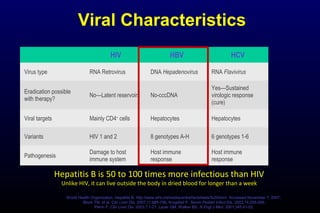
Viral Characteristics
HIV HBV HCV
Virus type RNA Retrovirus DNA Hepadenovirus RNA Flavivirus
Eradication possible
with therapy?
No—Latent reservoirs No-cccDNA
Yes—Sustained
virologic response
(cure)
Viral targets Mainly CD4+
cells Hepatocytes Hepatocytes
Variants HIV 1 and 2 8 genotypes A-H 6 genotypes 1-6
Pathogenesis
Damage to host
immune system
Host immune
response
Host immune
response
Hepatitis B is 50 to 100 times more infectious than HIV
Unlike HIV, it can live outside the body in dried blood for longer than a week
World Health Organization. Hepatitis B. http://www.who.int/mediacentre/factsheets/fs204/en/. Accessed November 7, 2007;
Block TM, et al. Clin Liver Dis. 2007;11:685-706; Krogstad P. Semin Pediatr Infect Dis. 2003;14:258-268;
Penin F. Clin Liver Dis. 2003;7:1-21; Lauer GM, Walker BD. N Engl J Med. 2001;345:41-52.
Nucleoside Analogues in HBV
HBV- Global health problem 250m people
worldwide
Max prevalence in Asia Pacific and Subsaharan
Africa
HBV: Vaccination : 179 countries
Chronic carriers at risk
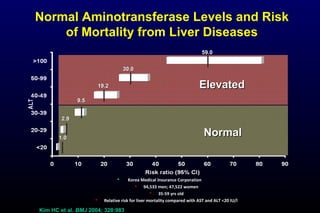
Normal Aminotransferase Levels and Risk
of Mortality from Liver Diseases
Kim HC et al.Kim HC et al. BMJBMJ 2004; 328:9832004; 328:983
1.01.0
2.92.9
9.59.5
19.219.2
30.030.0
59.059.0
NormalNormal
ElevatedElevated
 Korea Medical Insurance Corporation
 94,533 men; 47,522 women
 35-59 yrs old
 Relative risk for liver mortality compared with AST and ALT <20 IU/l
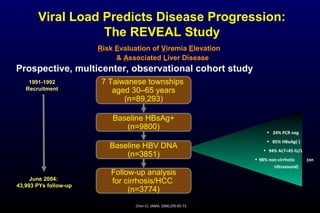
7 Taiwanese townships
aged 30–65 years
(n=89,293)
Baseline HBsAg+
(n=9800)
Baseline HBV DNA
(n=3851)
Follow-up analysis
for cirrhosis/HCC
(n=3774)
Viral Load Predicts Disease Progression:
The REVEAL Study
Risk Evaluation of Viremia Elevation
& Associated Liver Disease
Prospective, multicenter, observational cohort study
Chen CJ. JAMA. 2006;295:65-73.
1991-19921991-1992
RecruitmentRecruitment
June 2004:June 2004:
43,993 PYs follow-up43,993 PYs follow-up
• 24% PCR neg
• 85% HBeAg(-)
• 94% ALT<45 IU/L
• 98% non-cirrhotic (on
Ultrasound)
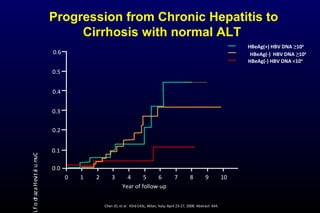
0
0.0
0.1
0.2
0.3
0.4
0.5
0.6
1 2 3 4 5 6 7 8 9 10
Year of follow-up
CumulativeHazardofL
HBeAg(+) HBV DNA ≥104
HBeAg(-) HBV DNA ≥104
HBeAg(-) HBV DNA <104
Progression from Chronic Hepatitis to
Cirrhosis with normal ALT
Chen JD, et al. 43rd EASL; Milan, Italy; April 23-27, 2008. Abstract 644.
Chronic HBV
• Primary aim of treatment : progression of
disease progression to cirrhosis,
decompensation and HCC
• HBV DNA: Strongest predictor of HCC
Reveal study
Hongkong study: 8 yrs follow up
HCC risk calculators
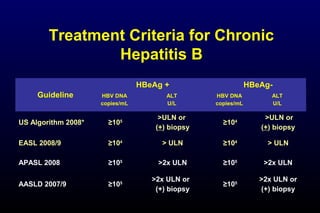
Guideline
HBeAg + HBeAg-
HBV DNA
copies/mL
ALT
U/L
HBV DNA
copies/mL
ALT
U/L
US Algorithm 2008* ≥105
>ULN or
(+) biopsy
≥104
>ULN or
(+) biopsy
EASL 2008/9 ≥104
> ULN ≥104
> ULN
APASL 2008 ≥105
>2x ULN ≥105
>2x ULN
AASLD 2007/9 ≥105
>2x ULN or
(+) biopsy
≥105
>2x ULN or
(+) biopsy
Treatment Criteria for Chronic
Hepatitis B
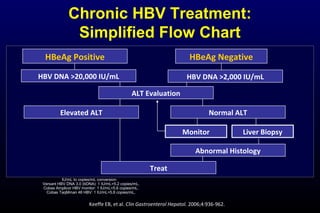
Chronic HBV Treatment:
Simplified Flow Chart
Keeffe EB, et al. Clin Gastroenterol Hepatol. 2006;4:936-962.
HBeAg Positive
Treat
Monitor
HBeAg Negative
HBV DNA >20,000 IU/mL HBV DNA >2,000 IU/mL
Normal ALT
Liver Biopsy
Abnormal Histology
Elevated ALT
ALT Evaluation
IU/mL to copies/mL conversion:
Versant HBV DNA 3.0 (bDNA): 1 IU/mL=5.2 copies/mL.
Cobas Amplicor HBV monitor: 1 IU/mL=5.6 copies/mL.
Cobas TaqMman 48 HBV: 1 IU/mL=5.8 copies/mL.
Indications of treatment
• Moderate to severe liver disease- h/p
ALT/HBV DNA levels
• AASLD/ EASL/APASL guidelines
• But
• Advanced age,
• Extrahepatic manifestations,
• Family history of cirrhosis
• HBV treatment with help of biomarkers
• Fiborscan
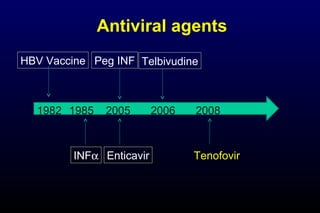
Antiviral agents
1982
HBV Vaccine
1985
INFα
2005
Peg INF
Enticavir
2006
Telbivudine
2008
Tenofovir
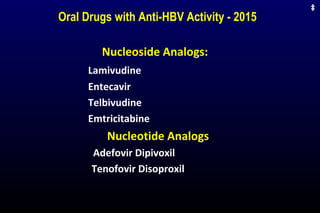
Oral Drugs with Anti-HBV Activity - 2015
Nucleoside Analogs:
Lamivudine
Entecavir
Telbivudine
Emtricitabine
Nucleotide Analogs
Adefovir Dipivoxil
Tenofovir Disoproxil
‡
First Line Treatment Options Have
The Lowest Resistance Rates
Lowest
Rate of
Resistance
Lamivudine
65% to 70% at 4 to 5 years
Telbivudine
25% in HBeAg-positive patients
11% in HBeAg-negative patients
at 2 years
Adefovir dipivoxil
29% at 5 years
Entecavir*
in the absence of prior
lamivudine resistance
(1.25% at 5 years)
*Patients with LAM resistance have a 51% rate of novel mutations after 5 years of entecavir therapy
Tenofovir DF
in treatment
naïve patients
(0% at 2 years)
Highest
Rate of
Resistance
US Treatment Algorithm – Resistance Profile
Keeffe, E, et al. Clinical Gastroenterology and Hepatology 2008;doi: 10.1016/j.cgh.2008.08.021 (e-pub).
New Preferred First-Line Treatment
Options
• Based on superior efficacy, tolerability, and
favorable resistance, the new preferred Oral
first-line treatments are:
– Tenofovir DF*
– Entecavir
US Treatment Algorithm and EASL Guidelines - Treatment Options
+
Tenofovir DF should replace adefovir dipivoxil as a first-line drug in previously untreated patients with HBeAg-positive and HBeAg -negative disease
Keeffe, E, et al. Clinical Gastroenterology and Hepatology 2008;doi: 10.1016/j.cgh.2008.08.021 (e-pub).
EASL Clinical Practice Guidelines (update, in press); access: www.easl.ch/PDF/cpg/EASL_HBV_CPGs.pdf, 11.14.08
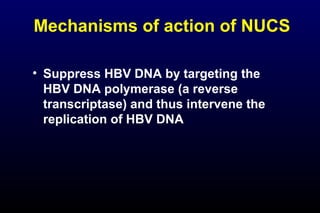
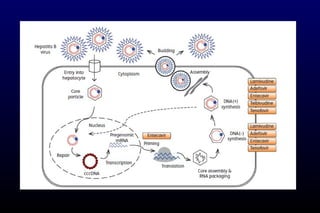
Mechanisms of action of NUCS
• Suppress HBV DNA by targeting the
HBV DNA polymerase (a reverse
transcriptase) and thus intervene the
replication of HBV DNA
0
10
20
30
40
50
60
70
80
90
PEG-INF LAM ADV ETV LdT TDF
Rates of Undetectable HBV DNA
and Normal ALT in HBeAg+ Patients
0
10
20
30
40
50
60
70
80
PEG-INF LAM ADV ETV LdT TDF
24%
39%
21%
67%
60%
74%
39%
66%
48%
68% 69%
77%
Undetectable HBV DNA Normal Range ALT
Rates of undetectable HBV DNA and normal range ALT at one year of therapy with:
pegylated interferon alpha 21 (PEG_INF), lamivudine (LAM), adefovir (ADV), entecavir (ETV),
and tenofovir DF (TDF) in HBeAg positive patients with CHB in randomized clinical trails.
These trials used different HBV DNA assays and they were not head-to-head comparisons for all the drugs.
EASL Clinical Practice Guidelines (update, in press); access: www.easl.ch/PDF/cpg/EASL_HBV_CPGs.pdf, 11.14.08
Rates of Undetectable HBV DNA
and Normal ALT in HBeAg– Patients
0
20
40
60
80
100
PEG-INF LAM ADV ETV LdT TDF
0
10
20
30
40
50
60
70
80
90
PEG-INF LAM ADV ETV LdT TDF
63%
72%
51%
90% 88% 91%
38%
74% 72%
78%
74% 77%
Undetectable HBV DNA Normal Range ALT
Rates of undetectable HBV DNA and normal range ALT at one year of therapy with:
pegylated interferon alpha 21 (PEG_INF), lamivudine (LAM), adefovir (ADV), entecavir (ETV),
and tenofovir DF (TDF) in HBeAg negative patients with CHB in randomized clinical trails.
These trials used different HBV DNA assays and they were not head-to-head comparisons for all the drugs.
EASL Clinical Practice Guidelines (update, in press); access: www.easl.ch/PDF/cpg/EASL_HBV_CPGs.pdf, 11.14.08
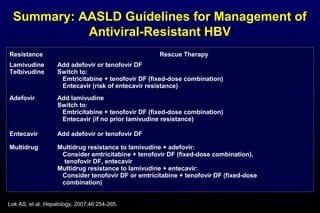
Summary: AASLD Guidelines for Management of
Antiviral-Resistant HBV
Resistance Rescue Therapy
Lamivudine
Telbivudine
Add adefovir or tenofovir DF
Switch to:
Emtricitabine + tenofovir DF (fixed-dose combination)
Entecavir (risk of entecavir resistance)
Adefovir Add lamivudine
Switch to:
Emtricitabine + tenofovir DF (fixed-dose combination)
Entecavir (if no prior lamivudine resistance)
Entecavir Add adefovir or tenofovir DF
Multidrug Multidrug resistance to lamivudine + adefovir:
Consider emtricitabine + tenofovir DF (fixed-dose combination),
tenofovir DF, entecavir
Multidrug resistance to lamivudine + entecavir:
Consider tenofovir DF or emtricitabine + tenofovir DF (fixed-dose
combination)
Lok AS, et al. Hepatology. 2007;46:254-265.
Durability of response
LAM: HBeAg –VE : 50% relapse with 6m of cessation of
treatment
ADV: 46% relapse with 5 years
ETV : 29% to 53% after cessation of treatment
50% - sustained HBeAg seroconversion off treatment
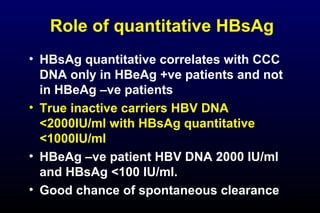
Role of quantitative HBsAg
• HBsAg quantitative correlates with CCC
DNA only in HBeAg +ve patients and not
in HBeAg –ve patients
• True inactive carriers HBV DNA
<2000IU/ml with HBsAg quantitative
<1000IU/ml
• HBeAg –ve patient HBV DNA 2000 IU/ml
and HBsAg <100 IU/ml.
• Good chance of spontaneous clearance
GS-103: HBsAg Loss/seroconversion Occurred
only in HBV Genotypes A + D
• At week 48, HBsAg loss
occurred in 3.2% with TDF
and 0% with ADV (p=0.02)
• 14 patients (6%) lost HBsAg
by year 2 on TDF
– 9 TDF-TDF and 5 ADV-TDF
– 11/14 HBsAb seroconversion
• TDF induced loss of HBsAg
in Caucasian patients
infected with genotype A or D
virus
Genotype
HBsAg Clearance at
Year 2 n/N (%)
A 8/67 (12%)
B 0/35 (0%)
C 0/69 (0%)
D 6/90 (7%)
Heathcote EJ, et al. 44th EASL; Copenhagen, Denmark; April 22-26, 2009; Abst. 909.
Impact of HBV Genotype on
treatment response
• No relation with HBeAg seroconversion
or HBV DNA decline respond.
Oral Antivirals Reduce the Incidence of
HCC in Patients with HBV-related Liver
Cirrhosis
Eun, J. et al, AASLD 2007, Abstract #961.
Control, n=111
Treated, n=111
Mean follow-up 4.4 for treated, 5.4 for untreated
Annual incidence rate of 1.02% Tx. vs. 6.0% non-Tx. patients/year
* (Log-rank, p=0.003)
5%*
33%
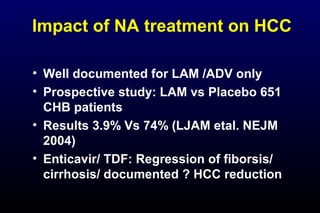
Impact of NA treatment on HCC
• Well documented for LAM /ADV only
• Prospective study: LAM vs Placebo 651
CHB patients
• Results 3.9% Vs 74% (LJAM etal. NEJM
2004)
• Enticavir/ TDF: Regression of fiborsis/
cirrhosis/ documented ? HCC reduction
Impact of NA treatment on hepatic
decompensation
Lam : 32M : 50% reduction in rate of hepatic
decompensation
A significant proportion of
patients taken off OLT list
NA treatment after LT
• Entecavir monotherapy
91% HBsAg loss
98.8% undetectable HBV DNA after LT after a mean follow up of 53
months
Fung et al AJ Gastroentrol 2013
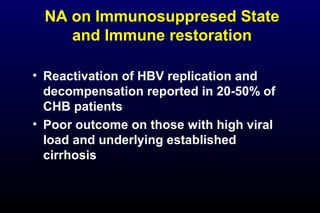
NA on Immunosuppresed State
and Immune restoration
• Reactivation of HBV replication and
decompensation reported in 20-50% of
CHB patients
• Poor outcome on those with high viral
load and underlying established
cirrhosis
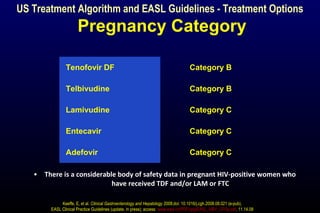
Pregnancy Category
Tenofovir DF Category B
Telbivudine Category B
Lamivudine Category C
Entecavir Category C
Adefovir Category C
• There is a considerable body of safety data in pregnant HIV-positive women who
have received TDF and/or LAM or FTC
US Treatment Algorithm and EASL Guidelines - Treatment Options
Keeffe, E, et al. Clinical Gastroenterology and Hepatology 2008;doi: 10.1016/j.cgh.2008.08.021 (e-pub).
EASL Clinical Practice Guidelines (update, in press); access: www.easl.ch/PDF/cpg/EASL_HBV_CPGs.pdf, 11.14.08
Strategies to improve treatment efficacy
– Denovo combination treatment
• TDF + ETV better than either along if
HBVDNA > 108
IU/ml in HBeAg +ve
patients
Lok AS(Gastroenterol 2012)
• Road Map therapy -only for TDV
patients
NEWER NAS
• Prodrug of Tenofovir better lymphoid
distribution
• Lesser renal and bone toxicities
• Besifovir : Acyclic nucleotide
phosphonate : as good as ETV/ TDF
Tenofovir Alafenamide 25mg
Future NA development
• Viral entry inhibitors
• Acylated peptides derived from the large HBV
envelop protein block viral entry
• Use preS1 peptides
• Small interfering RNA produce strong and
persistent antiHBV activity
• Block interaction between HBeAg and HBsAg
• Some HBV Gerome Oligonuclitides induce Robust
expression of INFα by plasmocytosed cells.
Conclusion
• NAS- New era of HBV treatment
• Reduce hepatic decompensation and HCC
• Infrequent side effects/ ease administration
• 1st
Generation : Viral resistance
• 2nd
Generation: ETV : 1.2% ( 5 years)
TDF: 0% ( 6 years)
• Combination treatment for HBV DNA>10 8
log
• ? What to do for suboptimal responders
• ?RGT
Future Perspectives
• Indefinite treatment : major drawback
• ? Peg INF + TDF – RCT on
• ? Peg INF after HBeAg seroconversion
• Tenofovir Alafenamide, Besifovir :
Newer NAS/entry inhibitors/smrnas
39
HBsAg
NUCs in Chronic Hepatitis B

NUCs in Chronic Hepatitis B

  • 2.
    How Old isHBV? • HBV associated with humans for >1,000 years but no definitive evidence • Recent evidence establishes ≥500 years • Naturally mummified body of a Korean child found virtually intact • Laparoscopy: Large organ in RUQ and biopsies sent for pathology and HBV DNA testing – HBV DNA genotype C isolated from the liver – Pathology: Appeared to be normal liver Klein A, et al. 58th AASLD; Boston, MA; November 2-6, 2007. Poster 925.
  • 3.
    Viral Characteristics HIV HBVHCV Virus type RNA Retrovirus DNA Hepadenovirus RNA Flavivirus Eradication possible with therapy? No—Latent reservoirs No-cccDNA Yes—Sustained virologic response (cure) Viral targets Mainly CD4+ cells Hepatocytes Hepatocytes Variants HIV 1 and 2 8 genotypes A-H 6 genotypes 1-6 Pathogenesis Damage to host immune system Host immune response Host immune response Hepatitis B is 50 to 100 times more infectious than HIV Unlike HIV, it can live outside the body in dried blood for longer than a week World Health Organization. Hepatitis B. http://www.who.int/mediacentre/factsheets/fs204/en/. Accessed November 7, 2007; Block TM, et al. Clin Liver Dis. 2007;11:685-706; Krogstad P. Semin Pediatr Infect Dis. 2003;14:258-268; Penin F. Clin Liver Dis. 2003;7:1-21; Lauer GM, Walker BD. N Engl J Med. 2001;345:41-52.
  • 4.
    Nucleoside Analogues inHBV HBV- Global health problem 250m people worldwide Max prevalence in Asia Pacific and Subsaharan Africa HBV: Vaccination : 179 countries Chronic carriers at risk
  • 5.
    Normal Aminotransferase Levelsand Risk of Mortality from Liver Diseases Kim HC et al.Kim HC et al. BMJBMJ 2004; 328:9832004; 328:983 1.01.0 2.92.9 9.59.5 19.219.2 30.030.0 59.059.0 NormalNormal ElevatedElevated  Korea Medical Insurance Corporation  94,533 men; 47,522 women  35-59 yrs old  Relative risk for liver mortality compared with AST and ALT <20 IU/l
  • 6.
    7 Taiwanese townships aged30–65 years (n=89,293) Baseline HBsAg+ (n=9800) Baseline HBV DNA (n=3851) Follow-up analysis for cirrhosis/HCC (n=3774) Viral Load Predicts Disease Progression: The REVEAL Study Risk Evaluation of Viremia Elevation & Associated Liver Disease Prospective, multicenter, observational cohort study Chen CJ. JAMA. 2006;295:65-73. 1991-19921991-1992 RecruitmentRecruitment June 2004:June 2004: 43,993 PYs follow-up43,993 PYs follow-up • 24% PCR neg • 85% HBeAg(-) • 94% ALT<45 IU/L • 98% non-cirrhotic (on Ultrasound)
  • 8.
    0 0.0 0.1 0.2 0.3 0.4 0.5 0.6 1 2 34 5 6 7 8 9 10 Year of follow-up CumulativeHazardofL HBeAg(+) HBV DNA ≥104 HBeAg(-) HBV DNA ≥104 HBeAg(-) HBV DNA <104 Progression from Chronic Hepatitis to Cirrhosis with normal ALT Chen JD, et al. 43rd EASL; Milan, Italy; April 23-27, 2008. Abstract 644.
  • 9.
    Chronic HBV • Primaryaim of treatment : progression of disease progression to cirrhosis, decompensation and HCC • HBV DNA: Strongest predictor of HCC Reveal study Hongkong study: 8 yrs follow up HCC risk calculators
  • 10.
    Guideline HBeAg + HBeAg- HBVDNA copies/mL ALT U/L HBV DNA copies/mL ALT U/L US Algorithm 2008* ≥105 >ULN or (+) biopsy ≥104 >ULN or (+) biopsy EASL 2008/9 ≥104 > ULN ≥104 > ULN APASL 2008 ≥105 >2x ULN ≥105 >2x ULN AASLD 2007/9 ≥105 >2x ULN or (+) biopsy ≥105 >2x ULN or (+) biopsy Treatment Criteria for Chronic Hepatitis B
  • 11.
    Chronic HBV Treatment: SimplifiedFlow Chart Keeffe EB, et al. Clin Gastroenterol Hepatol. 2006;4:936-962. HBeAg Positive Treat Monitor HBeAg Negative HBV DNA >20,000 IU/mL HBV DNA >2,000 IU/mL Normal ALT Liver Biopsy Abnormal Histology Elevated ALT ALT Evaluation IU/mL to copies/mL conversion: Versant HBV DNA 3.0 (bDNA): 1 IU/mL=5.2 copies/mL. Cobas Amplicor HBV monitor: 1 IU/mL=5.6 copies/mL. Cobas TaqMman 48 HBV: 1 IU/mL=5.8 copies/mL.
  • 12.
    Indications of treatment •Moderate to severe liver disease- h/p ALT/HBV DNA levels • AASLD/ EASL/APASL guidelines • But • Advanced age, • Extrahepatic manifestations, • Family history of cirrhosis • HBV treatment with help of biomarkers • Fiborscan
  • 13.
    Antiviral agents 1982 HBV Vaccine 1985 INFα 2005 PegINF Enticavir 2006 Telbivudine 2008 Tenofovir
  • 14.
    Oral Drugs withAnti-HBV Activity - 2015 Nucleoside Analogs: Lamivudine Entecavir Telbivudine Emtricitabine Nucleotide Analogs Adefovir Dipivoxil Tenofovir Disoproxil ‡
  • 15.
    First Line TreatmentOptions Have The Lowest Resistance Rates Lowest Rate of Resistance Lamivudine 65% to 70% at 4 to 5 years Telbivudine 25% in HBeAg-positive patients 11% in HBeAg-negative patients at 2 years Adefovir dipivoxil 29% at 5 years Entecavir* in the absence of prior lamivudine resistance (1.25% at 5 years) *Patients with LAM resistance have a 51% rate of novel mutations after 5 years of entecavir therapy Tenofovir DF in treatment naïve patients (0% at 2 years) Highest Rate of Resistance US Treatment Algorithm – Resistance Profile Keeffe, E, et al. Clinical Gastroenterology and Hepatology 2008;doi: 10.1016/j.cgh.2008.08.021 (e-pub).
  • 17.
    New Preferred First-LineTreatment Options • Based on superior efficacy, tolerability, and favorable resistance, the new preferred Oral first-line treatments are: – Tenofovir DF* – Entecavir US Treatment Algorithm and EASL Guidelines - Treatment Options + Tenofovir DF should replace adefovir dipivoxil as a first-line drug in previously untreated patients with HBeAg-positive and HBeAg -negative disease Keeffe, E, et al. Clinical Gastroenterology and Hepatology 2008;doi: 10.1016/j.cgh.2008.08.021 (e-pub). EASL Clinical Practice Guidelines (update, in press); access: www.easl.ch/PDF/cpg/EASL_HBV_CPGs.pdf, 11.14.08
  • 18.
    Mechanisms of actionof NUCS • Suppress HBV DNA by targeting the HBV DNA polymerase (a reverse transcriptase) and thus intervene the replication of HBV DNA
  • 20.
    0 10 20 30 40 50 60 70 80 90 PEG-INF LAM ADVETV LdT TDF Rates of Undetectable HBV DNA and Normal ALT in HBeAg+ Patients 0 10 20 30 40 50 60 70 80 PEG-INF LAM ADV ETV LdT TDF 24% 39% 21% 67% 60% 74% 39% 66% 48% 68% 69% 77% Undetectable HBV DNA Normal Range ALT Rates of undetectable HBV DNA and normal range ALT at one year of therapy with: pegylated interferon alpha 21 (PEG_INF), lamivudine (LAM), adefovir (ADV), entecavir (ETV), and tenofovir DF (TDF) in HBeAg positive patients with CHB in randomized clinical trails. These trials used different HBV DNA assays and they were not head-to-head comparisons for all the drugs. EASL Clinical Practice Guidelines (update, in press); access: www.easl.ch/PDF/cpg/EASL_HBV_CPGs.pdf, 11.14.08
  • 21.
    Rates of UndetectableHBV DNA and Normal ALT in HBeAg– Patients 0 20 40 60 80 100 PEG-INF LAM ADV ETV LdT TDF 0 10 20 30 40 50 60 70 80 90 PEG-INF LAM ADV ETV LdT TDF 63% 72% 51% 90% 88% 91% 38% 74% 72% 78% 74% 77% Undetectable HBV DNA Normal Range ALT Rates of undetectable HBV DNA and normal range ALT at one year of therapy with: pegylated interferon alpha 21 (PEG_INF), lamivudine (LAM), adefovir (ADV), entecavir (ETV), and tenofovir DF (TDF) in HBeAg negative patients with CHB in randomized clinical trails. These trials used different HBV DNA assays and they were not head-to-head comparisons for all the drugs. EASL Clinical Practice Guidelines (update, in press); access: www.easl.ch/PDF/cpg/EASL_HBV_CPGs.pdf, 11.14.08
  • 23.
    Summary: AASLD Guidelinesfor Management of Antiviral-Resistant HBV Resistance Rescue Therapy Lamivudine Telbivudine Add adefovir or tenofovir DF Switch to: Emtricitabine + tenofovir DF (fixed-dose combination) Entecavir (risk of entecavir resistance) Adefovir Add lamivudine Switch to: Emtricitabine + tenofovir DF (fixed-dose combination) Entecavir (if no prior lamivudine resistance) Entecavir Add adefovir or tenofovir DF Multidrug Multidrug resistance to lamivudine + adefovir: Consider emtricitabine + tenofovir DF (fixed-dose combination), tenofovir DF, entecavir Multidrug resistance to lamivudine + entecavir: Consider tenofovir DF or emtricitabine + tenofovir DF (fixed-dose combination) Lok AS, et al. Hepatology. 2007;46:254-265.
  • 24.
    Durability of response LAM:HBeAg –VE : 50% relapse with 6m of cessation of treatment ADV: 46% relapse with 5 years ETV : 29% to 53% after cessation of treatment 50% - sustained HBeAg seroconversion off treatment
  • 25.
    Role of quantitativeHBsAg • HBsAg quantitative correlates with CCC DNA only in HBeAg +ve patients and not in HBeAg –ve patients • True inactive carriers HBV DNA <2000IU/ml with HBsAg quantitative <1000IU/ml • HBeAg –ve patient HBV DNA 2000 IU/ml and HBsAg <100 IU/ml. • Good chance of spontaneous clearance
  • 26.
    GS-103: HBsAg Loss/seroconversionOccurred only in HBV Genotypes A + D • At week 48, HBsAg loss occurred in 3.2% with TDF and 0% with ADV (p=0.02) • 14 patients (6%) lost HBsAg by year 2 on TDF – 9 TDF-TDF and 5 ADV-TDF – 11/14 HBsAb seroconversion • TDF induced loss of HBsAg in Caucasian patients infected with genotype A or D virus Genotype HBsAg Clearance at Year 2 n/N (%) A 8/67 (12%) B 0/35 (0%) C 0/69 (0%) D 6/90 (7%) Heathcote EJ, et al. 44th EASL; Copenhagen, Denmark; April 22-26, 2009; Abst. 909.
  • 27.
    Impact of HBVGenotype on treatment response • No relation with HBeAg seroconversion or HBV DNA decline respond.
  • 28.
    Oral Antivirals Reducethe Incidence of HCC in Patients with HBV-related Liver Cirrhosis Eun, J. et al, AASLD 2007, Abstract #961. Control, n=111 Treated, n=111 Mean follow-up 4.4 for treated, 5.4 for untreated Annual incidence rate of 1.02% Tx. vs. 6.0% non-Tx. patients/year * (Log-rank, p=0.003) 5%* 33%
  • 29.
    Impact of NAtreatment on HCC • Well documented for LAM /ADV only • Prospective study: LAM vs Placebo 651 CHB patients • Results 3.9% Vs 74% (LJAM etal. NEJM 2004) • Enticavir/ TDF: Regression of fiborsis/ cirrhosis/ documented ? HCC reduction
  • 30.
    Impact of NAtreatment on hepatic decompensation Lam : 32M : 50% reduction in rate of hepatic decompensation A significant proportion of patients taken off OLT list
  • 31.
    NA treatment afterLT • Entecavir monotherapy 91% HBsAg loss 98.8% undetectable HBV DNA after LT after a mean follow up of 53 months Fung et al AJ Gastroentrol 2013
  • 32.
    NA on ImmunosuppresedState and Immune restoration • Reactivation of HBV replication and decompensation reported in 20-50% of CHB patients • Poor outcome on those with high viral load and underlying established cirrhosis
  • 33.
    Pregnancy Category Tenofovir DFCategory B Telbivudine Category B Lamivudine Category C Entecavir Category C Adefovir Category C • There is a considerable body of safety data in pregnant HIV-positive women who have received TDF and/or LAM or FTC US Treatment Algorithm and EASL Guidelines - Treatment Options Keeffe, E, et al. Clinical Gastroenterology and Hepatology 2008;doi: 10.1016/j.cgh.2008.08.021 (e-pub). EASL Clinical Practice Guidelines (update, in press); access: www.easl.ch/PDF/cpg/EASL_HBV_CPGs.pdf, 11.14.08
  • 34.
    Strategies to improvetreatment efficacy – Denovo combination treatment • TDF + ETV better than either along if HBVDNA > 108 IU/ml in HBeAg +ve patients Lok AS(Gastroenterol 2012) • Road Map therapy -only for TDV patients
  • 35.
    NEWER NAS • Prodrugof Tenofovir better lymphoid distribution • Lesser renal and bone toxicities • Besifovir : Acyclic nucleotide phosphonate : as good as ETV/ TDF Tenofovir Alafenamide 25mg
  • 36.
    Future NA development •Viral entry inhibitors • Acylated peptides derived from the large HBV envelop protein block viral entry • Use preS1 peptides • Small interfering RNA produce strong and persistent antiHBV activity • Block interaction between HBeAg and HBsAg • Some HBV Gerome Oligonuclitides induce Robust expression of INFα by plasmocytosed cells.
  • 37.
    Conclusion • NAS- Newera of HBV treatment • Reduce hepatic decompensation and HCC • Infrequent side effects/ ease administration • 1st Generation : Viral resistance • 2nd Generation: ETV : 1.2% ( 5 years) TDF: 0% ( 6 years) • Combination treatment for HBV DNA>10 8 log • ? What to do for suboptimal responders • ?RGT
  • 38.
    Future Perspectives • Indefinitetreatment : major drawback • ? Peg INF + TDF – RCT on • ? Peg INF after HBeAg seroconversion • Tenofovir Alafenamide, Besifovir : Newer NAS/entry inhibitors/smrnas
  • 39.

Editor's Notes

  • #12 Slide: Chronic HBV Treatment: Simplified Flow Chart In evaluating patients with chronic HBV infection, HBeAg status is important to determine, because patients who are e-antigen negative have a lower threshold for therapy. In particular, e-antigen negative patients should be considered for treatment if they have viral load of one order of magnitude lower than e-antigen positive patients.1 For HBeAg+ patients, HBV DNA levels above 20,000 IU/mL (approximately 104 copies/mL) should be considered as potential candidates for therapy. Patients who are HBeAg- should be considered for therapy if HBV DNA levels are above 2,000 IU/mL (approximately 103 copies/mL). Patients below these viral load thresholds should be monitored every 6 to 12 months.1 Antigen status and viral load determinations should be combined with an assessment of alanine aminotransferase (ALT). Patients with elevated viral loads above threshold levels and elevated ALT levels should be treated. Patients with normal ALT may be monitored. Alternatively, especially in older patients, a liver biopsy may be considered in order to determine whether there is ongoing damage from HBV. Abnormal histology, even in the face of normal ALT levels and/or viral loads below the treatment thresholds are indications to provide antiviral therapy.1 Reference Keeffe EB, Dieterich DT, Han SH, et al. A treatment algorithm for the management of chronic hepatitis B virus infection in the United States: an update. Clin Gastroenterol Hepatol. 2006;4:936-962.
  • #23 MAIN MESSAGE The 5-year data represents the findings in 108/663 patients, or 16% of the original cohort. The remaining 84% are not presented or reported here. A large proportion of patients entirely left the ETV program, but a majority are followed in ETV-049, a study of long-term assessment off treatment. Although presented as 5-year data for eAg-positive and –negative patients, it is likely that the 108 patients treated during year 5 included less than 10 eAg-negative patients. (As explained through the presentation by Senturk at EASL 2007.) TRANSITION This is the resistance report at 5 years for ETV in naïve patients. The LAM-refractory patients have a different experience.
  • #24 Slide: Summary: AASLD Guidelines for Management of Antiviral Resistant HBV In summary, as part of the most recent AASLD guidelines, this chart was developed to help guide the second choice of therapy in patients who develop resistance to their first regimen.1 Reference Lok AS, Zoulim F, Locarnini S, et al. Antiviral drug-resistant HBV: standardization of nomenclature and assays and recommendations for management. Hepatology. 2007;46:254-265.
  • #27 See note for slide 30
  • #29 Background/Aims: We evaluated the effect of lamivudine and adefovir dipivoxil on preventing HCC in hepatitis B virus(HBV)-related liver cirrhosis. Patients and Methods: We reviewed the medical records of the patients who were diagnosed with HBV-related liver disease at Yeungnam University hospital from Jan 1983 to Dec 2005. The number of patients treated with lamivudine over 12 months was 570 and the number of patients treated with adefovir dipivoxil after lamivudine resistance was 284 from Mar 1997 to Dec 2005. The number of patients who could not be treated with oral antiviral agent from 1983 to 1999, followed over 12 months, was 1592. In our results using Cox regression model, 4 factors were related with HCC; gender(male, OR=1.81, p&amp;lt;0.001), age(≥40 years, OR=4.95, p&amp;lt;0.001), platelet count(&amp;lt;150x10^3/mm3, OR=3.48, p&amp;lt;0.001), and ascites(yes, OR=1.69, p=0.009). Using SPSS program, 111 patients of the oral antiviral agent-treated group and the untreated group were randomly selected, respectively, matching an age variable, a gender variable, liver cirrhosis with Child-Pugh class A and positive HBe antigen. Results: The mean follow-up period was 4.4 years in the oral antiviral agent-treated group and 5.4 years in the control group. In oral antiviral agent-treated group, HCC occurred in 5 patients (4.5%) with an annual incidnce rate of 1.02% patients/year, whereas in the control group, HCC occurred in 36 patients (32.4%) with an annual incidence rate of 6.0% patients/year. The cumulative incidence of HCC in the oral antiviral agent-treated group was lower than that in the control group(Log-rank, p=0.003). Conclusion: Oral antiviral agents, such as lamivudine and adefovir dipivoxil may reduce the incidence of HCC in patients with HBV-related liver cirrhosis.
  • #34 The oral ant-HBV agents are pregnancy category B or C. The FDA pregnancy categories are A through D and an X category. They are defined as follows: Category A – Adequate and well-controlled studies have failed to demonstrate a risk to the fetus in the first trimester of pregnancy (and there is no risk in later trimesters). Category B – Animal reproduction studies have failed to demonstrate a risk to the fetus and there are no adequate and well-controlled studies in pregnant women. Category C – Animal reproduction studies have shown an adverse effect upon the fetus and there are no adequate and well-controlled studies in humans, but the potential benefits may warrant use of the drug in pregnant women despite potential risks. Category D – There is positive evidence of human fetal risk based on adverse reaction data from investigational or marketing experience or studies in humans, but potential benefits may warrant use of the drug in pregnant women despite potential risks. Category X – Studies in animals or humans have demonstrated fetal abnormalities and/or there is evidence of positive human risk based on adverse reaction data from investigational or marketing experience, and the risks involved in the use of the drug in pregnant women clearly outweigh potential benefits.