



Hepatitis C
A NEW FUTURE EVERYDAY
Dr.S.M.Nazmul Alam
Medicine,Orange Unit
Resident,Oncology
BSMMU.
Source
AASLD(American Association for the Study of
Liver Disease) Guidelines updated on
February,2016
WHO Guidelines updated on April,2016
EASL(European Association for the Study of
Liver Disease) Guidelines updated on
September,2016
Introduction
Globally,the morbidity and mortality
attributable to hepatitis C virus(HCV) infection
continues to increase.About 700000 persons
die in each year.
In Bangladesh 1 percentage of total
population are suffering from HCV.
Consequently,the field of HCV therapeutics
continues to evolve rapidly as well Since 1989
to 2016.
The virus and distribution of
genotypes
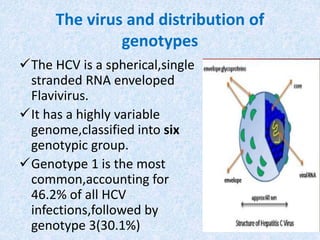
The HCV is a spherical,single
stranded RNA enveloped
Flavivirus.
It has a highly variable
genome,classified into six
genotypic group.
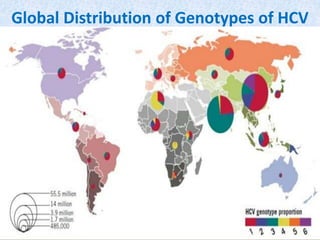
Genotype 1 is the most
common,accounting for
46.2% of all HCV
infections,followed by
genotype 3(30.1%)
Global Distribution of Genotypes of HCV
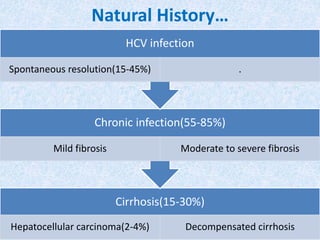
Natural History…
Cirrhosis(15-30%)
Hepatocellular carcinoma(2-4%) Decompensated cirrhosis
Chronic infection(55-85%)
Mild fibrosis Moderate to severe fibrosis
HCV infection
Spontaneous resolution(15-45%) .
Highlights of 2016 Recommendations
1. Screening
2. Assessment for HCV treatment
3. Clinical assessment or care of patients
4. Treatment of Chronic HCV infection
5. Treatment in special situations
6. Prevention
Recommendations on Screening
HCV serology testing be offered to individuals
who are part of a population with high HCV
seroprevalence or who have a history of HCV
risk exposure/behaviour(A1).
 Such as
IV drug misuser.
Medical or Dental interventions.
Unscreened Blood Product.
Vertical transmission
Person with HIV infection
How to confirm?
Detection of anti-HCV antibodies(A1).
If anti-HCV antibodies are detected,HCV RNA or
alternatively core antigen should be determined
to identify patients with on-going infection(A1).
Anti-HCV positive,HCV RNA-negative individuals
should be informed that they do not have
evidence of current(active) infection,but should
retested 3 months later to confirm definitive
clearance(A1)
Goals and Endpoints of Treatment
The goal of therapy is to cure HCV infection to
prevent hepatic cirrhosis,decompensation of
cirrhosis,HCC,severe extra hepatic manifestation
and death(A1).
Success of treatment measured by Sustained
Virological Response(SVR) has steadily increased.
The endpoint of therapy is undetectable HCV
RNA in blood(<15IU/ml) by 12 weeks(SVR12) and
/or 24 weeks(SVR24) after the end of
treatment(A1).
The benefits of treatment clearly
outweighed the potential harms
Virological cure (SVR) offers:
-A decrease in liver inflammation.
-Regression fibrosis,resolution of cirrhosis.
-Portal hypertention,splenomegaly,and other
clinical manifestation also improve.
-More than 70% reduction in the risk of liver
cancer(HCC) & a 90% reduction in the risk of
liver related mortality and liver transplantaion.
Clinical Assessment
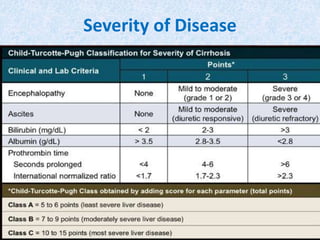
Severity of the disease
Staging of the disease
Genotype
Severity of Disease
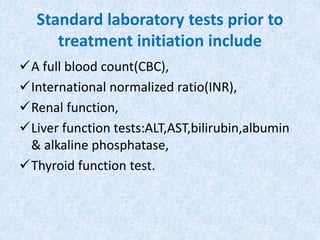
Standard laboratory tests prior to
treatment initiation include
A full blood count(CBC),
International normalized ratio(INR),
Renal function,
Liver function tests:ALT,AST,bilirubin,albumin
& alkaline phosphatase,
Thyroid function test.
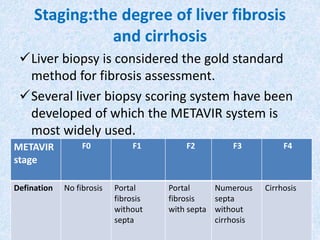
Staging:the degree of liver fibrosis
and cirrhosis
Liver biopsy is considered the gold standard
method for fibrosis assessment.
Several liver biopsy scoring system have been
developed of which the METAVIR system is
most widely used.
METAVIR
stage
F0 F1 F2 F3 F4
Defination No fibrosis Portal
fibrosis
without
septa
Portal
fibrosis
with septa
Numerous
septa
without
cirrhosis
Cirrhosis
Staging:the degree of liver fibrosis
and cirrhosis
But,liver biopsy is not widely used in low-
income countries for
-high cost,
-invasiveness,
-patient discomfort
-risk of complications.
-need for expert histological interpretion.
So,Non-invasive methods are recommended
for low income countries.
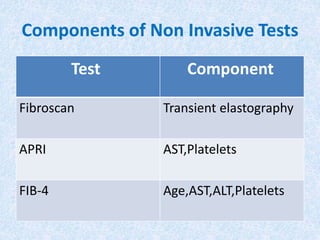
Components of Non Invasive Tests
Test Component
Fibroscan Transient elastography
APRI AST,Platelets
FIB-4 Age,AST,ALT,Platelets
Genotype Testing
The 2016 Guidelines provide
recommendations on the preferred &
alternative Direct Acting Antiviral(DAA)
regimens by HCV genotype.
Therefore knowing a patients genotype is still
important for determining the most
appropriate treatment regimen.
So genotype have no effect on progression of
disease but does effect response of treatment.
Recommendations on Treatment
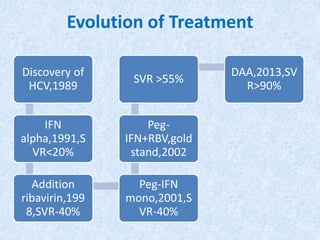
Evolution of Treatment
Discovery of
HCV,1989
IFN
alpha,1991,S
VR<20%
Addition
ribavirin,199
8,SVR-40%
Peg-IFN
mono,2001,S
VR-40%
Peg-
IFN+RBV,gold
stand,2002
SVR >55%
DAA,2013,SV
R>90%
The Direct Acting Anti-Viral Agents…
Oral medicines that directly inhibited the
replication cycle of HCV.
These medicines
-have higher SVR than interferon-based
regimens,
-shorter in treatment duration(as short as 12
weeks),
-orally administered,
-have fewer side-effects.
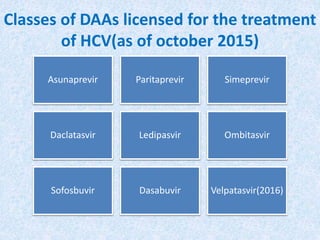
Classes of DAAs licensed for the treatment
of HCV(as of october 2015)
Asunaprevir Paritaprevir Simeprevir
Daclatasvir Ledipasvir Ombitasvir
Sofosbuvir Dasabuvir Velpatasvir(2016)
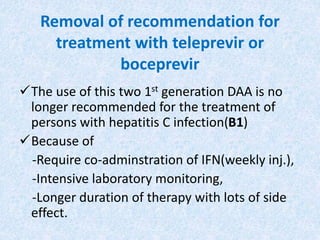
Removal of recommendation for
treatment with teleprevir or
boceprevir
The use of this two 1st generation DAA is no
longer recommended for the treatment of
persons with hepatitis C infection(B1)
Because of
-Require co-adminstration of IFN(weekly inj.),
-Intensive laboratory monitoring,
-Longer duration of therapy with lots of side
effect.
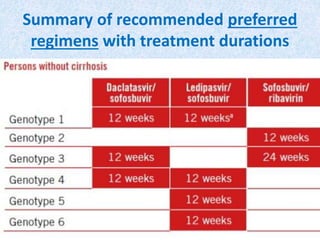
Summary of recommended preferred
regimens with treatment durations
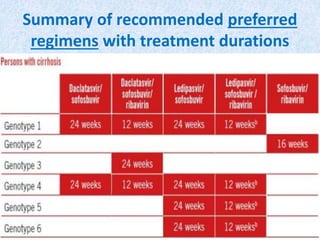
Summary of recommended preferred
regimens with treatment durations
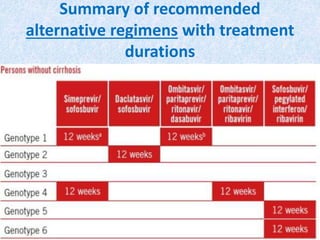
Summary of recommended
alternative regimens with treatment
durations
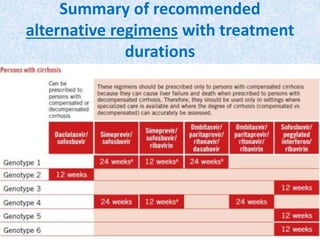
Summary of recommended
alternative regimens with treatment
durations
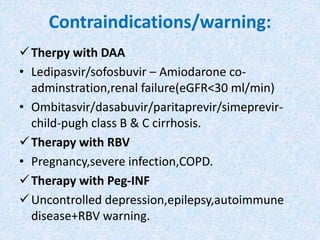
Contraindications/warning:
Therpy with DAA
• Ledipasvir/sofosbuvir – Amiodarone co-
adminstration,renal failure(eGFR<30 ml/min)
• Ombitasvir/dasabuvir/paritaprevir/simeprevir-
child-pugh class B & C cirrhosis.
Therapy with RBV
• Pregnancy,severe infection,COPD.
Therapy with Peg-INF
Uncontrolled depression,epilepsy,autoimmune
disease+RBV warning.
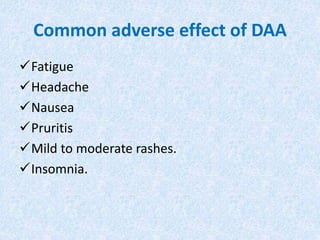
Common adverse effect of DAA
Fatigue
Headache
Nausea
Pruritis
Mild to moderate rashes.
Insomnia.
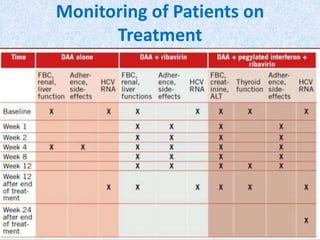
Monitoring of Patients on
Treatment
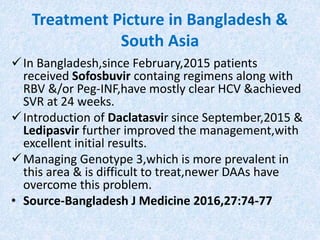
Treatment Picture in Bangladesh &
South Asia
In Bangladesh,since February,2015 patients
received Sofosbuvir containg regimens along with
RBV &/or Peg-INF,have mostly clear HCV &achieved
SVR at 24 weeks.
Introduction of Daclatasvir since September,2015 &
Ledipasvir further improved the management,with
excellent initial results.
Managing Genotype 3,which is more prevalent in
this area & is difficult to treat,newer DAAs have
overcome this problem.
• Source-Bangladesh J Medicine 2016,27:74-77
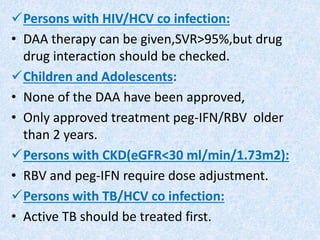
HCV in Special Situations
Persons with HIV/HCV co infection:
• DAA therapy can be given,SVR>95%,but drug
drug interaction should be checked.
Children and Adolescents:
• None of the DAA have been approved,
• Only approved treatment peg-IFN/RBV older
than 2 years.
Persons with CKD(eGFR<30 ml/min/1.73m2):
• RBV and peg-IFN require dose adjustment.
Persons with TB/HCV co infection:
• Active TB should be treated first.
Prevention
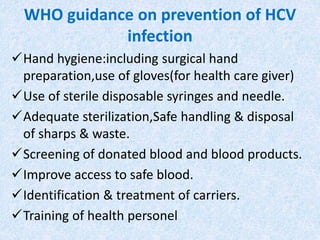
WHO guidance on prevention of HCV
infection
Hand hygiene:including surgical hand
preparation,use of gloves(for health care giver)
Use of sterile disposable syringes and needle.
Adequate sterilization,Safe handling & disposal
of sharps & waste.
Screening of donated blood and blood products.
Improve access to safe blood.
Identification & treatment of carriers.
Training of health personel
Conclusion
Due to availability of very effective oral
medications with a high sustained virological
response,scientists working in this field are
hopeful to eradicate HCV infection from the
planet in future.
DAAs which are pan-genotypic are great hope
to achieve “NOhep” within 2030.
Properly addressing the global burden with
appropriate management to combat HCV
infection surely mark great advancement
towards a newer and better future.
THANK YOU ALL
FOR
Attention,Commen
ts and Questions.

Hepatitis c

  • 1.
    Hepatitis C A NEWFUTURE EVERYDAY Dr.S.M.Nazmul Alam Medicine,Orange Unit Resident,Oncology BSMMU.
  • 2.
    Source AASLD(American Association forthe Study of Liver Disease) Guidelines updated on February,2016 WHO Guidelines updated on April,2016 EASL(European Association for the Study of Liver Disease) Guidelines updated on September,2016
  • 3.
    Introduction Globally,the morbidity andmortality attributable to hepatitis C virus(HCV) infection continues to increase.About 700000 persons die in each year. In Bangladesh 1 percentage of total population are suffering from HCV. Consequently,the field of HCV therapeutics continues to evolve rapidly as well Since 1989 to 2016.
  • 4.
    The virus anddistribution of genotypes The HCV is a spherical,single stranded RNA enveloped Flavivirus. It has a highly variable genome,classified into six genotypic group. Genotype 1 is the most common,accounting for 46.2% of all HCV infections,followed by genotype 3(30.1%)
  • 5.
    Global Distribution ofGenotypes of HCV
  • 6.
    Natural History… Cirrhosis(15-30%) Hepatocellular carcinoma(2-4%)Decompensated cirrhosis Chronic infection(55-85%) Mild fibrosis Moderate to severe fibrosis HCV infection Spontaneous resolution(15-45%) .
  • 7.
    Highlights of 2016Recommendations 1. Screening 2. Assessment for HCV treatment 3. Clinical assessment or care of patients 4. Treatment of Chronic HCV infection 5. Treatment in special situations 6. Prevention
  • 8.
    Recommendations on Screening HCVserology testing be offered to individuals who are part of a population with high HCV seroprevalence or who have a history of HCV risk exposure/behaviour(A1).  Such as IV drug misuser. Medical or Dental interventions. Unscreened Blood Product. Vertical transmission Person with HIV infection
  • 9.
    How to confirm? Detectionof anti-HCV antibodies(A1). If anti-HCV antibodies are detected,HCV RNA or alternatively core antigen should be determined to identify patients with on-going infection(A1). Anti-HCV positive,HCV RNA-negative individuals should be informed that they do not have evidence of current(active) infection,but should retested 3 months later to confirm definitive clearance(A1)
  • 10.
    Goals and Endpointsof Treatment The goal of therapy is to cure HCV infection to prevent hepatic cirrhosis,decompensation of cirrhosis,HCC,severe extra hepatic manifestation and death(A1). Success of treatment measured by Sustained Virological Response(SVR) has steadily increased. The endpoint of therapy is undetectable HCV RNA in blood(<15IU/ml) by 12 weeks(SVR12) and /or 24 weeks(SVR24) after the end of treatment(A1).
  • 11.
    The benefits oftreatment clearly outweighed the potential harms Virological cure (SVR) offers: -A decrease in liver inflammation. -Regression fibrosis,resolution of cirrhosis. -Portal hypertention,splenomegaly,and other clinical manifestation also improve. -More than 70% reduction in the risk of liver cancer(HCC) & a 90% reduction in the risk of liver related mortality and liver transplantaion.
  • 12.
    Clinical Assessment Severity ofthe disease Staging of the disease Genotype
  • 13.
  • 14.
    Standard laboratory testsprior to treatment initiation include A full blood count(CBC), International normalized ratio(INR), Renal function, Liver function tests:ALT,AST,bilirubin,albumin & alkaline phosphatase, Thyroid function test.
  • 15.
    Staging:the degree ofliver fibrosis and cirrhosis Liver biopsy is considered the gold standard method for fibrosis assessment. Several liver biopsy scoring system have been developed of which the METAVIR system is most widely used. METAVIR stage F0 F1 F2 F3 F4 Defination No fibrosis Portal fibrosis without septa Portal fibrosis with septa Numerous septa without cirrhosis Cirrhosis
  • 16.
    Staging:the degree ofliver fibrosis and cirrhosis But,liver biopsy is not widely used in low- income countries for -high cost, -invasiveness, -patient discomfort -risk of complications. -need for expert histological interpretion. So,Non-invasive methods are recommended for low income countries.
  • 17.
    Components of NonInvasive Tests Test Component Fibroscan Transient elastography APRI AST,Platelets FIB-4 Age,AST,ALT,Platelets
  • 18.
    Genotype Testing The 2016Guidelines provide recommendations on the preferred & alternative Direct Acting Antiviral(DAA) regimens by HCV genotype. Therefore knowing a patients genotype is still important for determining the most appropriate treatment regimen. So genotype have no effect on progression of disease but does effect response of treatment.
  • 19.
  • 20.
    Evolution of Treatment Discoveryof HCV,1989 IFN alpha,1991,S VR<20% Addition ribavirin,199 8,SVR-40% Peg-IFN mono,2001,S VR-40% Peg- IFN+RBV,gold stand,2002 SVR >55% DAA,2013,SV R>90%
  • 21.
    The Direct ActingAnti-Viral Agents… Oral medicines that directly inhibited the replication cycle of HCV. These medicines -have higher SVR than interferon-based regimens, -shorter in treatment duration(as short as 12 weeks), -orally administered, -have fewer side-effects.
  • 22.
    Classes of DAAslicensed for the treatment of HCV(as of october 2015) Asunaprevir Paritaprevir Simeprevir Daclatasvir Ledipasvir Ombitasvir Sofosbuvir Dasabuvir Velpatasvir(2016)
  • 23.
    Removal of recommendationfor treatment with teleprevir or boceprevir The use of this two 1st generation DAA is no longer recommended for the treatment of persons with hepatitis C infection(B1) Because of -Require co-adminstration of IFN(weekly inj.), -Intensive laboratory monitoring, -Longer duration of therapy with lots of side effect.
  • 24.
    Summary of recommendedpreferred regimens with treatment durations
  • 25.
    Summary of recommendedpreferred regimens with treatment durations
  • 26.
    Summary of recommended alternativeregimens with treatment durations
  • 27.
    Summary of recommended alternativeregimens with treatment durations
  • 28.
    Contraindications/warning: Therpy with DAA •Ledipasvir/sofosbuvir – Amiodarone co- adminstration,renal failure(eGFR<30 ml/min) • Ombitasvir/dasabuvir/paritaprevir/simeprevir- child-pugh class B & C cirrhosis. Therapy with RBV • Pregnancy,severe infection,COPD. Therapy with Peg-INF Uncontrolled depression,epilepsy,autoimmune disease+RBV warning.
  • 29.
    Common adverse effectof DAA Fatigue Headache Nausea Pruritis Mild to moderate rashes. Insomnia.
  • 30.
  • 31.
    Treatment Picture inBangladesh & South Asia In Bangladesh,since February,2015 patients received Sofosbuvir containg regimens along with RBV &/or Peg-INF,have mostly clear HCV &achieved SVR at 24 weeks. Introduction of Daclatasvir since September,2015 & Ledipasvir further improved the management,with excellent initial results. Managing Genotype 3,which is more prevalent in this area & is difficult to treat,newer DAAs have overcome this problem. • Source-Bangladesh J Medicine 2016,27:74-77
  • 32.
    HCV in SpecialSituations
  • 33.
    Persons with HIV/HCVco infection: • DAA therapy can be given,SVR>95%,but drug drug interaction should be checked. Children and Adolescents: • None of the DAA have been approved, • Only approved treatment peg-IFN/RBV older than 2 years. Persons with CKD(eGFR<30 ml/min/1.73m2): • RBV and peg-IFN require dose adjustment. Persons with TB/HCV co infection: • Active TB should be treated first.
  • 34.
  • 35.
    WHO guidance onprevention of HCV infection Hand hygiene:including surgical hand preparation,use of gloves(for health care giver) Use of sterile disposable syringes and needle. Adequate sterilization,Safe handling & disposal of sharps & waste. Screening of donated blood and blood products. Improve access to safe blood. Identification & treatment of carriers. Training of health personel
  • 36.
    Conclusion Due to availabilityof very effective oral medications with a high sustained virological response,scientists working in this field are hopeful to eradicate HCV infection from the planet in future. DAAs which are pan-genotypic are great hope to achieve “NOhep” within 2030. Properly addressing the global burden with appropriate management to combat HCV infection surely mark great advancement towards a newer and better future.
  • 37.