1
Amjad Khan Afridi
Hepatitis B Virus
Contents
Generalconcept
Definitionsof hepatitis
HepatitisB virus
Whatis hepatitis
Reservoir
Causativeagentand its structure
Decoypartial
Symptoms,mode of transmission and RF
Replication
Epidemiology
Preventionsstatistics
Epidemiology Notes
Madam Saira
2
Amjad Khan Afridi
General Concepts
Hepatitis = 'inflammation of the liver'.
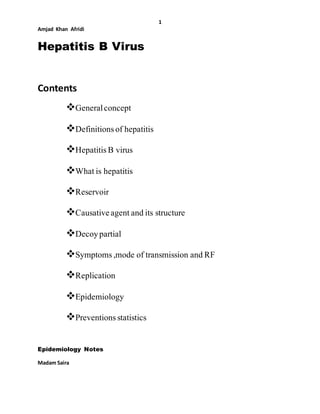
six medically important viruses are commonly described as “hepatitis viruses”:
HAV,HBV,HCV,HDV,HEV,HGV.
Definitions for Hepatitis
 Acute: Short term and/or severe.
 Chronic: Lingering or lasting - may or may not be severe
 Fulminant: Developing quickly and lasting a short time, high mortality rate.
 Cirrhosis: Hardening: may be the result of infection or toxins (e.g. alcohol)
 Jaundice: Yellowing of the skin, eyes,etc due to raised levels of bilirubin in the blood due to
liver damage.
 Hepatocellular carcinoma: is closely associated with hepatitis B, and at least in some regions
of the world with hepatitis C virus.
3
Amjad Khan Afridi
Hepatits B
What is Hepatits B?
Hepatitis B is serious disease caused by a virus that infect the liver.
Can cause lifelong infection, cirrhosis (liver scarring), liver cancer,liver failure and death Hepatitis B.
Reservoir ofhepatitis B virus
 Humansare the reservoir.
Causative agent and its structure
 Causative agent is Hep B virus
 Family: Hepadnaviridae
 Hepa: for liver
 Dna: for Deoxyribonucleic acid
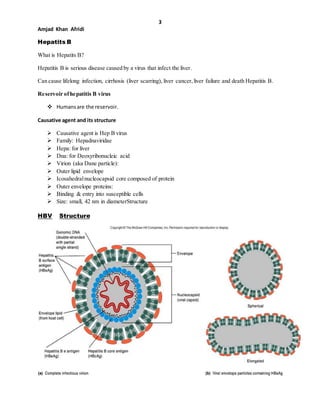
 Virion (aka Dane particle):
 Outer lipid envelope
 Icosahedralnucleocapsid core composed of protein
 Outer envelope proteins:
 Binding & entry into susceptible cells
 Size: small, 42 nm in diameterStructure
HBV Structure
4
Amjad Khan Afridi
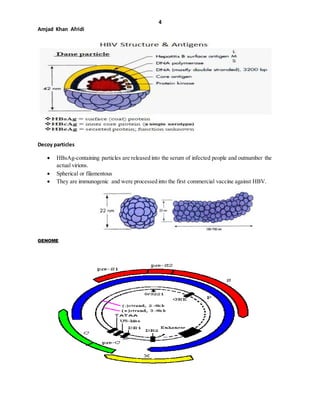
Decoy particles
 HBsAg-containing particles are released into the serum of infected people and outnumber the
actual virions.
 Spherical or filamentous
 They are immunogenic and were processed into the first commercial vaccine against HBV.
GENOME
5
Amjad Khan Afridi
HBV Replication
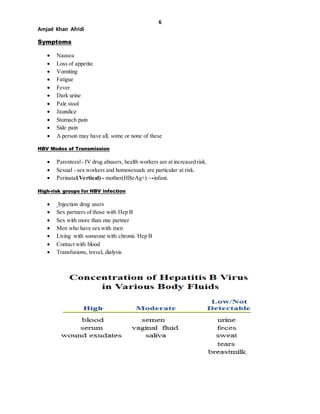
 Reverse transcription: one of the mRNAs is replicated with a reverse transcriptase making the
DNA that will eventually be the core of the progeny virion
 RNA intermediate: HBV replicates through an RNA intermediate and produces and release
antigenic decoy particles.
 Integration: Some DNA integrates into host genome causing carrier state .
Global Patterns of Chronic HBV Infection
 High (>8%): 45% of global population
 lifetime risk of infection >60%
 early childhood infections common
 Intermediate (2%-7%):43% of global population
 lifetime risk of infection 20%-60%
 infections occur in all age groups
 Low (<2%): 12% of global population
 lifetime risk of infection <20%
 most infections occur in adult risk groups
6
Amjad Khan Afridi
Symptoms
 Nausea
 Loss of appetite
 Vomiting
 Fatigue
 Fever
 Dark urine
 Pale stool
 Jaundice
 Stomach pain
 Side pain
 A person may have all, some or none of these
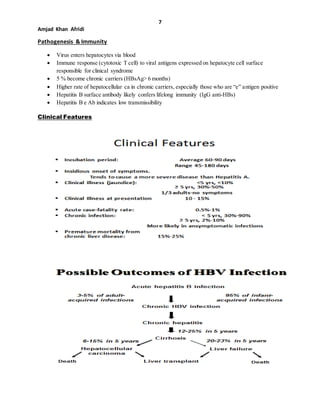
HBV Modes of Transmission
 Parenteral- IV drug abusers, health workers are at increased risk.
 Sexual - sex workers and homosexuals are particular at risk.
 Perinatal(Vertical) - mother(HBeAg+) →infant.
High-risk groups for HBV infection
 Injection drug users
 Sex partners of those with Hep B
 Sex with more than one partner
 Men who have sex with men
 Living with someone with chronic Hep B
 Contact with blood
 Transfusions, travel, dialysis
7
Amjad Khan Afridi
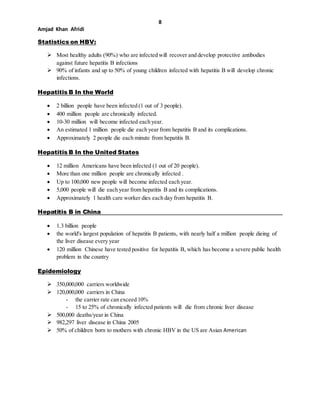
Pathogenesis & Immunity
 Virus enters hepatocytes via blood
 Immune response (cytotoxic T cell) to viral antigens expressed on hepatocyte cell surface
responsible for clinical syndrome
 5 % become chronic carriers (HBsAg> 6 months)
 Higher rate of hepatocellular ca in chronic carriers, especially those who are “e” antigen positive
 Hepatitis B surface antibody likely confers lifelong immunity (IgG anti-HBs)
 Hepatitis B e Ab indicates low transmissibility
Clinical Features
8
Amjad Khan Afridi
Statistics on HBV:
 Most healthy adults (90%) who are infected will recover and develop protective antibodies
against future hepatitis B infections
 90% of infants and up to 50% of young children infected with hepatitis B will develop chronic
infections.
Hepatitis B In the World
 2 billion people have been infected (1 out of 3 people).
 400 million people are chronically infected.
 10-30 million will become infected each year.
 An estimated 1 million people die each year from hepatitis B and its complications.
 Approximately 2 people die each minute from hepatitis B.
Hepatitis B In the United States
 12 million Americans have been infected (1 out of 20 people).
 More than one million people are chronically infected .
 Up to 100,000 new people will become infected each year.
 5,000 people will die each year from hepatitis B and its complications.
 Approximately 1 health care worker dies each day from hepatitis B.
Hepatitis B in China
 1.3 billion people
 the world's largest population of hepatitis B patients, with nearly half a million people dieing of
the liver disease every year
 120 million Chinese have tested positive for hepatitis B, which has become a severe public health
problem in the country
Epidemiology
 350,000,000 carriers worldwide
 120,000,000 carriers in China
- the carrier rate can exceed 10%
- 15 to 25% of chronically infected patients will die from chronic liver disease
 500,000 deaths/year in China
 982,297 liver disease in China 2005
 50% of children born to mothers with chronic HBV in the US are Asian American
9
Amjad Khan Afridi
Current Treatment Options
 Interferon alfa (Intron A) Response rate is 30 to 40%.
 Lamivudine (Epivir HBV) (relapse ,drug resistance)
 Adefovir dipivoxil (Hepsera)
Prevention
 Vaccination
- highlyeffectiverecombinantvaccines
 HepatitisBImmunoglobulin(HBIG)
- exposedwithin48hours of the incident/neonateswhose mothersare HBsAgand
HBeAgpositive.
 Othermeasures
- screeningof blooddonors,bloodandbodyfluidprecautions.
PreparedBy Amjad Khan Afridi
Date : 22 May, 2016

Hepatitis B Virus

  • 1.
    1 Amjad Khan Afridi HepatitisB Virus Contents Generalconcept Definitionsof hepatitis HepatitisB virus Whatis hepatitis Reservoir Causativeagentand its structure Decoypartial Symptoms,mode of transmission and RF Replication Epidemiology Preventionsstatistics Epidemiology Notes Madam Saira
  • 2.
    2 Amjad Khan Afridi GeneralConcepts Hepatitis = 'inflammation of the liver'. six medically important viruses are commonly described as “hepatitis viruses”: HAV,HBV,HCV,HDV,HEV,HGV. Definitions for Hepatitis  Acute: Short term and/or severe.  Chronic: Lingering or lasting - may or may not be severe  Fulminant: Developing quickly and lasting a short time, high mortality rate.  Cirrhosis: Hardening: may be the result of infection or toxins (e.g. alcohol)  Jaundice: Yellowing of the skin, eyes,etc due to raised levels of bilirubin in the blood due to liver damage.  Hepatocellular carcinoma: is closely associated with hepatitis B, and at least in some regions of the world with hepatitis C virus.
  • 3.
    3 Amjad Khan Afridi HepatitsB What is Hepatits B? Hepatitis B is serious disease caused by a virus that infect the liver. Can cause lifelong infection, cirrhosis (liver scarring), liver cancer,liver failure and death Hepatitis B. Reservoir ofhepatitis B virus  Humansare the reservoir. Causative agent and its structure  Causative agent is Hep B virus  Family: Hepadnaviridae  Hepa: for liver  Dna: for Deoxyribonucleic acid  Virion (aka Dane particle):  Outer lipid envelope  Icosahedralnucleocapsid core composed of protein  Outer envelope proteins:  Binding & entry into susceptible cells  Size: small, 42 nm in diameterStructure HBV Structure
  • 4.
    4 Amjad Khan Afridi Decoyparticles  HBsAg-containing particles are released into the serum of infected people and outnumber the actual virions.  Spherical or filamentous  They are immunogenic and were processed into the first commercial vaccine against HBV. GENOME
  • 5.
    5 Amjad Khan Afridi HBVReplication  Reverse transcription: one of the mRNAs is replicated with a reverse transcriptase making the DNA that will eventually be the core of the progeny virion  RNA intermediate: HBV replicates through an RNA intermediate and produces and release antigenic decoy particles.  Integration: Some DNA integrates into host genome causing carrier state . Global Patterns of Chronic HBV Infection  High (>8%): 45% of global population  lifetime risk of infection >60%  early childhood infections common  Intermediate (2%-7%):43% of global population  lifetime risk of infection 20%-60%  infections occur in all age groups  Low (<2%): 12% of global population  lifetime risk of infection <20%  most infections occur in adult risk groups
  • 6.
    6 Amjad Khan Afridi Symptoms Nausea  Loss of appetite  Vomiting  Fatigue  Fever  Dark urine  Pale stool  Jaundice  Stomach pain  Side pain  A person may have all, some or none of these HBV Modes of Transmission  Parenteral- IV drug abusers, health workers are at increased risk.  Sexual - sex workers and homosexuals are particular at risk.  Perinatal(Vertical) - mother(HBeAg+) →infant. High-risk groups for HBV infection  Injection drug users  Sex partners of those with Hep B  Sex with more than one partner  Men who have sex with men  Living with someone with chronic Hep B  Contact with blood  Transfusions, travel, dialysis
  • 7.
    7 Amjad Khan Afridi Pathogenesis& Immunity  Virus enters hepatocytes via blood  Immune response (cytotoxic T cell) to viral antigens expressed on hepatocyte cell surface responsible for clinical syndrome  5 % become chronic carriers (HBsAg> 6 months)  Higher rate of hepatocellular ca in chronic carriers, especially those who are “e” antigen positive  Hepatitis B surface antibody likely confers lifelong immunity (IgG anti-HBs)  Hepatitis B e Ab indicates low transmissibility Clinical Features
  • 8.
    8 Amjad Khan Afridi Statisticson HBV:  Most healthy adults (90%) who are infected will recover and develop protective antibodies against future hepatitis B infections  90% of infants and up to 50% of young children infected with hepatitis B will develop chronic infections. Hepatitis B In the World  2 billion people have been infected (1 out of 3 people).  400 million people are chronically infected.  10-30 million will become infected each year.  An estimated 1 million people die each year from hepatitis B and its complications.  Approximately 2 people die each minute from hepatitis B. Hepatitis B In the United States  12 million Americans have been infected (1 out of 20 people).  More than one million people are chronically infected .  Up to 100,000 new people will become infected each year.  5,000 people will die each year from hepatitis B and its complications.  Approximately 1 health care worker dies each day from hepatitis B. Hepatitis B in China  1.3 billion people  the world's largest population of hepatitis B patients, with nearly half a million people dieing of the liver disease every year  120 million Chinese have tested positive for hepatitis B, which has become a severe public health problem in the country Epidemiology  350,000,000 carriers worldwide  120,000,000 carriers in China - the carrier rate can exceed 10% - 15 to 25% of chronically infected patients will die from chronic liver disease  500,000 deaths/year in China  982,297 liver disease in China 2005  50% of children born to mothers with chronic HBV in the US are Asian American
  • 9.
    9 Amjad Khan Afridi CurrentTreatment Options  Interferon alfa (Intron A) Response rate is 30 to 40%.  Lamivudine (Epivir HBV) (relapse ,drug resistance)  Adefovir dipivoxil (Hepsera) Prevention  Vaccination - highlyeffectiverecombinantvaccines  HepatitisBImmunoglobulin(HBIG) - exposedwithin48hours of the incident/neonateswhose mothersare HBsAgand HBeAgpositive.  Othermeasures - screeningof blooddonors,bloodandbodyfluidprecautions. PreparedBy Amjad Khan Afridi Date : 22 May, 2016