1
Amjad KhanAfridi
Molecular Genetic
Genetics is playing an important role in the practice of clinical medicine.
Medical genetics involves any application of genetics to medical practice, it thus includes:
 Studies of the inheritance of disease in families.
 Mapping of disease genes to specific locations on chromosomes
 Analysis of the molecular mechanisms through which genes cause disease
 Diagnosis and treatment of genetic disease (ex. Gene therapy)
DNA Isolation
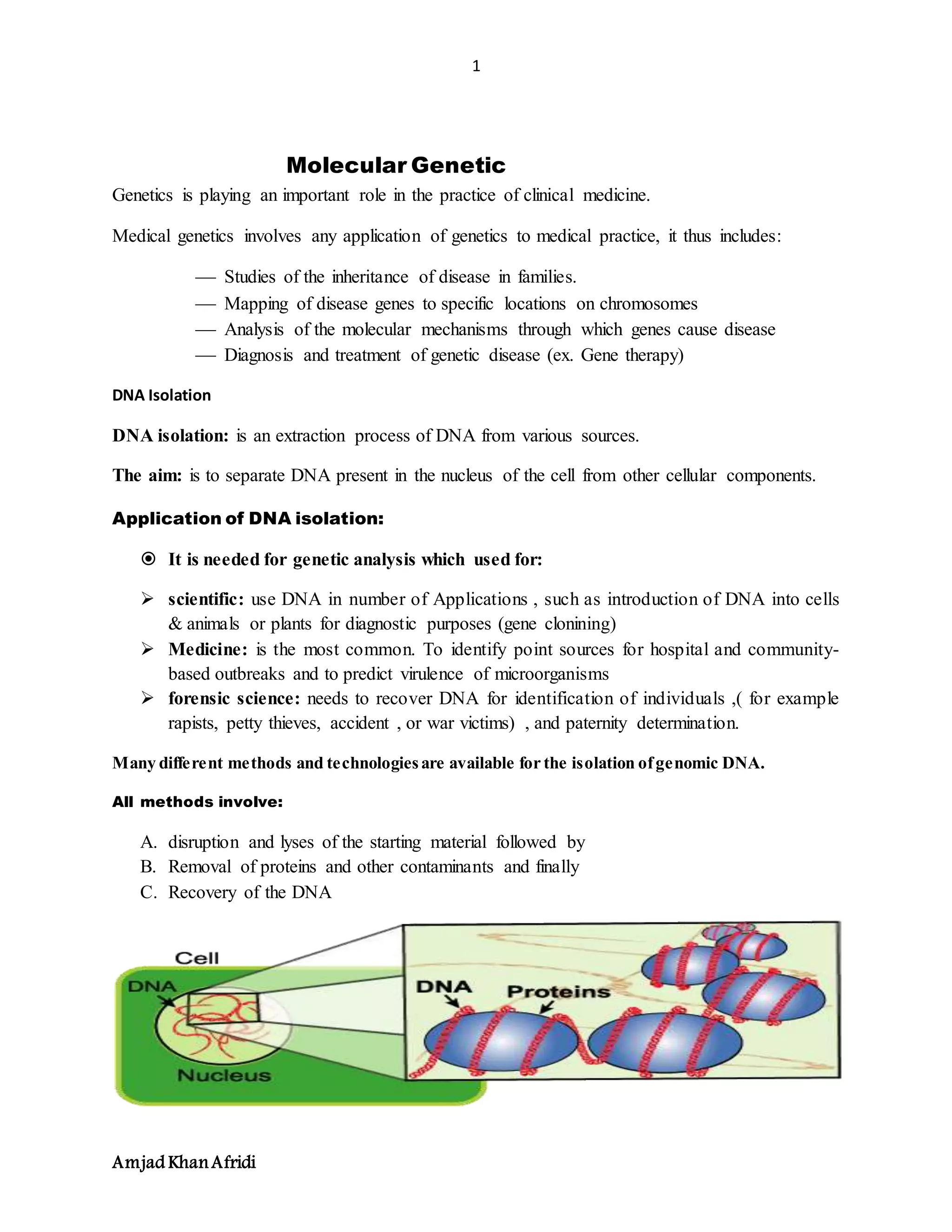
DNA isolation: is an extraction process of DNA from various sources.
The aim: is to separate DNA present in the nucleus of the cell from other cellular components.
Application of DNA isolation:
 It is needed for genetic analysis which used for:
 scientific: use DNA in number of Applications , such as introduction of DNA into cells
& animals or plants for diagnostic purposes (gene clonining)
 Medicine: is the most common. To identify point sources for hospital and community-
based outbreaks and to predict virulence of microorganisms
 forensic science: needs to recover DNA for identification of individuals ,( for example
rapists, petty thieves, accident , or war victims) , and paternity determination.
Many different methods and technologiesare available for the isolation ofgenomic DNA.
All methods involve:
A. disruption and lyses of the starting material followed by
B. Removal of proteins and other contaminants and finally
C. Recovery of the DNA
2
Amjad KhanAfridi
To choice of a method depends on many factors:
A. The quantity and molecular weight of the DNA
B. The purity reqired for application
C. The time and expense
Sample Collection
A- Source:Sample canbe isolatedfromanylivingordeadorganism
Common sources for DNA isolation include:
 Whole blood
 Buffycoat
 Bone material
 Buccal cells
 Culturedcells
 Amniocytesoramnioticfluid
 Sputum,urine,CSF,orotherbodyfluids
B. Sample age:
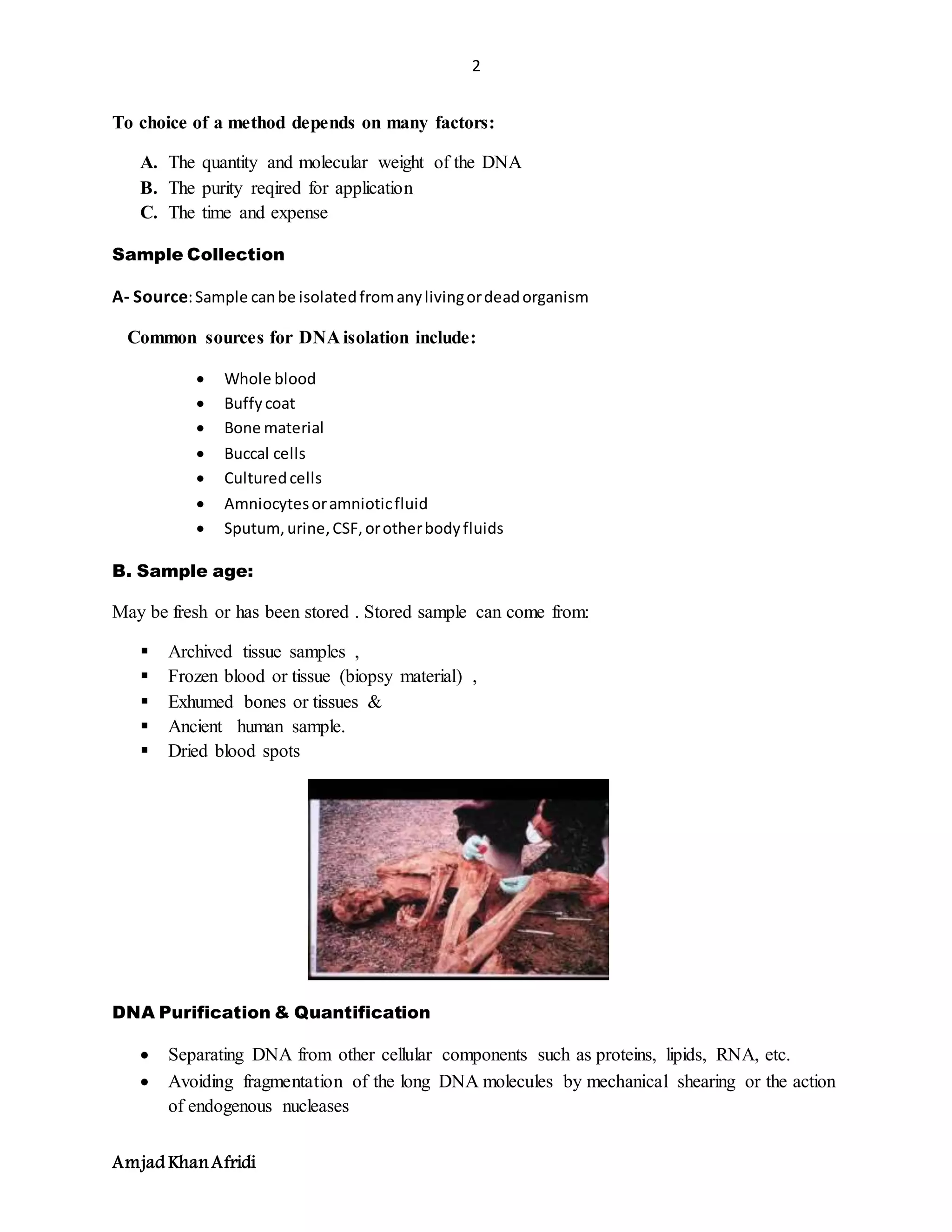
May be fresh or has been stored . Stored sample can come from:
 Archived tissue samples ,
 Frozen blood or tissue (biopsy material) ,
 Exhumed bones or tissues &
 Ancient human sample.
 Dried blood spots
DNA Purification & Quantification
 Separating DNA from other cellular components such as proteins, lipids, RNA, etc.
 Avoiding fragmentation of the long DNA molecules by mechanical shearing or the action
of endogenous nucleases
3
Amjad KhanAfridi
 Effectively inactivating endogenous nucleases (DNase enzymes) and preventing them
from digesting the genomic DNA is a key early step in the purification process. DNases
can usually be inactivated by use of heat or chelating agents.
Extraction of DNA
Key Steps
 Lysis of the cells
 Removal of contaminants includes
 Proteins
 RNA
 Other macromolecules
 Concentration of purified DNA
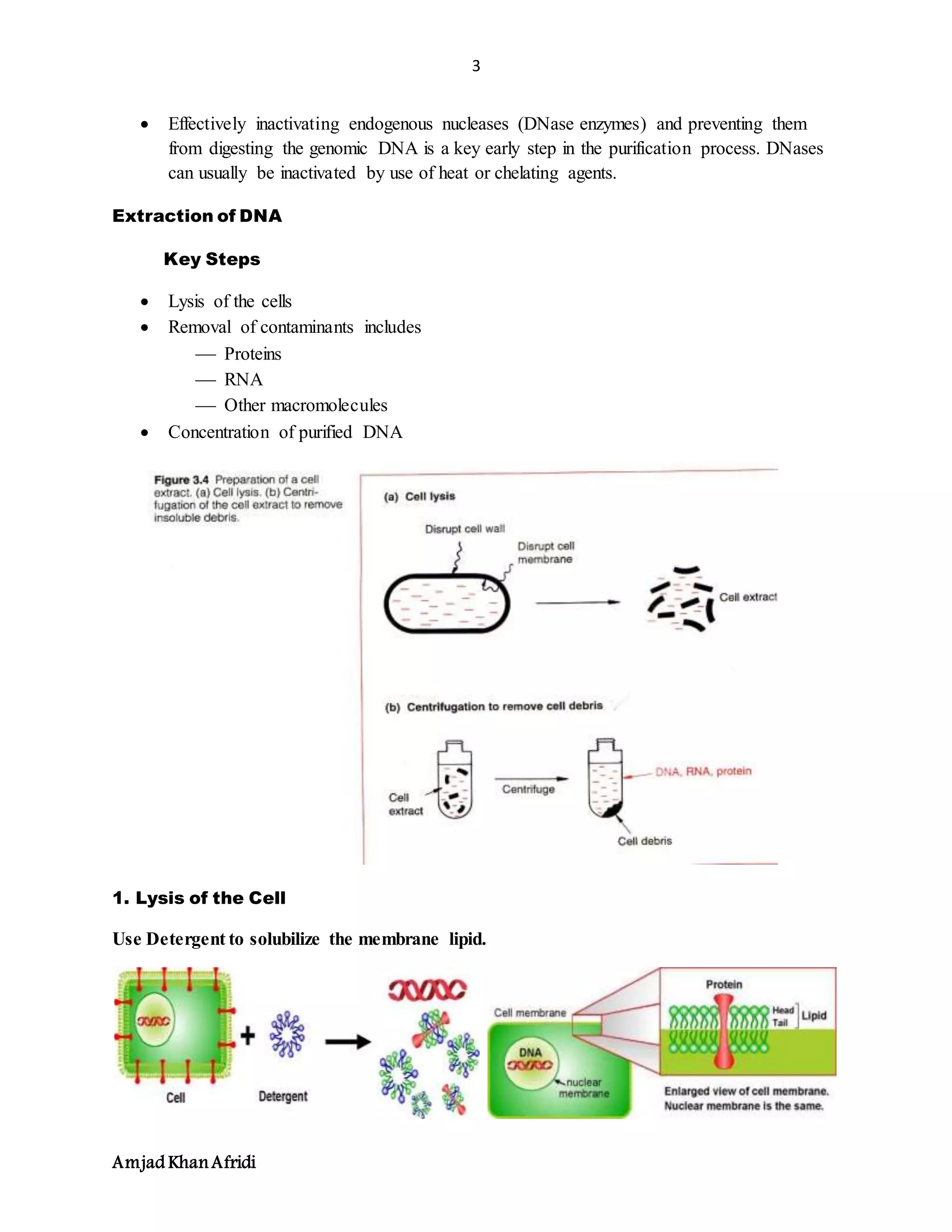
1. Lysis of the Cell
Use Detergent to solubilize the membrane lipid.
4
Amjad KhanAfridi
2. Separate DNA From Crude Lysate
 DNA must be separated from proteins and cellular debris.
Separation Methods
a) Organic extraction
b) Salting out
a) Separation by Organic Extraction
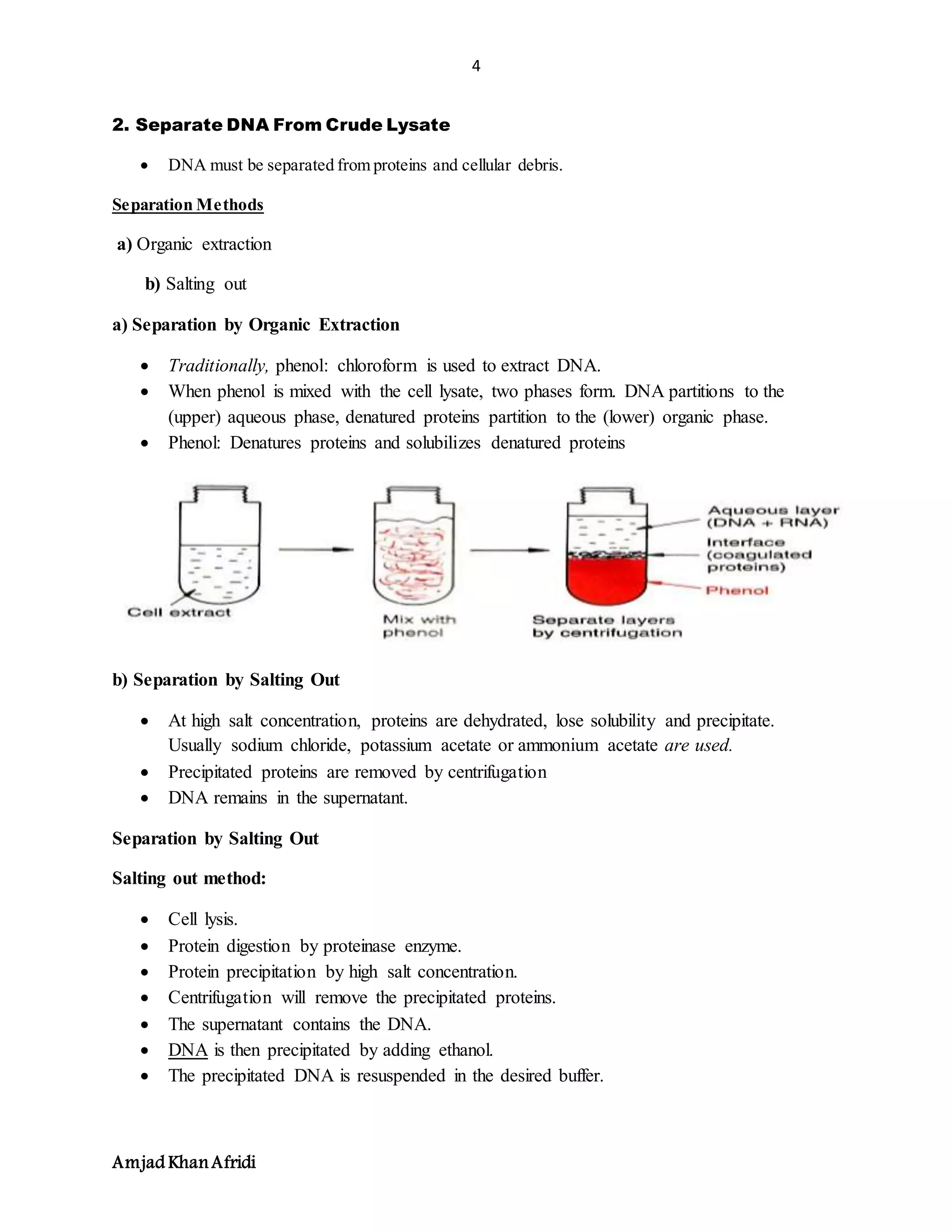
 Traditionally, phenol: chloroform is used to extract DNA.
 When phenol is mixed with the cell lysate, two phases form. DNA partitions to the
(upper) aqueous phase, denatured proteins partition to the (lower) organic phase.
 Phenol: Denatures proteins and solubilizes denatured proteins
b) Separation by Salting Out
 At high salt concentration, proteins are dehydrated, lose solubility and precipitate.
Usually sodium chloride, potassium acetate or ammonium acetate are used.
 Precipitated proteins are removed by centrifugation
 DNA remains in the supernatant.
Separation by Salting Out
Salting out method:
 Cell lysis.
 Protein digestion by proteinase enzyme.
 Protein precipitation by high salt concentration.
 Centrifugation will remove the precipitated proteins.
 The supernatant contains the DNA.
 DNA is then precipitated by adding ethanol.
 The precipitated DNA is resuspended in the desired buffer.
5
Amjad KhanAfridi
Ethanol precipitation:
 Precipitation of DNA: Absolute Ethanol is layered on the top of concentrated
solution of DNA
 Fibers of DNA can be withdrawn with a glass rod
 Washing of DNA
 Desalt DNA: Most salts are soluble in 70% ethanol
2- Use of Commercial DNA purification kits:
 The common lysissolutionscontain
A. sodium chloride
B. Trimethamine (also known as tris ) , which is a buffer to retain constant pH
C. Ethylendiaminetetraacetic (EDTA) , which binds metal ions
D. Sodium dodecyl sulfate (SDS) which is a detergent .
E. An enzyme used in DNA extraction is protienase K
3- Heat denaturation
Achieved by boiling samples.
Heating of a sample to 100 c releases DNA into the solution but also denatures it by separating
the two strand.
Drawbacks: There are remaining inhibitors in the form of degraded proteins and other organic
compound or ions .
6
Amjad KhanAfridi
4- Magnetic beads with DNA binding capacity
 Magnetic beads are coated with DNA antibodies or silica to bind to DNA.
 Samples are lyses & and then treated with proteinase K.
 The lysates are then applied to the beads.
 Resin is subsequently washed & DNA is eluted of it at 65c
 Magnetic beads are separated from the sample on a magnetic stand.
Summary of DNA extraction :
There are three basic & two optional steps in a DNA extraction :
1. Cell lysis , to expose the DNA within .
2. removing membrane lipids by adding a detergents or surfactants .
3. removing proteins by adding a protease .
4. removing RNA by adding an Rnase.
5. precipitating the DNA with alcohol- usually ice cold ethanol. In these alcohols , DNA
strand will aggregate together, giving a pellet upon centrifugation . This step also
removes alcohol- soluble salt.
DNA Extraction & Purification:
Evaluation
 DNA concentration can be determined by measuring the intensity of absorbance with a
spectrophotometers & comparing to a standard curve of known DNA concentration.
 Measuring the intensity of absorbance of the DNA solution at wavelength 260nm &
280nm is used as a measure of DNA purity
 DNA purity: A260/A280 ratio: 1.7 – 1.9
 DNA concentration (μg/ml): A260 X 50
 DNA yield:
DNA conc. X Total volume of DNA solution
Spectrophotometers
7
Amjad KhanAfridi
MeasurementofDNA purity
Checkingfor Degradation DNA
 Running your sample through an agarose gel is a common method for examining the
extent of DNA degradation. Good quality DNA should migrate as a high molecular
weight band, with little or no evidence of smearing.
 DNA absorbs UV light at 260 &280 nm & aromatic proteins absorb UV light at 280 nm
Apure sample of DNA has the 260/280 ratio at 1.8 & is relatively free from protein
contamination.
A DNA preparation that is contaminated with protein will have a 260/280 ratio lower than 1.8
Agarose gel
Gell Electrophoresis
8
Amjad KhanAfridi
Vertical electrophoresis
Gell Electrophoresis

How to Isolated DNA

  • 1.
    1 Amjad KhanAfridi Molecular Genetic Geneticsis playing an important role in the practice of clinical medicine. Medical genetics involves any application of genetics to medical practice, it thus includes:  Studies of the inheritance of disease in families.  Mapping of disease genes to specific locations on chromosomes  Analysis of the molecular mechanisms through which genes cause disease  Diagnosis and treatment of genetic disease (ex. Gene therapy) DNA Isolation DNA isolation: is an extraction process of DNA from various sources. The aim: is to separate DNA present in the nucleus of the cell from other cellular components. Application of DNA isolation:  It is needed for genetic analysis which used for:  scientific: use DNA in number of Applications , such as introduction of DNA into cells & animals or plants for diagnostic purposes (gene clonining)  Medicine: is the most common. To identify point sources for hospital and community- based outbreaks and to predict virulence of microorganisms  forensic science: needs to recover DNA for identification of individuals ,( for example rapists, petty thieves, accident , or war victims) , and paternity determination. Many different methods and technologiesare available for the isolation ofgenomic DNA. All methods involve: A. disruption and lyses of the starting material followed by B. Removal of proteins and other contaminants and finally C. Recovery of the DNA
  • 2.
    2 Amjad KhanAfridi To choiceof a method depends on many factors: A. The quantity and molecular weight of the DNA B. The purity reqired for application C. The time and expense Sample Collection A- Source:Sample canbe isolatedfromanylivingordeadorganism Common sources for DNA isolation include:  Whole blood  Buffycoat  Bone material  Buccal cells  Culturedcells  Amniocytesoramnioticfluid  Sputum,urine,CSF,orotherbodyfluids B. Sample age: May be fresh or has been stored . Stored sample can come from:  Archived tissue samples ,  Frozen blood or tissue (biopsy material) ,  Exhumed bones or tissues &  Ancient human sample.  Dried blood spots DNA Purification & Quantification  Separating DNA from other cellular components such as proteins, lipids, RNA, etc.  Avoiding fragmentation of the long DNA molecules by mechanical shearing or the action of endogenous nucleases
  • 3.
    3 Amjad KhanAfridi  Effectivelyinactivating endogenous nucleases (DNase enzymes) and preventing them from digesting the genomic DNA is a key early step in the purification process. DNases can usually be inactivated by use of heat or chelating agents. Extraction of DNA Key Steps  Lysis of the cells  Removal of contaminants includes  Proteins  RNA  Other macromolecules  Concentration of purified DNA 1. Lysis of the Cell Use Detergent to solubilize the membrane lipid.
  • 4.
    4 Amjad KhanAfridi 2. SeparateDNA From Crude Lysate  DNA must be separated from proteins and cellular debris. Separation Methods a) Organic extraction b) Salting out a) Separation by Organic Extraction  Traditionally, phenol: chloroform is used to extract DNA.  When phenol is mixed with the cell lysate, two phases form. DNA partitions to the (upper) aqueous phase, denatured proteins partition to the (lower) organic phase.  Phenol: Denatures proteins and solubilizes denatured proteins b) Separation by Salting Out  At high salt concentration, proteins are dehydrated, lose solubility and precipitate. Usually sodium chloride, potassium acetate or ammonium acetate are used.  Precipitated proteins are removed by centrifugation  DNA remains in the supernatant. Separation by Salting Out Salting out method:  Cell lysis.  Protein digestion by proteinase enzyme.  Protein precipitation by high salt concentration.  Centrifugation will remove the precipitated proteins.  The supernatant contains the DNA.  DNA is then precipitated by adding ethanol.  The precipitated DNA is resuspended in the desired buffer.
  • 5.
    5 Amjad KhanAfridi Ethanol precipitation: Precipitation of DNA: Absolute Ethanol is layered on the top of concentrated solution of DNA  Fibers of DNA can be withdrawn with a glass rod  Washing of DNA  Desalt DNA: Most salts are soluble in 70% ethanol 2- Use of Commercial DNA purification kits:  The common lysissolutionscontain A. sodium chloride B. Trimethamine (also known as tris ) , which is a buffer to retain constant pH C. Ethylendiaminetetraacetic (EDTA) , which binds metal ions D. Sodium dodecyl sulfate (SDS) which is a detergent . E. An enzyme used in DNA extraction is protienase K 3- Heat denaturation Achieved by boiling samples. Heating of a sample to 100 c releases DNA into the solution but also denatures it by separating the two strand. Drawbacks: There are remaining inhibitors in the form of degraded proteins and other organic compound or ions .
  • 6.
    6 Amjad KhanAfridi 4- Magneticbeads with DNA binding capacity  Magnetic beads are coated with DNA antibodies or silica to bind to DNA.  Samples are lyses & and then treated with proteinase K.  The lysates are then applied to the beads.  Resin is subsequently washed & DNA is eluted of it at 65c  Magnetic beads are separated from the sample on a magnetic stand. Summary of DNA extraction : There are three basic & two optional steps in a DNA extraction : 1. Cell lysis , to expose the DNA within . 2. removing membrane lipids by adding a detergents or surfactants . 3. removing proteins by adding a protease . 4. removing RNA by adding an Rnase. 5. precipitating the DNA with alcohol- usually ice cold ethanol. In these alcohols , DNA strand will aggregate together, giving a pellet upon centrifugation . This step also removes alcohol- soluble salt. DNA Extraction & Purification: Evaluation  DNA concentration can be determined by measuring the intensity of absorbance with a spectrophotometers & comparing to a standard curve of known DNA concentration.  Measuring the intensity of absorbance of the DNA solution at wavelength 260nm & 280nm is used as a measure of DNA purity  DNA purity: A260/A280 ratio: 1.7 – 1.9  DNA concentration (μg/ml): A260 X 50  DNA yield: DNA conc. X Total volume of DNA solution Spectrophotometers
  • 7.
    7 Amjad KhanAfridi MeasurementofDNA purity CheckingforDegradation DNA  Running your sample through an agarose gel is a common method for examining the extent of DNA degradation. Good quality DNA should migrate as a high molecular weight band, with little or no evidence of smearing.  DNA absorbs UV light at 260 &280 nm & aromatic proteins absorb UV light at 280 nm Apure sample of DNA has the 260/280 ratio at 1.8 & is relatively free from protein contamination. A DNA preparation that is contaminated with protein will have a 260/280 ratio lower than 1.8 Agarose gel Gell Electrophoresis
  • 8.