Epidemiology of hepatitis B Prevalence in Thailand 8%  Has been classified to be an intermediate endemic country  for HBV infection
Transmission of hepatitis B Vertical transmission Sexual transmission Blood: IDU, blood transfusion Household contact
Viral Hepatitis B DNA virus Hepatitis B antigens Hepatitis B DNA: indicate viral load HBV DNA polymerase (DNAp): indicate disease progression Hepatitis B core protein (HBcAg): can be detected from liver Bx Hepatitis B surface protein (HBsAg): appear1-6 wks before symptom HBe protein (HbeAg): indicate actively producing virus Hepatitis B antibodies Anti-HBC: first detected Ab, appear around 8 weeks after infection HBeAb: appear a few weeks after HBeAg  no longer detectable HBsAb: the last antibodies to appear, Can neutralise the virus,  so provide protection against HBV. HBV morphology
Clinical manifestation IP  50-150  days Acute hepatitis:  10%  in children.  30-40%  in adult   : Flu-like symptom to fulminant hepatitis Chronic hepatitis:   70-90%  of infants   infected at age <  1 yr   10-40%  of children infected at  4-6  yrs   6-10%  of children infected after age  7  yrs
Serological marker of acute  and resolved hepatitis B Serological marker of  chronic hepatitis B
Interpretation of hepatitis B Serology Test Result Interpretation HBsAg Negative  Anti-HBc Negative Susceptible Anti-HBs Negative HBsAg Negative Anti-HBc Negative Immune due to natural infection Anti-HBs Positive HBs-Ag Positive Anti-HBc Positive Acutely infected IgM anti-HBc Positive Anti-HBs Negative HBs-Ag Positive Anti-HBc Positive Chronically infected IgM anti-HBc Negative Anti-HBs Negative HBs-Ag Negative   1.Might be recovering from acute infection Anti-HBc Positive   2.Might be distantly immune Anti-HBs Negative   3.False positive anti-HBc   4.Chronically infected with undertectable level of HBsAg
Natural history of chronic hepatitis B The course is highly variable, can be described by 3 phases 1.Immune tolerance phase: high level of virus in serum (HBeAg positive), minimal hepatic inflammation 2.Active phase: intermittent or continuous hepatitis of varying severity, seroconversion, anti-HBe positive may occur 3.Residual or inactive phase: low viral concentration with  minimal inflammatory activity
Liver Pathology There is a poor correlation between symptom or level of  liver enzyme and histologic features of the liver Liver Bx: Method Percutanious liver Bx Transjugular liver Bx Laparoscopic liver Bx Fine-needle aspiration Bx: accuracy  80-90%
Normal liver histology AHB with marked periportal bridging necrosis   CHB gradeIII necroinflammation  and intralobular necrosis   stage IV fibrosis
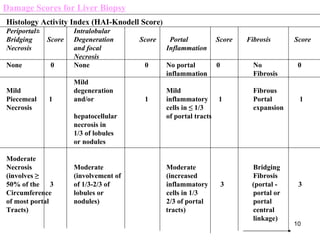
Damage Scores for Liver Biopsy Histology Activity Index (HAI-Knodell Score ) Periportal ±   Intralobular Bridging   Score   Degeneration   Score   Portal   Score  Fibrosis Score Necrosis   and focal Inflammation   Necrosis None   0   None   0 No portal  0   No    0 inflammation   Fibrosis     Mild Mild   degeneration Mild   Fibrous Piecemeal  1   and/or   1 inflammatory  1   Portal   1 Necrosis cells in ≤ 1/3   expansion   hepatocellular of portal tracts   necrosis in    1/3 of lobules   or nodules Moderate   Necrosis     Moderate Moderate   Bridging (involves ≥    (involvement of  (increased     Fibrosis   50% of the  3   of 1/3-2/3 of  inflammatory  3  (portal -  3 Circumference   lobules or  cells in 1/3   portal or  of most portal    nodules) 2/3 of portal   portal  Tracts)     tracts)   central    linkage)
Periportal ±   Intralobular Bridging    Score   Degeneration Score   Portal  Score  Fibrosis  Score Necrosis   and focal Inflammation   Necrosis Marked Marked Piecemeal   Marked (dense Necrosis   (involvement packing of (involves ≥  4   of ≥ 2/3 of   4 inflammatory  4   Cirrhosis   4 50% of the    lobules or cells in ≥ 2/3  circumference   nodules) of portal of most portal  tracts) tracts) Moderate piecemeal necrosis plus  5 bridging necrosis Marked piecemeal necrosis plus  6 bridging Necrosis Multilobular  10 necrosis
Prognosis of chronic hepatitis From a retrospective study in China in  183  chronic hepatitis B  age  31.75   ±  8.03  yrs follow up  11.8   ±   4  yrs Result :  12%  develop cirrhosis,  6.5%  HCC,  11%  dead ( compared with  2.43%  in control ) : The  5,10,15  yrs survival rate were  97.2%, 91.6%  and  84.4%  respectively : The  5, 10, 15  yrs incidence rate of HCC were  0,3.1%, 11.6%  respectively Conclusion : old age, severe histological injury, positive HBeAg, male, alcohol abuse, co-infection with HIV, HCV  and family Hx. are factors related to cirrhosis, HCC and death.
Treatment Indication:  1. Persistence of serum HBsAg  ≥   6  month   2. Active viral replication: HBeAg positive and/or HBV DNA >  105  copies/ml   3. Elevation of serum aminotransferase (SGPT) ≥   2  folds for  3  months or more    4. HAI score ≥  5  from liver biopsy Medication:     1. Alpha-interferon (IFN):  24-48   weeks:  HBe-seroconversion  40-60%   2. Nucleoside analogues: Lamivudine (Zeffix),   adefovir, dipivoxil, entecavir  1-5  yrs:   HBe-seroconversion  10-60%

Hepatitis B

  • 1.
    Epidemiology of hepatitisB Prevalence in Thailand 8% Has been classified to be an intermediate endemic country for HBV infection
  • 2.
    Transmission of hepatitisB Vertical transmission Sexual transmission Blood: IDU, blood transfusion Household contact
  • 3.
    Viral Hepatitis BDNA virus Hepatitis B antigens Hepatitis B DNA: indicate viral load HBV DNA polymerase (DNAp): indicate disease progression Hepatitis B core protein (HBcAg): can be detected from liver Bx Hepatitis B surface protein (HBsAg): appear1-6 wks before symptom HBe protein (HbeAg): indicate actively producing virus Hepatitis B antibodies Anti-HBC: first detected Ab, appear around 8 weeks after infection HBeAb: appear a few weeks after HBeAg no longer detectable HBsAb: the last antibodies to appear, Can neutralise the virus, so provide protection against HBV. HBV morphology
  • 4.
    Clinical manifestation IP 50-150 days Acute hepatitis: 10% in children. 30-40% in adult : Flu-like symptom to fulminant hepatitis Chronic hepatitis: 70-90% of infants infected at age < 1 yr 10-40% of children infected at 4-6 yrs 6-10% of children infected after age 7 yrs
  • 5.
    Serological marker ofacute and resolved hepatitis B Serological marker of chronic hepatitis B
  • 6.
    Interpretation of hepatitisB Serology Test Result Interpretation HBsAg Negative Anti-HBc Negative Susceptible Anti-HBs Negative HBsAg Negative Anti-HBc Negative Immune due to natural infection Anti-HBs Positive HBs-Ag Positive Anti-HBc Positive Acutely infected IgM anti-HBc Positive Anti-HBs Negative HBs-Ag Positive Anti-HBc Positive Chronically infected IgM anti-HBc Negative Anti-HBs Negative HBs-Ag Negative 1.Might be recovering from acute infection Anti-HBc Positive 2.Might be distantly immune Anti-HBs Negative 3.False positive anti-HBc 4.Chronically infected with undertectable level of HBsAg
  • 7.
    Natural history ofchronic hepatitis B The course is highly variable, can be described by 3 phases 1.Immune tolerance phase: high level of virus in serum (HBeAg positive), minimal hepatic inflammation 2.Active phase: intermittent or continuous hepatitis of varying severity, seroconversion, anti-HBe positive may occur 3.Residual or inactive phase: low viral concentration with minimal inflammatory activity
  • 8.
    Liver Pathology Thereis a poor correlation between symptom or level of liver enzyme and histologic features of the liver Liver Bx: Method Percutanious liver Bx Transjugular liver Bx Laparoscopic liver Bx Fine-needle aspiration Bx: accuracy 80-90%
  • 9.
    Normal liver histologyAHB with marked periportal bridging necrosis CHB gradeIII necroinflammation and intralobular necrosis stage IV fibrosis
  • 10.
    Damage Scores forLiver Biopsy Histology Activity Index (HAI-Knodell Score ) Periportal ± Intralobular Bridging Score Degeneration Score Portal Score Fibrosis Score Necrosis and focal Inflammation Necrosis None 0 None 0 No portal 0 No 0 inflammation Fibrosis Mild Mild degeneration Mild Fibrous Piecemeal 1 and/or 1 inflammatory 1 Portal 1 Necrosis cells in ≤ 1/3 expansion hepatocellular of portal tracts necrosis in 1/3 of lobules or nodules Moderate Necrosis Moderate Moderate Bridging (involves ≥ (involvement of (increased Fibrosis 50% of the 3 of 1/3-2/3 of inflammatory 3 (portal - 3 Circumference lobules or cells in 1/3 portal or of most portal nodules) 2/3 of portal portal Tracts) tracts) central linkage)
  • 11.
    Periportal ± Intralobular Bridging Score Degeneration Score Portal Score Fibrosis Score Necrosis and focal Inflammation Necrosis Marked Marked Piecemeal Marked (dense Necrosis (involvement packing of (involves ≥ 4 of ≥ 2/3 of 4 inflammatory 4 Cirrhosis 4 50% of the lobules or cells in ≥ 2/3 circumference nodules) of portal of most portal tracts) tracts) Moderate piecemeal necrosis plus 5 bridging necrosis Marked piecemeal necrosis plus 6 bridging Necrosis Multilobular 10 necrosis
  • 12.
    Prognosis of chronichepatitis From a retrospective study in China in 183 chronic hepatitis B age 31.75 ± 8.03 yrs follow up 11.8 ± 4 yrs Result : 12% develop cirrhosis, 6.5% HCC, 11% dead ( compared with 2.43% in control ) : The 5,10,15 yrs survival rate were 97.2%, 91.6% and 84.4% respectively : The 5, 10, 15 yrs incidence rate of HCC were 0,3.1%, 11.6% respectively Conclusion : old age, severe histological injury, positive HBeAg, male, alcohol abuse, co-infection with HIV, HCV and family Hx. are factors related to cirrhosis, HCC and death.
  • 13.
    Treatment Indication: 1. Persistence of serum HBsAg ≥ 6 month 2. Active viral replication: HBeAg positive and/or HBV DNA > 105 copies/ml 3. Elevation of serum aminotransferase (SGPT) ≥ 2 folds for 3 months or more 4. HAI score ≥ 5 from liver biopsy Medication: 1. Alpha-interferon (IFN): 24-48 weeks: HBe-seroconversion 40-60% 2. Nucleoside analogues: Lamivudine (Zeffix), adefovir, dipivoxil, entecavir 1-5 yrs: HBe-seroconversion 10-60%