Laboratory Diagnosis of
Hemoglobinopathies andThalassemia by
HPLC
HEMOGLOBIN molecule is a tetramer made up of two pairs
polypepetide chains, with each chain Having a iron containig
heme group attached.
Polypeptide chains are of chemically different.Various globin
chain differ in both number and sequence of amino acids and
their synthesis by different genes.
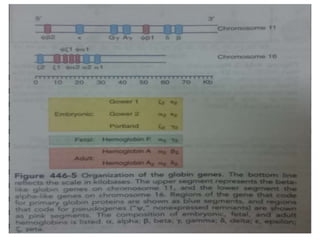
On chomosone no. 16, 2 sets of gene for alfa chains and zeta
chains are located and genes for beta , gama , epsilon and delta
globin chains Are located on chromosome 11.
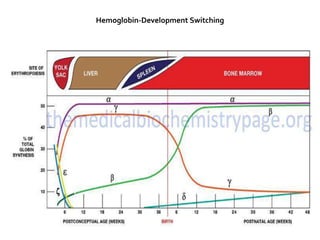
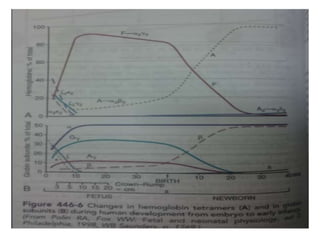
Within the red blood cells of an embryo, fetus, child and adult 6
different hemoglobins are detected:
embryonic Hbs: Gower 1(zeta 2 and epsilon 2 )and gower 2 ( alfa
2 and epsilon 2)and Portland (zeta 2 and gama 2). Gower Hb are
predominate in 4 to 8 weeks of gestation and portland Hb
predominate in 3rd month of gestation.
Fetal Hb: HbF ( alfa 2 and gama 2). After 8th week of gestation it
predominates and @ 24 week of gestation it constitutes 90% of
total Hb. During third trimester a gradual decline occurs so that @
birth HbF is 70% of total Hb and only trace is present @ 6 to 12
months of age.
Adult Hbs: HbA (alfa 2 and beta 2) and HbA2 (alfa 2 and delta 2).
@24th of gestation HbA is 5 to 10% and @ birth 30% of total Hb.
After 6 to 12 months of life normal adult pattern apppears. HbA2
is <1% @ birth and 2 to 3.4% @ 12 months of age.
Hemoglobin-Development Switching
Abnormalities in protein part of hemoglobin are reffered to as
Hemoglobinopathies, which include: Sickle cell anaemia(Hb SS),
Sickle cellTrait (Hb AS) , Hb C, Hb D, Hb E, Hb M, HPFH,
Thalassemia syndromes and so many(>800Variants of Hb.).
Most of which can be diagnosed by HPLC.
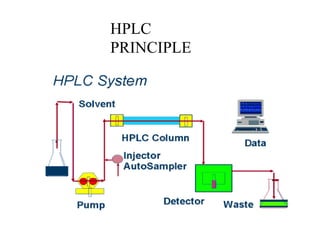
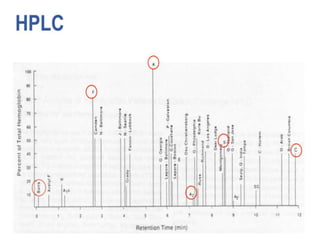
High-Pressure Liquid Chromatography
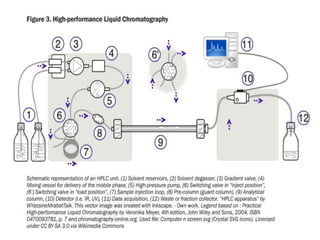
Hemoglobins are separated by an analytical cartridge(negetively
charged silica) in cation exchange HPLC using a preprogrammed
buffer(Na+ and K+ ions) gradient with increasing ionic strength to
the cartridge (Figure 3).
The hemoglobin fractions separate based on their ionic interaction
with the cartridge.
The separated fractions pass through a flow cell, where absorbance
is measured at 415 nm and again at 690 nm to reduce background
noise.
Changes in absorbance are monitored over time producing a
chromatogram (absorbance vs. time).
Each hemoglobin has its own characteristic retention time and is
measured from the time of sample injection into the HPLC to the
maximum point of each peak
Identification of unknown hemoglobin is achieved through
comparison with known hemoglobin retention times. If a peak
elutes at a retention time not predetermined, it is labeled as an
unknown.
HPLC achieves good separation and quantitation of HbF and HbA2
in addition to screening for variant hemoglobins along with
thalassemia. Chromatography of each sample is completed in 6
min.
HPLC is highly reproducible, offers simplicity with automation,
superior resolution and rapid results. Some HPLC instrument
programs can identify hemoglobinopathies from both newborns
and adult specimens while others identify only one or the other.
Identification between adult and newborn specimens depends on
the algorithm/software/instrument specifications.
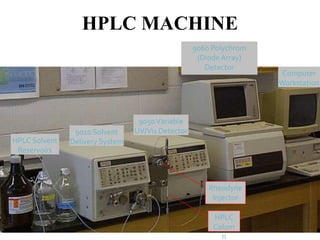
9050Variable
UV/Vis Detector
9010 Solvent
Delivery System
HPLC Solvent
Reservoirs
Rheodyne
Injector
HPLC
Colum
n
9060 Polychrom
(Diode Array)
Detector
Computer
Workstation
HPLC MACHINE
HPLC
PRINCIPLE
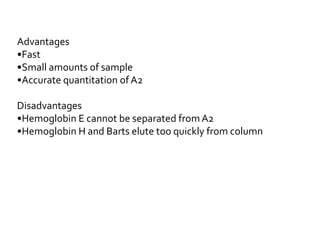
Advantages
•Fast
•Small amounts of sample
•Accurate quantitation of A2
Disadvantages
•Hemoglobin E cannot be separated fromA2
•Hemoglobin H and Barts elute too quickly from column
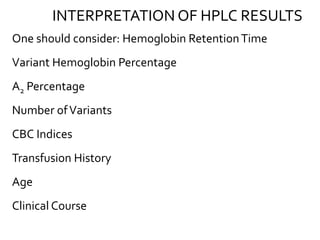
INTERPRETATION OF HPLC RESULTS
One should consider: Hemoglobin RetentionTime
Variant Hemoglobin Percentage
A2 Percentage
Number ofVariants
CBC Indices
Transfusion History
Age
Clinical Course
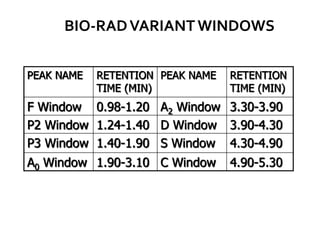
BIO-RADVARIANT WINDOWS
PEAK NAME RETENTION
TIME (MIN)
PEAK NAME RETENTION
TIME (MIN)
F Window 0.98-1.20 A2 Window 3.30-3.90
P2 Window 1.24-1.40 D Window 3.90-4.30
P3 Window 1.40-1.90 S Window 4.30-4.90
A0 Window 1.90-3.10 C Window 4.90-5.30
Various Hemoglobinopathies
and HPLC reports
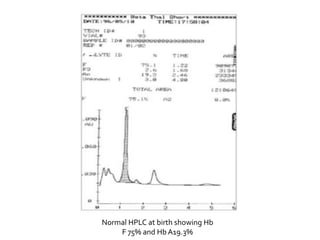
Normal HPLC at birth showing Hb
F 75% and Hb A19.3%
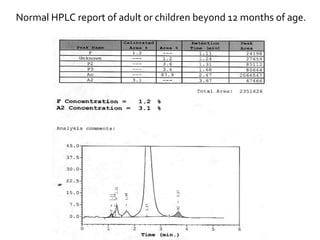
Normal HPLC report of adult or children beyond 12 months of age.
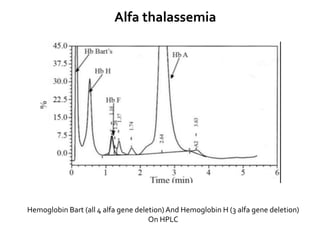
Alfa thalassemia
Hemoglobin Bart (all 4 alfa gene deletion) And Hemoglobin H (3 alfa gene deletion)
On HPLC
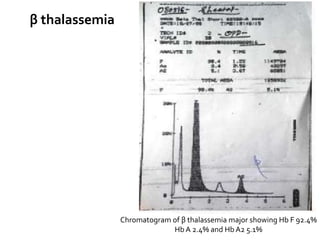
Chromatogram of β thalassemia major showing Hb F 92.4%
Hb A 2.4% and Hb A2 5.1%
β thalassemia
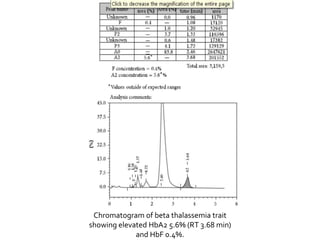
Chromatogram of beta thalassemia trait
showing elevated HbA2 5.6% (RT 3.68 min)
and HbF 0.4%.
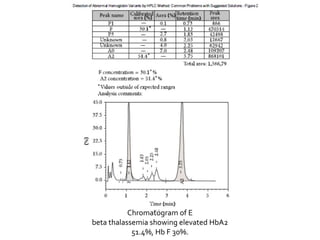
Chromatogram of E
beta thalassemia showing elevated HbA2
51.4%, Hb F 30%.
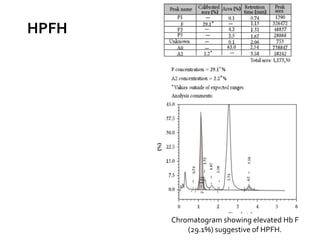
Chromatogram showing elevated Hb F
(29.1%) suggestive of HPFH.
HPFH
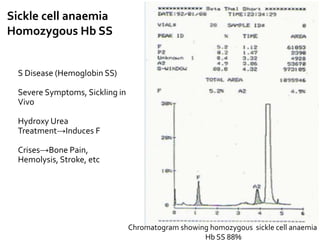
Chromatogram showing homozygous sickle cell anaemia
Hb SS 88%
Sickle cell anaemia
Homozygous Hb SS
S Disease (Hemoglobin SS)
Severe Symptoms, Sickling in
Vivo
Hydroxy Urea
Treatment→Induces F
Crises→Bone Pain,
Hemolysis, Stroke, etc
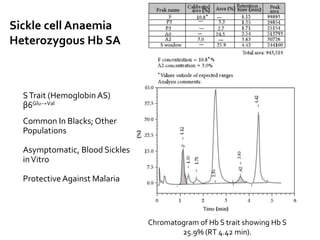
Chromatogram of Hb S trait showing Hb S
25.9% (RT 4.42 min).
Sickle cell Anaemia
Heterozygous Hb SA
STrait (Hemoglobin AS)
β6Glu→Val
Common In Blacks; Other
Populations
Asymptomatic, Blood Sickles
inVitro
Protective Against Malaria
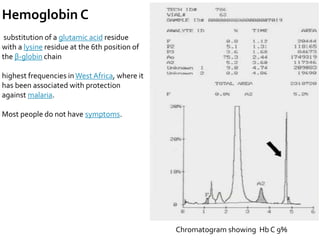
Chromatogram showing Hb C 9%
Hemoglobin C
substitution of a glutamic acid residue
with a lysine residue at the 6th position of
the β-globin chain
highest frequencies inWest Africa, where it
has been associated with protection
against malaria.
Most people do not have symptoms.
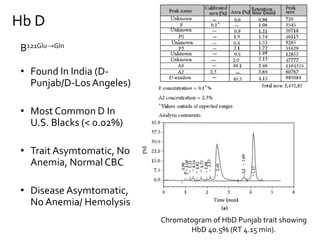
Chromatogram of HbD Punjab trait showing
HbD 40.5% (RT 4.15 min).
Β121Glu→Gln
• Found In India (D-
Punjab/D-Los Angeles)
• Most Common D In
U.S. Blacks (< 0.02%)
• Trait Asymtomatic, No
Anemia, Normal CBC
• Disease Asymtomatic,
No Anemia/ Hemolysis
Hb D
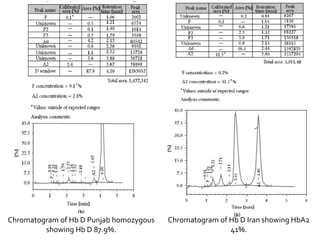
Chromatogram of Hb D Punjab homozygous
showing Hb D 87.9%.
Chromatogram of Hb D Iran showing HbA2
41%.
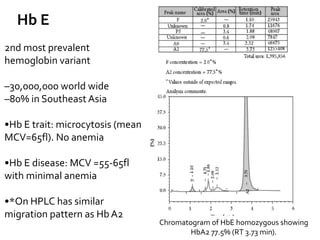
Chromatogram of HbE homozygous showing
HbA2 77.5% (RT 3.73 min).
Hb E
2nd most prevalent
hemoglobin variant
–30,000,000 world wide
–80% in Southeast Asia
•Hb E trait: microcytosis (mean
MCV=65fl). No anemia
•Hb E disease: MCV =55-65fl
with minimal anemia
•*On HPLC has similar
migration pattern as HbA2
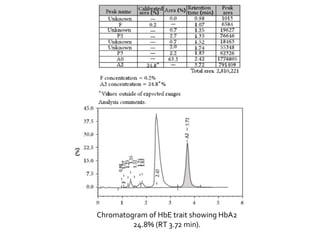
Chromatogram of HbE trait showing HbA2
24.8% (RT 3.72 min).
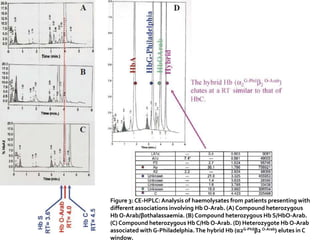
Figure 3: CE-HPLC: Analysis of haemolysates from patients
presenting with different associations involving Hb O-Arab.
(A) Compound heterozygous Hb O-Arab/β0thalassaemia.
(B) Compound heterozygous Hb S/HbO-Arab. (C) Compound
heterozygous Hb C/Hb O-Arab. (D) Heterozygote Hb O-Arab
associated with G-Philadelphia.The hybrid Hb (α2G-Philβ2 O-
Arab) elutes in C window.
Figure 3: CE-HPLC: Analysis of haemolysates from patients presenting with
different associations involving Hb O-Arab. (A) Compound heterozygous
Hb O-Arab/β0thalassaemia. (B) Compound heterozygous Hb S/HbO-Arab.
(C) Compound heterozygous Hb C/Hb O-Arab. (D) Heterozygote Hb O-Arab
associated with G-Philadelphia.The hybrid Hb (α2G-Philβ2 O-Arab) elutes in C
window.
Hemoglobin S/O(Arab)is a rare compound heterozygous
hemoglobinopathy characterized by the presence of two variant
beta-globin chains: beta6Glu -->Val (Hb S) and beta121Glu --> Lys
(Hb O(Arab)).
Hb S/O(Arab) disease is a severe sickling hemoglobinopathy with
laboratory and clinical manifestations similar to those of
homozygous sickle cell anemia.
Hemoglobin G-Philadelphia is a stable, normally-
functioning oxygen carrier. G-Philadelphia trait (1 mutated
gene) is completely silent. HomozygousG-Philadelphia (2
mutated genes) is rare and, depending on the origin of the
mutation and the coinheritance of other alpha thalassemic
mutations, produces a spectrum of effects from mild
microcytosis to full blown H disease in very rare cases .
Most patients without additional thalassemias adapt well to
persistent borderline anemia. Significant hemolysis and/or
anemia or microcytosis with hemoglobin G-Philadelphia
trait should prompt further investigations for the coinheritance
of a thalassemia or sickle hemoglobin
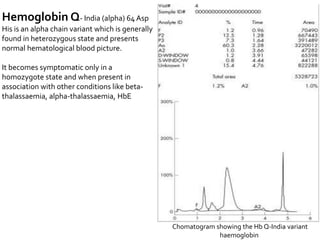
Chomatogram showing the Hb Q-India variant
haemoglobin
Hemoglobin Q- India (alpha) 64 Asp
His is an alpha chain variant which is generally
found in heterozygous state and presents
normal hematological blood picture.
It becomes symptomatic only in a
homozygote state and when present in
association with other conditions like beta-
thalassaemia, alpha-thalassaemia, HbE
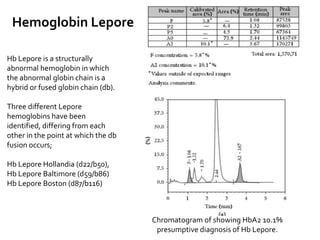
Chromatogram of showing HbA2 10.1%
presumptive diagnosis of Hb Lepore.
Hemoglobin Lepore
Hb Lepore is a structurally
abnormal hemoglobin in which
the abnormal globin chain is a
hybrid or fused globin chain (db).
Three different Lepore
hemoglobins have been
identified, differing from each
other in the point at which the db
fusion occurs;
Hb Lepore Hollandia (d22/b50),
Hb Lepore Baltimore (d59/b86)
Hb Lepore Boston (d87/b116)
Chromatogram of Hb Hope showing elevated
P2 peak (48.4%).
Hb Hopeis a clinically asymptomatic
β- chain variant [beta136 (H14) Gly→Asp
(GGT→GAT)].
It is more prevalent in Mediterranean region of
the world than in Asian countries and
extremely rare in India.
Causes Spuriously Elevated HbA1cValues on
HPLC Assay.
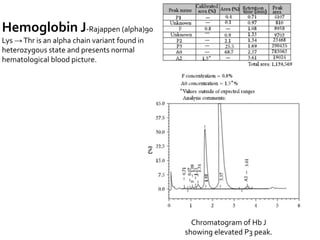
Chromatogram of Hb J
showing elevated P3 peak.
Hemoglobin J-Rajappen (alpha)90
Lys →Thr is an alpha chain variant found in
heterozygous state and presents normal
hematological blood picture.

thalassemia

  • 1.
  • 2.
    HEMOGLOBIN molecule isa tetramer made up of two pairs polypepetide chains, with each chain Having a iron containig heme group attached. Polypeptide chains are of chemically different.Various globin chain differ in both number and sequence of amino acids and their synthesis by different genes. On chomosone no. 16, 2 sets of gene for alfa chains and zeta chains are located and genes for beta , gama , epsilon and delta globin chains Are located on chromosome 11.
  • 4.
    Within the redblood cells of an embryo, fetus, child and adult 6 different hemoglobins are detected: embryonic Hbs: Gower 1(zeta 2 and epsilon 2 )and gower 2 ( alfa 2 and epsilon 2)and Portland (zeta 2 and gama 2). Gower Hb are predominate in 4 to 8 weeks of gestation and portland Hb predominate in 3rd month of gestation. Fetal Hb: HbF ( alfa 2 and gama 2). After 8th week of gestation it predominates and @ 24 week of gestation it constitutes 90% of total Hb. During third trimester a gradual decline occurs so that @ birth HbF is 70% of total Hb and only trace is present @ 6 to 12 months of age. Adult Hbs: HbA (alfa 2 and beta 2) and HbA2 (alfa 2 and delta 2). @24th of gestation HbA is 5 to 10% and @ birth 30% of total Hb. After 6 to 12 months of life normal adult pattern apppears. HbA2 is <1% @ birth and 2 to 3.4% @ 12 months of age.
  • 5.
  • 7.
    Abnormalities in proteinpart of hemoglobin are reffered to as Hemoglobinopathies, which include: Sickle cell anaemia(Hb SS), Sickle cellTrait (Hb AS) , Hb C, Hb D, Hb E, Hb M, HPFH, Thalassemia syndromes and so many(>800Variants of Hb.). Most of which can be diagnosed by HPLC.
  • 8.
  • 9.
    Hemoglobins are separatedby an analytical cartridge(negetively charged silica) in cation exchange HPLC using a preprogrammed buffer(Na+ and K+ ions) gradient with increasing ionic strength to the cartridge (Figure 3). The hemoglobin fractions separate based on their ionic interaction with the cartridge. The separated fractions pass through a flow cell, where absorbance is measured at 415 nm and again at 690 nm to reduce background noise. Changes in absorbance are monitored over time producing a chromatogram (absorbance vs. time). Each hemoglobin has its own characteristic retention time and is measured from the time of sample injection into the HPLC to the maximum point of each peak
  • 10.
    Identification of unknownhemoglobin is achieved through comparison with known hemoglobin retention times. If a peak elutes at a retention time not predetermined, it is labeled as an unknown. HPLC achieves good separation and quantitation of HbF and HbA2 in addition to screening for variant hemoglobins along with thalassemia. Chromatography of each sample is completed in 6 min. HPLC is highly reproducible, offers simplicity with automation, superior resolution and rapid results. Some HPLC instrument programs can identify hemoglobinopathies from both newborns and adult specimens while others identify only one or the other. Identification between adult and newborn specimens depends on the algorithm/software/instrument specifications.
  • 12.
    9050Variable UV/Vis Detector 9010 Solvent DeliverySystem HPLC Solvent Reservoirs Rheodyne Injector HPLC Colum n 9060 Polychrom (Diode Array) Detector Computer Workstation HPLC MACHINE
  • 13.
  • 14.
    Advantages •Fast •Small amounts ofsample •Accurate quantitation of A2 Disadvantages •Hemoglobin E cannot be separated fromA2 •Hemoglobin H and Barts elute too quickly from column
  • 15.
    INTERPRETATION OF HPLCRESULTS One should consider: Hemoglobin RetentionTime Variant Hemoglobin Percentage A2 Percentage Number ofVariants CBC Indices Transfusion History Age Clinical Course
  • 16.
    BIO-RADVARIANT WINDOWS PEAK NAMERETENTION TIME (MIN) PEAK NAME RETENTION TIME (MIN) F Window 0.98-1.20 A2 Window 3.30-3.90 P2 Window 1.24-1.40 D Window 3.90-4.30 P3 Window 1.40-1.90 S Window 4.30-4.90 A0 Window 1.90-3.10 C Window 4.90-5.30
  • 18.
  • 19.
    Normal HPLC atbirth showing Hb F 75% and Hb A19.3%
  • 20.
    Normal HPLC reportof adult or children beyond 12 months of age.
  • 21.
    Alfa thalassemia Hemoglobin Bart(all 4 alfa gene deletion) And Hemoglobin H (3 alfa gene deletion) On HPLC
  • 22.
    Chromatogram of βthalassemia major showing Hb F 92.4% Hb A 2.4% and Hb A2 5.1% β thalassemia
  • 23.
    Chromatogram of betathalassemia trait showing elevated HbA2 5.6% (RT 3.68 min) and HbF 0.4%.
  • 24.
    Chromatogram of E betathalassemia showing elevated HbA2 51.4%, Hb F 30%.
  • 25.
    Chromatogram showing elevatedHb F (29.1%) suggestive of HPFH. HPFH
  • 26.
    Chromatogram showing homozygoussickle cell anaemia Hb SS 88% Sickle cell anaemia Homozygous Hb SS S Disease (Hemoglobin SS) Severe Symptoms, Sickling in Vivo Hydroxy Urea Treatment→Induces F Crises→Bone Pain, Hemolysis, Stroke, etc
  • 27.
    Chromatogram of HbS trait showing Hb S 25.9% (RT 4.42 min). Sickle cell Anaemia Heterozygous Hb SA STrait (Hemoglobin AS) β6Glu→Val Common In Blacks; Other Populations Asymptomatic, Blood Sickles inVitro Protective Against Malaria
  • 28.
    Chromatogram showing HbC 9% Hemoglobin C substitution of a glutamic acid residue with a lysine residue at the 6th position of the β-globin chain highest frequencies inWest Africa, where it has been associated with protection against malaria. Most people do not have symptoms.
  • 29.
    Chromatogram of HbDPunjab trait showing HbD 40.5% (RT 4.15 min). Β121Glu→Gln • Found In India (D- Punjab/D-Los Angeles) • Most Common D In U.S. Blacks (< 0.02%) • Trait Asymtomatic, No Anemia, Normal CBC • Disease Asymtomatic, No Anemia/ Hemolysis Hb D
  • 30.
    Chromatogram of HbD Punjab homozygous showing Hb D 87.9%. Chromatogram of Hb D Iran showing HbA2 41%.
  • 31.
    Chromatogram of HbEhomozygous showing HbA2 77.5% (RT 3.73 min). Hb E 2nd most prevalent hemoglobin variant –30,000,000 world wide –80% in Southeast Asia •Hb E trait: microcytosis (mean MCV=65fl). No anemia •Hb E disease: MCV =55-65fl with minimal anemia •*On HPLC has similar migration pattern as HbA2
  • 32.
    Chromatogram of HbEtrait showing HbA2 24.8% (RT 3.72 min).
  • 33.
    Figure 3: CE-HPLC:Analysis of haemolysates from patients presenting with different associations involving Hb O-Arab. (A) Compound heterozygous Hb O-Arab/β0thalassaemia. (B) Compound heterozygous Hb S/HbO-Arab. (C) Compound heterozygous Hb C/Hb O-Arab. (D) Heterozygote Hb O-Arab associated with G-Philadelphia.The hybrid Hb (α2G-Philβ2 O- Arab) elutes in C window. Figure 3: CE-HPLC: Analysis of haemolysates from patients presenting with different associations involving Hb O-Arab. (A) Compound heterozygous Hb O-Arab/β0thalassaemia. (B) Compound heterozygous Hb S/HbO-Arab. (C) Compound heterozygous Hb C/Hb O-Arab. (D) Heterozygote Hb O-Arab associated with G-Philadelphia.The hybrid Hb (α2G-Philβ2 O-Arab) elutes in C window.
  • 34.
    Hemoglobin S/O(Arab)is arare compound heterozygous hemoglobinopathy characterized by the presence of two variant beta-globin chains: beta6Glu -->Val (Hb S) and beta121Glu --> Lys (Hb O(Arab)). Hb S/O(Arab) disease is a severe sickling hemoglobinopathy with laboratory and clinical manifestations similar to those of homozygous sickle cell anemia.
  • 35.
    Hemoglobin G-Philadelphia isa stable, normally- functioning oxygen carrier. G-Philadelphia trait (1 mutated gene) is completely silent. HomozygousG-Philadelphia (2 mutated genes) is rare and, depending on the origin of the mutation and the coinheritance of other alpha thalassemic mutations, produces a spectrum of effects from mild microcytosis to full blown H disease in very rare cases . Most patients without additional thalassemias adapt well to persistent borderline anemia. Significant hemolysis and/or anemia or microcytosis with hemoglobin G-Philadelphia trait should prompt further investigations for the coinheritance of a thalassemia or sickle hemoglobin
  • 36.
    Chomatogram showing theHb Q-India variant haemoglobin Hemoglobin Q- India (alpha) 64 Asp His is an alpha chain variant which is generally found in heterozygous state and presents normal hematological blood picture. It becomes symptomatic only in a homozygote state and when present in association with other conditions like beta- thalassaemia, alpha-thalassaemia, HbE
  • 37.
    Chromatogram of showingHbA2 10.1% presumptive diagnosis of Hb Lepore. Hemoglobin Lepore Hb Lepore is a structurally abnormal hemoglobin in which the abnormal globin chain is a hybrid or fused globin chain (db). Three different Lepore hemoglobins have been identified, differing from each other in the point at which the db fusion occurs; Hb Lepore Hollandia (d22/b50), Hb Lepore Baltimore (d59/b86) Hb Lepore Boston (d87/b116)
  • 38.
    Chromatogram of HbHope showing elevated P2 peak (48.4%). Hb Hopeis a clinically asymptomatic β- chain variant [beta136 (H14) Gly→Asp (GGT→GAT)]. It is more prevalent in Mediterranean region of the world than in Asian countries and extremely rare in India. Causes Spuriously Elevated HbA1cValues on HPLC Assay.
  • 39.
    Chromatogram of HbJ showing elevated P3 peak. Hemoglobin J-Rajappen (alpha)90 Lys →Thr is an alpha chain variant found in heterozygous state and presents normal hematological blood picture.